Knowledge Management Analysis: Education Case Study Report
VerifiedAdded on 2023/01/19
|13
|3199
|20
Report
AI Summary
This report delves into the intricacies of knowledge management within an educational setting, focusing on performance assessment as a key application. The study begins with an abstract and introduction, laying the groundwork for a comprehensive literature review that explores the core concepts of knowledge management. The report then examines a specific knowledge management system, followed by a critical discussion that analyzes various models, including the Nonaka and Takeuchi model, and their relevance to the case study. The analysis covers knowledge management processes such as creation, codification, application, and transfer, along with the application of tools and techniques like knowledge bases and communities of practice. Furthermore, the report addresses organizational learning, knowledge sharing, innovation, and the impact of organizational culture and governance on knowledge management. The conclusion summarizes the findings, emphasizing the significance of effective knowledge management for improving educational quality and addressing student needs. References are provided to support the research and analysis presented throughout the report.
Knowledge Management
NAME OF STUDENT
NAME OF COLLEGE
AUTHORS NOTE
NAME OF STUDENT
NAME OF COLLEGE
AUTHORS NOTE

Paraphrase This Document
Need a fresh take? Get an instant paraphrase of this document with our AI Paraphraser
KNOWLEDGE MANAGEMENT
Contents
Abstract........................................................................................................................................2
Introduction..................................................................................................................................2
Literature Review........................................................................................................................2
Review of Knowledge Management System...............................................................................3
Critical Discussion.......................................................................................................................4
Conclusion.................................................................................................................................10
References..................................................................................................................................11
1
Contents
Abstract........................................................................................................................................2
Introduction..................................................................................................................................2
Literature Review........................................................................................................................2
Review of Knowledge Management System...............................................................................3
Critical Discussion.......................................................................................................................4
Conclusion.................................................................................................................................10
References..................................................................................................................................11
1
KNOWLEDGE MANAGEMENT
Abstract
The aspect of knowledge management which has been identified in context of the present case
study is information management in which the primary goal of the case study is to improvise
quality of education system through tactic performance assessment which is only possible
through information management. So as to ensure effectiveness of the knowledge management
approach, model which is used is Nonaka and Takeuchi model which comprises of four
knowledge conversion modes i.e. socialization, externalization, combination and internalization.
Introduction
Performance Assessment is considered as a very vital task in all educational levels, both for
enhancement of education quality and also to identify remedial needs of individual students.
Though, explicit evaluation standards can be attained through objective standardized testing, it is
comparatively more challenging to gather tactic or fuzzier measures of performance assessment.
Current report focuses on discussing one aspect of knowledge management which is observed
during the course of the case study and accordingly analysis of the components associated with
the aspects.
Literature Review
As stated by Kaçmaz & Serinkan (2016) knowledge management is described as change process
of tactic knowledge to explicit knowledge and then distributing it in an enterprise. Knowledge
management is bothered with procedure of recognising, collecting, sharing and administering
knowledge which is vital for an enterprise. For instance a result oriented description of
knowledge management states that it involves possessing correct knowledge at correct place, at
correct time and in correct format. According to Tkachenko, Rogova & Karlik (2017) whereas
process oriented definition of management of knowledge describes it as systematic
administration of procedure through which identification of knowledge, creation of knowledge,
gathering of knowledge, sharing of knowledge and application of knowledge take place.
Whereas, a technology oriented description of knowledge management defines management of
knowledge as the addition of business intelligence, collaboration, search engines and intelligent
agents.
2
Abstract
The aspect of knowledge management which has been identified in context of the present case
study is information management in which the primary goal of the case study is to improvise
quality of education system through tactic performance assessment which is only possible
through information management. So as to ensure effectiveness of the knowledge management
approach, model which is used is Nonaka and Takeuchi model which comprises of four
knowledge conversion modes i.e. socialization, externalization, combination and internalization.
Introduction
Performance Assessment is considered as a very vital task in all educational levels, both for
enhancement of education quality and also to identify remedial needs of individual students.
Though, explicit evaluation standards can be attained through objective standardized testing, it is
comparatively more challenging to gather tactic or fuzzier measures of performance assessment.
Current report focuses on discussing one aspect of knowledge management which is observed
during the course of the case study and accordingly analysis of the components associated with
the aspects.
Literature Review
As stated by Kaçmaz & Serinkan (2016) knowledge management is described as change process
of tactic knowledge to explicit knowledge and then distributing it in an enterprise. Knowledge
management is bothered with procedure of recognising, collecting, sharing and administering
knowledge which is vital for an enterprise. For instance a result oriented description of
knowledge management states that it involves possessing correct knowledge at correct place, at
correct time and in correct format. According to Tkachenko, Rogova & Karlik (2017) whereas
process oriented definition of management of knowledge describes it as systematic
administration of procedure through which identification of knowledge, creation of knowledge,
gathering of knowledge, sharing of knowledge and application of knowledge take place.
Whereas, a technology oriented description of knowledge management defines management of
knowledge as the addition of business intelligence, collaboration, search engines and intelligent
agents.
2
⊘ This is a preview!⊘
Do you want full access?
Subscribe today to unlock all pages.

Trusted by 1+ million students worldwide
KNOWLEDGE MANAGEMENT
There are two dimensions of knowledge management, i.e. information management and people
management.
As opined by Mitrevski & Aceski (2015) the aspect of knowledge management which has been
identified in context of the present case study is information management in which the primary
goal of case study is to improvise quality of education system through tactic performance
assessment which is only possible through information management.
As stated by Syysnummi & Laihonen (2014) majority of business organizations are aware of
terminology information management as it is connected with information administration
connected to elements whose identification and handling is done by information systems.
Review of Knowledge Management System
A knowledge management system is described as procedure for applying and implementing
knowledge management principles which involves data driven goals regarding business
productivity, a competitive business model, business intelligence analysis and much more.
The knowledge management system which is applicable in context of the current case study is
information systems which are developed to assist and improve organizational knowledge
procedure in the form of creation, storage, retrieval, transfer and application of knowedge.
In context of the current case study, it can be stated that information management is very vital for
transformation of tactic knowledge to explicit knowledge in context of an education system for
improving the education quality. As stated by Chawla & Saxena (2016) in order to gain adequate
information regarding the exact needs of the students regarding the education system and in
order to analyse scope of improvements regarding the quality of education system, tactic
performance assessment is very necessary but one of the major road blocks for tactic
performance assessment for education sector is availability of explicit knowledge and therefore
information management, tactic information will be transformed into explicit information which
will contribute to tactic performance assessment.
The Knowledge Management Processes which is applicable to the current case study are as
follows:
3
There are two dimensions of knowledge management, i.e. information management and people
management.
As opined by Mitrevski & Aceski (2015) the aspect of knowledge management which has been
identified in context of the present case study is information management in which the primary
goal of case study is to improvise quality of education system through tactic performance
assessment which is only possible through information management.
As stated by Syysnummi & Laihonen (2014) majority of business organizations are aware of
terminology information management as it is connected with information administration
connected to elements whose identification and handling is done by information systems.
Review of Knowledge Management System
A knowledge management system is described as procedure for applying and implementing
knowledge management principles which involves data driven goals regarding business
productivity, a competitive business model, business intelligence analysis and much more.
The knowledge management system which is applicable in context of the current case study is
information systems which are developed to assist and improve organizational knowledge
procedure in the form of creation, storage, retrieval, transfer and application of knowedge.
In context of the current case study, it can be stated that information management is very vital for
transformation of tactic knowledge to explicit knowledge in context of an education system for
improving the education quality. As stated by Chawla & Saxena (2016) in order to gain adequate
information regarding the exact needs of the students regarding the education system and in
order to analyse scope of improvements regarding the quality of education system, tactic
performance assessment is very necessary but one of the major road blocks for tactic
performance assessment for education sector is availability of explicit knowledge and therefore
information management, tactic information will be transformed into explicit information which
will contribute to tactic performance assessment.
The Knowledge Management Processes which is applicable to the current case study are as
follows:
3
Paraphrase This Document
Need a fresh take? Get an instant paraphrase of this document with our AI Paraphraser
KNOWLEDGE MANAGEMENT
Knowledge creation and generation- This process of knowledge management involves creating
and generating knowledge by interacting with the various members of the educational level and
by collecting the feedbacks which are received by the educational organization.
Knowledge codification- As stated by Saktoev et al. (2015) the collected data and information
needs to be analysed in order to transform them into useful knowledge. In this stage the tactic
knowledge which has been gathered for tactic performance assessment is being converted into
explicit knowledge.
Knowledge Application- As stated by Blagov, Pleshkova & Begler (2018) the process of
knowledge application involves utilizing the knowledge and information which has been
captured and analysed by organization.
Knowledge Transfer- As stated by Kuznetsova (2016) the process of knowledge transfer enables
the transfer of knowledge from one entity to other so as to insure that explicit knowledge is
utilized to fullest extent for the sake of value creation as knowledge and information is dynamic
in nature and can be utilized in various forms.
Critical Discussion
Knowledge Management Models
There are numerous models for management of knowledge which are being used by various
organizations for ensuring that the knowledge management processes of the organization are
effective. In context of the current case study, the knowledge management model which is
applicable for performing tactical performance assessment in educational institution is The
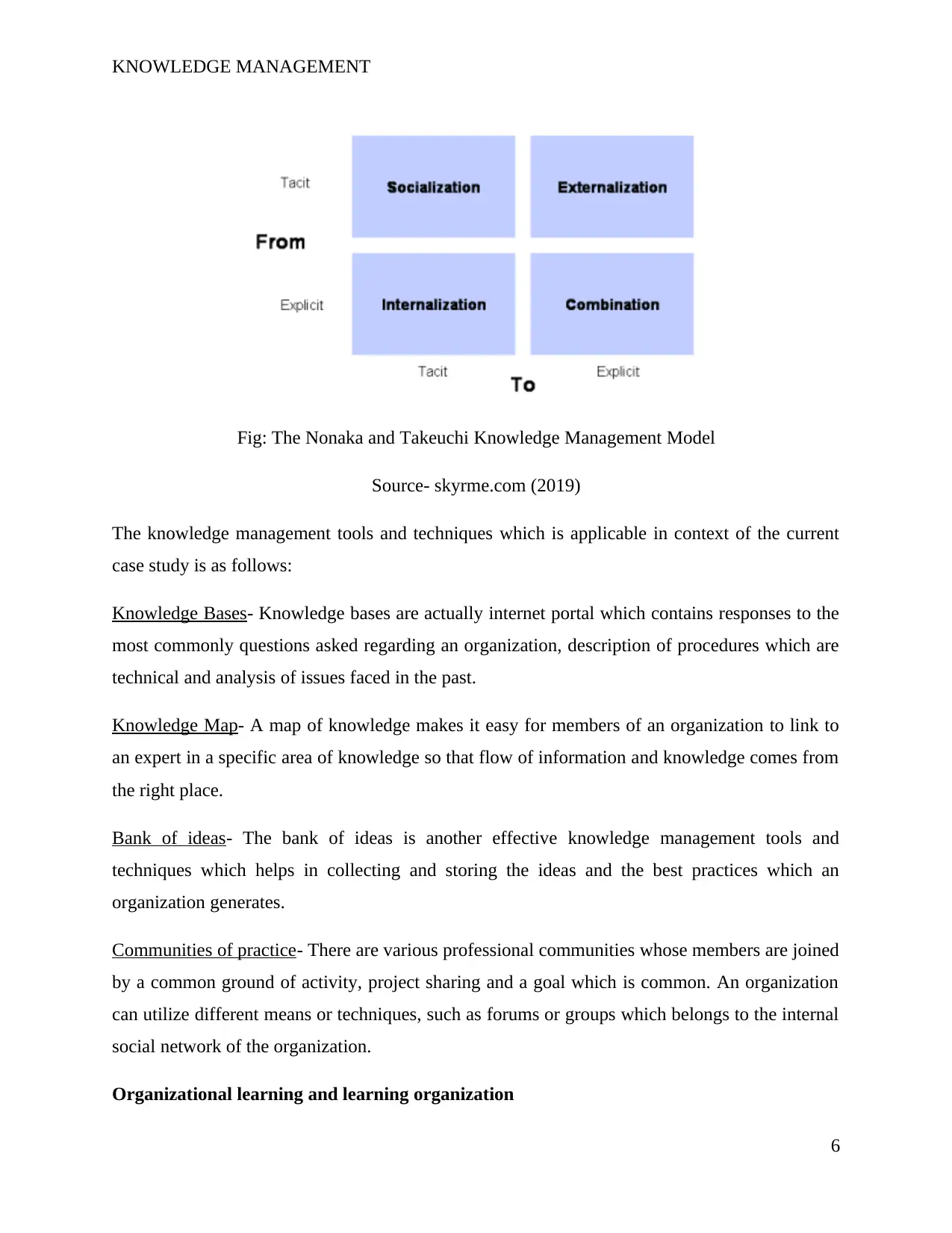
Knowledge Management Model of Nonaka and Takeuchi which concentrates on spirals of
knowledge which transforms tactic knowledge to explicit knowledge and reverts back again as
ground for individuals, groups and organizational innovation and learning. According to
Kumaravel & Vikkiraman (2018) the model is mainly a two dimensional model which depicts
four potential situations regarding the interaction and conversion of tactic knowledge and explicit
knowledge. Four knowledge conversion modes according to the model are socialization,
externalization, combination and internalization.
4
Knowledge creation and generation- This process of knowledge management involves creating
and generating knowledge by interacting with the various members of the educational level and
by collecting the feedbacks which are received by the educational organization.
Knowledge codification- As stated by Saktoev et al. (2015) the collected data and information
needs to be analysed in order to transform them into useful knowledge. In this stage the tactic
knowledge which has been gathered for tactic performance assessment is being converted into
explicit knowledge.
Knowledge Application- As stated by Blagov, Pleshkova & Begler (2018) the process of
knowledge application involves utilizing the knowledge and information which has been
captured and analysed by organization.
Knowledge Transfer- As stated by Kuznetsova (2016) the process of knowledge transfer enables
the transfer of knowledge from one entity to other so as to insure that explicit knowledge is
utilized to fullest extent for the sake of value creation as knowledge and information is dynamic
in nature and can be utilized in various forms.
Critical Discussion
Knowledge Management Models
There are numerous models for management of knowledge which are being used by various
organizations for ensuring that the knowledge management processes of the organization are
effective. In context of the current case study, the knowledge management model which is
applicable for performing tactical performance assessment in educational institution is The
Knowledge Management Model of Nonaka and Takeuchi which concentrates on spirals of
knowledge which transforms tactic knowledge to explicit knowledge and reverts back again as
ground for individuals, groups and organizational innovation and learning. According to
Kumaravel & Vikkiraman (2018) the model is mainly a two dimensional model which depicts
four potential situations regarding the interaction and conversion of tactic knowledge and explicit
knowledge. Four knowledge conversion modes according to the model are socialization,
externalization, combination and internalization.
4
KNOWLEDGE MANAGEMENT
Socialization is phenomenon of creating common tactic knowledge from shared experiences in
which the knowledge originates and develops within the teachers and faculties who are
responsible for imparting knowledge to the students.
Externalization is a phenomenon of expressing tactic knowledge into explicit knowledge through
concepts or diagrams in which the educational institutions as a whole or the teachers and
faculties of the educational institutions internalize knowledge as a common practice.
As opined by Elezi & Bamber (2018) combination is the phenomenon of combining new and
current explicit knowledge into systematic knowledge like by the identification and development
of new curriculum implementation plan by educational organizations or by teachers and faculties
or by modifying their teaching methods and style based on the requirements of the students in
which the educational institutions and the teachers and faculties embed knowledge or
information in structured capital.
Internalization is phenomenon of incorporating explicit knowledge into tactic pedagogical
knowledge like by possessing knowledge to teach in which teachers and faculty share explicit
knowledge and information.
As stated by Veer Ramjeawon & Rowley (2017) in this model it can be observed that internal
organizational flow of knowledge can be derived by mutual interactions and sharing by the
members of the educational organizations which help in strengthening the quality of education in
the educational institutions and also help in developing the skill and competency levels of the
members of the educational institutions.
5
Socialization is phenomenon of creating common tactic knowledge from shared experiences in
which the knowledge originates and develops within the teachers and faculties who are
responsible for imparting knowledge to the students.
Externalization is a phenomenon of expressing tactic knowledge into explicit knowledge through
concepts or diagrams in which the educational institutions as a whole or the teachers and
faculties of the educational institutions internalize knowledge as a common practice.
As opined by Elezi & Bamber (2018) combination is the phenomenon of combining new and
current explicit knowledge into systematic knowledge like by the identification and development
of new curriculum implementation plan by educational organizations or by teachers and faculties
or by modifying their teaching methods and style based on the requirements of the students in
which the educational institutions and the teachers and faculties embed knowledge or
information in structured capital.
Internalization is phenomenon of incorporating explicit knowledge into tactic pedagogical
knowledge like by possessing knowledge to teach in which teachers and faculty share explicit
knowledge and information.
As stated by Veer Ramjeawon & Rowley (2017) in this model it can be observed that internal
organizational flow of knowledge can be derived by mutual interactions and sharing by the
members of the educational organizations which help in strengthening the quality of education in
the educational institutions and also help in developing the skill and competency levels of the
members of the educational institutions.
5
⊘ This is a preview!⊘
Do you want full access?
Subscribe today to unlock all pages.
Trusted by 1+ million students worldwide
KNOWLEDGE MANAGEMENT
Fig: The Nonaka and Takeuchi Knowledge Management Model
Source- skyrme.com (2019)
The knowledge management tools and techniques which is applicable in context of the current
case study is as follows:
Knowledge Bases- Knowledge bases are actually internet portal which contains responses to the
most commonly questions asked regarding an organization, description of procedures which are
technical and analysis of issues faced in the past.
Knowledge Map- A map of knowledge makes it easy for members of an organization to link to
an expert in a specific area of knowledge so that flow of information and knowledge comes from
the right place.
Bank of ideas- The bank of ideas is another effective knowledge management tools and
techniques which helps in collecting and storing the ideas and the best practices which an
organization generates.
Communities of practice- There are various professional communities whose members are joined
by a common ground of activity, project sharing and a goal which is common. An organization
can utilize different means or techniques, such as forums or groups which belongs to the internal
social network of the organization.
Organizational learning and learning organization
6
Fig: The Nonaka and Takeuchi Knowledge Management Model
Source- skyrme.com (2019)
The knowledge management tools and techniques which is applicable in context of the current
case study is as follows:
Knowledge Bases- Knowledge bases are actually internet portal which contains responses to the
most commonly questions asked regarding an organization, description of procedures which are
technical and analysis of issues faced in the past.
Knowledge Map- A map of knowledge makes it easy for members of an organization to link to
an expert in a specific area of knowledge so that flow of information and knowledge comes from
the right place.
Bank of ideas- The bank of ideas is another effective knowledge management tools and
techniques which helps in collecting and storing the ideas and the best practices which an
organization generates.
Communities of practice- There are various professional communities whose members are joined
by a common ground of activity, project sharing and a goal which is common. An organization
can utilize different means or techniques, such as forums or groups which belongs to the internal
social network of the organization.
Organizational learning and learning organization
6
Paraphrase This Document
Need a fresh take? Get an instant paraphrase of this document with our AI Paraphraser
KNOWLEDGE MANAGEMENT
Organizational learning is defined as the phenomenon of developing the actions of an
organization via better knowledge and understanding. As stated by Ahmad, Lodhi, Zaman &
Naseem (2017) learning organization is an organization which intentionally constructs strategies
and structures for in order to develop and maximize the learning in an organization. In context of
the current case study it can be stated that both the concept of organizational learning and
learning organization are very similar as they relate to and complement one other but the main
difference is that the one involves real learning in context of an institution, while the other
involves the course of gaining the learning in the organization.
Knowledge sharing and trust
Knowledge sharing and trust are two elements which are interdependent on each other. As stated
by Dhamdhere (2015) the element of trust helps in enabling knowledge sharing among
individuals which in turns improves the effectiveness of knowledge management approach in an
organization. In context of the current case study it can be stated that it is very important for the
educational institutions to develop trust among their members so that they reluctantly share their
knowledge in tactical form which can be later transformed in explicit form in order to identify
scope of improvements in the education quality and to identify the remedial needs of individual
students.
Applying knowledge for innovation
As stated by Rao (2016) the knowledge and innovation which is collected and codified in
explicit form helps in identifying need for improvements and also help in addressing various
issues which can lead to innovation. In context of the current case study it can be stated that the
knowledge which will be collected from the members of the educational institutions will help in
improving the quality of education and will also help in addressing the remedial needs of
students in an innovative manner.
New knowledge creation
As opined by Komejani & Mohaghegh (2017) the management of knowledge also helps in new
knowledge creation through the insights gained from the collected knowledge. In context of the
current case study it can be stated that the tactic information which was collected for the sake of
7
Organizational learning is defined as the phenomenon of developing the actions of an
organization via better knowledge and understanding. As stated by Ahmad, Lodhi, Zaman &
Naseem (2017) learning organization is an organization which intentionally constructs strategies
and structures for in order to develop and maximize the learning in an organization. In context of
the current case study it can be stated that both the concept of organizational learning and
learning organization are very similar as they relate to and complement one other but the main
difference is that the one involves real learning in context of an institution, while the other
involves the course of gaining the learning in the organization.
Knowledge sharing and trust
Knowledge sharing and trust are two elements which are interdependent on each other. As stated
by Dhamdhere (2015) the element of trust helps in enabling knowledge sharing among
individuals which in turns improves the effectiveness of knowledge management approach in an
organization. In context of the current case study it can be stated that it is very important for the
educational institutions to develop trust among their members so that they reluctantly share their
knowledge in tactical form which can be later transformed in explicit form in order to identify
scope of improvements in the education quality and to identify the remedial needs of individual
students.
Applying knowledge for innovation
As stated by Rao (2016) the knowledge and innovation which is collected and codified in
explicit form helps in identifying need for improvements and also help in addressing various
issues which can lead to innovation. In context of the current case study it can be stated that the
knowledge which will be collected from the members of the educational institutions will help in
improving the quality of education and will also help in addressing the remedial needs of
students in an innovative manner.
New knowledge creation
As opined by Komejani & Mohaghegh (2017) the management of knowledge also helps in new
knowledge creation through the insights gained from the collected knowledge. In context of the
current case study it can be stated that the tactic information which was collected for the sake of
7
KNOWLEDGE MANAGEMENT
tactic performance assessment helps in new knowledge creation in the form of explicit
knowledge which can be utilized for improving the education quality.
Knowledge Management and organizational culture
The culture of an organizational plays a very important role in context of management of
knowledge as it helps in affecting the effectiveness of knowledge management approach of an
organization. In context of the case study it can be stated that the educational institution must
foster a positive culture in their organizations in which the members of the organizations do not
feel reluctant to share their views and information with other members of the organization, which
will in turn help in promoting knowledge management.
Knowledge Management Governance
The main aim of designing a governance system for knowledge management is to ensure that it
is entirely attached as expected, owned, measured and rewarded element of operations of a
business organization. In context of the current case study regarding using knowledge
management for tactic performance assessment, the elements of the governance regarding
knowledge management are a set of clear expectations regarding assessment which are expressed
as the policy of knowledge management, clear accountabilities of all dimensions of knowledge
management, a set of metric regarding administration of knowledge which includes metrics of
value, metrics of application and metrics of activity and structure of reporting and a system of
performance management for knowledge management which is linked to the current
performance management structure.
Organizational Memory
As opined by Ngoc-Tan & Gregar (2018) organizational memory or institutional memories is
defined as the gathered body of data, knowledge and information which are created during the
course of existence of an individual organization. In context of the current case study it can be
stated that the organizational memory of the educational institutions has two repositories namely
the archives of the educational institutions which includes the electronic database of the
company and the individual memories of the members belonging to the educational institutions.
8
tactic performance assessment helps in new knowledge creation in the form of explicit
knowledge which can be utilized for improving the education quality.
Knowledge Management and organizational culture
The culture of an organizational plays a very important role in context of management of
knowledge as it helps in affecting the effectiveness of knowledge management approach of an
organization. In context of the case study it can be stated that the educational institution must
foster a positive culture in their organizations in which the members of the organizations do not
feel reluctant to share their views and information with other members of the organization, which
will in turn help in promoting knowledge management.
Knowledge Management Governance
The main aim of designing a governance system for knowledge management is to ensure that it
is entirely attached as expected, owned, measured and rewarded element of operations of a
business organization. In context of the current case study regarding using knowledge
management for tactic performance assessment, the elements of the governance regarding
knowledge management are a set of clear expectations regarding assessment which are expressed
as the policy of knowledge management, clear accountabilities of all dimensions of knowledge
management, a set of metric regarding administration of knowledge which includes metrics of
value, metrics of application and metrics of activity and structure of reporting and a system of
performance management for knowledge management which is linked to the current
performance management structure.
Organizational Memory
As opined by Ngoc-Tan & Gregar (2018) organizational memory or institutional memories is
defined as the gathered body of data, knowledge and information which are created during the
course of existence of an individual organization. In context of the current case study it can be
stated that the organizational memory of the educational institutions has two repositories namely
the archives of the educational institutions which includes the electronic database of the
company and the individual memories of the members belonging to the educational institutions.
8
⊘ This is a preview!⊘
Do you want full access?
Subscribe today to unlock all pages.
Trusted by 1+ million students worldwide
KNOWLEDGE MANAGEMENT
As stated by Rodríguez-gómez & Gairín (2015) the outcomes which are associated with the
implementation of the above mentioned outcomes is that the concept of management of
knowledge will help in addressing the roadblocks which are faced during tactic performance
assessment and therefore it will lead to the enhancement of the current educational quality by
addressing the issues which are identified through the tactic performance assessment and the
outcomes of the implementation are at par with the techno-centric theory of knowledge
management which concentrates on technology and the designing technology process enablers to
help in facilitating the knowledge flow and information storage
Conclusion
From the above report it can be stated that the concept of knowledge management is very vital
for educational institutions as it enables them to conduct tactic performance assessment which is
considered as helpful for developing the quality of education and also for addressing the
individual concerns for the students. From the above report it is also clear and evident that
technology plays very important role in ensuring effectiveness of knowledge management
approach as it helps in reducing the hurdles which are encountered during implementation of
knowledge management tools and techniques.
9
As stated by Rodríguez-gómez & Gairín (2015) the outcomes which are associated with the
implementation of the above mentioned outcomes is that the concept of management of
knowledge will help in addressing the roadblocks which are faced during tactic performance
assessment and therefore it will lead to the enhancement of the current educational quality by
addressing the issues which are identified through the tactic performance assessment and the
outcomes of the implementation are at par with the techno-centric theory of knowledge
management which concentrates on technology and the designing technology process enablers to
help in facilitating the knowledge flow and information storage
Conclusion
From the above report it can be stated that the concept of knowledge management is very vital
for educational institutions as it enables them to conduct tactic performance assessment which is
considered as helpful for developing the quality of education and also for addressing the
individual concerns for the students. From the above report it is also clear and evident that
technology plays very important role in ensuring effectiveness of knowledge management
approach as it helps in reducing the hurdles which are encountered during implementation of
knowledge management tools and techniques.
9
Paraphrase This Document
Need a fresh take? Get an instant paraphrase of this document with our AI Paraphraser
KNOWLEDGE MANAGEMENT
References
Ahmad, N., Lodhi, M. S., Zaman, K., & Naseem, I. (2017). Knowledge management: A gateway
for organizational performance. Journal of the Knowledge Economy, 8(3), 859-876.
doi:http://dx.doi.org/10.1007/s13132-015-0282-3
Blagov, E., Pleshkova, A., & Begler, A. (2018). The influence of knowledge sharing barriers on
the performance of administrative subdivisions of universities. Academic
Conferences International Limited. Kidmore End. Retrieved from
https://search.proquest.com/docview/2158169814?accountid=30552
Chawla, A., & Saxena, S. (2016). A confirmatory factor analysis of knowledge management
assessment instrument in higher educational institutions. The International Journal
of Quality & Reliability Management, 33(7), 1019-1029. Retrieved from
https://search.proquest.com/docview/1803412646?accountid=30552
Dhamdhere, S. N. (2015). Knowledge management model for higher educational
institutes. Journal of Commerce and Management Thought, 6(1), 130-161. Retrieved
from https://search.proquest.com/docview/1657284598?accountid=30552
Elezi, E., & Bamber, C. (2018). Empirical analysis of knowledge exchange in higher education
partnerships: Using knowledge elicitation methods and techniques. Management
Dynamics in the Knowledge Economy, 6(4), 609-625.
doi:http://dx.doi.org/10.25019/MDKE/6.4.07
Kaçmaz, R., & Serinkan, C. (2016). A research on levels of organizational learning in
educational institutions. International Journal of Organizational Leadership, 5(3), 285-
298. doi:http://dx.doi.org/10.19236/IJOL.2016.03.09
Komejani, S. M. M., & Mohaghegh, N. (2017). The effects of customer knowledge management
in improving customer loyalty in private educational institutions. Academic Conferences
International Limited: Kidmore End. Retrieved from
https://search.proquest.com/docview/1980474539?accountid=30552
10
References
Ahmad, N., Lodhi, M. S., Zaman, K., & Naseem, I. (2017). Knowledge management: A gateway
for organizational performance. Journal of the Knowledge Economy, 8(3), 859-876.
doi:http://dx.doi.org/10.1007/s13132-015-0282-3
Blagov, E., Pleshkova, A., & Begler, A. (2018). The influence of knowledge sharing barriers on
the performance of administrative subdivisions of universities. Academic
Conferences International Limited. Kidmore End. Retrieved from
https://search.proquest.com/docview/2158169814?accountid=30552
Chawla, A., & Saxena, S. (2016). A confirmatory factor analysis of knowledge management
assessment instrument in higher educational institutions. The International Journal
of Quality & Reliability Management, 33(7), 1019-1029. Retrieved from
https://search.proquest.com/docview/1803412646?accountid=30552
Dhamdhere, S. N. (2015). Knowledge management model for higher educational
institutes. Journal of Commerce and Management Thought, 6(1), 130-161. Retrieved
from https://search.proquest.com/docview/1657284598?accountid=30552
Elezi, E., & Bamber, C. (2018). Empirical analysis of knowledge exchange in higher education
partnerships: Using knowledge elicitation methods and techniques. Management
Dynamics in the Knowledge Economy, 6(4), 609-625.
doi:http://dx.doi.org/10.25019/MDKE/6.4.07
Kaçmaz, R., & Serinkan, C. (2016). A research on levels of organizational learning in
educational institutions. International Journal of Organizational Leadership, 5(3), 285-
298. doi:http://dx.doi.org/10.19236/IJOL.2016.03.09
Komejani, S. M. M., & Mohaghegh, N. (2017). The effects of customer knowledge management
in improving customer loyalty in private educational institutions. Academic Conferences
International Limited: Kidmore End. Retrieved from
https://search.proquest.com/docview/1980474539?accountid=30552
10
KNOWLEDGE MANAGEMENT
Kumaravel, V., & Vikkiraman, P. (2018). The challenges of knowledge sharing practices in
higher educational institutions: A Kendall approach. Journal of Contemporary Research
in Management, 13(3), 1-15. Retrieved from
https://search.proquest.com/docview/2212683323?accountid=30552
Kuznetsova, E. (2016). Exploring the links between knowledge management and leadership in
education. Academic Conferences International Limited: Kidmore End. Retrieved from
https://search.proquest.com/docview/1860070350?accountid=30552
Mitrevski, V., & Aceski, A. (2015). Creation and transfer of knowledge management in sports
institution and organisation. Indian Journal of Commerce and Management Studies, 6(1),
70-75. Retrieved from https://search.proquest.com/docview/1645882028?
accountid=30552
Ngoc-Tan, N., & Gregar, A. (2018). Impact of knowledge management on innovations in higher
education institutions. Economics & Sociology, 11(3), 301-320.
doi:http://dx.doi.org/10.14254/2071-789X.2018/11-3/18
Rao, M. S. (2016). Tools and techniques to ensure innovative management education. Industrial
and Commercial Training, 48(5), 265-268. doi:http://dx.doi.org/10.1108/ICT-10-2015-
0071
Rodríguez-gómez, D., & Gairín, J. (2015). Unravelling knowledge creation and management in
educational organisations: Barriers and enablers. Knowledge Management Research &
Practice, 13(2), 149-159. doi:http://dx.doi.org/10.1057/kmrp.2013.37
Saktoev, V., Vanchikova, E., Slepneva, L., Bulatova, N., & Khaltaeva, S. (2015). The study of
implementation and adaptation processes of innovative organization and economic
management mechanisms for the activity of municipal educational
institutions. International Journal of Economics and Financial Issues, 5(3) Retrieved
from https://search.proquest.com/docview/1753590164?accountid=30552
Skyrme.com(2019) Knowledge Conversion and the Knowledge Spiral Available at
https://www.skyrme.com/kmbasics/kspiral.html Accessed as on 27/04/2019
11
Kumaravel, V., & Vikkiraman, P. (2018). The challenges of knowledge sharing practices in
higher educational institutions: A Kendall approach. Journal of Contemporary Research
in Management, 13(3), 1-15. Retrieved from
https://search.proquest.com/docview/2212683323?accountid=30552
Kuznetsova, E. (2016). Exploring the links between knowledge management and leadership in
education. Academic Conferences International Limited: Kidmore End. Retrieved from
https://search.proquest.com/docview/1860070350?accountid=30552
Mitrevski, V., & Aceski, A. (2015). Creation and transfer of knowledge management in sports
institution and organisation. Indian Journal of Commerce and Management Studies, 6(1),
70-75. Retrieved from https://search.proquest.com/docview/1645882028?
accountid=30552
Ngoc-Tan, N., & Gregar, A. (2018). Impact of knowledge management on innovations in higher
education institutions. Economics & Sociology, 11(3), 301-320.
doi:http://dx.doi.org/10.14254/2071-789X.2018/11-3/18
Rao, M. S. (2016). Tools and techniques to ensure innovative management education. Industrial
and Commercial Training, 48(5), 265-268. doi:http://dx.doi.org/10.1108/ICT-10-2015-
0071
Rodríguez-gómez, D., & Gairín, J. (2015). Unravelling knowledge creation and management in
educational organisations: Barriers and enablers. Knowledge Management Research &
Practice, 13(2), 149-159. doi:http://dx.doi.org/10.1057/kmrp.2013.37
Saktoev, V., Vanchikova, E., Slepneva, L., Bulatova, N., & Khaltaeva, S. (2015). The study of
implementation and adaptation processes of innovative organization and economic
management mechanisms for the activity of municipal educational
institutions. International Journal of Economics and Financial Issues, 5(3) Retrieved
from https://search.proquest.com/docview/1753590164?accountid=30552
Skyrme.com(2019) Knowledge Conversion and the Knowledge Spiral Available at
https://www.skyrme.com/kmbasics/kspiral.html Accessed as on 27/04/2019
11
⊘ This is a preview!⊘
Do you want full access?
Subscribe today to unlock all pages.
Trusted by 1+ million students worldwide

1 out of 13


Related Documents


Your All-in-One AI-Powered Toolkit for Academic Success.
+13062052269
info@desklib.com
Available 24*7 on WhatsApp / Email
![[object Object]](/_next/static/media/star-bottom.7253800d.svg)
Unlock your academic potential
Copyright © 2020–2026 A2Z Services. All Rights Reserved. Developed and managed by ZUCOL.