Knowledge Management Practices at Toyota Motors: Case Study Analysis

Verified

Added on  2023/05/27

|7
|392
|293
Presentation
AI Summary
This presentation analyzes Toyota's knowledge management (KM) practices, addressing key aspects such as knowledge creation, dissemination, and preservation. It highlights the special characteristics of KM at Toyota, including its decentralized approach and people-based enterprise. The presentation examines the role of organizational culture, including continuous training, employee encouragement, and the use of quality circles, in establishing successful KM practices. It also explores the influence of Japanese culture on KM at Toyota, with a focus on learning, detail, teamwork, and a favorable learning environment. A comparative analysis between Toyota and Honda as learning organizations is provided, along with a debate on the advantages and disadvantages of tacit and explicit knowledge management approaches, concluding with an assessment of their balance at Toyota. The analysis is supported by case study materials and academic references.

Document Page
KNOWLEDGE
MANAGEMENT
Name of the student
Name of the University
Author note
tabler-icon-diamond-filled.svg

Paraphrase This Document

Need a fresh take? Get an instant paraphrase of this document with our AI Paraphraser
Document Page
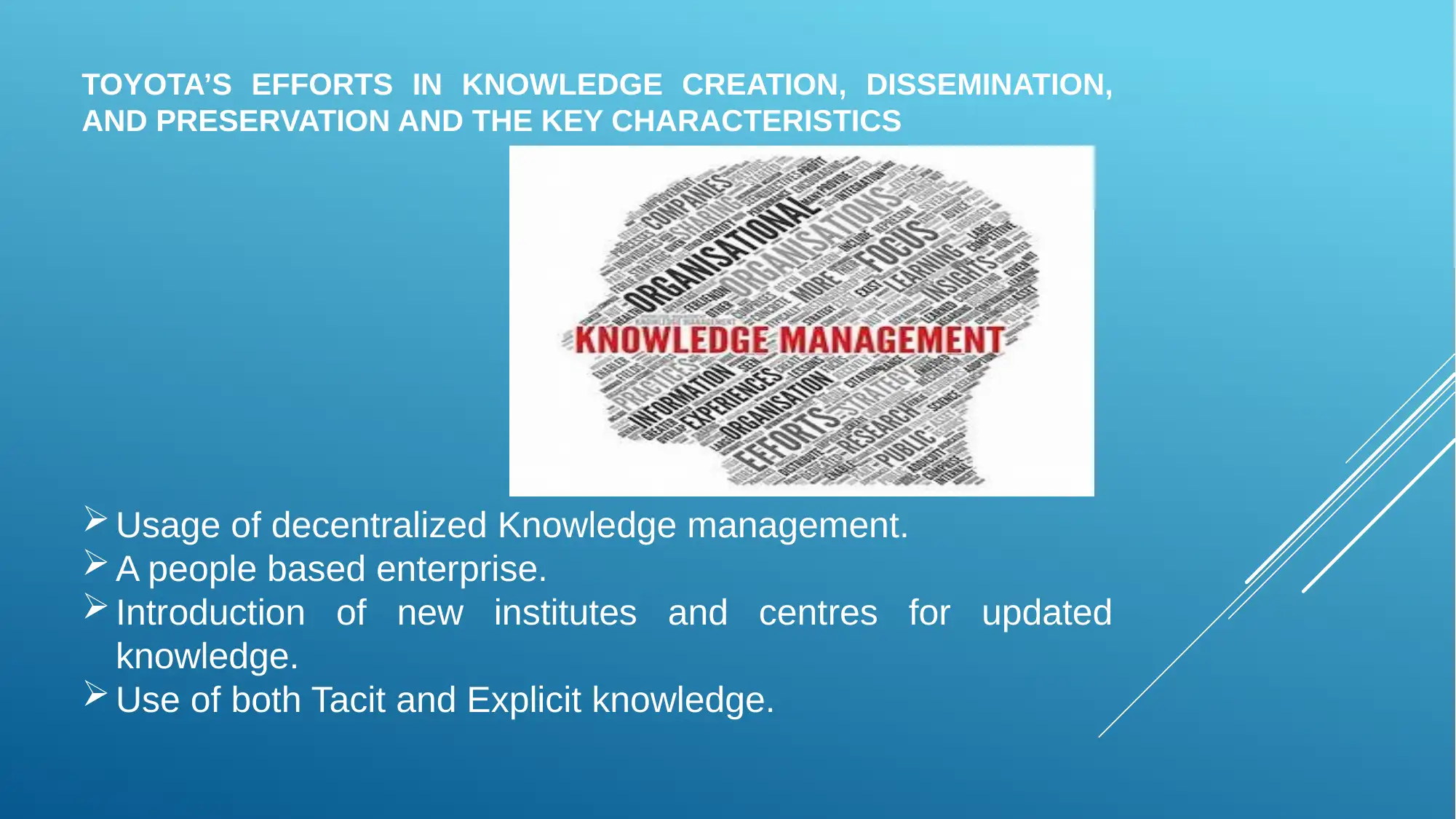
TOYOTA’S EFFORTS IN KNOWLEDGE CREATION, DISSEMINATION,
AND PRESERVATION AND THE KEY CHARACTERISTICS
Usage of decentralized Knowledge management.
A people based enterprise.
Introduction of new institutes and centres for updated
knowledge.
Use of both Tacit and Explicit knowledge.
Document Page
ROLE OF ORGANIZATIONAL CULTURE IN
ESTABLISHING KM AND HELPFULNESS
OF PRINCIPLES KM IN TOYOTA.
Continuous training and mentoring.
Encouraging employees to share
more views.
Usage of Quality circles to assess
work.
Usage of 5 key principles to lead to
success.
Document Page
TO WHAT EXTENT DOES
JAPNESE CULTURE
CONTRIBUTE TO KM AT
TOYOTA?
MORE FOCUS ON LEARNING.
LOVE FOR DETAIL AND PERFECTION.
TEAM WORK AND LOYALTY.
FAVORABLE LEARNING
ENVIRONMENT.
tabler-icon-diamond-filled.svg

Paraphrase This Document

Need a fresh take? Get an instant paraphrase of this document with our AI Paraphraser
Document Page
Compare Toyota as a learning organization with another Japanese
automobile company - Honda. What does the analysis reveal?
Document Page
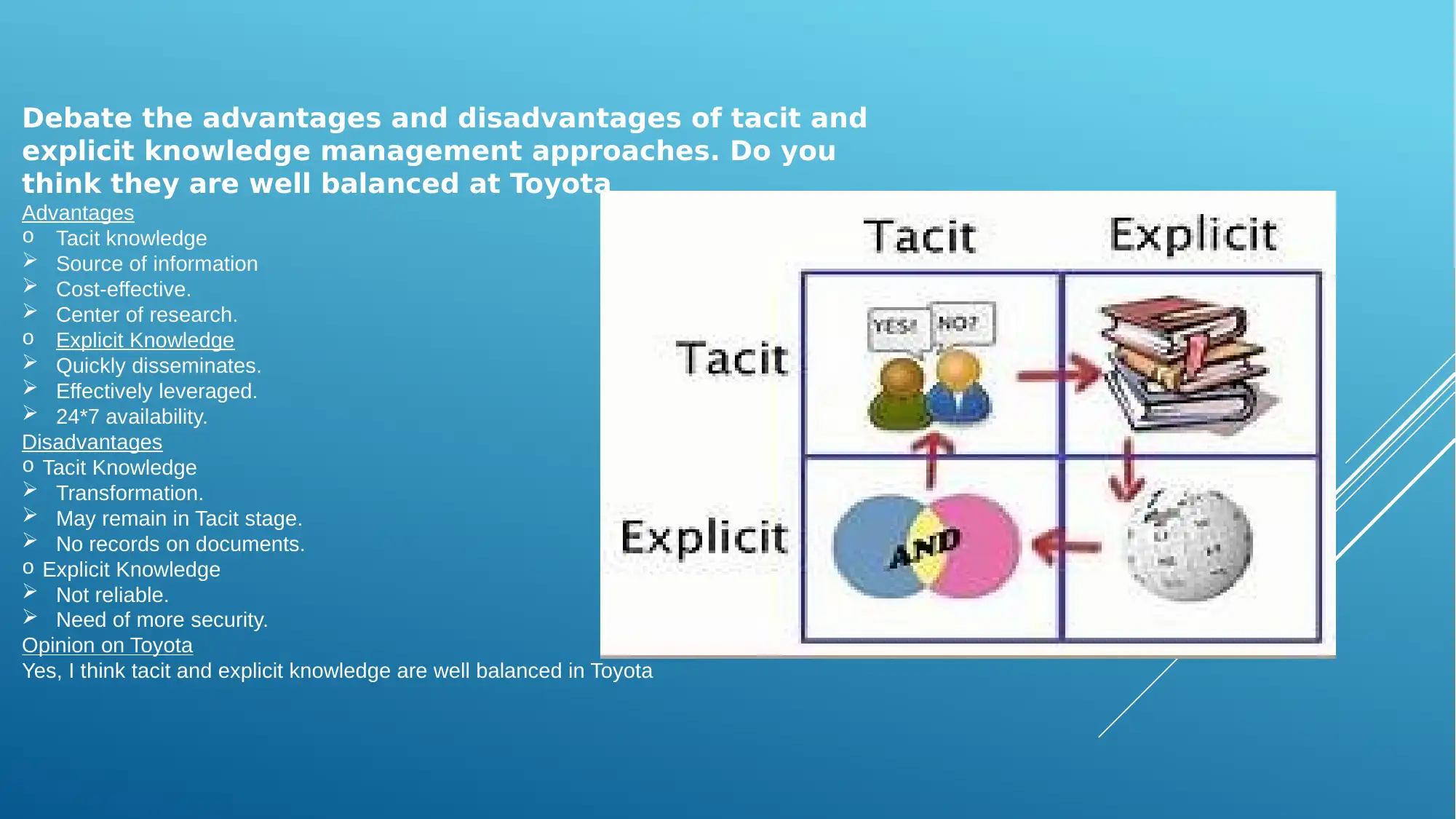
Debate the advantages and disadvantages of tacit and
explicit knowledge management approaches. Do you
think they are well balanced at Toyota
Advantages
o Tacit knowledge
Source of information
Cost-effective.
Center of research.
o Explicit Knowledge
Quickly disseminates.
Effectively leveraged.
24*7 availability.
Disadvantages
o Tacit Knowledge
Transformation.
May remain in Tacit stage.
No records on documents.
o Explicit Knowledge
Not reliable.
Need of more security.
Opinion on Toyota
Yes, I think tacit and explicit knowledge are well balanced in Toyota
Document Page
REFERENCES
Christine Tierney and Ed Garsten, “Toyota, GM, Locked in Fight for Worldwide
Supermacy,” February 13, 2005.
Duncan Watts, Slate, Decentralized Knowledge: What Toyota Can Teach Us,
August 21, 2004.
Jeffery H. Dyer and Kentaro Nobeoka, “Creating and Managing a High Performance
Knowledge-sharing Network: The Toyota Case,” March 1998.
Stephen Bell, “Interview with Larry Prusak,” Computerworld, April 2, 2004.
Stephen Spears, “Learning to Lead at Toyota,” Harvard Business Review, May 1,
2004.
Wareen Karlenzig, Chrylser’s New Know-Mobiles, Knowledge Management
Magazine, May 1999.
chevron_up_icon
1 out of 7
circle_padding
hide_on_mobile
zoom_out_icon
[object Object]