Report on Knowledge and Management Skills in the Workplace
VerifiedAdded on 2020/11/23
|17
|5766
|406
Report
AI Summary
This report delves into the critical aspects of knowledge and management skills within the context of a workplace, using Sainsbury's as a case study. It explores the relationships between data, information, and knowledge, emphasizing their significance in informed decision-making. The report differentiates between individual and organizational knowledge, highlighting how individual skills contribute to organizational learning and success. It then analyzes knowledge assets, differentiating between actual and potential assets and methods for identifying and managing these assets, with a focus on techniques like evaluation and comparison. The report also examines the importance of integrating knowledge and intellectual property, and it concludes by discussing knowledge requirements and organizational frameworks for enhancing knowledge sharing and improvement within Sainsbury's.
Knowledge And Management
Skills For The Workplace
Skills For The Workplace

Paraphrase This Document
Need a fresh take? Get an instant paraphrase of this document with our AI Paraphraser
Table of Contents
INTRODUCTION...........................................................................................................................1
TASK 1............................................................................................................................................1
a....................................................................................................................................................1
b....................................................................................................................................................3
c....................................................................................................................................................4
d....................................................................................................................................................5
TASK 2............................................................................................................................................6
a....................................................................................................................................................6
b....................................................................................................................................................7
TASK 3............................................................................................................................................8
a....................................................................................................................................................8
b....................................................................................................................................................9
c..................................................................................................................................................11
d..................................................................................................................................................12
CONCLUSION..............................................................................................................................13
REFERENCES..............................................................................................................................14
INTRODUCTION...........................................................................................................................1
TASK 1............................................................................................................................................1
a....................................................................................................................................................1
b....................................................................................................................................................3
c....................................................................................................................................................4
d....................................................................................................................................................5
TASK 2............................................................................................................................................6
a....................................................................................................................................................6
b....................................................................................................................................................7
TASK 3............................................................................................................................................8
a....................................................................................................................................................8
b....................................................................................................................................................9
c..................................................................................................................................................11
d..................................................................................................................................................12
CONCLUSION..............................................................................................................................13
REFERENCES..............................................................................................................................14
INTRODUCTION
Management skills are the certain attributes or skills that a person possess in order to
accomplish the assigned task or objectives. They indulge the capableness to execute
administration responsibility in an organisation while ignoring obstacles and resolving difficulty
as and when it occurs. Knowledge plays important role in performing management duties. As a
manager in an organisation various management skills needs to be possessed and these skills are
developed through knowledge. In a workplace performance of various activities requires
knowledge and skills. As management skills at workplace required to motivate, encourage and
communicate with employees. The organisation which is chosen for this report is Sainsbury's
that works in three different sectors. One is supermarket and bank and other one is Argos, head
office is situated in London. This report consist subject matter about link between data,
information and knowledge and between organisational and individual knowledge (Gould and
Gruben, 2015). Various modelling techniques together with actual and potential knowledge
assets. Importance of integrated knowledge and intellectual property right. This report also
consists knowledge requirements and organisational framework for establishing knowledge
sharing and improvements in organisational framework of Sainsbury's.
TASK 1
Knowledge management is the systematized set up of an organisations cognition assets
for the intention of creating worth and meeting plan of action and strategic necessities. It
emphasises on making availability of right knowledge to the right people. It is a multi
disciplinary formulation to accomplish organisational objectives by devising foremost utilization
of knowledge. Knowledge management attempt to focussing on objectives of Sainsbury's such
as transformation of perfection, competitive benefit, creation, consolidation and regular growth
of the organisation. It is the procedure of creating, managing and distribution of knowledge. It
determines a strong link between organisations goals and scheme (Spender, 2017).
a
Data- Data is a subject matter in raw or unorganized descriptor and connected with
scientific investigation. It consist information regarding a particular issue that needs to be
considered to solve that issue. Data is also concluded as collection of objectives or results of
some processes.
1
Management skills are the certain attributes or skills that a person possess in order to
accomplish the assigned task or objectives. They indulge the capableness to execute
administration responsibility in an organisation while ignoring obstacles and resolving difficulty
as and when it occurs. Knowledge plays important role in performing management duties. As a
manager in an organisation various management skills needs to be possessed and these skills are
developed through knowledge. In a workplace performance of various activities requires
knowledge and skills. As management skills at workplace required to motivate, encourage and
communicate with employees. The organisation which is chosen for this report is Sainsbury's
that works in three different sectors. One is supermarket and bank and other one is Argos, head
office is situated in London. This report consist subject matter about link between data,
information and knowledge and between organisational and individual knowledge (Gould and
Gruben, 2015). Various modelling techniques together with actual and potential knowledge
assets. Importance of integrated knowledge and intellectual property right. This report also
consists knowledge requirements and organisational framework for establishing knowledge
sharing and improvements in organisational framework of Sainsbury's.
TASK 1
Knowledge management is the systematized set up of an organisations cognition assets
for the intention of creating worth and meeting plan of action and strategic necessities. It
emphasises on making availability of right knowledge to the right people. It is a multi
disciplinary formulation to accomplish organisational objectives by devising foremost utilization
of knowledge. Knowledge management attempt to focussing on objectives of Sainsbury's such
as transformation of perfection, competitive benefit, creation, consolidation and regular growth
of the organisation. It is the procedure of creating, managing and distribution of knowledge. It
determines a strong link between organisations goals and scheme (Spender, 2017).
a
Data- Data is a subject matter in raw or unorganized descriptor and connected with
scientific investigation. It consist information regarding a particular issue that needs to be
considered to solve that issue. Data is also concluded as collection of objectives or results of
some processes.
1
⊘ This is a preview!⊘
Do you want full access?
Subscribe today to unlock all pages.

Trusted by 1+ million students worldwide
Information- Clarified collection of data is known as information. Data is aggregation of
immense information and from that information a result that provides some help to resolve an
issue is information. Data that do not provides any information can not be converted into
information.
Knowledge- After collection or raw data and aggregation of information, knowledge is
the last step of development. When cognitive content, legal power or opinion is applied to a
peculiar content then knowledge is rendered from that subject matter of information.
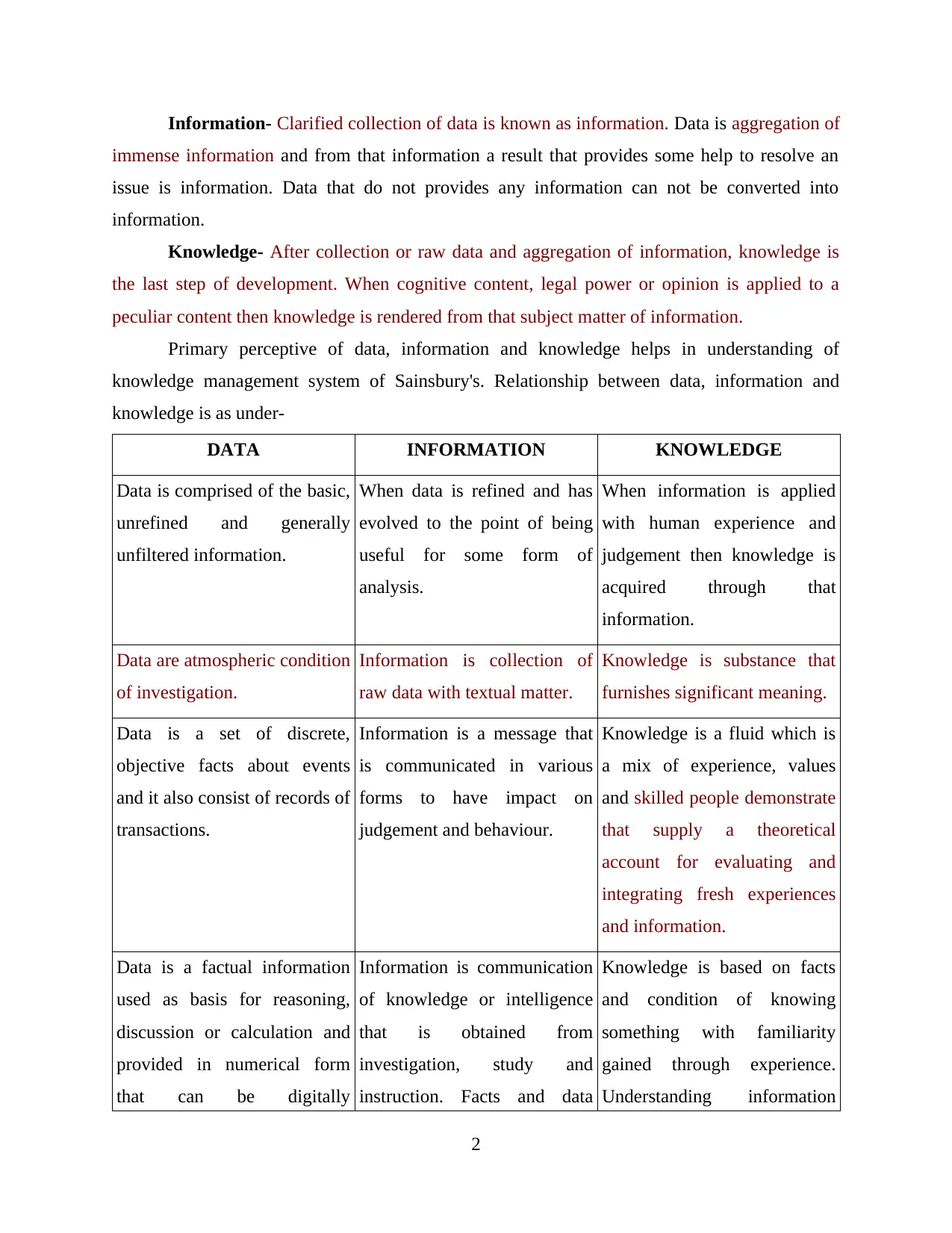
Primary perceptive of data, information and knowledge helps in understanding of
knowledge management system of Sainsbury's. Relationship between data, information and
knowledge is as under-
DATA INFORMATION KNOWLEDGE
Data is comprised of the basic,
unrefined and generally
unfiltered information.
When data is refined and has
evolved to the point of being
useful for some form of
analysis.
When information is applied
with human experience and
judgement then knowledge is
acquired through that
information.
Data are atmospheric condition
of investigation.
Information is collection of
raw data with textual matter.
Knowledge is substance that
furnishes significant meaning.
Data is a set of discrete,
objective facts about events
and it also consist of records of
transactions.
Information is a message that
is communicated in various
forms to have impact on
judgement and behaviour.
Knowledge is a fluid which is
a mix of experience, values
and skilled people demonstrate
that supply a theoretical
account for evaluating and
integrating fresh experiences
and information.
Data is a factual information
used as basis for reasoning,
discussion or calculation and
provided in numerical form
that can be digitally
Information is communication
of knowledge or intelligence
that is obtained from
investigation, study and
instruction. Facts and data
Knowledge is based on facts
and condition of knowing
something with familiarity
gained through experience.
Understanding information
2
immense information and from that information a result that provides some help to resolve an
issue is information. Data that do not provides any information can not be converted into
information.
Knowledge- After collection or raw data and aggregation of information, knowledge is
the last step of development. When cognitive content, legal power or opinion is applied to a
peculiar content then knowledge is rendered from that subject matter of information.
Primary perceptive of data, information and knowledge helps in understanding of
knowledge management system of Sainsbury's. Relationship between data, information and
knowledge is as under-
DATA INFORMATION KNOWLEDGE
Data is comprised of the basic,
unrefined and generally
unfiltered information.
When data is refined and has
evolved to the point of being
useful for some form of
analysis.
When information is applied
with human experience and
judgement then knowledge is
acquired through that
information.
Data are atmospheric condition
of investigation.
Information is collection of
raw data with textual matter.
Knowledge is substance that
furnishes significant meaning.
Data is a set of discrete,
objective facts about events
and it also consist of records of
transactions.
Information is a message that
is communicated in various
forms to have impact on
judgement and behaviour.
Knowledge is a fluid which is
a mix of experience, values
and skilled people demonstrate
that supply a theoretical
account for evaluating and
integrating fresh experiences
and information.
Data is a factual information
used as basis for reasoning,
discussion or calculation and
provided in numerical form
that can be digitally
Information is communication
of knowledge or intelligence
that is obtained from
investigation, study and
instruction. Facts and data
Knowledge is based on facts
and condition of knowing
something with familiarity
gained through experience.
Understanding information
2
Paraphrase This Document
Need a fresh take? Get an instant paraphrase of this document with our AI Paraphraser
transmitted or processed. provides quantitative
measurement of content of
information.
with what is known and an
basis of some principals leads
to required knowledge.
From the above relation it is clear that to gain required knowledge Sainsbury's needs to
have a data that provides some meaningful information. As information forms basis of various
decisions that needs to be taken in the organisation. Understanding importance of right data will
helps to be more competitive and productivity that helps to survive in long run.
b
Individual knowledge- This is a knowledge of a circumstances or concept amplified
through first hand measurement or experience. Everyone is different and unique and personal
knowledge possessed by each person also differs as this is based on skills and experience.
Knowledge and learning in an administration begins with respective individualistic.
Individualized capabilities, ability, acquisition and connection preferences as well as business
structure all illustrates how an individual prosecute with the occupation. Work civilization of
Sainsbury's are hugely affected by how effectual individualistic attempts at acquisition and
knowledge interdependency and this helps in encouraging employees (Choo, 2015).
Organisational knowledge- Organisational knowledge is the corporate cognition and
potency controlled by the individuals who belongs to the Sainsbury's. Knowledge is a realistic
form of subject matter that is properly shared and utilized by individuals in the organisation.
Organisation is comprised of various individuals and knowledge possessed by these individuals
that helps in performing various organisational activities is termed as organisational knowledge.
Individuals in an organisation keeps on changing that makes it difficult to transfer and retain
organisational knowledge. Organisational knowledge is an asset to Sainsbury's in which
individuals pool their knowledge. This knowledge helps organisation to gain advantage others in
the same field.
Individual knowledge is used as a bridge for organisational learning as individual
knowledge can not be managed itself. As individual have various skills that increases
productivity of organisation by coordinating individuals knowledge and through managing
organisational knowledge. Relationship between individual and organisational knowledge is that
in an organisation decision making capabilities involves the collective memories and activities of
3
measurement of content of
information.
with what is known and an
basis of some principals leads
to required knowledge.
From the above relation it is clear that to gain required knowledge Sainsbury's needs to
have a data that provides some meaningful information. As information forms basis of various
decisions that needs to be taken in the organisation. Understanding importance of right data will
helps to be more competitive and productivity that helps to survive in long run.
b
Individual knowledge- This is a knowledge of a circumstances or concept amplified
through first hand measurement or experience. Everyone is different and unique and personal
knowledge possessed by each person also differs as this is based on skills and experience.
Knowledge and learning in an administration begins with respective individualistic.
Individualized capabilities, ability, acquisition and connection preferences as well as business
structure all illustrates how an individual prosecute with the occupation. Work civilization of
Sainsbury's are hugely affected by how effectual individualistic attempts at acquisition and
knowledge interdependency and this helps in encouraging employees (Choo, 2015).
Organisational knowledge- Organisational knowledge is the corporate cognition and
potency controlled by the individuals who belongs to the Sainsbury's. Knowledge is a realistic
form of subject matter that is properly shared and utilized by individuals in the organisation.
Organisation is comprised of various individuals and knowledge possessed by these individuals
that helps in performing various organisational activities is termed as organisational knowledge.
Individuals in an organisation keeps on changing that makes it difficult to transfer and retain
organisational knowledge. Organisational knowledge is an asset to Sainsbury's in which
individuals pool their knowledge. This knowledge helps organisation to gain advantage others in
the same field.
Individual knowledge is used as a bridge for organisational learning as individual
knowledge can not be managed itself. As individual have various skills that increases
productivity of organisation by coordinating individuals knowledge and through managing
organisational knowledge. Relationship between individual and organisational knowledge is that
in an organisation decision making capabilities involves the collective memories and activities of
3
many individuals. As organisation knowledge is formed from various individuals knowledge
who are working in the organisation. Knowledge of an individual derived from past experience
and education and organisational knowledge also evolved in years based on past experience and
set principals that needs to be followed while working in the organisation.
c
Knowledge possession mentions to the assembled rational assets of Sainsbury's. This is
cognition channelised by administration and their manpower in the variety of subject matter,
opinion, acquisition, knowing, mental representation, brainstorm, specialized ability and
capacity. These assets in knowledge management provides way through which one group or
individual can share their cognition with multiple groups or individuals at different locations in
different time.
In the business environment, commercial enterprises are continuously ranked according
to the worth of their resources such as cash in hand, revenue and profits and physical assets both
past and expected. But when it comes to measuring knowledge assets the value is heard to
calculate but these assets are very critical for the prosperity of any organisation. Knowledge
assets are the knowledge drivers of an organisation's success. It is important to think knowledge
assets as an asset that will increase worth of Sainsbury's for it shareholders and creditors
(Schneider, 2011). Every organisation posses different knowledge assets depending on the
workforce involved for work. It is important to calculate knowledge for organisation that will
help organisation to keep proper knowledge management. Identifying knowledge assets involves
techniques like-
Evaluation- Before identifying knowledge assets first target set for the previous year
needs to be evaluated. Comparison is done regarding what target is set and up to what level that
target is achieved. Evaluation helps to note regarding variation in the set target and various steps
that needs to be taken to cope up with standards is introduced by Sainsbury's.
Setting goals- Once variations in past standards are recorded targets that needs to be
achieved in coming year is introduced. Goals are set on the basis of their duration of achieving
them such as long term and short term goals. In each goal, knowledge possessed by organisation
is evaluated by breaking down different technologies with regard to competitiveness compared to
competitors of Sainsbury's. For example if Sainsbury's do not possess strong consumer
communication then knowledge sharing event focusing on consumer communication will be
4
who are working in the organisation. Knowledge of an individual derived from past experience
and education and organisational knowledge also evolved in years based on past experience and
set principals that needs to be followed while working in the organisation.
c
Knowledge possession mentions to the assembled rational assets of Sainsbury's. This is
cognition channelised by administration and their manpower in the variety of subject matter,
opinion, acquisition, knowing, mental representation, brainstorm, specialized ability and
capacity. These assets in knowledge management provides way through which one group or
individual can share their cognition with multiple groups or individuals at different locations in
different time.
In the business environment, commercial enterprises are continuously ranked according
to the worth of their resources such as cash in hand, revenue and profits and physical assets both
past and expected. But when it comes to measuring knowledge assets the value is heard to
calculate but these assets are very critical for the prosperity of any organisation. Knowledge
assets are the knowledge drivers of an organisation's success. It is important to think knowledge
assets as an asset that will increase worth of Sainsbury's for it shareholders and creditors
(Schneider, 2011). Every organisation posses different knowledge assets depending on the
workforce involved for work. It is important to calculate knowledge for organisation that will
help organisation to keep proper knowledge management. Identifying knowledge assets involves
techniques like-
Evaluation- Before identifying knowledge assets first target set for the previous year
needs to be evaluated. Comparison is done regarding what target is set and up to what level that
target is achieved. Evaluation helps to note regarding variation in the set target and various steps
that needs to be taken to cope up with standards is introduced by Sainsbury's.
Setting goals- Once variations in past standards are recorded targets that needs to be
achieved in coming year is introduced. Goals are set on the basis of their duration of achieving
them such as long term and short term goals. In each goal, knowledge possessed by organisation
is evaluated by breaking down different technologies with regard to competitiveness compared to
competitors of Sainsbury's. For example if Sainsbury's do not possess strong consumer
communication then knowledge sharing event focusing on consumer communication will be
4
⊘ This is a preview!⊘
Do you want full access?
Subscribe today to unlock all pages.
Trusted by 1+ million students worldwide
introduced to develop knowledge assets. After going through all aspects of business selection of
main area to be focused in the organisation will be done. This leads to identifying knowledge
assets on which focus is made by organisation.
Comparison- Once knowledge assets have been identified and evaluated then focus area
selected by the board and the lead developers will be compared. This comparison provides
valuable information and feed back that is required to identify knowledge assets possessed by the
Sainsbury's.
Identifying knowledge assets helps in management of knowledge that lies in organisation.
Assets in terms of knowledge helps to achieve objectives of organisation and also increases good
image. Efficiency and productivity of Sainsbury's operations will increase and information of
business will be updated (Cook and Brown, 2015).
d
Assets are the resources acquired by the commercial enterprise. Anything tangible and
intangible that can be closely held and monitored to make worth and that is held by the company
to produce affirmative economical worth is an asset. Knowledge assets are the accumulated
intellectual resources of Sainsbury's. Actual knowledge assets possessed by Sainsbury's are-
Ideas- As Sainsbury's is dealing in supermarkets that requires effective and innovative
ideas to attract more consumers. Currently workforce in Sainsbury's is very effective as ideas
provided by them have a positive impact on growth of businesses. Contribution of an idea
towards success of an organisation is hard to measure but it plays a important role as all the
activities performed by the organisation is to make what is planned successful.
Understanding- Consumers are different in their requirements and it to make business
successful Sainsbury's deeply studies consumers requirement to understand them. Understanding
consumers requirements helps Sainsbury's to develop a consumer group which is highly satisfied
with the services provided by them. Whenever a business decision is taken consumers are
targeted and their requirements needs identified this is done by Sainsbury's because of
understanding workforce.
Insights- Workforce which is experienced and deal with various situation have their
imagination which is very strong. Sainsbury's have workforce that is highly experience and their
intuition regarding future projects turned out to be an asset. As opportunities can be garbed when
qualified and experienced workforce is engaged in the operations.
5
main area to be focused in the organisation will be done. This leads to identifying knowledge
assets on which focus is made by organisation.
Comparison- Once knowledge assets have been identified and evaluated then focus area
selected by the board and the lead developers will be compared. This comparison provides
valuable information and feed back that is required to identify knowledge assets possessed by the
Sainsbury's.
Identifying knowledge assets helps in management of knowledge that lies in organisation.
Assets in terms of knowledge helps to achieve objectives of organisation and also increases good
image. Efficiency and productivity of Sainsbury's operations will increase and information of
business will be updated (Cook and Brown, 2015).
d
Assets are the resources acquired by the commercial enterprise. Anything tangible and
intangible that can be closely held and monitored to make worth and that is held by the company
to produce affirmative economical worth is an asset. Knowledge assets are the accumulated
intellectual resources of Sainsbury's. Actual knowledge assets possessed by Sainsbury's are-
Ideas- As Sainsbury's is dealing in supermarkets that requires effective and innovative
ideas to attract more consumers. Currently workforce in Sainsbury's is very effective as ideas
provided by them have a positive impact on growth of businesses. Contribution of an idea
towards success of an organisation is hard to measure but it plays a important role as all the
activities performed by the organisation is to make what is planned successful.
Understanding- Consumers are different in their requirements and it to make business
successful Sainsbury's deeply studies consumers requirement to understand them. Understanding
consumers requirements helps Sainsbury's to develop a consumer group which is highly satisfied
with the services provided by them. Whenever a business decision is taken consumers are
targeted and their requirements needs identified this is done by Sainsbury's because of
understanding workforce.
Insights- Workforce which is experienced and deal with various situation have their
imagination which is very strong. Sainsbury's have workforce that is highly experience and their
intuition regarding future projects turned out to be an asset. As opportunities can be garbed when
qualified and experienced workforce is engaged in the operations.
5
Paraphrase This Document
Need a fresh take? Get an instant paraphrase of this document with our AI Paraphraser
Potential assets that might be owned by the company in the future. Potential assets
depends on future events that can not be controlled by the company. While introducing any new
range of business or exploring existing business Sainsbury's can generate more knowledge assets
such as-
Technical skills- These skills are the ability and knowledge needed to perform specific
tasks. In competitive market use of machines in business is continuously increasing and technical
skills in workforce helps in adoption of these changes. Technical skills makes managers of
organisation to perform tasks that provides positive results and also efficiency of individual will
increase which helps organisation to grow (Tsoukas, 2015).
Learning- Learning is the process of absorbing and retaining acquired knowledge.
Learning on continuous basis by workforce of organisation helps to make them more
competitive. Learning of new techniques and technologies helps to become more competitive
and productive. This asset helps Sainsbury's to adopt changing environment easily.
Memory- Memory is facility of the brain by which information is recorded, encoded,
stored and retrieved when needed. A good memory power in organisational workforce helps
them to retain policies and rules. This also helps them to take decision that requires some past
references. A sharp memory will remember all stapes that went wrong in past and new future
policies that needs to be taken to become more efficient.
TASK 2
Knowledge management is an activity practised by Sainsbury's. For the purpose of
knowledge management enterprise uses information that is gathered using various methods and
tools. Analysis of information gathered is based on resources, documents, people and their skills.
Knowledge management helps in better and faster decision making, solving problems on quick
basis. Rate of innovation in the organisation has increased due to managing knowledge this helps
to develop Sainsbury's. A better communication system and improved business process helps in
organisational development.
a
Knowledge management is a system that helps to creates, store, retain and retrieve
knowledge. Knowledge management is a process that that improves co action, regain cognition
informant, mines depository for invisible psychological feature, seizure and utilization of
6
depends on future events that can not be controlled by the company. While introducing any new
range of business or exploring existing business Sainsbury's can generate more knowledge assets
such as-
Technical skills- These skills are the ability and knowledge needed to perform specific
tasks. In competitive market use of machines in business is continuously increasing and technical
skills in workforce helps in adoption of these changes. Technical skills makes managers of
organisation to perform tasks that provides positive results and also efficiency of individual will
increase which helps organisation to grow (Tsoukas, 2015).
Learning- Learning is the process of absorbing and retaining acquired knowledge.
Learning on continuous basis by workforce of organisation helps to make them more
competitive. Learning of new techniques and technologies helps to become more competitive
and productive. This asset helps Sainsbury's to adopt changing environment easily.
Memory- Memory is facility of the brain by which information is recorded, encoded,
stored and retrieved when needed. A good memory power in organisational workforce helps
them to retain policies and rules. This also helps them to take decision that requires some past
references. A sharp memory will remember all stapes that went wrong in past and new future
policies that needs to be taken to become more efficient.
TASK 2
Knowledge management is an activity practised by Sainsbury's. For the purpose of
knowledge management enterprise uses information that is gathered using various methods and
tools. Analysis of information gathered is based on resources, documents, people and their skills.
Knowledge management helps in better and faster decision making, solving problems on quick
basis. Rate of innovation in the organisation has increased due to managing knowledge this helps
to develop Sainsbury's. A better communication system and improved business process helps in
organisational development.
a
Knowledge management is a system that helps to creates, store, retain and retrieve
knowledge. Knowledge management is a process that that improves co action, regain cognition
informant, mines depository for invisible psychological feature, seizure and utilization of
6
knowledge. It represents the consciousness and apprehension of subject matter and the way the
content will be made helpful to assist a decision. Knowledge management system in Sainsbury's
helps in organised collection of people, procedure, software, database and store, share and utilise
the knowledge and experience of organisation.
Knowledge management involves various types of knowledge. Explicit knowledge is
objective and can be measured and documented. Example, original budget of actual expenditure
of variety of products, it is possible to identify which type of projects are more likely to go over
budget. Tacit knowledge on the other hand is not so easy to measure and very difficult to
formalize. Capturing, storing and sharing knowledge is critical to any knowledge management
system. This starts with identifying where the organisational knowledge is located (DeCarolis
and Deeds, 2017).
To create knowledge a relevant data needs to be present and that data needs to be
converted in information that provides basis for knowledge. Knowledge in an organisation can
also be created from past experience of workforce that helps to provides basis to take decisions
regarding various opportunities. It is very difficult to store knowledge as workforce keeps on
changing on annual basis and person skills of individual moves with the person when individual
leaves organisation. Application of acquired knowledge is very important as this helps to take
various decisions to Sainsbury's regarding new business ideas or for expanding a business.
b
Intellectual property rights (IPR) refers to the term by which property rights through
patents, trademarks and copyrights are assigned. This gives an opportunity to the holder to
exercise control and monopoly for using the items for a specified period. The purpose of IPR is
to provide a large variety of intellectual goods (Rubenstein-Montano and et. al., 2011). IPR are
the intangible in nature. It includes other IPR also other than the three mentioned above and they
are industrial design, trade secrets, publicity rights laws, database protection laws etc. The
importance of main IPR of Sainsbury are as follows:
Patents: It gives an exclusive right to the holder to make use of and sale an invention
when a person invents a new process, manufacture, machine or a combination of these. A
patent right provides an exclusive and legal right to protect the invention. Sainsbury has
patented the process in its computer systems used at retail premises. This has given it an
exclusive right on the process which can not be used by others.
7
content will be made helpful to assist a decision. Knowledge management system in Sainsbury's
helps in organised collection of people, procedure, software, database and store, share and utilise
the knowledge and experience of organisation.
Knowledge management involves various types of knowledge. Explicit knowledge is
objective and can be measured and documented. Example, original budget of actual expenditure
of variety of products, it is possible to identify which type of projects are more likely to go over
budget. Tacit knowledge on the other hand is not so easy to measure and very difficult to
formalize. Capturing, storing and sharing knowledge is critical to any knowledge management
system. This starts with identifying where the organisational knowledge is located (DeCarolis
and Deeds, 2017).
To create knowledge a relevant data needs to be present and that data needs to be
converted in information that provides basis for knowledge. Knowledge in an organisation can
also be created from past experience of workforce that helps to provides basis to take decisions
regarding various opportunities. It is very difficult to store knowledge as workforce keeps on
changing on annual basis and person skills of individual moves with the person when individual
leaves organisation. Application of acquired knowledge is very important as this helps to take
various decisions to Sainsbury's regarding new business ideas or for expanding a business.
b
Intellectual property rights (IPR) refers to the term by which property rights through
patents, trademarks and copyrights are assigned. This gives an opportunity to the holder to
exercise control and monopoly for using the items for a specified period. The purpose of IPR is
to provide a large variety of intellectual goods (Rubenstein-Montano and et. al., 2011). IPR are
the intangible in nature. It includes other IPR also other than the three mentioned above and they
are industrial design, trade secrets, publicity rights laws, database protection laws etc. The
importance of main IPR of Sainsbury are as follows:
Patents: It gives an exclusive right to the holder to make use of and sale an invention
when a person invents a new process, manufacture, machine or a combination of these. A
patent right provides an exclusive and legal right to protect the invention. Sainsbury has
patented the process in its computer systems used at retail premises. This has given it an
exclusive right on the process which can not be used by others.
7
⊘ This is a preview!⊘
Do you want full access?
Subscribe today to unlock all pages.
Trusted by 1+ million students worldwide
Trademarks: It may be a symbol, word or design that is used to create a difference
between the services or goods of an organization from the goods or services of others in
the marketplace. A trademark will be rendered invalid if a person uses a trademark
registered previously. Sainsbury has a an exclusive right to use and protect the logo of the
company. No other person can use its logo without the previous permission. If it has been
used without Sainsbury's permission then Sainsbury can avail legal protection.
Copyright: It gives an exclusive right to the owner to copy his work or authorised some
other person to so. A person may exercise his sole right on the expression of ideas.
Copyright also includes the various fields such as artistic, creativity in scientific works
and literacy creativity. It protects the original ideas. Sainsbury has a copyright on the
information it has provided on its website which means that the information on its
website can not be changed, delete or move without the prior permission of Sainsbury.
Industrial Design Law: It means an exclusive right of a person on a product that has
been designed by him. The design means the appearance of the product. A consumer gets
attracted to the product by looking at its appearance. The importance of this IPR is that
Sainsbury can exercise its exclusive right on the appearance of a product. Customer can
recognize the product of Sainsbury from the appearance of its products.
TASK 3
Knowledge management (KM) is the management process of organizational knowledge
and information so that both the things are passed smoothly between the right people at the right
cost and time. It includes three process viz. Organization learning, knowledge production and
knowledge distribution. The smooth flow is necessary to create value for the organization.
Knowledge management culture is possible in an organization with right strategies, tactics and
behaviour. Sainsbury conducted knowledge management workshops to assess the strategies and
areas which work well and which don't. Employees were involved in the discussion to make and
implement the program that will work for the company in a improved and transformed way. It
has 4 full time knowledge managers and 150 part time and full time knowledge specialists.
a
Knowledge assets in the knowledge management works as a means by which a person or
employee can transfer his knowledge to many people or employees within the specified time and
8
between the services or goods of an organization from the goods or services of others in
the marketplace. A trademark will be rendered invalid if a person uses a trademark
registered previously. Sainsbury has a an exclusive right to use and protect the logo of the
company. No other person can use its logo without the previous permission. If it has been
used without Sainsbury's permission then Sainsbury can avail legal protection.
Copyright: It gives an exclusive right to the owner to copy his work or authorised some
other person to so. A person may exercise his sole right on the expression of ideas.
Copyright also includes the various fields such as artistic, creativity in scientific works
and literacy creativity. It protects the original ideas. Sainsbury has a copyright on the
information it has provided on its website which means that the information on its
website can not be changed, delete or move without the prior permission of Sainsbury.
Industrial Design Law: It means an exclusive right of a person on a product that has
been designed by him. The design means the appearance of the product. A consumer gets
attracted to the product by looking at its appearance. The importance of this IPR is that
Sainsbury can exercise its exclusive right on the appearance of a product. Customer can
recognize the product of Sainsbury from the appearance of its products.
TASK 3
Knowledge management (KM) is the management process of organizational knowledge
and information so that both the things are passed smoothly between the right people at the right
cost and time. It includes three process viz. Organization learning, knowledge production and
knowledge distribution. The smooth flow is necessary to create value for the organization.
Knowledge management culture is possible in an organization with right strategies, tactics and
behaviour. Sainsbury conducted knowledge management workshops to assess the strategies and
areas which work well and which don't. Employees were involved in the discussion to make and
implement the program that will work for the company in a improved and transformed way. It
has 4 full time knowledge managers and 150 part time and full time knowledge specialists.
a
Knowledge assets in the knowledge management works as a means by which a person or
employee can transfer his knowledge to many people or employees within the specified time and
8
Paraphrase This Document
Need a fresh take? Get an instant paraphrase of this document with our AI Paraphraser
distance. It may also include the experiences of the expert or seniors (Alavi and Leidner, 2011).
Knowledge assets create a competitive advantage by being valuable, rare, exclusive and non-
substitutable and it creates value for the organization by improving the performance of the
company.
A company can not achieve its goals or make profits by applying accounting standards, it
has to use its knowledge assets wisely. A company can create its value by transforming its
intangible assets into tangible assets by managing the company and using the human capital
effectively. The company should provide training and contribute in the development of the
employees so that “knowledge workers” can use their knowledge in creating value for the
company. The strategic skills can be used for employees development which will support the
day-to-day activities of the organization.
Further, knowledge assets may provide competitive advantage. The company have legal
rights on the knowledge assets it is using, therefore, the company can protects its patents,
trademarks, copyrights etc. from its competitors and maintain a monopoly. The competitor can
not use the IPR of other companies without their permission. Timely transfer of information and
knowledge enables the company to make strategies and implement them so that cost can be
reduced (Laudon and Laudon, 2016). Furthermore, it provides value added benefits to the
company in the long-run. The knowledge assets will help the company to be a sustainable
company.
b
Every organization has various departments for carrying its activities in order to achieve its
goals. The different organization may have different needs of information and knowledge to
carry out its activities. The knowledge requirements of various departments are as follows:
1. Finance: This department is responsible for allocating and managing the funds required
for the activities in an organization. The finance department will require knowledge about
the accounts, financial data to prepare financial statements, knowledge about the
requirements of the funds, analytical knowledge for comparing the performance,
knowledge about the extent funds have been utilized in an activity or by a department, the
funds not utilized, knowledge about the changes in sources of funds, capital structure
changes etc. The company may have financial information system for proper flow of
information so that prompt financial decisions can be made by the company.
9
Knowledge assets create a competitive advantage by being valuable, rare, exclusive and non-
substitutable and it creates value for the organization by improving the performance of the
company.
A company can not achieve its goals or make profits by applying accounting standards, it
has to use its knowledge assets wisely. A company can create its value by transforming its
intangible assets into tangible assets by managing the company and using the human capital
effectively. The company should provide training and contribute in the development of the
employees so that “knowledge workers” can use their knowledge in creating value for the
company. The strategic skills can be used for employees development which will support the
day-to-day activities of the organization.
Further, knowledge assets may provide competitive advantage. The company have legal
rights on the knowledge assets it is using, therefore, the company can protects its patents,
trademarks, copyrights etc. from its competitors and maintain a monopoly. The competitor can
not use the IPR of other companies without their permission. Timely transfer of information and
knowledge enables the company to make strategies and implement them so that cost can be
reduced (Laudon and Laudon, 2016). Furthermore, it provides value added benefits to the
company in the long-run. The knowledge assets will help the company to be a sustainable
company.
b
Every organization has various departments for carrying its activities in order to achieve its
goals. The different organization may have different needs of information and knowledge to
carry out its activities. The knowledge requirements of various departments are as follows:
1. Finance: This department is responsible for allocating and managing the funds required
for the activities in an organization. The finance department will require knowledge about
the accounts, financial data to prepare financial statements, knowledge about the
requirements of the funds, analytical knowledge for comparing the performance,
knowledge about the extent funds have been utilized in an activity or by a department, the
funds not utilized, knowledge about the changes in sources of funds, capital structure
changes etc. The company may have financial information system for proper flow of
information so that prompt financial decisions can be made by the company.
9
2. Marketing: This department is responsible for promoting the business and managing
the sales of the products or services. The core function is to analyse the target market
according to the demand of the customers. This department requires various knowledge
public relation management, web skills, production knowledge, innovation to the existing
process, industry knowledge, project management and knowledge of budget required by
marketing department (Teece, 2012). Sainsbury may use Marketing information system
to provide information about equipments, procedures and people.
3. Operations: This department manages the day-to-day operations for profitable
production. This department will oversee the needs of the producing a product and what
will be required to produce. For this purpose, the manager will require knowledge to co-
ordinate other activities, for managing the time allotted to produce a product etc. Along
with this, the manager must have the knowledge about complex problems, the terms of
the contract regarding production for negotiation, knowledge about costs and benefits
accruing from a product to make further decision etc.
4. Human Resource: This department is responsible for managing and developing the
human resources (employees) of the company. The department recruit, select, shortlist
and hire employees for doing the work of the company. This department will require the
knowledge about the performance of the existing employees, vacancy in the office, skills
and qualifications required for the vacant position, information about the conflict between
employer and employees, knowledge about problems regarding reward, incentives,
salary, knowledge about the performance of the employees for their appraisal, the
attendance, etc. HR department may use Human Resource Information system (HRIS) for
storing the master data about employees for human resource processes.
5. Research and Development: This department performs the functions of research for
developing new products or may also conduct research for improving the quality of an
existing product (Gould and Gruben, 2012). The R&D department will require the
information about the existing product so that it can design the product in an innovating
way which will attract large number of consumer.
6. Information Technology Department: This department deals with planning, organizing
of IT infrastructure as well as supports the IT infrastructure. The IT department is
primarily responsible for maintaining the smooth functioning of networks for this
10
the sales of the products or services. The core function is to analyse the target market
according to the demand of the customers. This department requires various knowledge
public relation management, web skills, production knowledge, innovation to the existing
process, industry knowledge, project management and knowledge of budget required by
marketing department (Teece, 2012). Sainsbury may use Marketing information system
to provide information about equipments, procedures and people.
3. Operations: This department manages the day-to-day operations for profitable
production. This department will oversee the needs of the producing a product and what
will be required to produce. For this purpose, the manager will require knowledge to co-
ordinate other activities, for managing the time allotted to produce a product etc. Along
with this, the manager must have the knowledge about complex problems, the terms of
the contract regarding production for negotiation, knowledge about costs and benefits
accruing from a product to make further decision etc.
4. Human Resource: This department is responsible for managing and developing the
human resources (employees) of the company. The department recruit, select, shortlist
and hire employees for doing the work of the company. This department will require the
knowledge about the performance of the existing employees, vacancy in the office, skills
and qualifications required for the vacant position, information about the conflict between
employer and employees, knowledge about problems regarding reward, incentives,
salary, knowledge about the performance of the employees for their appraisal, the
attendance, etc. HR department may use Human Resource Information system (HRIS) for
storing the master data about employees for human resource processes.
5. Research and Development: This department performs the functions of research for
developing new products or may also conduct research for improving the quality of an
existing product (Gould and Gruben, 2012). The R&D department will require the
information about the existing product so that it can design the product in an innovating
way which will attract large number of consumer.
6. Information Technology Department: This department deals with planning, organizing
of IT infrastructure as well as supports the IT infrastructure. The IT department is
primarily responsible for maintaining the smooth functioning of networks for this
10
⊘ This is a preview!⊘
Do you want full access?
Subscribe today to unlock all pages.
Trusted by 1+ million students worldwide

1 out of 17


Related Documents


Your All-in-One AI-Powered Toolkit for Academic Success.
+13062052269
info@desklib.com
Available 24*7 on WhatsApp / Email
![[object Object]](/_next/static/media/star-bottom.7253800d.svg)
Unlock your academic potential
Copyright © 2020–2026 A2Z Services. All Rights Reserved. Developed and managed by ZUCOL.