Exploring Knowledge Use and Learning in Everyday Social Work Practice
VerifiedAdded on 2023/02/02
|1
|1042
|29
Report
AI Summary
This report analyzes the utilization of knowledge and learning among social workers in everyday practice, focusing on a study conducted in Swedish Children's departments. The research, employing qualitative methods such as interviews, observations, and focus groups, aimed to identify the various types of knowledge used by social workers, including informal knowledge, intellectual knowledge, and knowledge of states. The findings highlight social workers' preference for practice-based knowledge and the importance of transparency, accuracy, purposivity, utility, propriety, and accessibility in knowledge generation and application. The report also discusses the use of ethnographic approaches and potential alternative methods, such as quantitative and participatory research, to enhance the understanding of knowledge use in social work. The conclusion emphasizes the need for appropriate and ethically managed knowledge to improve social work practices and meet the needs of knowledge seekers.
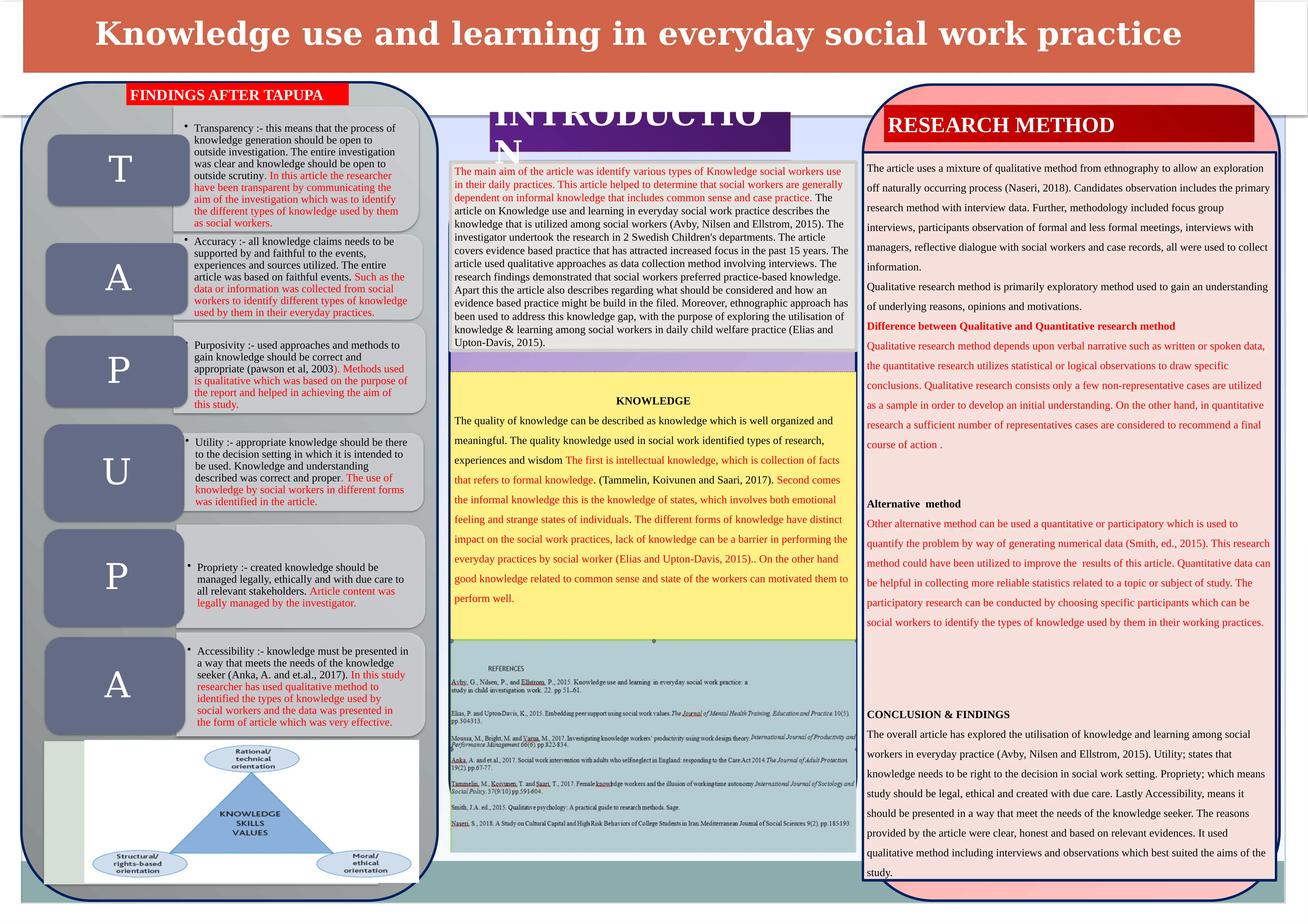
The main aim of the article was identify various types of Knowledge social workers use
in their daily practices. This article helped to determine that social workers are generally
dependent on informal knowledge that includes common sense and case practice. The
article on Knowledge use and learning in everyday social work practice describes the
knowledge that is utilized among social workers (Avby, Nilsen and Ellstrom, 2015). The
investigator undertook the research in 2 Swedish Children's departments. The article
covers evidence based practice that has attracted increased focus in the past 15 years. The
article used qualitative approaches as data collection method involving interviews. The
research findings demonstrated that social workers preferred practice-based knowledge.
Apart this the article also describes regarding what should be considered and how an
evidence based practice might be build in the filed. Moreover, ethnographic approach has
been used to address this knowledge gap, with the purpose of exploring the utilisation of
knowledge & learning among social workers in daily child welfare practice (Elias and
Upton-Davis, 2015).
The article uses a mixture of qualitative method from ethnography to allow an exploration
off naturally occurring process (Naseri, 2018). Candidates observation includes the primary
research method with interview data. Further, methodology included focus group
interviews, participants observation of formal and less formal meetings, interviews with
managers, reflective dialogue with social workers and case records, all were used to collect
information.
Qualitative research method is primarily exploratory method used to gain an understanding
of underlying reasons, opinions and motivations.
Difference between Qualitative and Quantitative research method
Qualitative research method depends upon verbal narrative such as written or spoken data,
the quantitative research utilizes statistical or logical observations to draw specific
conclusions. Qualitative research consists only a few non-representative cases are utilized
as a sample in order to develop an initial understanding. On the other hand, in quantitative
research a sufficient number of representatives cases are considered to recommend a final
course of action .
Alternative method
Other alternative method can be used a quantitative or participatory which is used to
quantify the problem by way of generating numerical data (Smith, ed., 2015). This research
method could have been utilized to improve the results of this article. Quantitative data can
be helpful in collecting more reliable statistics related to a topic or subject of study. The
participatory research can be conducted by choosing specific participants which can be
social workers to identify the types of knowledge used by them in their working practices.
CONCLUSION & FINDINGS
The overall article has explored the utilisation of knowledge and learning among social
workers in everyday practice (Avby, Nilsen and Ellstrom, 2015). Utility; states that
knowledge needs to be right to the decision in social work setting. Propriety; which means
study should be legal, ethical and created with due care. Lastly Accessibility, means it
should be presented in a way that meet the needs of the knowledge seeker. The reasons
provided by the article were clear, honest and based on relevant evidences. It used
qualitative method including interviews and observations which best suited the aims of the
study.
INTRODUCTIO
N RESEARCH METHOD• Transparency :- this means that the process of
knowledge generation should be open to
outside investigation. The entire investigation
was clear and knowledge should be open to
outside scrutiny. In this article the researcher
have been transparent by communicating the
aim of the investigation which was to identify
the different types of knowledge used by them
as social workers.
T
• Accuracy :- all knowledge claims needs to be
supported by and faithful to the events,
experiences and sources utilized. The entire
article was based on faithful events. Such as the
data or information was collected from social
workers to identify different types of knowledge
used by them in their everyday practices.
A
• Purposivity :- used approaches and methods to
gain knowledge should be correct and
appropriate (pawson et al, 2003). Methods used
is qualitative which was based on the purpose of
the report and helped in achieving the aim of
this study.
• .
P
• Utility :- appropriate knowledge should be there
to the decision setting in which it is intended to
be used. Knowledge and understanding
described was correct and proper. The use of
knowledge by social workers in different forms
was identified in the article.
U
• Propriety :- created knowledge should be
managed legally, ethically and with due care to
all relevant stakeholders. Article content was
legally managed by the investigator.
P
• Accessibility :- knowledge must be presented in
a way that meets the needs of the knowledge
seeker (Anka, A. and et.al., 2017). In this study
researcher has used qualitative method to
identified the types of knowledge used by
social workers and the data was presented in
the form of article which was very effective.
A
Knowledge use and learning in everyday social work practice
KNOWLEDGE
The quality of knowledge can be described as knowledge which is well organized and
meaningful. The quality knowledge used in social work identified types of research,
experiences and wisdom The first is intellectual knowledge, which is collection of facts
that refers to formal knowledge. (Tammelin, Koivunen and Saari, 2017). Second comes
the informal knowledge this is the knowledge of states, which involves both emotional
feeling and strange states of individuals. The different forms of knowledge have distinct
impact on the social work practices, lack of knowledge can be a barrier in performing the
everyday practices by social worker (Elias and Upton-Davis, 2015).. On the other hand
good knowledge related to common sense and state of the workers can motivated them to
perform well.
FINDINGS AFTER TAPUPA
in their daily practices. This article helped to determine that social workers are generally
dependent on informal knowledge that includes common sense and case practice. The
article on Knowledge use and learning in everyday social work practice describes the
knowledge that is utilized among social workers (Avby, Nilsen and Ellstrom, 2015). The
investigator undertook the research in 2 Swedish Children's departments. The article
covers evidence based practice that has attracted increased focus in the past 15 years. The
article used qualitative approaches as data collection method involving interviews. The
research findings demonstrated that social workers preferred practice-based knowledge.
Apart this the article also describes regarding what should be considered and how an
evidence based practice might be build in the filed. Moreover, ethnographic approach has
been used to address this knowledge gap, with the purpose of exploring the utilisation of
knowledge & learning among social workers in daily child welfare practice (Elias and
Upton-Davis, 2015).
The article uses a mixture of qualitative method from ethnography to allow an exploration
off naturally occurring process (Naseri, 2018). Candidates observation includes the primary
research method with interview data. Further, methodology included focus group
interviews, participants observation of formal and less formal meetings, interviews with
managers, reflective dialogue with social workers and case records, all were used to collect
information.
Qualitative research method is primarily exploratory method used to gain an understanding
of underlying reasons, opinions and motivations.
Difference between Qualitative and Quantitative research method
Qualitative research method depends upon verbal narrative such as written or spoken data,
the quantitative research utilizes statistical or logical observations to draw specific
conclusions. Qualitative research consists only a few non-representative cases are utilized
as a sample in order to develop an initial understanding. On the other hand, in quantitative
research a sufficient number of representatives cases are considered to recommend a final
course of action .
Alternative method
Other alternative method can be used a quantitative or participatory which is used to
quantify the problem by way of generating numerical data (Smith, ed., 2015). This research
method could have been utilized to improve the results of this article. Quantitative data can
be helpful in collecting more reliable statistics related to a topic or subject of study. The
participatory research can be conducted by choosing specific participants which can be
social workers to identify the types of knowledge used by them in their working practices.
CONCLUSION & FINDINGS
The overall article has explored the utilisation of knowledge and learning among social
workers in everyday practice (Avby, Nilsen and Ellstrom, 2015). Utility; states that
knowledge needs to be right to the decision in social work setting. Propriety; which means
study should be legal, ethical and created with due care. Lastly Accessibility, means it
should be presented in a way that meet the needs of the knowledge seeker. The reasons
provided by the article were clear, honest and based on relevant evidences. It used
qualitative method including interviews and observations which best suited the aims of the
study.
INTRODUCTIO
N RESEARCH METHOD• Transparency :- this means that the process of
knowledge generation should be open to
outside investigation. The entire investigation
was clear and knowledge should be open to
outside scrutiny. In this article the researcher
have been transparent by communicating the
aim of the investigation which was to identify
the different types of knowledge used by them
as social workers.
T
• Accuracy :- all knowledge claims needs to be
supported by and faithful to the events,
experiences and sources utilized. The entire
article was based on faithful events. Such as the
data or information was collected from social
workers to identify different types of knowledge
used by them in their everyday practices.
A
• Purposivity :- used approaches and methods to
gain knowledge should be correct and
appropriate (pawson et al, 2003). Methods used
is qualitative which was based on the purpose of
the report and helped in achieving the aim of
this study.
• .
P
• Utility :- appropriate knowledge should be there
to the decision setting in which it is intended to
be used. Knowledge and understanding
described was correct and proper. The use of
knowledge by social workers in different forms
was identified in the article.
U
• Propriety :- created knowledge should be
managed legally, ethically and with due care to
all relevant stakeholders. Article content was
legally managed by the investigator.
P
• Accessibility :- knowledge must be presented in
a way that meets the needs of the knowledge
seeker (Anka, A. and et.al., 2017). In this study
researcher has used qualitative method to
identified the types of knowledge used by
social workers and the data was presented in
the form of article which was very effective.
A
Knowledge use and learning in everyday social work practice
KNOWLEDGE
The quality of knowledge can be described as knowledge which is well organized and
meaningful. The quality knowledge used in social work identified types of research,
experiences and wisdom The first is intellectual knowledge, which is collection of facts
that refers to formal knowledge. (Tammelin, Koivunen and Saari, 2017). Second comes
the informal knowledge this is the knowledge of states, which involves both emotional
feeling and strange states of individuals. The different forms of knowledge have distinct
impact on the social work practices, lack of knowledge can be a barrier in performing the
everyday practices by social worker (Elias and Upton-Davis, 2015).. On the other hand
good knowledge related to common sense and state of the workers can motivated them to
perform well.
FINDINGS AFTER TAPUPA
Paraphrase This Document
Need a fresh take? Get an instant paraphrase of this document with our AI Paraphraser
Related Documents
Your All-in-One AI-Powered Toolkit for Academic Success.
+13062052269
info@desklib.com
Available 24*7 on WhatsApp / Email
Unlock your academic potential
Copyright © 2020–2025 A2Z Services. All Rights Reserved. Developed and managed by ZUCOL.


