Analysis of the Kogan Business Model: A Comprehensive Report
VerifiedAdded on 2023/06/08
|12
|2314
|127
Report
AI Summary
This report provides a comprehensive analysis of the Kogan business model, an Australian online retail company. The analysis examines the company's building blocks, including customer segmentation, key partners, value proposition, main activities, channels, cost structure, key resources, revenue streams, and customer relations. The report delves into the interrelationships between these elements and identifies critical factors contributing to Kogan's success. It also discusses potential downside risks and suggests recommendations for adapting the business model. The report highlights Kogan's strategies such as cost reduction through plain packaging, online manuals, and smart shipping, and its focus on making technology affordable and accessible to customers. The analysis concludes with a Kogan business model canvas and references.
Running head: KOGAN BUSINESS MODEL
Kogan Business Model
Name
Institutional Affiliations
Kogan Business Model
Name
Institutional Affiliations

Paraphrase This Document
Need a fresh take? Get an instant paraphrase of this document with our AI Paraphraser
KOGAN BUSINESS MODEL 2
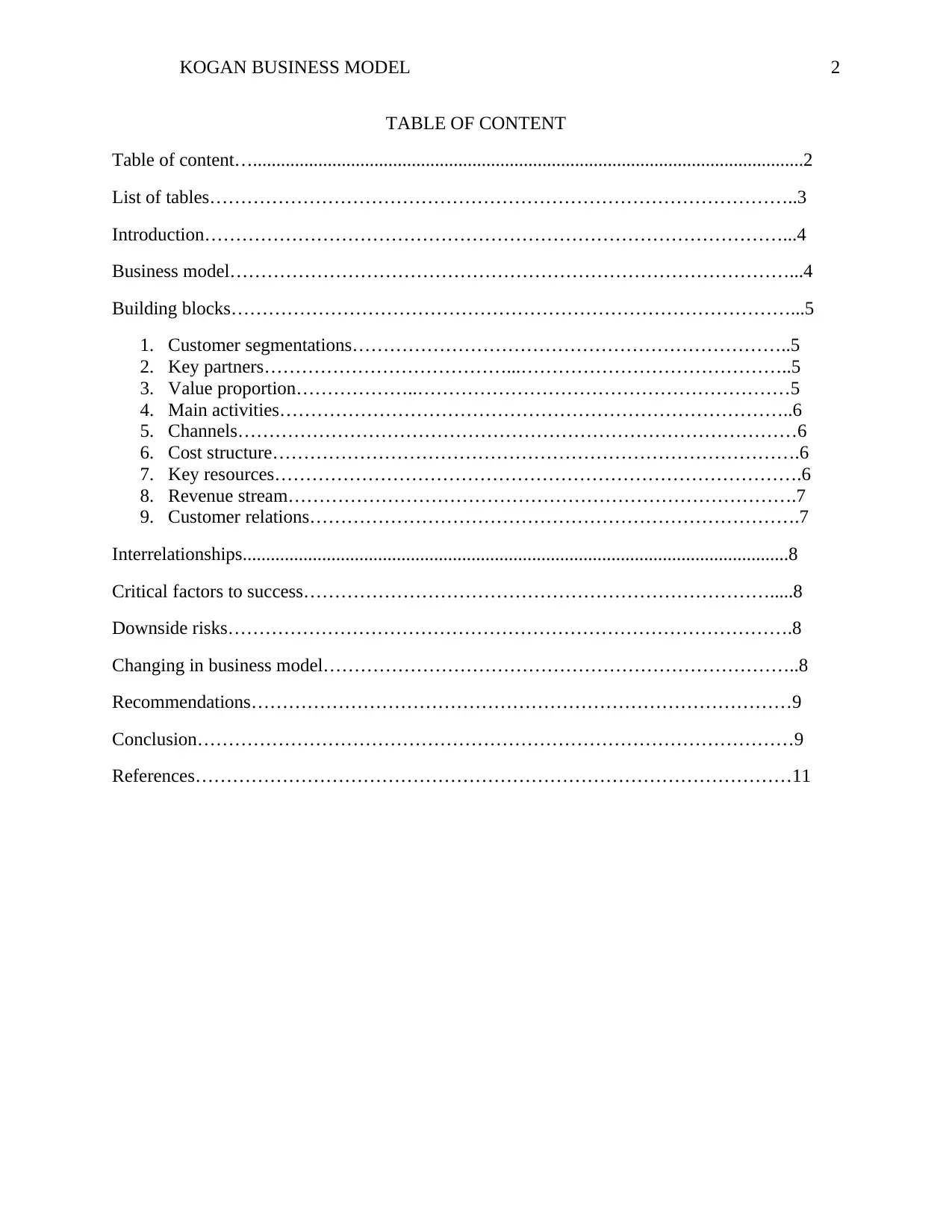
TABLE OF CONTENT
Table of content…......................................................................................................................2
List of tables…………………………………………………………………………………..3
Introduction…………………………………………………………………………………...4
Business model………………………………………………………………………………...4
Building blocks………………………………………………………………………………...5
1. Customer segmentations……………………………………………………………..5
2. Key partners…………………………………...……………………………………..5
3. Value proportion………………..……………………………………………………5
4. Main activities………………………………………………………………………..6
5. Channels………………………………………………………………………………6
6. Cost structure………………………………………………………………………….6
7. Key resources………………………………………………………………………….6
8. Revenue stream……………………………………………………………………….7
9. Customer relations…………………………………………………………………….7
Interrelationships.....................................................................................................................8
Critical factors to success………………………………………………………………….....8
Downside risks……………………………………………………………………………….8
Changing in business model…………………………………………………………………..8
Recommendations……………………………………………………………………………9
Conclusion……………………………………………………………………………………9
References……………………………………………………………………………………11
TABLE OF CONTENT
Table of content…......................................................................................................................2
List of tables…………………………………………………………………………………..3
Introduction…………………………………………………………………………………...4
Business model………………………………………………………………………………...4
Building blocks………………………………………………………………………………...5
1. Customer segmentations……………………………………………………………..5
2. Key partners…………………………………...……………………………………..5
3. Value proportion………………..……………………………………………………5
4. Main activities………………………………………………………………………..6
5. Channels………………………………………………………………………………6
6. Cost structure………………………………………………………………………….6
7. Key resources………………………………………………………………………….6
8. Revenue stream……………………………………………………………………….7
9. Customer relations…………………………………………………………………….7
Interrelationships.....................................................................................................................8
Critical factors to success………………………………………………………………….....8
Downside risks……………………………………………………………………………….8
Changing in business model…………………………………………………………………..8
Recommendations……………………………………………………………………………9
Conclusion……………………………………………………………………………………9
References……………………………………………………………………………………11
KOGAN BUSINESS MODEL 3
LIST OF FIGURES
Revenue stream 2015-2016……………………………………………………………………7
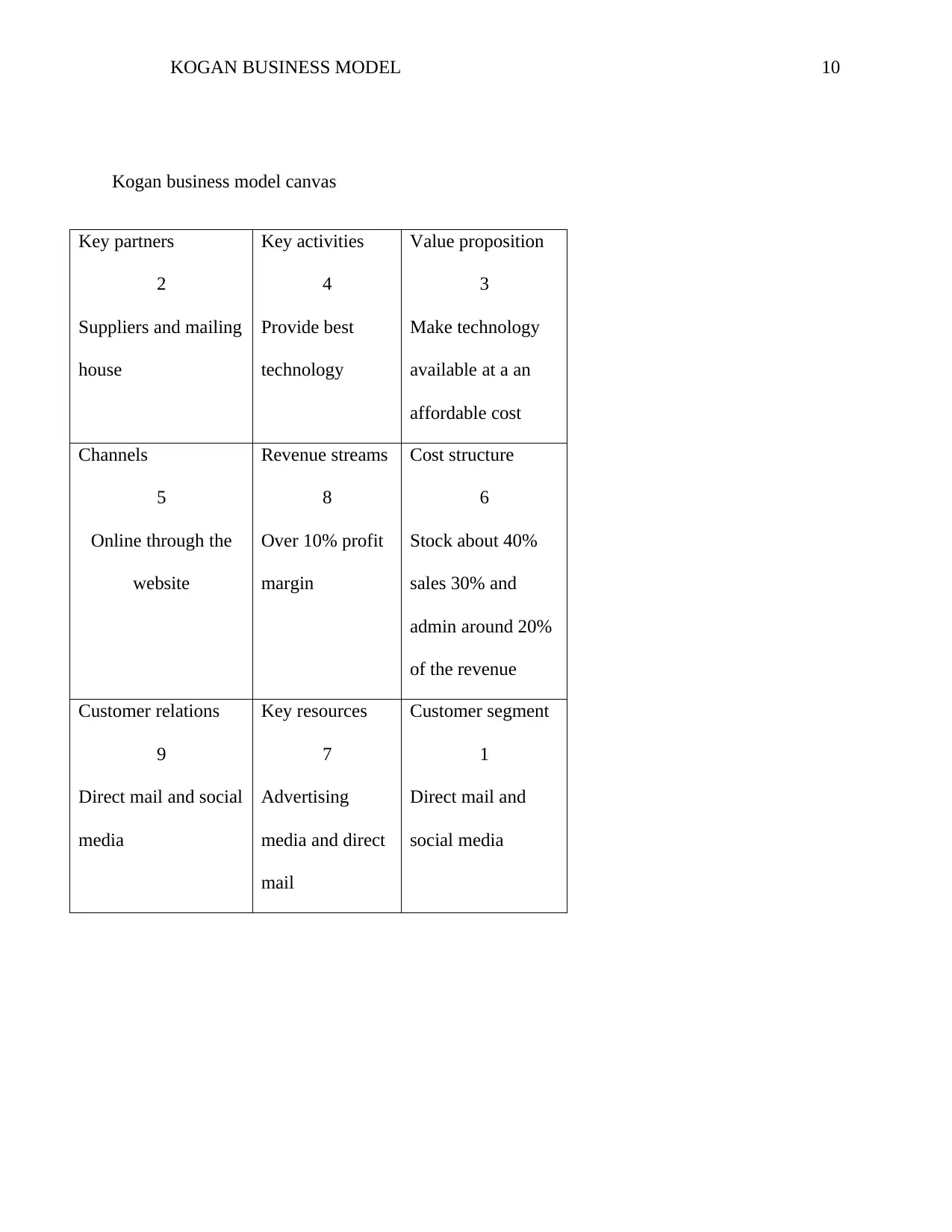
Kogan canvas business model…………………………………………………………………10
LIST OF FIGURES
Revenue stream 2015-2016……………………………………………………………………7
Kogan canvas business model…………………………………………………………………10
⊘ This is a preview!⊘
Do you want full access?
Subscribe today to unlock all pages.

Trusted by 1+ million students worldwide
KOGAN BUSINESS MODEL 4
KOGAN BUSINESS MODEL
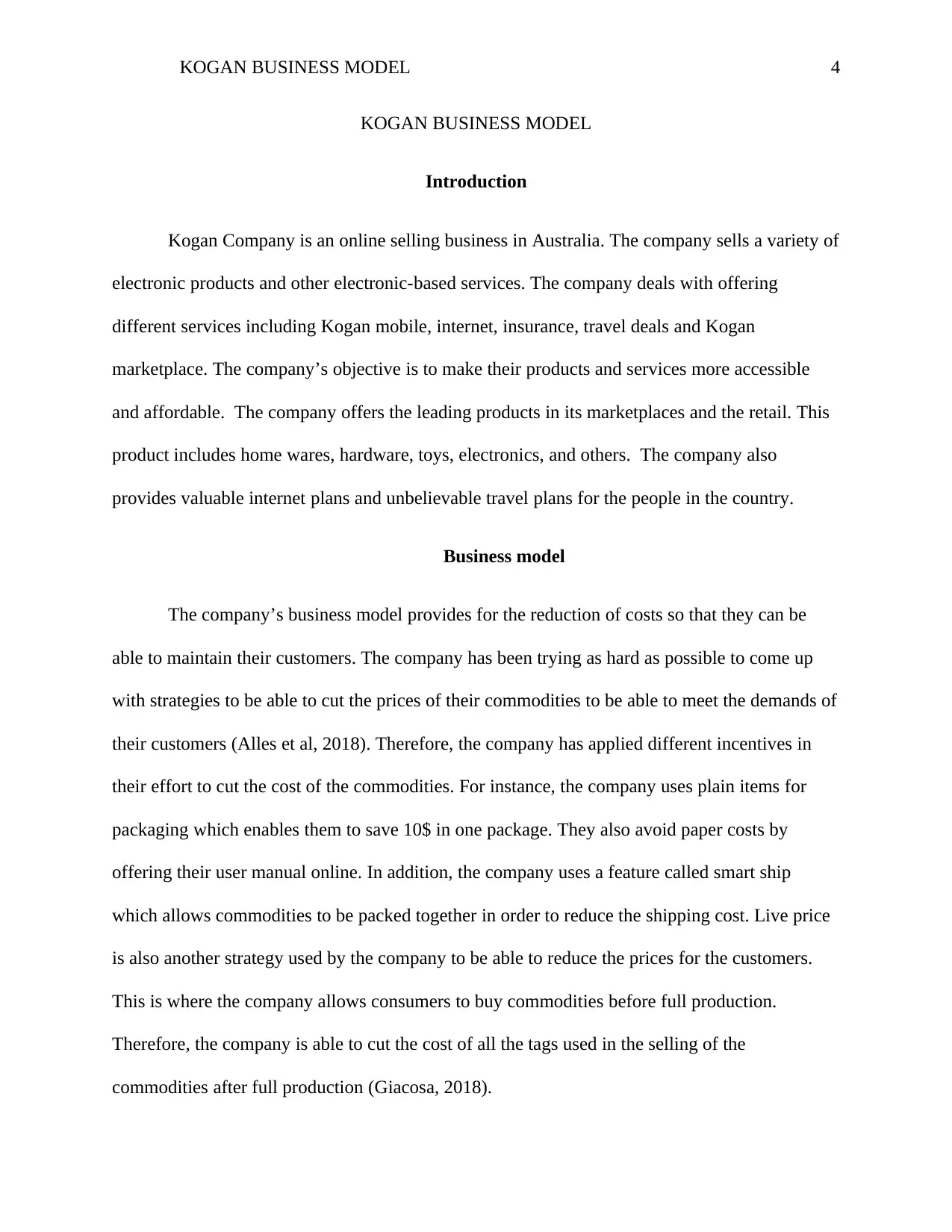
Introduction
Kogan Company is an online selling business in Australia. The company sells a variety of
electronic products and other electronic-based services. The company deals with offering
different services including Kogan mobile, internet, insurance, travel deals and Kogan
marketplace. The company’s objective is to make their products and services more accessible
and affordable. The company offers the leading products in its marketplaces and the retail. This
product includes home wares, hardware, toys, electronics, and others. The company also
provides valuable internet plans and unbelievable travel plans for the people in the country.
Business model
The company’s business model provides for the reduction of costs so that they can be
able to maintain their customers. The company has been trying as hard as possible to come up
with strategies to be able to cut the prices of their commodities to be able to meet the demands of
their customers (Alles et al, 2018). Therefore, the company has applied different incentives in
their effort to cut the cost of the commodities. For instance, the company uses plain items for
packaging which enables them to save 10$ in one package. They also avoid paper costs by
offering their user manual online. In addition, the company uses a feature called smart ship
which allows commodities to be packed together in order to reduce the shipping cost. Live price
is also another strategy used by the company to be able to reduce the prices for the customers.
This is where the company allows consumers to buy commodities before full production.
Therefore, the company is able to cut the cost of all the tags used in the selling of the
commodities after full production (Giacosa, 2018).
KOGAN BUSINESS MODEL
Introduction
Kogan Company is an online selling business in Australia. The company sells a variety of
electronic products and other electronic-based services. The company deals with offering
different services including Kogan mobile, internet, insurance, travel deals and Kogan
marketplace. The company’s objective is to make their products and services more accessible
and affordable. The company offers the leading products in its marketplaces and the retail. This
product includes home wares, hardware, toys, electronics, and others. The company also
provides valuable internet plans and unbelievable travel plans for the people in the country.
Business model
The company’s business model provides for the reduction of costs so that they can be
able to maintain their customers. The company has been trying as hard as possible to come up
with strategies to be able to cut the prices of their commodities to be able to meet the demands of
their customers (Alles et al, 2018). Therefore, the company has applied different incentives in
their effort to cut the cost of the commodities. For instance, the company uses plain items for
packaging which enables them to save 10$ in one package. They also avoid paper costs by
offering their user manual online. In addition, the company uses a feature called smart ship
which allows commodities to be packed together in order to reduce the shipping cost. Live price
is also another strategy used by the company to be able to reduce the prices for the customers.
This is where the company allows consumers to buy commodities before full production.
Therefore, the company is able to cut the cost of all the tags used in the selling of the
commodities after full production (Giacosa, 2018).
Paraphrase This Document
Need a fresh take? Get an instant paraphrase of this document with our AI Paraphraser
KOGAN BUSINESS MODEL 5
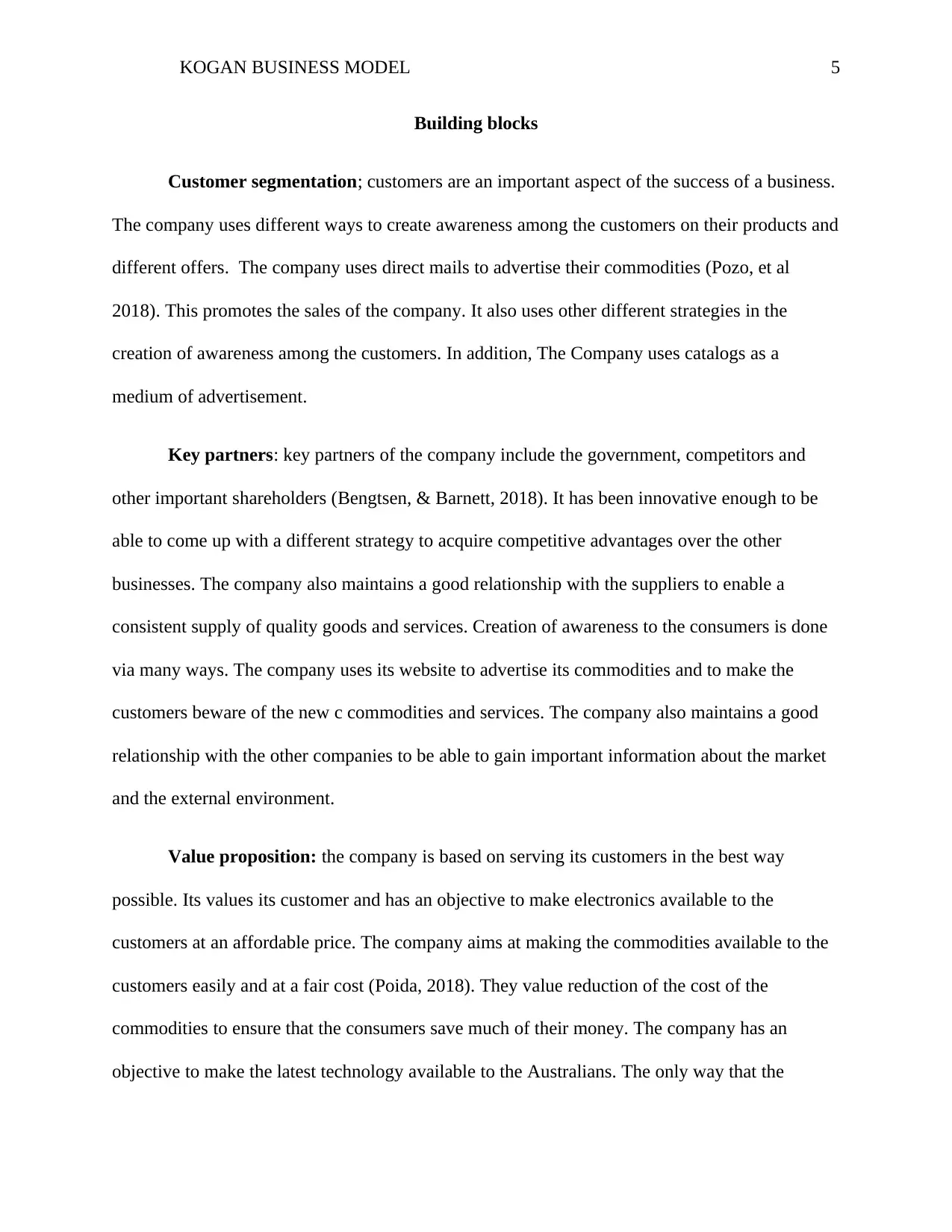
Building blocks
Customer segmentation; customers are an important aspect of the success of a business.
The company uses different ways to create awareness among the customers on their products and
different offers. The company uses direct mails to advertise their commodities (Pozo, et al
2018). This promotes the sales of the company. It also uses other different strategies in the
creation of awareness among the customers. In addition, The Company uses catalogs as a
medium of advertisement.
Key partners: key partners of the company include the government, competitors and
other important shareholders (Bengtsen, & Barnett, 2018). It has been innovative enough to be
able to come up with a different strategy to acquire competitive advantages over the other
businesses. The company also maintains a good relationship with the suppliers to enable a
consistent supply of quality goods and services. Creation of awareness to the consumers is done
via many ways. The company uses its website to advertise its commodities and to make the
customers beware of the new c commodities and services. The company also maintains a good
relationship with the other companies to be able to gain important information about the market
and the external environment.
Value proposition: the company is based on serving its customers in the best way
possible. Its values its customer and has an objective to make electronics available to the
customers at an affordable price. The company aims at making the commodities available to the
customers easily and at a fair cost (Poida, 2018). They value reduction of the cost of the
commodities to ensure that the consumers save much of their money. The company has an
objective to make the latest technology available to the Australians. The only way that the
Building blocks
Customer segmentation; customers are an important aspect of the success of a business.
The company uses different ways to create awareness among the customers on their products and
different offers. The company uses direct mails to advertise their commodities (Pozo, et al
2018). This promotes the sales of the company. It also uses other different strategies in the
creation of awareness among the customers. In addition, The Company uses catalogs as a
medium of advertisement.
Key partners: key partners of the company include the government, competitors and
other important shareholders (Bengtsen, & Barnett, 2018). It has been innovative enough to be
able to come up with a different strategy to acquire competitive advantages over the other
businesses. The company also maintains a good relationship with the suppliers to enable a
consistent supply of quality goods and services. Creation of awareness to the consumers is done
via many ways. The company uses its website to advertise its commodities and to make the
customers beware of the new c commodities and services. The company also maintains a good
relationship with the other companies to be able to gain important information about the market
and the external environment.
Value proposition: the company is based on serving its customers in the best way
possible. Its values its customer and has an objective to make electronics available to the
customers at an affordable price. The company aims at making the commodities available to the
customers easily and at a fair cost (Poida, 2018). They value reduction of the cost of the
commodities to ensure that the consumers save much of their money. The company has an
objective to make the latest technology available to the Australians. The only way that the
KOGAN BUSINESS MODEL 6
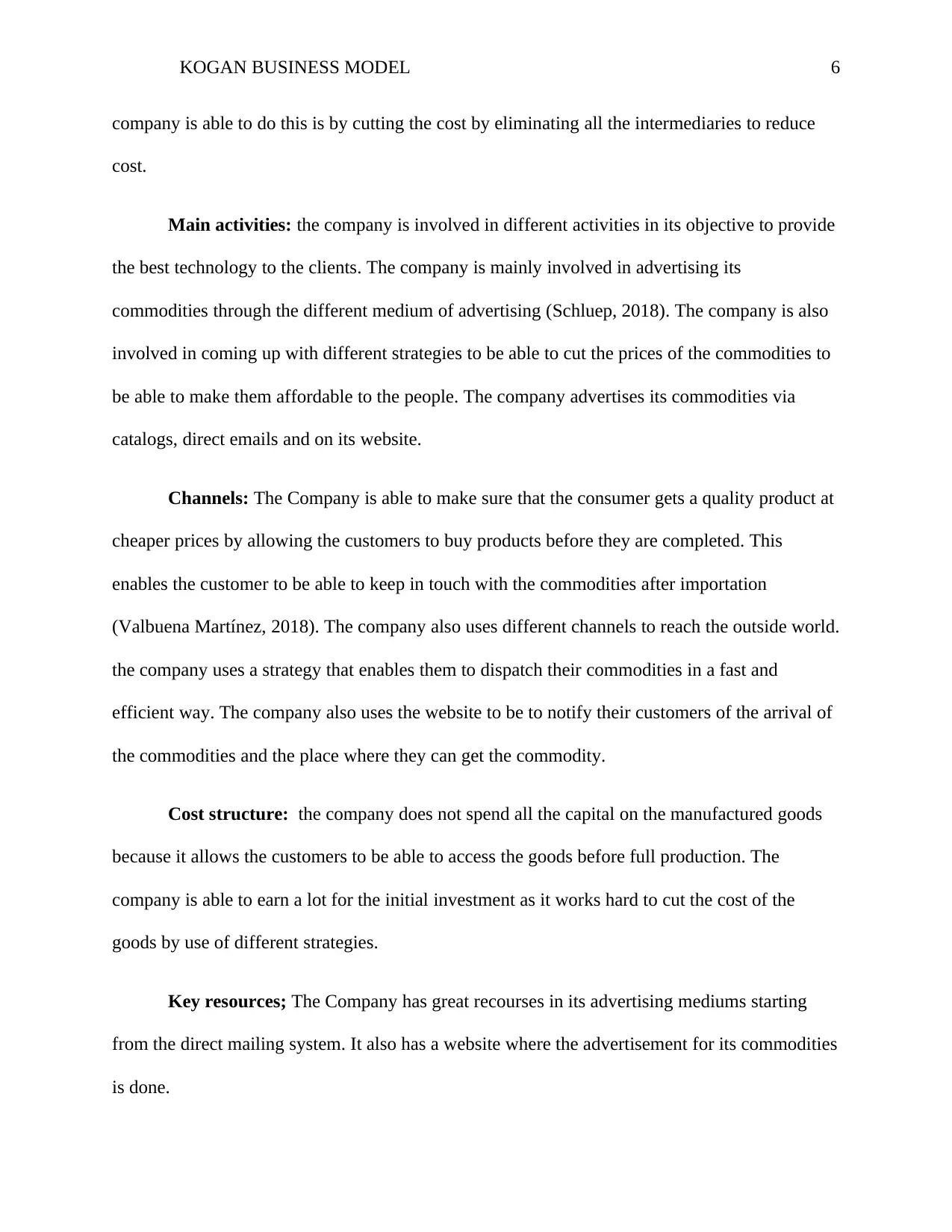
company is able to do this is by cutting the cost by eliminating all the intermediaries to reduce
cost.
Main activities: the company is involved in different activities in its objective to provide
the best technology to the clients. The company is mainly involved in advertising its
commodities through the different medium of advertising (Schluep, 2018). The company is also
involved in coming up with different strategies to be able to cut the prices of the commodities to
be able to make them affordable to the people. The company advertises its commodities via
catalogs, direct emails and on its website.
Channels: The Company is able to make sure that the consumer gets a quality product at
cheaper prices by allowing the customers to buy products before they are completed. This
enables the customer to be able to keep in touch with the commodities after importation
(Valbuena Martínez, 2018). The company also uses different channels to reach the outside world.
the company uses a strategy that enables them to dispatch their commodities in a fast and
efficient way. The company also uses the website to be to notify their customers of the arrival of
the commodities and the place where they can get the commodity.
Cost structure: the company does not spend all the capital on the manufactured goods
because it allows the customers to be able to access the goods before full production. The
company is able to earn a lot for the initial investment as it works hard to cut the cost of the
goods by use of different strategies.
Key resources; The Company has great recourses in its advertising mediums starting
from the direct mailing system. It also has a website where the advertisement for its commodities
is done.
company is able to do this is by cutting the cost by eliminating all the intermediaries to reduce
cost.
Main activities: the company is involved in different activities in its objective to provide
the best technology to the clients. The company is mainly involved in advertising its
commodities through the different medium of advertising (Schluep, 2018). The company is also
involved in coming up with different strategies to be able to cut the prices of the commodities to
be able to make them affordable to the people. The company advertises its commodities via
catalogs, direct emails and on its website.
Channels: The Company is able to make sure that the consumer gets a quality product at
cheaper prices by allowing the customers to buy products before they are completed. This
enables the customer to be able to keep in touch with the commodities after importation
(Valbuena Martínez, 2018). The company also uses different channels to reach the outside world.
the company uses a strategy that enables them to dispatch their commodities in a fast and
efficient way. The company also uses the website to be to notify their customers of the arrival of
the commodities and the place where they can get the commodity.
Cost structure: the company does not spend all the capital on the manufactured goods
because it allows the customers to be able to access the goods before full production. The
company is able to earn a lot for the initial investment as it works hard to cut the cost of the
goods by use of different strategies.
Key resources; The Company has great recourses in its advertising mediums starting
from the direct mailing system. It also has a website where the advertisement for its commodities
is done.
⊘ This is a preview!⊘
Do you want full access?
Subscribe today to unlock all pages.
Trusted by 1+ million students worldwide
KOGAN BUSINESS MODEL 7
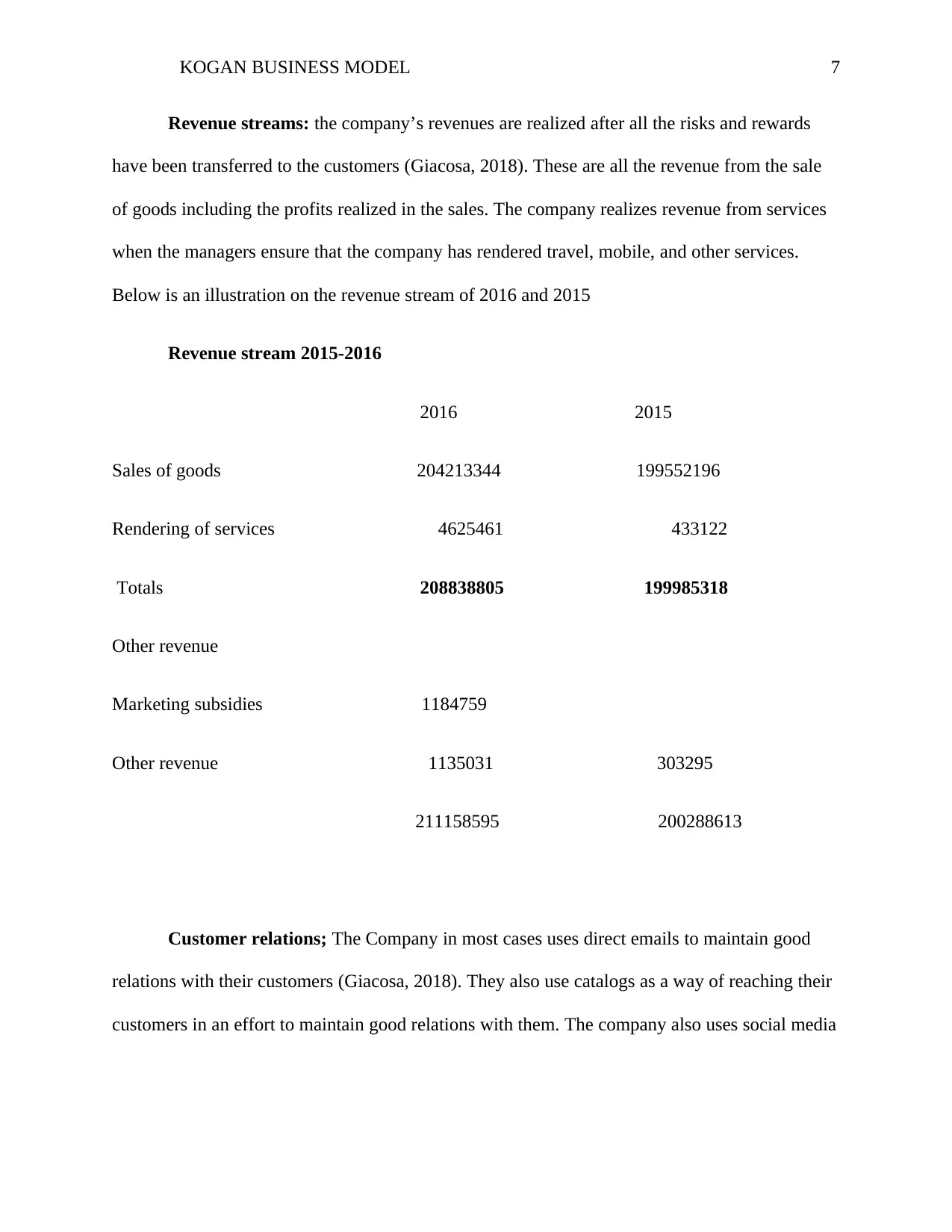
Revenue streams: the company’s revenues are realized after all the risks and rewards
have been transferred to the customers (Giacosa, 2018). These are all the revenue from the sale
of goods including the profits realized in the sales. The company realizes revenue from services
when the managers ensure that the company has rendered travel, mobile, and other services.
Below is an illustration on the revenue stream of 2016 and 2015
Revenue stream 2015-2016
2016 2015
Sales of goods 204213344 199552196
Rendering of services 4625461 433122
Totals 208838805 199985318
Other revenue
Marketing subsidies 1184759
Other revenue 1135031 303295
211158595 200288613
Customer relations; The Company in most cases uses direct emails to maintain good
relations with their customers (Giacosa, 2018). They also use catalogs as a way of reaching their
customers in an effort to maintain good relations with them. The company also uses social media
Revenue streams: the company’s revenues are realized after all the risks and rewards
have been transferred to the customers (Giacosa, 2018). These are all the revenue from the sale
of goods including the profits realized in the sales. The company realizes revenue from services
when the managers ensure that the company has rendered travel, mobile, and other services.
Below is an illustration on the revenue stream of 2016 and 2015
Revenue stream 2015-2016
2016 2015
Sales of goods 204213344 199552196
Rendering of services 4625461 433122
Totals 208838805 199985318
Other revenue
Marketing subsidies 1184759
Other revenue 1135031 303295
211158595 200288613
Customer relations; The Company in most cases uses direct emails to maintain good
relations with their customers (Giacosa, 2018). They also use catalogs as a way of reaching their
customers in an effort to maintain good relations with them. The company also uses social media
Paraphrase This Document
Need a fresh take? Get an instant paraphrase of this document with our AI Paraphraser
KOGAN BUSINESS MODEL 8
to be able to reach their consumers. The consumers after buying their commodities are able to
like the company’s products on Face book to be able to influence more customers.
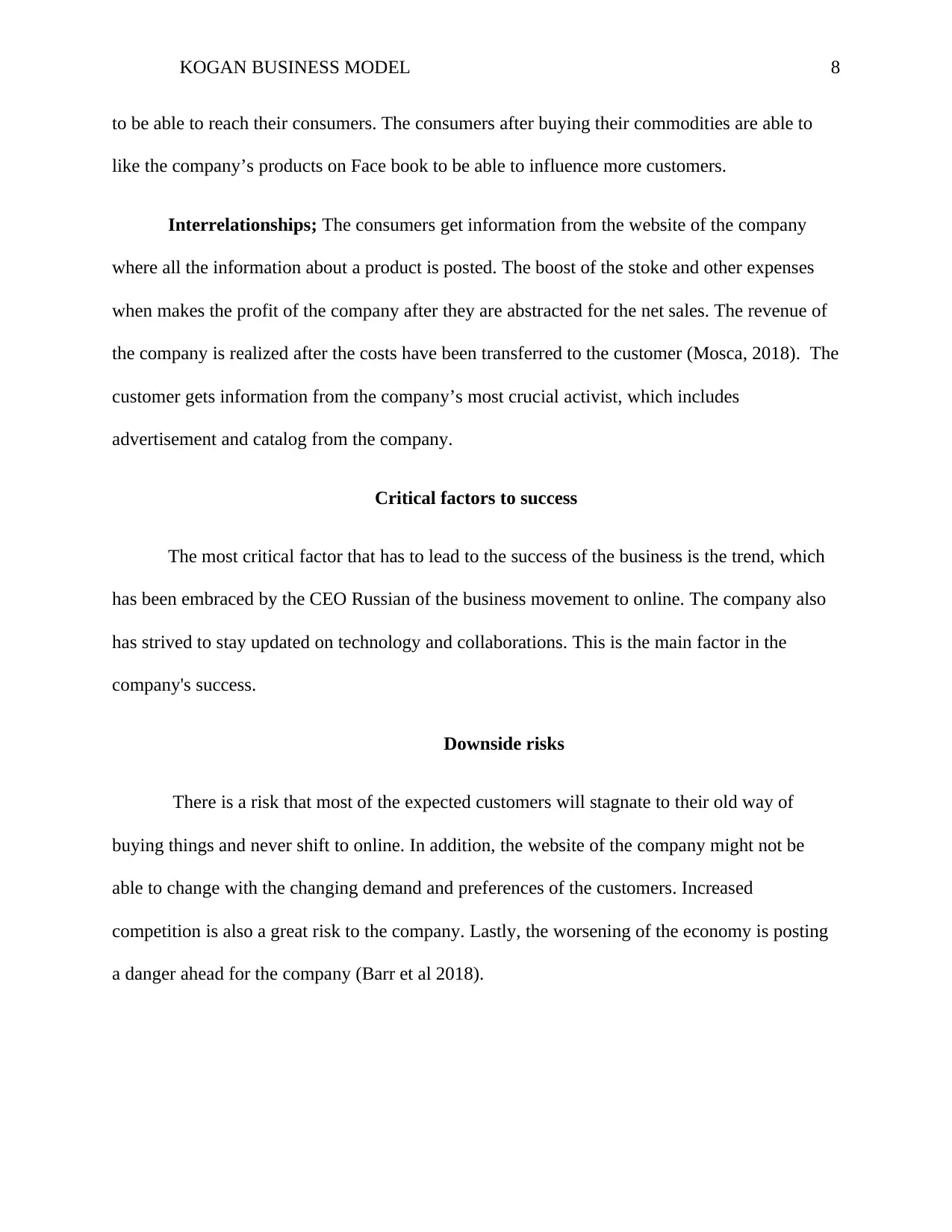
Interrelationships; The consumers get information from the website of the company
where all the information about a product is posted. The boost of the stoke and other expenses
when makes the profit of the company after they are abstracted for the net sales. The revenue of
the company is realized after the costs have been transferred to the customer (Mosca, 2018). The
customer gets information from the company’s most crucial activist, which includes
advertisement and catalog from the company.
Critical factors to success
The most critical factor that has to lead to the success of the business is the trend, which
has been embraced by the CEO Russian of the business movement to online. The company also
has strived to stay updated on technology and collaborations. This is the main factor in the
company's success.
Downside risks
There is a risk that most of the expected customers will stagnate to their old way of
buying things and never shift to online. In addition, the website of the company might not be
able to change with the changing demand and preferences of the customers. Increased
competition is also a great risk to the company. Lastly, the worsening of the economy is posting
a danger ahead for the company (Barr et al 2018).
to be able to reach their consumers. The consumers after buying their commodities are able to
like the company’s products on Face book to be able to influence more customers.
Interrelationships; The consumers get information from the website of the company
where all the information about a product is posted. The boost of the stoke and other expenses
when makes the profit of the company after they are abstracted for the net sales. The revenue of
the company is realized after the costs have been transferred to the customer (Mosca, 2018). The
customer gets information from the company’s most crucial activist, which includes
advertisement and catalog from the company.
Critical factors to success
The most critical factor that has to lead to the success of the business is the trend, which
has been embraced by the CEO Russian of the business movement to online. The company also
has strived to stay updated on technology and collaborations. This is the main factor in the
company's success.
Downside risks
There is a risk that most of the expected customers will stagnate to their old way of
buying things and never shift to online. In addition, the website of the company might not be
able to change with the changing demand and preferences of the customers. Increased
competition is also a great risk to the company. Lastly, the worsening of the economy is posting
a danger ahead for the company (Barr et al 2018).
KOGAN BUSINESS MODEL 9
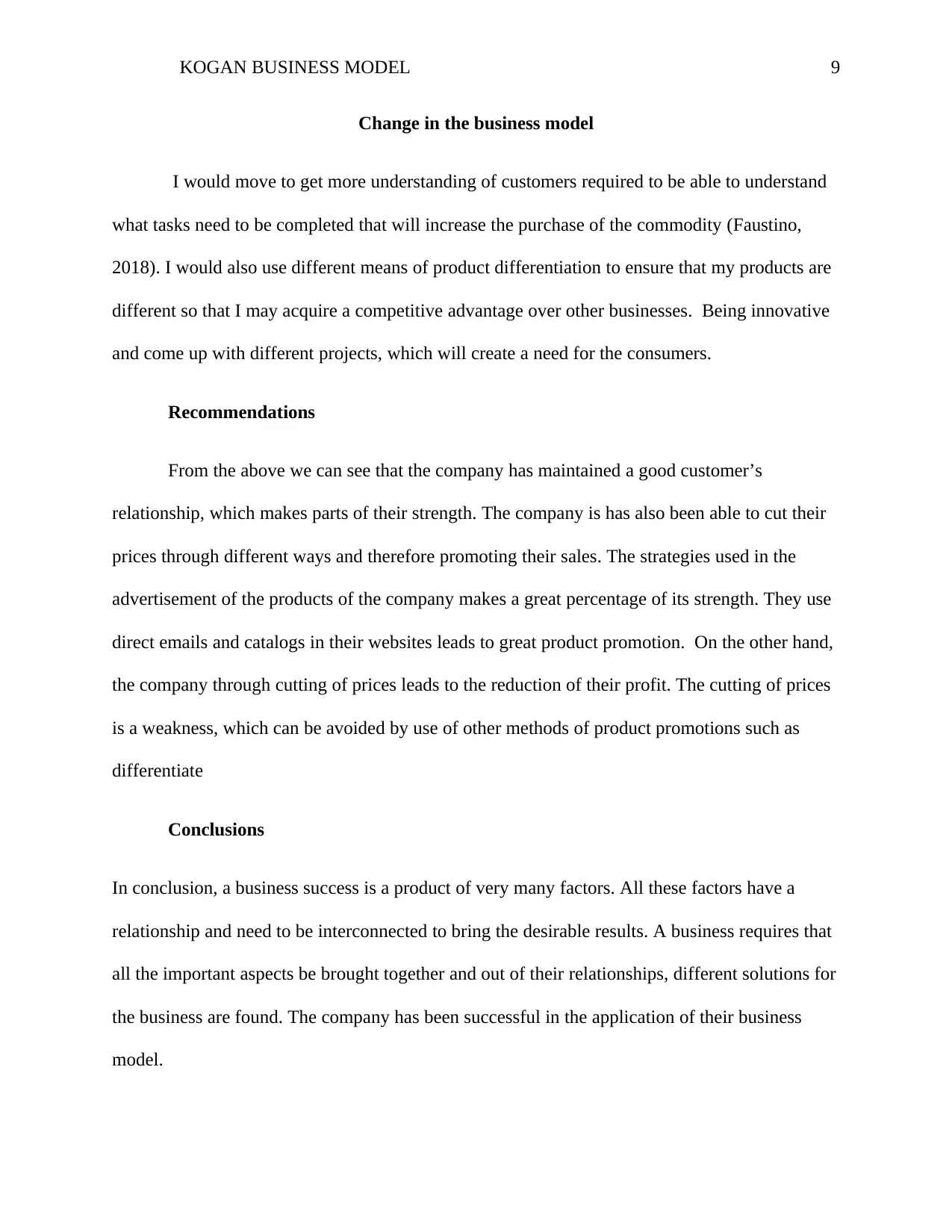
Change in the business model
I would move to get more understanding of customers required to be able to understand
what tasks need to be completed that will increase the purchase of the commodity (Faustino,
2018). I would also use different means of product differentiation to ensure that my products are
different so that I may acquire a competitive advantage over other businesses. Being innovative
and come up with different projects, which will create a need for the consumers.
Recommendations
From the above we can see that the company has maintained a good customer’s
relationship, which makes parts of their strength. The company is has also been able to cut their
prices through different ways and therefore promoting their sales. The strategies used in the
advertisement of the products of the company makes a great percentage of its strength. They use
direct emails and catalogs in their websites leads to great product promotion. On the other hand,
the company through cutting of prices leads to the reduction of their profit. The cutting of prices
is a weakness, which can be avoided by use of other methods of product promotions such as
differentiate
Conclusions
In conclusion, a business success is a product of very many factors. All these factors have a
relationship and need to be interconnected to bring the desirable results. A business requires that
all the important aspects be brought together and out of their relationships, different solutions for
the business are found. The company has been successful in the application of their business
model.
Change in the business model
I would move to get more understanding of customers required to be able to understand
what tasks need to be completed that will increase the purchase of the commodity (Faustino,
2018). I would also use different means of product differentiation to ensure that my products are
different so that I may acquire a competitive advantage over other businesses. Being innovative
and come up with different projects, which will create a need for the consumers.
Recommendations
From the above we can see that the company has maintained a good customer’s
relationship, which makes parts of their strength. The company is has also been able to cut their
prices through different ways and therefore promoting their sales. The strategies used in the
advertisement of the products of the company makes a great percentage of its strength. They use
direct emails and catalogs in their websites leads to great product promotion. On the other hand,
the company through cutting of prices leads to the reduction of their profit. The cutting of prices
is a weakness, which can be avoided by use of other methods of product promotions such as
differentiate
Conclusions
In conclusion, a business success is a product of very many factors. All these factors have a
relationship and need to be interconnected to bring the desirable results. A business requires that
all the important aspects be brought together and out of their relationships, different solutions for
the business are found. The company has been successful in the application of their business
model.
⊘ This is a preview!⊘
Do you want full access?
Subscribe today to unlock all pages.
Trusted by 1+ million students worldwide
KOGAN BUSINESS MODEL 10
Kogan business model canvas
Key partners
2
Suppliers and mailing
house
Key activities
4
Provide best
technology
Value proposition
3
Make technology
available at a an
affordable cost
Channels
5
Online through the
website
Revenue streams
8
Over 10% profit
margin
Cost structure
6
Stock about 40%
sales 30% and
admin around 20%
of the revenue
Customer relations
9
Direct mail and social
media
Key resources
7
Advertising
media and direct
mail
Customer segment
1
Direct mail and
social media
Kogan business model canvas
Key partners
2
Suppliers and mailing
house
Key activities
4
Provide best
technology
Value proposition
3
Make technology
available at a an
affordable cost
Channels
5
Online through the
website
Revenue streams
8
Over 10% profit
margin
Cost structure
6
Stock about 40%
sales 30% and
admin around 20%
of the revenue
Customer relations
9
Direct mail and social
media
Key resources
7
Advertising
media and direct
Customer segment
1
Direct mail and
social media
Paraphrase This Document
Need a fresh take? Get an instant paraphrase of this document with our AI Paraphraser
KOGAN BUSINESS MODEL 11
References
Alles, M., Brennan, G., Kogan, A., & Vasarhelyi, M. A. (2018). Continuous monitoring of business
process controls A pilot implementation of a continuous auditing system at Siemens. In
Continuous Auditing: Theory and Application (pp. 219-246). Emerald Publishing Limited.
Barr, N., Chapman, B., Dearden, L., & Dynarski, S. M. (2018). Reflections on the US college loans
system: Lessons from Australia and England.
Bengtsen, S. S., & Barnett, R. (Eds.). (2018). The Thinking University: A Philosophical
Examination of Thought and Higher Education (Vol. 1). Springer.
Faustino, P. (2018). Television market, ownership concentration and management strategies in
Portugal. International Journal of Digital Television, 9(2), 125-146.
Giacosa, E. (2018). How the Business Model Could Increase the Competitiveness of a Luxury
Company?. In Sustainable Luxury, Entrepreneurship, and Innovation (pp. 17-29). Springer,
Singapore.
POIDA, I. I. (2018). Rolul auditorului în contextul evoluţiei reglementărilor contabile. Audit
Financiar, 16(150).
Pozo, M. J., & Durán, R. (2018). Model CANVAS: Its Application for the Promotion of Regional
Economies Under the Case Study of Buffalo Milk Cheese. Journal of Modern Accounting
and Auditing, 14(4), 174-188.
Schluep, R. B. (2018). Fashion Technology and the Development of New Business Models. In
Fashion and Textiles: Breakthroughs in Research and Practice (pp. 174-210). IGI Global.
Valbuena Martínez, M. C. (2018). La movilidad humana y migraciones y sus motores económicos.
References
Alles, M., Brennan, G., Kogan, A., & Vasarhelyi, M. A. (2018). Continuous monitoring of business
process controls A pilot implementation of a continuous auditing system at Siemens. In
Continuous Auditing: Theory and Application (pp. 219-246). Emerald Publishing Limited.
Barr, N., Chapman, B., Dearden, L., & Dynarski, S. M. (2018). Reflections on the US college loans
system: Lessons from Australia and England.
Bengtsen, S. S., & Barnett, R. (Eds.). (2018). The Thinking University: A Philosophical
Examination of Thought and Higher Education (Vol. 1). Springer.
Faustino, P. (2018). Television market, ownership concentration and management strategies in
Portugal. International Journal of Digital Television, 9(2), 125-146.
Giacosa, E. (2018). How the Business Model Could Increase the Competitiveness of a Luxury
Company?. In Sustainable Luxury, Entrepreneurship, and Innovation (pp. 17-29). Springer,
Singapore.
POIDA, I. I. (2018). Rolul auditorului în contextul evoluţiei reglementărilor contabile. Audit
Financiar, 16(150).
Pozo, M. J., & Durán, R. (2018). Model CANVAS: Its Application for the Promotion of Regional
Economies Under the Case Study of Buffalo Milk Cheese. Journal of Modern Accounting
and Auditing, 14(4), 174-188.
Schluep, R. B. (2018). Fashion Technology and the Development of New Business Models. In
Fashion and Textiles: Breakthroughs in Research and Practice (pp. 174-210). IGI Global.
Valbuena Martínez, M. C. (2018). La movilidad humana y migraciones y sus motores económicos.
KOGAN BUSINESS MODEL 12
Mosca, F. (2018). Stone Island: Product Innovation and Market Positioning as Drivers of Value
Creation. In Product Innovation in the Global Fashion Industry (pp. 35-56). Palgrave Pivot,
New York.
Giacosa, E. (2018). How the Business Model Could Increase the Competitiveness of a Luxury
Company?. In Sustainable Luxury, Entrepreneurship, and Innovation (pp. 17-29). Springer,
Singapore.
Mosca, F. (2018). Stone Island: Product Innovation and Market Positioning as Drivers of Value
Creation. In Product Innovation in the Global Fashion Industry (pp. 35-56). Palgrave Pivot,
New York.
Giacosa, E. (2018). How the Business Model Could Increase the Competitiveness of a Luxury
Company?. In Sustainable Luxury, Entrepreneurship, and Innovation (pp. 17-29). Springer,
Singapore.
⊘ This is a preview!⊘
Do you want full access?
Subscribe today to unlock all pages.
Trusted by 1+ million students worldwide

1 out of 12


Related Documents


Your All-in-One AI-Powered Toolkit for Academic Success.
+13062052269
info@desklib.com
Available 24*7 on WhatsApp / Email
![[object Object]](/_next/static/media/star-bottom.7253800d.svg)
Unlock your academic potential
Copyright © 2020–2026 A2Z Services. All Rights Reserved. Developed and managed by ZUCOL.