BEX5601: Korean Air Case Study - Business Environment Analysis Report
VerifiedAdded on 2022/09/21
|11
|3116
|25
Case Study
AI Summary
This case study analysis examines the business environment of Korean Air, focusing on the challenges and factors impacting its operations. The analysis employs a PEST framework to identify political, economic, social, and technological factors affecting Korean Air's performance. Key issues include trade wars, economic deregulation, jet fuel price increases, changing customer preferences, and technological advancements. The core problem identified is the ineffectiveness in retaining market share, particularly against competitors like Cathay Pacific. The document analyzes this problem, discussing the loss of market leadership and the impact of rising operational costs. Several alternative solutions are proposed, including extending services, market development in emerging economies, and market penetration through sub-brands. The analysis evaluates these solutions, considering their potential benefits and drawbacks. The study highlights the importance of adapting to the changing business environment and developing strategies to maintain competitiveness and ensure long-term viability in the air cargo industry.
Running head: BUSINESS ENVIRONMENT
Business environment
Name of the student
Name of the university
Author note
Business environment
Name of the student
Name of the university
Author note

Paraphrase This Document
Need a fresh take? Get an instant paraphrase of this document with our AI Paraphraser
1BUSINESS ENVIRONMENT
Explanation of the key business issues
As per the case study, there are number of issues and factors being faced by the Korean
Air due to the change in the external business factors. In this case, PEST analysis will be used to
identify the key factors that are posing challenges for Korean Air.
Political factors
One of the key political factors that are having impacts on the business of Korean Air is
the trade wars and diminishing political relationships between the countries. This is due to the
reason that air cargo services are mainly having international routes and trade wars are reducing
the economic potentiality of a certain regions and cargo services are getting affected. For
example, the trade war between the different countries is causing negative implications in the
business process between the two countries (Bartlik, 2016). The import and export between the
two countries got reduced due to the imposition of duties and cargo industry is having low
consignment left to transport. On the other hand, political turbulence in many countries is also
posing challenges for the air cargo service providers. This is due to the reason that countries
facing higher intensity of political turbulence will have low sets of economic activities in place.
For example, the political turbulence in the Middle Eastern regions is causing barriers in the
international trading with other parts of the world and thus the air cargo routes in these areas are
getting hit (Sowers, Ciccantell & Smith, 2014). In the case of Korean Air, their potentiality in
transporting between the western countries and China and in the Middle Eastern countries is
getting reduced due to these political factors.
Economical factors
Explanation of the key business issues
As per the case study, there are number of issues and factors being faced by the Korean
Air due to the change in the external business factors. In this case, PEST analysis will be used to
identify the key factors that are posing challenges for Korean Air.
Political factors
One of the key political factors that are having impacts on the business of Korean Air is
the trade wars and diminishing political relationships between the countries. This is due to the
reason that air cargo services are mainly having international routes and trade wars are reducing
the economic potentiality of a certain regions and cargo services are getting affected. For
example, the trade war between the different countries is causing negative implications in the
business process between the two countries (Bartlik, 2016). The import and export between the
two countries got reduced due to the imposition of duties and cargo industry is having low
consignment left to transport. On the other hand, political turbulence in many countries is also
posing challenges for the air cargo service providers. This is due to the reason that countries
facing higher intensity of political turbulence will have low sets of economic activities in place.
For example, the political turbulence in the Middle Eastern regions is causing barriers in the
international trading with other parts of the world and thus the air cargo routes in these areas are
getting hit (Sowers, Ciccantell & Smith, 2014). In the case of Korean Air, their potentiality in
transporting between the western countries and China and in the Middle Eastern countries is
getting reduced due to these political factors.
Economical factors
2BUSINESS ENVIRONMENT
One of the key economical factors that are having impact on the existing cargo players
such as Korean Air is the deregulation of the market. In the current era of globalization, each of
the business areas is getting deregulated and barriers are getting reduced and air cargo sector is
no exception. Even though this regulation will help Korean Air to enter in new locations but it
will also pose challenges in terms of attracting new players (Wang, Bonilla & Banister, 2016). In
the case, it is stated that new players such as Air China cargo and Eastern Airlines are the new
addition in these sector. Thus, with the continuous deregulation in the market, the intensity of
competition is getting increased for Korean Air and managing and retaining their existing market
share is also getting challenging (Prentice & Knotts, 2014). In addition, the increasing trend of
the price of jet fuel is also reducing the profitability for the cargo service providers. This is due
to the reason that Korean Air is already facing huge competition in the market and cannot
increase the price but on the other hand, the increase in the price of jet fuel is reducing their
profit margin. Thus, the air cargo providers such as Korean Air are losing out their business
viability. Emergence of the economic recession is also posing problems for the air cargo service
providers because with the emergence of the economic recession, rate of unemployment is
increasing and average spending and expenditure is reducing (Shiao & Hwang, 2013). Thus, the
economical development is getting stagnant and less need of import and export. This is causing
Korean Air left with minimal options in their international trading scenario.
Social factors
Traditionally the air cargo services are the most expensive forms of transportation
compared to other services such as maritime services. Thus, the market growth rate and
potentiality is limited and in the further stage, the development of alternative transportation
services is reducing the social preferences for the air cargo services. In the current time, majority
One of the key economical factors that are having impact on the existing cargo players
such as Korean Air is the deregulation of the market. In the current era of globalization, each of
the business areas is getting deregulated and barriers are getting reduced and air cargo sector is
no exception. Even though this regulation will help Korean Air to enter in new locations but it
will also pose challenges in terms of attracting new players (Wang, Bonilla & Banister, 2016). In
the case, it is stated that new players such as Air China cargo and Eastern Airlines are the new
addition in these sector. Thus, with the continuous deregulation in the market, the intensity of
competition is getting increased for Korean Air and managing and retaining their existing market
share is also getting challenging (Prentice & Knotts, 2014). In addition, the increasing trend of
the price of jet fuel is also reducing the profitability for the cargo service providers. This is due
to the reason that Korean Air is already facing huge competition in the market and cannot
increase the price but on the other hand, the increase in the price of jet fuel is reducing their
profit margin. Thus, the air cargo providers such as Korean Air are losing out their business
viability. Emergence of the economic recession is also posing problems for the air cargo service
providers because with the emergence of the economic recession, rate of unemployment is
increasing and average spending and expenditure is reducing (Shiao & Hwang, 2013). Thus, the
economical development is getting stagnant and less need of import and export. This is causing
Korean Air left with minimal options in their international trading scenario.
Social factors
Traditionally the air cargo services are the most expensive forms of transportation
compared to other services such as maritime services. Thus, the market growth rate and
potentiality is limited and in the further stage, the development of alternative transportation
services is reducing the social preferences for the air cargo services. In the current time, majority
⊘ This is a preview!⊘
Do you want full access?
Subscribe today to unlock all pages.

Trusted by 1+ million students worldwide
3BUSINESS ENVIRONMENT
of the social trends including the business entities prefer sustainable practices, cost effectiveness
and lower exploitation of resources (Fu & Oum, 2014). Any of these factors are not compatible
with the air cargo services and thus it is getting problematic for Korean Air to gain the social
preferences over their substitutes. It is also getting challenging for Korean Air to meet the ever
changing expectations and preference patterns of the customers due to the fact that the
expectations of the business clients from the air cargo service providers in the difference of five
years is not the same (Feng, Li & Shen, 2015). Thus, the change to be done in the business
process in coping up with the change in the customer expectation is challenging for Korean Air
and business uncertainties are getting increased. It is also stated that with the strong economic
position of China, Chinese players are offering the maximum value propositions for the
customers and it is getting more challenging for Korean Air to match the same.
Technological factors
In terms of the technological factors, Korean Air is already using the Boeing 737 and
747s in their inventory for the cargo transportation. However, the point of differences in this case
is less because their competitors are also using the same fleet type. Gaining competitive
advantages through distinctive mediums is having lower probability for Korean Air. Moreover, it
should be noted that in the current scenario, technological advancements in terms of the
transportation mode is not enough but also the entire process should be developed. In the case, it
is stated that the pre and post process of air transportation should also be developed and in this
case, Korean Air is leading the way (Xu, 2016). They have effectively integrated the IT process
in their documentation and consignment handling process. However, the major challenge in this
case is the rapid change in the technological environment. With each of the competing rivals in
this sector is developing their technologies, Korean Air should also have the periodical
of the social trends including the business entities prefer sustainable practices, cost effectiveness
and lower exploitation of resources (Fu & Oum, 2014). Any of these factors are not compatible
with the air cargo services and thus it is getting problematic for Korean Air to gain the social
preferences over their substitutes. It is also getting challenging for Korean Air to meet the ever
changing expectations and preference patterns of the customers due to the fact that the
expectations of the business clients from the air cargo service providers in the difference of five
years is not the same (Feng, Li & Shen, 2015). Thus, the change to be done in the business
process in coping up with the change in the customer expectation is challenging for Korean Air
and business uncertainties are getting increased. It is also stated that with the strong economic
position of China, Chinese players are offering the maximum value propositions for the
customers and it is getting more challenging for Korean Air to match the same.
Technological factors
In terms of the technological factors, Korean Air is already using the Boeing 737 and
747s in their inventory for the cargo transportation. However, the point of differences in this case
is less because their competitors are also using the same fleet type. Gaining competitive
advantages through distinctive mediums is having lower probability for Korean Air. Moreover, it
should be noted that in the current scenario, technological advancements in terms of the
transportation mode is not enough but also the entire process should be developed. In the case, it
is stated that the pre and post process of air transportation should also be developed and in this
case, Korean Air is leading the way (Xu, 2016). They have effectively integrated the IT process
in their documentation and consignment handling process. However, the major challenge in this
case is the rapid change in the technological environment. With each of the competing rivals in
this sector is developing their technologies, Korean Air should also have the periodical
Paraphrase This Document
Need a fresh take? Get an instant paraphrase of this document with our AI Paraphraser
4BUSINESS ENVIRONMENT
mechanism of improving their technologies in order to stay ahead in the competition, which will
involve more cost for Korean Air (Petrescu et al., 2017). Hence, the probability of getting the
return on investment is further getting bleak for Korean Air.
Problem statement
The key problem identified for Korean Air is the ineffectiveness in retaining the existing
customers and market share. This is the main reason and problem for Korean Air in not being
able to protect the market leadership from Cathay Pacific. The long term business strategies
should be developed in considering this fact and that will be help in retaining the existing market
share.
Problem analysis
With the cut throat competition in its segment, the major objective for Korean Air is to
retain their market share and ensure the continuous flow of revenue from the existing customers.
However, the major problem for Korean Air is in exactly the same area where they are facing
challenges in meeting the expectations of the customers or not being able to cope up with the
change in the market. Already the tag of market leadership got lost to Cathay Pacific and if this
trend continuous, Korean Air is going to lose more market share in the coming period. The core
objective of Korean Air about 40 years of excellence and gaining the market leadership status is
thus not getting achieved (May et al., 2014). The objective of Korean Air of having extensive
infrastructure and routes across the world is also getting affected because of lack of revenue
generation from their existing operation. Thus, the rate of revenue generation from the side of the
customers should be first increased and strategies should be based on this objective. This will
pave the way for long term business viability and regaining the tag of market leadership.
mechanism of improving their technologies in order to stay ahead in the competition, which will
involve more cost for Korean Air (Petrescu et al., 2017). Hence, the probability of getting the
return on investment is further getting bleak for Korean Air.
Problem statement
The key problem identified for Korean Air is the ineffectiveness in retaining the existing
customers and market share. This is the main reason and problem for Korean Air in not being
able to protect the market leadership from Cathay Pacific. The long term business strategies
should be developed in considering this fact and that will be help in retaining the existing market
share.
Problem analysis
With the cut throat competition in its segment, the major objective for Korean Air is to
retain their market share and ensure the continuous flow of revenue from the existing customers.
However, the major problem for Korean Air is in exactly the same area where they are facing
challenges in meeting the expectations of the customers or not being able to cope up with the
change in the market. Already the tag of market leadership got lost to Cathay Pacific and if this
trend continuous, Korean Air is going to lose more market share in the coming period. The core
objective of Korean Air about 40 years of excellence and gaining the market leadership status is
thus not getting achieved (May et al., 2014). The objective of Korean Air of having extensive
infrastructure and routes across the world is also getting affected because of lack of revenue
generation from their existing operation. Thus, the rate of revenue generation from the side of the
customers should be first increased and strategies should be based on this objective. This will
pave the way for long term business viability and regaining the tag of market leadership.
5BUSINESS ENVIRONMENT
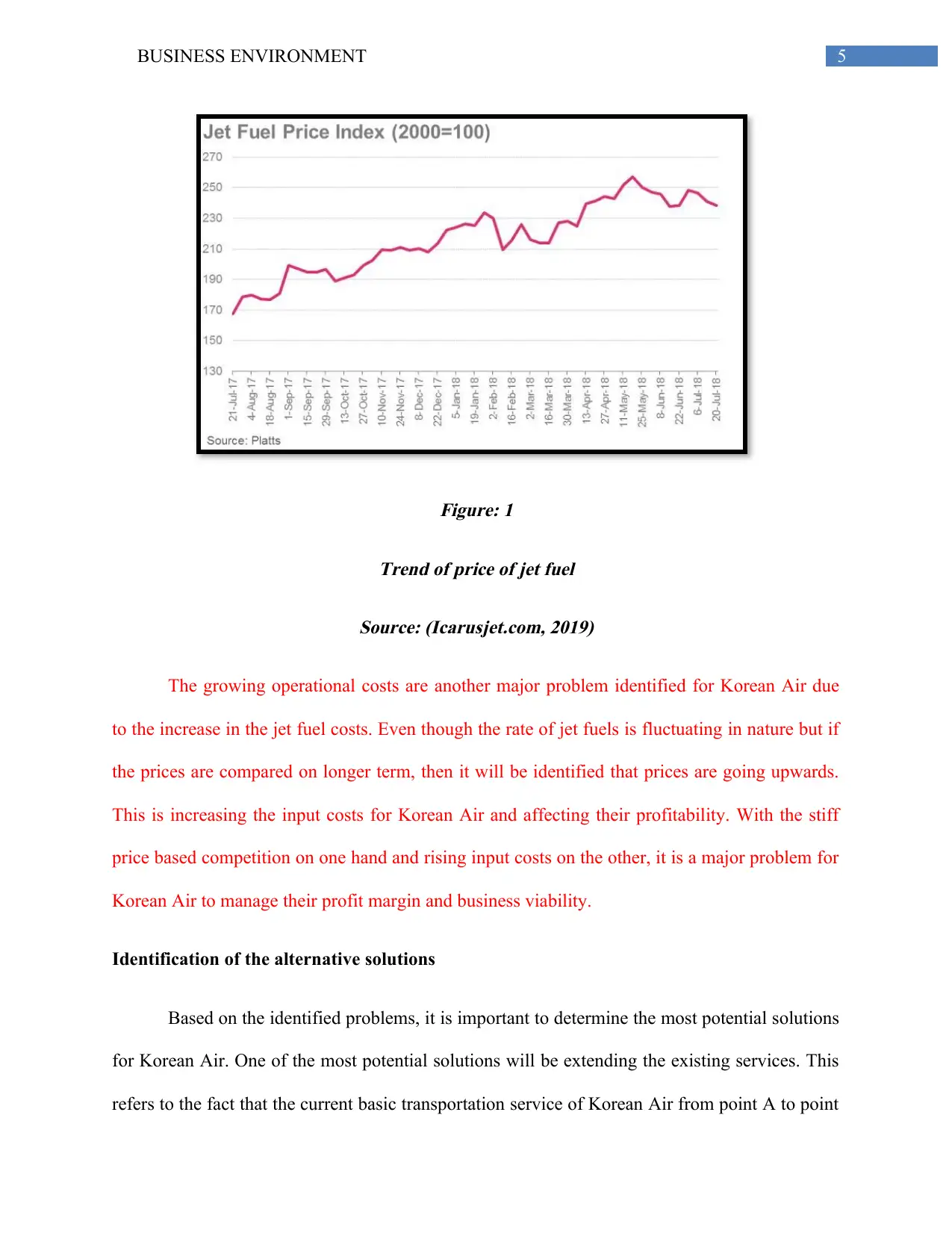
Figure: 1
Trend of price of jet fuel
Source: (Icarusjet.com, 2019)
The growing operational costs are another major problem identified for Korean Air due
to the increase in the jet fuel costs. Even though the rate of jet fuels is fluctuating in nature but if
the prices are compared on longer term, then it will be identified that prices are going upwards.
This is increasing the input costs for Korean Air and affecting their profitability. With the stiff
price based competition on one hand and rising input costs on the other, it is a major problem for
Korean Air to manage their profit margin and business viability.
Identification of the alternative solutions
Based on the identified problems, it is important to determine the most potential solutions
for Korean Air. One of the most potential solutions will be extending the existing services. This
refers to the fact that the current basic transportation service of Korean Air from point A to point
Figure: 1
Trend of price of jet fuel
Source: (Icarusjet.com, 2019)
The growing operational costs are another major problem identified for Korean Air due
to the increase in the jet fuel costs. Even though the rate of jet fuels is fluctuating in nature but if
the prices are compared on longer term, then it will be identified that prices are going upwards.
This is increasing the input costs for Korean Air and affecting their profitability. With the stiff
price based competition on one hand and rising input costs on the other, it is a major problem for
Korean Air to manage their profit margin and business viability.
Identification of the alternative solutions
Based on the identified problems, it is important to determine the most potential solutions
for Korean Air. One of the most potential solutions will be extending the existing services. This
refers to the fact that the current basic transportation service of Korean Air from point A to point
⊘ This is a preview!⊘
Do you want full access?
Subscribe today to unlock all pages.
Trusted by 1+ million students worldwide
6BUSINESS ENVIRONMENT
B should get changed and added services should be involved. For instance, the customers can be
offered to the end mile connectivity and transportation by offering roadways or railways from the
destination airport to the destination point (Kupfer et al., 2017). This will increase the value
proposition for the customers and market attractiveness can also get increased. The added
services should also include the various payment options that refer to the fact that customers
should be offered with more flexible payment options that will find ore value for them along
with ease in transaction process.
The next potential solution will be the market development approach. In this case, the
existing competitive market locations should be replaced by the more potential and less tapped
regions majorly among the emerging economies. This will be more risky affairs due to the
involved uncertainty but will have the maximum potentiality of increasing the market exposure.
Moreover, according to the global financial institutes, developing countries will continue to grow
in higher rate compared to the developed nations in the coming few years (Boonekamp &
Burghouwt, 2017). Thus, it is of great opportunity for Korean Air to adjust the loss of business
by tapping these regions.
Market penetration can be another potential solution for Korean Air in retaining their
market share. This is due to the reason that in the recent time, the introduction of the budget
carriers is also changing the business trend in the cargo sector as well. Thus, in this case, it is
recommended that Korean Air should come up with new sub brand that will offer no frills and
basic transportation services in the most competitive pricing possible. This will attract more
customers and the customers that are still not tapped by the higher price points of the air cargo
services (Rezaei, Hemmes & Tavasszy, 2017). Hence, the target market for Korean Air will get
B should get changed and added services should be involved. For instance, the customers can be
offered to the end mile connectivity and transportation by offering roadways or railways from the
destination airport to the destination point (Kupfer et al., 2017). This will increase the value
proposition for the customers and market attractiveness can also get increased. The added
services should also include the various payment options that refer to the fact that customers
should be offered with more flexible payment options that will find ore value for them along
with ease in transaction process.
The next potential solution will be the market development approach. In this case, the
existing competitive market locations should be replaced by the more potential and less tapped
regions majorly among the emerging economies. This will be more risky affairs due to the
involved uncertainty but will have the maximum potentiality of increasing the market exposure.
Moreover, according to the global financial institutes, developing countries will continue to grow
in higher rate compared to the developed nations in the coming few years (Boonekamp &
Burghouwt, 2017). Thus, it is of great opportunity for Korean Air to adjust the loss of business
by tapping these regions.
Market penetration can be another potential solution for Korean Air in retaining their
market share. This is due to the reason that in the recent time, the introduction of the budget
carriers is also changing the business trend in the cargo sector as well. Thus, in this case, it is
recommended that Korean Air should come up with new sub brand that will offer no frills and
basic transportation services in the most competitive pricing possible. This will attract more
customers and the customers that are still not tapped by the higher price points of the air cargo
services (Rezaei, Hemmes & Tavasszy, 2017). Hence, the target market for Korean Air will get
Paraphrase This Document
Need a fresh take? Get an instant paraphrase of this document with our AI Paraphraser
7BUSINESS ENVIRONMENT
increased by catering to different customer segments across different price levels. The market
share can also be maintained along with the potentiality of gaining the market leadership status.
Evaluation of the alternative solutions
Each of the alternatives discussed in the above section will have positive implications for
Korean Air but the most effective and suitable one should be selected. In terms of the added
service offerings, the major challenge for Korean Air will be to manage the complexities. This is
due to the reason that the more will be the payment options in place and the more will be the
added services, business complexities will get increased for Korean Air. In addition, the added
cost to be incurred for these services might not attract the potential clients. Thus, in terms of
gaining long term viability, this solution will not be effective enough.
The next solution is tapping the emerging economies over the developed economies. This
will help Korean Air to increase their market share in the coming years and tap the most from the
most happening and buzzing regions in the current world. However, this solution might not
fulfill the core problem of Korean Air because focusing more on the emerging economies will
lose the existing customers left in the current market. Thus, the problem of not retaining the
existing customers will still remain with Korean Air. In addition, it should also be noted that
price sensitivity will be more in the developing economies compared to the developed
economies. Thus, Korean Air will face more price war in the emerging economies.
The last solution for Korean Air is to introduce a new budget and no frill cargo service
for the new and emerging customer trends. This will involve cost of investment in the initial
stage but will be effective in meeting their objectives as well mitigate the core problem. This is
due to the reason that with the help of the new sub brand, the existing market segment of Korean
increased by catering to different customer segments across different price levels. The market
share can also be maintained along with the potentiality of gaining the market leadership status.
Evaluation of the alternative solutions
Each of the alternatives discussed in the above section will have positive implications for
Korean Air but the most effective and suitable one should be selected. In terms of the added
service offerings, the major challenge for Korean Air will be to manage the complexities. This is
due to the reason that the more will be the payment options in place and the more will be the
added services, business complexities will get increased for Korean Air. In addition, the added
cost to be incurred for these services might not attract the potential clients. Thus, in terms of
gaining long term viability, this solution will not be effective enough.
The next solution is tapping the emerging economies over the developed economies. This
will help Korean Air to increase their market share in the coming years and tap the most from the
most happening and buzzing regions in the current world. However, this solution might not
fulfill the core problem of Korean Air because focusing more on the emerging economies will
lose the existing customers left in the current market. Thus, the problem of not retaining the
existing customers will still remain with Korean Air. In addition, it should also be noted that
price sensitivity will be more in the developing economies compared to the developed
economies. Thus, Korean Air will face more price war in the emerging economies.
The last solution for Korean Air is to introduce a new budget and no frill cargo service
for the new and emerging customer trends. This will involve cost of investment in the initial
stage but will be effective in meeting their objectives as well mitigate the core problem. This is
due to the reason that with the help of the new sub brand, the existing market segment of Korean
8BUSINESS ENVIRONMENT
Air will get retained as same and new segments can be tapped as well. However, it should also
be noted that introduction of a new sub brand might be challenging in acquiring the market
share. This is due to the reason that the new sub brand will have completely new branding
activities and they should start from the scratch. Hence, the new brand will find it difficult and
challenging in getting the expected market share from the current competitive scenario. In
addition, in introducing a new sub brand, Korean Air will have to invest huge in developing
infrastructure in different destinations. Hence, the investment will be huge, which should be done
only on the assurance of positive return.
Recommendation
Thus, it is recommended that Korean Air should come up with a new sub brand for the
budget cargo carrier service. This will attract the customers who are willing to avail the air cargo
service but cannot due to high cost. Korean Air will have an entire new customer segment to tap
and with addition to their existing customer segments, Korean Air will be able to regain the
maximum market share and gain the market leadership status. On the other hand, it is also
recommended that Korean Air should invest more in the usages of alternative jet fuels. There are
number of examples evident in the current global aviation sector where the airliners are
partnering with the oil and gas entities in developing alternative fuels. Thus, it will help Korean
Air to gain access to the affordable and more efficient jet fuels, which will reduce their current
fuel costs and will contribute in the enhancement of the profit margin.
Air will get retained as same and new segments can be tapped as well. However, it should also
be noted that introduction of a new sub brand might be challenging in acquiring the market
share. This is due to the reason that the new sub brand will have completely new branding
activities and they should start from the scratch. Hence, the new brand will find it difficult and
challenging in getting the expected market share from the current competitive scenario. In
addition, in introducing a new sub brand, Korean Air will have to invest huge in developing
infrastructure in different destinations. Hence, the investment will be huge, which should be done
only on the assurance of positive return.
Recommendation
Thus, it is recommended that Korean Air should come up with a new sub brand for the
budget cargo carrier service. This will attract the customers who are willing to avail the air cargo
service but cannot due to high cost. Korean Air will have an entire new customer segment to tap
and with addition to their existing customer segments, Korean Air will be able to regain the
maximum market share and gain the market leadership status. On the other hand, it is also
recommended that Korean Air should invest more in the usages of alternative jet fuels. There are
number of examples evident in the current global aviation sector where the airliners are
partnering with the oil and gas entities in developing alternative fuels. Thus, it will help Korean
Air to gain access to the affordable and more efficient jet fuels, which will reduce their current
fuel costs and will contribute in the enhancement of the profit margin.
⊘ This is a preview!⊘
Do you want full access?
Subscribe today to unlock all pages.
Trusted by 1+ million students worldwide
9BUSINESS ENVIRONMENT
Reference
Bartlik, M. (2016). The impact of EU law on the regulation of international air transportation.
Routledge.
Boonekamp, T., & Burghouwt, G. (2017). Measuring connectivity in the air freight industry.
Journal of Air Transport Management, 61, 81-94.
Feng, B., Li, Y., & Shen, Z. J. M. (2015). Air cargo operations: Literature review and
comparison with practices. Transportation Research Part C: Emerging Technologies, 56,
263-280.
Fu, X., & Oum, T. H. (2014). Air transport liberalization and its effects on airline competition
and traffic growth–an overview. In The economics of international airline transport (pp.
11-44). Emerald Group Publishing Limited.
Icarusjet.com. (2019). Jet-A rates- The upward trend -. Retrieved 11 October 2019, from
https://www.icarusjet.com/blog/jet-a-rates-the-upward-trend/
Kupfer, F., Meersman, H., Onghena, E., & Van de Voorde, E. (2017). The underlying drivers
and future development of air cargo. Journal of Air Transport Management, 61, 6-14.
May, A., Anslow, A., Wu, Y., Ojiako, U., Chipulu, M., & Marshall, A. (2014). Prioritisation of
performance indicators in air cargo demand management: an insight from industry.
Supply Chain Management: An International Journal, 19(1), 108-113.
Petrescu, R. V., Aversa, R., Akash, B., Corchado, J., Berto, F., Apicella, A., & Petrescu, F. I.
(2017). Some special aircraft. Journal of Aircraft and Spacecraft Technology, 1(3).
Reference
Bartlik, M. (2016). The impact of EU law on the regulation of international air transportation.
Routledge.
Boonekamp, T., & Burghouwt, G. (2017). Measuring connectivity in the air freight industry.
Journal of Air Transport Management, 61, 81-94.
Feng, B., Li, Y., & Shen, Z. J. M. (2015). Air cargo operations: Literature review and
comparison with practices. Transportation Research Part C: Emerging Technologies, 56,
263-280.
Fu, X., & Oum, T. H. (2014). Air transport liberalization and its effects on airline competition
and traffic growth–an overview. In The economics of international airline transport (pp.
11-44). Emerald Group Publishing Limited.
Icarusjet.com. (2019). Jet-A rates- The upward trend -. Retrieved 11 October 2019, from
https://www.icarusjet.com/blog/jet-a-rates-the-upward-trend/
Kupfer, F., Meersman, H., Onghena, E., & Van de Voorde, E. (2017). The underlying drivers
and future development of air cargo. Journal of Air Transport Management, 61, 6-14.
May, A., Anslow, A., Wu, Y., Ojiako, U., Chipulu, M., & Marshall, A. (2014). Prioritisation of
performance indicators in air cargo demand management: an insight from industry.
Supply Chain Management: An International Journal, 19(1), 108-113.
Petrescu, R. V., Aversa, R., Akash, B., Corchado, J., Berto, F., Apicella, A., & Petrescu, F. I.
(2017). Some special aircraft. Journal of Aircraft and Spacecraft Technology, 1(3).
Paraphrase This Document
Need a fresh take? Get an instant paraphrase of this document with our AI Paraphraser
10BUSINESS ENVIRONMENT
Prentice, B. E., & Knotts, R. (2014). Cargo airships: international competition. Journal of
Transportation Technologies, 4(3), 187-195.
Rezaei, J., Hemmes, A., & Tavasszy, L. (2017). Multi-criteria decision-making for complex
bundling configurations in surface transportation of air freight. Journal of Air Transport
Management, 61, 95-105.
Shiao, G. C., & Hwang, C. C. (2013). Analyzing competition of international air cargo carriers in
the Asian general air cargo markets. Transport Policy, 27, 164-170.
Sowers, E., Ciccantell, P. S., & Smith, D. A. (2014). Comparing critical capitalist commodity
chains in the early twenty-first century: opportunities for and constraints on labor and
political movements. Journal of World-Systems Research, 20(1), 112-139.
Wang, J., Bonilla, D., & Banister, D. (2016). Air deregulation in China and its impact on airline
competition 1994–2012. Journal of Transport Geography, 50, 12-23.
Xu, B. (2016). Disturbance observer-based dynamic surface control of transport aircraft with
continuous heavy cargo airdrop. IEEE Transactions on Systems, Man, and Cybernetics:
Systems, 47(1), 161-170.
Prentice, B. E., & Knotts, R. (2014). Cargo airships: international competition. Journal of
Transportation Technologies, 4(3), 187-195.
Rezaei, J., Hemmes, A., & Tavasszy, L. (2017). Multi-criteria decision-making for complex
bundling configurations in surface transportation of air freight. Journal of Air Transport
Management, 61, 95-105.
Shiao, G. C., & Hwang, C. C. (2013). Analyzing competition of international air cargo carriers in
the Asian general air cargo markets. Transport Policy, 27, 164-170.
Sowers, E., Ciccantell, P. S., & Smith, D. A. (2014). Comparing critical capitalist commodity
chains in the early twenty-first century: opportunities for and constraints on labor and
political movements. Journal of World-Systems Research, 20(1), 112-139.
Wang, J., Bonilla, D., & Banister, D. (2016). Air deregulation in China and its impact on airline
competition 1994–2012. Journal of Transport Geography, 50, 12-23.
Xu, B. (2016). Disturbance observer-based dynamic surface control of transport aircraft with
continuous heavy cargo airdrop. IEEE Transactions on Systems, Man, and Cybernetics:
Systems, 47(1), 161-170.

1 out of 11


Related Documents


Your All-in-One AI-Powered Toolkit for Academic Success.
+13062052269
info@desklib.com
Available 24*7 on WhatsApp / Email
![[object Object]](/_next/static/media/star-bottom.7253800d.svg)
Unlock your academic potential
Copyright © 2020–2026 A2Z Services. All Rights Reserved. Developed and managed by ZUCOL.