University Essay: Examining Kuno's Role as a Hero in The Machine Stops

Verified

Added on  2023/01/12

|5
|1016
|69
Essay
AI Summary
This essay examines the character of Kuno in E.M. Forster's short story, "The Machine Stops," and argues for his heroic role within the dystopian narrative. The essay begins by defining the concept of a hero, contrasting classical and modern interpretations. It then analyzes Kuno's actions and motivations, particularly his desire to escape the control of the Machine and his influence on his mother, Vashti. The essay highlights how Kuno challenges the established order and ultimately inspires Vashti to question the Machine's dominance, which is central to the story's warning about the dangers of technology. The analysis is supported by references to secondary sources and direct quotes from the story, demonstrating how Kuno's actions drive the plot and contribute to the story's thematic concerns about the relationship between humanity and technology. Ultimately, the essay concludes that Kuno functions as a hero by prompting change and advocating for a return to a more natural way of life.
Document Page
Running head: THE MACHINE STOPS
The Machine Stops
Name of the Student
Name of the University
Author Note
tabler-icon-diamond-filled.svg

Paraphrase This Document

Need a fresh take? Get an instant paraphrase of this document with our AI Paraphraser
Document Page
1THE MACHINE STOPS
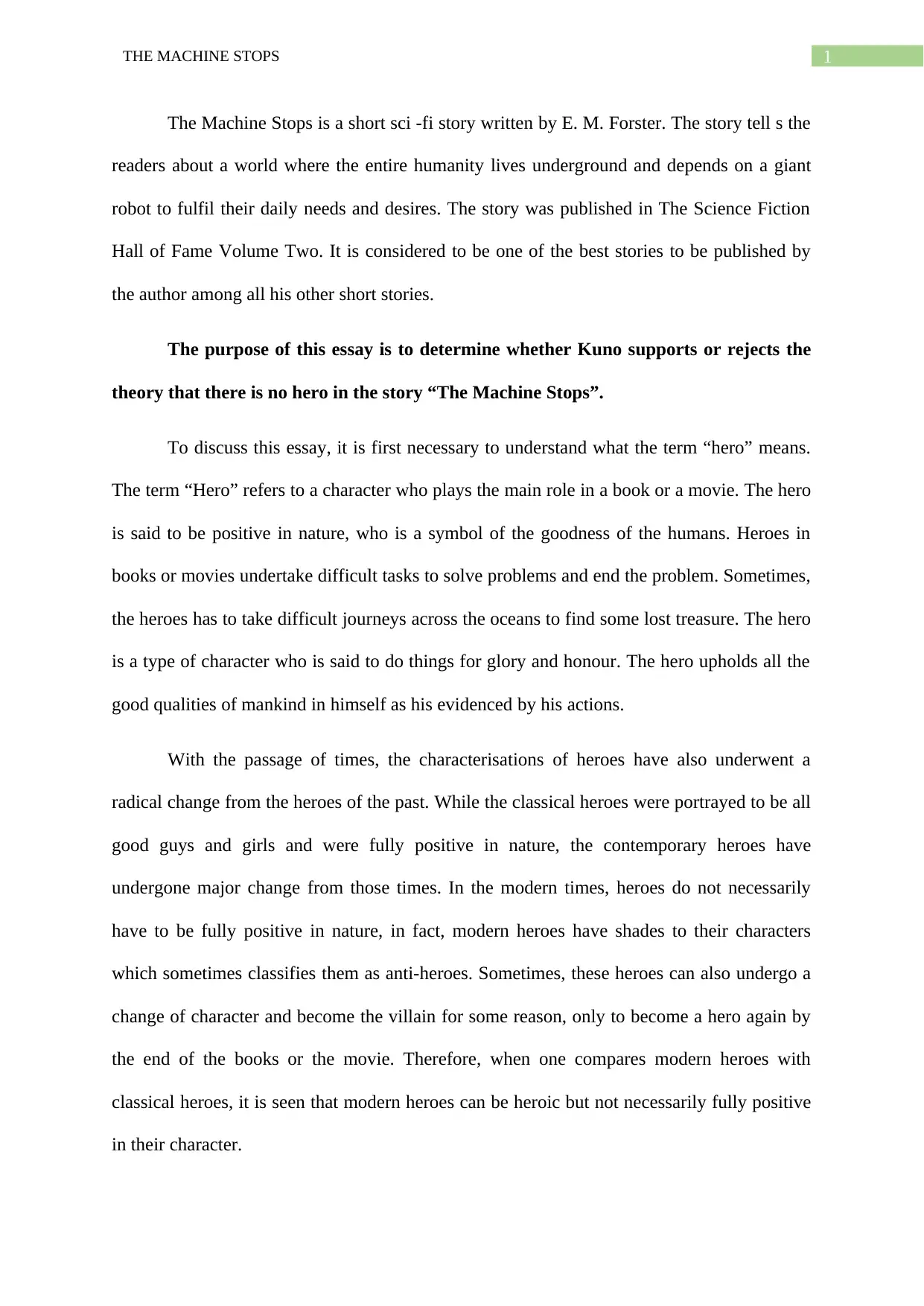
The Machine Stops is a short sci -fi story written by E. M. Forster. The story tell s the
readers about a world where the entire humanity lives underground and depends on a giant
robot to fulfil their daily needs and desires. The story was published in The Science Fiction
Hall of Fame Volume Two. It is considered to be one of the best stories to be published by
the author among all his other short stories.
The purpose of this essay is to determine whether Kuno supports or rejects the
theory that there is no hero in the story “The Machine Stops”.
To discuss this essay, it is first necessary to understand what the term “hero” means.
The term “Hero” refers to a character who plays the main role in a book or a movie. The hero
is said to be positive in nature, who is a symbol of the goodness of the humans. Heroes in
books or movies undertake difficult tasks to solve problems and end the problem. Sometimes,
the heroes has to take difficult journeys across the oceans to find some lost treasure. The hero
is a type of character who is said to do things for glory and honour. The hero upholds all the
good qualities of mankind in himself as his evidenced by his actions.
With the passage of times, the characterisations of heroes have also underwent a
radical change from the heroes of the past. While the classical heroes were portrayed to be all
good guys and girls and were fully positive in nature, the contemporary heroes have
undergone major change from those times. In the modern times, heroes do not necessarily
have to be fully positive in nature, in fact, modern heroes have shades to their characters
which sometimes classifies them as anti-heroes. Sometimes, these heroes can also undergo a
change of character and become the villain for some reason, only to become a hero again by
the end of the books or the movie. Therefore, when one compares modern heroes with
classical heroes, it is seen that modern heroes can be heroic but not necessarily fully positive
in their character.
Document Page
2THE MACHINE STOPS
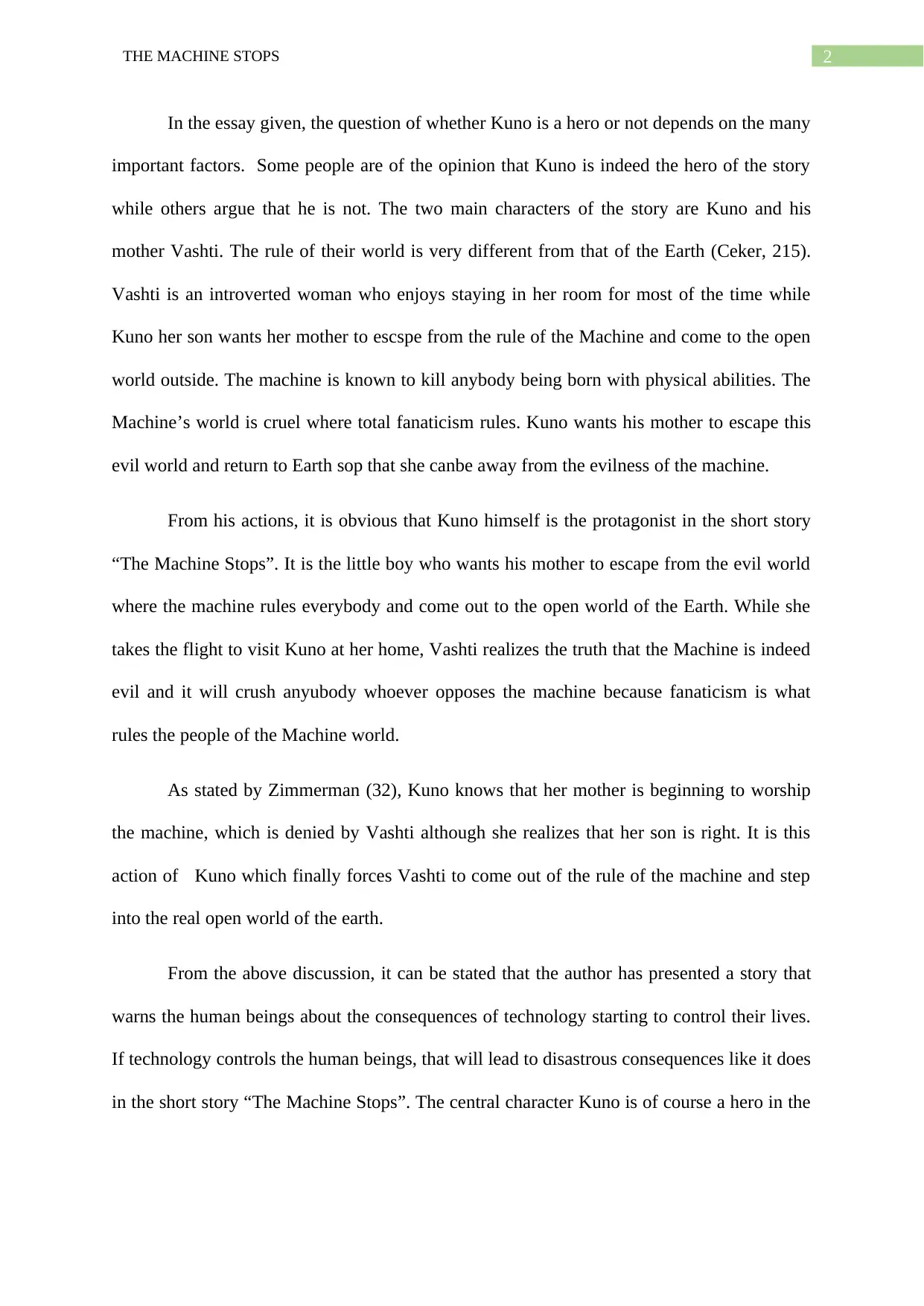
In the essay given, the question of whether Kuno is a hero or not depends on the many
important factors. Some people are of the opinion that Kuno is indeed the hero of the story
while others argue that he is not. The two main characters of the story are Kuno and his
mother Vashti. The rule of their world is very different from that of the Earth (Ceker, 215).
Vashti is an introverted woman who enjoys staying in her room for most of the time while
Kuno her son wants her mother to escspe from the rule of the Machine and come to the open
world outside. The machine is known to kill anybody being born with physical abilities. The
Machine’s world is cruel where total fanaticism rules. Kuno wants his mother to escape this
evil world and return to Earth sop that she canbe away from the evilness of the machine.
From his actions, it is obvious that Kuno himself is the protagonist in the short story
“The Machine Stops”. It is the little boy who wants his mother to escape from the evil world
where the machine rules everybody and come out to the open world of the Earth. While she
takes the flight to visit Kuno at her home, Vashti realizes the truth that the Machine is indeed
evil and it will crush anyubody whoever opposes the machine because fanaticism is what
rules the people of the Machine world.
As stated by Zimmerman (32), Kuno knows that her mother is beginning to worship
the machine, which is denied by Vashti although she realizes that her son is right. It is this
action of Kuno which finally forces Vashti to come out of the rule of the machine and step
into the real open world of the earth.
From the above discussion, it can be stated that the author has presented a story that
warns the human beings about the consequences of technology starting to control their lives.
If technology controls the human beings, that will lead to disastrous consequences like it does
in the short story “The Machine Stops”. The central character Kuno is of course a hero in the
Document Page
3THE MACHINE STOPS
story as it is Kuno himself who finally makes his mother understand the evilness of the
machine and motivates her to come out in the open world of the Earth itself (Ceker, 215).
tabler-icon-diamond-filled.svg

Paraphrase This Document

Need a fresh take? Get an instant paraphrase of this document with our AI Paraphraser
Document Page
4THE MACHINE STOPS
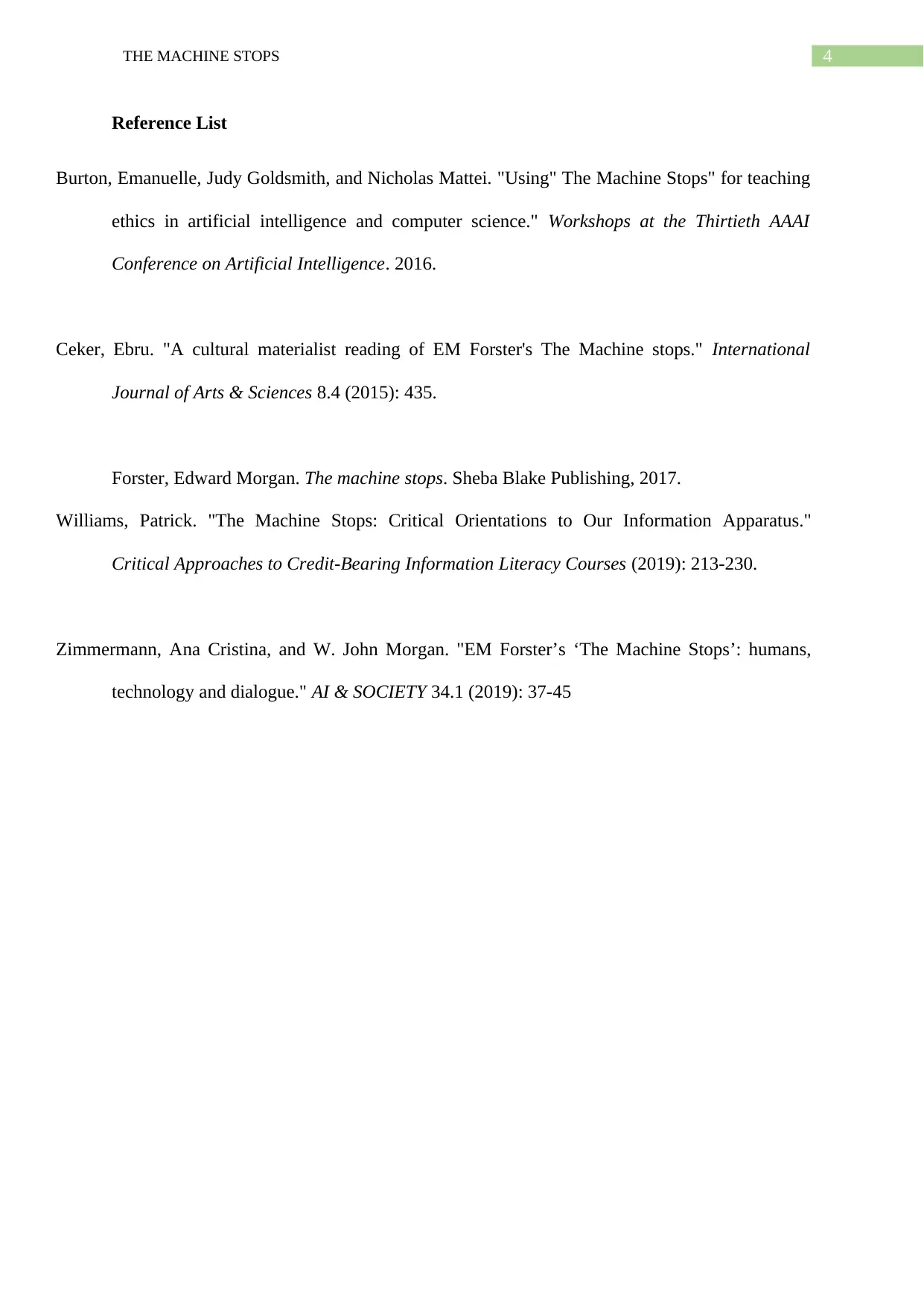
Reference List
Burton, Emanuelle, Judy Goldsmith, and Nicholas Mattei. "Using" The Machine Stops" for teaching
ethics in artificial intelligence and computer science." Workshops at the Thirtieth AAAI
Conference on Artificial Intelligence. 2016.
Ceker, Ebru. "A cultural materialist reading of EM Forster's The Machine stops." International
Journal of Arts & Sciences 8.4 (2015): 435.
Forster, Edward Morgan. The machine stops. Sheba Blake Publishing, 2017.
Williams, Patrick. "The Machine Stops: Critical Orientations to Our Information Apparatus."
Critical Approaches to Credit-Bearing Information Literacy Courses (2019): 213-230.
Zimmermann, Ana Cristina, and W. John Morgan. "EM Forster’s ‘The Machine Stops’: humans,
technology and dialogue." AI & SOCIETY 34.1 (2019): 37-45
chevron_up_icon
1 out of 5
circle_padding
hide_on_mobile
zoom_out_icon
[object Object]