Evaluating Tap and Bottled Water Quality in Kuwait: A Detailed Report
VerifiedAdded on  2023/04/25
|6
|1102
|132
Report
AI Summary
This report examines water resources in Kuwait, focusing on the production of potable water through desalination and blending processes. It identifies problems encountered during production, storage, and distribution, including chemical residues and physicochemical contaminants. The report assesses the quality of tap water against WHO, KEPA, and EPA standards, considering physical and chemical parameters. It also compares the quality of bottled water samples, highlighting differences in ion composition and potential contamination sources. Health concerns related to trace elements in bottled water are discussed, emphasizing the need for monitoring and control. The document concludes by referencing key studies on water quality in Kuwait.
WATER RESOURCES 1
WATER RESOURCES
Student Name
Student Number
Professor’s Name
University Name
Date of Submission
WATER RESOURCES
Student Name
Student Number
Professor’s Name
University Name
Date of Submission
Paraphrase This Document
Need a fresh take? Get an instant paraphrase of this document with our AI Paraphraser

WATER RESOURCES 2
Part 1: The Process of Production of Water in Kuwait
Kuwait is a state located in a dry area with little access to fresh water. It also lacks
adequate rainfall and sufficient distribution of rivers and lakes. Similarly, underground water is
insufficient and it is for this reason that the state rely on seawater as a source of potable water.
The process of production begins with desalination through multistage flash (MSF) plants. This
water is then mixed with brackish water (5-10%) producing a blend. This blend of water is then
fed into the treatment plant consisting of chlorination and pumping mechanism. Chlorination
involves adding chlorine to kill harmful organisms like bacteria. Additionally, caustic soda is
added to the disinfected water to maintain pH to slightly about 8.0 which correlates to the
international standards. The pumping system directs water into a distribution plant which
consists of underground reservoirs, pipelines, elevated storage tanks, filling stations and
pipelines. Road tankers obtain water from the filling stations and distribute water in areas not
connected with the pipeline network (Al-Ruwaih, Alhumoud, and Al-Mutairi, 2019).
Problems Encountered During the Production, Storage and Distribution
During the distillation process, water contains little supply of mineral and organic making
it chemically aggressive. It is in this process that a red brown rust, ferric hydroxide is produced.
This compound produces the red-brown color in water flowing in iron pipes. As opposed to
disinfecting the water, the process of water production release chemical residues known as
disinfection by-products. They are produced when organic and inorganic compounds present in
water react with the disinfectant. Disinfection plants utilizing ozone are known to produce
bromate, nitriles, ketones and aldehydes (Humood F. Al-mudhaf, 2019.
Part 1: The Process of Production of Water in Kuwait
Kuwait is a state located in a dry area with little access to fresh water. It also lacks
adequate rainfall and sufficient distribution of rivers and lakes. Similarly, underground water is
insufficient and it is for this reason that the state rely on seawater as a source of potable water.
The process of production begins with desalination through multistage flash (MSF) plants. This
water is then mixed with brackish water (5-10%) producing a blend. This blend of water is then
fed into the treatment plant consisting of chlorination and pumping mechanism. Chlorination
involves adding chlorine to kill harmful organisms like bacteria. Additionally, caustic soda is
added to the disinfected water to maintain pH to slightly about 8.0 which correlates to the
international standards. The pumping system directs water into a distribution plant which
consists of underground reservoirs, pipelines, elevated storage tanks, filling stations and
pipelines. Road tankers obtain water from the filling stations and distribute water in areas not
connected with the pipeline network (Al-Ruwaih, Alhumoud, and Al-Mutairi, 2019).
Problems Encountered During the Production, Storage and Distribution
During the distillation process, water contains little supply of mineral and organic making
it chemically aggressive. It is in this process that a red brown rust, ferric hydroxide is produced.
This compound produces the red-brown color in water flowing in iron pipes. As opposed to
disinfecting the water, the process of water production release chemical residues known as
disinfection by-products. They are produced when organic and inorganic compounds present in
water react with the disinfectant. Disinfection plants utilizing ozone are known to produce
bromate, nitriles, ketones and aldehydes (Humood F. Al-mudhaf, 2019.

WATER RESOURCES 3
During the storage and distribution process, the major problem encountered are the
physicochemical contaminants. These contaminants develop as the produced water come into
contact with the storage and transport facilities. A majority of the reported contaminants in
Kuwait were located on the points of consumption. In these points lead is a major contaminant
arising from the water coolers and from male and female fingernails (Humood F. Al-mudhaf,
2019).
Quality of Tap Water With Reference To WHO, KEPA and EPA Standards
First, the physical parameters to be attained are pH, electrical conductivity and total
dissolved solids. The pH of the tap water should range from 6.5-8.5 according to WHO
guidelines. Total dissolved solids should not be more than 500 mg/L as dictated by USEPA
standards. However, there is no minimum value for electrical conductivity (Humood F. Al-
mudhaf, 2019).
Chemical parameters for tap water is the concentrations of anions and cations. Ca2+, Mg2+,
Na+, and K+ are major cations. The agreed value for Ca2+ as required by WHO is 200 mg/l. 50
mg/l is required for Mg2+ by WHO guidelines. KUEPA requires K+ to have a concentration of 10
mg/l while WHO requires a concentration of 12 mg/l. The major anions are Cl-, F- , Br- , SO42-
and NO32-. Cl- is required to have a concentration of 200 mg/l required by WHO. The
concentration for F- should be below 1.5 mg/l outlined in the WHO health guidelines. The
concentration for sulfate should be 250 mg/l as required by WHO standards. The KUEPA and
WHO guidelines have provided a concentration of 50 mg/l for nitrates (Humood F. Al-mudhaf,
2019).
During the storage and distribution process, the major problem encountered are the
physicochemical contaminants. These contaminants develop as the produced water come into
contact with the storage and transport facilities. A majority of the reported contaminants in
Kuwait were located on the points of consumption. In these points lead is a major contaminant
arising from the water coolers and from male and female fingernails (Humood F. Al-mudhaf,
2019).
Quality of Tap Water With Reference To WHO, KEPA and EPA Standards
First, the physical parameters to be attained are pH, electrical conductivity and total
dissolved solids. The pH of the tap water should range from 6.5-8.5 according to WHO
guidelines. Total dissolved solids should not be more than 500 mg/L as dictated by USEPA
standards. However, there is no minimum value for electrical conductivity (Humood F. Al-
mudhaf, 2019).
Chemical parameters for tap water is the concentrations of anions and cations. Ca2+, Mg2+,
Na+, and K+ are major cations. The agreed value for Ca2+ as required by WHO is 200 mg/l. 50
mg/l is required for Mg2+ by WHO guidelines. KUEPA requires K+ to have a concentration of 10
mg/l while WHO requires a concentration of 12 mg/l. The major anions are Cl-, F- , Br- , SO42-
and NO32-. Cl- is required to have a concentration of 200 mg/l required by WHO. The
concentration for F- should be below 1.5 mg/l outlined in the WHO health guidelines. The
concentration for sulfate should be 250 mg/l as required by WHO standards. The KUEPA and
WHO guidelines have provided a concentration of 50 mg/l for nitrates (Humood F. Al-mudhaf,
2019).
⊘ This is a preview!⊘
Do you want full access?
Subscribe today to unlock all pages.

Trusted by 1+ million students worldwide

WATER RESOURCES 4
Part 2: Quality of Bottled Water
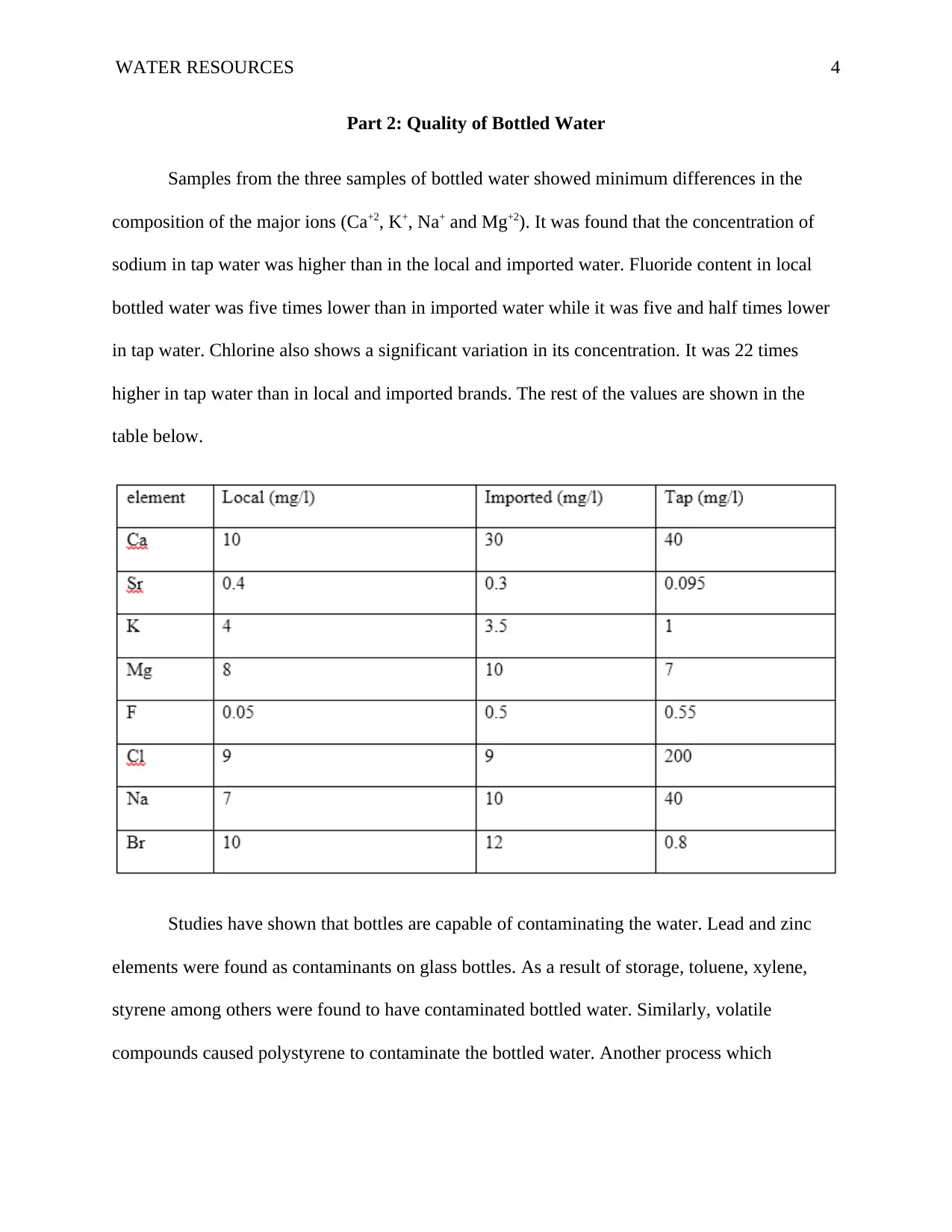
Samples from the three samples of bottled water showed minimum differences in the
composition of the major ions (Ca+2, K+, Na+ and Mg+2). It was found that the concentration of
sodium in tap water was higher than in the local and imported water. Fluoride content in local
bottled water was five times lower than in imported water while it was five and half times lower
in tap water. Chlorine also shows a significant variation in its concentration. It was 22 times
higher in tap water than in local and imported brands. The rest of the values are shown in the
table below.
Studies have shown that bottles are capable of contaminating the water. Lead and zinc
elements were found as contaminants on glass bottles. As a result of storage, toluene, xylene,
styrene among others were found to have contaminated bottled water. Similarly, volatile
compounds caused polystyrene to contaminate the bottled water. Another process which
Part 2: Quality of Bottled Water
Samples from the three samples of bottled water showed minimum differences in the
composition of the major ions (Ca+2, K+, Na+ and Mg+2). It was found that the concentration of
sodium in tap water was higher than in the local and imported water. Fluoride content in local
bottled water was five times lower than in imported water while it was five and half times lower
in tap water. Chlorine also shows a significant variation in its concentration. It was 22 times
higher in tap water than in local and imported brands. The rest of the values are shown in the
table below.
Studies have shown that bottles are capable of contaminating the water. Lead and zinc
elements were found as contaminants on glass bottles. As a result of storage, toluene, xylene,
styrene among others were found to have contaminated bottled water. Similarly, volatile
compounds caused polystyrene to contaminate the bottled water. Another process which
Paraphrase This Document
Need a fresh take? Get an instant paraphrase of this document with our AI Paraphraser

WATER RESOURCES 5
contributed to contamination was adsorption on the wall of the bottle (Alsulaili, Al-Harbi and
Al-Tawari, 2019).
Health Concerns
The presence of trace elements in the bottled water pose serious health problems to the
consumers. These elements introduce chronic diseases to the consumers. Some of these diseases
are kidney disorders, heart diseases, diseases of the nervous system and different types of cancer.
Nevertheless, large concentration of trace elements like Zn, As, and B enter water as a result of
flow through natural geological features. In order to protect the health of the population, proper
monitoring and control of these elements must be ensured (Alsulaili, Al-Harbi and Al-Tawari,
2019).
contributed to contamination was adsorption on the wall of the bottle (Alsulaili, Al-Harbi and
Al-Tawari, 2019).
Health Concerns
The presence of trace elements in the bottled water pose serious health problems to the
consumers. These elements introduce chronic diseases to the consumers. Some of these diseases
are kidney disorders, heart diseases, diseases of the nervous system and different types of cancer.
Nevertheless, large concentration of trace elements like Zn, As, and B enter water as a result of
flow through natural geological features. In order to protect the health of the population, proper
monitoring and control of these elements must be ensured (Alsulaili, Al-Harbi and Al-Tawari,
2019).

WATER RESOURCES 6
References
Al-Ruwaih, F., Alhumoud, J. and Al-Mutairi, S. (2019). Quality of potable water in Kuwait.
[online] Cabdirect.org. Available at:
https://www.cabdirect.org/cabdirect/abstract/20103256834 [Accessed 8 Mar. 2019].
Alsulaili, A., Al-Harbi, M. and Al-Tawari, K. (2019). Physical and chemical characteristics of
drinking water quality in Kuwait: tap vs. bottled water. [online] Kuwaitjournals.org.
Available at: http://kuwaitjournals.org/jer/index.php/JER/article/view/346 [Accessed 8
Mar. 2019].
Humood F. Al-mudhaf, M. (2019). Overview of the Chemical Content of Household (Tap)
Drinking Water Quality in the State of Kuwait. [online] Citeseerx.ist.psu.edu. Available
at: http://citeseerx.ist.psu.edu/viewdoc/summary?doi=10.1.1.302.3287 [Accessed 8 Mar.
2019].
References
Al-Ruwaih, F., Alhumoud, J. and Al-Mutairi, S. (2019). Quality of potable water in Kuwait.
[online] Cabdirect.org. Available at:
https://www.cabdirect.org/cabdirect/abstract/20103256834 [Accessed 8 Mar. 2019].
Alsulaili, A., Al-Harbi, M. and Al-Tawari, K. (2019). Physical and chemical characteristics of
drinking water quality in Kuwait: tap vs. bottled water. [online] Kuwaitjournals.org.
Available at: http://kuwaitjournals.org/jer/index.php/JER/article/view/346 [Accessed 8
Mar. 2019].
Humood F. Al-mudhaf, M. (2019). Overview of the Chemical Content of Household (Tap)
Drinking Water Quality in the State of Kuwait. [online] Citeseerx.ist.psu.edu. Available
at: http://citeseerx.ist.psu.edu/viewdoc/summary?doi=10.1.1.302.3287 [Accessed 8 Mar.
2019].
⊘ This is a preview!⊘
Do you want full access?
Subscribe today to unlock all pages.

Trusted by 1+ million students worldwide
1 out of 6
Your All-in-One AI-Powered Toolkit for Academic Success.
 +13062052269
info@desklib.com
Available 24*7 on WhatsApp / Email
Unlock your academic potential
Copyright © 2020–2025 A2Z Services. All Rights Reserved. Developed and managed by ZUCOL.