Detailed Analysis of Renaissance Art: Lamentation of Christ Painting

Verified

Added on  2021/04/24

|4
|817
|30
Essay
AI Summary
This essay provides an in-depth analysis of Rogier van der Weyden's 'Lamentation of Christ,' a significant work of Renaissance art. The analysis covers the painting's historical context, artistic techniques, and symbolic meaning. It examines the composition, the use of color, and the emotional impact of the figures depicted, including Christ, Mary, and other key characters. The essay highlights the influence of earlier Renaissance painters, the use of oil painting, and the symbolism of various colors, such as red, white, and blue. It explores the painting's setting, the expressions of the figures, and the overall depiction of anguish and lamenting. The essay also discusses the artist's influences and the painting's role in the early Netherlandish art style, drawing on references to provide a comprehensive understanding of the artwork's significance.
Document Page
Running head: RENAISSANCE ART
RENAISSANCE ART
Name of the student:
Name of University:
Author Note:
tabler-icon-diamond-filled.svg

Paraphrase This Document

Need a fresh take? Get an instant paraphrase of this document with our AI Paraphraser
Document Page
1RENAISSANCE ART
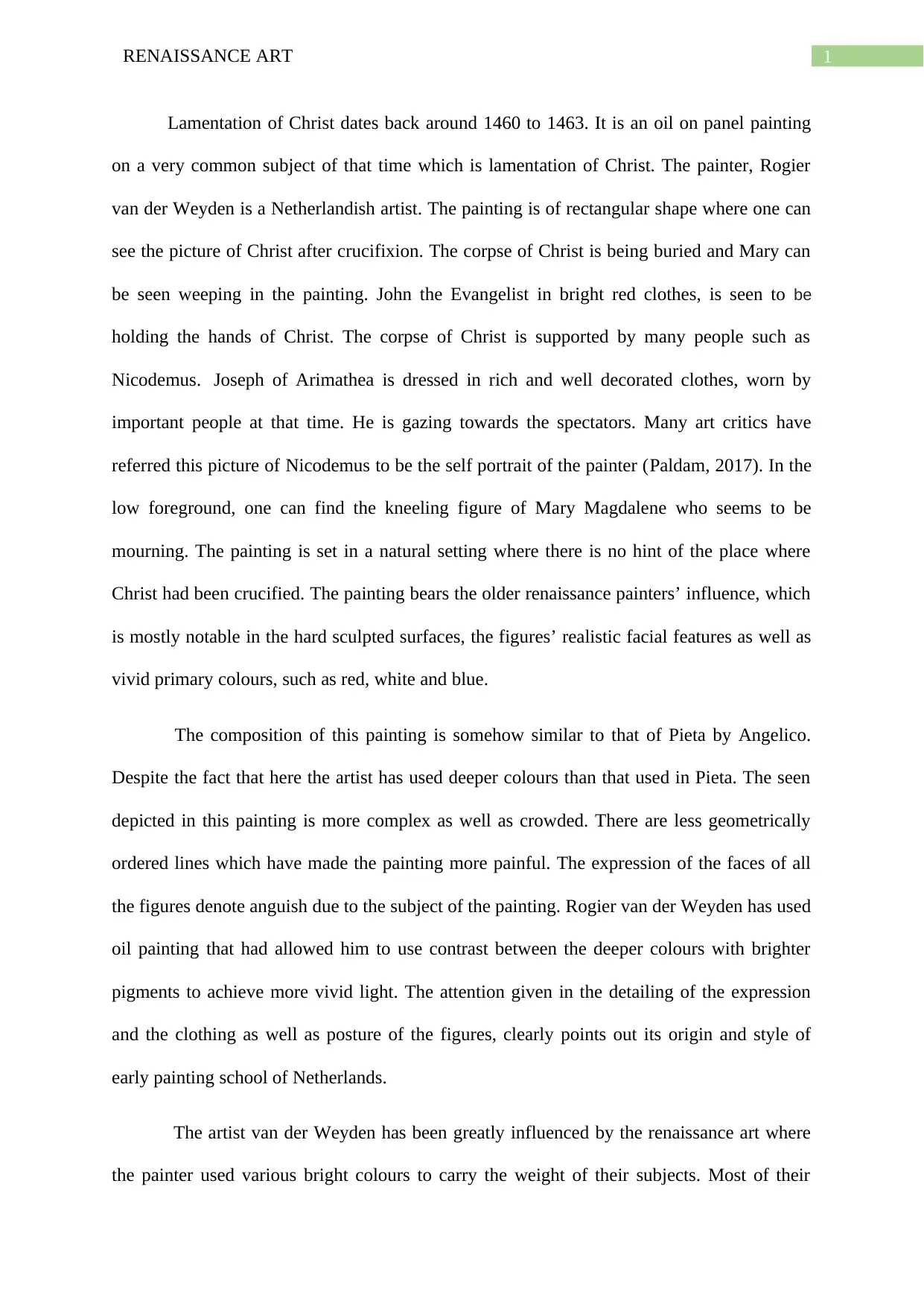
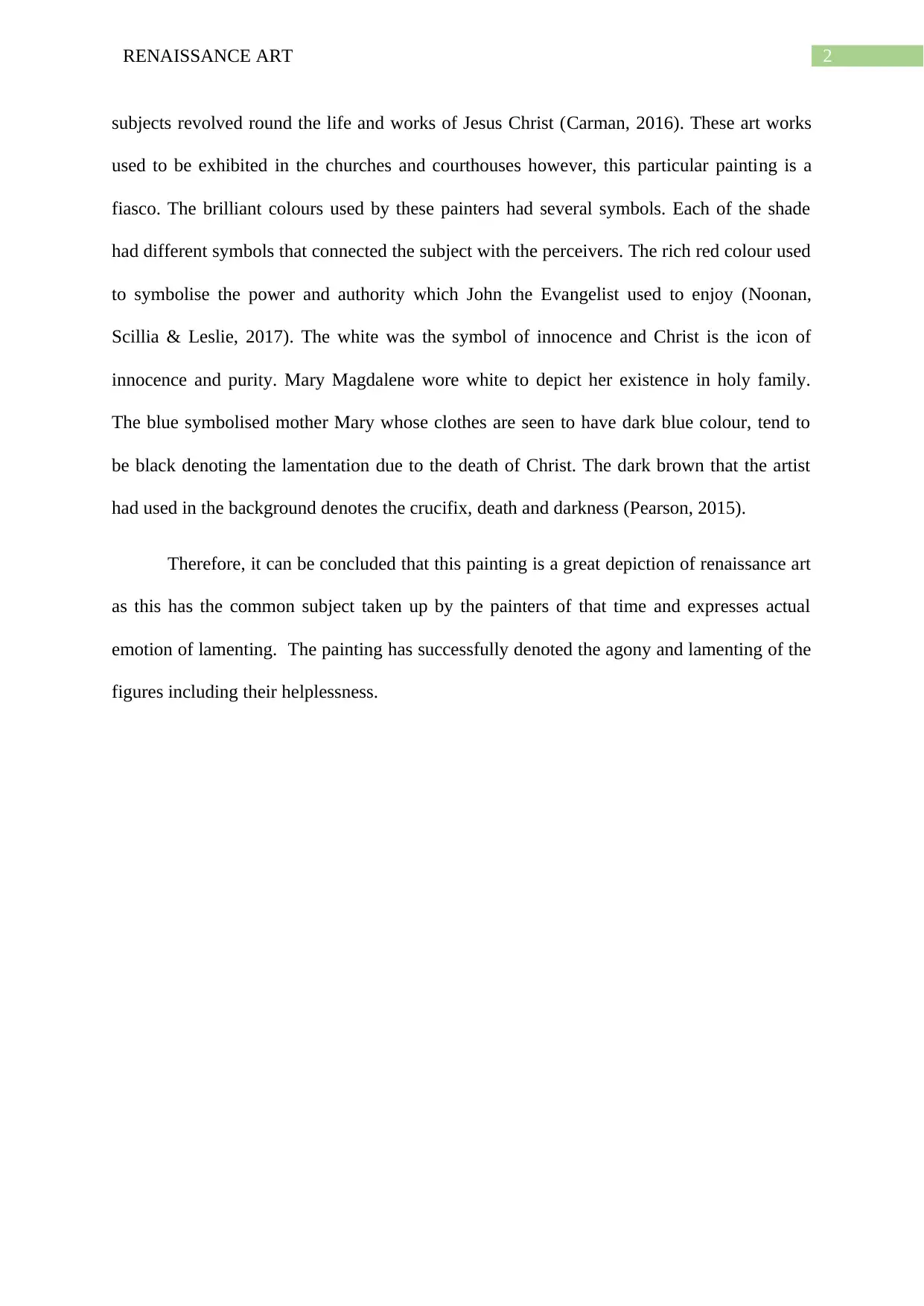
Lamentation of Christ dates back around 1460 to 1463. It is an oil on panel painting
on a very common subject of that time which is lamentation of Christ. The painter, Rogier
van der Weyden is a Netherlandish artist. The painting is of rectangular shape where one can
see the picture of Christ after crucifixion. The corpse of Christ is being buried and Mary can
be seen weeping in the painting. John the Evangelist in bright red clothes, is seen to be
holding the hands of Christ. The corpse of Christ is supported by many people such as
Nicodemus. Joseph of Arimathea is dressed in rich and well decorated clothes, worn by
important people at that time. He is gazing towards the spectators. Many art critics have
referred this picture of Nicodemus to be the self portrait of the painter (Paldam, 2017). In the
low foreground, one can find the kneeling figure of Mary Magdalene who seems to be
mourning. The painting is set in a natural setting where there is no hint of the place where
Christ had been crucified. The painting bears the older renaissance painters’ influence, which
is mostly notable in the hard sculpted surfaces, the figures’ realistic facial features as well as
vivid primary colours, such as red, white and blue.
The composition of this painting is somehow similar to that of Pieta by Angelico.
Despite the fact that here the artist has used deeper colours than that used in Pieta. The seen
depicted in this painting is more complex as well as crowded. There are less geometrically
ordered lines which have made the painting more painful. The expression of the faces of all
the figures denote anguish due to the subject of the painting. Rogier van der Weyden has used
oil painting that had allowed him to use contrast between the deeper colours with brighter
pigments to achieve more vivid light. The attention given in the detailing of the expression
and the clothing as well as posture of the figures, clearly points out its origin and style of
early painting school of Netherlands.
The artist van der Weyden has been greatly influenced by the renaissance art where
the painter used various bright colours to carry the weight of their subjects. Most of their
Document Page
2RENAISSANCE ART
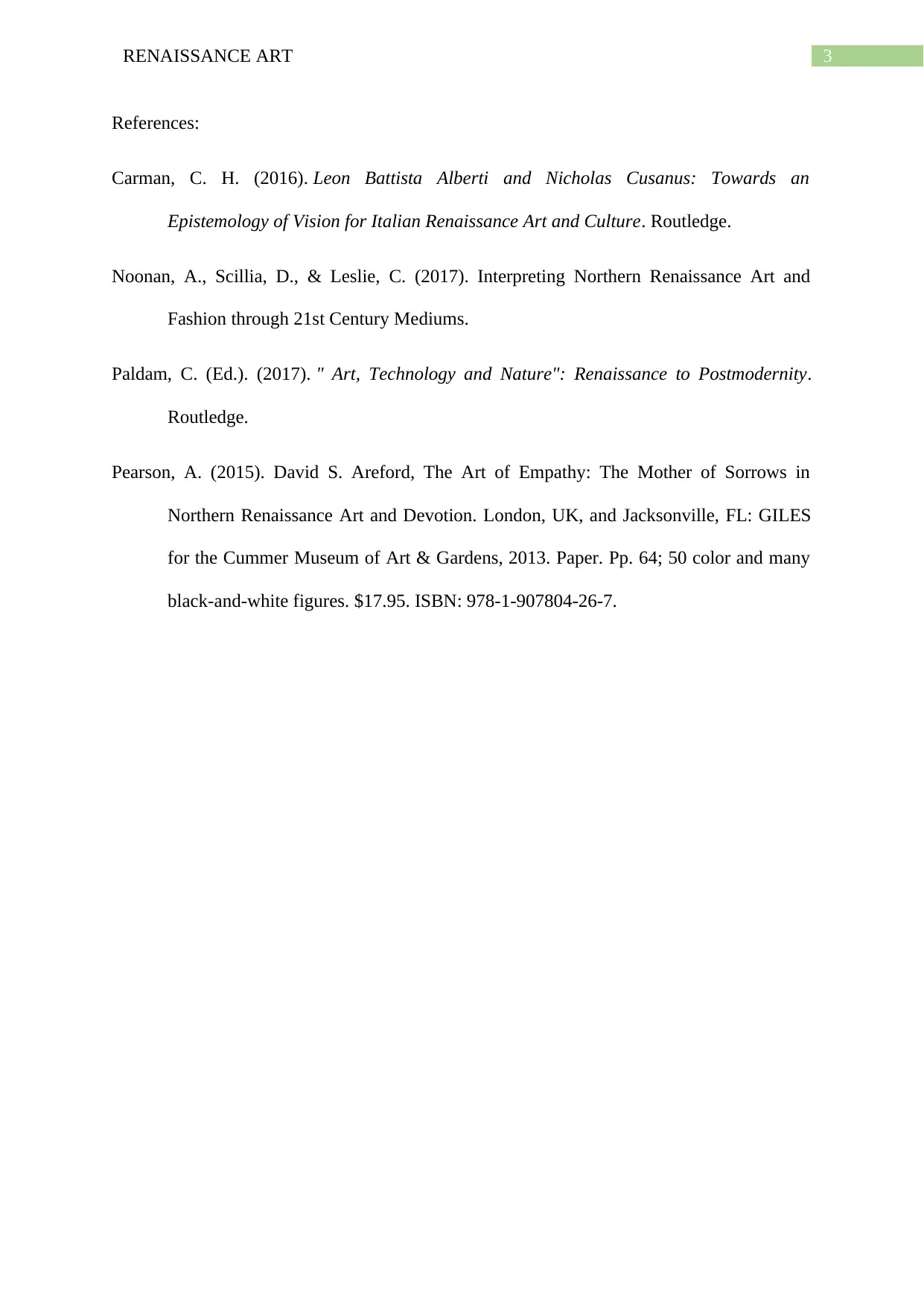
subjects revolved round the life and works of Jesus Christ (Carman, 2016). These art works
used to be exhibited in the churches and courthouses however, this particular painting is a
fiasco. The brilliant colours used by these painters had several symbols. Each of the shade
had different symbols that connected the subject with the perceivers. The rich red colour used
to symbolise the power and authority which John the Evangelist used to enjoy (Noonan,
Scillia & Leslie, 2017). The white was the symbol of innocence and Christ is the icon of
innocence and purity. Mary Magdalene wore white to depict her existence in holy family.
The blue symbolised mother Mary whose clothes are seen to have dark blue colour, tend to
be black denoting the lamentation due to the death of Christ. The dark brown that the artist
had used in the background denotes the crucifix, death and darkness (Pearson, 2015).
Therefore, it can be concluded that this painting is a great depiction of renaissance art
as this has the common subject taken up by the painters of that time and expresses actual
emotion of lamenting. The painting has successfully denoted the agony and lamenting of the
figures including their helplessness.
Document Page
3RENAISSANCE ART
References:
Carman, C. H. (2016). Leon Battista Alberti and Nicholas Cusanus: Towards an
Epistemology of Vision for Italian Renaissance Art and Culture. Routledge.
Noonan, A., Scillia, D., & Leslie, C. (2017). Interpreting Northern Renaissance Art and
Fashion through 21st Century Mediums.
Paldam, C. (Ed.). (2017). " Art, Technology and Nature": Renaissance to Postmodernity.
Routledge.
Pearson, A. (2015). David S. Areford, The Art of Empathy: The Mother of Sorrows in
Northern Renaissance Art and Devotion. London, UK, and Jacksonville, FL: GILES
for the Cummer Museum of Art & Gardens, 2013. Paper. Pp. 64; 50 color and many
black-and-white figures. $17.95. ISBN: 978-1-907804-26-7.
chevron_up_icon
1 out of 4
circle_padding
hide_on_mobile
zoom_out_icon
[object Object]