Networking Fundamentals: Designing and Implementing a New LAN Plan
VerifiedAdded on 2023/06/12
|8
|2229
|137
Report
AI Summary
This report delves into networking fundamentals crucial for designing and implementing a Local Area Network (LAN) for a company. It begins with an introduction to networking protocols and standards, including the OSI reference model and layered architecture. The report compares the OSI, TCP/IP, and DoD network models, highlighting their layers and functions. It discusses various transmission media like twisted pair, coaxial cable, fiber optic cable, and wireless networks, evaluating their advantages and disadvantages. Finally, it differentiates between asynchronous and synchronous transmission, explaining their mechanisms and applications in telecommunications. The document provides a comprehensive understanding of networking principles and technologies.
Introduction
This report is all about networking fundamentals that are used to create a strategy for designing and
implementing those fundamentals for a company that set needs a new LAN plan, design and
implementation. Before executing the plan there is a need of understanding those fundamentals. This
report gives an overview of networking protocols and standards including reference models and layered
architecture in networking.
Answer 1-
OSI means open system interconnection plays an important role in maintaining the interoperability
of the products manufactured by different manufacturers. OSI model guarantees that the segments
of the system all work with similar interchanges attributes at the transmission interface . OSI
standards rules make manufacturers to adopt one method of connectivity or then again another at
different layers of the OSI demonstrates, leaving industry at an intersection of solidifying around a
couple of pervasive advancements or tolerating discontinuity that could exist on a vertical-by-
vertical or application-by-application premise. Interoperability is important for the other systems to
work properly. At whatever point we interface at least two PCs to share data, we make information
arrange. This information arranges utilizes a few conventions amid the information trade process.
OSI Layer display clarifies this procedure and utilized conventions in basic route by partitioning it in
seven layers.
The OSI model show proposes an elective procedure for interoperability that is given at the
Network Layer. The physical (Layer 1) gives the mechanical, electrical, valuable, and procedural
qualities critical for the transmission of significant bits. The Data Link (Layer 2) obliges the tried and
true trade of data units (traces) over the physical affiliation. The Network (Layer 3) suits self-
governing coordinating and trading of the information traces. In this way, at the Network Layer
"switches" give the best possible tending to and coordinating over the related sort out for the
digitized information. In view of fundamental traditions gave by the Transmission Control Protocol
(TCP) and the Internet Protocol (IP), which are the most regularly used Layer 3 traditions,
interoperability between sorts of rigging of different dealers and in truth unprecedented
frameworks can be proficient.
Comparison between three common network model standards –
OSI (Open System Interconnection) is a network reference model developed by ISO (Indian
Standardization Organisation) which shows how the data is communicated over the network. It has
seven layers of architecture each having different functions.
This report is all about networking fundamentals that are used to create a strategy for designing and
implementing those fundamentals for a company that set needs a new LAN plan, design and
implementation. Before executing the plan there is a need of understanding those fundamentals. This
report gives an overview of networking protocols and standards including reference models and layered
architecture in networking.
Answer 1-
OSI means open system interconnection plays an important role in maintaining the interoperability
of the products manufactured by different manufacturers. OSI model guarantees that the segments
of the system all work with similar interchanges attributes at the transmission interface . OSI
standards rules make manufacturers to adopt one method of connectivity or then again another at
different layers of the OSI demonstrates, leaving industry at an intersection of solidifying around a
couple of pervasive advancements or tolerating discontinuity that could exist on a vertical-by-
vertical or application-by-application premise. Interoperability is important for the other systems to
work properly. At whatever point we interface at least two PCs to share data, we make information
arrange. This information arranges utilizes a few conventions amid the information trade process.
OSI Layer display clarifies this procedure and utilized conventions in basic route by partitioning it in
seven layers.
The OSI model show proposes an elective procedure for interoperability that is given at the
Network Layer. The physical (Layer 1) gives the mechanical, electrical, valuable, and procedural
qualities critical for the transmission of significant bits. The Data Link (Layer 2) obliges the tried and
true trade of data units (traces) over the physical affiliation. The Network (Layer 3) suits self-
governing coordinating and trading of the information traces. In this way, at the Network Layer
"switches" give the best possible tending to and coordinating over the related sort out for the
digitized information. In view of fundamental traditions gave by the Transmission Control Protocol
(TCP) and the Internet Protocol (IP), which are the most regularly used Layer 3 traditions,
interoperability between sorts of rigging of different dealers and in truth unprecedented
frameworks can be proficient.
Comparison between three common network model standards –
OSI (Open System Interconnection) is a network reference model developed by ISO (Indian
Standardization Organisation) which shows how the data is communicated over the network. It has
seven layers of architecture each having different functions.

Paraphrase This Document
Need a fresh take? Get an instant paraphrase of this document with our AI Paraphraser
TCP/IP is known as Transmission Control Protocol or Internet Protocol developed by Advanced
Research Projects Agency (a subsidiary of Department of Defence (DoD)). It was developed with the
intention to build packet data network across the country.
DoD (Department of Defence) model is a condensed form of OSI model which has four layers same
as that of TCP/IP reference model.
OSI reference model is a conceptual or theoretical model that standardizes the functions of
computing systems without any consent to the internal structure of the model. Basically it’s a
virtual model and not even tangible. It is an interface between network and user.
Whereas TCP/IP model is a client server model that is used to connect devices over the internet.
TCP/IP is more reliable than OSI as it checks as the packets are delivered correctly or not and
notifies to the user. OSI guarantees the delivery of packets but it is still unreliable.
OSI model is protocol independent as all the layers have different functionality. On the other hand,
TCP/IP is protocol dependent as interfaces and protocols are not clearly separated.
Firstly, the model was developed in OSI model then protocols whereas in TCP/IP protocols came
first then model was created. [1]
OSI supports both connection oriented and connectionless service while TCP/IP supports only
connectionless service over the network layer.
OSI layer follows a vertical approach from physical layer to application layer while TCP/IP follows
horizontal approach.
P.S.- DoD is same as TCP/IP model
Research Projects Agency (a subsidiary of Department of Defence (DoD)). It was developed with the
intention to build packet data network across the country.
DoD (Department of Defence) model is a condensed form of OSI model which has four layers same
as that of TCP/IP reference model.
OSI reference model is a conceptual or theoretical model that standardizes the functions of
computing systems without any consent to the internal structure of the model. Basically it’s a
virtual model and not even tangible. It is an interface between network and user.
Whereas TCP/IP model is a client server model that is used to connect devices over the internet.
TCP/IP is more reliable than OSI as it checks as the packets are delivered correctly or not and
notifies to the user. OSI guarantees the delivery of packets but it is still unreliable.
OSI model is protocol independent as all the layers have different functionality. On the other hand,
TCP/IP is protocol dependent as interfaces and protocols are not clearly separated.
Firstly, the model was developed in OSI model then protocols whereas in TCP/IP protocols came
first then model was created. [1]
OSI supports both connection oriented and connectionless service while TCP/IP supports only
connectionless service over the network layer.
OSI layer follows a vertical approach from physical layer to application layer while TCP/IP follows
horizontal approach.
P.S.- DoD is same as TCP/IP model
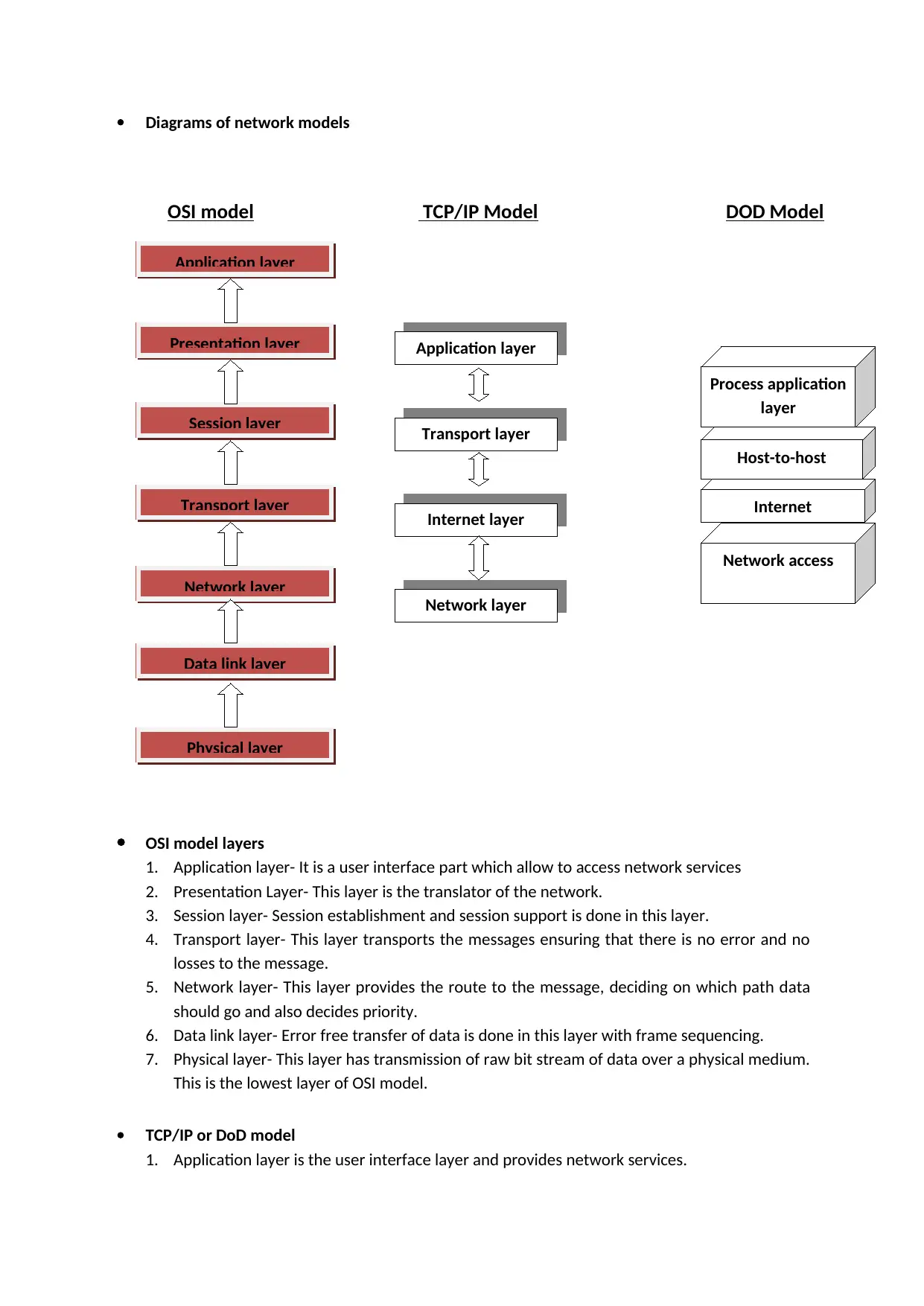
Diagrams of network models
OSI model TCP/IP Model DOD Model
OSI model layers
1. Application layer- It is a user interface part which allow to access network services
2. Presentation Layer- This layer is the translator of the network.
3. Session layer- Session establishment and session support is done in this layer.
4. Transport layer- This layer transports the messages ensuring that there is no error and no
losses to the message.
5. Network layer- This layer provides the route to the message, deciding on which path data
should go and also decides priority.
6. Data link layer- Error free transfer of data is done in this layer with frame sequencing.
7. Physical layer- This layer has transmission of raw bit stream of data over a physical medium.
This is the lowest layer of OSI model.
TCP/IP or DoD model
1. Application layer is the user interface layer and provides network services.
Application layer
Presentation layer
Physical layer
Data link layer
Network layer
Transport layer
Session layer
Application layer
Transport layer
Internet layer
Network layer
Process application
layer
Host-to-host
Internet
Network access
OSI model TCP/IP Model DOD Model
OSI model layers
1. Application layer- It is a user interface part which allow to access network services
2. Presentation Layer- This layer is the translator of the network.
3. Session layer- Session establishment and session support is done in this layer.
4. Transport layer- This layer transports the messages ensuring that there is no error and no
losses to the message.
5. Network layer- This layer provides the route to the message, deciding on which path data
should go and also decides priority.
6. Data link layer- Error free transfer of data is done in this layer with frame sequencing.
7. Physical layer- This layer has transmission of raw bit stream of data over a physical medium.
This is the lowest layer of OSI model.
TCP/IP or DoD model
1. Application layer is the user interface layer and provides network services.
Application layer
Presentation layer
Physical layer
Data link layer
Network layer
Transport layer
Session layer
Application layer
Transport layer
Internet layer
Network layer
Process application
layer
Host-to-host
Internet
Network access
⊘ This is a preview!⊘
Do you want full access?
Subscribe today to unlock all pages.

Trusted by 1+ million students worldwide
2. Transport layer maintains the transmission data through the help two protocols TCP and
UDP.
3. The Internet layer contains the packets with IP address of source and destinations.
4. Lowest layer of TCP/IP i.e. network layer performs the encapsulation of packets in the form
of frames for transmission over the network. [2]
Answer 2-
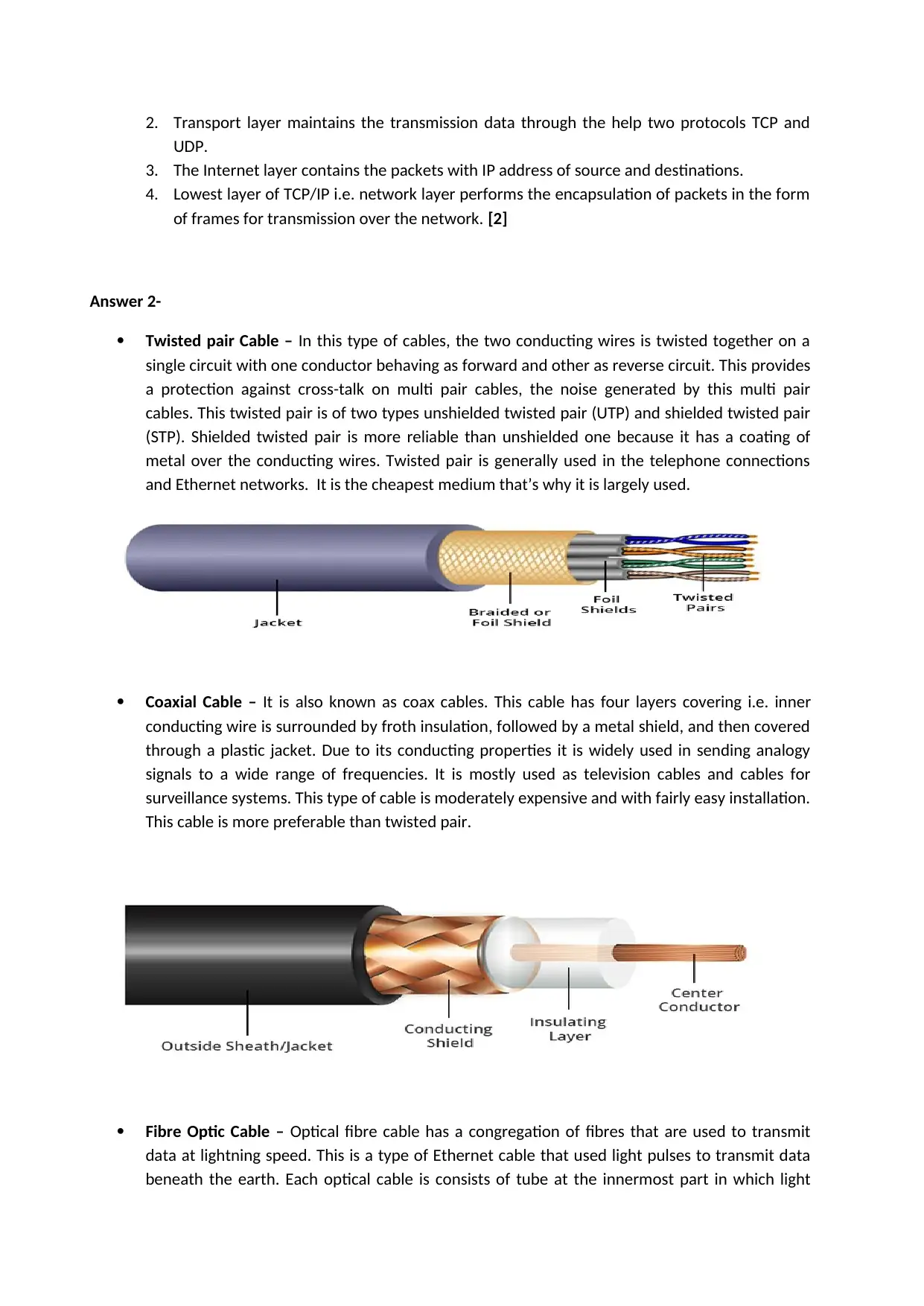
Twisted pair Cable – In this type of cables, the two conducting wires is twisted together on a
single circuit with one conductor behaving as forward and other as reverse circuit. This provides
a protection against cross-talk on multi pair cables, the noise generated by this multi pair
cables. This twisted pair is of two types unshielded twisted pair (UTP) and shielded twisted pair
(STP). Shielded twisted pair is more reliable than unshielded one because it has a coating of
metal over the conducting wires. Twisted pair is generally used in the telephone connections
and Ethernet networks. It is the cheapest medium that’s why it is largely used.
Coaxial Cable – It is also known as coax cables. This cable has four layers covering i.e. inner
conducting wire is surrounded by froth insulation, followed by a metal shield, and then covered
through a plastic jacket. Due to its conducting properties it is widely used in sending analogy
signals to a wide range of frequencies. It is mostly used as television cables and cables for
surveillance systems. This type of cable is moderately expensive and with fairly easy installation.
This cable is more preferable than twisted pair.
Fibre Optic Cable – Optical fibre cable has a congregation of fibres that are used to transmit
data at lightning speed. This is a type of Ethernet cable that used light pulses to transmit data
beneath the earth. Each optical cable is consists of tube at the innermost part in which light
UDP.
3. The Internet layer contains the packets with IP address of source and destinations.
4. Lowest layer of TCP/IP i.e. network layer performs the encapsulation of packets in the form
of frames for transmission over the network. [2]
Answer 2-
Twisted pair Cable – In this type of cables, the two conducting wires is twisted together on a
single circuit with one conductor behaving as forward and other as reverse circuit. This provides
a protection against cross-talk on multi pair cables, the noise generated by this multi pair
cables. This twisted pair is of two types unshielded twisted pair (UTP) and shielded twisted pair
(STP). Shielded twisted pair is more reliable than unshielded one because it has a coating of
metal over the conducting wires. Twisted pair is generally used in the telephone connections
and Ethernet networks. It is the cheapest medium that’s why it is largely used.
Coaxial Cable – It is also known as coax cables. This cable has four layers covering i.e. inner
conducting wire is surrounded by froth insulation, followed by a metal shield, and then covered
through a plastic jacket. Due to its conducting properties it is widely used in sending analogy
signals to a wide range of frequencies. It is mostly used as television cables and cables for
surveillance systems. This type of cable is moderately expensive and with fairly easy installation.
This cable is more preferable than twisted pair.
Fibre Optic Cable – Optical fibre cable has a congregation of fibres that are used to transmit
data at lightning speed. This is a type of Ethernet cable that used light pulses to transmit data
beneath the earth. Each optical cable is consists of tube at the innermost part in which light
Paraphrase This Document
Need a fresh take? Get an instant paraphrase of this document with our AI Paraphraser
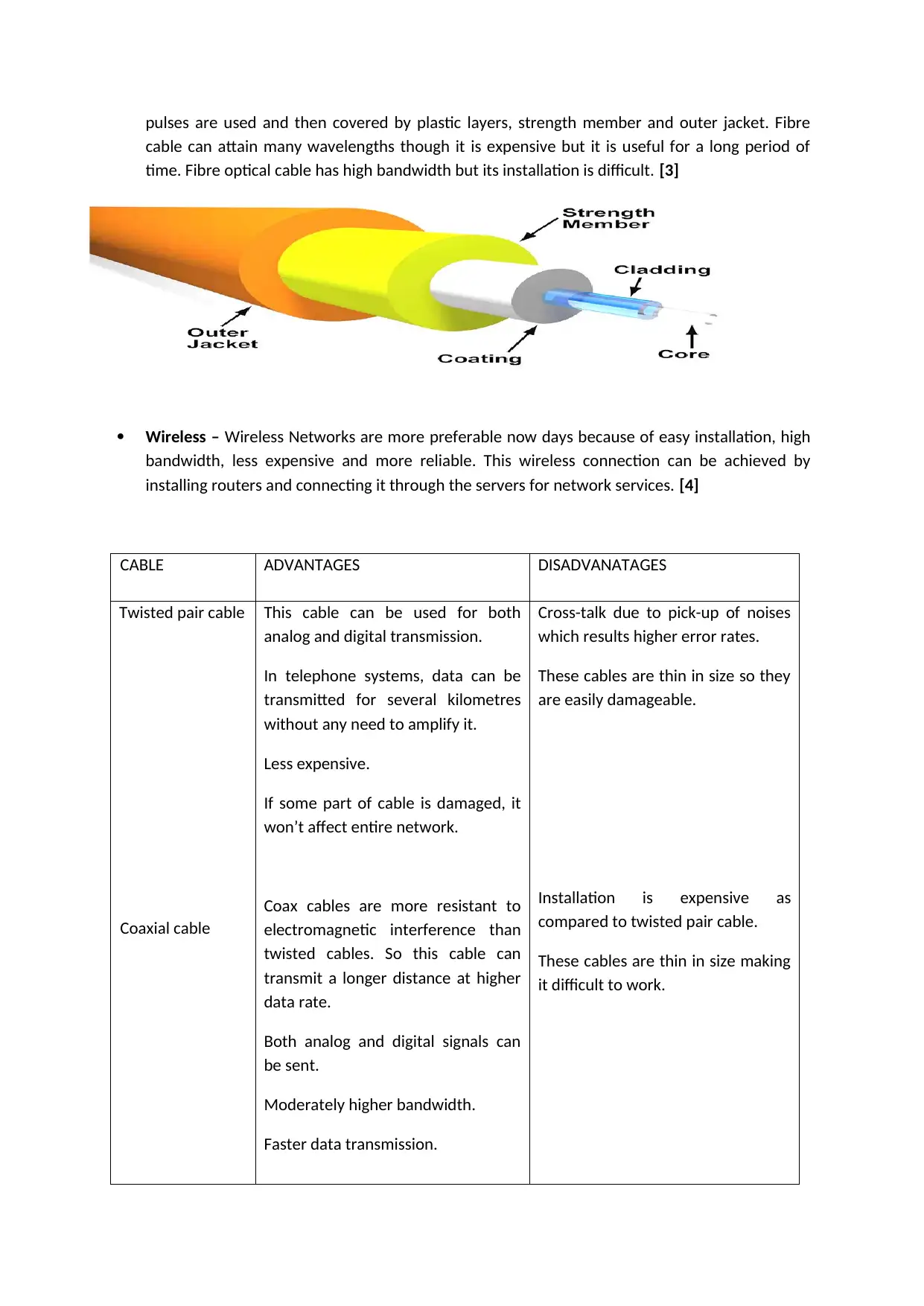
pulses are used and then covered by plastic layers, strength member and outer jacket. Fibre
cable can attain many wavelengths though it is expensive but it is useful for a long period of
time. Fibre optical cable has high bandwidth but its installation is difficult. [3]
Wireless – Wireless Networks are more preferable now days because of easy installation, high
bandwidth, less expensive and more reliable. This wireless connection can be achieved by
installing routers and connecting it through the servers for network services. [4]
CABLE ADVANTAGES DISADVANATAGES
Twisted pair cable
Coaxial cable
This cable can be used for both
analog and digital transmission.
In telephone systems, data can be
transmitted for several kilometres
without any need to amplify it.
Less expensive.
If some part of cable is damaged, it
won’t affect entire network.
Coax cables are more resistant to
electromagnetic interference than
twisted cables. So this cable can
transmit a longer distance at higher
data rate.
Both analog and digital signals can
be sent.
Moderately higher bandwidth.
Faster data transmission.
Cross-talk due to pick-up of noises
which results higher error rates.
These cables are thin in size so they
are easily damageable.
Installation is expensive as
compared to twisted pair cable.
These cables are thin in size making
it difficult to work.
cable can attain many wavelengths though it is expensive but it is useful for a long period of
time. Fibre optical cable has high bandwidth but its installation is difficult. [3]
Wireless – Wireless Networks are more preferable now days because of easy installation, high
bandwidth, less expensive and more reliable. This wireless connection can be achieved by
installing routers and connecting it through the servers for network services. [4]
CABLE ADVANTAGES DISADVANATAGES
Twisted pair cable
Coaxial cable
This cable can be used for both
analog and digital transmission.
In telephone systems, data can be
transmitted for several kilometres
without any need to amplify it.
Less expensive.
If some part of cable is damaged, it
won’t affect entire network.
Coax cables are more resistant to
electromagnetic interference than
twisted cables. So this cable can
transmit a longer distance at higher
data rate.
Both analog and digital signals can
be sent.
Moderately higher bandwidth.
Faster data transmission.
Cross-talk due to pick-up of noises
which results higher error rates.
These cables are thin in size so they
are easily damageable.
Installation is expensive as
compared to twisted pair cable.
These cables are thin in size making
it difficult to work.
Fibre Optical
Cable
Wireless
Higher bandwidth than both that’s
why no repeaters are required for
around 30kms.
No effect of electromagnetic
interference, making it suitable to
deploy at factory locations where
magnetic effect is high.
Fibre cables weight less than copper
making it easy transportable.
Fibre cables are difficult to tap, so
security is also good against wire
trappers.
They are resistant to any chemicals
in the environment.
This is a connection-less service.
User can move around freely within
the area of network.
Easy installation and less expensive.
Higher bandwidth.
Fibre cables are more expensive to
install.
It is a new technology which
requires skills.
Fibre interfaces costs more than
electrical interfaces.
Wireless connection can be hacked.
Network is not stable.
Answer 3 –
Asynchronous transmission utilizes a transmitter, a beneficiary and a wire without coordination
between the clock paces and information rates. Truth be told there is no synchronization
between the two end focuses on to what extent the transmitter leaves the flag and at what rate
to speak to a solitary piece. Every gadget utilizes a clock to quantify the length of the bit.
Cable
Wireless
Higher bandwidth than both that’s
why no repeaters are required for
around 30kms.
No effect of electromagnetic
interference, making it suitable to
deploy at factory locations where
magnetic effect is high.
Fibre cables weight less than copper
making it easy transportable.
Fibre cables are difficult to tap, so
security is also good against wire
trappers.
They are resistant to any chemicals
in the environment.
This is a connection-less service.
User can move around freely within
the area of network.
Easy installation and less expensive.
Higher bandwidth.
Fibre cables are more expensive to
install.
It is a new technology which
requires skills.
Fibre interfaces costs more than
electrical interfaces.
Wireless connection can be hacked.
Network is not stable.
Answer 3 –
Asynchronous transmission utilizes a transmitter, a beneficiary and a wire without coordination
between the clock paces and information rates. Truth be told there is no synchronization
between the two end focuses on to what extent the transmitter leaves the flag and at what rate
to speak to a solitary piece. Every gadget utilizes a clock to quantify the length of the bit.
⊘ This is a preview!⊘
Do you want full access?
Subscribe today to unlock all pages.
Trusted by 1+ million students worldwide
Toward one side transmitter transmits the information and at the opposite end recipient needs
to make sense of it when the flag will come and organize and after that retime its clock to
coordinate the approaching sign.
Synchronous signifies concurred timing for the sending of bit at transmit end and receive end of
the circuit. Synchronous frameworks arrange the correspondence parameters at the
information connect layer before correspondence starts. Fundamental synchronous
frameworks will synchronize the flag tickers on the two sides previously transmission starts,
reset their numeric counters and make different strides.
In this, synchronous transmission is more efficient as the clock will adjust itself at the time
interval of 0.25 seconds and will send the 1000 bit data without any losses. Synchronization will
help in proper sequencing of data and signalling the transmitter that data is received
successfully. This type of transmission is also efficient in system where the transmission
medium is electric wire or radio signal is not particularly reliable. [5]
A terminal for a media communications framework gives access to maybe a couple fast
synchronous transmission lines by both low-speed transmission lines and supporter lines. A
centre module incorporates interfaces to the rapid lines, a schedule opening interchanger, an
interface to the low-speed transmission lines, processors and overhead hardware for
supporting the terminal. An entrance module incorporates a majority of line racks associated
with supporter lines; each line rack incorporates a couple of processors and for schedule
vacancy assignors. A multi-interface serial transport associates the vacancy interchanger to the
entrance module and to the low-speed interface and gives close coupling between the
processors in the centre module and the line racks. The processors coordinate to prepare
supporter data from said endorser lines to and from schedule vacancies in said rapid feeder line
and said low-speed transmission line. Supporter data may likewise be prepared between
availabilities of the rapid feeder line and the low-speed transmission lines and between
vacancies inside every endorser line.
to make sense of it when the flag will come and organize and after that retime its clock to
coordinate the approaching sign.
Synchronous signifies concurred timing for the sending of bit at transmit end and receive end of
the circuit. Synchronous frameworks arrange the correspondence parameters at the
information connect layer before correspondence starts. Fundamental synchronous
frameworks will synchronize the flag tickers on the two sides previously transmission starts,
reset their numeric counters and make different strides.
In this, synchronous transmission is more efficient as the clock will adjust itself at the time
interval of 0.25 seconds and will send the 1000 bit data without any losses. Synchronization will
help in proper sequencing of data and signalling the transmitter that data is received
successfully. This type of transmission is also efficient in system where the transmission
medium is electric wire or radio signal is not particularly reliable. [5]
A terminal for a media communications framework gives access to maybe a couple fast
synchronous transmission lines by both low-speed transmission lines and supporter lines. A
centre module incorporates interfaces to the rapid lines, a schedule opening interchanger, an
interface to the low-speed transmission lines, processors and overhead hardware for
supporting the terminal. An entrance module incorporates a majority of line racks associated
with supporter lines; each line rack incorporates a couple of processors and for schedule
vacancy assignors. A multi-interface serial transport associates the vacancy interchanger to the
entrance module and to the low-speed interface and gives close coupling between the
processors in the centre module and the line racks. The processors coordinate to prepare
supporter data from said endorser lines to and from schedule vacancies in said rapid feeder line
and said low-speed transmission line. Supporter data may likewise be prepared between
availabilities of the rapid feeder line and the low-speed transmission lines and between
vacancies inside every endorser line.
Paraphrase This Document
Need a fresh take? Get an instant paraphrase of this document with our AI Paraphraser

[1] Frenzel, L. (2018). What’s The Difference Between The OSI Seven-Layer Network Model And TCP/IP?.
[online] Electronic Design. Available at: http://www.electronicdesign.com/what-s-difference-
between/what-s-difference-between-osi-seven-layer-network-model-and-tcpip[Accessed 27 Apr. 2018].
[2] En.wikipedia.org. (2018). OSI model. [online] Available at: https://en.wikipedia.org/wiki/OSI_model
[Accessed 27 Apr. 2018].
[3] Blog of FS.COM. (2018). Fiber Optic Cable vs Twisted Pair Cable vs Coaxial Cable. [online] Available at:
https://community.fs.com/blog/the-difference-between-fiber-optic-cable-twisted-pair-and-cable.html
[Accessed 27 Apr. 2018].
[4] Inetdaemon.com. (2018). Asynchronous vs. Synchronous. [online] Available at:
http://www.inetdaemon.com/tutorials/basic_concepts/communication/asynchronous_vs_synchronous
.shtml [Accessed 27 Apr. 2018].
[5] Gadre, J., Rohrer, C., Summers, C., & Symington, S. (1989). A COS study of OSI interoperability. Computer
Standards & Interfaces, 9(3), 217-237.
[online] Electronic Design. Available at: http://www.electronicdesign.com/what-s-difference-
between/what-s-difference-between-osi-seven-layer-network-model-and-tcpip[Accessed 27 Apr. 2018].
[2] En.wikipedia.org. (2018). OSI model. [online] Available at: https://en.wikipedia.org/wiki/OSI_model
[Accessed 27 Apr. 2018].
[3] Blog of FS.COM. (2018). Fiber Optic Cable vs Twisted Pair Cable vs Coaxial Cable. [online] Available at:
https://community.fs.com/blog/the-difference-between-fiber-optic-cable-twisted-pair-and-cable.html
[Accessed 27 Apr. 2018].
[4] Inetdaemon.com. (2018). Asynchronous vs. Synchronous. [online] Available at:
http://www.inetdaemon.com/tutorials/basic_concepts/communication/asynchronous_vs_synchronous
.shtml [Accessed 27 Apr. 2018].
[5] Gadre, J., Rohrer, C., Summers, C., & Symington, S. (1989). A COS study of OSI interoperability. Computer
Standards & Interfaces, 9(3), 217-237.

1 out of 8


Related Documents


Your All-in-One AI-Powered Toolkit for Academic Success.
+13062052269
info@desklib.com
Available 24*7 on WhatsApp / Email
![[object Object]](/_next/static/media/star-bottom.7253800d.svg)
Unlock your academic potential
Copyright © 2020–2026 A2Z Services. All Rights Reserved. Developed and managed by ZUCOL.