Analyzing Roberto Burle Marx's Landscape Architecture Designs
VerifiedAdded on 2023/06/08
|9
|1687
|492
Essay
AI Summary
This essay delves into the landscape architecture of Roberto Burle Marx, a prominent figure in Brazilian modernism. It examines his designs, including the mosaic promenade along Copacabana Beach and the garden of the Clemente Gomes residence, highlighting how they reflect the values of his time. Marx's philosophy, emphasizing gardens designed for future generations, is explored alongside his incorporation of native flora and his innovative use of both natural and man-made elements. The essay discusses how Marx created urban spaces that enhanced the aesthetic appeal of cities while promoting environmental conservation and restoration. References to relevant academic sources provide context for understanding his impact on landscape architecture.
LANDSCAPE ARCHITECTURE
By Name
Course
Instructor
Institution
Location
Date
By Name
Course
Instructor
Institution
Location
Date

Paraphrase This Document
Need a fresh take? Get an instant paraphrase of this document with our AI Paraphraser
Roberto Burle Marx was a landscape architect besides a painter, artist, naturalist, ecologist and
musician of a Brazilian origin who lived between 1909 and 1994. He gained fame from his
design of parks and gardens and has been acknowledged to be the brain behind the introduction
of modernist landscape architecture to Brazil (Davis 2015). He was commonly known as a
modern nature artist and a public space designer with most of his works having a great influence
on the design of the tropical garden in the 20th century. Water gardens were a polar theme in his
work and could successfully create a transition of the traditional artistic expressions including
tapestry, fork art and graphic design into the design for landscapes.
Roberto Burle Marx practiced landscape architecture in the 19th century, a period during which a
concept of time and space arose following industrial revolution that completely eroded the
agrarian society. During this people, a large population of the people found their easy into the
cities to supply labor that was required for running the industries. This led to a swelling in the
urban population and this concern for the public welfare arose (Deckker 2016). The economic,
political and social order of the western world was at the time defined by industrial production.
The ever rise in the belief in technology led to a backlash in which the romanticism turned to be
the antidote to the ills that affected the mechanized society. For this people who belonged to the
middle class, emotion overruled reason with imagination being pried more hat cultivated
scholarship (Hepner & Macedo 2016). Nature was uplifted as the main source of inspiration with
the members of the societies having a strong belief in natural phenomenon while acknowledging
the natural beauty and to be both morally and spiritually uplifting.
The landscape architecture of the 19th century was thus Romantic, public and urban. As a result
of the industrial revolution, there were tremendous changes that were experienced on the
musician of a Brazilian origin who lived between 1909 and 1994. He gained fame from his
design of parks and gardens and has been acknowledged to be the brain behind the introduction
of modernist landscape architecture to Brazil (Davis 2015). He was commonly known as a
modern nature artist and a public space designer with most of his works having a great influence
on the design of the tropical garden in the 20th century. Water gardens were a polar theme in his
work and could successfully create a transition of the traditional artistic expressions including
tapestry, fork art and graphic design into the design for landscapes.
Roberto Burle Marx practiced landscape architecture in the 19th century, a period during which a
concept of time and space arose following industrial revolution that completely eroded the
agrarian society. During this people, a large population of the people found their easy into the
cities to supply labor that was required for running the industries. This led to a swelling in the
urban population and this concern for the public welfare arose (Deckker 2016). The economic,
political and social order of the western world was at the time defined by industrial production.
The ever rise in the belief in technology led to a backlash in which the romanticism turned to be
the antidote to the ills that affected the mechanized society. For this people who belonged to the
middle class, emotion overruled reason with imagination being pried more hat cultivated
scholarship (Hepner & Macedo 2016). Nature was uplifted as the main source of inspiration with
the members of the societies having a strong belief in natural phenomenon while acknowledging
the natural beauty and to be both morally and spiritually uplifting.
The landscape architecture of the 19th century was thus Romantic, public and urban. As a result
of the industrial revolution, there were tremendous changes that were experienced on the
landscape as well as to the society (Waterman 2015). A new class of low wage employees was
generated in the American and European cities following the change from an agricultural to an
industrial economy.
The Romantic aspect of the 19th century made significant contribution to a perception and
conception of nature as being restorative. It gave people an opportunity to have an understanding
of the landscape both in the political, social and economic value and hence massive campaigns
were mounted in a bid to access its benefits. Landscape architecture, by the end of the century,
was a profession that seek accessibility, identity, transformation observation as well as
collaboration between the various spaces in design.
These were the main guiding principles that kept in check landscape architecture design projects
by Roberto Burle Marx and through excellently incorporating such concerns into his design; he
was able to do famous and popular projects. The landscape architecture of the time was aimed at
restoring the lost values and glory of landscape due to industrial revolution in which focus was
shifted to working in the industries. Among the projects by Roberto Burle Marx that were
representative of the values of their time include:
The mosaic promenade alongside the Copacabana Beach in Rio de Janeiro
Guided by his philosophy that a garden is different from any other form of art as to os designed
for the future and the future generations, Roberto Burle Marx managed to successfully complete
over 2000 garden projects in which he discovered almost 50 species of plants during the course.
The mosaic promenade alongside the Copacabana Beach in Rio de Janeiro was a promenade,
4km in length and was completed in 1970. It forms one of the giant abstract painting in which
none of the sections long the promenade is similar to another, a painting is can be observed
generated in the American and European cities following the change from an agricultural to an
industrial economy.
The Romantic aspect of the 19th century made significant contribution to a perception and
conception of nature as being restorative. It gave people an opportunity to have an understanding
of the landscape both in the political, social and economic value and hence massive campaigns
were mounted in a bid to access its benefits. Landscape architecture, by the end of the century,
was a profession that seek accessibility, identity, transformation observation as well as
collaboration between the various spaces in design.
These were the main guiding principles that kept in check landscape architecture design projects
by Roberto Burle Marx and through excellently incorporating such concerns into his design; he
was able to do famous and popular projects. The landscape architecture of the time was aimed at
restoring the lost values and glory of landscape due to industrial revolution in which focus was
shifted to working in the industries. Among the projects by Roberto Burle Marx that were
representative of the values of their time include:
The mosaic promenade alongside the Copacabana Beach in Rio de Janeiro
Guided by his philosophy that a garden is different from any other form of art as to os designed
for the future and the future generations, Roberto Burle Marx managed to successfully complete
over 2000 garden projects in which he discovered almost 50 species of plants during the course.
The mosaic promenade alongside the Copacabana Beach in Rio de Janeiro was a promenade,
4km in length and was completed in 1970. It forms one of the giant abstract painting in which
none of the sections long the promenade is similar to another, a painting is can be observed
⊘ This is a preview!⊘
Do you want full access?
Subscribe today to unlock all pages.

Trusted by 1+ million students worldwide
from the balconies of the hotels and provide an ever changing view for those who are having a
drive along the beach. The paintings have been done in black and white waves which are
representative of the white Americans and the black African slaves who had their history
intertwining in Brazil (Romão et al., 2015). Even though they are not interwoven, the waves
are intermingled and hence each of them has an influence on the other.
There are pockets of red within the white and black lines which are representative of the
indigenous people of Brazil who were absorbed by the European and slaves population and
thus remained isolated even though they were still able to have an influence on the presence
of the other groups of people (Treib 2017). The design illustrates that their colours are minute
patches that are found within the larger picture illustrating that their lands were smaller
pockets within the enormous country.
This landscape design by Roberto Burle Marx served to attach values to the political
developments and achievements that the country has gone through over the time and hence
served to attach to political value (Hartman 2016). At a time when a large percentage of people
were rushing to the cities owing to industrial revolution that introduced industrialization, there
was need to remind them of the causes of their slow rate of growth in economic development as
well as a reminder of their social life in the preceding centuries.
The garden of the Clemente Gomes residence in Areias
drive along the beach. The paintings have been done in black and white waves which are
representative of the white Americans and the black African slaves who had their history
intertwining in Brazil (Romão et al., 2015). Even though they are not interwoven, the waves
are intermingled and hence each of them has an influence on the other.
There are pockets of red within the white and black lines which are representative of the
indigenous people of Brazil who were absorbed by the European and slaves population and
thus remained isolated even though they were still able to have an influence on the presence
of the other groups of people (Treib 2017). The design illustrates that their colours are minute
patches that are found within the larger picture illustrating that their lands were smaller
pockets within the enormous country.
This landscape design by Roberto Burle Marx served to attach values to the political
developments and achievements that the country has gone through over the time and hence
served to attach to political value (Hartman 2016). At a time when a large percentage of people
were rushing to the cities owing to industrial revolution that introduced industrialization, there
was need to remind them of the causes of their slow rate of growth in economic development as
well as a reminder of their social life in the preceding centuries.
The garden of the Clemente Gomes residence in Areias
Paraphrase This Document
Need a fresh take? Get an instant paraphrase of this document with our AI Paraphraser
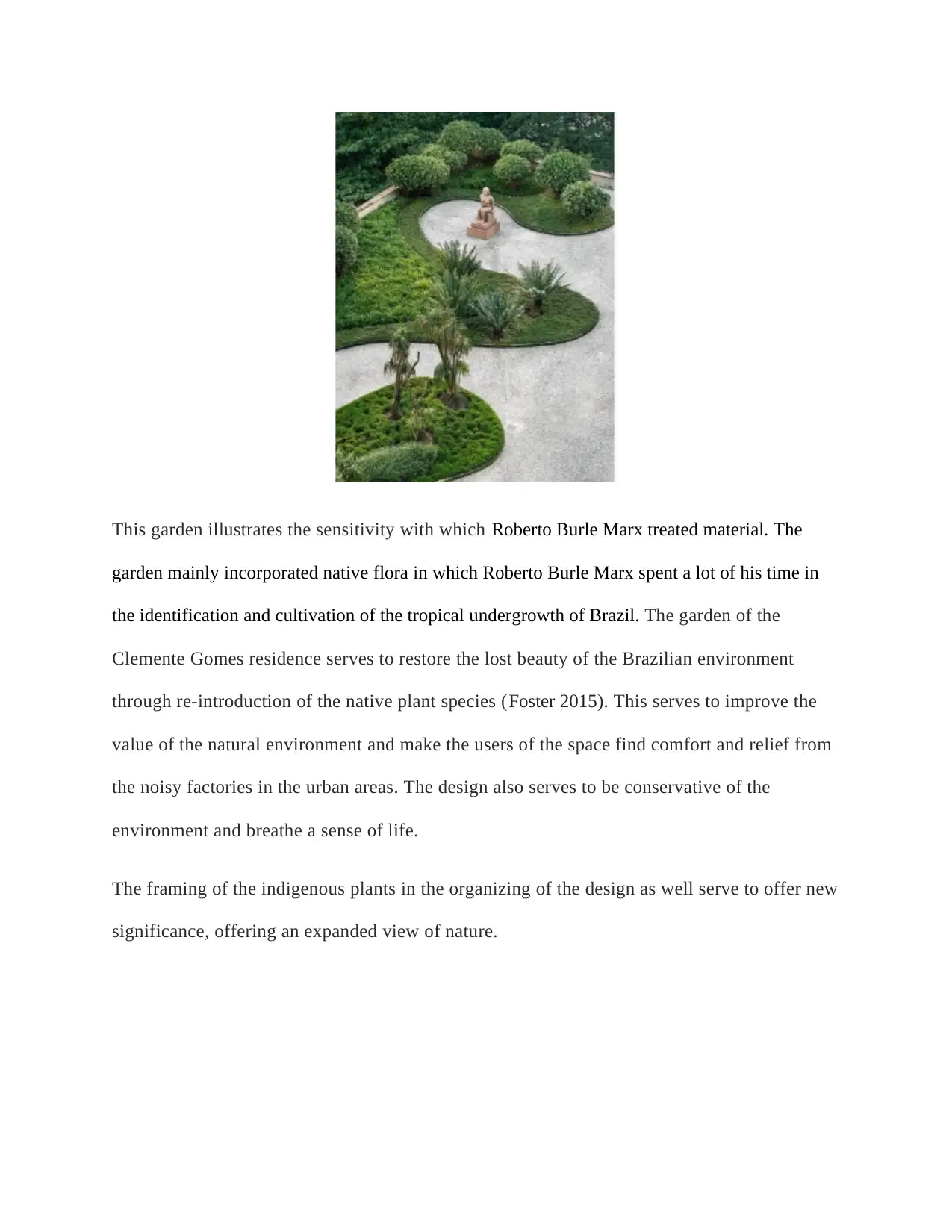
This garden illustrates the sensitivity with which Roberto Burle Marx treated material. The
garden mainly incorporated native flora in which Roberto Burle Marx spent a lot of his time in
the identification and cultivation of the tropical undergrowth of Brazil. The garden of the
Clemente Gomes residence serves to restore the lost beauty of the Brazilian environment
through re-introduction of the native plant species (Foster 2015). This serves to improve the
value of the natural environment and make the users of the space find comfort and relief from
the noisy factories in the urban areas. The design also serves to be conservative of the
environment and breathe a sense of life.
The framing of the indigenous plants in the organizing of the design as well serve to offer new
significance, offering an expanded view of nature.
garden mainly incorporated native flora in which Roberto Burle Marx spent a lot of his time in
the identification and cultivation of the tropical undergrowth of Brazil. The garden of the
Clemente Gomes residence serves to restore the lost beauty of the Brazilian environment
through re-introduction of the native plant species (Foster 2015). This serves to improve the
value of the natural environment and make the users of the space find comfort and relief from
the noisy factories in the urban areas. The design also serves to be conservative of the
environment and breathe a sense of life.
The framing of the indigenous plants in the organizing of the design as well serve to offer new
significance, offering an expanded view of nature.
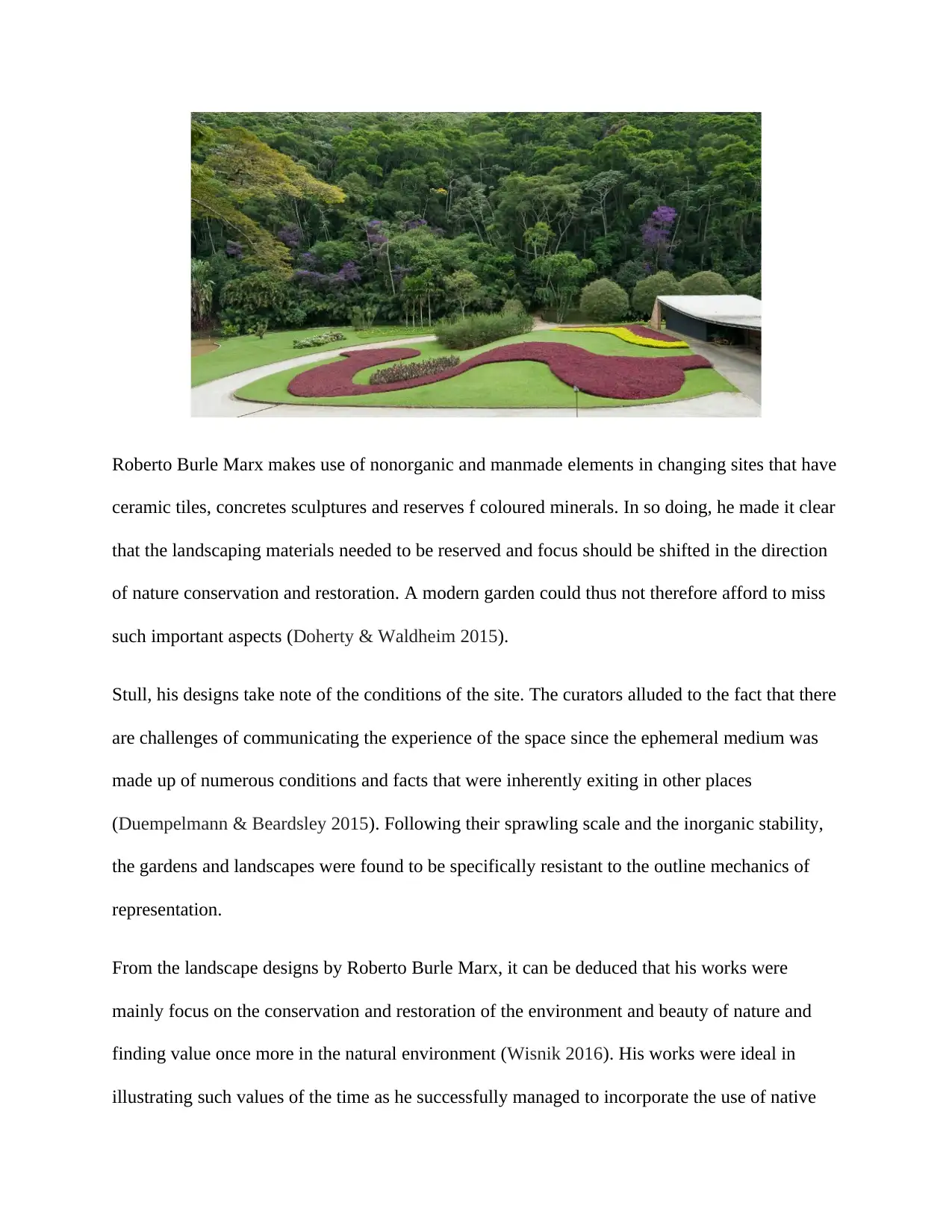
Roberto Burle Marx makes use of nonorganic and manmade elements in changing sites that have
ceramic tiles, concretes sculptures and reserves f coloured minerals. In so doing, he made it clear
that the landscaping materials needed to be reserved and focus should be shifted in the direction
of nature conservation and restoration. A modern garden could thus not therefore afford to miss
such important aspects (Doherty & Waldheim 2015).
Stull, his designs take note of the conditions of the site. The curators alluded to the fact that there
are challenges of communicating the experience of the space since the ephemeral medium was
made up of numerous conditions and facts that were inherently exiting in other places
(Duempelmann & Beardsley 2015). Following their sprawling scale and the inorganic stability,
the gardens and landscapes were found to be specifically resistant to the outline mechanics of
representation.
From the landscape designs by Roberto Burle Marx, it can be deduced that his works were
mainly focus on the conservation and restoration of the environment and beauty of nature and
finding value once more in the natural environment (Wisnik 2016). His works were ideal in
illustrating such values of the time as he successfully managed to incorporate the use of native
ceramic tiles, concretes sculptures and reserves f coloured minerals. In so doing, he made it clear
that the landscaping materials needed to be reserved and focus should be shifted in the direction
of nature conservation and restoration. A modern garden could thus not therefore afford to miss
such important aspects (Doherty & Waldheim 2015).
Stull, his designs take note of the conditions of the site. The curators alluded to the fact that there
are challenges of communicating the experience of the space since the ephemeral medium was
made up of numerous conditions and facts that were inherently exiting in other places
(Duempelmann & Beardsley 2015). Following their sprawling scale and the inorganic stability,
the gardens and landscapes were found to be specifically resistant to the outline mechanics of
representation.
From the landscape designs by Roberto Burle Marx, it can be deduced that his works were
mainly focus on the conservation and restoration of the environment and beauty of nature and
finding value once more in the natural environment (Wisnik 2016). His works were ideal in
illustrating such values of the time as he successfully managed to incorporate the use of native
⊘ This is a preview!⊘
Do you want full access?
Subscribe today to unlock all pages.
Trusted by 1+ million students worldwide

plant species in the design of his gardens. Still, Roberto Burle Marx was able to create urban
spaces in the crowded cities whose population tremendously grew following the heavy migration
of people to offer labor in the industries. He managed to allow the city dwellers to interact with
spaces that added more aesthetic to the city (Hoffmann & Nahson 2016).
spaces in the crowded cities whose population tremendously grew following the heavy migration
of people to offer labor in the industries. He managed to allow the city dwellers to interact with
spaces that added more aesthetic to the city (Hoffmann & Nahson 2016).
Paraphrase This Document
Need a fresh take? Get an instant paraphrase of this document with our AI Paraphraser
References
Davis, B., 2015. Wider Horizons of American Landscape. Landscape Journal, 34(1), pp.79-96
Deckker, T., 2016. Brasília: Life Beyond Utopia. Architectural Design, 86(3), pp.88-95
Doherty, G. and Waldheim, C. eds., 2015. Is landscape...?: essays on the identity of landscape.
Routledge
Duempelmann, S. and Beardsley, J. eds., 2015. Women, Modernity, and Landscape Architecture.
Routledge
Foster, J., 2015. Modernity, Mining and Improvement (pp. 122-144). London: Routledge
Hartman, H., 2016. Seeds of change: Urban transformation in Brazil. Architectural
Design, 86(3), pp.10-19
Hepner, A. and Macedo, S.S., 2016. Landscaping Brazil: The Legacy of Roberto Burle
Marx. Architectural Design, 86(3), pp.118-125.
Hoffmann, J. and Nahson, C.J., 2016. Roberto Burle Marx: Brazilian Modernist. Yale University
Press
Romão, R., Martinelli, G., Crepaldi, I. and Martinez-Laborde, J.B., 2015. Brazilian biodiversity
for ornamental use and conservation. Crop Breeding and Applied Biotechnology, 15(2), pp.100-
105
Treib, M., 2017. Roberto Burle Marx: Brazilian Modernist. Journal of Landscape
Architecture, 12(1), pp.94-96
Davis, B., 2015. Wider Horizons of American Landscape. Landscape Journal, 34(1), pp.79-96
Deckker, T., 2016. Brasília: Life Beyond Utopia. Architectural Design, 86(3), pp.88-95
Doherty, G. and Waldheim, C. eds., 2015. Is landscape...?: essays on the identity of landscape.
Routledge
Duempelmann, S. and Beardsley, J. eds., 2015. Women, Modernity, and Landscape Architecture.
Routledge
Foster, J., 2015. Modernity, Mining and Improvement (pp. 122-144). London: Routledge
Hartman, H., 2016. Seeds of change: Urban transformation in Brazil. Architectural
Design, 86(3), pp.10-19
Hepner, A. and Macedo, S.S., 2016. Landscaping Brazil: The Legacy of Roberto Burle
Marx. Architectural Design, 86(3), pp.118-125.
Hoffmann, J. and Nahson, C.J., 2016. Roberto Burle Marx: Brazilian Modernist. Yale University
Press
Romão, R., Martinelli, G., Crepaldi, I. and Martinez-Laborde, J.B., 2015. Brazilian biodiversity
for ornamental use and conservation. Crop Breeding and Applied Biotechnology, 15(2), pp.100-
105
Treib, M., 2017. Roberto Burle Marx: Brazilian Modernist. Journal of Landscape
Architecture, 12(1), pp.94-96

Waterman, T., 2015. The fundamentals of landscape architecture. Bloomsbury Publishing
Wisnik, G., 2016. Where to for Brazil's Cities? Citizen Empowerment or Global
Marketing?. Architectural Design, 86(3), pp.20-27
Wisnik, G., 2016. Where to for Brazil's Cities? Citizen Empowerment or Global
Marketing?. Architectural Design, 86(3), pp.20-27
⊘ This is a preview!⊘
Do you want full access?
Subscribe today to unlock all pages.
Trusted by 1+ million students worldwide

1 out of 9


Your All-in-One AI-Powered Toolkit for Academic Success.
+13062052269
info@desklib.com
Available 24*7 on WhatsApp / Email
![[object Object]](/_next/static/media/star-bottom.7253800d.svg)
Unlock your academic potential
Copyright © 2020–2026 A2Z Services. All Rights Reserved. Developed and managed by ZUCOL.