Language Barriers Faced by Chinese Students in Social Media
VerifiedAdded on 2020/04/07
|15
|4459
|42
Essay
AI Summary
This essay investigates the language barriers encountered by Chinese students when integrating into global social media platforms, using Victoria University as a case study. It examines the reluctance to change, the factors hindering adoption, and the interplay between language, culture, and technology. The study highlights the importance of language proficiency for social integration, particularly in the context of social media's role in facilitating communication and cultural exchange. The paper reviews the literature on the impact of language barriers on international students' academic and social lives, emphasizing the challenges faced by Chinese students in navigating English-dominated platforms. The essay explores how the development of localized social media platforms in China affects students' integration and communication with others. It also discusses the role of social and academic integration for Chinese students in Australian universities, examining how language proficiency impacts their ability to form relationships and participate in campus life.
Language Barriers among Chinese Students 1
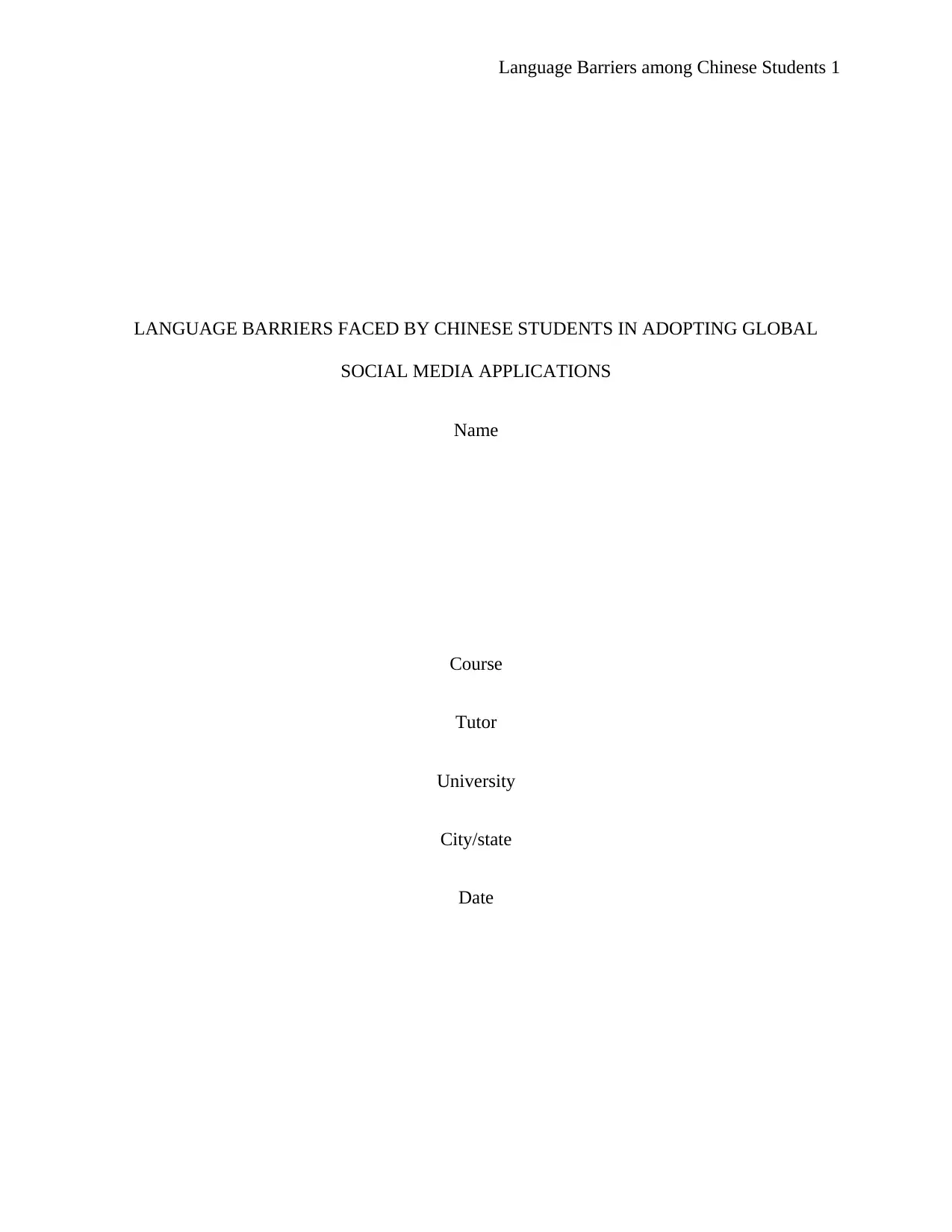
LANGUAGE BARRIERS FACED BY CHINESE STUDENTS IN ADOPTING GLOBAL
SOCIAL MEDIA APPLICATIONS
Name
Course
Tutor
University
City/state
Date
LANGUAGE BARRIERS FACED BY CHINESE STUDENTS IN ADOPTING GLOBAL
SOCIAL MEDIA APPLICATIONS
Name
Course
Tutor
University
City/state
Date

Paraphrase This Document
Need a fresh take? Get an instant paraphrase of this document with our AI Paraphraser
Language Barriers among Chinese Students 2
Abstract
This paper evaluates and presents language barrier as a challenge facing Chinese students in their
attempt of adopting global social media practices and applications. The paper gives a focus to
Victoria University as a case study with a focus on the description and comparison of reluctance
to change, what holds back the students to adopt change, and how the concept of language
barrier is connected to culture and technology. The paper concludes with a personal reflection of
what I have learned in the whole unit.
Introduction
Social integration plays a very important role in the general performance, growth, and
development of a student in any academic world. However, as individuals seek to integrate
socially, they encounter a number of challenges. In the case effective strategies are not deployed
to counter the effects of the challenges, and then the probability is that the students with different
cultural background may feel isolated in a social context or in classroom is high. This may
greatly affect their performance in colleges and universities as well as have long-term effects in
building relationships (Armstrong, 2015, p. 2). One of the most common barriers to effective
social integration and has affected the development and growth of international students both
academically and socially is the language barrier.
Literature Review
In every aspect of life, language is essential in all kinds of communication, including those with
speech impairments. In such cases, those with speech impairments often use brail and sign
language (Lowinger et al. 2014, p. 146). In other words, communication is often difficult in cases
Abstract
This paper evaluates and presents language barrier as a challenge facing Chinese students in their
attempt of adopting global social media practices and applications. The paper gives a focus to
Victoria University as a case study with a focus on the description and comparison of reluctance
to change, what holds back the students to adopt change, and how the concept of language
barrier is connected to culture and technology. The paper concludes with a personal reflection of
what I have learned in the whole unit.
Introduction
Social integration plays a very important role in the general performance, growth, and
development of a student in any academic world. However, as individuals seek to integrate
socially, they encounter a number of challenges. In the case effective strategies are not deployed
to counter the effects of the challenges, and then the probability is that the students with different
cultural background may feel isolated in a social context or in classroom is high. This may
greatly affect their performance in colleges and universities as well as have long-term effects in
building relationships (Armstrong, 2015, p. 2). One of the most common barriers to effective
social integration and has affected the development and growth of international students both
academically and socially is the language barrier.
Literature Review
In every aspect of life, language is essential in all kinds of communication, including those with
speech impairments. In such cases, those with speech impairments often use brail and sign
language (Lowinger et al. 2014, p. 146). In other words, communication is often difficult in cases
Language Barriers among Chinese Students 3
where people do not understand one another. According to Ha and Li (2016), the inability of
communicating using through a use of a language is understood as language barrier. According
to the study, language barrier is the most common aspect communication barrier that tends to
course misinterpretation and misunderstanding between two or more parties. Language barrier
often has a direct or indirect effect on individuals, an aspect that is often experienced by students
in both local and international students.
Embracing international students in colleges and universities contributes to increased diversity
and internationalization of their classrooms; the campuses as well as the communities involved
and provide a great platform for learning and appreciating cultural differences (Ngai et al. 2015,
p. 772). The development of social media platforms and applications as well as practices have
brought a new change and a shift to social integration practices in which many students use the
platforms to engage with each other and get to know more about the other student. However, the
language barrier has still challenged the effective use of social media to promote social
integration in universities and colleges. This study, therefore, seeks to provide an understanding
of the challenges posed by the language barrier as faced by the Chinese students in adapting to
global social media applications and practices in a case study of the Chinese students at Victoria
University.
The today's globalizing society or community has been characterized by the increased use of
social media platforms in our everyday lives. The social media has provided a platform where
individuals can freely communicate and interact with each other. The users can as well share
knowledge as well as exchange messages regardless of the distance that separates them (Trainor
et al. 2014, P. 1206). However Chinese students in international universities and in this case in
where people do not understand one another. According to Ha and Li (2016), the inability of
communicating using through a use of a language is understood as language barrier. According
to the study, language barrier is the most common aspect communication barrier that tends to
course misinterpretation and misunderstanding between two or more parties. Language barrier
often has a direct or indirect effect on individuals, an aspect that is often experienced by students
in both local and international students.
Embracing international students in colleges and universities contributes to increased diversity
and internationalization of their classrooms; the campuses as well as the communities involved
and provide a great platform for learning and appreciating cultural differences (Ngai et al. 2015,
p. 772). The development of social media platforms and applications as well as practices have
brought a new change and a shift to social integration practices in which many students use the
platforms to engage with each other and get to know more about the other student. However, the
language barrier has still challenged the effective use of social media to promote social
integration in universities and colleges. This study, therefore, seeks to provide an understanding
of the challenges posed by the language barrier as faced by the Chinese students in adapting to
global social media applications and practices in a case study of the Chinese students at Victoria
University.
The today's globalizing society or community has been characterized by the increased use of
social media platforms in our everyday lives. The social media has provided a platform where
individuals can freely communicate and interact with each other. The users can as well share
knowledge as well as exchange messages regardless of the distance that separates them (Trainor
et al. 2014, P. 1206). However Chinese students in international universities and in this case in
⊘ This is a preview!⊘
Do you want full access?
Subscribe today to unlock all pages.

Trusted by 1+ million students worldwide
Language Barriers among Chinese Students 4
Victoria University have been found to or are believed to socialize among themselves and
therefore they experience great difficulties or challenges in befriending the local students. Social
media platforms have been used by different individuals to become more integrated into the host
culture as well as get to understand and appreciate the diversity among the students. Therefore
intercultural adaptation involves the process of promoting understanding through interaction to
increase the level of fitness so that the demands of a new cultural environment can be met (Li &
Chen, 2014, p. 120).
Some of the global released statistics on social media usage globally provided that internet users
have an average of 5.54 social media accounts whereas 1 million new and active mobile social
users are added every day. It is also provided that 55 percent of Facebook users get news or news
headlines from the social network (Lowinger et al. 2014, p. 146). The New York Times
newspapers also point out to the fact that 67 percent of all consumers tap networks such as
Twitter and Facebook for custom services. However, according to the Global web index,
Facebook users spend an average of 50 minutes a day on its multiple platforms. Such statistics
show how social media has been used for different purposes and how it has become very
important in the modern world in fostering good relationships and enhancing communication.
Social and academic integration has become very important for the Chinese students in
Australian universities. The argument of increased language barrier that has affected the
integration of Chinese international students has being counteracted by the fact that in English
speaking nations, it is the responsibility of the student to improve his or her language skills so
that he or she may improve his or her English proficiency (Ha & Li, 2014, p. 240). However, the
Victoria University have been found to or are believed to socialize among themselves and
therefore they experience great difficulties or challenges in befriending the local students. Social
media platforms have been used by different individuals to become more integrated into the host
culture as well as get to understand and appreciate the diversity among the students. Therefore
intercultural adaptation involves the process of promoting understanding through interaction to
increase the level of fitness so that the demands of a new cultural environment can be met (Li &
Chen, 2014, p. 120).
Some of the global released statistics on social media usage globally provided that internet users
have an average of 5.54 social media accounts whereas 1 million new and active mobile social
users are added every day. It is also provided that 55 percent of Facebook users get news or news
headlines from the social network (Lowinger et al. 2014, p. 146). The New York Times
newspapers also point out to the fact that 67 percent of all consumers tap networks such as
Twitter and Facebook for custom services. However, according to the Global web index,
Facebook users spend an average of 50 minutes a day on its multiple platforms. Such statistics
show how social media has been used for different purposes and how it has become very
important in the modern world in fostering good relationships and enhancing communication.
Social and academic integration has become very important for the Chinese students in
Australian universities. The argument of increased language barrier that has affected the
integration of Chinese international students has being counteracted by the fact that in English
speaking nations, it is the responsibility of the student to improve his or her language skills so
that he or she may improve his or her English proficiency (Ha & Li, 2014, p. 240). However, the
Paraphrase This Document
Need a fresh take? Get an instant paraphrase of this document with our AI Paraphraser
Language Barriers among Chinese Students 5
local students also have a responsibility of facilitating social opportunities and platforms for
engagement between the domestic students and the international students.
China has the greatest percentage of internet users globally however despite using the commonly
used social media platforms as used by the western countries such as the Facebook and Google.
In a systematic study, Ha and Li (2014), the information technology departments in China have
developed and created their own social media platforms. However, it is also to note that in China
there are not only unique platforms that do not exist elsewhere but also there exist a multiplicity
of overlapping platforms and ecosystems that are in constant flux (Bloom, 2014, p. 3). The
development of these social media platforms and applications has been made through a
technology that allows the user to use his or her language and most of them are also designed to
use the English language.
Most of the Chinese greatest population nearly speaks Chinese language and cannot
communicate any other foreign language. It is an aspect that has increased the need for more
Chinese students to study in other international universities and colleges in order to understand
other universal languages such as English. With the greatest number of internet users, most of
these users can only use the platforms to engage in social integration through the use of Chinese
language (Bertram et al. 2014, p. 120). This has greatly affected their social interactions and
integration into different environments and especially in colleges and universities. For instance
in our case study of challenges Chinese students are facing in constructing meaningful
relationships with students from other backgrounds, it was evident that most of the Chinese
students feel isolated due to the fact that they cannot prolifically use English language to
local students also have a responsibility of facilitating social opportunities and platforms for
engagement between the domestic students and the international students.
China has the greatest percentage of internet users globally however despite using the commonly
used social media platforms as used by the western countries such as the Facebook and Google.
In a systematic study, Ha and Li (2014), the information technology departments in China have
developed and created their own social media platforms. However, it is also to note that in China
there are not only unique platforms that do not exist elsewhere but also there exist a multiplicity
of overlapping platforms and ecosystems that are in constant flux (Bloom, 2014, p. 3). The
development of these social media platforms and applications has been made through a
technology that allows the user to use his or her language and most of them are also designed to
use the English language.
Most of the Chinese greatest population nearly speaks Chinese language and cannot
communicate any other foreign language. It is an aspect that has increased the need for more
Chinese students to study in other international universities and colleges in order to understand
other universal languages such as English. With the greatest number of internet users, most of
these users can only use the platforms to engage in social integration through the use of Chinese
language (Bertram et al. 2014, p. 120). This has greatly affected their social interactions and
integration into different environments and especially in colleges and universities. For instance
in our case study of challenges Chinese students are facing in constructing meaningful
relationships with students from other backgrounds, it was evident that most of the Chinese
students feel isolated due to the fact that they cannot prolifically use English language to
Language Barriers among Chinese Students 6
communicate and therefore the friends they can make or build social circles across are only those
from their backgrounds.
Social platforms are also designed and used by universities to facilitate social integration and a
platform where students can share ideas, exchange messages and get to learn from each other as
well as appreciate the different cultural backgrounds and diversity. The most widely used
internet platforms are the Facebook as well as the Google which is used for conducting
information research. These platforms have been designed to use English language and have not
yet been customized to any other local language (Wu et al. 2015, p. 2). Therefore the Chinese
students could not, therefore, establish social relationships and meaningful engagements. Before
the advent of the new technology, the traditional sources of information which were dominant in
those times were print and broadcast media, friends, families, and websites in which the students
could use to get information about the university courses. However, many youths have now
become prolific users of the internet through social media applications such as the Facebook’s,
Twitter and Google.
With the increase in technological advancements, the advent of social media and the new social
media innovations and developments there has been a great influence for organizations to
discover effective and sustainable ways to communicate with the clients and attract the
prospective ones as well. The development of this new communication and marketing strategy
has been applied to universities and educational institutions to influence international student’s
decision-making process (Liu & Brown, 2014, p. 214). Due to the language barriers and
inefficiency of other social media platforms to meet the demands of the Chinese students, the
Chinese information technology experts have developed other social platforms including the
communicate and therefore the friends they can make or build social circles across are only those
from their backgrounds.
Social platforms are also designed and used by universities to facilitate social integration and a
platform where students can share ideas, exchange messages and get to learn from each other as
well as appreciate the different cultural backgrounds and diversity. The most widely used
internet platforms are the Facebook as well as the Google which is used for conducting
information research. These platforms have been designed to use English language and have not
yet been customized to any other local language (Wu et al. 2015, p. 2). Therefore the Chinese
students could not, therefore, establish social relationships and meaningful engagements. Before
the advent of the new technology, the traditional sources of information which were dominant in
those times were print and broadcast media, friends, families, and websites in which the students
could use to get information about the university courses. However, many youths have now
become prolific users of the internet through social media applications such as the Facebook’s,
Twitter and Google.
With the increase in technological advancements, the advent of social media and the new social
media innovations and developments there has been a great influence for organizations to
discover effective and sustainable ways to communicate with the clients and attract the
prospective ones as well. The development of this new communication and marketing strategy
has been applied to universities and educational institutions to influence international student’s
decision-making process (Liu & Brown, 2014, p. 214). Due to the language barriers and
inefficiency of other social media platforms to meet the demands of the Chinese students, the
Chinese information technology experts have developed other social platforms including the
⊘ This is a preview!⊘
Do you want full access?
Subscribe today to unlock all pages.
Trusted by 1+ million students worldwide
Language Barriers among Chinese Students 7
WeChat social platform where the students can interact and share information’s as well as video
chats. The development of this social site has had positive implications as it has resulted to
increase in the number of students joining international universities and colleges. Therefore the
Chinese students have shifted to use of such a platform to enhance their communication and
interactions in foreign environments. The platform or the social media platform provides the
users with the ability to use local language and translate the language into the language of the
recipient of the information (Gomes et al. 2014, p. 12).
The students have been reluctant to change due to their cultural backgrounds as well as the
ability to develop other media social platforms where they can interact with their friends. The
technological culture of the Chinese people has evolved greatly and has seen to the development
of great innovations which have increased competition to the existing technology (Stromquist &
Monkman, 2014, p. 3). They have embraced their own technological advancements at the
expense of the commonly and widely used social platforms in the world. The resistance to
cultural change and adoption of their own technology has improved the modes of communication
and marketing in China. However, this reluctance to change has greatly had negative impacts to
the students at institutions of higher learning as the environment speaks differently to them
(Wang 2015, p. 66). With the new innovation of We Chat which has over 600 million users in
China all the other social media platforms including emails have been rendered less useful.
The major language barrier most of the Chinese students face is the proficiency of speaking the
English language. During admission to any university in Australia, the students are accessed on
certain language proficiency which will enable the at least be in a position to engage in a
conversation or what understand each other (Gribble et al. 2015, p. 412). This assessment is
WeChat social platform where the students can interact and share information’s as well as video
chats. The development of this social site has had positive implications as it has resulted to
increase in the number of students joining international universities and colleges. Therefore the
Chinese students have shifted to use of such a platform to enhance their communication and
interactions in foreign environments. The platform or the social media platform provides the
users with the ability to use local language and translate the language into the language of the
recipient of the information (Gomes et al. 2014, p. 12).
The students have been reluctant to change due to their cultural backgrounds as well as the
ability to develop other media social platforms where they can interact with their friends. The
technological culture of the Chinese people has evolved greatly and has seen to the development
of great innovations which have increased competition to the existing technology (Stromquist &
Monkman, 2014, p. 3). They have embraced their own technological advancements at the
expense of the commonly and widely used social platforms in the world. The resistance to
cultural change and adoption of their own technology has improved the modes of communication
and marketing in China. However, this reluctance to change has greatly had negative impacts to
the students at institutions of higher learning as the environment speaks differently to them
(Wang 2015, p. 66). With the new innovation of We Chat which has over 600 million users in
China all the other social media platforms including emails have been rendered less useful.
The major language barrier most of the Chinese students face is the proficiency of speaking the
English language. During admission to any university in Australia, the students are accessed on
certain language proficiency which will enable the at least be in a position to engage in a
conversation or what understand each other (Gribble et al. 2015, p. 412). This assessment is
Paraphrase This Document
Need a fresh take? Get an instant paraphrase of this document with our AI Paraphraser
Language Barriers among Chinese Students 8
however not sufficient enough to make the Chinese students confident to engage in
conversations with other foreign students and especially in social media the expectations differ
from having one on one conversation with someone. Language is important to person’s self-
identity and self-identity is believed to be the contributing factor to having confidence even as
you express yourself to someone (Griths et al. 2014. P. 122). It enables a person or an individual
to express his or her emotions, feelings, tell stories as well as convey messages. It acts as the
greatest mediator that allows the students to relate and understand each other and it also provides
them with a significant frame of reference and relational context that helps the students to sustain
their identities (Nguyen et al. 2015, p. 15).
The development of the social media applications and practices is aimed at improving
relationships. However, China has always felt that the western media has always had negative
impacts to them as it did not cover China fairly and probably what led to innovations of their
own technological platforms. However, these platforms only helped them to build their
relationship with one another and not with other foreigners (Zhang et al. 2015, p. 806). Such a
culture has affected the Chinese international students in colleges and universities in other
nations in building healthy relationships and creating the required class environment for studies.
It is not the desire of the students to feel isolated in a social context or community. It is therefore
important that they learn to adapt to the technologies and means of communication commonly
used globally for effective communication. Social media and especially in the context of learning
institutions contributes and facilitates to knowledge sharing in online communities, particularly
on knowledge related to college or university information, course information as well as creating
general relationships (McKinley et al. 2015, p. 290).
however not sufficient enough to make the Chinese students confident to engage in
conversations with other foreign students and especially in social media the expectations differ
from having one on one conversation with someone. Language is important to person’s self-
identity and self-identity is believed to be the contributing factor to having confidence even as
you express yourself to someone (Griths et al. 2014. P. 122). It enables a person or an individual
to express his or her emotions, feelings, tell stories as well as convey messages. It acts as the
greatest mediator that allows the students to relate and understand each other and it also provides
them with a significant frame of reference and relational context that helps the students to sustain
their identities (Nguyen et al. 2015, p. 15).
The development of the social media applications and practices is aimed at improving
relationships. However, China has always felt that the western media has always had negative
impacts to them as it did not cover China fairly and probably what led to innovations of their
own technological platforms. However, these platforms only helped them to build their
relationship with one another and not with other foreigners (Zhang et al. 2015, p. 806). Such a
culture has affected the Chinese international students in colleges and universities in other
nations in building healthy relationships and creating the required class environment for studies.
It is not the desire of the students to feel isolated in a social context or community. It is therefore
important that they learn to adapt to the technologies and means of communication commonly
used globally for effective communication. Social media and especially in the context of learning
institutions contributes and facilitates to knowledge sharing in online communities, particularly
on knowledge related to college or university information, course information as well as creating
general relationships (McKinley et al. 2015, p. 290).
Language Barriers among Chinese Students 9
The recent rapid growth of the China economy has led to increased innovations and
technological advancements. Such advancement in technology has made it difficult for the
students as well as the other China natives more conservative to their technology (Yang et al.
2014, p. 250). Despite the continued trade relationships between China and Australia the two
countries use different technologies as one is still using the western technologies whereas China
is has developed its own innovations. And therefore China social media users not only are more
active than those of any other country but also more than 80 percent of the total global internet
users. Despite the continued encouragement to use the newly developed applications such as the
WeChat, the Victoria University has continued to call for initiatives which will allow and
facilitate student growth as China international students in Australia have continued to increase
and now are at 42 percent of the total international students and therefore apart from the cultural
benefit the Australian government has continued to enjoy great revenue collection from the
education sector (Mikal et al. 2015, p. 215).
Regardless of the technological change, it is often important for learning institutions to come up
with policies which promote the creation of an environment centered not only to bring the best
out of every student academically but also socially and that can only be achieved through
creating effective social strategies and policies. The development of social media applications
should be done in a standard language that helps to build the user and not the use of local
language as that may imply economic backwardness (Gan et al. 2015, p. 355). An effective and
conducive learning environment is created where the students can or are in a position to learn
from each other through the exchange of ideas and knowledge.
The recent rapid growth of the China economy has led to increased innovations and
technological advancements. Such advancement in technology has made it difficult for the
students as well as the other China natives more conservative to their technology (Yang et al.
2014, p. 250). Despite the continued trade relationships between China and Australia the two
countries use different technologies as one is still using the western technologies whereas China
is has developed its own innovations. And therefore China social media users not only are more
active than those of any other country but also more than 80 percent of the total global internet
users. Despite the continued encouragement to use the newly developed applications such as the
WeChat, the Victoria University has continued to call for initiatives which will allow and
facilitate student growth as China international students in Australia have continued to increase
and now are at 42 percent of the total international students and therefore apart from the cultural
benefit the Australian government has continued to enjoy great revenue collection from the
education sector (Mikal et al. 2015, p. 215).
Regardless of the technological change, it is often important for learning institutions to come up
with policies which promote the creation of an environment centered not only to bring the best
out of every student academically but also socially and that can only be achieved through
creating effective social strategies and policies. The development of social media applications
should be done in a standard language that helps to build the user and not the use of local
language as that may imply economic backwardness (Gan et al. 2015, p. 355). An effective and
conducive learning environment is created where the students can or are in a position to learn
from each other through the exchange of ideas and knowledge.
⊘ This is a preview!⊘
Do you want full access?
Subscribe today to unlock all pages.
Trusted by 1+ million students worldwide
Language Barriers among Chinese Students 10
The use of technology is only beneficial if it helps the user achieve a certain set goal otherwise
the technology may not be appropriate or relevant to him (Rui & Wang 2015, p. 421). There is
need therefore for the China government to develop their innovations or customize them to
standard language that can globally be recognized. This will not only help in fostering social
integration but will also help the China population to learn a global language. However much it
is the responsibility of the university or college management to create a conducive environment
for learning it is equally important to for the students to take it as their sole responsibility to
practice learning other languages not only and especially to have proficiency in speaking English
(Song, 2014, p. 349). The goal or aim of technology is to improve our living conditions by
providing solutions to our needs and in this case our social needs. The development of social
media applications and its implementation in schools should provide a platform for growth and
improved social relations in schools as well as in the community we come from.
In the international education arena, students in the international institutions are facing various
challenges that have both direct and indirect effects on their performance as well as interaction
with other students. The inability of communicating using through a use of a language is
understood as language barrier. According to the study, language barrier is the most common
aspect communication barrier that tends to course misinterpretation and misunderstanding
between two or more parties. Language barrier often has a direct or indirect effect on individuals,
an aspect that is often experienced by students in both local and international students.
The paper has thus evaluated and presented language barrier as a challenge facing Chinese
students in their attempt of adopting global social media practices and applications. It has also
given a focus to Victoria University as a case study with a focus on the description and
The use of technology is only beneficial if it helps the user achieve a certain set goal otherwise
the technology may not be appropriate or relevant to him (Rui & Wang 2015, p. 421). There is
need therefore for the China government to develop their innovations or customize them to
standard language that can globally be recognized. This will not only help in fostering social
integration but will also help the China population to learn a global language. However much it
is the responsibility of the university or college management to create a conducive environment
for learning it is equally important to for the students to take it as their sole responsibility to
practice learning other languages not only and especially to have proficiency in speaking English
(Song, 2014, p. 349). The goal or aim of technology is to improve our living conditions by
providing solutions to our needs and in this case our social needs. The development of social
media applications and its implementation in schools should provide a platform for growth and
improved social relations in schools as well as in the community we come from.
In the international education arena, students in the international institutions are facing various
challenges that have both direct and indirect effects on their performance as well as interaction
with other students. The inability of communicating using through a use of a language is
understood as language barrier. According to the study, language barrier is the most common
aspect communication barrier that tends to course misinterpretation and misunderstanding
between two or more parties. Language barrier often has a direct or indirect effect on individuals,
an aspect that is often experienced by students in both local and international students.
The paper has thus evaluated and presented language barrier as a challenge facing Chinese
students in their attempt of adopting global social media practices and applications. It has also
given a focus to Victoria University as a case study with a focus on the description and
Paraphrase This Document
Need a fresh take? Get an instant paraphrase of this document with our AI Paraphraser
Language Barriers among Chinese Students 11
comparison of reluctance to change, what holds back the students to adopt change, and how the
concept of language barrier is connected to culture and technology.
Conclusion
The literature review has helped me understand the role played by social media in promoting
social integration amongst students in schools as well as at the large community. It has also
helped me to appreciate the current development and innovations in social media which have
revolutionized the communication and marketing strategies used by different institutions and
organizations. It is also important to note that it is not a number of technological innovations that
a country makes that matters but how the innovations are contributing to the improved means of
doing things. Language barriers have affected greatly the use of social media applications
globally as such innovations are made using local technologies as well as languages which make
it difficult for other users from different nations from using the applications. The development of
the innovations should be done in an integrated manner under a standardized language but
customization to different local languages can be done for specific. Information should also be
made available to all social networks to give the users some preference and a choice on the most
effective and reliable source as well as the most convenient social media platform. However, it is
still important for the developers of the social media applications to ask themselves as to who is
their target consumer of their product? What value will the product or the innovation add to
them? Is the product or innovation made for local use or can be used globally? Such questions
will ensure that the challenges discussed can be addressed before the innovations are made so
that the final product or innovation meets the market demands.
comparison of reluctance to change, what holds back the students to adopt change, and how the
concept of language barrier is connected to culture and technology.
Conclusion
The literature review has helped me understand the role played by social media in promoting
social integration amongst students in schools as well as at the large community. It has also
helped me to appreciate the current development and innovations in social media which have
revolutionized the communication and marketing strategies used by different institutions and
organizations. It is also important to note that it is not a number of technological innovations that
a country makes that matters but how the innovations are contributing to the improved means of
doing things. Language barriers have affected greatly the use of social media applications
globally as such innovations are made using local technologies as well as languages which make
it difficult for other users from different nations from using the applications. The development of
the innovations should be done in an integrated manner under a standardized language but
customization to different local languages can be done for specific. Information should also be
made available to all social networks to give the users some preference and a choice on the most
effective and reliable source as well as the most convenient social media platform. However, it is
still important for the developers of the social media applications to ask themselves as to who is
their target consumer of their product? What value will the product or the innovation add to
them? Is the product or innovation made for local use or can be used globally? Such questions
will ensure that the challenges discussed can be addressed before the innovations are made so
that the final product or innovation meets the market demands.
Language Barriers among Chinese Students 12
List of References
Armstrong, G., Kotler, P., Harker, M. and Brennan, R., 2015. Marketing: an introduction.
Pearson Education.
Bertram, D.M., Poulakis, M., Elsasser, B.S. and Kumar, E., 2014.Social support and
acculturation in Chinese international students.Journal of Multicultural Counseling and
Development, 42(2), pp.107-124.
Bloom, A.H., 2014. The linguistic shaping of thought: A study in the impact of language on
thinking in China and the West. Psychology Press.
Gan, C. and Wang, W., 2015. Uses and gratifications of social media: a comparison of microblog
and WeChat. Journal of Systems and Information Technology, 17(4), pp.351-363.
Gomes, C., Berry, M., Alzougool, B. and Chang, S., 2014. Home away from home: International
students and their identity-based social networks in Australia. Journal of International Students,
4(1), pp.2-15.
Gribble, C., Blackmore, J. and Rahimi, M., 2015. Challenges to providing work integrated
learning to international business students at Australian universities. Higher Education, Skills
and Work-Based Learning, 5(4), pp.401-416.
Griths, M.D., Kuss, D.J. and Demetrovics, Z., 2014. Social networking addiction: An overview
of preliminary findings. Behavioral addictions: Criteria, evidence and treatment, pp.119-141.
List of References
Armstrong, G., Kotler, P., Harker, M. and Brennan, R., 2015. Marketing: an introduction.
Pearson Education.
Bertram, D.M., Poulakis, M., Elsasser, B.S. and Kumar, E., 2014.Social support and
acculturation in Chinese international students.Journal of Multicultural Counseling and
Development, 42(2), pp.107-124.
Bloom, A.H., 2014. The linguistic shaping of thought: A study in the impact of language on
thinking in China and the West. Psychology Press.
Gan, C. and Wang, W., 2015. Uses and gratifications of social media: a comparison of microblog
and WeChat. Journal of Systems and Information Technology, 17(4), pp.351-363.
Gomes, C., Berry, M., Alzougool, B. and Chang, S., 2014. Home away from home: International
students and their identity-based social networks in Australia. Journal of International Students,
4(1), pp.2-15.
Gribble, C., Blackmore, J. and Rahimi, M., 2015. Challenges to providing work integrated
learning to international business students at Australian universities. Higher Education, Skills
and Work-Based Learning, 5(4), pp.401-416.
Griths, M.D., Kuss, D.J. and Demetrovics, Z., 2014. Social networking addiction: An overview
of preliminary findings. Behavioral addictions: Criteria, evidence and treatment, pp.119-141.
⊘ This is a preview!⊘
Do you want full access?
Subscribe today to unlock all pages.
Trusted by 1+ million students worldwide

1 out of 15


Related Documents


Your All-in-One AI-Powered Toolkit for Academic Success.
+13062052269
info@desklib.com
Available 24*7 on WhatsApp / Email
![[object Object]](/_next/static/media/star-bottom.7253800d.svg)
Unlock your academic potential
Copyright © 2020–2026 A2Z Services. All Rights Reserved. Developed and managed by ZUCOL.