Master of Education: Language, Culture, and Writing Challenges

Verified

Added on  2022/11/26

|3
|448
|85
Homework Assignment
AI Summary
This assignment, written by a Master of Education student, delves into the intricate relationship between language and culture, particularly focusing on how these factors influence writing styles and academic performance. The student reflects on their personal experiences as a second language learner in Australia, highlighting the challenges encountered in adapting to English academic writing conventions. The assignment references key literature on cross-cultural writing, including works by Phan & Baurain, Chason et al., Simpson, and Tran, and explores the difficulties faced by non-native speakers in constructing paragraphs and texts that align with native English-speaking cultural norms. The student's reflection covers issues related to the use of a second language in a new cultural context, drawing on the provided readings on writing across cultures and contrastive rhetoric, to illustrate how cultural background shapes writing practices, and how individual experiences and strategies affect writing in a new academic setting. The assignment also addresses the importance of understanding the nuances of written versus spoken language and the development of critical thinking skills in writing to improve clarity and coherence. This reflection provides a valuable perspective on the impact of cultural and linguistic differences on writing and offers insights into strategies for improving writing skills.
Document Page
Running head: MASTER OF EDUCATION ADVANCE LEADERSHIP
MASTER OF EDUCATION ADVANCE LEADERSHIP
Name of the Student
Name of the University
Author Note
tabler-icon-diamond-filled.svg

Paraphrase This Document

Need a fresh take? Get an instant paraphrase of this document with our AI Paraphraser
Document Page
1MASTER OF EDUCATION ADVANCE LEADERSHIP
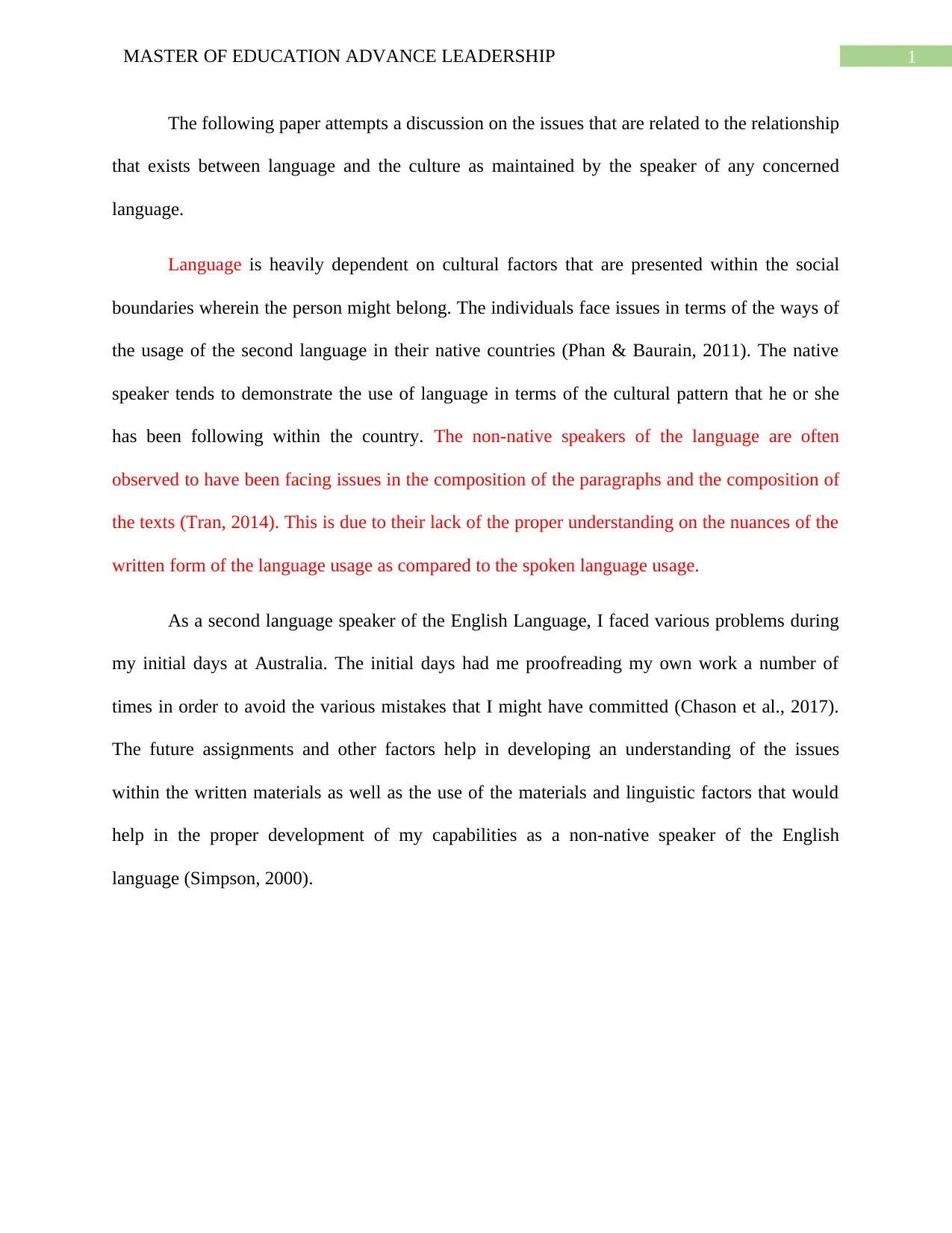
The following paper attempts a discussion on the issues that are related to the relationship
that exists between language and the culture as maintained by the speaker of any concerned
language.
Language is heavily dependent on cultural factors that are presented within the social
boundaries wherein the person might belong. The individuals face issues in terms of the ways of
the usage of the second language in their native countries (Phan & Baurain, 2011). The native
speaker tends to demonstrate the use of language in terms of the cultural pattern that he or she
has been following within the country. The non-native speakers of the language are often
observed to have been facing issues in the composition of the paragraphs and the composition of
the texts (Tran, 2014). This is due to their lack of the proper understanding on the nuances of the
written form of the language usage as compared to the spoken language usage.
As a second language speaker of the English Language, I faced various problems during
my initial days at Australia. The initial days had me proofreading my own work a number of
times in order to avoid the various mistakes that I might have committed (Chason et al., 2017).
The future assignments and other factors help in developing an understanding of the issues
within the written materials as well as the use of the materials and linguistic factors that would
help in the proper development of my capabilities as a non-native speaker of the English
language (Simpson, 2000).
Document Page
2MASTER OF EDUCATION ADVANCE LEADERSHIP
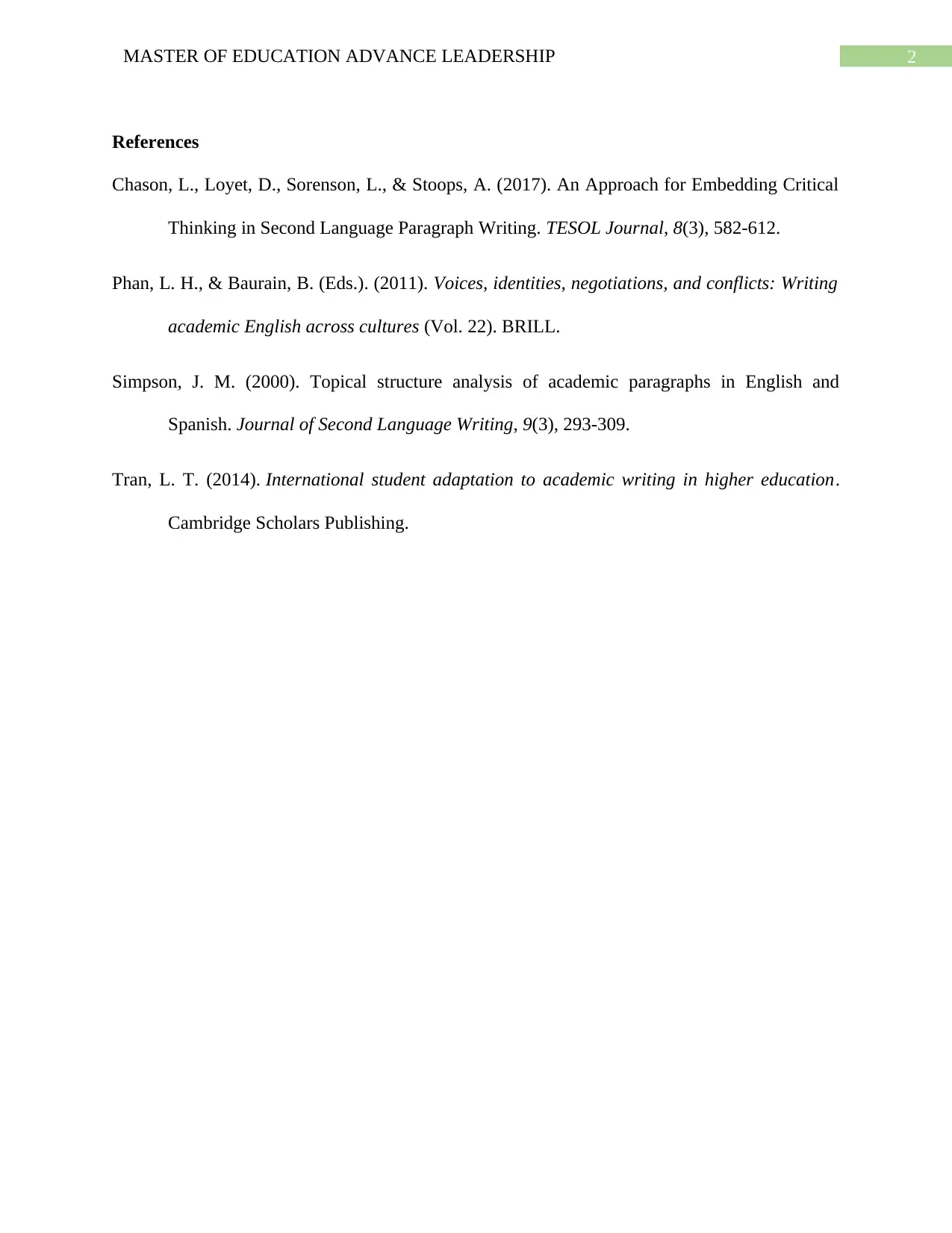
References
Chason, L., Loyet, D., Sorenson, L., & Stoops, A. (2017). An Approach for Embedding Critical
Thinking in Second Language Paragraph Writing. TESOL Journal, 8(3), 582-612.
Phan, L. H., & Baurain, B. (Eds.). (2011). Voices, identities, negotiations, and conflicts: Writing
academic English across cultures (Vol. 22). BRILL.
Simpson, J. M. (2000). Topical structure analysis of academic paragraphs in English and
Spanish. Journal of Second Language Writing, 9(3), 293-309.
Tran, L. T. (2014). International student adaptation to academic writing in higher education.
Cambridge Scholars Publishing.
chevron_up_icon
1 out of 3
circle_padding
hide_on_mobile
zoom_out_icon
[object Object]