LING248: How Language Use Has Altered and Developed within CMC Blogs
VerifiedAdded on 2023/03/21
|18
|6073
|47
Essay
AI Summary
This essay explores the evolution of language use within Computer-Mediated Communication (CMC) blogs, comparing early and current examples to understand linguistic changes. It identifies key factors such as the rise of digital literacy, technological advancements, and societal influences that have shaped blogging language. The analysis considers shifts in blog topics, writing styles, and the integration of multimedia elements, highlighting how blogs have transformed from simple online journals to multifaceted platforms for knowledge sharing, opinion expression, and community building. The study also addresses the impact of commercialization and the changing dynamics of online communication, concluding that blogs have become a distinct genre driven by interactive web technologies, reflecting both linguistic creativity and the pressures of globalization. Desklib provides access to this and similar academic resources for students.
LANGUAGE USE WITHIN CMC
GENRE
GENRE

Paraphrase This Document
Need a fresh take? Get an instant paraphrase of this document with our AI Paraphraser
Introduction
The computer mediated language are dominantly text based interactions which facilitated by
computer network or mobile phones. The identification of basic problems related to CMC which
includes basic modalities of language includes speech and writing. The internet has become a
potential resource for studies related to linguistics. The number of studies undertaken in the field
of CMC highlights the fact that internet is emerging as a new genre for linguistic studies. The
current study aims to understand the changes in the language and development in the linguistic
properties of blogs. The blogs are impacted by the individual differences and it becomes easy to
reflect on the character of the individuals without knowing the traditional physical cue. The
constant evolution of the related blog contents has classified the blogs as frugal blogs,
entrepreneurship blogs, technological blogs, making money blogs, parenting blogs, adventure
blogs, personality development blogs, financial blogs, fitness blogs, word press development
blogs, and so on.
CMC TEXT
Analysis
How has language use altered and developed within the CMC genre
The internet and in particular blogs have become sites where the exchange of expert knowledge
takes place and is disseminated through various sources including emails, blogs and so on. the
important factor that contributed to the fact that people chose to write blogs included creative
expressions of themselves (Bondi, 2018, p.3), documentation of personal experiences and
sharing them with others, sharing practical knowledge and skills staying in touch with the
family and friends. the potentialities related to web has brought significant changes in the
English language. The blogs text has led to potential gain in the learning abilities and academic
blogs have contributed towards the learning and emotional closes between students and their
peers. The adaptation of blogs expanding learning experiences has moved beyond the
boundaries of limited class time and four walls of class rooms. The blogs topics have become
diverse in nature covering essentially all aspects of academic writing.
Comparisons between early blogs and current blogs
2
The computer mediated language are dominantly text based interactions which facilitated by
computer network or mobile phones. The identification of basic problems related to CMC which
includes basic modalities of language includes speech and writing. The internet has become a
potential resource for studies related to linguistics. The number of studies undertaken in the field
of CMC highlights the fact that internet is emerging as a new genre for linguistic studies. The
current study aims to understand the changes in the language and development in the linguistic
properties of blogs. The blogs are impacted by the individual differences and it becomes easy to
reflect on the character of the individuals without knowing the traditional physical cue. The
constant evolution of the related blog contents has classified the blogs as frugal blogs,
entrepreneurship blogs, technological blogs, making money blogs, parenting blogs, adventure
blogs, personality development blogs, financial blogs, fitness blogs, word press development
blogs, and so on.
CMC TEXT
Analysis
How has language use altered and developed within the CMC genre
The internet and in particular blogs have become sites where the exchange of expert knowledge
takes place and is disseminated through various sources including emails, blogs and so on. the
important factor that contributed to the fact that people chose to write blogs included creative
expressions of themselves (Bondi, 2018, p.3), documentation of personal experiences and
sharing them with others, sharing practical knowledge and skills staying in touch with the
family and friends. the potentialities related to web has brought significant changes in the
English language. The blogs text has led to potential gain in the learning abilities and academic
blogs have contributed towards the learning and emotional closes between students and their
peers. The adaptation of blogs expanding learning experiences has moved beyond the
boundaries of limited class time and four walls of class rooms. The blogs topics have become
diverse in nature covering essentially all aspects of academic writing.
Comparisons between early blogs and current blogs
2
The early blogs consisted catchy headlines which was accompanied by links that led the user to
the actual stories. There were brief news summaries and discussion related to contemporary
topics. The updating of blogs on regular basis provided gaining of immense popularity along
with introduction of free tools of blogging. The scope of blogs expanded dramatically turning
blogging services as multifaceted tools for internet platforms. The topical blogs gained immense
popularity and exampled news based political blogs that figured predominantly in media
discussions (Ishihara & Takamiya, 2019, p.829).
The difference between the topical blog and online newspaper column was increasingly blurred.
The close resemblance today writing language which was to be from the newspaper columns
identified with formal language and patterns of Standard English with kinetically correct
spellings and punctuations. The only differences between the newspaper column and blogs were
use of hypertext links. There were also additional features in blogs which included special
fountain styles prepositional Phrases and attributive adjectives which helped in increasing
Innovation and creativity to be employed in the blog writing. This was popular among the
personal journals that work posted online buys the uses without interferences and editing. The
typical features of blogs constitute characteristic entries that were posted in in Reverse
chronological format and enhancing of social interactivity which fostered social interactivity.
The blocks were linked to one another and allowed readers to post comment on individual entries
which gave rise to controversial exchanges.
The earlier blogs acted as filters and language become more fluid with introduction of partitive
expression. The language had a close resemblances to speech and relied on both speech and
writing (Chun, Kern & Smith, 2016, p.64).
The changes in the subjects in current blogging pattern focused on updating of activities and
whereabouts and expression of opinion for influencing others opinion. The focus of the blogs
shifted to seeking others opinion and releasing emotional tensions and expression of
relentlessness regarding social issues and initiate thinking by writing. The current bloggers
include the medium constitutes important platform that provides free speech and there is no
demand regarding potentials for or expressing opinion and controlling access of audiences and
inputs of audience. The current blogging button provided opportunities of equal participation and
absence of lengthy quotations which platform for budding writers. The short messages provide
dynamic touch to interactions and use of rhetorical questions and tag questions also help in
3
the actual stories. There were brief news summaries and discussion related to contemporary
topics. The updating of blogs on regular basis provided gaining of immense popularity along
with introduction of free tools of blogging. The scope of blogs expanded dramatically turning
blogging services as multifaceted tools for internet platforms. The topical blogs gained immense
popularity and exampled news based political blogs that figured predominantly in media
discussions (Ishihara & Takamiya, 2019, p.829).
The difference between the topical blog and online newspaper column was increasingly blurred.
The close resemblance today writing language which was to be from the newspaper columns
identified with formal language and patterns of Standard English with kinetically correct
spellings and punctuations. The only differences between the newspaper column and blogs were
use of hypertext links. There were also additional features in blogs which included special
fountain styles prepositional Phrases and attributive adjectives which helped in increasing
Innovation and creativity to be employed in the blog writing. This was popular among the
personal journals that work posted online buys the uses without interferences and editing. The
typical features of blogs constitute characteristic entries that were posted in in Reverse
chronological format and enhancing of social interactivity which fostered social interactivity.
The blocks were linked to one another and allowed readers to post comment on individual entries
which gave rise to controversial exchanges.
The earlier blogs acted as filters and language become more fluid with introduction of partitive
expression. The language had a close resemblances to speech and relied on both speech and
writing (Chun, Kern & Smith, 2016, p.64).
The changes in the subjects in current blogging pattern focused on updating of activities and
whereabouts and expression of opinion for influencing others opinion. The focus of the blogs
shifted to seeking others opinion and releasing emotional tensions and expression of
relentlessness regarding social issues and initiate thinking by writing. The current bloggers
include the medium constitutes important platform that provides free speech and there is no
demand regarding potentials for or expressing opinion and controlling access of audiences and
inputs of audience. The current blogging button provided opportunities of equal participation and
absence of lengthy quotations which platform for budding writers. The short messages provide
dynamic touch to interactions and use of rhetorical questions and tag questions also help in
3
⊘ This is a preview!⊘
Do you want full access?
Subscribe today to unlock all pages.

Trusted by 1+ million students worldwide
expressing personal opinions and stress upon utterance. The numbers coming from various
backgrounds provided diversity in language construction and use of grammatical Constructions
jargons abbreviations and sharing of linguistic characters becomes a prominent feature. The
members accommodated other members and this led to growth in the extensive literature of the
blogging lexicon (Reinhardt, 2019, p. 32).
As seen in the blog on open education in higher education which focuses on policies
recommendation highlights to fact that in and out degree related to centrality has significantly
increased in the areas of blog writing. The changes and development of language in blog writing
has contributed to sense of learning community and fostered collaborative discussions and flow
knowledge. The learner relationship and establishing online interactions trough blogs indicates
pattern and values that has brought change in the relationship of learner's and writers. The impact
of blog writing has established a system of fast, economic and democratic system of expression
of ideas. The rapid popularity of blogging has attracted the attention of scholars what are
increasingly expressing views on blogs (Lee & Bonk, 2016, p.44).
There is however existence of systematic bias as can be compared from the earlier blog and
current blogs. there has been a Paradigm shift in the estimation of effects of social forces which
includes mass popularization and changes in the pattern has been flagged off with respect to
commercialization of the contents on internet. The reconciliation of the perception of
technological innovations reveals a conflicting friend which is different words ordinary. The has
been marked differences in pattern of communication and public engagement and blogging is
continuously growing as sites for co construction of researches and decimating results and
theories for wider public reading. The deception new form of academic public engagement and
contribution paved way towards exploration of wider questions. The changes in pattern of blog
topic selection have been marked by juxtaposition of social concerns which are hyped
commercially (Reinhardt, 2019, p.39). The differences in the linguistic pattern as observed from
the comparative analysis of earlier blogs and current blogs expounds the fact that academic
writers are going client to reap benefits of virtual community, enormity and also attracting e-
commerce Advertising platforms. The changes in the technological trends have impacted the
online communication practices in the past 5 years and have opened up avenues for availability
of interface options and access to multimedia applications. There has been integration of
4
backgrounds provided diversity in language construction and use of grammatical Constructions
jargons abbreviations and sharing of linguistic characters becomes a prominent feature. The
members accommodated other members and this led to growth in the extensive literature of the
blogging lexicon (Reinhardt, 2019, p. 32).
As seen in the blog on open education in higher education which focuses on policies
recommendation highlights to fact that in and out degree related to centrality has significantly
increased in the areas of blog writing. The changes and development of language in blog writing
has contributed to sense of learning community and fostered collaborative discussions and flow
knowledge. The learner relationship and establishing online interactions trough blogs indicates
pattern and values that has brought change in the relationship of learner's and writers. The impact
of blog writing has established a system of fast, economic and democratic system of expression
of ideas. The rapid popularity of blogging has attracted the attention of scholars what are
increasingly expressing views on blogs (Lee & Bonk, 2016, p.44).
There is however existence of systematic bias as can be compared from the earlier blog and
current blogs. there has been a Paradigm shift in the estimation of effects of social forces which
includes mass popularization and changes in the pattern has been flagged off with respect to
commercialization of the contents on internet. The reconciliation of the perception of
technological innovations reveals a conflicting friend which is different words ordinary. The has
been marked differences in pattern of communication and public engagement and blogging is
continuously growing as sites for co construction of researches and decimating results and
theories for wider public reading. The deception new form of academic public engagement and
contribution paved way towards exploration of wider questions. The changes in pattern of blog
topic selection have been marked by juxtaposition of social concerns which are hyped
commercially (Reinhardt, 2019, p.39). The differences in the linguistic pattern as observed from
the comparative analysis of earlier blogs and current blogs expounds the fact that academic
writers are going client to reap benefits of virtual community, enormity and also attracting e-
commerce Advertising platforms. The changes in the technological trends have impacted the
online communication practices in the past 5 years and have opened up avenues for availability
of interface options and access to multimedia applications. There has been integration of
4
Paraphrase This Document
Need a fresh take? Get an instant paraphrase of this document with our AI Paraphraser
protocols in the interface of web browsers which provides convenience and ease of access to
online communication options.
Potential shifting in the digital literacy skills of audience, society and technology
The optimisation of skills, accessing information, understanding and creation of information by
using digital Technologies is collectively known as digital literacy skills. The trends in the arena
of blogging specifically in marketing and academic blogging have witnessed extensive change.
Educational and academic structures are undergoing digital transformation and there has been a
constant rise in the education Technologies. The potential shift in the digital skills is evident
from the comparative analysis of the earlier blogs and current blogs which displays diversity and
complexities in bank choice of topics which are discussed via blogs. The new technologies and
development in the field of social media and communication has transformed communication
processes learning working and governing among individuals groups and societies (Tuttle, 2016,
p.45). the socio technical realities has propelled the requirement for participants to possess
skills and abilities related to use of technological tools and accentuated the need for knowledge
related to norms and practices of these tools appropriately. The blogs has been central in the
transformation of digital literacy that encompasses issues related to cognitive therapy privacy
safety creativity and responsible use of digital media. The potential use of blogs has empowered
students, employees and engages netizens for developing informal learning context through
affinities to Blogging websites. The potential shift in the informal learning context and
connecting the individuals for releasing expanded views of digital literacy platforms that
appropriately fits in changing reality of today's world.
Conclusion
It can be safely concluded from the study that there has been a remarkable change and potential
shifts in the digital literacy skills and changes in the linguistic and written text patterns in the
blogging genre of computer mediated communication. The modern software’s for blogging
involve visual display and focuses on nonlinear nature of interactions. The study contributes
towards theoretical understanding of technological changes that have postulated formation of
new genres and evolved future stages of evolution. The study points to the fact that blogs are
neither fundamental new unique concepts but has emerged as a distinct genre driven by
interactive web technologies and has occupied opposition in the internet ecology with growing
5
online communication options.
Potential shifting in the digital literacy skills of audience, society and technology
The optimisation of skills, accessing information, understanding and creation of information by
using digital Technologies is collectively known as digital literacy skills. The trends in the arena
of blogging specifically in marketing and academic blogging have witnessed extensive change.
Educational and academic structures are undergoing digital transformation and there has been a
constant rise in the education Technologies. The potential shift in the digital skills is evident
from the comparative analysis of the earlier blogs and current blogs which displays diversity and
complexities in bank choice of topics which are discussed via blogs. The new technologies and
development in the field of social media and communication has transformed communication
processes learning working and governing among individuals groups and societies (Tuttle, 2016,
p.45). the socio technical realities has propelled the requirement for participants to possess
skills and abilities related to use of technological tools and accentuated the need for knowledge
related to norms and practices of these tools appropriately. The blogs has been central in the
transformation of digital literacy that encompasses issues related to cognitive therapy privacy
safety creativity and responsible use of digital media. The potential use of blogs has empowered
students, employees and engages netizens for developing informal learning context through
affinities to Blogging websites. The potential shift in the informal learning context and
connecting the individuals for releasing expanded views of digital literacy platforms that
appropriately fits in changing reality of today's world.
Conclusion
It can be safely concluded from the study that there has been a remarkable change and potential
shifts in the digital literacy skills and changes in the linguistic and written text patterns in the
blogging genre of computer mediated communication. The modern software’s for blogging
involve visual display and focuses on nonlinear nature of interactions. The study contributes
towards theoretical understanding of technological changes that have postulated formation of
new genres and evolved future stages of evolution. The study points to the fact that blogs are
neither fundamental new unique concepts but has emerged as a distinct genre driven by
interactive web technologies and has occupied opposition in the internet ecology with growing
5

popularity of blogging community. The effects of internet on language have health anxiety
among scholars focusing on important questions related to position of linguistic creativity and
flexibility in the era of globalisation which imposes sameness.
6
among scholars focusing on important questions related to position of linguistic creativity and
flexibility in the era of globalisation which imposes sameness.
6
⊘ This is a preview!⊘
Do you want full access?
Subscribe today to unlock all pages.
Trusted by 1+ million students worldwide
References
Bondi, M. (2018). Try to prove me wrong: Dialogicity and audience involvement in economics
blogs.
Chun, D., Kern, R., & Smith, B. (2016). Technology in language use, language teaching, and
language learning. The Modern Language Journal, 100(S1), 64-80.
http://catherinecronin.net/research/recommendations/
http:// www.huffingtonpost.com/news/huffpolitics-blog/
http:// www.david crystal.com/blog
http://getalifephd.blogspot.com/2018/10/why-daily-writing-leads-to-productivity.html
Ishihara, N., & Takamiya, Y. (2019). Pragmatic development through blogs: A longitudinal
study of telecollaboration and language socialization. In Computer-Assisted Language
Learning: Concepts, Methodologies, Tools, and Applications(pp. 829-854). IGI Global.
Lee, J., & Bonk, C. J. (2016). Social network analysis of peer relationships and online
interactions in a blended class using blogs. The Internet and Higher Education, 28, 35-
44.
Reinhardt, J. (2019). Social media in second and foreign language teaching and learning: Blogs,
wikis, and social networking. Language Teaching, 52(1), 1-39.
Tuttle, E. C. (2016). The Past, Present and Future of the English Language: How Has the
English Language Changed and What Effects Are Going to Come as a Result of Texting?
(Doctoral dissertation).
7
Bondi, M. (2018). Try to prove me wrong: Dialogicity and audience involvement in economics
blogs.
Chun, D., Kern, R., & Smith, B. (2016). Technology in language use, language teaching, and
language learning. The Modern Language Journal, 100(S1), 64-80.
http://catherinecronin.net/research/recommendations/
http:// www.huffingtonpost.com/news/huffpolitics-blog/
http:// www.david crystal.com/blog
http://getalifephd.blogspot.com/2018/10/why-daily-writing-leads-to-productivity.html
Ishihara, N., & Takamiya, Y. (2019). Pragmatic development through blogs: A longitudinal
study of telecollaboration and language socialization. In Computer-Assisted Language
Learning: Concepts, Methodologies, Tools, and Applications(pp. 829-854). IGI Global.
Lee, J., & Bonk, C. J. (2016). Social network analysis of peer relationships and online
interactions in a blended class using blogs. The Internet and Higher Education, 28, 35-
44.
Reinhardt, J. (2019). Social media in second and foreign language teaching and learning: Blogs,
wikis, and social networking. Language Teaching, 52(1), 1-39.
Tuttle, E. C. (2016). The Past, Present and Future of the English Language: How Has the
English Language Changed and What Effects Are Going to Come as a Result of Texting?
(Doctoral dissertation).
7
Paraphrase This Document
Need a fresh take? Get an instant paraphrase of this document with our AI Paraphraser
CMC text
Earlier blogs
1: (taken from: http:// www.huffingtonpost.com/news/huffpolitics-blog/)
Paul Ryan On Benghazi: 'I Don't Know' If There Was A Cover-up WASHINGTON– Rep. Paul
Ryan (R-Wis.) said Sunday that he does not know whether President Barack Obama
intentionally misled the public about the nature of the September 2012 attack in Benghazi,
Libya, backtracking from previous comments that the administration had engaged in a "cover-
up." "What we now know from congressional testimony is that the number two man in
Benghazi, the deputy chief of mission, informed his superiors including the secretary of state
that this was a terrorist attack," Ryan said during an appearance on "Fox News Sunday."
"Those of us who have had the briefings, seen the videos, know there was no protest involved.
To suggest afterwards that this was the result of a spontaneous protest, we now know is not the
case. So the burden of proof here is on the administration's side. It is -- why did they continue to
push this kind of a story when they knew nearly immediately afterwards that that was not the
case?" "Do you believe that the White House purposely misled the American people on
Benghazi to try to beat you and Mitt Romney and win the election?" host Chris Wallace asked.
"I don't know the answer to that question," Ryan responded. "Rather make a conclusion
before an investigation has been completed, we just need to investigate this for the sake of
good government." As recently as last week, Ryan insisted to conservative radio that there is
"no doubt" a cover-up took place, an assertion that remains on his official congressional
website. But a day after Ryan's talk radio appearance, the White House released more than
100 pages of emails that cast doubt on the Republican theory that the administration had
altered its talking points about the attack for political gain. The emails detailed revisions to the
talking points that were ultimately used by UN Ambassador Susan Rice in appearances on
Sunday talk shows. Although one State Department email did voice concerns about the talking
points being "abused" by members of Congress to "beat up the State Department," the
documents show that both the CIA and the State Department had urged revisions, with both
agencies voicing concerns that the talking points not interfere with an investigation into what
had taken place in Benghazi. The repeated GOP refrain that Rice had been responsible for
doctoring the talking points was discredited. Ryan, the 2012 Republican vice presidential
nominee, repeatedly attacked the Obama administration on Benghazi during the campaign.
8
Earlier blogs
1: (taken from: http:// www.huffingtonpost.com/news/huffpolitics-blog/)
Paul Ryan On Benghazi: 'I Don't Know' If There Was A Cover-up WASHINGTON– Rep. Paul
Ryan (R-Wis.) said Sunday that he does not know whether President Barack Obama
intentionally misled the public about the nature of the September 2012 attack in Benghazi,
Libya, backtracking from previous comments that the administration had engaged in a "cover-
up." "What we now know from congressional testimony is that the number two man in
Benghazi, the deputy chief of mission, informed his superiors including the secretary of state
that this was a terrorist attack," Ryan said during an appearance on "Fox News Sunday."
"Those of us who have had the briefings, seen the videos, know there was no protest involved.
To suggest afterwards that this was the result of a spontaneous protest, we now know is not the
case. So the burden of proof here is on the administration's side. It is -- why did they continue to
push this kind of a story when they knew nearly immediately afterwards that that was not the
case?" "Do you believe that the White House purposely misled the American people on
Benghazi to try to beat you and Mitt Romney and win the election?" host Chris Wallace asked.
"I don't know the answer to that question," Ryan responded. "Rather make a conclusion
before an investigation has been completed, we just need to investigate this for the sake of
good government." As recently as last week, Ryan insisted to conservative radio that there is
"no doubt" a cover-up took place, an assertion that remains on his official congressional
website. But a day after Ryan's talk radio appearance, the White House released more than
100 pages of emails that cast doubt on the Republican theory that the administration had
altered its talking points about the attack for political gain. The emails detailed revisions to the
talking points that were ultimately used by UN Ambassador Susan Rice in appearances on
Sunday talk shows. Although one State Department email did voice concerns about the talking
points being "abused" by members of Congress to "beat up the State Department," the
documents show that both the CIA and the State Department had urged revisions, with both
agencies voicing concerns that the talking points not interfere with an investigation into what
had taken place in Benghazi. The repeated GOP refrain that Rice had been responsible for
doctoring the talking points was discredited. Ryan, the 2012 Republican vice presidential
nominee, repeatedly attacked the Obama administration on Benghazi during the campaign.
8
2: David Crystal shares his language expertise: (www.david crystal.com/blog):
On giving advices A correspondent writes to ask whether he can write advices instead of pieces
of advice in a report. Advice is certainly one of those uncountable nouns that’s developing a
renewed countable use in present-day English, along with researches, informations, and the
like. What surprises people is to realise just how long-standing the countable usage is. In the
case of advice, the OED has citations dating from the 15th century. ‘Getting good advices’
appears in one of William Caxton’s translations (1481). We are not talking downmarket usage
here. The Duchess of Newcastle in 1664 talks about being ‘attentive to good advices’. And
here’s Gibbon in 1796: ‘These are so many advices which it is easy to give, but difficult to
follow.’ The examples continue right down to the present day, but the 18th century saw a shift
away from the countable use when prescriptive writers took against it, preferring a partitive
expression (such as piece of advice) - and also against other such nouns such as information,
which also had a long history of countable use (with citations from the 15th to the 18th century).
Advices fell out of use in standard English, accordingly, but retained its identity in regional
speech. The OED has some modern quotations, but they are all Caribbean and South Asian.
What seems to be happening is that the original instinct to use advice and the other words in
both countable and uncountable ways is reasserting itself. People who have not been
influenced by a prescriptive mindset in school are most likely to use it – which mainly means the
millions learning English as a foreign language. Often the countable usage is reinforced by an
analogous countability in a mothertongue (as with informations in French). But it would be
wrong to see the renewed plural use as solely an L2 phenomenon, as it is present in regional
dialects, both national and (as the OED recognizes) international. I suspect it will become a
standard usage again one day. In the case of informations there are signs of this already
happening, in that the legal profession continues to use the plural form routinely in various
special contexts. But advices isn’t standard yet, so in formal writing I would say stick with the
partitive form for the time being.
Current blogs
9
On giving advices A correspondent writes to ask whether he can write advices instead of pieces
of advice in a report. Advice is certainly one of those uncountable nouns that’s developing a
renewed countable use in present-day English, along with researches, informations, and the
like. What surprises people is to realise just how long-standing the countable usage is. In the
case of advice, the OED has citations dating from the 15th century. ‘Getting good advices’
appears in one of William Caxton’s translations (1481). We are not talking downmarket usage
here. The Duchess of Newcastle in 1664 talks about being ‘attentive to good advices’. And
here’s Gibbon in 1796: ‘These are so many advices which it is easy to give, but difficult to
follow.’ The examples continue right down to the present day, but the 18th century saw a shift
away from the countable use when prescriptive writers took against it, preferring a partitive
expression (such as piece of advice) - and also against other such nouns such as information,
which also had a long history of countable use (with citations from the 15th to the 18th century).
Advices fell out of use in standard English, accordingly, but retained its identity in regional
speech. The OED has some modern quotations, but they are all Caribbean and South Asian.
What seems to be happening is that the original instinct to use advice and the other words in
both countable and uncountable ways is reasserting itself. People who have not been
influenced by a prescriptive mindset in school are most likely to use it – which mainly means the
millions learning English as a foreign language. Often the countable usage is reinforced by an
analogous countability in a mothertongue (as with informations in French). But it would be
wrong to see the renewed plural use as solely an L2 phenomenon, as it is present in regional
dialects, both national and (as the OED recognizes) international. I suspect it will become a
standard usage again one day. In the case of informations there are signs of this already
happening, in that the legal profession continues to use the plural form routinely in various
special contexts. But advices isn’t standard yet, so in formal writing I would say stick with the
partitive form for the time being.
Current blogs
9
⊘ This is a preview!⊘
Do you want full access?
Subscribe today to unlock all pages.
Trusted by 1+ million students worldwide
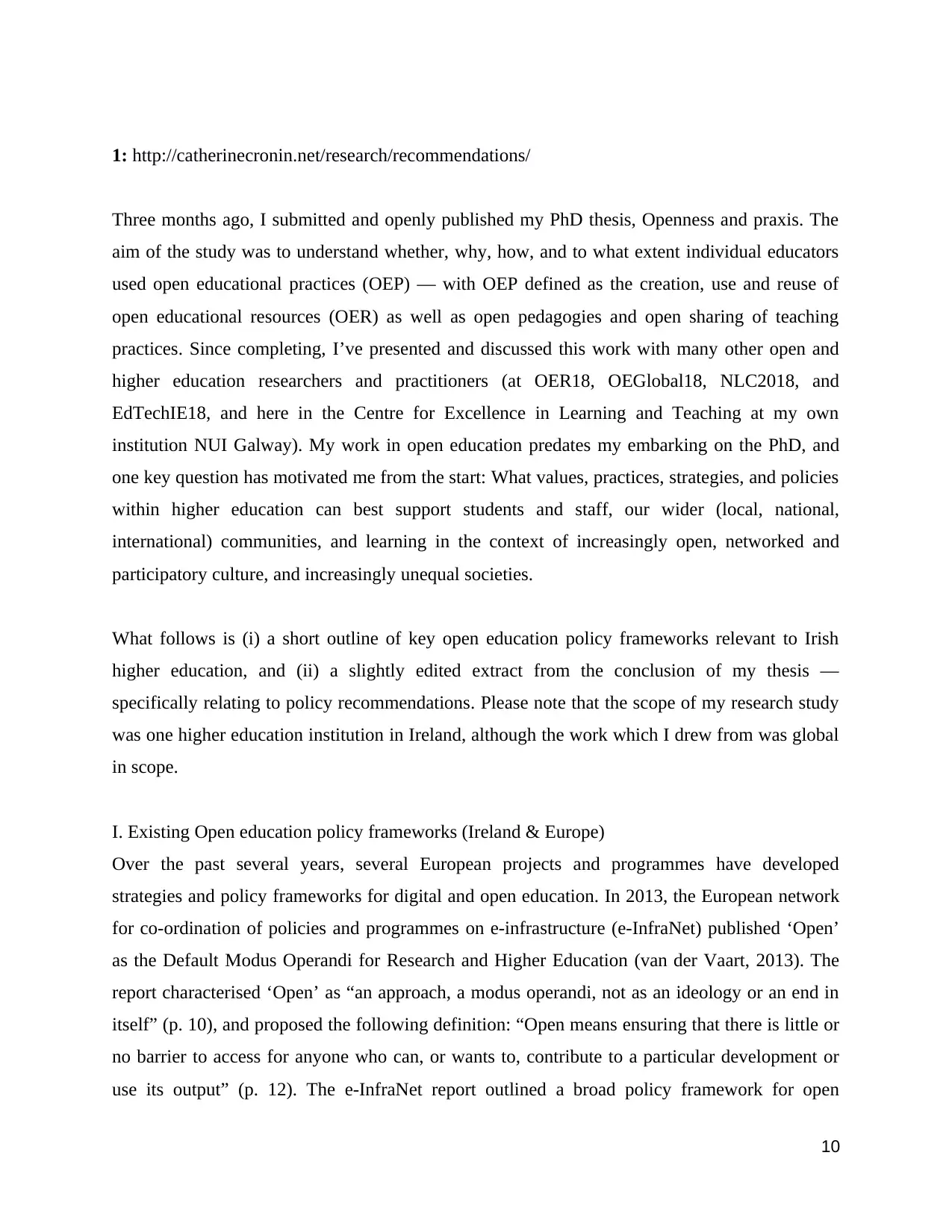
1: http://catherinecronin.net/research/recommendations/
Three months ago, I submitted and openly published my PhD thesis, Openness and praxis. The
aim of the study was to understand whether, why, how, and to what extent individual educators
used open educational practices (OEP) — with OEP defined as the creation, use and reuse of
open educational resources (OER) as well as open pedagogies and open sharing of teaching
practices. Since completing, I’ve presented and discussed this work with many other open and
higher education researchers and practitioners (at OER18, OEGlobal18, NLC2018, and
EdTechIE18, and here in the Centre for Excellence in Learning and Teaching at my own
institution NUI Galway). My work in open education predates my embarking on the PhD, and
one key question has motivated me from the start: What values, practices, strategies, and policies
within higher education can best support students and staff, our wider (local, national,
international) communities, and learning in the context of increasingly open, networked and
participatory culture, and increasingly unequal societies.
What follows is (i) a short outline of key open education policy frameworks relevant to Irish
higher education, and (ii) a slightly edited extract from the conclusion of my thesis —
specifically relating to policy recommendations. Please note that the scope of my research study
was one higher education institution in Ireland, although the work which I drew from was global
in scope.
I. Existing Open education policy frameworks (Ireland & Europe)
Over the past several years, several European projects and programmes have developed
strategies and policy frameworks for digital and open education. In 2013, the European network
for co-ordination of policies and programmes on e-infrastructure (e-InfraNet) published ‘Open’
as the Default Modus Operandi for Research and Higher Education (van der Vaart, 2013). The
report characterised ‘Open’ as “an approach, a modus operandi, not as an ideology or an end in
itself” (p. 10), and proposed the following definition: “Open means ensuring that there is little or
no barrier to access for anyone who can, or wants to, contribute to a particular development or
use its output” (p. 12). The e-InfraNet report outlined a broad policy framework for open
10
Three months ago, I submitted and openly published my PhD thesis, Openness and praxis. The
aim of the study was to understand whether, why, how, and to what extent individual educators
used open educational practices (OEP) — with OEP defined as the creation, use and reuse of
open educational resources (OER) as well as open pedagogies and open sharing of teaching
practices. Since completing, I’ve presented and discussed this work with many other open and
higher education researchers and practitioners (at OER18, OEGlobal18, NLC2018, and
EdTechIE18, and here in the Centre for Excellence in Learning and Teaching at my own
institution NUI Galway). My work in open education predates my embarking on the PhD, and
one key question has motivated me from the start: What values, practices, strategies, and policies
within higher education can best support students and staff, our wider (local, national,
international) communities, and learning in the context of increasingly open, networked and
participatory culture, and increasingly unequal societies.
What follows is (i) a short outline of key open education policy frameworks relevant to Irish
higher education, and (ii) a slightly edited extract from the conclusion of my thesis —
specifically relating to policy recommendations. Please note that the scope of my research study
was one higher education institution in Ireland, although the work which I drew from was global
in scope.
I. Existing Open education policy frameworks (Ireland & Europe)
Over the past several years, several European projects and programmes have developed
strategies and policy frameworks for digital and open education. In 2013, the European network
for co-ordination of policies and programmes on e-infrastructure (e-InfraNet) published ‘Open’
as the Default Modus Operandi for Research and Higher Education (van der Vaart, 2013). The
report characterised ‘Open’ as “an approach, a modus operandi, not as an ideology or an end in
itself” (p. 10), and proposed the following definition: “Open means ensuring that there is little or
no barrier to access for anyone who can, or wants to, contribute to a particular development or
use its output” (p. 12). The e-InfraNet report outlined a broad policy framework for open
10
Paraphrase This Document
Need a fresh take? Get an instant paraphrase of this document with our AI Paraphraser
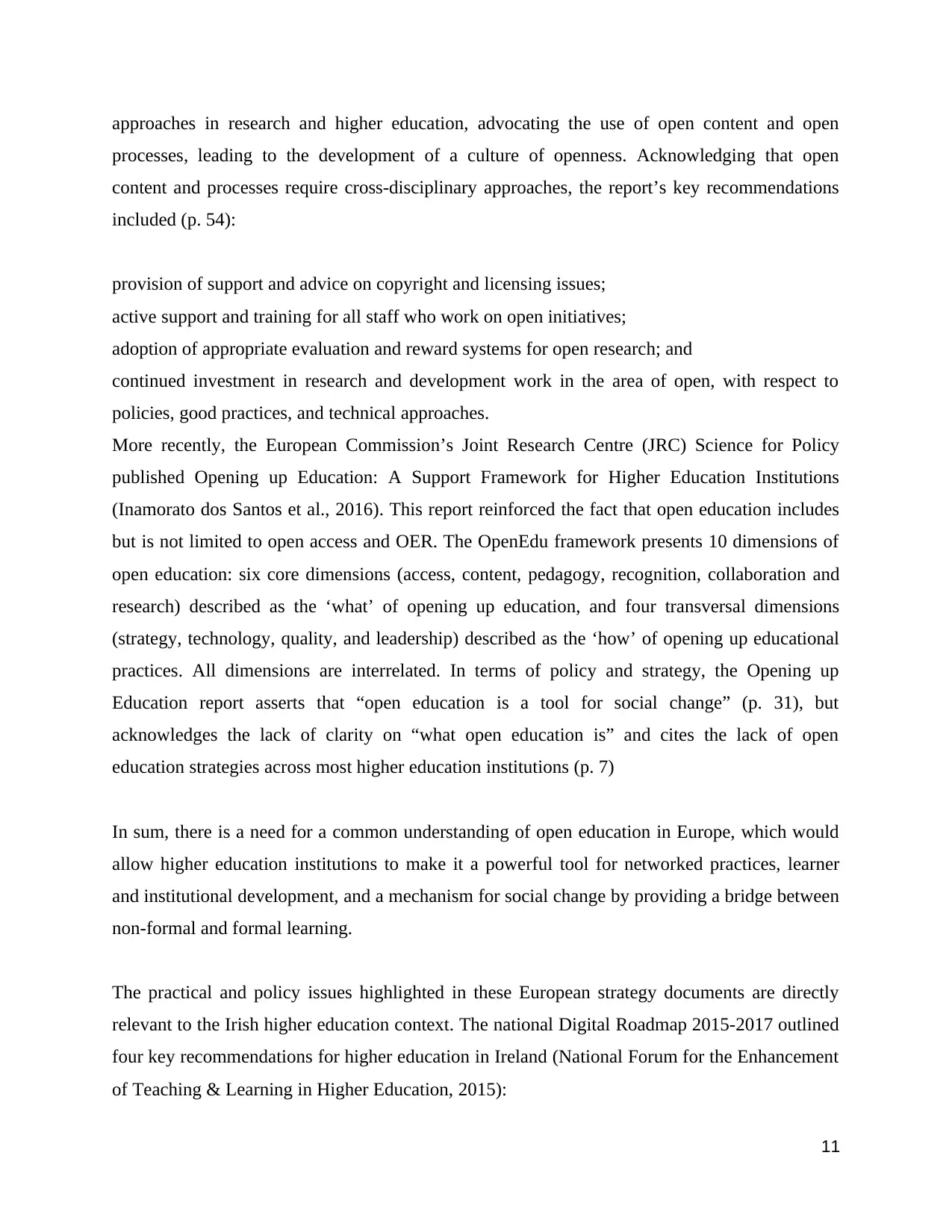
approaches in research and higher education, advocating the use of open content and open
processes, leading to the development of a culture of openness. Acknowledging that open
content and processes require cross-disciplinary approaches, the report’s key recommendations
included (p. 54):
provision of support and advice on copyright and licensing issues;
active support and training for all staff who work on open initiatives;
adoption of appropriate evaluation and reward systems for open research; and
continued investment in research and development work in the area of open, with respect to
policies, good practices, and technical approaches.
More recently, the European Commission’s Joint Research Centre (JRC) Science for Policy
published Opening up Education: A Support Framework for Higher Education Institutions
(Inamorato dos Santos et al., 2016). This report reinforced the fact that open education includes
but is not limited to open access and OER. The OpenEdu framework presents 10 dimensions of
open education: six core dimensions (access, content, pedagogy, recognition, collaboration and
research) described as the ‘what’ of opening up education, and four transversal dimensions
(strategy, technology, quality, and leadership) described as the ‘how’ of opening up educational
practices. All dimensions are interrelated. In terms of policy and strategy, the Opening up
Education report asserts that “open education is a tool for social change” (p. 31), but
acknowledges the lack of clarity on “what open education is” and cites the lack of open
education strategies across most higher education institutions (p. 7)
In sum, there is a need for a common understanding of open education in Europe, which would
allow higher education institutions to make it a powerful tool for networked practices, learner
and institutional development, and a mechanism for social change by providing a bridge between
non-formal and formal learning.
The practical and policy issues highlighted in these European strategy documents are directly
relevant to the Irish higher education context. The national Digital Roadmap 2015-2017 outlined
four key recommendations for higher education in Ireland (National Forum for the Enhancement
of Teaching & Learning in Higher Education, 2015):
11
processes, leading to the development of a culture of openness. Acknowledging that open
content and processes require cross-disciplinary approaches, the report’s key recommendations
included (p. 54):
provision of support and advice on copyright and licensing issues;
active support and training for all staff who work on open initiatives;
adoption of appropriate evaluation and reward systems for open research; and
continued investment in research and development work in the area of open, with respect to
policies, good practices, and technical approaches.
More recently, the European Commission’s Joint Research Centre (JRC) Science for Policy
published Opening up Education: A Support Framework for Higher Education Institutions
(Inamorato dos Santos et al., 2016). This report reinforced the fact that open education includes
but is not limited to open access and OER. The OpenEdu framework presents 10 dimensions of
open education: six core dimensions (access, content, pedagogy, recognition, collaboration and
research) described as the ‘what’ of opening up education, and four transversal dimensions
(strategy, technology, quality, and leadership) described as the ‘how’ of opening up educational
practices. All dimensions are interrelated. In terms of policy and strategy, the Opening up
Education report asserts that “open education is a tool for social change” (p. 31), but
acknowledges the lack of clarity on “what open education is” and cites the lack of open
education strategies across most higher education institutions (p. 7)
In sum, there is a need for a common understanding of open education in Europe, which would
allow higher education institutions to make it a powerful tool for networked practices, learner
and institutional development, and a mechanism for social change by providing a bridge between
non-formal and formal learning.
The practical and policy issues highlighted in these European strategy documents are directly
relevant to the Irish higher education context. The national Digital Roadmap 2015-2017 outlined
four key recommendations for higher education in Ireland (National Forum for the Enhancement
of Teaching & Learning in Higher Education, 2015):
11
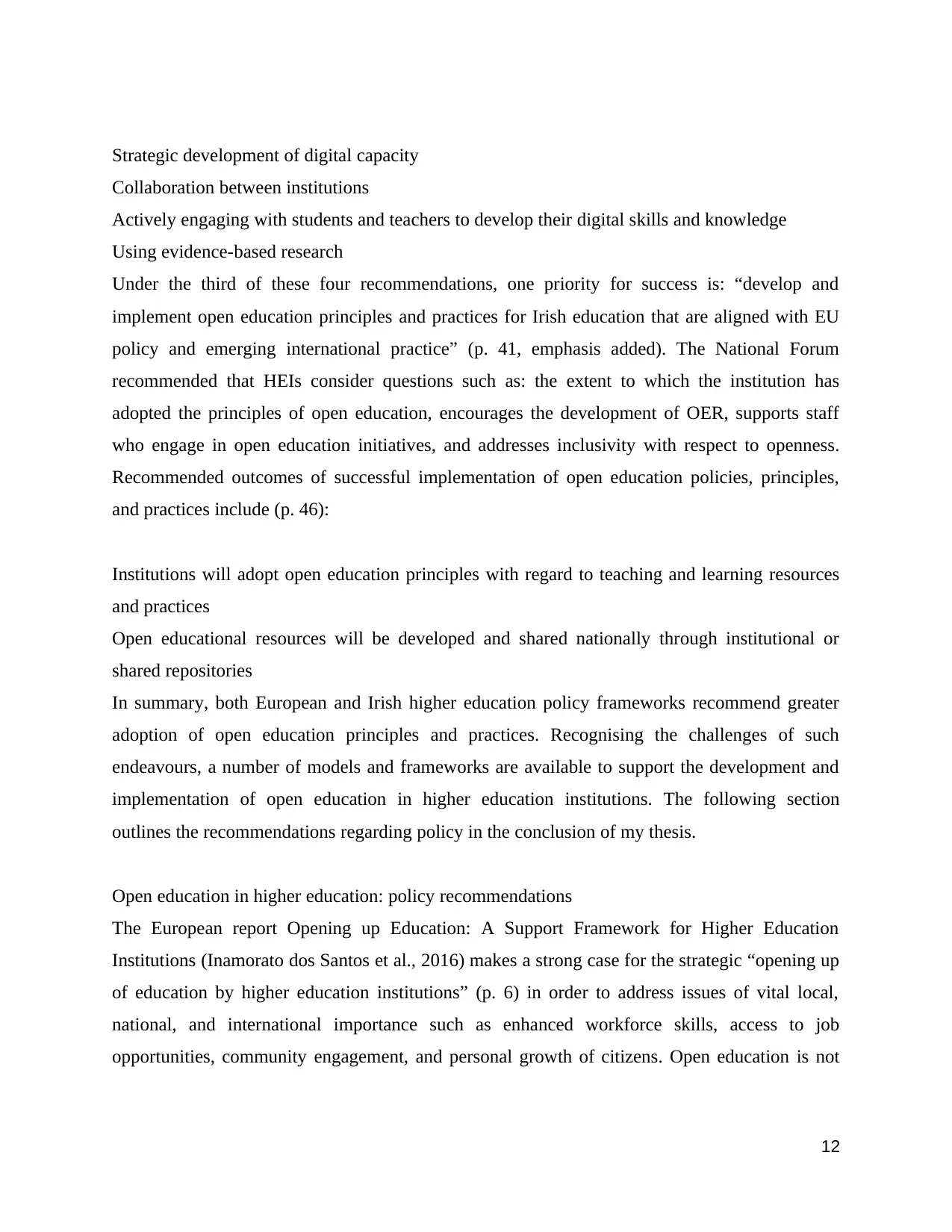
Strategic development of digital capacity
Collaboration between institutions
Actively engaging with students and teachers to develop their digital skills and knowledge
Using evidence-based research
Under the third of these four recommendations, one priority for success is: “develop and
implement open education principles and practices for Irish education that are aligned with EU
policy and emerging international practice” (p. 41, emphasis added). The National Forum
recommended that HEIs consider questions such as: the extent to which the institution has
adopted the principles of open education, encourages the development of OER, supports staff
who engage in open education initiatives, and addresses inclusivity with respect to openness.
Recommended outcomes of successful implementation of open education policies, principles,
and practices include (p. 46):
Institutions will adopt open education principles with regard to teaching and learning resources
and practices
Open educational resources will be developed and shared nationally through institutional or
shared repositories
In summary, both European and Irish higher education policy frameworks recommend greater
adoption of open education principles and practices. Recognising the challenges of such
endeavours, a number of models and frameworks are available to support the development and
implementation of open education in higher education institutions. The following section
outlines the recommendations regarding policy in the conclusion of my thesis.
Open education in higher education: policy recommendations
The European report Opening up Education: A Support Framework for Higher Education
Institutions (Inamorato dos Santos et al., 2016) makes a strong case for the strategic “opening up
of education by higher education institutions” (p. 6) in order to address issues of vital local,
national, and international importance such as enhanced workforce skills, access to job
opportunities, community engagement, and personal growth of citizens. Open education is not
12
Collaboration between institutions
Actively engaging with students and teachers to develop their digital skills and knowledge
Using evidence-based research
Under the third of these four recommendations, one priority for success is: “develop and
implement open education principles and practices for Irish education that are aligned with EU
policy and emerging international practice” (p. 41, emphasis added). The National Forum
recommended that HEIs consider questions such as: the extent to which the institution has
adopted the principles of open education, encourages the development of OER, supports staff
who engage in open education initiatives, and addresses inclusivity with respect to openness.
Recommended outcomes of successful implementation of open education policies, principles,
and practices include (p. 46):
Institutions will adopt open education principles with regard to teaching and learning resources
and practices
Open educational resources will be developed and shared nationally through institutional or
shared repositories
In summary, both European and Irish higher education policy frameworks recommend greater
adoption of open education principles and practices. Recognising the challenges of such
endeavours, a number of models and frameworks are available to support the development and
implementation of open education in higher education institutions. The following section
outlines the recommendations regarding policy in the conclusion of my thesis.
Open education in higher education: policy recommendations
The European report Opening up Education: A Support Framework for Higher Education
Institutions (Inamorato dos Santos et al., 2016) makes a strong case for the strategic “opening up
of education by higher education institutions” (p. 6) in order to address issues of vital local,
national, and international importance such as enhanced workforce skills, access to job
opportunities, community engagement, and personal growth of citizens. Open education is not
12
⊘ This is a preview!⊘
Do you want full access?
Subscribe today to unlock all pages.
Trusted by 1+ million students worldwide

1 out of 18


Related Documents


Your All-in-One AI-Powered Toolkit for Academic Success.
+13062052269
info@desklib.com
Available 24*7 on WhatsApp / Email
![[object Object]](/_next/static/media/star-bottom.7253800d.svg)
Unlock your academic potential
Copyright © 2020–2026 A2Z Services. All Rights Reserved. Developed and managed by ZUCOL.