ELA Mini-Unit Plan: Addressing Stephanie's Language Disorder

Verified

Added on  2023/01/20

|4
|1035
|57
Homework Assignment
AI Summary
This assignment presents an ELA mini-unit plan designed to support a student, Stephanie, with a language disorder. The plan is divided into three parts: student goals, a mini-unit with lesson plans for three days, and a rationale. The IEP goals focus on improving decoding and reading comprehension skills using vocabulary from the student's syllabus. The mini-unit includes lesson titles, objectives, summaries, national/state learning standards, vocabulary, materials, instructional strategies, and assessment accommodations. The lesson plans emphasize reading aloud, vocabulary development, and the use of AAC (Augmentative and Alternative Communication) strategies. Pre- and post-assessments are included to monitor the student's progress. The rationale highlights the importance of addressing the student's difficulties with expression, language, and reading comprehension, emphasizing the use of AAC and vocabulary development to improve learning abilities. The assignment references research supporting these educational strategies.
Document Page
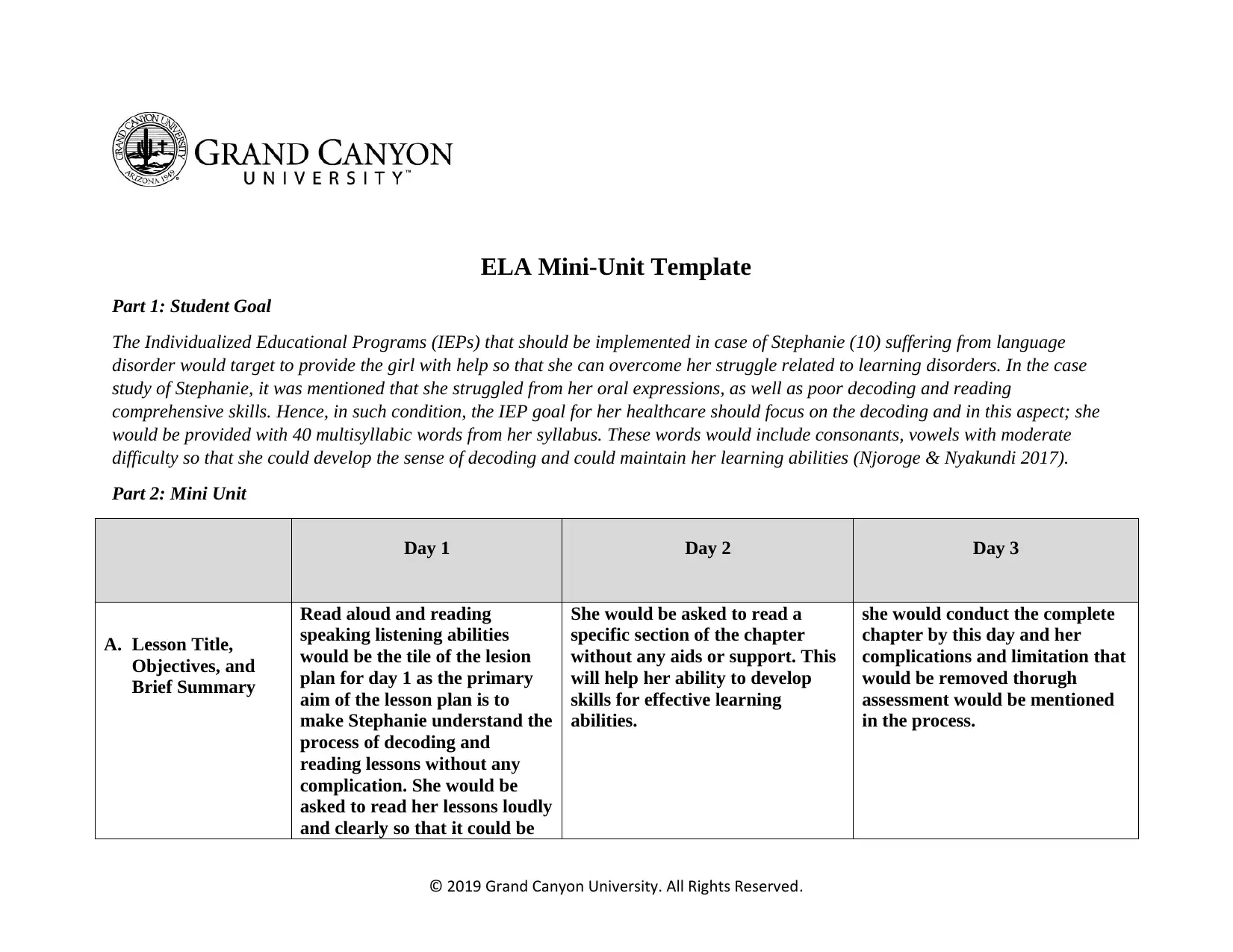
ELA Mini-Unit Template
Part 1: Student Goal
The Individualized Educational Programs (IEPs) that should be implemented in case of Stephanie (10) suffering from language
disorder would target to provide the girl with help so that she can overcome her struggle related to learning disorders. In the case
study of Stephanie, it was mentioned that she struggled from her oral expressions, as well as poor decoding and reading
comprehensive skills. Hence, in such condition, the IEP goal for her healthcare should focus on the decoding and in this aspect; she
would be provided with 40 multisyllabic words from her syllabus. These words would include consonants, vowels with moderate
difficulty so that she could develop the sense of decoding and could maintain her learning abilities (Njoroge & Nyakundi 2017).
Part 2: Mini Unit
Day 1 Day 2 Day 3
A. Lesson Title,
Objectives, and
Brief Summary
Read aloud and reading
speaking listening abilities
would be the tile of the lesion
plan for day 1 as the primary
aim of the lesson plan is to
make Stephanie understand the
process of decoding and
reading lessons without any
complication. She would be
asked to read her lessons loudly
and clearly so that it could be
She would be asked to read a
specific section of the chapter
without any aids or support. This
will help her ability to develop
skills for effective learning
abilities.
she would conduct the complete
chapter by this day and her
complications and limitation that
would be removed thorugh
assessment would be mentioned
in the process.
© 2019 Grand Canyon University. All Rights Reserved.
tabler-icon-diamond-filled.svg

Paraphrase This Document

Need a fresh take? Get an instant paraphrase of this document with our AI Paraphraser
Document Page
audible her assisting physicians
and they can her to maintain
her adequate learning abilities.
B. National/State
Learning
Standards
Both the national and state
based legislations would be
applied for the development
and implement of the lesson
plan for the development of
educational program for
Stephanie could be developed.
Both the national and state based
legislations would be applied for
the development and implement
of the lesson plan for the
development of educational
program for Stephanie could be
developed.
Both the national and state based
legislations would be applied for
the development and implement
of the lesson plan for the
development of educational
program for Stephanie could be
developed.
C. Vocabulary and
Academic
Language
she would be provided with less
complicated vocabulary so that
she could develop vocabulary
the level of complication for her
vocabulary would be increased
she would be asked to develop all
the vocabulary present in the
chapter
D. Materials and
Resources
class room, pen, chalk, duster
and books
class room, pen, chalk, duster and
books
class room, pen, chalk, duster
and books
E. Instructional
Strategy/Strategie
s
She would be provided with
instruction in the class room
through general educator.
class room strategies and effective
learning approach would be
applied
class room strategies and
effective learning approach
would be applied
F. Summary of
Instruction and
Activities for the
Lesson
she would be asked to
communicate to the Instructor
assistant so that they can
develop the sense of related
ness
she would be communicating in
class with fellow students
she would develop effective
communication abilities
G. Lesson
Differentiation
for Stephanie
Using AAC
Stephanie would be provided
with high tech learning aids as
per AAC so that she could
develop effective abilities
related to her learning abilities
body language, facial expressions,
and sign language would be the
unaided AACs that would be
applied.
both aided and unaided aspects
would be used in this process
© 2019 Grand Canyon University. All Rights Reserved.
Document Page
H. Pre- and Post-
Assessments
general teacher would conduct
the pre and post assessment for
comparison of growth and
development.
class room assessment would be
conducted
class room assessment would be
conducted
I. Assessment
Accommodation
for Stephanie
Using AAC
Her ability to use the aided
high tech product for the
assessment of AAC.
At the final section assessment
would be conducted to
understand the progress after
implementing AAC.
After completion of the session,
Stephanie would mention her
own loopholes and difficulties so
that further growth and
development of aspects could be
understood.
Part 3: Rationale
While analyzing the case study one situation which was observed critically is the inability of Stephanie to understand the way she can
use her expressions, languages, meanings and abilities learn the decoding or reading or comprehension abilities (Njoroge & Nyakundi,
2017). Hence, in such condition, application of these three days long mini unit lesion plan would be useful so that she could be
provided with effective reading and comprehension related abilities and hence, it would help her to understand the way she can use the
AACs and develop learning and decoding abilities (Boillos Pereira, Pérez-Izaguirre & Apaolaza-Llorente, 2019). As per da Silva et al.
(2018), in children with learning or language difficulties, the children should be provided with support so that they can develop their
list of vocabulary on their own and then can implement that in their own learning. Hence, this aspect has been used.
© 2019 Grand Canyon University. All Rights Reserved.
Document Page
References
Boillos Pereira, M. D. M., Pérez-Izaguirre, E., & Apaolaza-Llorente, D. (2019). Systems of Augmentative and Alternative
Communication (SAACs) in Spain: A Systematic Review of the Educational Practices Conducted in the Last Decade. Social
Sciences, 8(1), 15.
da Silva, A. P., Bulle Oliveira, A. S., Pinheiro Bezerra, I. M., Pedrozo Campos Antunes, T., Guerrero Daboin, B. E., Raimundo, R. D.,
... & de Abreu, L. C. (2018). Low cost assistive technology to support educational activities for adolescents with cerebral
palsy. Disability and Rehabilitation: Assistive Technology, 13(7), 676-682.
Njoroge, M. C., & Nyakundi, A. (2017). Navigating communication difficulties faced by children with autism: Evidence from Kenya.
© 2019 Grand Canyon University. All Rights Reserved.
chevron_up_icon
1 out of 4
circle_padding
hide_on_mobile
zoom_out_icon
[object Object]