Althusser, Foucault, and Language: An Analysis of Power and Ideology
VerifiedAdded on 2023/04/21
|11
|3214
|83
Essay
AI Summary
This essay delves into the assertion that language is inherently ideological, examining its role in shaping subjectivity and expressing power through the theoretical frameworks of Louis Althusser and Michel Foucault. It elucidates Althusser's concept of ideology as a representation of individuals' imaginary relationship to their real conditions of existence, highlighting the influence of Repressive State Apparatuses (RSAs) and Ideological State Apparatuses (ISAs) in perpetuating dominant ideologies. The essay contrasts Althusser's perspective with Foucault's analysis of power as a productive force intertwined with knowledge and discourse, shaping human behavior and perceptions. It discusses how language, according to Foucault, is not merely a tool for communication but a fundamental instrument for sharing values and opinions, and how power structures utilize language to manipulate and control individuals. Ultimately, the essay navigates the complex interplay between language, ideology, and power, offering insights into the construction of subjectivity and the dynamics of social control, find more solved assignments and study resources on Desklib.
Running head: PHILOSOPHY
PHILOSOPHY
Name of the Student
Name of the University
Author Note
PHILOSOPHY
Name of the Student
Name of the University
Author Note

Paraphrase This Document
Need a fresh take? Get an instant paraphrase of this document with our AI Paraphraser
1PHILOSOPHY
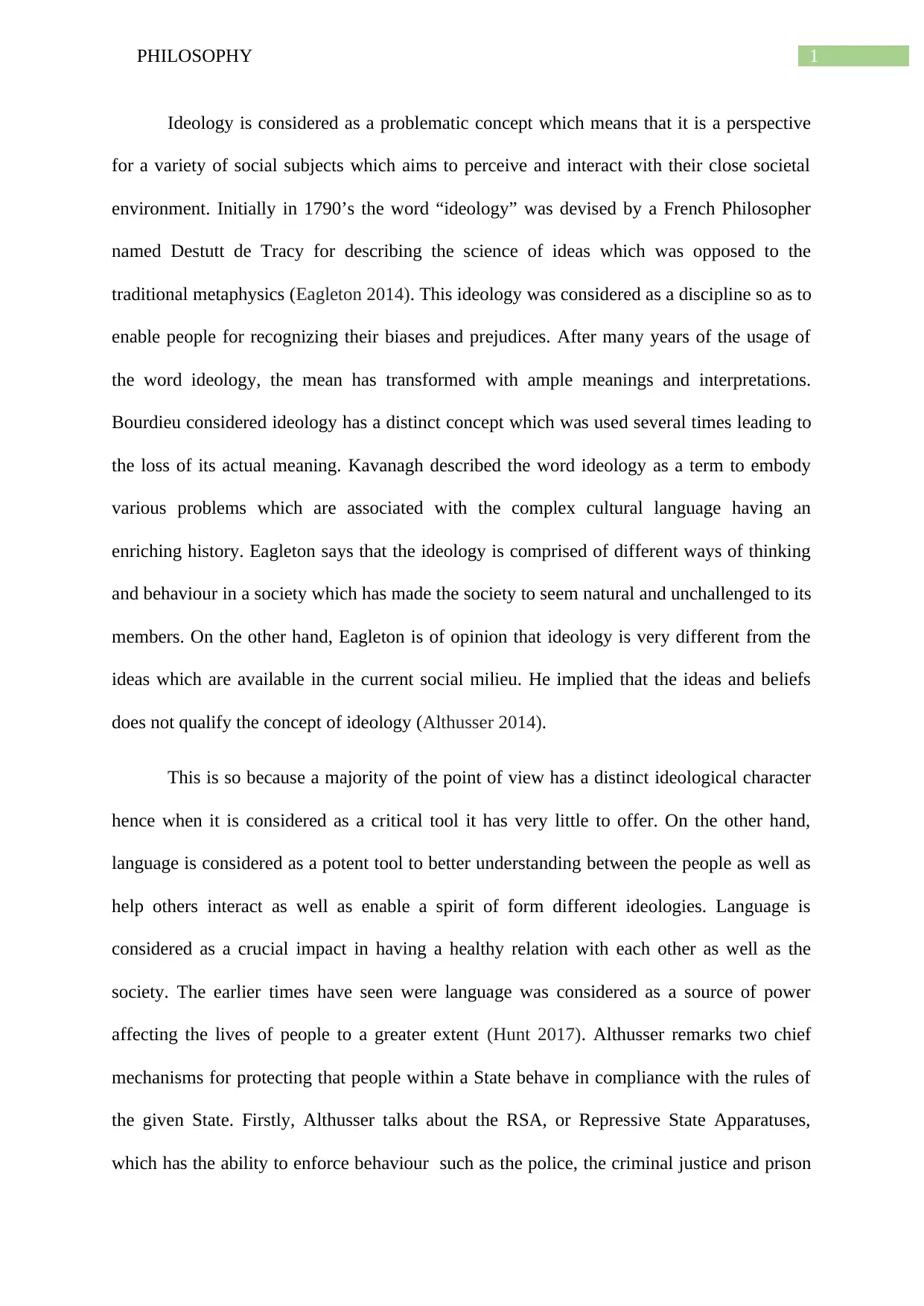
Ideology is considered as a problematic concept which means that it is a perspective
for a variety of social subjects which aims to perceive and interact with their close societal
environment. Initially in 1790’s the word “ideology” was devised by a French Philosopher
named Destutt de Tracy for describing the science of ideas which was opposed to the
traditional metaphysics (Eagleton 2014). This ideology was considered as a discipline so as to
enable people for recognizing their biases and prejudices. After many years of the usage of
the word ideology, the mean has transformed with ample meanings and interpretations.
Bourdieu considered ideology has a distinct concept which was used several times leading to
the loss of its actual meaning. Kavanagh described the word ideology as a term to embody
various problems which are associated with the complex cultural language having an
enriching history. Eagleton says that the ideology is comprised of different ways of thinking
and behaviour in a society which has made the society to seem natural and unchallenged to its
members. On the other hand, Eagleton is of opinion that ideology is very different from the
ideas which are available in the current social milieu. He implied that the ideas and beliefs
does not qualify the concept of ideology (Althusser 2014).
This is so because a majority of the point of view has a distinct ideological character
hence when it is considered as a critical tool it has very little to offer. On the other hand,
language is considered as a potent tool to better understanding between the people as well as
help others interact as well as enable a spirit of form different ideologies. Language is
considered as a crucial impact in having a healthy relation with each other as well as the
society. The earlier times have seen were language was considered as a source of power
affecting the lives of people to a greater extent (Hunt 2017). Althusser remarks two chief
mechanisms for protecting that people within a State behave in compliance with the rules of
the given State. Firstly, Althusser talks about the RSA, or Repressive State Apparatuses,
which has the ability to enforce behaviour such as the police, the criminal justice and prison
Ideology is considered as a problematic concept which means that it is a perspective
for a variety of social subjects which aims to perceive and interact with their close societal
environment. Initially in 1790’s the word “ideology” was devised by a French Philosopher
named Destutt de Tracy for describing the science of ideas which was opposed to the
traditional metaphysics (Eagleton 2014). This ideology was considered as a discipline so as to
enable people for recognizing their biases and prejudices. After many years of the usage of
the word ideology, the mean has transformed with ample meanings and interpretations.
Bourdieu considered ideology has a distinct concept which was used several times leading to
the loss of its actual meaning. Kavanagh described the word ideology as a term to embody
various problems which are associated with the complex cultural language having an
enriching history. Eagleton says that the ideology is comprised of different ways of thinking
and behaviour in a society which has made the society to seem natural and unchallenged to its
members. On the other hand, Eagleton is of opinion that ideology is very different from the
ideas which are available in the current social milieu. He implied that the ideas and beliefs
does not qualify the concept of ideology (Althusser 2014).
This is so because a majority of the point of view has a distinct ideological character
hence when it is considered as a critical tool it has very little to offer. On the other hand,
language is considered as a potent tool to better understanding between the people as well as
help others interact as well as enable a spirit of form different ideologies. Language is
considered as a crucial impact in having a healthy relation with each other as well as the
society. The earlier times have seen were language was considered as a source of power
affecting the lives of people to a greater extent (Hunt 2017). Althusser remarks two chief
mechanisms for protecting that people within a State behave in compliance with the rules of
the given State. Firstly, Althusser talks about the RSA, or Repressive State Apparatuses,
which has the ability to enforce behaviour such as the police, the criminal justice and prison
2PHILOSOPHY
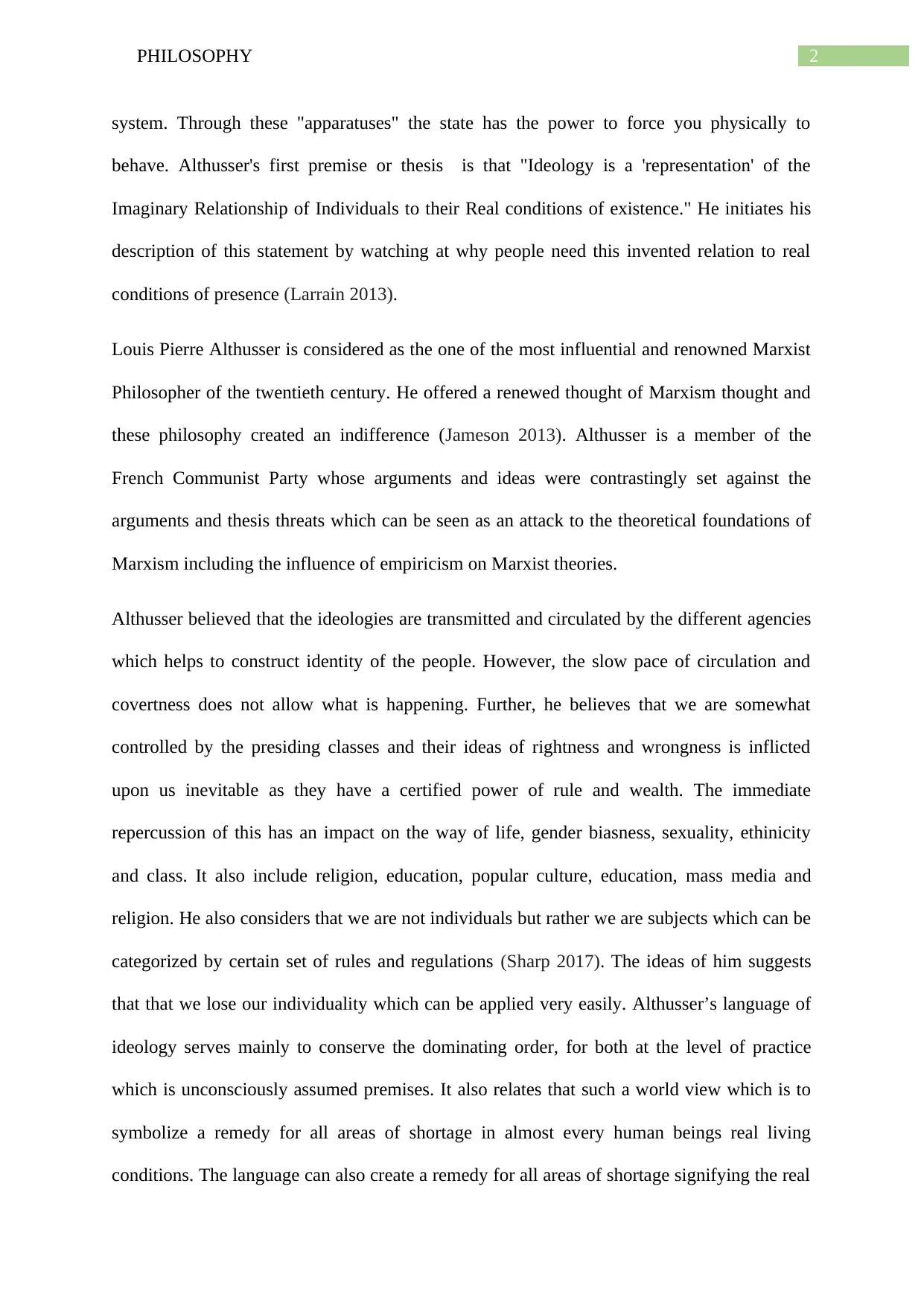
system. Through these "apparatuses" the state has the power to force you physically to
behave. Althusser's first premise or thesis is that "Ideology is a 'representation' of the
Imaginary Relationship of Individuals to their Real conditions of existence." He initiates his
description of this statement by watching at why people need this invented relation to real
conditions of presence (Larrain 2013).
Louis Pierre Althusser is considered as the one of the most influential and renowned Marxist
Philosopher of the twentieth century. He offered a renewed thought of Marxism thought and
these philosophy created an indifference (Jameson 2013). Althusser is a member of the
French Communist Party whose arguments and ideas were contrastingly set against the
arguments and thesis threats which can be seen as an attack to the theoretical foundations of
Marxism including the influence of empiricism on Marxist theories.
Althusser believed that the ideologies are transmitted and circulated by the different agencies
which helps to construct identity of the people. However, the slow pace of circulation and
covertness does not allow what is happening. Further, he believes that we are somewhat
controlled by the presiding classes and their ideas of rightness and wrongness is inflicted
upon us inevitable as they have a certified power of rule and wealth. The immediate
repercussion of this has an impact on the way of life, gender biasness, sexuality, ethinicity
and class. It also include religion, education, popular culture, education, mass media and
religion. He also considers that we are not individuals but rather we are subjects which can be
categorized by certain set of rules and regulations (Sharp 2017). The ideas of him suggests
that that we lose our individuality which can be applied very easily. Althusser’s language of
ideology serves mainly to conserve the dominating order, for both at the level of practice
which is unconsciously assumed premises. It also relates that such a world view which is to
symbolize a remedy for all areas of shortage in almost every human beings real living
conditions. The language can also create a remedy for all areas of shortage signifying the real
system. Through these "apparatuses" the state has the power to force you physically to
behave. Althusser's first premise or thesis is that "Ideology is a 'representation' of the
Imaginary Relationship of Individuals to their Real conditions of existence." He initiates his
description of this statement by watching at why people need this invented relation to real
conditions of presence (Larrain 2013).
Louis Pierre Althusser is considered as the one of the most influential and renowned Marxist
Philosopher of the twentieth century. He offered a renewed thought of Marxism thought and
these philosophy created an indifference (Jameson 2013). Althusser is a member of the
French Communist Party whose arguments and ideas were contrastingly set against the
arguments and thesis threats which can be seen as an attack to the theoretical foundations of
Marxism including the influence of empiricism on Marxist theories.
Althusser believed that the ideologies are transmitted and circulated by the different agencies
which helps to construct identity of the people. However, the slow pace of circulation and
covertness does not allow what is happening. Further, he believes that we are somewhat
controlled by the presiding classes and their ideas of rightness and wrongness is inflicted
upon us inevitable as they have a certified power of rule and wealth. The immediate
repercussion of this has an impact on the way of life, gender biasness, sexuality, ethinicity
and class. It also include religion, education, popular culture, education, mass media and
religion. He also considers that we are not individuals but rather we are subjects which can be
categorized by certain set of rules and regulations (Sharp 2017). The ideas of him suggests
that that we lose our individuality which can be applied very easily. Althusser’s language of
ideology serves mainly to conserve the dominating order, for both at the level of practice
which is unconsciously assumed premises. It also relates that such a world view which is to
symbolize a remedy for all areas of shortage in almost every human beings real living
conditions. The language can also create a remedy for all areas of shortage signifying the real
⊘ This is a preview!⊘
Do you want full access?
Subscribe today to unlock all pages.

Trusted by 1+ million students worldwide
3PHILOSOPHY
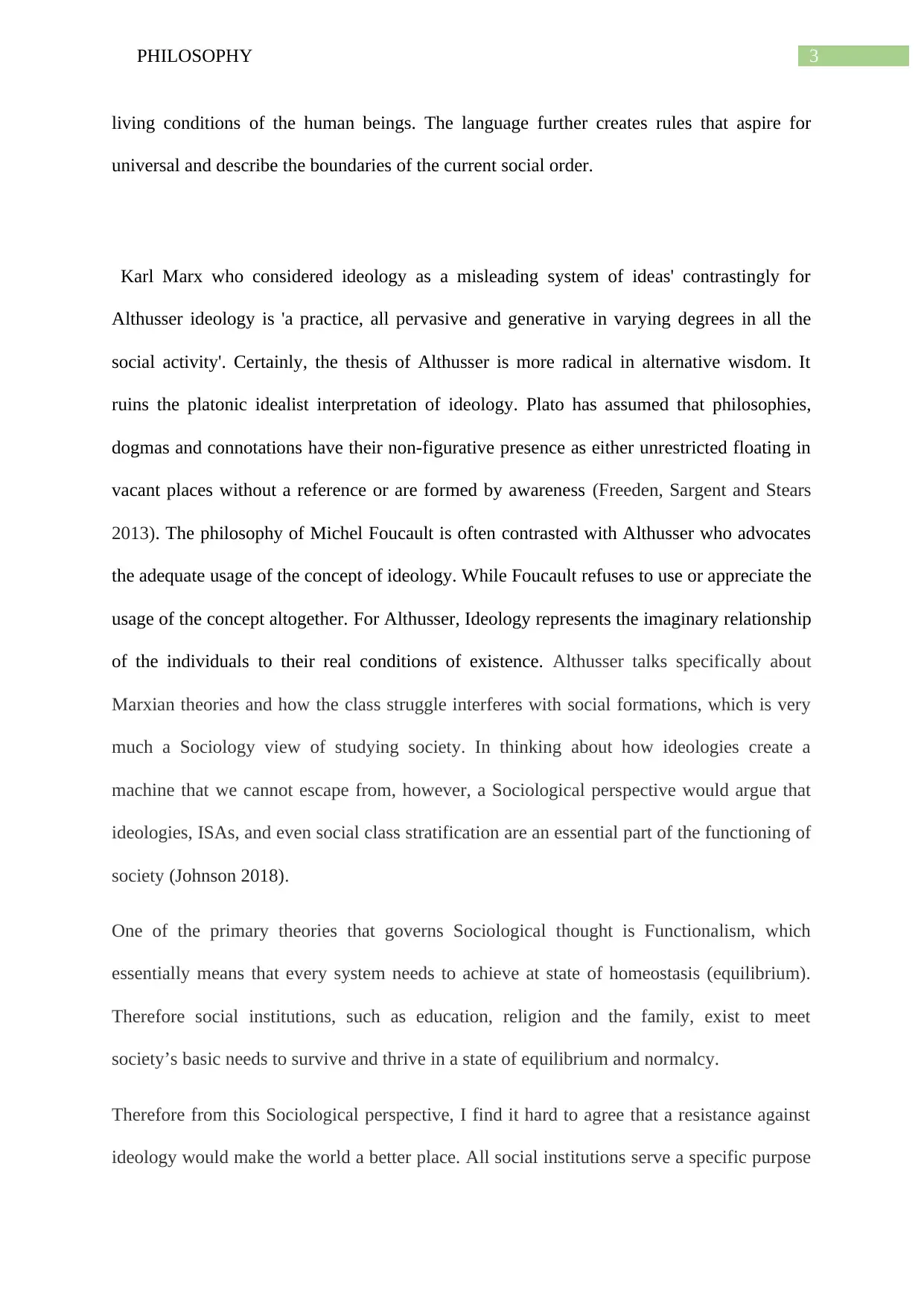
living conditions of the human beings. The language further creates rules that aspire for
universal and describe the boundaries of the current social order.
Karl Marx who considered ideology as a misleading system of ideas' contrastingly for
Althusser ideology is 'a practice, all pervasive and generative in varying degrees in all the
social activity'. Certainly, the thesis of Althusser is more radical in alternative wisdom. It
ruins the platonic idealist interpretation of ideology. Plato has assumed that philosophies,
dogmas and connotations have their non-figurative presence as either unrestricted floating in
vacant places without a reference or are formed by awareness (Freeden, Sargent and Stears
2013). The philosophy of Michel Foucault is often contrasted with Althusser who advocates
the adequate usage of the concept of ideology. While Foucault refuses to use or appreciate the
usage of the concept altogether. For Althusser, Ideology represents the imaginary relationship
of the individuals to their real conditions of existence. Althusser talks specifically about
Marxian theories and how the class struggle interferes with social formations, which is very
much a Sociology view of studying society. In thinking about how ideologies create a
machine that we cannot escape from, however, a Sociological perspective would argue that
ideologies, ISAs, and even social class stratification are an essential part of the functioning of
society (Johnson 2018).
One of the primary theories that governs Sociological thought is Functionalism, which
essentially means that every system needs to achieve at state of homeostasis (equilibrium).
Therefore social institutions, such as education, religion and the family, exist to meet
society’s basic needs to survive and thrive in a state of equilibrium and normalcy.
Therefore from this Sociological perspective, I find it hard to agree that a resistance against
ideology would make the world a better place. All social institutions serve a specific purpose
living conditions of the human beings. The language further creates rules that aspire for
universal and describe the boundaries of the current social order.
Karl Marx who considered ideology as a misleading system of ideas' contrastingly for
Althusser ideology is 'a practice, all pervasive and generative in varying degrees in all the
social activity'. Certainly, the thesis of Althusser is more radical in alternative wisdom. It
ruins the platonic idealist interpretation of ideology. Plato has assumed that philosophies,
dogmas and connotations have their non-figurative presence as either unrestricted floating in
vacant places without a reference or are formed by awareness (Freeden, Sargent and Stears
2013). The philosophy of Michel Foucault is often contrasted with Althusser who advocates
the adequate usage of the concept of ideology. While Foucault refuses to use or appreciate the
usage of the concept altogether. For Althusser, Ideology represents the imaginary relationship
of the individuals to their real conditions of existence. Althusser talks specifically about
Marxian theories and how the class struggle interferes with social formations, which is very
much a Sociology view of studying society. In thinking about how ideologies create a
machine that we cannot escape from, however, a Sociological perspective would argue that
ideologies, ISAs, and even social class stratification are an essential part of the functioning of
society (Johnson 2018).
One of the primary theories that governs Sociological thought is Functionalism, which
essentially means that every system needs to achieve at state of homeostasis (equilibrium).
Therefore social institutions, such as education, religion and the family, exist to meet
society’s basic needs to survive and thrive in a state of equilibrium and normalcy.
Therefore from this Sociological perspective, I find it hard to agree that a resistance against
ideology would make the world a better place. All social institutions serve a specific purpose
Paraphrase This Document
Need a fresh take? Get an instant paraphrase of this document with our AI Paraphraser
4PHILOSOPHY
that allows society to function. For example, education is an important agent of socialization
for young children. They teach those social norms and how to behave among other people,
which Althusser agrees with, but protests against the dominant’s class affect on these
ideologies.
Michele Foucault was born on October 15, 1926. Though psychologically he was tormented
in his early childhood days, he was established academically erudite, holding a series of
position at French Universities. He was a philosopher with academics in both psychology and
history. Foucault work is predominantly celebrated for its pioneering method to the marvel of
power. A radically original analysis of power which defines power in the negative light
showing its repressive character yet productive (Apple 2017). The structures of power are
regarded as prohibition which has the ability to create newer things such as behaviour,
knowledge and other structures. Foucault demonstrates this by concentrating on the past of
Western penal systems further relating it with disciplinary establishments. He argues that the
power structures has been immensely used to confine the various elements of the society
emphasizing that these structures has a unique tendency of repression. The power structure is
largely used to manipulate and bring book to the behaviour of the people. In this logic, the
issue and his yearnings and wants are the creation of the supreme structures reasonably than a
system of ‘human nature’ that is purportedly inhibited. Foucault writes: “The individual is no
doubt the fictitious atom of an ‘ideological’ representation of society; but he is also a reality
fabricated by this specific technology of power that I have called ‘discipline’. We must cease
once and for all to describe the effects of power in negative terms: it ‘excludes’, it ‘represses’,
it ‘censors’, it ‘abstracts’, it ‘masks’, it ‘conceals’. In fact, power produces; it produces reality
it produces domains of objects and rituals of truth. The individual and the knowledge that
may be gained of him belong to this production.”
that allows society to function. For example, education is an important agent of socialization
for young children. They teach those social norms and how to behave among other people,
which Althusser agrees with, but protests against the dominant’s class affect on these
ideologies.
Michele Foucault was born on October 15, 1926. Though psychologically he was tormented
in his early childhood days, he was established academically erudite, holding a series of
position at French Universities. He was a philosopher with academics in both psychology and
history. Foucault work is predominantly celebrated for its pioneering method to the marvel of
power. A radically original analysis of power which defines power in the negative light
showing its repressive character yet productive (Apple 2017). The structures of power are
regarded as prohibition which has the ability to create newer things such as behaviour,
knowledge and other structures. Foucault demonstrates this by concentrating on the past of
Western penal systems further relating it with disciplinary establishments. He argues that the
power structures has been immensely used to confine the various elements of the society
emphasizing that these structures has a unique tendency of repression. The power structure is
largely used to manipulate and bring book to the behaviour of the people. In this logic, the
issue and his yearnings and wants are the creation of the supreme structures reasonably than a
system of ‘human nature’ that is purportedly inhibited. Foucault writes: “The individual is no
doubt the fictitious atom of an ‘ideological’ representation of society; but he is also a reality
fabricated by this specific technology of power that I have called ‘discipline’. We must cease
once and for all to describe the effects of power in negative terms: it ‘excludes’, it ‘represses’,
it ‘censors’, it ‘abstracts’, it ‘masks’, it ‘conceals’. In fact, power produces; it produces reality
it produces domains of objects and rituals of truth. The individual and the knowledge that
may be gained of him belong to this production.”
5PHILOSOPHY
Language, discourse and knowledge is known to affect the human behavior as well as his
perceptions. Language forms a basic and fundamental instrument which aims for sharing any
values and opinions as it is considered as the only medium to communicate human feelings. It
is considered as major weapon of expression through adequate usage of words (Layoun
2014). The various facts and information can be understood only through a proper language
as it enables a mutual understanding between two individual. An ideology can be only
communicated through language hence it acts as a foundation of understanding the thoughts
and perception of the people. Knowledge gained by the people either through writing or
verbally, is possible only through a language. While power on the other hand is considered as
a repressive measure having control and authority and inextricably related to masculinity. It is
further defined as a chance of a man or the number of men which realizes that their own will
is considered against the resistance of the others who are actively playing a part in the action.
Foucault analyzes that for many centuries the historians turned their focus and attention
towards the longer period of the history. These historians are trying to disclose that the stable
and eternal system of forms and balances, for the process which may be called as permanent,
or endless modifications further these tendencies gather required force. In context of
language, Foucault has given three level of language in which the first level of language, it is
raw and primitive and a simpler form of writing (Parekh 2015). Language is nothing more
than a certain case of importance of people or a singular case of presentation for the classical
though and age. This interpretation of language was inferred from his remarkable words that
the primacy of the written words went into abeyance.
Language has been inextricably linked with knowledge in variety of ways and each of them
corresponds to a unique sense of return. This can be understood by the history of natural
languages introducing many confusions and distortions that we can attempt to try to eliminate
Language, discourse and knowledge is known to affect the human behavior as well as his
perceptions. Language forms a basic and fundamental instrument which aims for sharing any
values and opinions as it is considered as the only medium to communicate human feelings. It
is considered as major weapon of expression through adequate usage of words (Layoun
2014). The various facts and information can be understood only through a proper language
as it enables a mutual understanding between two individual. An ideology can be only
communicated through language hence it acts as a foundation of understanding the thoughts
and perception of the people. Knowledge gained by the people either through writing or
verbally, is possible only through a language. While power on the other hand is considered as
a repressive measure having control and authority and inextricably related to masculinity. It is
further defined as a chance of a man or the number of men which realizes that their own will
is considered against the resistance of the others who are actively playing a part in the action.
Foucault analyzes that for many centuries the historians turned their focus and attention
towards the longer period of the history. These historians are trying to disclose that the stable
and eternal system of forms and balances, for the process which may be called as permanent,
or endless modifications further these tendencies gather required force. In context of
language, Foucault has given three level of language in which the first level of language, it is
raw and primitive and a simpler form of writing (Parekh 2015). Language is nothing more
than a certain case of importance of people or a singular case of presentation for the classical
though and age. This interpretation of language was inferred from his remarkable words that
the primacy of the written words went into abeyance.
Language has been inextricably linked with knowledge in variety of ways and each of them
corresponds to a unique sense of return. This can be understood by the history of natural
languages introducing many confusions and distortions that we can attempt to try to eliminate
⊘ This is a preview!⊘
Do you want full access?
Subscribe today to unlock all pages.
Trusted by 1+ million students worldwide
6PHILOSOPHY
through the techniques of formalization. Foucault has also described that language is not
more important than the figure of man.
Being one of the influential social theorists having a great length of work and greater
engagement with the theorization of power concentrating on the institutional structure which
is circulated in various discourses. Power has always been a contested subject of discussion
and considered strictly in the theories of international theories. In the book, of history of
sexuality, he has discussed upon the challenges of the traditional concepts of power as a
repression with an intricate relationship with knowledge (Brass 2013). The social forms such
as knowledge which has affected the power has been debated numerous times. The
conclusion arrived is the two distinct views. The first view is concerned with the quantitative
phenomenon of power which focuses on the comprehensive actions and discusses the
complexity of power in detail.
The language also creates rules which aspire to become a universal and define the boundaries
of the currently dominating social order. When a child grows up to become a pupil, he
accepts and then compiles with the rule to communicate in a language that he is learning in
the school which impacts in development of the ideology and enables which is created
through the language. Language also plays a crucial role in the developing the identity of the
human and the potential to influence his mind (McHoul, McHoul and Grace 2015). A human
being grows up on the strong basis on language which gives him or her the power to express.
This expression allows him to interact and understand the variety of life. The adult grows up
with an aim to assume power which he attains through working and effecting the lives of
people. When he attains certain power it enables him to create a dominating social order
which affects his life on prior basis. Therefore, the significance of language remains at every
stage of life and language also shapes the life of the individual largely. It can be distinctly
through the techniques of formalization. Foucault has also described that language is not
more important than the figure of man.
Being one of the influential social theorists having a great length of work and greater
engagement with the theorization of power concentrating on the institutional structure which
is circulated in various discourses. Power has always been a contested subject of discussion
and considered strictly in the theories of international theories. In the book, of history of
sexuality, he has discussed upon the challenges of the traditional concepts of power as a
repression with an intricate relationship with knowledge (Brass 2013). The social forms such
as knowledge which has affected the power has been debated numerous times. The
conclusion arrived is the two distinct views. The first view is concerned with the quantitative
phenomenon of power which focuses on the comprehensive actions and discusses the
complexity of power in detail.
The language also creates rules which aspire to become a universal and define the boundaries
of the currently dominating social order. When a child grows up to become a pupil, he
accepts and then compiles with the rule to communicate in a language that he is learning in
the school which impacts in development of the ideology and enables which is created
through the language. Language also plays a crucial role in the developing the identity of the
human and the potential to influence his mind (McHoul, McHoul and Grace 2015). A human
being grows up on the strong basis on language which gives him or her the power to express.
This expression allows him to interact and understand the variety of life. The adult grows up
with an aim to assume power which he attains through working and effecting the lives of
people. When he attains certain power it enables him to create a dominating social order
which affects his life on prior basis. Therefore, the significance of language remains at every
stage of life and language also shapes the life of the individual largely. It can be distinctly
Paraphrase This Document
Need a fresh take? Get an instant paraphrase of this document with our AI Paraphraser
7PHILOSOPHY
considered to affect the opinion and choices a human make in life further the social order is
also predominantly affects the opinion (Ball 2013).
The language acts as catalyst to the reproduction of subordination to the dominating
ideology which creates an everyday level of understanding through language. Further,
Althusser also failed to notice the distinct change in the ideological interpellation which force
different ideologies based on the visionaries of the world. Language has enabled people to
understand each other and given way to a globalization. It has brought people closer as one
person can interact with another person easily (Smart 2013). The ease of communication has
not only helped people to become interdependent but also to influence the opinion of others.
Building of perspectives, created a debatable society where people can impact each other
lives has been possible only due to extant language. On the other, hand power has enabled
people to subjugate. This influence can be created on the people at large with the weapon of
language.
Foucault and Althusser’s ideologies stand at poles apart and there concept make them
enemies of each other. Foucault has shown the impact and the implications of power which
can have on the lives of people particularly the vulnerable and the marginal segments of the
society. The power has enable people to dominate and create a pessimistic society which is
harmful for the growth of ideologies of the people. Power often make people obsessive due to
which can make them forget the basic humanity. Some people considered power as the
utmost crucial principle and quintessential element of life. Excessive power has enabled
people to overrule others at the expense of humanity. It has also made people inhuman which
has cost the lives of many people. The power should be used adequately used as it can create
havoc in the lives of the others. It affects the society of the and inhibits the growth and
development of the society as well as helps in growth of the nation as a whole. A
characteristic feature of modern power which implies disciplinary control. This concern
considered to affect the opinion and choices a human make in life further the social order is
also predominantly affects the opinion (Ball 2013).
The language acts as catalyst to the reproduction of subordination to the dominating
ideology which creates an everyday level of understanding through language. Further,
Althusser also failed to notice the distinct change in the ideological interpellation which force
different ideologies based on the visionaries of the world. Language has enabled people to
understand each other and given way to a globalization. It has brought people closer as one
person can interact with another person easily (Smart 2013). The ease of communication has
not only helped people to become interdependent but also to influence the opinion of others.
Building of perspectives, created a debatable society where people can impact each other
lives has been possible only due to extant language. On the other, hand power has enabled
people to subjugate. This influence can be created on the people at large with the weapon of
language.
Foucault and Althusser’s ideologies stand at poles apart and there concept make them
enemies of each other. Foucault has shown the impact and the implications of power which
can have on the lives of people particularly the vulnerable and the marginal segments of the
society. The power has enable people to dominate and create a pessimistic society which is
harmful for the growth of ideologies of the people. Power often make people obsessive due to
which can make them forget the basic humanity. Some people considered power as the
utmost crucial principle and quintessential element of life. Excessive power has enabled
people to overrule others at the expense of humanity. It has also made people inhuman which
has cost the lives of many people. The power should be used adequately used as it can create
havoc in the lives of the others. It affects the society of the and inhibits the growth and
development of the society as well as helps in growth of the nation as a whole. A
characteristic feature of modern power which implies disciplinary control. This concern
8PHILOSOPHY
demonstrates the crucial function of contemporary disciplinary systems. The foremost goal is
not retaliation which was in the case of the sufferings of pre-modern reprimand. It is in fact a
reform, meaning largely coming to live by the standards of the society. Discipline through
striking specific and comprehensive norms is pretty different from the traditional system of
legal punishment.
demonstrates the crucial function of contemporary disciplinary systems. The foremost goal is
not retaliation which was in the case of the sufferings of pre-modern reprimand. It is in fact a
reform, meaning largely coming to live by the standards of the society. Discipline through
striking specific and comprehensive norms is pretty different from the traditional system of
legal punishment.
⊘ This is a preview!⊘
Do you want full access?
Subscribe today to unlock all pages.
Trusted by 1+ million students worldwide
9PHILOSOPHY
References
Althusser, L., 2014. On the reproduction of capitalism: Ideology and ideological state
apparatuses. Verso Books.
Apple, M.W., 2017. Cultural and economic reproduction in education: Essays on class,
ideology and the state. Routledge.
Ball, S.J., 2013. Foucault and education: Disciplines and knowledge. Routledge.
Boucher, G., 2019. Tensions in the Post-Althusserian Project: Descriptive Indeterminacy and
Normative Uncertainty. In Discourse, Culture and Organization (pp. 299-322). Palgrave
Macmillan, Cham.
Brass, J., 2013. Problematizing the public intellectual: Foucault, activism, and critical public
pedagogy. In Problematizing public pedagogy (pp. 115-128). Routledge.
Eagleton, T., 2014. Ideology. Routledge.
Foucault, M., 2013. Politics, philosophy, culture: Interviews and other writings, 1977-1984.
Routledge.
Freeden, M., Sargent, L.T. and Stears, M. eds., 2013. The Oxford handbook of political
ideologies. OUP Oxford.
Gandhi, L., 2019. Postcolonial theory: A critical introduction. Columbia University Press.
Gandhi, L., 2019. Postcolonial theory: A critical introduction. Columbia University Press.
Hunt, A., 2017. The ideology of law: Advances and problems in recent applications of the
concept of ideology to the analysis of law. In Consciousness and Ideology (pp. 3-29).
Routledge.
References
Althusser, L., 2014. On the reproduction of capitalism: Ideology and ideological state
apparatuses. Verso Books.
Apple, M.W., 2017. Cultural and economic reproduction in education: Essays on class,
ideology and the state. Routledge.
Ball, S.J., 2013. Foucault and education: Disciplines and knowledge. Routledge.
Boucher, G., 2019. Tensions in the Post-Althusserian Project: Descriptive Indeterminacy and
Normative Uncertainty. In Discourse, Culture and Organization (pp. 299-322). Palgrave
Macmillan, Cham.
Brass, J., 2013. Problematizing the public intellectual: Foucault, activism, and critical public
pedagogy. In Problematizing public pedagogy (pp. 115-128). Routledge.
Eagleton, T., 2014. Ideology. Routledge.
Foucault, M., 2013. Politics, philosophy, culture: Interviews and other writings, 1977-1984.
Routledge.
Freeden, M., Sargent, L.T. and Stears, M. eds., 2013. The Oxford handbook of political
ideologies. OUP Oxford.
Gandhi, L., 2019. Postcolonial theory: A critical introduction. Columbia University Press.
Gandhi, L., 2019. Postcolonial theory: A critical introduction. Columbia University Press.
Hunt, A., 2017. The ideology of law: Advances and problems in recent applications of the
concept of ideology to the analysis of law. In Consciousness and Ideology (pp. 3-29).
Routledge.
Paraphrase This Document
Need a fresh take? Get an instant paraphrase of this document with our AI Paraphraser
10PHILOSOPHY
Jameson, F., 2013. The political unconscious: Narrative as a socially symbolic act.
Routledge.
Johnson, R., 2018. Histories of culture/theories of ideology: Notes on an impasse.
In Routledge Revivals: Ideology and Cultural Production (1979) (pp. 53-81). Routledge.
Larrain, J., 2013. Ideology and cultural identity: Modernity and the third world presence.
John Wiley & Sons.
Layoun, M.N., 2014. Travels of a genre: The modern novel and ideology (Vol. 1055).
Princeton University Press.
McHoul, A., McHoul, A. and Grace, W., 2015. A Foucault primer: Discourse, power and the
subject. Routledge.
Parekh, B., 2015. Marx's Theory of Ideology (RLE Marxism). Routledge.
Shahibzadeh, Y., 2019. French Marxism: Ideology and the Question of Power. In Marxism
and Left-Wing Politics in Europe and Iran (pp. 125-140). Palgrave Macmillan, Cham.
Sharp, R., 2017. Knowledge, ideology and the politics of schooling: Towards a Marxist
analysis of education. Routledge.
Smart, B., 2013. Foucault, Marxism and critique. Routledge.
Jameson, F., 2013. The political unconscious: Narrative as a socially symbolic act.
Routledge.
Johnson, R., 2018. Histories of culture/theories of ideology: Notes on an impasse.
In Routledge Revivals: Ideology and Cultural Production (1979) (pp. 53-81). Routledge.
Larrain, J., 2013. Ideology and cultural identity: Modernity and the third world presence.
John Wiley & Sons.
Layoun, M.N., 2014. Travels of a genre: The modern novel and ideology (Vol. 1055).
Princeton University Press.
McHoul, A., McHoul, A. and Grace, W., 2015. A Foucault primer: Discourse, power and the
subject. Routledge.
Parekh, B., 2015. Marx's Theory of Ideology (RLE Marxism). Routledge.
Shahibzadeh, Y., 2019. French Marxism: Ideology and the Question of Power. In Marxism
and Left-Wing Politics in Europe and Iran (pp. 125-140). Palgrave Macmillan, Cham.
Sharp, R., 2017. Knowledge, ideology and the politics of schooling: Towards a Marxist
analysis of education. Routledge.
Smart, B., 2013. Foucault, Marxism and critique. Routledge.

1 out of 11


Related Documents


Your All-in-One AI-Powered Toolkit for Academic Success.
+13062052269
info@desklib.com
Available 24*7 on WhatsApp / Email
![[object Object]](/_next/static/media/star-bottom.7253800d.svg)
Unlock your academic potential
Copyright © 2020–2026 A2Z Services. All Rights Reserved. Developed and managed by ZUCOL.