The Dynamics of Language Shift and Maintenance in Singapore
VerifiedAdded on 2022/11/25
|19
|5150
|430
Report
AI Summary
This report delves into the intricate dynamics of language shift, maintenance, and death within the multilingual context of Singapore. Through interviews with individuals from non-Tamil Indian backgrounds, the study examines how minority languages, such as Bengali and Hindi, are impacted by the dominance of official languages like English. The report explores the social contexts of language use, analyzing how language serves as a tool for social relations and cultural transmission, and how it is influenced by globalization and the cosmopolitan nature of Singapore. It discusses the phenomena of language shift, where minority language speakers adopt the dominant language; language maintenance, the struggle to retain the native tongue; and language death, the complete abandonment of a minority language. The report also critiques existing literature on linguistics in the context of Singapore's unique linguistic landscape and concludes that language should be analyzed through the lens of modern times.
Running head: ENGLISH LANGUAGE AND LINGUISTICS
English Language and Linguistics
‘
Name of Student:
Name of University:
Author Note:
English Language and Linguistics
‘
Name of Student:
Name of University:
Author Note:

Paraphrase This Document
Need a fresh take? Get an instant paraphrase of this document with our AI Paraphraser

1ENGLISH LANGUAGE AND LINGUISTICS
Executive Summary:
This paper takes a look at the features and fates of minority languages spoken by specific
ethnic groups while existing in a multi-lingual environment dominated by one or more
language that holds hegemony by virtue of it being prestigious or officially recognized. It
looks at the phenomena of language shift, maintenance and death by the way of referring to
the experiences of two individuals from an ethnic group that is a minority within Singapore,
that is, non-Tamil Indian people speaking an Indian language that is not Tamil. Through their
experiences, the paper tries to critically analyse certain aspects of language and linguistics
and it concludes that language should be seen as a tool of social relations and that it should be
analysed through the lens of modern times.
Executive Summary:
This paper takes a look at the features and fates of minority languages spoken by specific
ethnic groups while existing in a multi-lingual environment dominated by one or more
language that holds hegemony by virtue of it being prestigious or officially recognized. It
looks at the phenomena of language shift, maintenance and death by the way of referring to
the experiences of two individuals from an ethnic group that is a minority within Singapore,
that is, non-Tamil Indian people speaking an Indian language that is not Tamil. Through their
experiences, the paper tries to critically analyse certain aspects of language and linguistics
and it concludes that language should be seen as a tool of social relations and that it should be
analysed through the lens of modern times.
2ENGLISH LANGUAGE AND LINGUISTICS
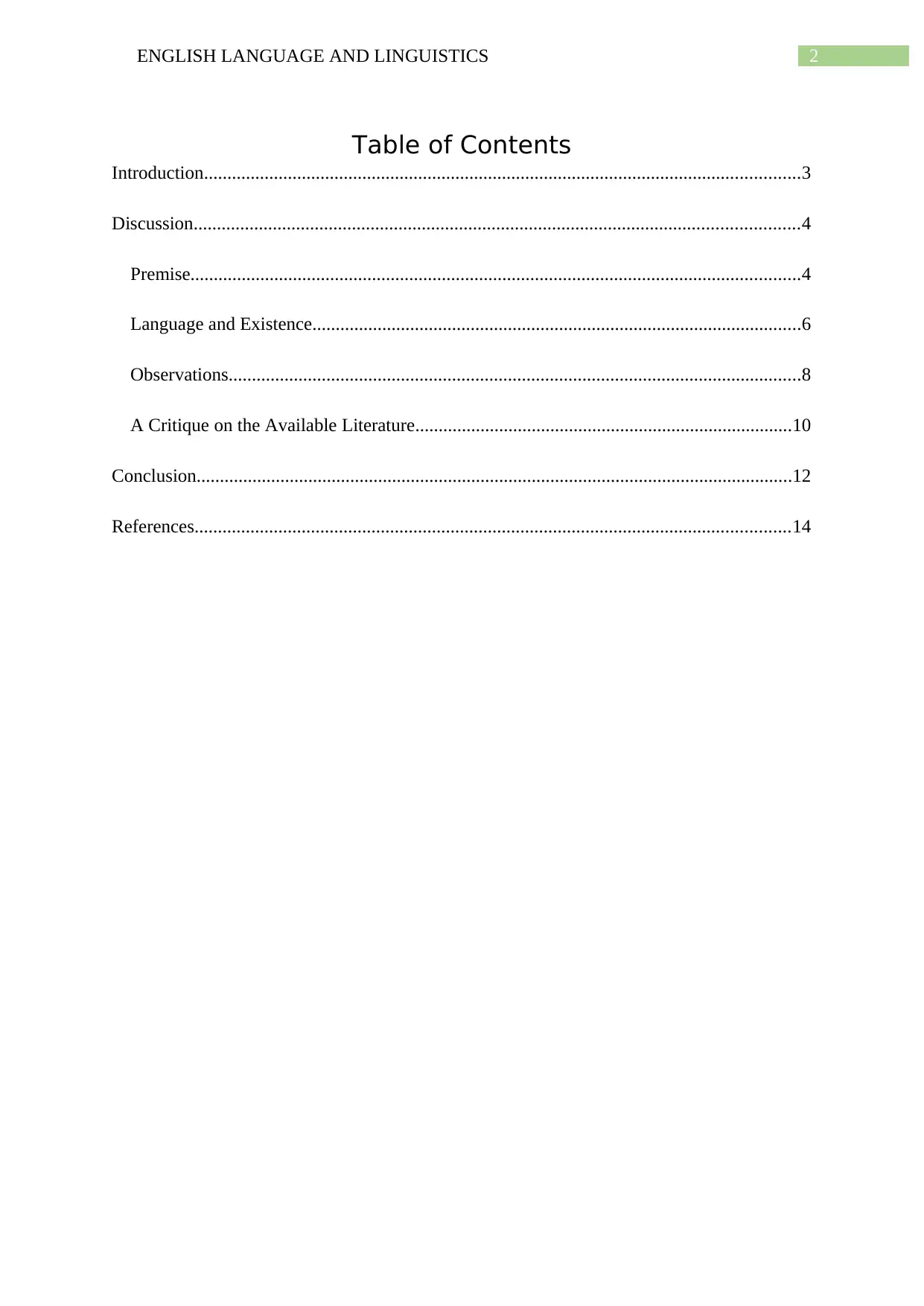
Table of Contents
Introduction................................................................................................................................3
Discussion..................................................................................................................................4
Premise...................................................................................................................................4
Language and Existence.........................................................................................................6
Observations...........................................................................................................................8
A Critique on the Available Literature.................................................................................10
Conclusion................................................................................................................................12
References................................................................................................................................14
Table of Contents
Introduction................................................................................................................................3
Discussion..................................................................................................................................4
Premise...................................................................................................................................4
Language and Existence.........................................................................................................6
Observations...........................................................................................................................8
A Critique on the Available Literature.................................................................................10
Conclusion................................................................................................................................12
References................................................................................................................................14
⊘ This is a preview!⊘
Do you want full access?
Subscribe today to unlock all pages.

Trusted by 1+ million students worldwide
3ENGLISH LANGUAGE AND LINGUISTICS
Introduction
Language and linguistics are an important aspect of the cultural and social life of any
group (Hodge, 2014). In fact, language can said to be the repository and vehicle through
which the culture of a particular group is transmitted from one generation to the next (Snow,
Owens & Tan, 2014). The study of language is important to understand the dynamics within
a particular group, which helps us to understand the phenomena of culture formation and
social organization within the context of that particular group (Kockelman, 2014). With such
an importance, language can said to be the life-blood of any ethnic group.
As far as Singapore is concerned, it has become one of the most ethnically and
linguistically diverse countries in the world (Jain & Wee, 2015). Rapid development and
better employment opportunities provided an incentive for foreign nationals to immigrate into
Singapore, whose consequence is the multi-cultural nature of the city’s populace and peaceful
co-existence between various ethnic groups (Rubdy & McKay, 2014). The official languages
of Singapore include Malay, English, Mandarin and Tamil, owing to the fact that throughout
its colonial history, the country has had enjoyed an overwhelmingly Chinese and Malay
population (Bolton & Ng, 2014) while the ancestors of the Indian population were brought in
by the colonial administration to re-enforce the workforce employed in the plantations
(Pande, 2013).
Although the official language is Tamil, representative of the Tamil ethnic group from
India, there are a plethora of other Indian ethnic groups who reside in Singapore and speak
various Indian languages apart from Tamil (Rajan, 2014). However, the cosmopolitan nature
of Singapore tends to affect the way in which non-Tamil Indian languages are spoken and
used (Cleveland, Laroche & Papandopoulos, 2015). Therefore the paper shall examine the
phenomena of language shift, language maintenance and language death from the perspective
Introduction
Language and linguistics are an important aspect of the cultural and social life of any
group (Hodge, 2014). In fact, language can said to be the repository and vehicle through
which the culture of a particular group is transmitted from one generation to the next (Snow,
Owens & Tan, 2014). The study of language is important to understand the dynamics within
a particular group, which helps us to understand the phenomena of culture formation and
social organization within the context of that particular group (Kockelman, 2014). With such
an importance, language can said to be the life-blood of any ethnic group.
As far as Singapore is concerned, it has become one of the most ethnically and
linguistically diverse countries in the world (Jain & Wee, 2015). Rapid development and
better employment opportunities provided an incentive for foreign nationals to immigrate into
Singapore, whose consequence is the multi-cultural nature of the city’s populace and peaceful
co-existence between various ethnic groups (Rubdy & McKay, 2014). The official languages
of Singapore include Malay, English, Mandarin and Tamil, owing to the fact that throughout
its colonial history, the country has had enjoyed an overwhelmingly Chinese and Malay
population (Bolton & Ng, 2014) while the ancestors of the Indian population were brought in
by the colonial administration to re-enforce the workforce employed in the plantations
(Pande, 2013).
Although the official language is Tamil, representative of the Tamil ethnic group from
India, there are a plethora of other Indian ethnic groups who reside in Singapore and speak
various Indian languages apart from Tamil (Rajan, 2014). However, the cosmopolitan nature
of Singapore tends to affect the way in which non-Tamil Indian languages are spoken and
used (Cleveland, Laroche & Papandopoulos, 2015). Therefore the paper shall examine the
phenomena of language shift, language maintenance and language death from the perspective
Paraphrase This Document
Need a fresh take? Get an instant paraphrase of this document with our AI Paraphraser
4ENGLISH LANGUAGE AND LINGUISTICS
of two individuals from a non-Tamil Indian background in order to understands how far is
language is subjected to various influences and developmental stimuli in a city where a
number of languages and ethnicities collide and are made to co-exist and consequently,
influence each other. The paper shall also look into the social contexts of language use in
order to find out how language is utilized in various social settings.
Discussion
Premise
For the sake of clearly demonstrating and elucidating the phenomenon of language
shift, maintenance and death, the paper has taken the interviews of two individuals who are of
Indian descent but they speak a language other than Tamil. The first respondent is a Bengali,
while the second respondent is a Hindi-speaker. Tracing their backgrounds and the
association with Singapore each of their family has thrown ample light as to how each of the
respondents have to negotiate with the use of their mother tongue even as it is influenced by a
cosmopolitan and multi-lingual environment (Ng, 2014). Therefore, it is necessary to briefly
state out the backgrounds of each of the respondents in brief.
The first respondent in question is, as it has been mentioned, a Bengali. His family
have been residents of Singapore for the past few decades. He tells me that his grandfather
had immigrated into Singapore in the wake of the Partition of India in order to escape the
communal violence raging in the Subcontinent at the time. After trying to survive on some
odd jobs, he finally found employment with the Civil Service, as a junior clerk. With time, he
was able to marry with a Bengali woman and settle down. Unlike his grandfather, his
grandmother and her family had been living in Singapore since the 19th century.
After the marriage and after having children, the first respondent’s grandparents
decided to raise their children in a typical Bengali setting, insisting that his children should
of two individuals from a non-Tamil Indian background in order to understands how far is
language is subjected to various influences and developmental stimuli in a city where a
number of languages and ethnicities collide and are made to co-exist and consequently,
influence each other. The paper shall also look into the social contexts of language use in
order to find out how language is utilized in various social settings.
Discussion
Premise
For the sake of clearly demonstrating and elucidating the phenomenon of language
shift, maintenance and death, the paper has taken the interviews of two individuals who are of
Indian descent but they speak a language other than Tamil. The first respondent is a Bengali,
while the second respondent is a Hindi-speaker. Tracing their backgrounds and the
association with Singapore each of their family has thrown ample light as to how each of the
respondents have to negotiate with the use of their mother tongue even as it is influenced by a
cosmopolitan and multi-lingual environment (Ng, 2014). Therefore, it is necessary to briefly
state out the backgrounds of each of the respondents in brief.
The first respondent in question is, as it has been mentioned, a Bengali. His family
have been residents of Singapore for the past few decades. He tells me that his grandfather
had immigrated into Singapore in the wake of the Partition of India in order to escape the
communal violence raging in the Subcontinent at the time. After trying to survive on some
odd jobs, he finally found employment with the Civil Service, as a junior clerk. With time, he
was able to marry with a Bengali woman and settle down. Unlike his grandfather, his
grandmother and her family had been living in Singapore since the 19th century.
After the marriage and after having children, the first respondent’s grandparents
decided to raise their children in a typical Bengali setting, insisting that his children should
5ENGLISH LANGUAGE AND LINGUISTICS
learn Bengali and that all of his children should be proud of their Bengali heritage. As a result
the spoken Bengali language was maintained in the environs of his home. However, being the
speaker of a minority language that is usually profiled under the “Other” classification under
which Singapore’s demographic census calculation takes place (Reddy, 2016), it is but
natural for the respondent to switch to either of the country’s four official languages in order
to be able to effectively communicate with rest of the population. The respondent stated that
he always converses in Bengali within the context of his family, but he resorted to the use of
English as the language of communication in social contexts that were outside of the
framework of his family (Curdt-Christiansen & Sun, 2016).
The second respondent is not native to Singapore, but rather, it is her family that has
come to the country quite recently (Thompson, 2014). As a result, the second respondent is
able to understand and navigate through the difficult task of continuously adapting oneself to
constantly changing socio-cultural changes all around her. She has achieved a balance
between speaking in Hindi in her home environment and speaking in English in other cases
of social interaction. Like many Indians of her generation, she has the ability to code switch
between languages on the go, mixing English and Hindi vocabulary to successfully convey a
message through to her peers and compatriots (Dewaele & Wei, 2014).
The difference between the first respondent and the second respondent is not just
limited to language but to also their status in regards to the Republic of Singapore (Liu,
2014). Respondent number one is a full-fledged citizen of Singapore and has therefore the
advantage of being integrated in to Singaporean society and culture (Rahman & Kiong,
2013). On the other hand, respondent number two has the status of a permanent resident who
is yet to become fully integrated with the socio-cultural norms of Singapore, although it
stands to reason that she is progressing rapidly towards integration (Yeoh & Lam, 2016).
learn Bengali and that all of his children should be proud of their Bengali heritage. As a result
the spoken Bengali language was maintained in the environs of his home. However, being the
speaker of a minority language that is usually profiled under the “Other” classification under
which Singapore’s demographic census calculation takes place (Reddy, 2016), it is but
natural for the respondent to switch to either of the country’s four official languages in order
to be able to effectively communicate with rest of the population. The respondent stated that
he always converses in Bengali within the context of his family, but he resorted to the use of
English as the language of communication in social contexts that were outside of the
framework of his family (Curdt-Christiansen & Sun, 2016).
The second respondent is not native to Singapore, but rather, it is her family that has
come to the country quite recently (Thompson, 2014). As a result, the second respondent is
able to understand and navigate through the difficult task of continuously adapting oneself to
constantly changing socio-cultural changes all around her. She has achieved a balance
between speaking in Hindi in her home environment and speaking in English in other cases
of social interaction. Like many Indians of her generation, she has the ability to code switch
between languages on the go, mixing English and Hindi vocabulary to successfully convey a
message through to her peers and compatriots (Dewaele & Wei, 2014).
The difference between the first respondent and the second respondent is not just
limited to language but to also their status in regards to the Republic of Singapore (Liu,
2014). Respondent number one is a full-fledged citizen of Singapore and has therefore the
advantage of being integrated in to Singaporean society and culture (Rahman & Kiong,
2013). On the other hand, respondent number two has the status of a permanent resident who
is yet to become fully integrated with the socio-cultural norms of Singapore, although it
stands to reason that she is progressing rapidly towards integration (Yeoh & Lam, 2016).
⊘ This is a preview!⊘
Do you want full access?
Subscribe today to unlock all pages.
Trusted by 1+ million students worldwide
6ENGLISH LANGUAGE AND LINGUISTICS
Having established the basic background identity of the two respondents, the paper
will now analyse the status of various languages and determine how the linguistic landscape
has changed over the years which has led to the popularity of one language at the expense of
another (Tan, 2014). Considering that the two respondents are of Indian origin, a brief look
could be taken at the status and health of the various Indian languages, other than Tamil, that
are spoken in Singapore (Wee, 2014). This will help to better understand the situation and
contextualize the criticism of the existing literature on linguistics with the material conditions
of Singapore and the consequence it has on the languages that are spoken among various
ethnic groups in the country and how the dynamics of these languages operate.
Language and Existence
As it has been observed, language by its very virtue of being a vehicle for the
transmission of cultural norms and values, is termed as the life-blood for any ethnic grouping.
However in a world which is getting connected more and more thanks to the onward progress
of globalization, language is slowly losing its unique position as a vehicle and store of culture
and it is inevitably emerging as a mere tool for communication which is used to conduct
activities that are common among almost all human beings in the world (Sharifan, 2017). A
number of consequence of such a change are important to note for any linguist.
The first consequence of language becoming a mere communicative tool in the
twenty-first century is the phenomenon of language shift (Kibler & Valdes, 2016). This
typically takes place in places where there is a high density of languages, with only one
language possessing hegemonic influence over the others. This is quite observable in a
country like Singapore, where, despite the prevalence of a large number of languages which
co-exist side-by-side, the majoritarian languages spoken by the dominating ethnic groups also
becomes the language of communication for ethnic minorities, in order to remain connected
with the rest of society. In both the responses, regardless of the language being spoken at
Having established the basic background identity of the two respondents, the paper
will now analyse the status of various languages and determine how the linguistic landscape
has changed over the years which has led to the popularity of one language at the expense of
another (Tan, 2014). Considering that the two respondents are of Indian origin, a brief look
could be taken at the status and health of the various Indian languages, other than Tamil, that
are spoken in Singapore (Wee, 2014). This will help to better understand the situation and
contextualize the criticism of the existing literature on linguistics with the material conditions
of Singapore and the consequence it has on the languages that are spoken among various
ethnic groups in the country and how the dynamics of these languages operate.
Language and Existence
As it has been observed, language by its very virtue of being a vehicle for the
transmission of cultural norms and values, is termed as the life-blood for any ethnic grouping.
However in a world which is getting connected more and more thanks to the onward progress
of globalization, language is slowly losing its unique position as a vehicle and store of culture
and it is inevitably emerging as a mere tool for communication which is used to conduct
activities that are common among almost all human beings in the world (Sharifan, 2017). A
number of consequence of such a change are important to note for any linguist.
The first consequence of language becoming a mere communicative tool in the
twenty-first century is the phenomenon of language shift (Kibler & Valdes, 2016). This
typically takes place in places where there is a high density of languages, with only one
language possessing hegemonic influence over the others. This is quite observable in a
country like Singapore, where, despite the prevalence of a large number of languages which
co-exist side-by-side, the majoritarian languages spoken by the dominating ethnic groups also
becomes the language of communication for ethnic minorities, in order to remain connected
with the rest of society. In both the responses, regardless of the language being spoken at
Paraphrase This Document
Need a fresh take? Get an instant paraphrase of this document with our AI Paraphraser
7ENGLISH LANGUAGE AND LINGUISTICS
home, both of the respondents had to accommodate the regular use of the English language as
English happens to be the lingua-franca of Singapore.
The second consequence is less of a phenomenon and more of a conflict, the notion of
language maintenance (Romaine, 2017). Against the domination and pervasiveness of the
hegemonic language, the languages being spoken by ethnic minorities come under increasing
pressure since such speakers are subject to shift their mode of expression from their mother
tongue to the dominating language. Therefore, there is often a strain to retain the
unadulterated use of one’s mother tongue, often due to the limited scope of its usage within a
limited amount of contexts and interactions. Thereby, a marked difference might be observed
between how older generations and how younger generations tend to speak the same native
language in a different manner.
The third consequence is language death (Phillipson & Skutnabb-Kangas, 2017).
When the use of the dominant language amongst members of the ethnic minority starts to
have an adverse impact on the usage of that minority’s native language, there comes a point
in time when members of that ethnic group completely give up speaking or communicating in
their mother tongue and adopt the dominant language that is in vogue.
All of these factors combine to create a situation where even in the multilingual
milieu of Singapore, there always appears to be a struggle between the major, officially
recognized languages and the languages that belong to ethnically minority groups and are
thus, unrecognized by the government (Shang & Guo, 2014). Due to the wide applications of
the official languages in the country, little room and little relevance is left for any other
language to survive or to be used in the social sphere. Therefore, it is difficult for speakers of
minority languages to be able to continue using their own language as they are increasingly
pressured and encouraged to use any of the official languages – especially, English (Wee,
home, both of the respondents had to accommodate the regular use of the English language as
English happens to be the lingua-franca of Singapore.
The second consequence is less of a phenomenon and more of a conflict, the notion of
language maintenance (Romaine, 2017). Against the domination and pervasiveness of the
hegemonic language, the languages being spoken by ethnic minorities come under increasing
pressure since such speakers are subject to shift their mode of expression from their mother
tongue to the dominating language. Therefore, there is often a strain to retain the
unadulterated use of one’s mother tongue, often due to the limited scope of its usage within a
limited amount of contexts and interactions. Thereby, a marked difference might be observed
between how older generations and how younger generations tend to speak the same native
language in a different manner.
The third consequence is language death (Phillipson & Skutnabb-Kangas, 2017).
When the use of the dominant language amongst members of the ethnic minority starts to
have an adverse impact on the usage of that minority’s native language, there comes a point
in time when members of that ethnic group completely give up speaking or communicating in
their mother tongue and adopt the dominant language that is in vogue.
All of these factors combine to create a situation where even in the multilingual
milieu of Singapore, there always appears to be a struggle between the major, officially
recognized languages and the languages that belong to ethnically minority groups and are
thus, unrecognized by the government (Shang & Guo, 2014). Due to the wide applications of
the official languages in the country, little room and little relevance is left for any other
language to survive or to be used in the social sphere. Therefore, it is difficult for speakers of
minority languages to be able to continue using their own language as they are increasingly
pressured and encouraged to use any of the official languages – especially, English (Wee,
8ENGLISH LANGUAGE AND LINGUISTICS
2013) – to go about their daily lives in Singapore. As a result, minority languages are easily
stamped out to create a unique Singaporean identity.
Notwithstanding all of these obstacles that stands in the way of preserving native
languages among ethnic groups who speak a minority language in Singapore, it is still
possible for these languages to continue to exist and develop within the context of closely-
knit communities of the same ethnic group, via complicated interconnections and
relationships within family and kinship groups from the same ethnicity (Curdt-Christiansen,
2016). Rare as it might be, close familial relationships may actually be the biggest guarantee
for preserving the continuity of the use of native languages among minority language groups
among ethnic minority groups. Some critical observations made during the interview shall
bring out the point and further illustrate it for the benefit of the reader for their better
understanding of the sociological axiom of linguistics and how it goes on to develop the
dynamics of language in a particular ethnic group within a multicultural setting.
Observations
In interviewing the two respective respondents, certain details came up which was
considered to be relevant and even important from the point of view of language maintenance
in the context of language death among a certain ethnic group. As mentioned, a good and
cordial familial relationship is essential to strengthen the use of native languages to the extent
that its use in the home does not become jeopardized or unaffected due to external factors,
which are usually the causes behind the phenomenon of language death among most minority
languages in multi-linguistic settings. The following examples shall make this more
comprehensible.
2013) – to go about their daily lives in Singapore. As a result, minority languages are easily
stamped out to create a unique Singaporean identity.
Notwithstanding all of these obstacles that stands in the way of preserving native
languages among ethnic groups who speak a minority language in Singapore, it is still
possible for these languages to continue to exist and develop within the context of closely-
knit communities of the same ethnic group, via complicated interconnections and
relationships within family and kinship groups from the same ethnicity (Curdt-Christiansen,
2016). Rare as it might be, close familial relationships may actually be the biggest guarantee
for preserving the continuity of the use of native languages among minority language groups
among ethnic minority groups. Some critical observations made during the interview shall
bring out the point and further illustrate it for the benefit of the reader for their better
understanding of the sociological axiom of linguistics and how it goes on to develop the
dynamics of language in a particular ethnic group within a multicultural setting.
Observations
In interviewing the two respective respondents, certain details came up which was
considered to be relevant and even important from the point of view of language maintenance
in the context of language death among a certain ethnic group. As mentioned, a good and
cordial familial relationship is essential to strengthen the use of native languages to the extent
that its use in the home does not become jeopardized or unaffected due to external factors,
which are usually the causes behind the phenomenon of language death among most minority
languages in multi-linguistic settings. The following examples shall make this more
comprehensible.
⊘ This is a preview!⊘
Do you want full access?
Subscribe today to unlock all pages.
Trusted by 1+ million students worldwide
9ENGLISH LANGUAGE AND LINGUISTICS
As far as the first respondent is concerned, he mostly has an independent disposition
who does not rely upon his immediate family much. This is not to say that there is no
closeness, but his willingness to take the world on his own has made him stay away from his
home, away from his immediate family and other Bengali speakers from his neighbourhood.
As a result, in order to survive, he has to carry out most of his communications in English
both in the professional and personal spheres. As a result, there is a high likelihood of the
respondent of decreasing his frequency of using Bengali in the presence of his family,
whereby certain parts of English vocabulary would find inroads into his colloquial Bengali
speech in place of corresponding Bengali words which he might have used had he maintained
continued contact with his family or if he lived close to them (Braunmüller, 2013).
On the other hand, the second respondent has a strong bond with her family and she
prefers to stay with them. Although certain parts of the English vocabulary may have
permanently established themselves in her diction, it is improbable that any of those changes
would be minor as most of her Hindi vocabulary and language skills would remain the same
due to the proximity of her parents (Diependaele, Lemhöfer & Brysbaert, 2013), who may
not have the same amount of willingness to adopt new words and terms into their own
language. In this way, the second respondent has a higher chance of preserving her language.
Furthermore, even their status in relation to the Republic of Singapore plays a huge
role in determining how much linguistically amenable would each of the respondents be. In
the case of the first respondent, he and his family have been living in Singapore for a long
time and they are citizens of Singapore. Living in a place for a long time makes a person have
a thorough knowledge about the socio-cultural dynamics that are in play in shaping a
person’s attitudes and views, and especially, their use of language. Respondent number one
knows that no matter how much he may know about the Bengali language, it would not help
him survive in this city unless he makes a permanent shift towards English as a mode of
As far as the first respondent is concerned, he mostly has an independent disposition
who does not rely upon his immediate family much. This is not to say that there is no
closeness, but his willingness to take the world on his own has made him stay away from his
home, away from his immediate family and other Bengali speakers from his neighbourhood.
As a result, in order to survive, he has to carry out most of his communications in English
both in the professional and personal spheres. As a result, there is a high likelihood of the
respondent of decreasing his frequency of using Bengali in the presence of his family,
whereby certain parts of English vocabulary would find inroads into his colloquial Bengali
speech in place of corresponding Bengali words which he might have used had he maintained
continued contact with his family or if he lived close to them (Braunmüller, 2013).
On the other hand, the second respondent has a strong bond with her family and she
prefers to stay with them. Although certain parts of the English vocabulary may have
permanently established themselves in her diction, it is improbable that any of those changes
would be minor as most of her Hindi vocabulary and language skills would remain the same
due to the proximity of her parents (Diependaele, Lemhöfer & Brysbaert, 2013), who may
not have the same amount of willingness to adopt new words and terms into their own
language. In this way, the second respondent has a higher chance of preserving her language.
Furthermore, even their status in relation to the Republic of Singapore plays a huge
role in determining how much linguistically amenable would each of the respondents be. In
the case of the first respondent, he and his family have been living in Singapore for a long
time and they are citizens of Singapore. Living in a place for a long time makes a person have
a thorough knowledge about the socio-cultural dynamics that are in play in shaping a
person’s attitudes and views, and especially, their use of language. Respondent number one
knows that no matter how much he may know about the Bengali language, it would not help
him survive in this city unless he makes a permanent shift towards English as a mode of
Paraphrase This Document
Need a fresh take? Get an instant paraphrase of this document with our AI Paraphraser
10ENGLISH LANGUAGE AND LINGUISTICS
communication. Hence, practical considerations – informed by how the linguistic factors
operate – has created an instance of language shift in the first respondent.
On the other hand, respondent number two is a permanent resident and has
immigrated into Singapore relatively recently. As a result, she may take some time to
underside the way in which the socio-cultural factors tend to shape up an individual and their
use of language. Moreover, being close to her family also plays a huge role as she has yet to
experience the city all by herself and thus it is probable that she would retain a higher chance
of preserving the knowledge of Hindi even if she has to eventually shift towards English for
the same reasons that motivate respondent number one.
Therefore, closeness to one’s family or one’s kinship group from the same ethnicity
plays an important factor in maintaining minority languages among the speakers of such
languages. Another important factor operative here is the amount of time one has spent in a
particular social group. The longer a person is a part of a specific socio-cultural hegemony,
higher are the chances of an ethnic group forsaking its own language and adopting the
language of the hegemonic group. These are the interesting and critical fact that the
interviews have brought forth and which should be taken note of as the basis for any future
research on the topic.
A Critique on the Available Literature
In analysing the available literature on the processes of language shift, language
maintenance and language death, focus has been kept on the language in itself without
considering any sociological consequences that these phenomena might have for the ethnic
groups who use the language for daily communication and propagating their culture between
the generational divide. Therefore, a sociological approach to the study of these three
phenomena needs to be undertaken in good earnest in order to understand the magnitude of
communication. Hence, practical considerations – informed by how the linguistic factors
operate – has created an instance of language shift in the first respondent.
On the other hand, respondent number two is a permanent resident and has
immigrated into Singapore relatively recently. As a result, she may take some time to
underside the way in which the socio-cultural factors tend to shape up an individual and their
use of language. Moreover, being close to her family also plays a huge role as she has yet to
experience the city all by herself and thus it is probable that she would retain a higher chance
of preserving the knowledge of Hindi even if she has to eventually shift towards English for
the same reasons that motivate respondent number one.
Therefore, closeness to one’s family or one’s kinship group from the same ethnicity
plays an important factor in maintaining minority languages among the speakers of such
languages. Another important factor operative here is the amount of time one has spent in a
particular social group. The longer a person is a part of a specific socio-cultural hegemony,
higher are the chances of an ethnic group forsaking its own language and adopting the
language of the hegemonic group. These are the interesting and critical fact that the
interviews have brought forth and which should be taken note of as the basis for any future
research on the topic.
A Critique on the Available Literature
In analysing the available literature on the processes of language shift, language
maintenance and language death, focus has been kept on the language in itself without
considering any sociological consequences that these phenomena might have for the ethnic
groups who use the language for daily communication and propagating their culture between
the generational divide. Therefore, a sociological approach to the study of these three
phenomena needs to be undertaken in good earnest in order to understand the magnitude of
11ENGLISH LANGUAGE AND LINGUISTICS
the effect it might have not just on the language in question but upon the lives and
experiences of those people who speak that language as well.
A great place to start determining the vitality of any language, especially those of
minority languages, is the extent and degree of its use in educational institutions, particularly
schools, where the mode of instruction is in the minority language (Gorter, Zenotz & Cenoz,
2014). Such institutions are specifically established in environments where the language and
culture of an ethnic group are considered to be a minority in relation to the surrounding
conditions in which they are located in. Such institutions play an important role in helping to
maintain the unique traits and features that are found in a particular language (O’Neil &
Chapman, 2015). This offsets any effect that language shift or language death may have on
the identity of ethnic groups.
In the case of Singapore, many such educational institutions do exist in areas where
there is a large concentration of ethnic groups speaking a minority language. The existing
literature has no therefore factored in the role these schools play in preserving the language of
ethnic groups who are not native to Singapore. Hitherto, research has only focussed on only
the issues of language shift and language death but they are yet to shift their attention to the
idea of language maintenance and how it is possible to attain that through pedagogical means,
introducing the language to children in a classroom environment and encouraging them to
learn the language of their cultural identity.
Therefore, it is essential that in the context of Singapore, linguists should strive to
cover up this gap existing in the extant research regarding the dynamics of language and the
processes of language shift, maintenance and death in the context of Singapore. Special
attention should be paid to the attempts on maintaining the linguistic identity of minority
ethnic groups, when pitted against the hegemonic dominance of the officially recognized
the effect it might have not just on the language in question but upon the lives and
experiences of those people who speak that language as well.
A great place to start determining the vitality of any language, especially those of
minority languages, is the extent and degree of its use in educational institutions, particularly
schools, where the mode of instruction is in the minority language (Gorter, Zenotz & Cenoz,
2014). Such institutions are specifically established in environments where the language and
culture of an ethnic group are considered to be a minority in relation to the surrounding
conditions in which they are located in. Such institutions play an important role in helping to
maintain the unique traits and features that are found in a particular language (O’Neil &
Chapman, 2015). This offsets any effect that language shift or language death may have on
the identity of ethnic groups.
In the case of Singapore, many such educational institutions do exist in areas where
there is a large concentration of ethnic groups speaking a minority language. The existing
literature has no therefore factored in the role these schools play in preserving the language of
ethnic groups who are not native to Singapore. Hitherto, research has only focussed on only
the issues of language shift and language death but they are yet to shift their attention to the
idea of language maintenance and how it is possible to attain that through pedagogical means,
introducing the language to children in a classroom environment and encouraging them to
learn the language of their cultural identity.
Therefore, it is essential that in the context of Singapore, linguists should strive to
cover up this gap existing in the extant research regarding the dynamics of language and the
processes of language shift, maintenance and death in the context of Singapore. Special
attention should be paid to the attempts on maintaining the linguistic identity of minority
ethnic groups, when pitted against the hegemonic dominance of the officially recognized
⊘ This is a preview!⊘
Do you want full access?
Subscribe today to unlock all pages.
Trusted by 1+ million students worldwide

1 out of 19


Your All-in-One AI-Powered Toolkit for Academic Success.
+13062052269
info@desklib.com
Available 24*7 on WhatsApp / Email
![[object Object]](/_next/static/media/star-bottom.7253800d.svg)
Unlock your academic potential
Copyright © 2020–2026 A2Z Services. All Rights Reserved. Developed and managed by ZUCOL.