MLC101: Law for Commerce - Mini Case Studies Assessment Solution

Verified

Added on  2022/10/12

|5
|805
|197
Case Study
AI Summary
This document provides a solution to a Law of Commerce case study assignment, specifically addressing the legal issues presented in the mini-case studies for MLC101. The assignment focuses on applying key principles of law for commerce, drawing on materials from Topics 1 and 2, including the textbook, study guide, power points, and cited cases. The solution analyzes two primary issues: the legal entitlement of Veron to promised funds and trust money, and whether Shaina is entitled to a promised payment. The analysis delves into the rules of breach of promise, promissory estoppel, and voluntary obligations, referencing key cases such as Kirksey vs. Kirksey, Simmons vs. Hay, and Noble vs. Williams. The application section applies these legal principles to the facts of each case, considering factors such as consideration, the nature of the relationships, and the concept of voluntary action. The conclusion provides a concise summary of the legal outcomes for each issue, determining whether the parties are legally entitled to the funds in question.
Document Page
Running Head: LAW OF COMMERCE
LAW OF COMMERCE
Name of the Student
Name of the University
Author’s Note
tabler-icon-diamond-filled.svg

Paraphrase This Document

Need a fresh take? Get an instant paraphrase of this document with our AI Paraphraser
Document Page
1LAW OF COMMERCE
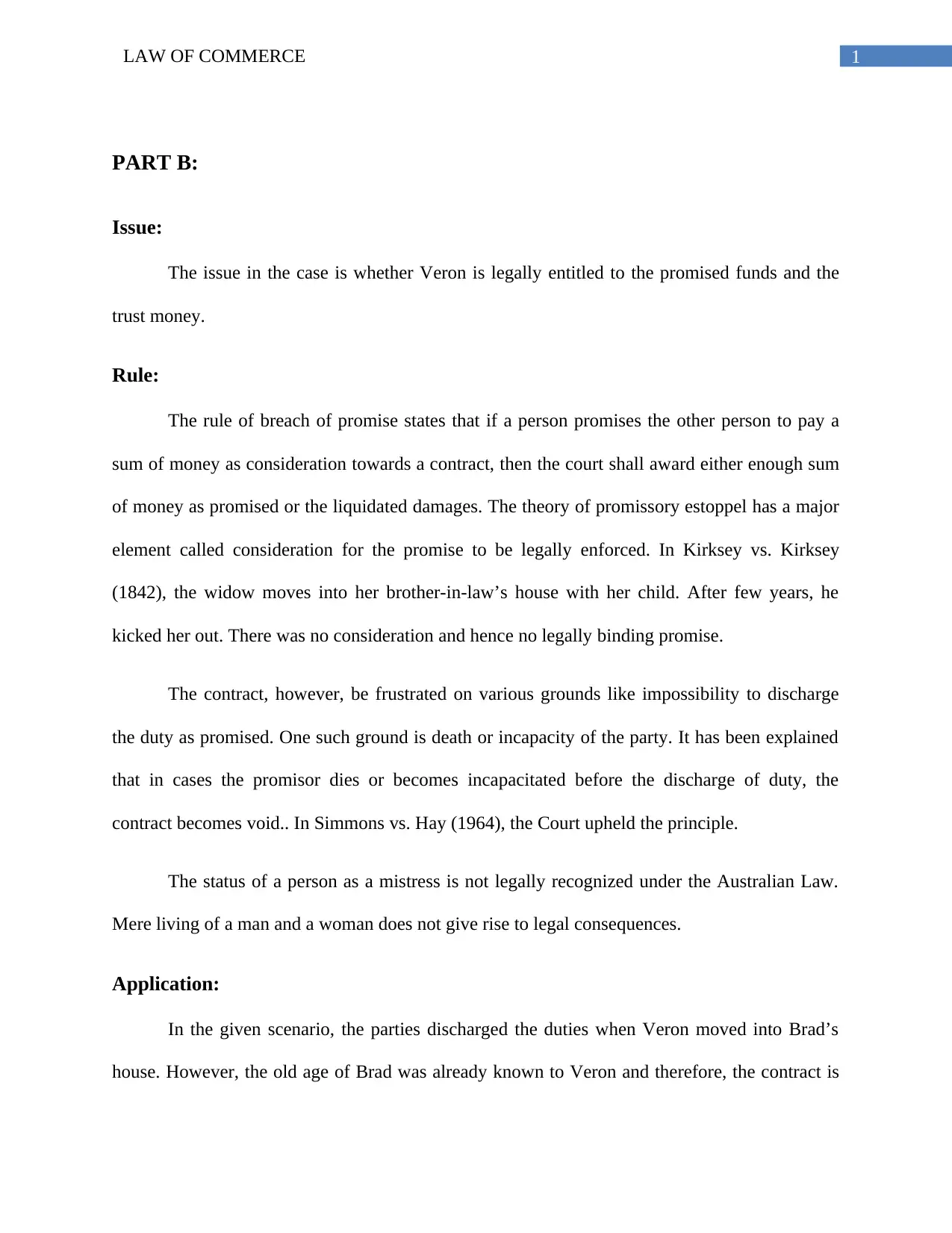
PART B:
Issue:
The issue in the case is whether Veron is legally entitled to the promised funds and the
trust money.
Rule:
The rule of breach of promise states that if a person promises the other person to pay a
sum of money as consideration towards a contract, then the court shall award either enough sum
of money as promised or the liquidated damages. The theory of promissory estoppel has a major
element called consideration for the promise to be legally enforced. In Kirksey vs. Kirksey
(1842), the widow moves into her brother-in-law’s house with her child. After few years, he
kicked her out. There was no consideration and hence no legally binding promise.
The contract, however, be frustrated on various grounds like impossibility to discharge
the duty as promised. One such ground is death or incapacity of the party. It has been explained
that in cases the promisor dies or becomes incapacitated before the discharge of duty, the
contract becomes void.. In Simmons vs. Hay (1964), the Court upheld the principle.
The status of a person as a mistress is not legally recognized under the Australian Law.
Mere living of a man and a woman does not give rise to legal consequences.
Application:
In the given scenario, the parties discharged the duties when Veron moved into Brad’s
house. However, the old age of Brad was already known to Veron and therefore, the contract is
Document Page
2LAW OF COMMERCE
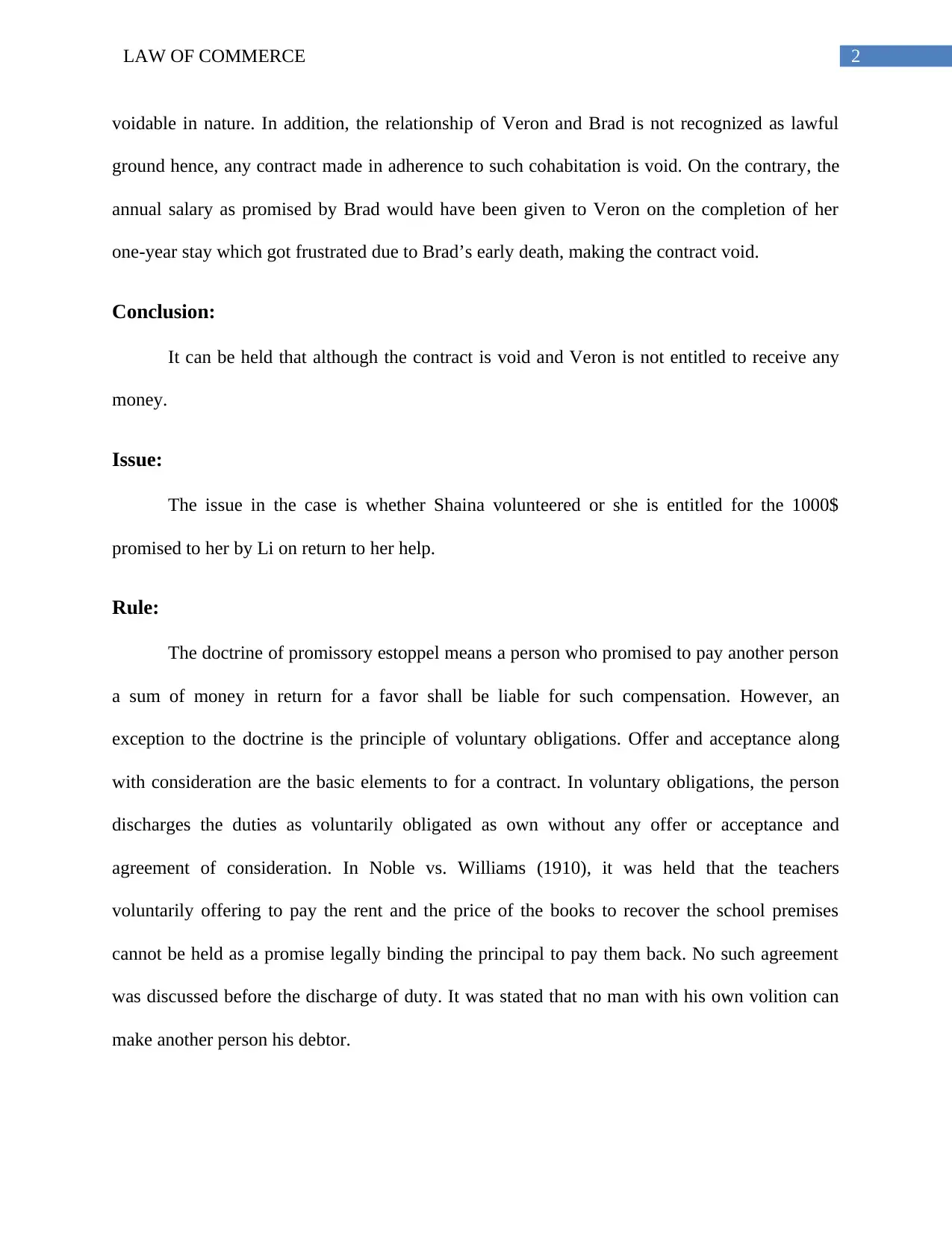
voidable in nature. In addition, the relationship of Veron and Brad is not recognized as lawful
ground hence, any contract made in adherence to such cohabitation is void. On the contrary, the
annual salary as promised by Brad would have been given to Veron on the completion of her
one-year stay which got frustrated due to Brad’s early death, making the contract void.
Conclusion:
It can be held that although the contract is void and Veron is not entitled to receive any
money.
Issue:
The issue in the case is whether Shaina volunteered or she is entitled for the 1000$
promised to her by Li on return to her help.
Rule:
The doctrine of promissory estoppel means a person who promised to pay another person
a sum of money in return for a favor shall be liable for such compensation. However, an
exception to the doctrine is the principle of voluntary obligations. Offer and acceptance along
with consideration are the basic elements to for a contract. In voluntary obligations, the person
discharges the duties as voluntarily obligated as own without any offer or acceptance and
agreement of consideration. In Noble vs. Williams (1910), it was held that the teachers
voluntarily offering to pay the rent and the price of the books to recover the school premises
cannot be held as a promise legally binding the principal to pay them back. No such agreement
was discussed before the discharge of duty. It was stated that no man with his own volition can
make another person his debtor.
Document Page
3LAW OF COMMERCE
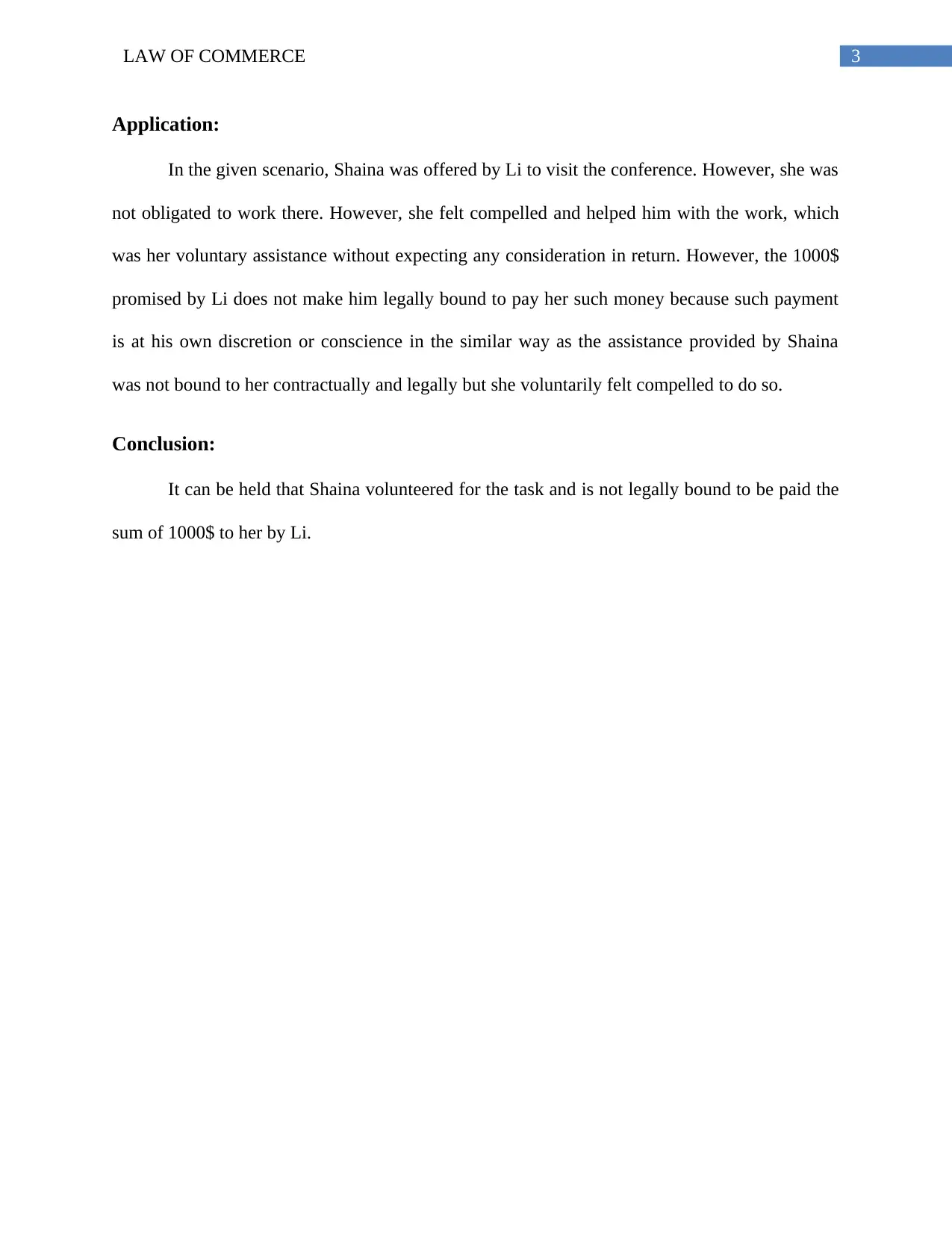
Application:
In the given scenario, Shaina was offered by Li to visit the conference. However, she was
not obligated to work there. However, she felt compelled and helped him with the work, which
was her voluntary assistance without expecting any consideration in return. However, the 1000$
promised by Li does not make him legally bound to pay her such money because such payment
is at his own discretion or conscience in the similar way as the assistance provided by Shaina
was not bound to her contractually and legally but she voluntarily felt compelled to do so.
Conclusion:
It can be held that Shaina volunteered for the task and is not legally bound to be paid the
sum of 1000$ to her by Li.
tabler-icon-diamond-filled.svg

Paraphrase This Document

Need a fresh take? Get an instant paraphrase of this document with our AI Paraphraser
Document Page
4LAW OF COMMERCE
References:
Gan, O., 2013. Promissory Estoppel: A Call for a More Inclusive Contract Law. J. Gender Race
& Just., 16, p.47.
Kirksey v. Kirksey, Ala. Sup. 8 Ala. 131 (1845)
McKendrick, E., 2013. Force Majeure and frustration of contract. Informa law from Routledge.
Noble vs. William 167 N.C. 112
Simmons vs. Hay (1964) 81 WN (Pt 1) (NSW) 358
chevron_up_icon
1 out of 5
circle_padding
hide_on_mobile
zoom_out_icon
[object Object]