Law of Contract Assignment: Case Studies and Legal Principles
VerifiedAdded on 2022/11/17
|11
|2755
|221
Homework Assignment
AI Summary
This assignment delves into key aspects of contract law through a series of questions and case studies. The first question examines the concept of unilateral offers and the validity of a reward offer, analyzing whether a policeman is entitled to a reward for finding a stolen car. The second question addresses offer and acceptance, focusing on the timing of acceptance via telex and the remedies available for breach of contract. The final question defines the requirements for a valid offer and distinguishes it from an invitation to treat, referencing relevant case law such as Harvey v. Facey and Pharmaceutical Society of Great Britain v. Boots. The assignment thoroughly explores the elements of a contract, including offer, acceptance, consideration, and intention, providing a comprehensive understanding of contract law principles.
Law of Contract
Running head: Law of Contract 0
Student’s Name
Address
Running head: Law of Contract 0
Student’s Name
Address

Paraphrase This Document
Need a fresh take? Get an instant paraphrase of this document with our AI Paraphraser
1
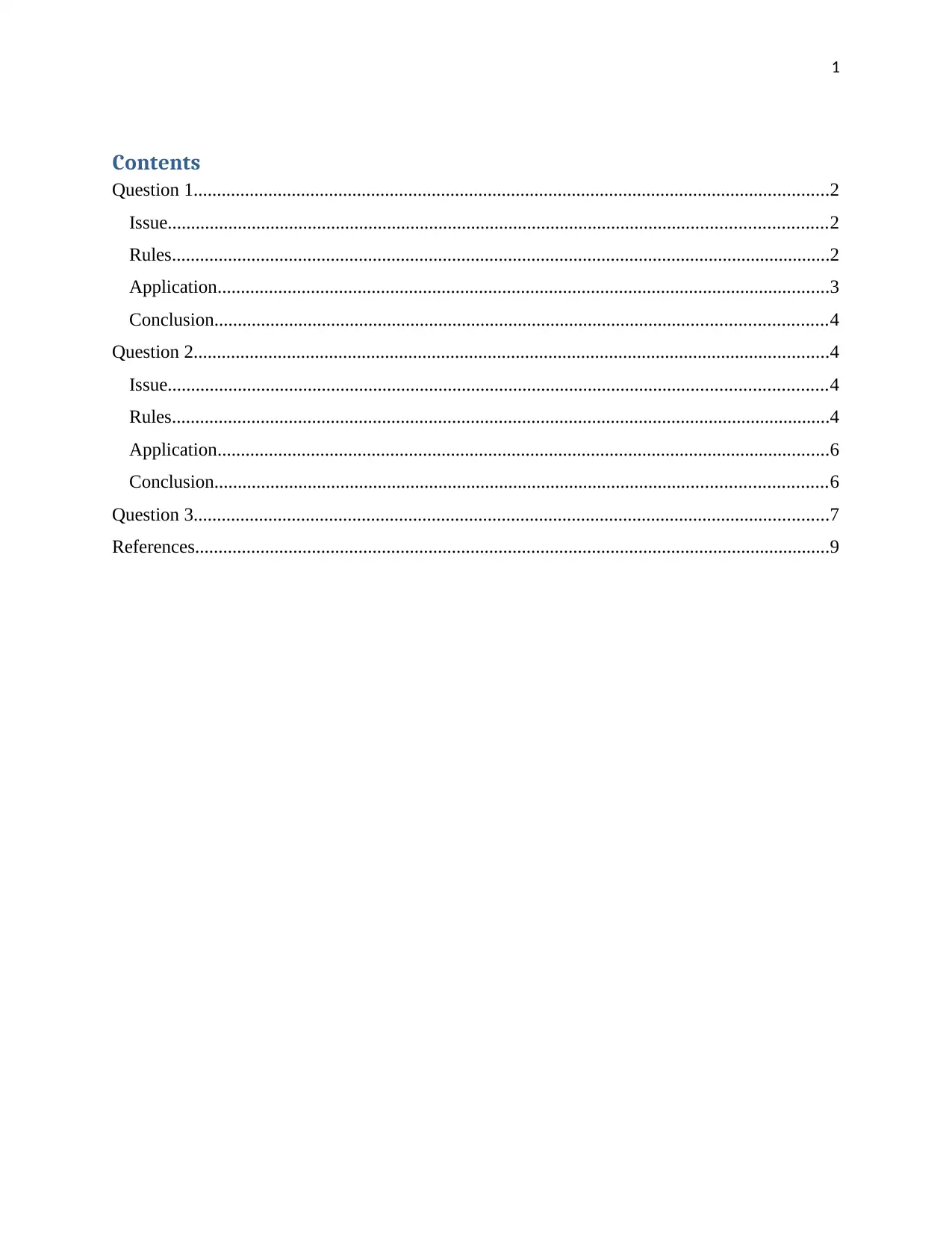
Contents
Question 1........................................................................................................................................2
Issue.............................................................................................................................................2
Rules.............................................................................................................................................2
Application...................................................................................................................................3
Conclusion...................................................................................................................................4
Question 2........................................................................................................................................4
Issue.............................................................................................................................................4
Rules.............................................................................................................................................4
Application...................................................................................................................................6
Conclusion...................................................................................................................................6
Question 3........................................................................................................................................7
References........................................................................................................................................9
Contents
Question 1........................................................................................................................................2
Issue.............................................................................................................................................2
Rules.............................................................................................................................................2
Application...................................................................................................................................3
Conclusion...................................................................................................................................4
Question 2........................................................................................................................................4
Issue.............................................................................................................................................4
Rules.............................................................................................................................................4
Application...................................................................................................................................6
Conclusion...................................................................................................................................6
Question 3........................................................................................................................................7
References........................................................................................................................................9
2
Question 1
Issue
Whether Peter has a contractual right of rewards or not?
Rules
A contract is required certain elements such as offer, acceptance, consideration, and intention of
the parties to develop a contract. For the validity of each element, some rules are prescribed
there. In general, an offer made by offeror needs the acceptance of the other party to form a
contract, but there is a certain exception of this rule. It means some kind of offer is there where
offeree does not require to place the consent but can be entered into a contract by fulfilling the
condition. This kind of offers are known as unilateral offers where consent is not required to be
informed but the action of another party forms a valid acceptance. Contracts of rewards are one
of the examples of unilateral offers. A person makes an offer to provide some consideration to
anyone who fulfills a particular condition or perform a specific task. Another party who do the
subjective actions becomes entitled to get a reward as per the conditions of advertisement/offer.
The case of Carlill v Carbolic Smoke Ball Company [1892] EWCA Civ 1 is an important one to
discuss here. It was decided in the subjective case that an advertisement, which contains some
terms to get rewards, makes a binding unilateral offer, which can be acknowledged by anyone
who performs its terms (Poole, 2012).
Similar to offer and acceptance, rules are also prescribed for consideration. Consideration can be
anything but must have some values in the opinion of the law. Further Chappell v Nestle [1960]
AC 87 is also an important case where it was given that consideration is not required to be
adequate but must be sufficient only. Many of the times, people have a duty to do certain things
Question 1
Issue
Whether Peter has a contractual right of rewards or not?
Rules
A contract is required certain elements such as offer, acceptance, consideration, and intention of
the parties to develop a contract. For the validity of each element, some rules are prescribed
there. In general, an offer made by offeror needs the acceptance of the other party to form a
contract, but there is a certain exception of this rule. It means some kind of offer is there where
offeree does not require to place the consent but can be entered into a contract by fulfilling the
condition. This kind of offers are known as unilateral offers where consent is not required to be
informed but the action of another party forms a valid acceptance. Contracts of rewards are one
of the examples of unilateral offers. A person makes an offer to provide some consideration to
anyone who fulfills a particular condition or perform a specific task. Another party who do the
subjective actions becomes entitled to get a reward as per the conditions of advertisement/offer.
The case of Carlill v Carbolic Smoke Ball Company [1892] EWCA Civ 1 is an important one to
discuss here. It was decided in the subjective case that an advertisement, which contains some
terms to get rewards, makes a binding unilateral offer, which can be acknowledged by anyone
who performs its terms (Poole, 2012).
Similar to offer and acceptance, rules are also prescribed for consideration. Consideration can be
anything but must have some values in the opinion of the law. Further Chappell v Nestle [1960]
AC 87 is also an important case where it was given that consideration is not required to be
adequate but must be sufficient only. Many of the times, people have a duty to do certain things
⊘ This is a preview!⊘
Do you want full access?
Subscribe today to unlock all pages.

Trusted by 1+ million students worldwide
3
and in such a situation, they cannot ask consideration for anything that they are required to do
because of their existing duty. The rule applies to public duty. The facts and decision of the case
of Collins v Godefrey (1831) 1 B & Ad 950 are required to have a look upon. In this case, a
person named Collin was required to attend court in the capacity of an expert witness. After the
trial, Collins prepared a bill and claimed consideration from the defendant for time and efforts
spent in court. It was held in the case that Collins was not entitled to receive any consideration
because it was his public duty to attend court. Therefore, this duty cannot be used as a
consideration. Nevertheless, it was given in the case of Glasbrook Bros v Glamorgan County
Council [1925] AC 270 consideration can be asked for extended public duty. It means if the
public servant does something going beyond their duty then such action can be treated as a
consideration for a new and distinct promise.
Application
In the provided case study, Peter’s car has been stolen and he published an advertisement in the
news. As per the condition of this advertisement, a person who would give the information
regarding this car will be entitled to claim a reward by 1 January. Firstly, to check the nature of
advertisement this is to state that applying the provisions of Carlill v Carbolic Smoke Ball
Company the same seems to be a unilateral offer. Here another party does not require to give
consent but giving information regarding recovery of the car will be treated as consent. Andrew
found the car and posted a letter to Peter to claim a reward. Here the issue of the case arises.
Being a policeman, it was the duty of Andrew to search for the car. He was not aware of reward
first yet search for the car it shows that searching for Peter’s car was an act that he was required
to do under his public duty and he did not go beyond the same. Therefore applying the provisions
of Collins v Godefrey, Andrew had no right to ask for rewards in this situation. If Peter would
and in such a situation, they cannot ask consideration for anything that they are required to do
because of their existing duty. The rule applies to public duty. The facts and decision of the case
of Collins v Godefrey (1831) 1 B & Ad 950 are required to have a look upon. In this case, a
person named Collin was required to attend court in the capacity of an expert witness. After the
trial, Collins prepared a bill and claimed consideration from the defendant for time and efforts
spent in court. It was held in the case that Collins was not entitled to receive any consideration
because it was his public duty to attend court. Therefore, this duty cannot be used as a
consideration. Nevertheless, it was given in the case of Glasbrook Bros v Glamorgan County
Council [1925] AC 270 consideration can be asked for extended public duty. It means if the
public servant does something going beyond their duty then such action can be treated as a
consideration for a new and distinct promise.
Application
In the provided case study, Peter’s car has been stolen and he published an advertisement in the
news. As per the condition of this advertisement, a person who would give the information
regarding this car will be entitled to claim a reward by 1 January. Firstly, to check the nature of
advertisement this is to state that applying the provisions of Carlill v Carbolic Smoke Ball
Company the same seems to be a unilateral offer. Here another party does not require to give
consent but giving information regarding recovery of the car will be treated as consent. Andrew
found the car and posted a letter to Peter to claim a reward. Here the issue of the case arises.
Being a policeman, it was the duty of Andrew to search for the car. He was not aware of reward
first yet search for the car it shows that searching for Peter’s car was an act that he was required
to do under his public duty and he did not go beyond the same. Therefore applying the provisions
of Collins v Godefrey, Andrew had no right to ask for rewards in this situation. If Peter would
Paraphrase This Document
Need a fresh take? Get an instant paraphrase of this document with our AI Paraphraser
4
not have given the advertisement, yet it was the public duty of Andrew to make a search of his
car.
Conclusion
To answer the issue, this is to state that the offer made by peter was a unilateral offer but Andrew
cannot accept the same as he is not able to provide valid consideration because of his public
duty.
Question 2
Issue
What is the legal position of Austin and what remedies are available to him?
Rules
Every offer is required acceptance then only the same can develop a contract. An offer is
required to accept within the time prescribed under the offer. If no time is prescribed in the same
then offeree must accept the offer within a reasonable time. Offeror needs to inform the offer to
offeree so that he/she may consider the same and can provide acceptance. Further to an amount
an effective acceptance, the same is required to communicate to the offeror (Merkin and Saintier,
2019). Now the issue is to know that at what time offer and acceptance seem to be effective.
Parties of the contract can use any mode of communication and depending on the same, effective
time of offer and acceptance is decided. In the case of oral communication, offer and acceptance
are effective as soon as parties inform the same to other party. With the development of new
technology, people are using electronic modes and other communication technology for a faster
mode of communication such as telephone, fax, telex, and e-mail. These modes are known as
not have given the advertisement, yet it was the public duty of Andrew to make a search of his
car.
Conclusion
To answer the issue, this is to state that the offer made by peter was a unilateral offer but Andrew
cannot accept the same as he is not able to provide valid consideration because of his public
duty.
Question 2
Issue
What is the legal position of Austin and what remedies are available to him?
Rules
Every offer is required acceptance then only the same can develop a contract. An offer is
required to accept within the time prescribed under the offer. If no time is prescribed in the same
then offeree must accept the offer within a reasonable time. Offeror needs to inform the offer to
offeree so that he/she may consider the same and can provide acceptance. Further to an amount
an effective acceptance, the same is required to communicate to the offeror (Merkin and Saintier,
2019). Now the issue is to know that at what time offer and acceptance seem to be effective.
Parties of the contract can use any mode of communication and depending on the same, effective
time of offer and acceptance is decided. In the case of oral communication, offer and acceptance
are effective as soon as parties inform the same to other party. With the development of new
technology, people are using electronic modes and other communication technology for a faster
mode of communication such as telephone, fax, telex, and e-mail. These modes are known as
5
instantaneous communication and there are separate rules for the effective time of offer and
acceptance. Under these modes, an acceptance becomes effective when the message is received
by another party i.e. offeror. In English contract law, Entores ltd V. Miles Far East Corperation
[1955] 2 QB 327(CA) is a lead case where the issue was related effectiveness of acceptance
where a telex was used as a mode of communication. In this case, the plaintiff and claimant were
from different countries. The claimant made an offer to purchase 100 tones of cathodes and sent
this offer via telex form England. Plaintiff on the different side received this offer and sent back
a telex accepting the offer from Holland. The issue that arose before the court was to check the
point on which contract was developed. The court provided that if the consent was effective at
the time of sending the telex then the contract was made in Holland or if the same was effective
at the time of receipt of acceptance letter in England, the contract was made in England. In the
decision of this case, the court decided the contract was developed in England because
acceptance became effective when claimant received the telex in England (Stone and Devenney,
2017).
Further, the case of Nm Superannuation Pty Ltd V Hughes & Ors, Supreme Court of New South
Wales, 04 March 1992 is also an important case. It was given that if fax machine is on, then the
acceptance will be deemed effective as soon as machines received the message irrespective of
the fact that the same received message outside of business hours and no one was there to read
the message. As soon as acceptance becomes effective, the contract is developed between the
parties. If any party breaches the contract, the other party has some remedies under the common
law of contract. The innocent party has option to cancels the contract and to claim damages.
instantaneous communication and there are separate rules for the effective time of offer and
acceptance. Under these modes, an acceptance becomes effective when the message is received
by another party i.e. offeror. In English contract law, Entores ltd V. Miles Far East Corperation
[1955] 2 QB 327(CA) is a lead case where the issue was related effectiveness of acceptance
where a telex was used as a mode of communication. In this case, the plaintiff and claimant were
from different countries. The claimant made an offer to purchase 100 tones of cathodes and sent
this offer via telex form England. Plaintiff on the different side received this offer and sent back
a telex accepting the offer from Holland. The issue that arose before the court was to check the
point on which contract was developed. The court provided that if the consent was effective at
the time of sending the telex then the contract was made in Holland or if the same was effective
at the time of receipt of acceptance letter in England, the contract was made in England. In the
decision of this case, the court decided the contract was developed in England because
acceptance became effective when claimant received the telex in England (Stone and Devenney,
2017).
Further, the case of Nm Superannuation Pty Ltd V Hughes & Ors, Supreme Court of New South
Wales, 04 March 1992 is also an important case. It was given that if fax machine is on, then the
acceptance will be deemed effective as soon as machines received the message irrespective of
the fact that the same received message outside of business hours and no one was there to read
the message. As soon as acceptance becomes effective, the contract is developed between the
parties. If any party breaches the contract, the other party has some remedies under the common
law of contract. The innocent party has option to cancels the contract and to claim damages.
⊘ This is a preview!⊘
Do you want full access?
Subscribe today to unlock all pages.
Trusted by 1+ million students worldwide
6
Application
In the presented case, Maurice made an offer to another person Austin. In the respective offer,
Maurice, in the capacity of a car dealer offered Austin to sell his rare vintage car for
consideration of GBP50,000. Maurice sent this offer by telex. Austin on the other side received
the offer at 09:15 am and placed the acceptance at 01:00 PM. The issue of the case started when
the office of Maurice was closed by this time. Even on the return to the office, Maurice did not
check the telex and accepted the offer made by another dealer to sell the car. Maurice read the
acceptance letter of Austin at 05 PM along with his another letter where Austin demanded
delivery of the car. Here applying the provisions of the case of Entores Ltd v Miles Far East
Corporation, acceptance will be considered completed on the point where offeree received the
same. In this case, the time at which Maurice received the acceptance letter is not clear hence to
assume that the same received acceptance of Austin as soon as Austin sent the same i.e. at 01
Pm. The contract was developed at this time.
Later on, Maurice received an offer of third party ford at 02:30 PM. By doing this, Maurice
breached the contract developed with Austin and now Austin is entitled to rescind the contract as
well as to ask damages as a remedy.
Conclusion
Austin can cancel the contract and is also entitled to claim the damages.
Question 3
Before discussing the rules related to offer, first the meaning of the same is required to
understand. Under contract law, an offer is a promise to do a thing or to not to do a thing in
exchange for consideration. A person who makes an offer is known as offeror and such offer
Application
In the presented case, Maurice made an offer to another person Austin. In the respective offer,
Maurice, in the capacity of a car dealer offered Austin to sell his rare vintage car for
consideration of GBP50,000. Maurice sent this offer by telex. Austin on the other side received
the offer at 09:15 am and placed the acceptance at 01:00 PM. The issue of the case started when
the office of Maurice was closed by this time. Even on the return to the office, Maurice did not
check the telex and accepted the offer made by another dealer to sell the car. Maurice read the
acceptance letter of Austin at 05 PM along with his another letter where Austin demanded
delivery of the car. Here applying the provisions of the case of Entores Ltd v Miles Far East
Corporation, acceptance will be considered completed on the point where offeree received the
same. In this case, the time at which Maurice received the acceptance letter is not clear hence to
assume that the same received acceptance of Austin as soon as Austin sent the same i.e. at 01
Pm. The contract was developed at this time.
Later on, Maurice received an offer of third party ford at 02:30 PM. By doing this, Maurice
breached the contract developed with Austin and now Austin is entitled to rescind the contract as
well as to ask damages as a remedy.
Conclusion
Austin can cancel the contract and is also entitled to claim the damages.
Question 3
Before discussing the rules related to offer, first the meaning of the same is required to
understand. Under contract law, an offer is a promise to do a thing or to not to do a thing in
exchange for consideration. A person who makes an offer is known as offeror and such offer
Paraphrase This Document
Need a fresh take? Get an instant paraphrase of this document with our AI Paraphraser
7
should be informed to another party. For a valid offer, some elements need to be there. To
amount an offer, a proposal must show that parties have the intention to bind each other. This
requirement has been established in the decision of the case of Harvey v Facey [1893] UKPC 1.
It means an offer must show that the offeror has the intention to seek acceptance of offeree and
to develop a contractual relationship with the same (E-lawresources.co.uk, 2019). An offer can
be oral as well as written. Apart from this, an offer is also required to be a valid one. It means the
same must not consist of any illegal or invalid term. Terms of the contract must be clear and
defined always. If a party presents a proposal containing some doubts then the same cannot be
treated as an absolute offer.
Apart from the above, an offer must have the capacity to create a legal relationship. It means that
on the receipt of acceptance, the same must be able to constitute a valid contract. In other words,
this is to state that an offer must have a valid consideration and intention of the parties to enter
into a contract. Some other terms are also there under contract law that seems similar to offer but
ate different form the same. An invitation to treat falls in this category as it looks like an offer
but is not in actual. It is only a call to invite offers. As acceptance is required in reply to an offer,
similarly an offer is required to develop in reply of an invitation to treat. One thing that needs to
be understood is that an invitation to treat cannot be accepted as an offer. In general,
advertisements are an invitation to treat because the same is addressed to the public and not to a
specific person (Taylor and Talyor, 2017).
The case of Pharmaceutical Society of Great Britain v Boots [1953] 1 QB 401 is an important
case while discussing the invitation of treat and offer (Bartsch and Bartsch, 2016). In the given
case, it was determined that articles placed in shelves with a price tag does not amounts an offer
but is merely an invitation to treat. However, exceptions are there where an invitation to treat can
should be informed to another party. For a valid offer, some elements need to be there. To
amount an offer, a proposal must show that parties have the intention to bind each other. This
requirement has been established in the decision of the case of Harvey v Facey [1893] UKPC 1.
It means an offer must show that the offeror has the intention to seek acceptance of offeree and
to develop a contractual relationship with the same (E-lawresources.co.uk, 2019). An offer can
be oral as well as written. Apart from this, an offer is also required to be a valid one. It means the
same must not consist of any illegal or invalid term. Terms of the contract must be clear and
defined always. If a party presents a proposal containing some doubts then the same cannot be
treated as an absolute offer.
Apart from the above, an offer must have the capacity to create a legal relationship. It means that
on the receipt of acceptance, the same must be able to constitute a valid contract. In other words,
this is to state that an offer must have a valid consideration and intention of the parties to enter
into a contract. Some other terms are also there under contract law that seems similar to offer but
ate different form the same. An invitation to treat falls in this category as it looks like an offer
but is not in actual. It is only a call to invite offers. As acceptance is required in reply to an offer,
similarly an offer is required to develop in reply of an invitation to treat. One thing that needs to
be understood is that an invitation to treat cannot be accepted as an offer. In general,
advertisements are an invitation to treat because the same is addressed to the public and not to a
specific person (Taylor and Talyor, 2017).
The case of Pharmaceutical Society of Great Britain v Boots [1953] 1 QB 401 is an important
case while discussing the invitation of treat and offer (Bartsch and Bartsch, 2016). In the given
case, it was determined that articles placed in shelves with a price tag does not amounts an offer
but is merely an invitation to treat. However, exceptions are there where an invitation to treat can
8
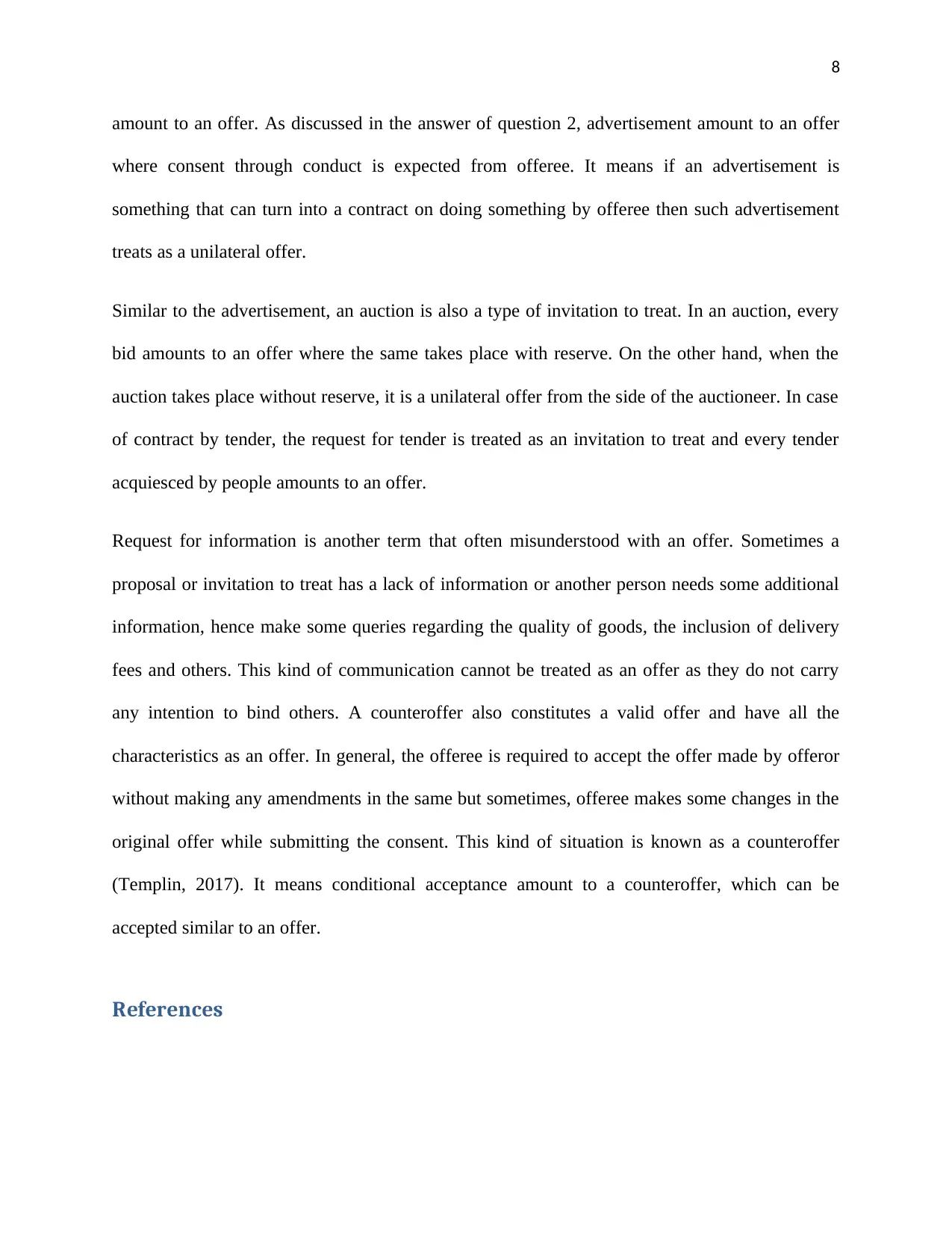
amount to an offer. As discussed in the answer of question 2, advertisement amount to an offer
where consent through conduct is expected from offeree. It means if an advertisement is
something that can turn into a contract on doing something by offeree then such advertisement
treats as a unilateral offer.
Similar to the advertisement, an auction is also a type of invitation to treat. In an auction, every
bid amounts to an offer where the same takes place with reserve. On the other hand, when the
auction takes place without reserve, it is a unilateral offer from the side of the auctioneer. In case
of contract by tender, the request for tender is treated as an invitation to treat and every tender
acquiesced by people amounts to an offer.
Request for information is another term that often misunderstood with an offer. Sometimes a
proposal or invitation to treat has a lack of information or another person needs some additional
information, hence make some queries regarding the quality of goods, the inclusion of delivery
fees and others. This kind of communication cannot be treated as an offer as they do not carry
any intention to bind others. A counteroffer also constitutes a valid offer and have all the
characteristics as an offer. In general, the offeree is required to accept the offer made by offeror
without making any amendments in the same but sometimes, offeree makes some changes in the
original offer while submitting the consent. This kind of situation is known as a counteroffer
(Templin, 2017). It means conditional acceptance amount to a counteroffer, which can be
accepted similar to an offer.
References
amount to an offer. As discussed in the answer of question 2, advertisement amount to an offer
where consent through conduct is expected from offeree. It means if an advertisement is
something that can turn into a contract on doing something by offeree then such advertisement
treats as a unilateral offer.
Similar to the advertisement, an auction is also a type of invitation to treat. In an auction, every
bid amounts to an offer where the same takes place with reserve. On the other hand, when the
auction takes place without reserve, it is a unilateral offer from the side of the auctioneer. In case
of contract by tender, the request for tender is treated as an invitation to treat and every tender
acquiesced by people amounts to an offer.
Request for information is another term that often misunderstood with an offer. Sometimes a
proposal or invitation to treat has a lack of information or another person needs some additional
information, hence make some queries regarding the quality of goods, the inclusion of delivery
fees and others. This kind of communication cannot be treated as an offer as they do not carry
any intention to bind others. A counteroffer also constitutes a valid offer and have all the
characteristics as an offer. In general, the offeree is required to accept the offer made by offeror
without making any amendments in the same but sometimes, offeree makes some changes in the
original offer while submitting the consent. This kind of situation is known as a counteroffer
(Templin, 2017). It means conditional acceptance amount to a counteroffer, which can be
accepted similar to an offer.
References
⊘ This is a preview!⊘
Do you want full access?
Subscribe today to unlock all pages.
Trusted by 1+ million students worldwide
9
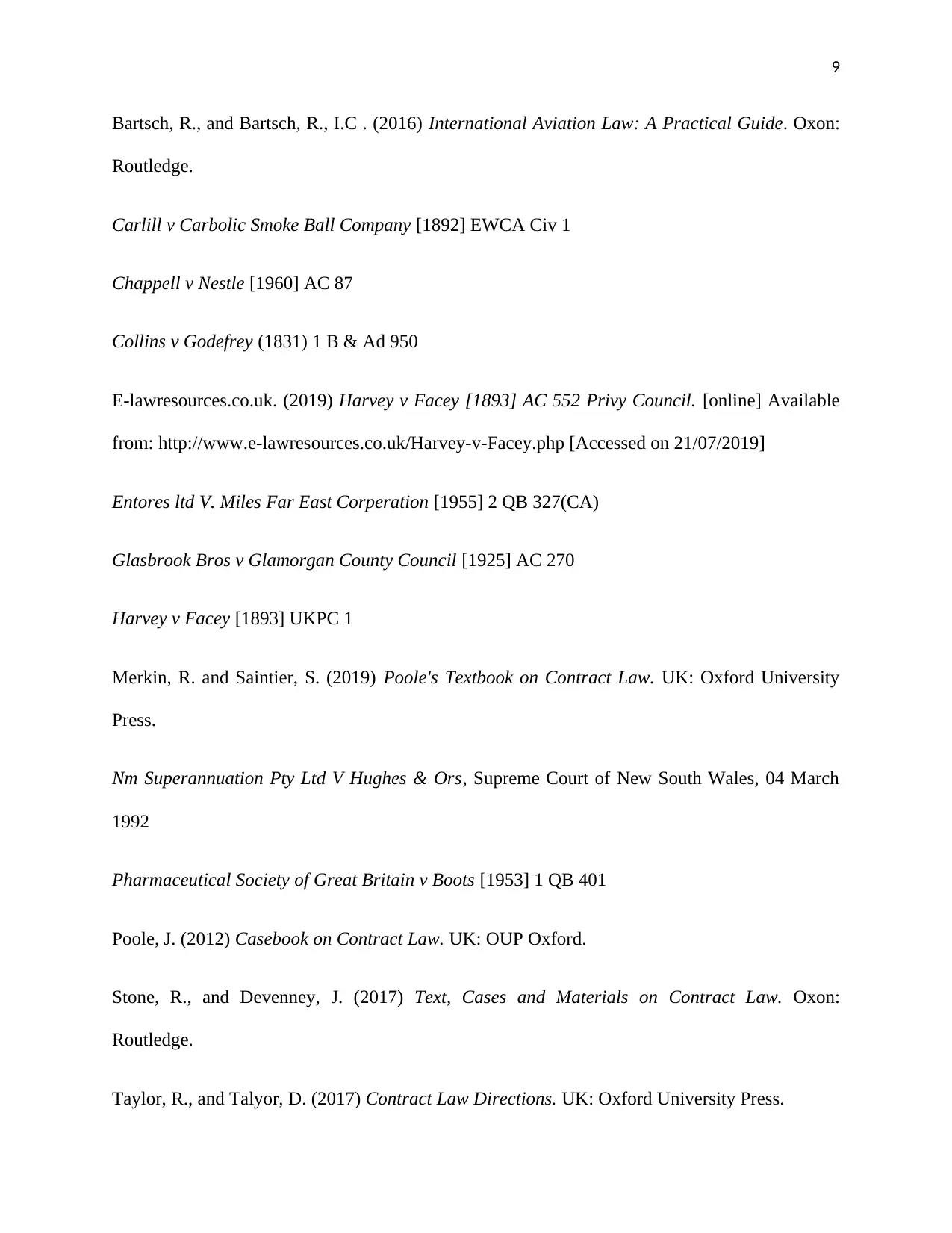
Bartsch, R., and Bartsch, R., I.C . (2016) International Aviation Law: A Practical Guide. Oxon:
Routledge.
Carlill v Carbolic Smoke Ball Company [1892] EWCA Civ 1
Chappell v Nestle [1960] AC 87
Collins v Godefrey (1831) 1 B & Ad 950
E-lawresources.co.uk. (2019) Harvey v Facey [1893] AC 552 Privy Council. [online] Available
from: http://www.e-lawresources.co.uk/Harvey-v-Facey.php [Accessed on 21/07/2019]
Entores ltd V. Miles Far East Corperation [1955] 2 QB 327(CA)
Glasbrook Bros v Glamorgan County Council [1925] AC 270
Harvey v Facey [1893] UKPC 1
Merkin, R. and Saintier, S. (2019) Poole's Textbook on Contract Law. UK: Oxford University
Press.
Nm Superannuation Pty Ltd V Hughes & Ors, Supreme Court of New South Wales, 04 March
1992
Pharmaceutical Society of Great Britain v Boots [1953] 1 QB 401
Poole, J. (2012) Casebook on Contract Law. UK: OUP Oxford.
Stone, R., and Devenney, J. (2017) Text, Cases and Materials on Contract Law. Oxon:
Routledge.
Taylor, R., and Talyor, D. (2017) Contract Law Directions. UK: Oxford University Press.
Bartsch, R., and Bartsch, R., I.C . (2016) International Aviation Law: A Practical Guide. Oxon:
Routledge.
Carlill v Carbolic Smoke Ball Company [1892] EWCA Civ 1
Chappell v Nestle [1960] AC 87
Collins v Godefrey (1831) 1 B & Ad 950
E-lawresources.co.uk. (2019) Harvey v Facey [1893] AC 552 Privy Council. [online] Available
from: http://www.e-lawresources.co.uk/Harvey-v-Facey.php [Accessed on 21/07/2019]
Entores ltd V. Miles Far East Corperation [1955] 2 QB 327(CA)
Glasbrook Bros v Glamorgan County Council [1925] AC 270
Harvey v Facey [1893] UKPC 1
Merkin, R. and Saintier, S. (2019) Poole's Textbook on Contract Law. UK: Oxford University
Press.
Nm Superannuation Pty Ltd V Hughes & Ors, Supreme Court of New South Wales, 04 March
1992
Pharmaceutical Society of Great Britain v Boots [1953] 1 QB 401
Poole, J. (2012) Casebook on Contract Law. UK: OUP Oxford.
Stone, R., and Devenney, J. (2017) Text, Cases and Materials on Contract Law. Oxon:
Routledge.
Taylor, R., and Talyor, D. (2017) Contract Law Directions. UK: Oxford University Press.
Paraphrase This Document
Need a fresh take? Get an instant paraphrase of this document with our AI Paraphraser

10
Templin, B. (2017) Contracts: A Modern Coursebook. New York: Wolters Kluwer Law &
Business.
Templin, B. (2017) Contracts: A Modern Coursebook. New York: Wolters Kluwer Law &
Business.

1 out of 11


Related Documents


Your All-in-One AI-Powered Toolkit for Academic Success.
+13062052269
info@desklib.com
Available 24*7 on WhatsApp / Email
![[object Object]](/_next/static/media/star-bottom.7253800d.svg)
Unlock your academic potential
Copyright © 2020–2026 A2Z Services. All Rights Reserved. Developed and managed by ZUCOL.