Law for Business Managers: Promises, Torts, and Artificial Personality
VerifiedAdded on 2023/01/16
|12
|3861
|71
Report
AI Summary
This report analyzes key aspects of business law, focusing on the enforceability of promises, the doctrine of torts, and the concept of artificial personality. The report begins by examining the legal requirements for enforceable promises, including consideration, conditions, and mutual consent, and applies these principles to several scenarios involving Sergio's promises to various individuals. The second part of the report delves into the law of torts, specifically the tort of negligence, using the IRAC method to analyze a case where Samantha is injured due to the bank's negligence. The analysis includes the elements of negligence, the bank's duty of care, the breach of that duty, causation, and the resulting injury to Samantha. The report concludes that the bank is liable for Samantha's injuries due to its failure to maintain a safe environment. The report offers a thorough understanding of legal principles and practical applications, making it a valuable resource for students of business law.
Law for Business Managers

Paraphrase This Document
Need a fresh take? Get an instant paraphrase of this document with our AI Paraphraser
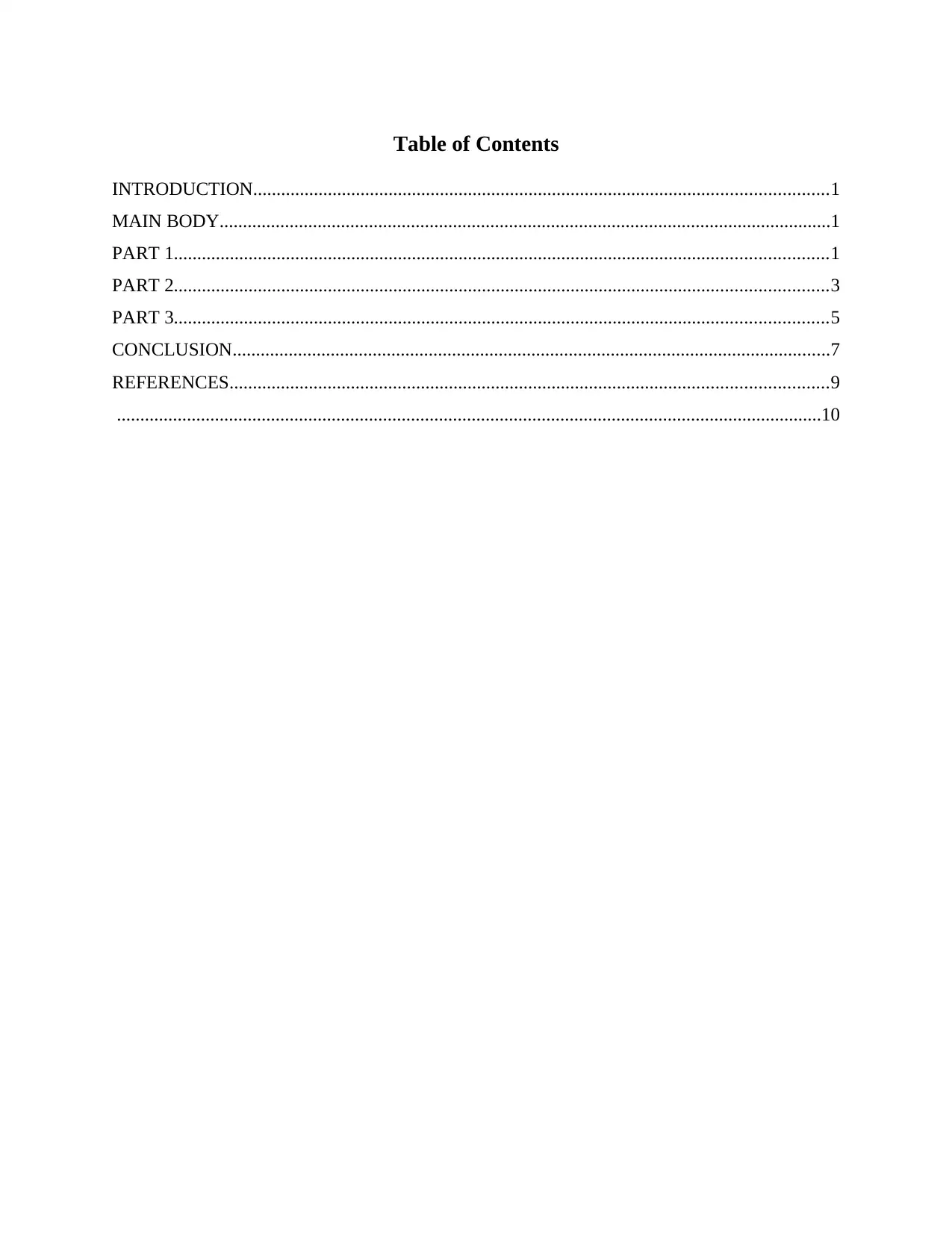
Table of Contents
INTRODUCTION...........................................................................................................................1
MAIN BODY...................................................................................................................................1
PART 1............................................................................................................................................1
PART 2............................................................................................................................................3
PART 3............................................................................................................................................5
CONCLUSION................................................................................................................................7
REFERENCES................................................................................................................................9
.......................................................................................................................................................10
INTRODUCTION...........................................................................................................................1
MAIN BODY...................................................................................................................................1
PART 1............................................................................................................................................1
PART 2............................................................................................................................................3
PART 3............................................................................................................................................5
CONCLUSION................................................................................................................................7
REFERENCES................................................................................................................................9
.......................................................................................................................................................10
INTRODUCTION
Law is system that consists different type of rules and regulations that are formulated by
social and governmental institutions to regulate the conduct of individuals and other institutions
persist in society. The main aim behind creating such laws is to govern the activities of society
needed to perform in day to day functioning. It is of different types and known as civil, criminal
and corporate laws. The rules that governs the activities related to functioning of businesses are
covered in corporate law (Allen and Kraakman, 2016). It includes the rules and regulations from
the very starting, running and closing of business activities. The other areas which are also
covered under this law are contract, employment, intellectual property, real estate, bankruptcy
and so on. The main aim of this report is about ascertainment of governing power of the different
laws over the different activities, promises and business functions.
The aspects which are covered in this report includes ascertainment of the binding nature
of the different promises under law, determination and explanation of the doctrine of tort for the
purpose of understanding the liability of Extortionate Plc over the injury of Samantha’s and
identification of the main features of artificial personality.
MAIN BODY
PART 1
Ascertainment of Enforceability of promises
According to law, promise is an agreement that happens in between the two parties
regarding execution or refraining from the performance of some act and making or restricting a
payment of delivery. The two different parties involved in any kind of promise are called as
promiser and promisee. Any promise which is done in written form is known as agreement. It
becomes covenant after affixing the seal (Siedel and Haapio, 2016). There is nothing lawful in
between the promise. It is just a promise by the one party to another in consideration of some
aspect in return. In the current case, three different promises are made by the different parties.
Sergio is the one who made promise to his son, secretary and Natasha (Stim, 2018). In
performance of the stipulated act in promise within the defined period of time, promiser provide
money to promisee's. Currently, there is no legal aspect present in such promises. There are
certain aspects which are needed to perform regarding creation of these promises in legal binding
nature. It is also determined that legality of any promise is not depends upon the matter that
1
Law is system that consists different type of rules and regulations that are formulated by
social and governmental institutions to regulate the conduct of individuals and other institutions
persist in society. The main aim behind creating such laws is to govern the activities of society
needed to perform in day to day functioning. It is of different types and known as civil, criminal
and corporate laws. The rules that governs the activities related to functioning of businesses are
covered in corporate law (Allen and Kraakman, 2016). It includes the rules and regulations from
the very starting, running and closing of business activities. The other areas which are also
covered under this law are contract, employment, intellectual property, real estate, bankruptcy
and so on. The main aim of this report is about ascertainment of governing power of the different
laws over the different activities, promises and business functions.
The aspects which are covered in this report includes ascertainment of the binding nature
of the different promises under law, determination and explanation of the doctrine of tort for the
purpose of understanding the liability of Extortionate Plc over the injury of Samantha’s and
identification of the main features of artificial personality.
MAIN BODY
PART 1
Ascertainment of Enforceability of promises
According to law, promise is an agreement that happens in between the two parties
regarding execution or refraining from the performance of some act and making or restricting a
payment of delivery. The two different parties involved in any kind of promise are called as
promiser and promisee. Any promise which is done in written form is known as agreement. It
becomes covenant after affixing the seal (Siedel and Haapio, 2016). There is nothing lawful in
between the promise. It is just a promise by the one party to another in consideration of some
aspect in return. In the current case, three different promises are made by the different parties.
Sergio is the one who made promise to his son, secretary and Natasha (Stim, 2018). In
performance of the stipulated act in promise within the defined period of time, promiser provide
money to promisee's. Currently, there is no legal aspect present in such promises. There are
certain aspects which are needed to perform regarding creation of these promises in legal binding
nature. It is also determined that legality of any promise is not depends upon the matter that
1
⊘ This is a preview!⊘
Do you want full access?
Subscribe today to unlock all pages.

Trusted by 1+ million students worldwide
promise is made in oral or written form. The aspects which are main to have in any kind of
promise to made it in legally binding nature are described below:
The involvement of consideration is must in any kind of promise to create the liability
over promiser. So, this states that this is the most effective component to made valid
promises otherwise without consideration there will be no legality of any promise
(Sullivan, 2015).
If any kind of promise is conditional then it is must for its completion before the
occurrence of any type of binding effect. This depicts that is promise has some condition
than must required to provide preferential importance.
To made the valid promise there is requirement for the involvement of 2 parties i.e.
promiser and promisee. This is the situation when any promise is called as appropriate or
legal in nature.
To made any promise legal required to have mutual consent of both the parties.
Otherwise the promise does not have any legal binding over any party.
The promise must be specific and definite. Also, not persist any condition which is vague
in nature. So, it is must to remove the same before its occurrence to made it legal.
The enforceability of the promise is also based upon the aspect of best interest for the
purpose to made it legally binding (Tari Schreider, CISM and CISO, 2017).
It is determined from the above analysis of the provisions that fictitious promises are also
considered as implied if conditions are fulfilled. The aspect of enforceability is must to create as
this will provides an opportunity regarding avoidance of any situation related to conflict or
injustice between the parties. The three different questions has promises by Sergio to the three
different individuals by specifically mentioning about consideration in return;
According to the case of Grange Vs. Abellio London Ltd., ascertained the declaration
from the side of EAT that employer must provide rest break to employees regardless demanded
by employees or not. It is also mentioned that rest break will be refused if employer made the
conditions where not allowed to take the rest for more than 20 minutes of time period. Also,
mentioned in the judgement that employees are not to be forced to take the rest breaks so,
employer has the duty to made the arrangements that rest must be taken by the employees. So,
the current case where consideration is paid to work in lunch hours is not justified or legal in
nature. So, the promise made has no legal enforceability in future.
2
promise to made it in legally binding nature are described below:
The involvement of consideration is must in any kind of promise to create the liability
over promiser. So, this states that this is the most effective component to made valid
promises otherwise without consideration there will be no legality of any promise
(Sullivan, 2015).
If any kind of promise is conditional then it is must for its completion before the
occurrence of any type of binding effect. This depicts that is promise has some condition
than must required to provide preferential importance.
To made the valid promise there is requirement for the involvement of 2 parties i.e.
promiser and promisee. This is the situation when any promise is called as appropriate or
legal in nature.
To made any promise legal required to have mutual consent of both the parties.
Otherwise the promise does not have any legal binding over any party.
The promise must be specific and definite. Also, not persist any condition which is vague
in nature. So, it is must to remove the same before its occurrence to made it legal.
The enforceability of the promise is also based upon the aspect of best interest for the
purpose to made it legally binding (Tari Schreider, CISM and CISO, 2017).
It is determined from the above analysis of the provisions that fictitious promises are also
considered as implied if conditions are fulfilled. The aspect of enforceability is must to create as
this will provides an opportunity regarding avoidance of any situation related to conflict or
injustice between the parties. The three different questions has promises by Sergio to the three
different individuals by specifically mentioning about consideration in return;
According to the case of Grange Vs. Abellio London Ltd., ascertained the declaration
from the side of EAT that employer must provide rest break to employees regardless demanded
by employees or not. It is also mentioned that rest break will be refused if employer made the
conditions where not allowed to take the rest for more than 20 minutes of time period. Also,
mentioned in the judgement that employees are not to be forced to take the rest breaks so,
employer has the duty to made the arrangements that rest must be taken by the employees. So,
the current case where consideration is paid to work in lunch hours is not justified or legal in
nature. So, the promise made has no legal enforceability in future.
2
Paraphrase This Document
Need a fresh take? Get an instant paraphrase of this document with our AI Paraphraser
Although, the two different promises made are legally binding in nature as all the
conditions regarding legality to the promises are fulfilled. This depicts that these two promises
are enforceable in nature.
PART 2
This part includes the case of injury to person due to carelessness of other. The law of tort
can be applied if proper justification will be provided regarding the instances that they fall under
the different circumstances of tort law. The method which is going to illustrate this case is IRAC.
This includes first description of issue then rule, application and conclusion. This will provides
an opportunity in clear description of overall aspects along with appropriate presentation
(Anderson and et. al., 2015). Finally, this will aid in easy identification of the each and every
aspect easily without any unnecessary discrepancies. Description and judgement in relation to
case is provided below:
Issue
Samantha is an account holder of bank named Extortionate Plc. Two weeks ago, she visit
the bank for the purpose of inquiring about a loan regarding starting of her new start up business.
After inquiring, when she was leaving the bank, she tripped and fell down from the stairs. The
cause of her injury was the carpet that had come away significantly from the sides. While she
was falling put her hands out of her for the purpose of saving from the fall. In this scenario, she
broke her writ and injured her hands over the nails at the bottom of stairs.
After few days, call is made by her friend to state that she was not the only one who falls
from the stairs of Extortionate Plc bank. There are many others who got injuries due to the fall
from stairs. Her friend send one link over the social media account as proof that states that there
are many others got same injuries over the same stairs in same way. This depicts that the injury
of Samantha was not her fault (Crawford and et. al., 2015). The carelessness of bank is the cause
due to which injury was faced by her. The factor that resultants into the fall of many persons
from the stairs is carpet that come away from the sides. So, the justification of same by Samantha
under the law of tort help in ascertainment claim from bank over her injuries.
Rule
The basic law that applies over this situation is Doctrine of Tort. It is a French word that
means wrong, civil wrong or wrongful act whether it would be intentionally or accidental due to
which injury occurs to other. This law includes all the cases related to negligence as well as
3
conditions regarding legality to the promises are fulfilled. This depicts that these two promises
are enforceable in nature.
PART 2
This part includes the case of injury to person due to carelessness of other. The law of tort
can be applied if proper justification will be provided regarding the instances that they fall under
the different circumstances of tort law. The method which is going to illustrate this case is IRAC.
This includes first description of issue then rule, application and conclusion. This will provides
an opportunity in clear description of overall aspects along with appropriate presentation
(Anderson and et. al., 2015). Finally, this will aid in easy identification of the each and every
aspect easily without any unnecessary discrepancies. Description and judgement in relation to
case is provided below:
Issue
Samantha is an account holder of bank named Extortionate Plc. Two weeks ago, she visit
the bank for the purpose of inquiring about a loan regarding starting of her new start up business.
After inquiring, when she was leaving the bank, she tripped and fell down from the stairs. The
cause of her injury was the carpet that had come away significantly from the sides. While she
was falling put her hands out of her for the purpose of saving from the fall. In this scenario, she
broke her writ and injured her hands over the nails at the bottom of stairs.
After few days, call is made by her friend to state that she was not the only one who falls
from the stairs of Extortionate Plc bank. There are many others who got injuries due to the fall
from stairs. Her friend send one link over the social media account as proof that states that there
are many others got same injuries over the same stairs in same way. This depicts that the injury
of Samantha was not her fault (Crawford and et. al., 2015). The carelessness of bank is the cause
due to which injury was faced by her. The factor that resultants into the fall of many persons
from the stairs is carpet that come away from the sides. So, the justification of same by Samantha
under the law of tort help in ascertainment claim from bank over her injuries.
Rule
The basic law that applies over this situation is Doctrine of Tort. It is a French word that
means wrong, civil wrong or wrongful act whether it would be intentionally or accidental due to
which injury occurs to other. This law includes all the cases related to negligence as well as
3
intentional wrongs which resultant into harm to other. The more elaborative description in
relation to this doctrine of tort is provided below for better and in depth understanding.
Tort is considered as the civil breach against another party due to which injury will be
incurred so, sue can be made for the claim of damages. In case of the personal injuries, the
person is allowed to claim the amount of compensation with the help of personal injury lawyer
for the purpose of recovery from damages incurred. There are four main elements in tort which
are required to justify includes duty, breach of duty, causation and injury. The aspect which is
must prove to claim damages under tort are breach of duty from the side of defendant against to
the plaintiff along with resultants into injury. Torts are also of three different types includes
negligence, strict liability and intentional torts (Frankel, Laby and Schwing, 2015).
Intentional tort: In this case, all the charges held over the person has some intent which
is in nature of civil wrong and performed by that person called as offender. This is totally
different from the tort of negligence. All the damages under this are dealt through civil litigation.
Negligence tort: This includes all the case where damage is ascertained by plaintiff due
to the fault of defendant that act negligently. Specific code of conduct is provide that includes
that how the people of society are required to act or perform so, that risk of harm can be reduced
to others. In case of injury due to the negligence of some other, plaintiff has the duty to prove his
injuries as they are occurred due to the fault of defendant. The proximate cause describes the link
between the defendant's actions and injuries occurred by plaintiff. As the name depicts, this
presents as the direct cause of default or incident due to which injury is sustained by plaintiff. In
such negligence cases, court appoints the jury to make the decisions on the basis of direct or
circumstantial evidences. In this case, the burden of proof is upon the plaintiff where needed to
justify all four elements such as existence of negligent act, act done or have relation with
defendant, led to injury, must to plaintiff or its property (Gilbert, 2016).
Strict liability: This is the tort or mistake where liability is over the person irrespective
to their intent or not. In this case, the main aspect is about happening of event either in fruition or
eventful injury to other. These are certain areas where safety laws are come to forefront the
liability of the incidents along with product defects. In these cases, consumers or plaintiff just
needed to prove that injury has direct ascertained from the product.
Application
4
relation to this doctrine of tort is provided below for better and in depth understanding.
Tort is considered as the civil breach against another party due to which injury will be
incurred so, sue can be made for the claim of damages. In case of the personal injuries, the
person is allowed to claim the amount of compensation with the help of personal injury lawyer
for the purpose of recovery from damages incurred. There are four main elements in tort which
are required to justify includes duty, breach of duty, causation and injury. The aspect which is
must prove to claim damages under tort are breach of duty from the side of defendant against to
the plaintiff along with resultants into injury. Torts are also of three different types includes
negligence, strict liability and intentional torts (Frankel, Laby and Schwing, 2015).
Intentional tort: In this case, all the charges held over the person has some intent which
is in nature of civil wrong and performed by that person called as offender. This is totally
different from the tort of negligence. All the damages under this are dealt through civil litigation.
Negligence tort: This includes all the case where damage is ascertained by plaintiff due
to the fault of defendant that act negligently. Specific code of conduct is provide that includes
that how the people of society are required to act or perform so, that risk of harm can be reduced
to others. In case of injury due to the negligence of some other, plaintiff has the duty to prove his
injuries as they are occurred due to the fault of defendant. The proximate cause describes the link
between the defendant's actions and injuries occurred by plaintiff. As the name depicts, this
presents as the direct cause of default or incident due to which injury is sustained by plaintiff. In
such negligence cases, court appoints the jury to make the decisions on the basis of direct or
circumstantial evidences. In this case, the burden of proof is upon the plaintiff where needed to
justify all four elements such as existence of negligent act, act done or have relation with
defendant, led to injury, must to plaintiff or its property (Gilbert, 2016).
Strict liability: This is the tort or mistake where liability is over the person irrespective
to their intent or not. In this case, the main aspect is about happening of event either in fruition or
eventful injury to other. These are certain areas where safety laws are come to forefront the
liability of the incidents along with product defects. In these cases, consumers or plaintiff just
needed to prove that injury has direct ascertained from the product.
Application
4
⊘ This is a preview!⊘
Do you want full access?
Subscribe today to unlock all pages.
Trusted by 1+ million students worldwide
The injury to Samantha over the stairs was due to the negligence of Extortionate Plc
Bank as nothing can be done by them in respect to properly place carpet come away from sides.
The major aspect of mistake from the side of bank was no action taken after ascertainment of the
injuries by the many clients at the same place. This clearly depicts the carelessness of the
management of bank that they not take any action over the placing of carpet right manner after
the many issues with different clients. It is determined from this that case of Samantha is covered
under tort of negligence. Now, Samantha is required to prove the fault of bank through
justification of the four main aspects such as negligent act, done by defendant, led to injury, to
plaintiff or its property (Mann, Roberts and Roberts, 2015).
So, in respect to the all four points ascertained that negligent act was done regarding not
placing of the carpet properly after getting injuries by many clients, management of bank is
responsible for such carelessness, injury to wrist or nails and ascertained by Samantha. All the
four points are justified and fulfilled that proves that defendant bank named Extortionate Plc is
liable for injuries and required to paid compensation to Samantha.
Conclusion
It has been concluded from the above description that the main fault has been done from
the side of bank as not reasonable actions are taken in respect to provide care. This is the reason
that Extortionate Plc bank is liable for the fault and to pay compensation to the plaintiff. The
same is also determined from the various cases occurred in past where defendant paid
compensation to plaintiff for its fault. So, Extortionate Plc bank is liable to pay the compensation
to Samantha.
PART 3
“ A corporation is known as legal entity or artificial person”
This is a statement that represents organisation is separate legal entity and artificial
person which is different from their owners. Corporation have the power regarding sue to other
parties on his own name along with that other parties can sue the corporation on its name
irrespective to their owners and promoters. The further description and justification in relation to
this statement is provided below for better and in-depth understanding (Miller, 2015).
Corporation is also known as organisation is a legal entity which is totally different from
their owners. This would be the reason that enjoy the rights and responsibilities as an individual.
It is also called as artificial person that have rights or responsibilities which possess; separate
5
Bank as nothing can be done by them in respect to properly place carpet come away from sides.
The major aspect of mistake from the side of bank was no action taken after ascertainment of the
injuries by the many clients at the same place. This clearly depicts the carelessness of the
management of bank that they not take any action over the placing of carpet right manner after
the many issues with different clients. It is determined from this that case of Samantha is covered
under tort of negligence. Now, Samantha is required to prove the fault of bank through
justification of the four main aspects such as negligent act, done by defendant, led to injury, to
plaintiff or its property (Mann, Roberts and Roberts, 2015).
So, in respect to the all four points ascertained that negligent act was done regarding not
placing of the carpet properly after getting injuries by many clients, management of bank is
responsible for such carelessness, injury to wrist or nails and ascertained by Samantha. All the
four points are justified and fulfilled that proves that defendant bank named Extortionate Plc is
liable for injuries and required to paid compensation to Samantha.
Conclusion
It has been concluded from the above description that the main fault has been done from
the side of bank as not reasonable actions are taken in respect to provide care. This is the reason
that Extortionate Plc bank is liable for the fault and to pay compensation to the plaintiff. The
same is also determined from the various cases occurred in past where defendant paid
compensation to plaintiff for its fault. So, Extortionate Plc bank is liable to pay the compensation
to Samantha.
PART 3
“ A corporation is known as legal entity or artificial person”
This is a statement that represents organisation is separate legal entity and artificial
person which is different from their owners. Corporation have the power regarding sue to other
parties on his own name along with that other parties can sue the corporation on its name
irrespective to their owners and promoters. The further description and justification in relation to
this statement is provided below for better and in-depth understanding (Miller, 2015).
Corporation is also known as organisation is a legal entity which is totally different from
their owners. This would be the reason that enjoy the rights and responsibilities as an individual.
It is also called as artificial person that have rights or responsibilities which possess; separate
5
Paraphrase This Document
Need a fresh take? Get an instant paraphrase of this document with our AI Paraphraser
entry in contract, loan and borrow money, sue and be sued, hire employees, having own assets
and pat taxes. This is the cause that this artificial person is considered or called as legal person or
entity. The one more specific element which is associated with the corporations is about limited
liability. This represents that shareholders can take the part in profits in the form of dividends
and stock appreciation but they does not have any personal liability in respect to the
organisational debts. It is not necessary that corporations are always operate for profit only. So,
some other motive of an organisation does not hinder the status of legal entity. To attain every
aspect in defined manner, corporations must have to incorporate themselves under law. This will
provides the status of body united by legal enactment.
Artificial person is the one who have some rights and responsibilities as have by
individuals. These are exists independently where treated as different persons against to their
participants. Overall, it establishes that corporations are also fall under the category of artificial
person that have separate legal rights and responsibilities (Murray, 2015).
All the above analysis provide correct observation in respect to statement but lot more is
pending regarding further understanding of corporation and is separate legal status. In this
regard, corporation is created through a legal process that goes from the charter, statute and by
registration. Afterwards, the person is formed is juristic in nature or considered as abstraction of
law. This comes into the rule under the company law from the case of Salomon V. Salomon
company Ltd.
Facts of case
Mr. Salmon was shoemaker in England. His sons wanted to be the part of business due to
which this business converted into limited company and named as A Salmon & Co. Ltd. The
company provide Mr. Salmon £10000 in debentures and simultaneously received the advance of
£5000 from Edmund Broderip as security for their debentures. The business of Salmon was
eventually failed that resultants into the default of the interest payments on the debentures. After
the sue of Broderip for enforcement of the security the amount of £5000 was paid. The left
company assets was £1055 which can be use for the payment of their debentures. This would be
the reason that nothing was leaved for unsecured creditors. So, in this liquidator argued that
Salmon is the responsible for company's debts (Peterson, 2018).
Judgement
6
and pat taxes. This is the cause that this artificial person is considered or called as legal person or
entity. The one more specific element which is associated with the corporations is about limited
liability. This represents that shareholders can take the part in profits in the form of dividends
and stock appreciation but they does not have any personal liability in respect to the
organisational debts. It is not necessary that corporations are always operate for profit only. So,
some other motive of an organisation does not hinder the status of legal entity. To attain every
aspect in defined manner, corporations must have to incorporate themselves under law. This will
provides the status of body united by legal enactment.
Artificial person is the one who have some rights and responsibilities as have by
individuals. These are exists independently where treated as different persons against to their
participants. Overall, it establishes that corporations are also fall under the category of artificial
person that have separate legal rights and responsibilities (Murray, 2015).
All the above analysis provide correct observation in respect to statement but lot more is
pending regarding further understanding of corporation and is separate legal status. In this
regard, corporation is created through a legal process that goes from the charter, statute and by
registration. Afterwards, the person is formed is juristic in nature or considered as abstraction of
law. This comes into the rule under the company law from the case of Salomon V. Salomon
company Ltd.
Facts of case
Mr. Salmon was shoemaker in England. His sons wanted to be the part of business due to
which this business converted into limited company and named as A Salmon & Co. Ltd. The
company provide Mr. Salmon £10000 in debentures and simultaneously received the advance of
£5000 from Edmund Broderip as security for their debentures. The business of Salmon was
eventually failed that resultants into the default of the interest payments on the debentures. After
the sue of Broderip for enforcement of the security the amount of £5000 was paid. The left
company assets was £1055 which can be use for the payment of their debentures. This would be
the reason that nothing was leaved for unsecured creditors. So, in this liquidator argued that
Salmon is the responsible for company's debts (Peterson, 2018).
Judgement
6
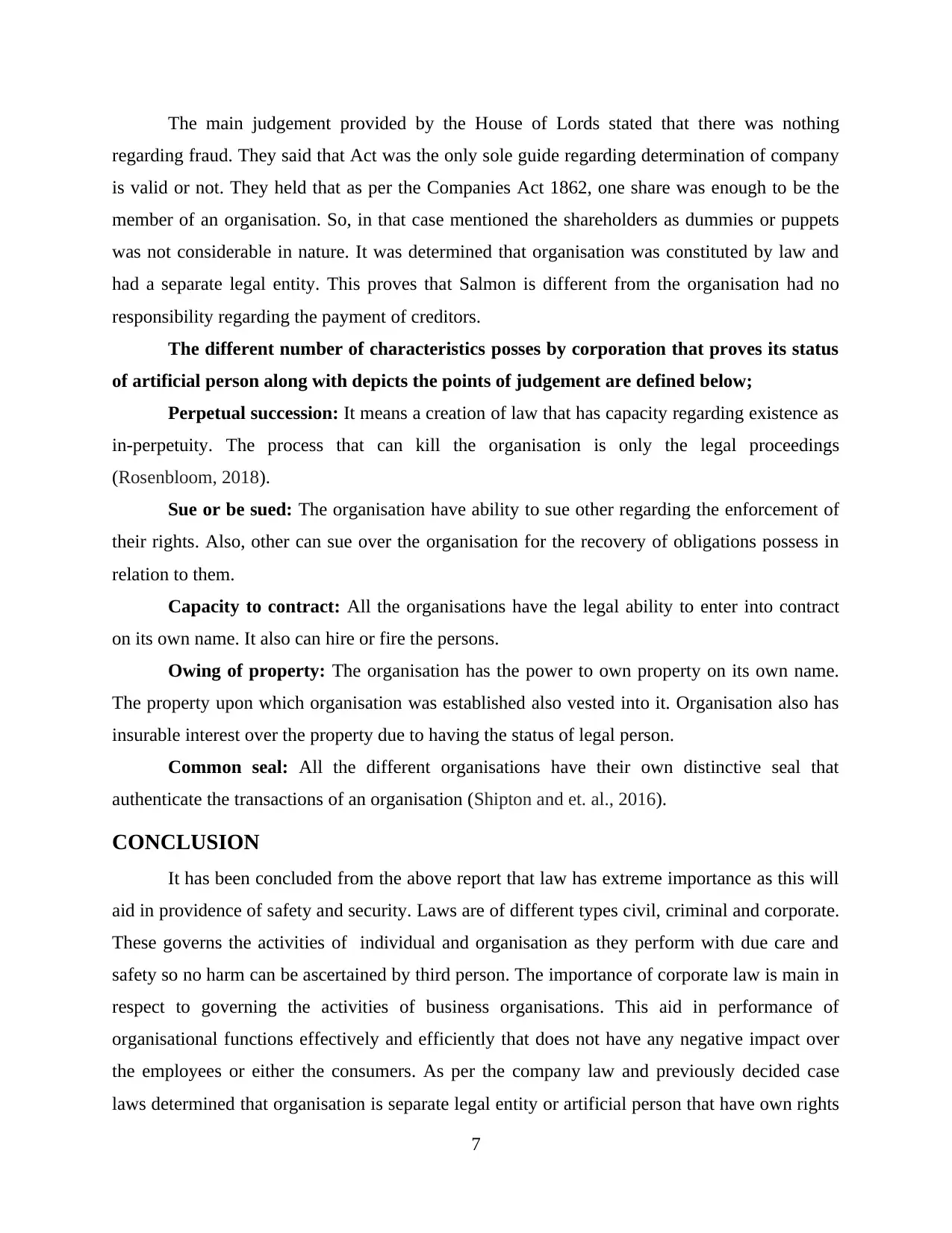
The main judgement provided by the House of Lords stated that there was nothing
regarding fraud. They said that Act was the only sole guide regarding determination of company
is valid or not. They held that as per the Companies Act 1862, one share was enough to be the
member of an organisation. So, in that case mentioned the shareholders as dummies or puppets
was not considerable in nature. It was determined that organisation was constituted by law and
had a separate legal entity. This proves that Salmon is different from the organisation had no
responsibility regarding the payment of creditors.
The different number of characteristics posses by corporation that proves its status
of artificial person along with depicts the points of judgement are defined below;
Perpetual succession: It means a creation of law that has capacity regarding existence as
in-perpetuity. The process that can kill the organisation is only the legal proceedings
(Rosenbloom, 2018).
Sue or be sued: The organisation have ability to sue other regarding the enforcement of
their rights. Also, other can sue over the organisation for the recovery of obligations possess in
relation to them.
Capacity to contract: All the organisations have the legal ability to enter into contract
on its own name. It also can hire or fire the persons.
Owing of property: The organisation has the power to own property on its own name.
The property upon which organisation was established also vested into it. Organisation also has
insurable interest over the property due to having the status of legal person.
Common seal: All the different organisations have their own distinctive seal that
authenticate the transactions of an organisation (Shipton and et. al., 2016).
CONCLUSION
It has been concluded from the above report that law has extreme importance as this will
aid in providence of safety and security. Laws are of different types civil, criminal and corporate.
These governs the activities of individual and organisation as they perform with due care and
safety so no harm can be ascertained by third person. The importance of corporate law is main in
respect to governing the activities of business organisations. This aid in performance of
organisational functions effectively and efficiently that does not have any negative impact over
the employees or either the consumers. As per the company law and previously decided case
laws determined that organisation is separate legal entity or artificial person that have own rights
7
regarding fraud. They said that Act was the only sole guide regarding determination of company
is valid or not. They held that as per the Companies Act 1862, one share was enough to be the
member of an organisation. So, in that case mentioned the shareholders as dummies or puppets
was not considerable in nature. It was determined that organisation was constituted by law and
had a separate legal entity. This proves that Salmon is different from the organisation had no
responsibility regarding the payment of creditors.
The different number of characteristics posses by corporation that proves its status
of artificial person along with depicts the points of judgement are defined below;
Perpetual succession: It means a creation of law that has capacity regarding existence as
in-perpetuity. The process that can kill the organisation is only the legal proceedings
(Rosenbloom, 2018).
Sue or be sued: The organisation have ability to sue other regarding the enforcement of
their rights. Also, other can sue over the organisation for the recovery of obligations possess in
relation to them.
Capacity to contract: All the organisations have the legal ability to enter into contract
on its own name. It also can hire or fire the persons.
Owing of property: The organisation has the power to own property on its own name.
The property upon which organisation was established also vested into it. Organisation also has
insurable interest over the property due to having the status of legal person.
Common seal: All the different organisations have their own distinctive seal that
authenticate the transactions of an organisation (Shipton and et. al., 2016).
CONCLUSION
It has been concluded from the above report that law has extreme importance as this will
aid in providence of safety and security. Laws are of different types civil, criminal and corporate.
These governs the activities of individual and organisation as they perform with due care and
safety so no harm can be ascertained by third person. The importance of corporate law is main in
respect to governing the activities of business organisations. This aid in performance of
organisational functions effectively and efficiently that does not have any negative impact over
the employees or either the consumers. As per the company law and previously decided case
laws determined that organisation is separate legal entity or artificial person that have own rights
7
⊘ This is a preview!⊘
Do you want full access?
Subscribe today to unlock all pages.
Trusted by 1+ million students worldwide
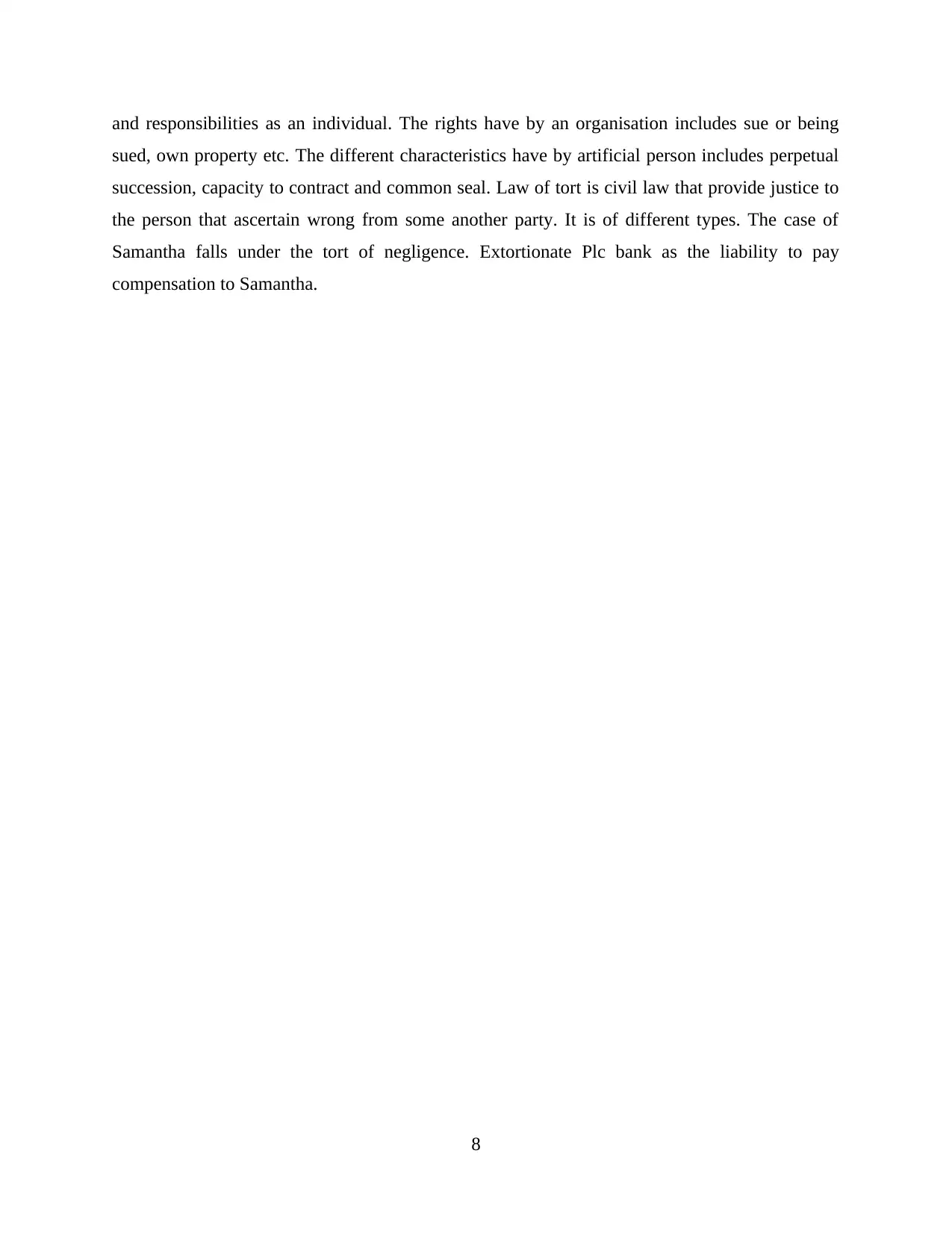
and responsibilities as an individual. The rights have by an organisation includes sue or being
sued, own property etc. The different characteristics have by artificial person includes perpetual
succession, capacity to contract and common seal. Law of tort is civil law that provide justice to
the person that ascertain wrong from some another party. It is of different types. The case of
Samantha falls under the tort of negligence. Extortionate Plc bank as the liability to pay
compensation to Samantha.
8
sued, own property etc. The different characteristics have by artificial person includes perpetual
succession, capacity to contract and common seal. Law of tort is civil law that provide justice to
the person that ascertain wrong from some another party. It is of different types. The case of
Samantha falls under the tort of negligence. Extortionate Plc bank as the liability to pay
compensation to Samantha.
8
Paraphrase This Document
Need a fresh take? Get an instant paraphrase of this document with our AI Paraphraser
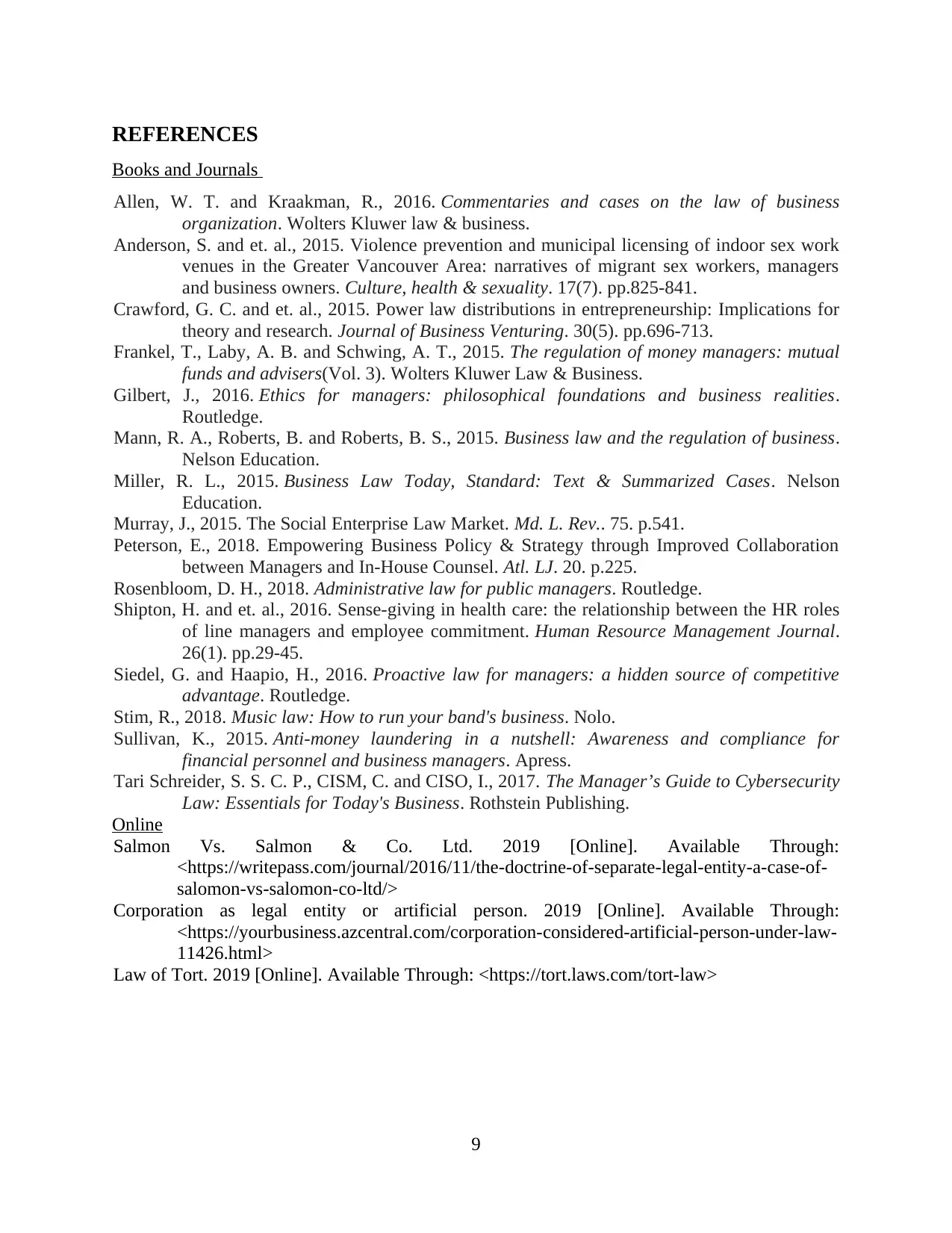
REFERENCES
Books and Journals
Allen, W. T. and Kraakman, R., 2016. Commentaries and cases on the law of business
organization. Wolters Kluwer law & business.
Anderson, S. and et. al., 2015. Violence prevention and municipal licensing of indoor sex work
venues in the Greater Vancouver Area: narratives of migrant sex workers, managers
and business owners. Culture, health & sexuality. 17(7). pp.825-841.
Crawford, G. C. and et. al., 2015. Power law distributions in entrepreneurship: Implications for
theory and research. Journal of Business Venturing. 30(5). pp.696-713.
Frankel, T., Laby, A. B. and Schwing, A. T., 2015. The regulation of money managers: mutual
funds and advisers(Vol. 3). Wolters Kluwer Law & Business.
Gilbert, J., 2016. Ethics for managers: philosophical foundations and business realities.
Routledge.
Mann, R. A., Roberts, B. and Roberts, B. S., 2015. Business law and the regulation of business.
Nelson Education.
Miller, R. L., 2015. Business Law Today, Standard: Text & Summarized Cases. Nelson
Education.
Murray, J., 2015. The Social Enterprise Law Market. Md. L. Rev.. 75. p.541.
Peterson, E., 2018. Empowering Business Policy & Strategy through Improved Collaboration
between Managers and In-House Counsel. Atl. LJ. 20. p.225.
Rosenbloom, D. H., 2018. Administrative law for public managers. Routledge.
Shipton, H. and et. al., 2016. Sense‐giving in health care: the relationship between the HR roles
of line managers and employee commitment. Human Resource Management Journal.
26(1). pp.29-45.
Siedel, G. and Haapio, H., 2016. Proactive law for managers: a hidden source of competitive
advantage. Routledge.
Stim, R., 2018. Music law: How to run your band's business. Nolo.
Sullivan, K., 2015. Anti-money laundering in a nutshell: Awareness and compliance for
financial personnel and business managers. Apress.
Tari Schreider, S. S. C. P., CISM, C. and CISO, I., 2017. The Manager’s Guide to Cybersecurity
Law: Essentials for Today's Business. Rothstein Publishing.
Online
Salmon Vs. Salmon & Co. Ltd. 2019 [Online]. Available Through:
<https://writepass.com/journal/2016/11/the-doctrine-of-separate-legal-entity-a-case-of-
salomon-vs-salomon-co-ltd/>
Corporation as legal entity or artificial person. 2019 [Online]. Available Through:
<https://yourbusiness.azcentral.com/corporation-considered-artificial-person-under-law-
11426.html>
Law of Tort. 2019 [Online]. Available Through: <https://tort.laws.com/tort-law>
9
Books and Journals
Allen, W. T. and Kraakman, R., 2016. Commentaries and cases on the law of business
organization. Wolters Kluwer law & business.
Anderson, S. and et. al., 2015. Violence prevention and municipal licensing of indoor sex work
venues in the Greater Vancouver Area: narratives of migrant sex workers, managers
and business owners. Culture, health & sexuality. 17(7). pp.825-841.
Crawford, G. C. and et. al., 2015. Power law distributions in entrepreneurship: Implications for
theory and research. Journal of Business Venturing. 30(5). pp.696-713.
Frankel, T., Laby, A. B. and Schwing, A. T., 2015. The regulation of money managers: mutual
funds and advisers(Vol. 3). Wolters Kluwer Law & Business.
Gilbert, J., 2016. Ethics for managers: philosophical foundations and business realities.
Routledge.
Mann, R. A., Roberts, B. and Roberts, B. S., 2015. Business law and the regulation of business.
Nelson Education.
Miller, R. L., 2015. Business Law Today, Standard: Text & Summarized Cases. Nelson
Education.
Murray, J., 2015. The Social Enterprise Law Market. Md. L. Rev.. 75. p.541.
Peterson, E., 2018. Empowering Business Policy & Strategy through Improved Collaboration
between Managers and In-House Counsel. Atl. LJ. 20. p.225.
Rosenbloom, D. H., 2018. Administrative law for public managers. Routledge.
Shipton, H. and et. al., 2016. Sense‐giving in health care: the relationship between the HR roles
of line managers and employee commitment. Human Resource Management Journal.
26(1). pp.29-45.
Siedel, G. and Haapio, H., 2016. Proactive law for managers: a hidden source of competitive
advantage. Routledge.
Stim, R., 2018. Music law: How to run your band's business. Nolo.
Sullivan, K., 2015. Anti-money laundering in a nutshell: Awareness and compliance for
financial personnel and business managers. Apress.
Tari Schreider, S. S. C. P., CISM, C. and CISO, I., 2017. The Manager’s Guide to Cybersecurity
Law: Essentials for Today's Business. Rothstein Publishing.
Online
Salmon Vs. Salmon & Co. Ltd. 2019 [Online]. Available Through:
<https://writepass.com/journal/2016/11/the-doctrine-of-separate-legal-entity-a-case-of-
salomon-vs-salomon-co-ltd/>
Corporation as legal entity or artificial person. 2019 [Online]. Available Through:
<https://yourbusiness.azcentral.com/corporation-considered-artificial-person-under-law-
11426.html>
Law of Tort. 2019 [Online]. Available Through: <https://tort.laws.com/tort-law>
9

10
⊘ This is a preview!⊘
Do you want full access?
Subscribe today to unlock all pages.
Trusted by 1+ million students worldwide

1 out of 12


Related Documents


Your All-in-One AI-Powered Toolkit for Academic Success.
+13062052269
info@desklib.com
Available 24*7 on WhatsApp / Email
![[object Object]](/_next/static/media/star-bottom.7253800d.svg)
Unlock your academic potential
Copyright © 2020–2026 A2Z Services. All Rights Reserved. Developed and managed by ZUCOL.