Comparative Analysis of the Intelligence Community and Law Enforcement

Verified

Added on  2022/10/19

|2
|616
|10
Report
AI Summary
This report provides a comparative analysis of the intelligence community and law enforcement, examining their often-uneven relationship and the challenges they face. It delves into issues such as tasking, crime reporting, coordination of activities, and oversight, drawing on resources from IC21, the Federation of American Scientists, and the National Academies of Sciences, Engineering, and Medicine. The report highlights the importance of covert action as a national security tool and the need for effective intelligence analysis to reduce uncertainty and protect national interests. It also explores the application of productivity measures in law enforcement, including the District Awareness Program in Omaha, Nebraska. The report offers insights into the complexities of their interaction, emphasizing the importance of collaboration and policy adjustments to enhance national security and public safety. The report also considers the need for a reevaluation of limits on clandestine activities.
Document Page
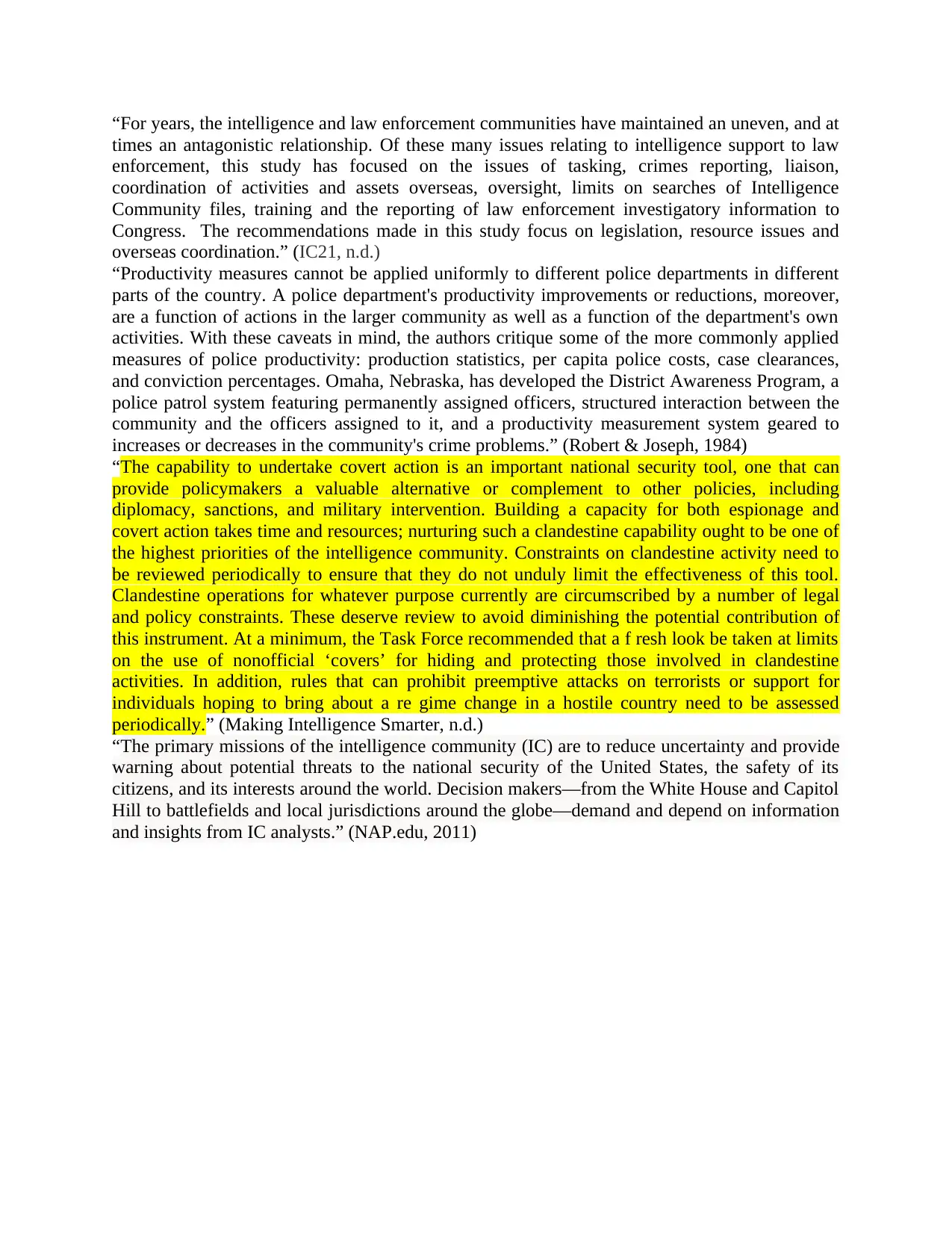
“For years, the intelligence and law enforcement communities have maintained an uneven, and at
times an antagonistic relationship. Of these many issues relating to intelligence support to law
enforcement, this study has focused on the issues of tasking, crimes reporting, liaison,
coordination of activities and assets overseas, oversight, limits on searches of Intelligence
Community files, training and the reporting of law enforcement investigatory information to
Congress. The recommendations made in this study focus on legislation, resource issues and
overseas coordination.” (IC21, n.d.)
“Productivity measures cannot be applied uniformly to different police departments in different
parts of the country. A police department's productivity improvements or reductions, moreover,
are a function of actions in the larger community as well as a function of the department's own
activities. With these caveats in mind, the authors critique some of the more commonly applied
measures of police productivity: production statistics, per capita police costs, case clearances,
and conviction percentages. Omaha, Nebraska, has developed the District Awareness Program, a
police patrol system featuring permanently assigned officers, structured interaction between the
community and the officers assigned to it, and a productivity measurement system geared to
increases or decreases in the community's crime problems.” (Robert & Joseph, 1984)
The capability to undertake covert action is an important national security tool, one that can
provide policymakers a valuable alternative or complement to other policies, including
diplomacy, sanctions, and military intervention. Building a capacity for both espionage and
covert action takes time and resources; nurturing such a clandestine capability ought to be one of
the highest priorities of the intelligence community. Constraints on clandestine activity need to
be reviewed periodically to ensure that they do not unduly limit the effectiveness of this tool.
Clandestine operations for whatever purpose currently are circumscribed by a number of legal
and policy constraints. These deserve review to avoid diminishing the potential contribution of
this instrument. At a minimum, the Task Force recommended that a f resh look be taken at limits
on the use of nonofficial ‘covers’ for hiding and protecting those involved in clandestine
activities. In addition, rules that can prohibit preemptive attacks on terrorists or support for
individuals hoping to bring about a re gime change in a hostile country need to be assessed
periodically.” (Making Intelligence Smarter, n.d.)
The primary missions of the intelligence community (IC) are to reduce uncertainty and provide
warning about potential threats to the national security of the United States, the safety of its
citizens, and its interests around the world. Decision makers—from the White House and Capitol
Hill to battlefields and local jurisdictions around the globe—demand and depend on information
and insights from IC analysts.” (NAP.edu, 2011)
tabler-icon-diamond-filled.svg

Paraphrase This Document

Need a fresh take? Get an instant paraphrase of this document with our AI Paraphraser
Document Page
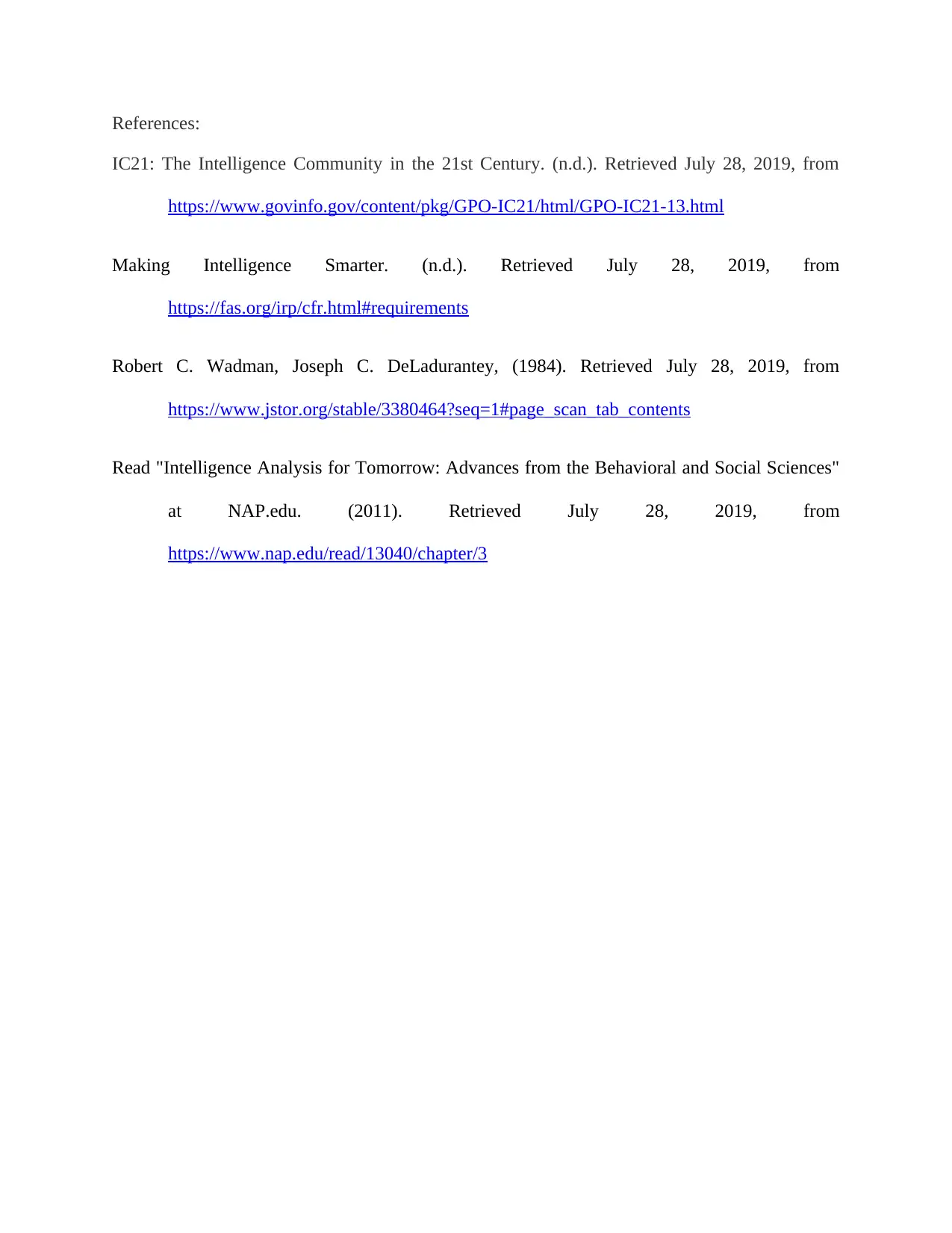
References:
IC21: The Intelligence Community in the 21st Century. (n.d.). Retrieved July 28, 2019, from
https://www.govinfo.gov/content/pkg/GPO-IC21/html/GPO-IC21-13.html
Making Intelligence Smarter. (n.d.). Retrieved July 28, 2019, from
https://fas.org/irp/cfr.html#requirements
Robert C. Wadman, Joseph C. DeLadurantey, (1984). Retrieved July 28, 2019, from
https://www.jstor.org/stable/3380464?seq=1#page_scan_tab_contents
Read "Intelligence Analysis for Tomorrow: Advances from the Behavioral and Social Sciences"
at NAP.edu. (2011). Retrieved July 28, 2019, from
https://www.nap.edu/read/13040/chapter/3
chevron_up_icon
1 out of 2
circle_padding
hide_on_mobile
zoom_out_icon
[object Object]