Law and Ethics: Analysis of Abbott's Actions and Ethical Reasoning

Verified

Added on  2021/04/21

|4
|706
|93
Case Study
AI Summary
This case study analyzes the actions of Abbott, a student facing financial difficulties and health issues, who is considering stealing from grocery stores. The analysis focuses on the ethical and legal dimensions of his potential actions. The study uses the 'Rights and Duties' ethical theory to evaluate Abbott's choices, emphasizing the importance of upholding rights and fulfilling duties. It argues that Abbott's actions, specifically theft, are not justified under any circumstances, as they violate both legal and ethical principles. The analysis references relevant literature to support the arguments and highlights the potential consequences of Abbott's actions, reinforcing the importance of adhering to legal and ethical standards within society. The case underscores the need for individuals to seek help through appropriate channels rather than resorting to illegal activities.
Document Page
Running head: LAW AND ETHICS
Law and Ethics
Name of the Student
Name of the University
Author Note
tabler-icon-diamond-filled.svg

Paraphrase This Document

Need a fresh take? Get an instant paraphrase of this document with our AI Paraphraser
Document Page
1LAW AND ETHICS
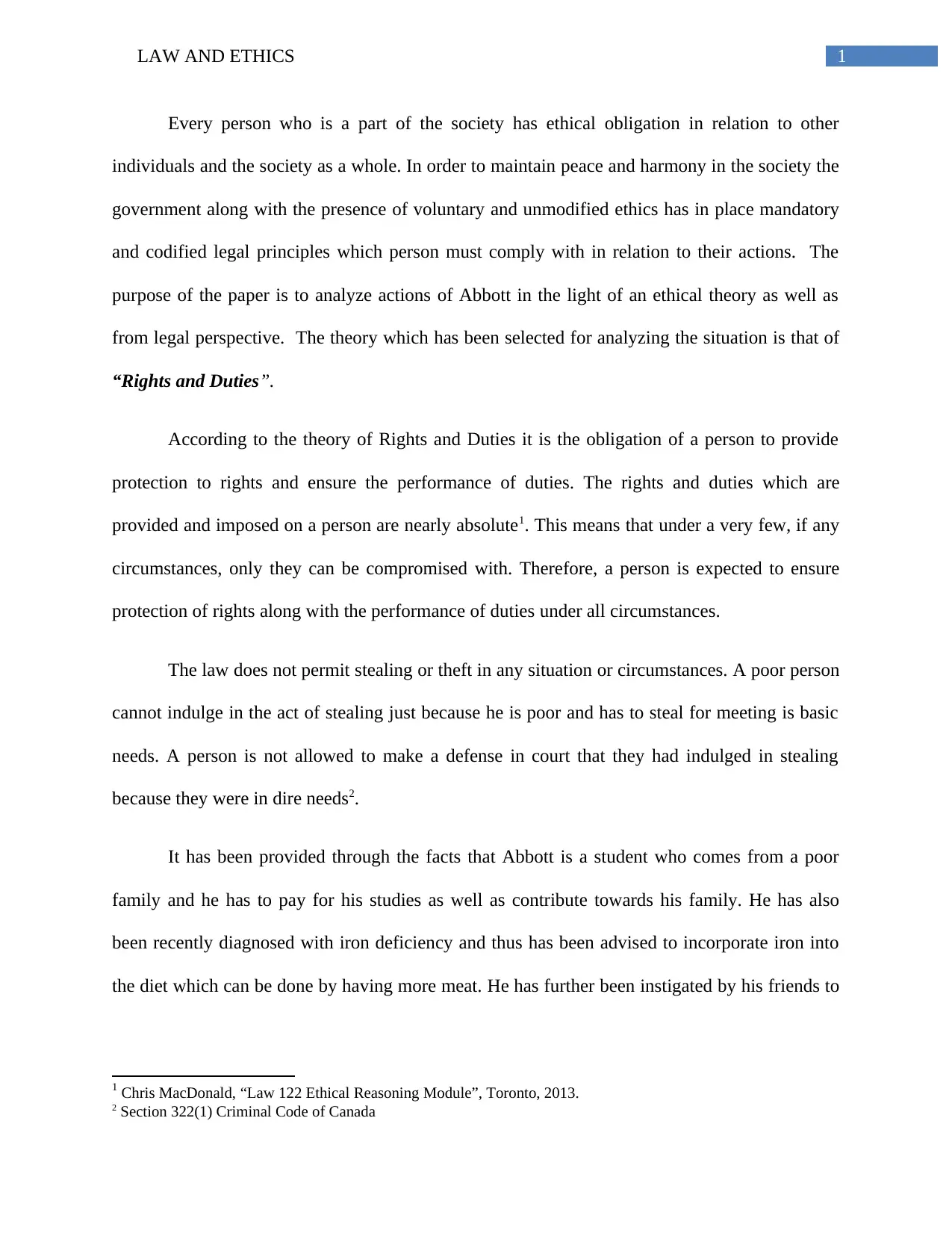
Every person who is a part of the society has ethical obligation in relation to other
individuals and the society as a whole. In order to maintain peace and harmony in the society the
government along with the presence of voluntary and unmodified ethics has in place mandatory
and codified legal principles which person must comply with in relation to their actions. The
purpose of the paper is to analyze actions of Abbott in the light of an ethical theory as well as
from legal perspective. The theory which has been selected for analyzing the situation is that of
“Rights and Duties”.
According to the theory of Rights and Duties it is the obligation of a person to provide
protection to rights and ensure the performance of duties. The rights and duties which are
provided and imposed on a person are nearly absolute1. This means that under a very few, if any
circumstances, only they can be compromised with. Therefore, a person is expected to ensure
protection of rights along with the performance of duties under all circumstances.
The law does not permit stealing or theft in any situation or circumstances. A poor person
cannot indulge in the act of stealing just because he is poor and has to steal for meeting is basic
needs. A person is not allowed to make a defense in court that they had indulged in stealing
because they were in dire needs2.
It has been provided through the facts that Abbott is a student who comes from a poor
family and he has to pay for his studies as well as contribute towards his family. He has also
been recently diagnosed with iron deficiency and thus has been advised to incorporate iron into
the diet which can be done by having more meat. He has further been instigated by his friends to
1 Chris MacDonald, “Law 122 Ethical Reasoning Module”, Toronto, 2013.
2 Section 322(1) Criminal Code of Canada
Document Page
2LAW AND ETHICS
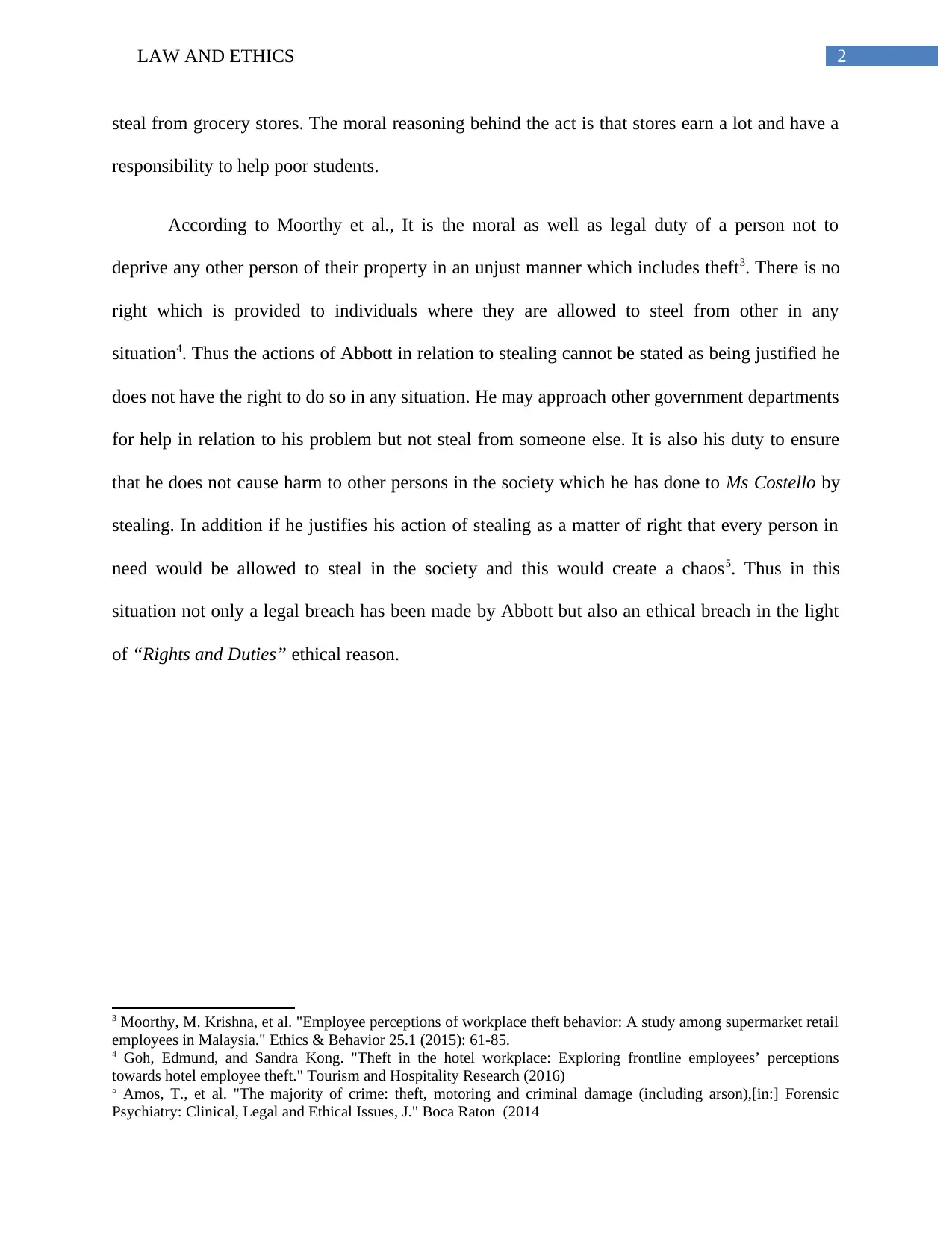
steal from grocery stores. The moral reasoning behind the act is that stores earn a lot and have a
responsibility to help poor students.
According to Moorthy et al., It is the moral as well as legal duty of a person not to
deprive any other person of their property in an unjust manner which includes theft3. There is no
right which is provided to individuals where they are allowed to steel from other in any
situation4. Thus the actions of Abbott in relation to stealing cannot be stated as being justified he
does not have the right to do so in any situation. He may approach other government departments
for help in relation to his problem but not steal from someone else. It is also his duty to ensure
that he does not cause harm to other persons in the society which he has done to Ms Costello by
stealing. In addition if he justifies his action of stealing as a matter of right that every person in
need would be allowed to steal in the society and this would create a chaos5. Thus in this
situation not only a legal breach has been made by Abbott but also an ethical breach in the light
of “Rights and Duties” ethical reason.
3 Moorthy, M. Krishna, et al. "Employee perceptions of workplace theft behavior: A study among supermarket retail
employees in Malaysia." Ethics & Behavior 25.1 (2015): 61-85.
4 Goh, Edmund, and Sandra Kong. "Theft in the hotel workplace: Exploring frontline employees’ perceptions
towards hotel employee theft." Tourism and Hospitality Research (2016)
5 Amos, T., et al. "The majority of crime: theft, motoring and criminal damage (including arson),[in:] Forensic
Psychiatry: Clinical, Legal and Ethical Issues, J." Boca Raton (2014
Document Page
3LAW AND ETHICS
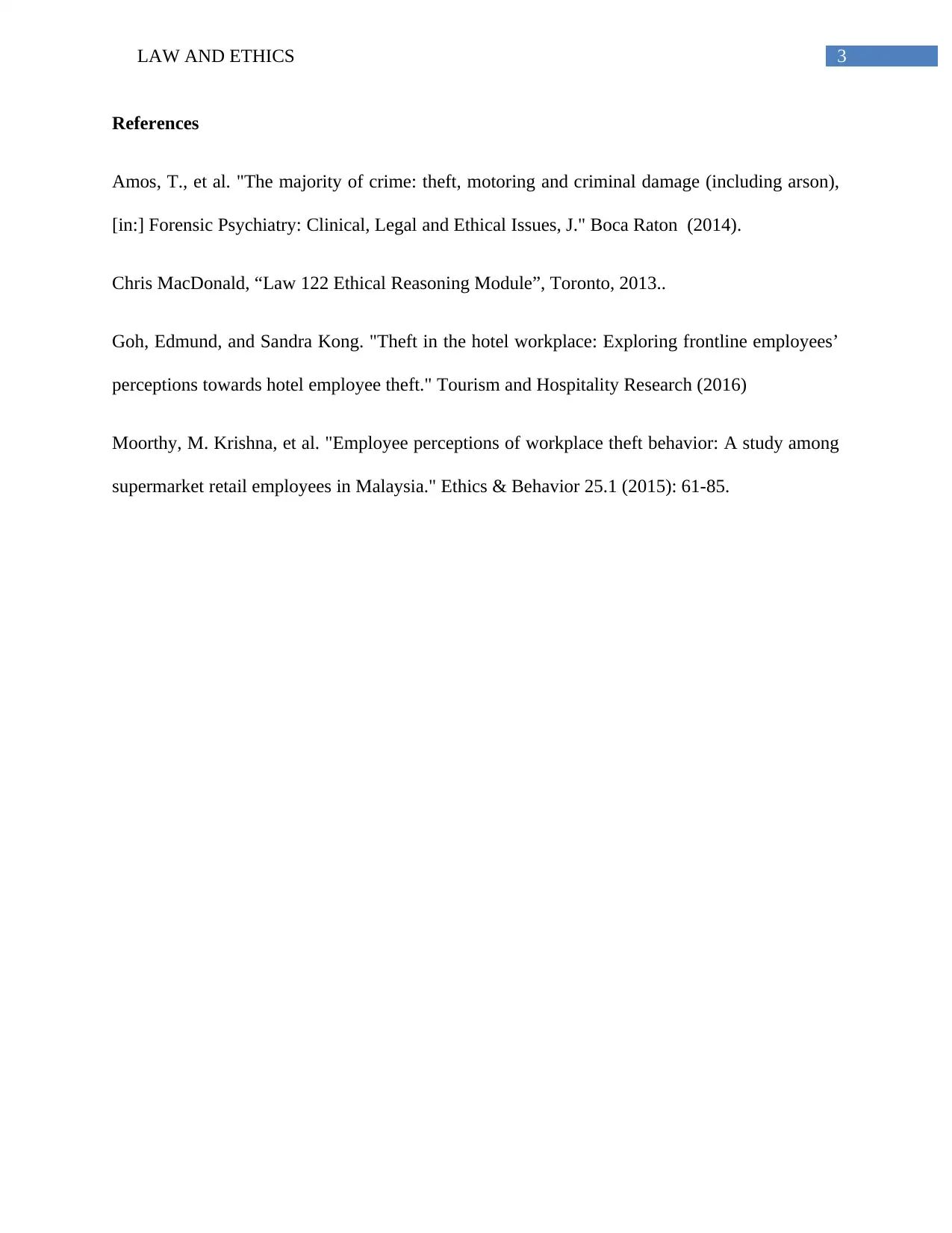
References
Amos, T., et al. "The majority of crime: theft, motoring and criminal damage (including arson),
[in:] Forensic Psychiatry: Clinical, Legal and Ethical Issues, J." Boca Raton (2014).
Chris MacDonald, “Law 122 Ethical Reasoning Module”, Toronto, 2013..
Goh, Edmund, and Sandra Kong. "Theft in the hotel workplace: Exploring frontline employees’
perceptions towards hotel employee theft." Tourism and Hospitality Research (2016)
Moorthy, M. Krishna, et al. "Employee perceptions of workplace theft behavior: A study among
supermarket retail employees in Malaysia." Ethics & Behavior 25.1 (2015): 61-85.
chevron_up_icon
1 out of 4
circle_padding
hide_on_mobile
zoom_out_icon
[object Object]