Law Assignment: Negligent Misstatement, Consumer Law, and Contracts

Verified

Added on  2020/03/16

|7
|1198
|41
Homework Assignment
AI Summary
This law assignment analyzes a case involving a meditation studio owner, Ellen, and her interactions with a local council. The assignment explores three key legal issues: whether Ellen can claim against the council for negligent advice, whether Ellen breached her contract with the landlord by failing to pay rent due to business disruption, and whether the council employee's statement constitutes a negligent misstatement. The solution references relevant Australian Consumer Law (ACL) provisions, including Section 60 regarding consumer guarantees of care and skill, and the legal concept of contract frustration, referencing the case of Taylor v Caldwell. It also addresses the tort of negligent misstatement, citing Hedley Byrne & Co Ltd v Heller & Partners Ltd. The assignment concludes that the council breached the ACL, Ellen did not breach her contract due to frustration, and the council employee made a negligent misstatement, providing a comprehensive legal analysis of the scenario.
Document Page
Running Head: Law 1
Law
tabler-icon-diamond-filled.svg

Paraphrase This Document

Need a fresh take? Get an instant paraphrase of this document with our AI Paraphraser
Document Page
Law 2
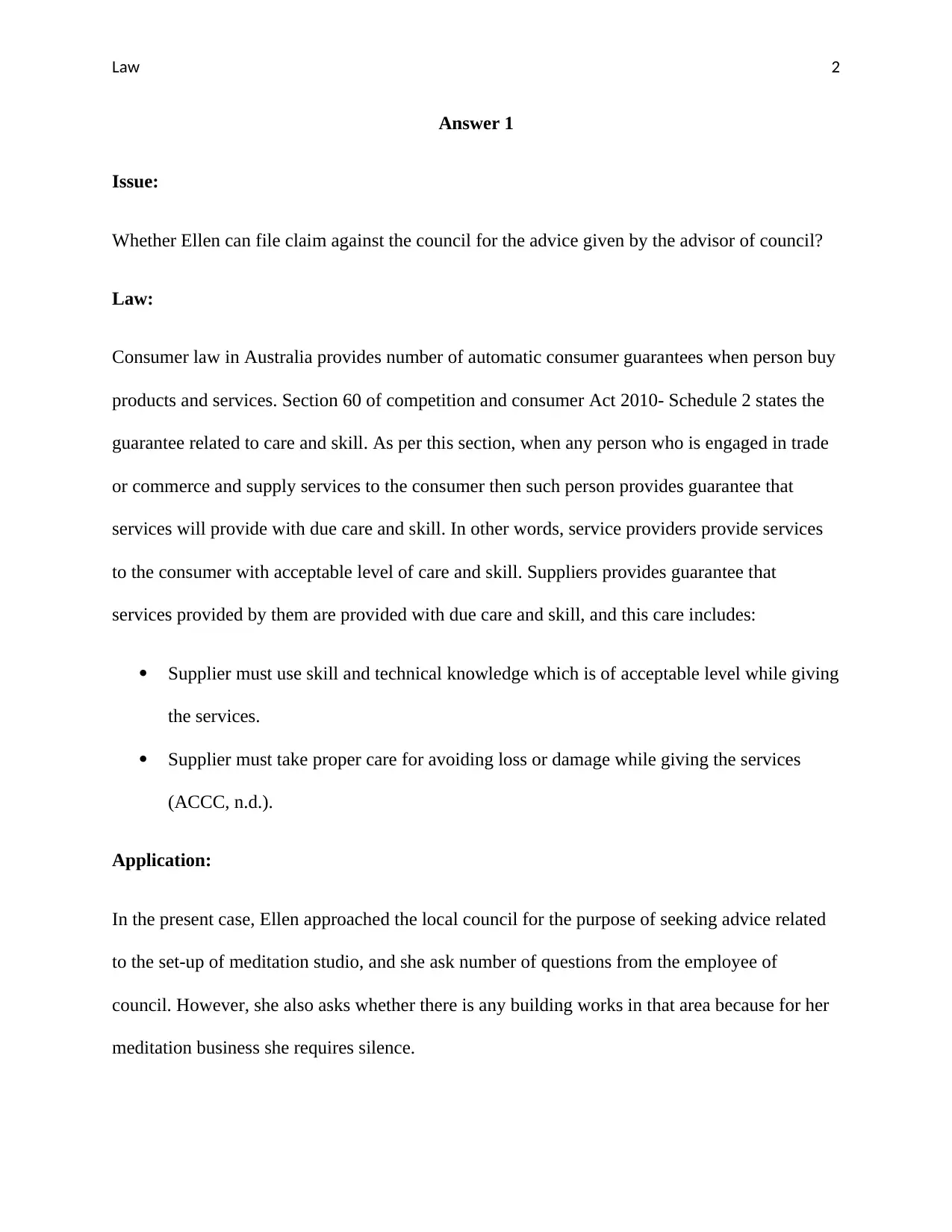
Answer 1
Issue:
Whether Ellen can file claim against the council for the advice given by the advisor of council?
Law:
Consumer law in Australia provides number of automatic consumer guarantees when person buy
products and services. Section 60 of competition and consumer Act 2010- Schedule 2 states the
guarantee related to care and skill. As per this section, when any person who is engaged in trade
or commerce and supply services to the consumer then such person provides guarantee that
services will provide with due care and skill. In other words, service providers provide services
to the consumer with acceptable level of care and skill. Suppliers provides guarantee that
services provided by them are provided with due care and skill, and this care includes:
Supplier must use skill and technical knowledge which is of acceptable level while giving
the services.
Supplier must take proper care for avoiding loss or damage while giving the services
(ACCC, n.d.).
Application:
In the present case, Ellen approached the local council for the purpose of seeking advice related
to the set-up of meditation studio, and she ask number of questions from the employee of
council. However, she also asks whether there is any building works in that area because for her
meditation business she requires silence.
Document Page
Law 3
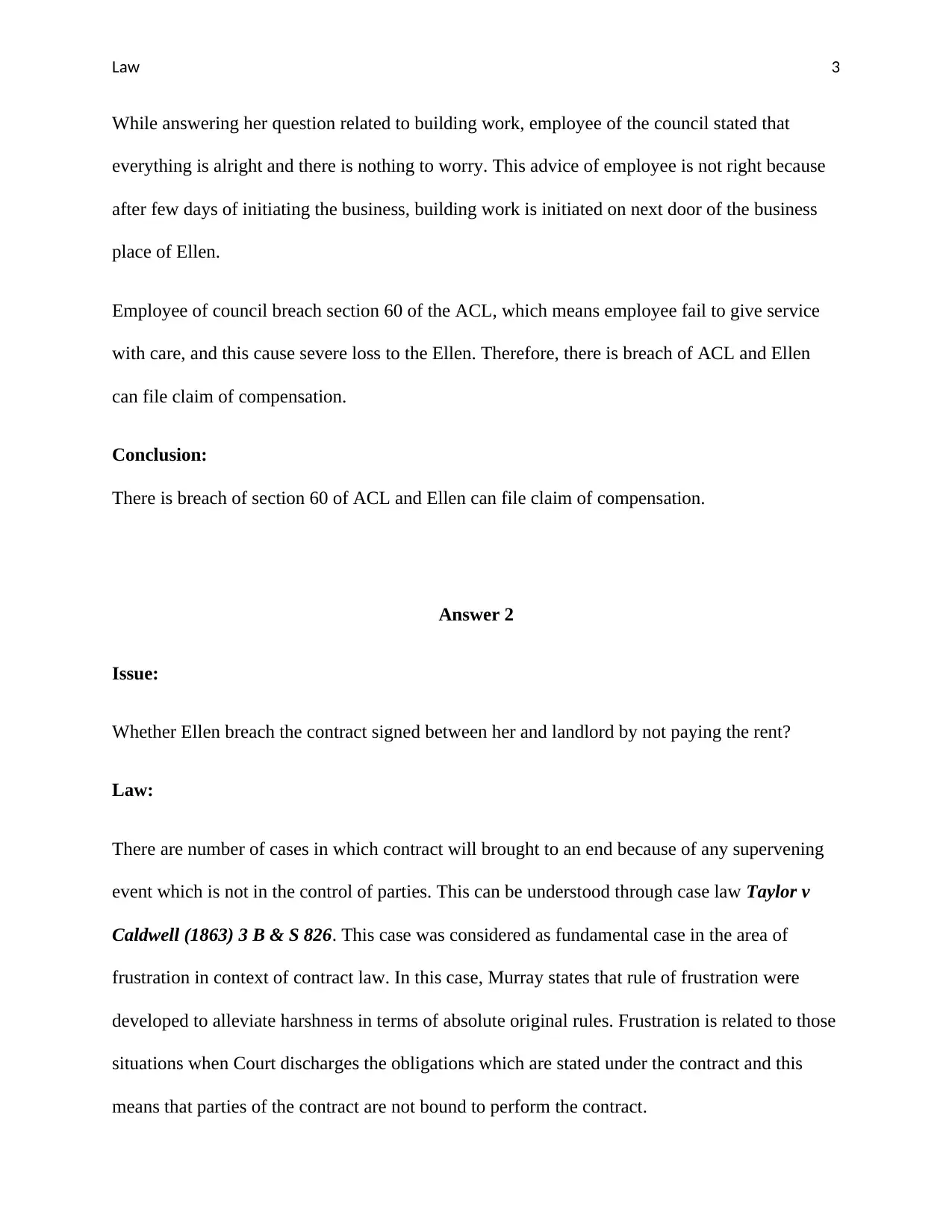
While answering her question related to building work, employee of the council stated that
everything is alright and there is nothing to worry. This advice of employee is not right because
after few days of initiating the business, building work is initiated on next door of the business
place of Ellen.
Employee of council breach section 60 of the ACL, which means employee fail to give service
with care, and this cause severe loss to the Ellen. Therefore, there is breach of ACL and Ellen
can file claim of compensation.
Conclusion:
There is breach of section 60 of ACL and Ellen can file claim of compensation.
Answer 2
Issue:
Whether Ellen breach the contract signed between her and landlord by not paying the rent?
Law:
There are number of cases in which contract will brought to an end because of any supervening
event which is not in the control of parties. This can be understood through case law Taylor v
Caldwell (1863) 3 B & S 826. This case was considered as fundamental case in the area of
frustration in context of contract law. In this case, Murray states that rule of frustration were
developed to alleviate harshness in terms of absolute original rules. Frustration is related to those
situations when Court discharges the obligations which are stated under the contract and this
means that parties of the contract are not bound to perform the contract.
Document Page
Law 4
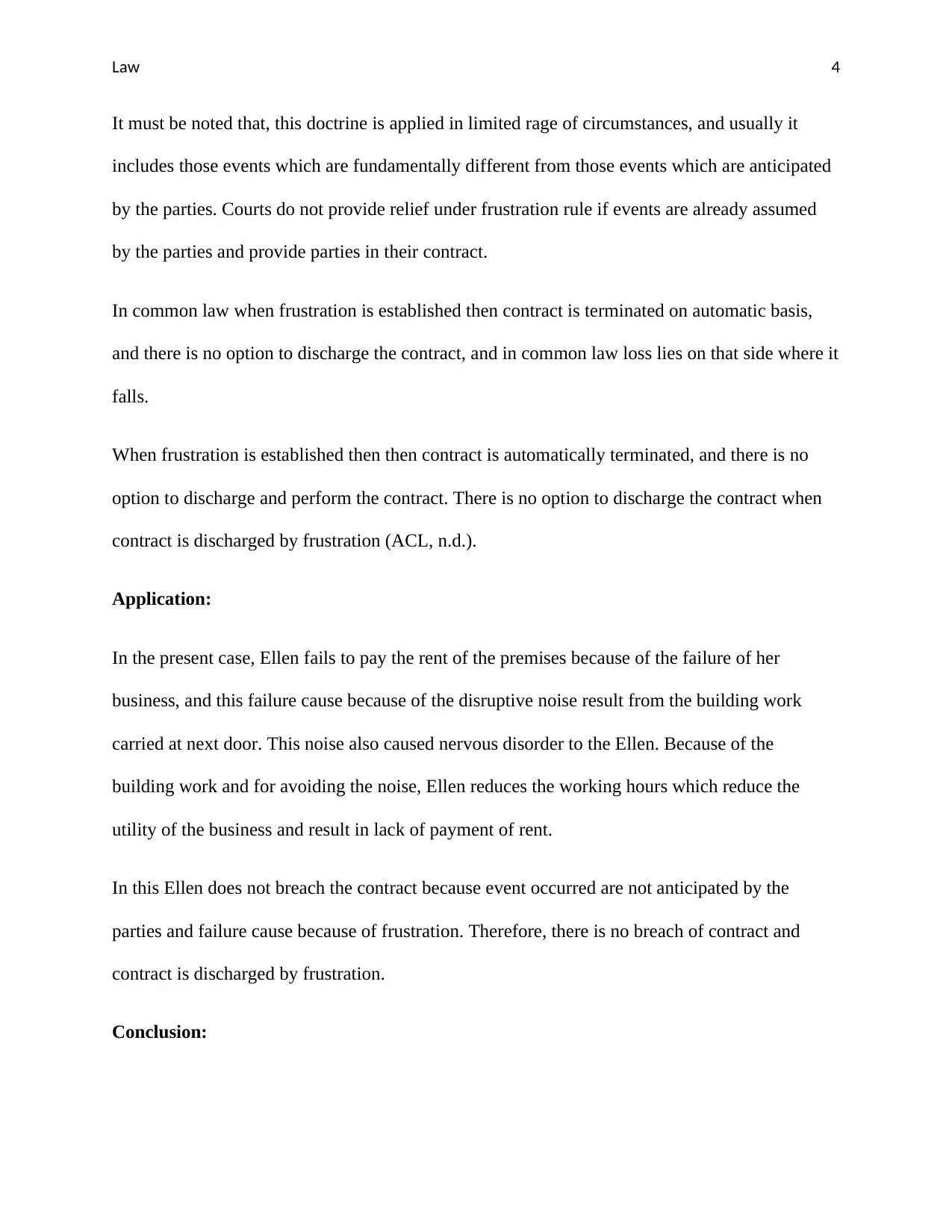
It must be noted that, this doctrine is applied in limited rage of circumstances, and usually it
includes those events which are fundamentally different from those events which are anticipated
by the parties. Courts do not provide relief under frustration rule if events are already assumed
by the parties and provide parties in their contract.
In common law when frustration is established then contract is terminated on automatic basis,
and there is no option to discharge the contract, and in common law loss lies on that side where it
falls.
When frustration is established then then contract is automatically terminated, and there is no
option to discharge and perform the contract. There is no option to discharge the contract when
contract is discharged by frustration (ACL, n.d.).
Application:
In the present case, Ellen fails to pay the rent of the premises because of the failure of her
business, and this failure cause because of the disruptive noise result from the building work
carried at next door. This noise also caused nervous disorder to the Ellen. Because of the
building work and for avoiding the noise, Ellen reduces the working hours which reduce the
utility of the business and result in lack of payment of rent.
In this Ellen does not breach the contract because event occurred are not anticipated by the
parties and failure cause because of frustration. Therefore, there is no breach of contract and
contract is discharged by frustration.
Conclusion:
tabler-icon-diamond-filled.svg

Paraphrase This Document

Need a fresh take? Get an instant paraphrase of this document with our AI Paraphraser
Document Page
Law 5
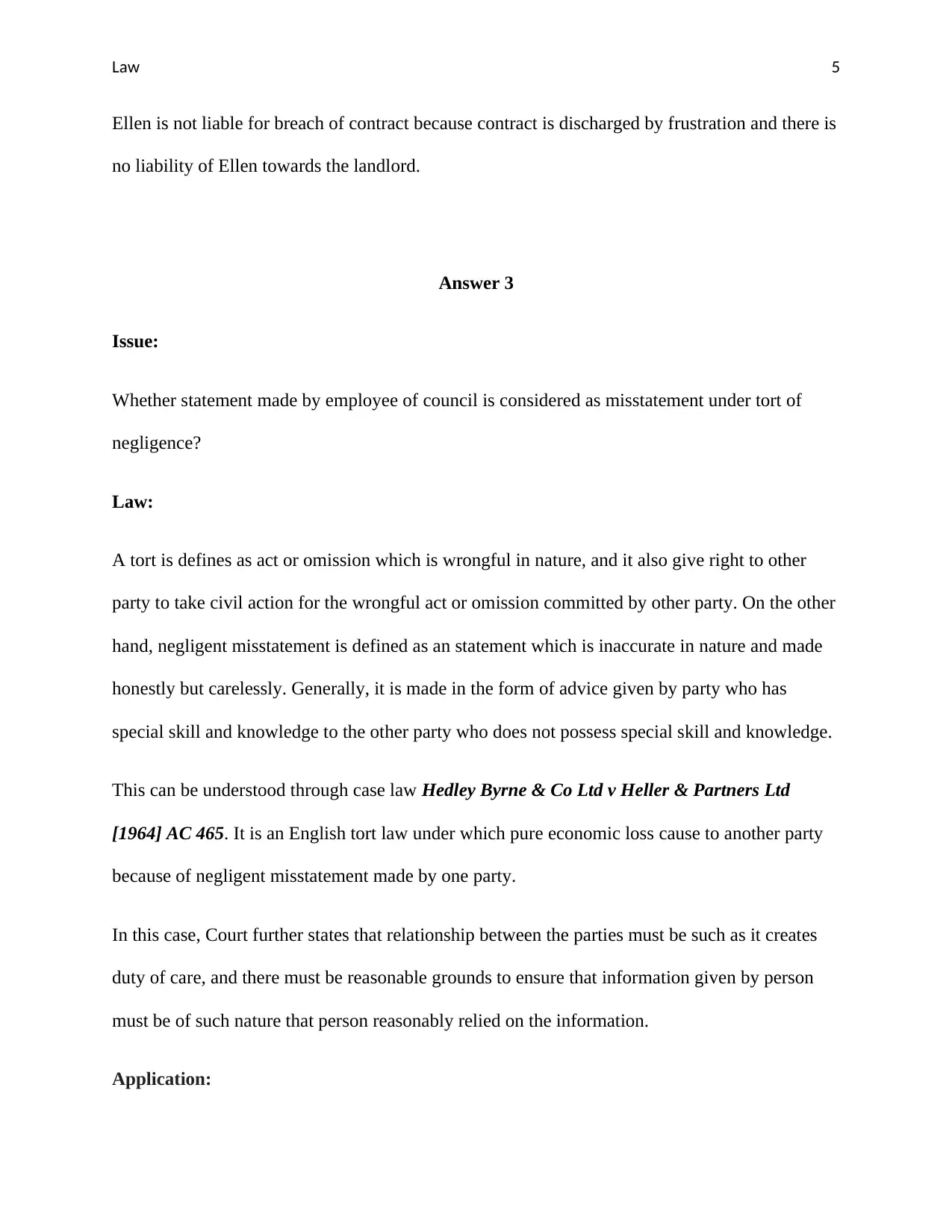
Ellen is not liable for breach of contract because contract is discharged by frustration and there is
no liability of Ellen towards the landlord.
Answer 3
Issue:
Whether statement made by employee of council is considered as misstatement under tort of
negligence?
Law:
A tort is defines as act or omission which is wrongful in nature, and it also give right to other
party to take civil action for the wrongful act or omission committed by other party. On the other
hand, negligent misstatement is defined as an statement which is inaccurate in nature and made
honestly but carelessly. Generally, it is made in the form of advice given by party who has
special skill and knowledge to the other party who does not possess special skill and knowledge.
This can be understood through case law Hedley Byrne & Co Ltd v Heller & Partners Ltd
[1964] AC 465. It is an English tort law under which pure economic loss cause to another party
because of negligent misstatement made by one party.
In this case, Court further states that relationship between the parties must be such as it creates
duty of care, and there must be reasonable grounds to ensure that information given by person
must be of such nature that person reasonably relied on the information.
Application:
Document Page
Law 6
In the present case, asks whether there is any building works in that area because for her
meditation business she requires silence. While answering this question, employee of the council
stated that everything is alright and there is nothing to worry. This statement is considered as
negligent misstatement because in this Ellen suffers pure economic loss by relying on the
statement made by employee carelessly.
Conclusion:
After concluding above facts, it is clear that statement made by employee of council is
considered as negligent misstatement.
Document Page
Law 7
References:
ACCC. Consumer Guarantees. Retrieved on 7th October 2017 from:
https://www.accc.gov.au/system/files/Consumer%20Guarantees%20A%20guide%20for
%20consumers_0.pdf.
ACL. Discharge by Frustration. Retrieved on 7th October 2017 from:
https://www.australiancontractlaw.com/law/termination-frustration.html.
Competition and Consumer Act 2010, Schedule 2- Section 60.
Hedley Byrne & Co Ltd v Heller & Partners Ltd [1964] AC 465.
Law Teacher. Tort Of Negligent Misstatement. Retrieved on 7th October 2017 from:
https://www.lawteacher.net/free-law-essays/contract-law/tort-of-negligent-misstatement-
contract-law-essay.php.
Taylor v Caldwell (1863) 3 B & S 826.
chevron_up_icon
1 out of 7
circle_padding
hide_on_mobile
zoom_out_icon
[object Object]