HND in Healthcare: Law, Policy & Ethical Practice - Unit 1 Report
VerifiedAdded on 2023/06/12
|21
|7224
|101
Report
AI Summary
This report provides a comprehensive overview of law, policy, and ethical practice within the health and social care sector. It begins by summarizing the key features of different levels of law and policy, including international, national, and organizational policies. The report explores the relationship between ethics and legislation, emphasizing their relevance to healthcare practitioners' professional responsibilities. It compares national and organizational policies against national professional standards, reflecting on how specific tasks meet these standards within a legal framework. The report also analyzes recent health and social care legislation and national policies, examining their importance in informing the rights and responsibilities of practitioners to provide safe and equitable care. Furthermore, it describes the relationship between law, policy, and ethical requirements in real case scenarios, explaining the impact of relevant law and policy on the outcomes and critically reviews how practitioners can ensure compliance with legislation and policies through ethical practice. The report concludes by highlighting the importance of understanding and adhering to legal and ethical standards to protect the rights and well-being of service users.
Part 1: Submission Front Sheet to be included with Final Submission and any Resubmission
Submission Front Sheet
Project Code: ABRQF862HSC1AA
Programme: Pearson BTEC Higher National Diploma in Healthcare Practice
(Healthcare Management)
Unit Title and Number: Law, Policy and Ethical Practice in Health and Social Care (Unit 1)
Is this a First Submission or Second Submission ?
Word Count (max.5000)
Turnitin Score
Complete and copy this page and add it as the front sheet to your online submission.
Page 1
Learner’s statement of authenticity:
I certify that the work submitted for this project is my own. Where the work of others has been used
to support my work then credit has been acknowledged. I have identified and acknowledged all
sources used in this project and have referenced according to the Harvard referencing system. I
have read and understood the Plagiarism and Collusion section provided with the project brief and
understood the consequences of plagiarising.
Signature: ___________LA________ Date: __
4561
words
%
Submission Front Sheet
Project Code: ABRQF862HSC1AA
Programme: Pearson BTEC Higher National Diploma in Healthcare Practice
(Healthcare Management)
Unit Title and Number: Law, Policy and Ethical Practice in Health and Social Care (Unit 1)
Is this a First Submission or Second Submission ?
Word Count (max.5000)
Turnitin Score
Complete and copy this page and add it as the front sheet to your online submission.
Page 1
Learner’s statement of authenticity:
I certify that the work submitted for this project is my own. Where the work of others has been used
to support my work then credit has been acknowledged. I have identified and acknowledged all
sources used in this project and have referenced according to the Harvard referencing system. I
have read and understood the Plagiarism and Collusion section provided with the project brief and
understood the consequences of plagiarising.
Signature: ___________LA________ Date: __
4561
words
%

Paraphrase This Document
Need a fresh take? Get an instant paraphrase of this document with our AI Paraphraser
Unit 1 Law, Policy and Ethical Practice in H&SC MRC January 2022
Law, Policy and Ethical
Practice in Health and
Social Care
Law, Policy and Ethical
Practice in Health and
Social Care
Unit 1 Law, Policy and Ethical Practice in H&SC MRC January 2022
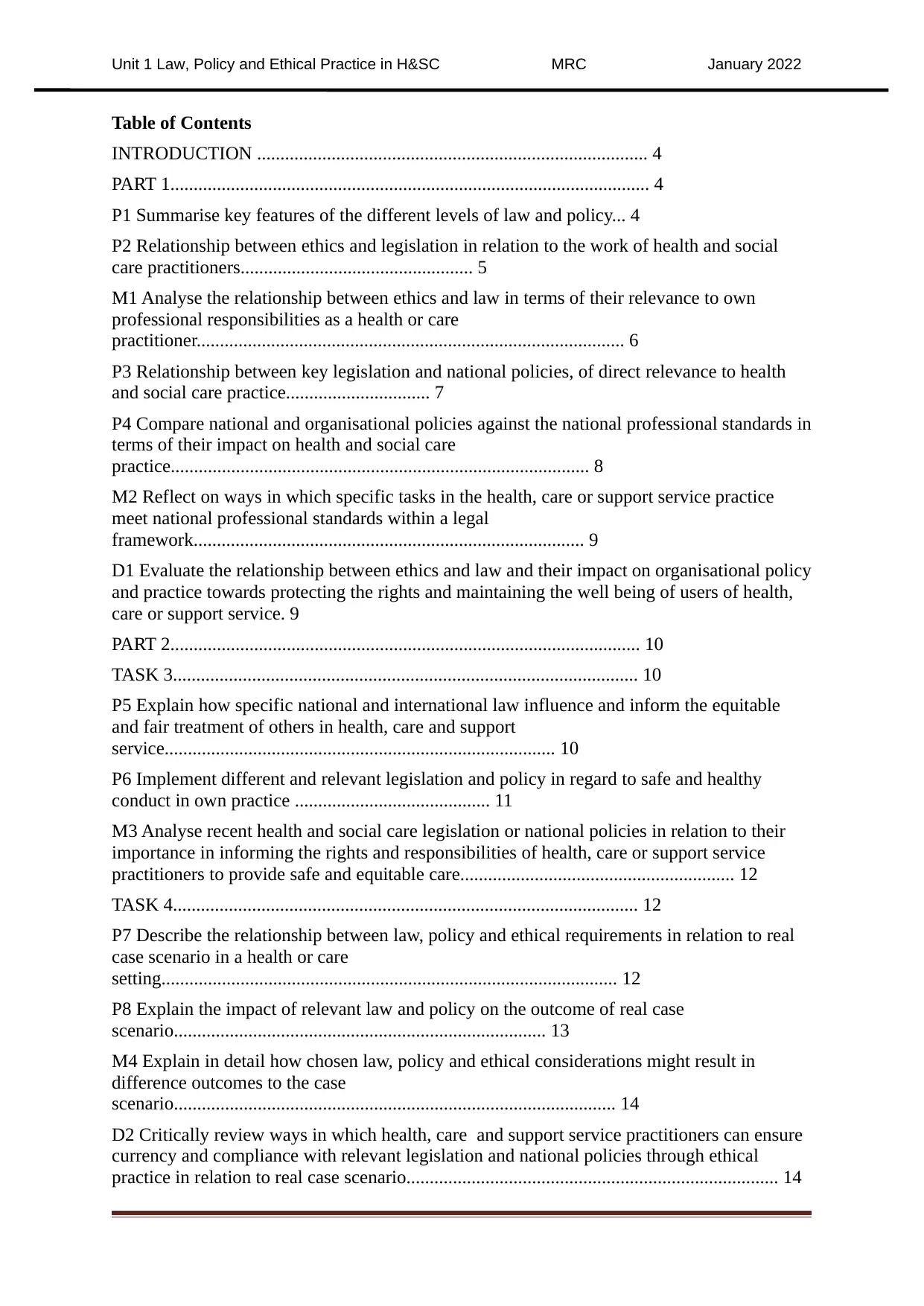
Table of Contents
INTRODUCTION .................................................................................... 4
PART 1....................................................................................................... 4
P1 Summarise key features of the different levels of law and policy... 4
P2 Relationship between ethics and legislation in relation to the work of health and social
care practitioners.................................................. 5
M1 Analyse the relationship between ethics and law in terms of their relevance to own
professional responsibilities as a health or care
practitioner............................................................................................ 6
P3 Relationship between key legislation and national policies, of direct relevance to health
and social care practice............................... 7
P4 Compare national and organisational policies against the national professional standards in
terms of their impact on health and social care
practice.......................................................................................... 8
M2 Reflect on ways in which specific tasks in the health, care or support service practice
meet national professional standards within a legal
framework.................................................................................... 9
D1 Evaluate the relationship between ethics and law and their impact on organisational policy
and practice towards protecting the rights and maintaining the well being of users of health,
care or support service. 9
PART 2..................................................................................................... 10
TASK 3.................................................................................................... 10
P5 Explain how specific national and international law influence and inform the equitable
and fair treatment of others in health, care and support
service.................................................................................... 10
P6 Implement different and relevant legislation and policy in regard to safe and healthy
conduct in own practice .......................................... 11
M3 Analyse recent health and social care legislation or national policies in relation to their
importance in informing the rights and responsibilities of health, care or support service
practitioners to provide safe and equitable care........................................................... 12
TASK 4.................................................................................................... 12
P7 Describe the relationship between law, policy and ethical requirements in relation to real
case scenario in a health or care
setting.................................................................................................. 12
P8 Explain the impact of relevant law and policy on the outcome of real case
scenario................................................................................ 13
M4 Explain in detail how chosen law, policy and ethical considerations might result in
difference outcomes to the case
scenario............................................................................................... 14
D2 Critically review ways in which health, care and support service practitioners can ensure
currency and compliance with relevant legislation and national policies through ethical
practice in relation to real case scenario................................................................................ 14
Table of Contents
INTRODUCTION .................................................................................... 4
PART 1....................................................................................................... 4
P1 Summarise key features of the different levels of law and policy... 4
P2 Relationship between ethics and legislation in relation to the work of health and social
care practitioners.................................................. 5
M1 Analyse the relationship between ethics and law in terms of their relevance to own
professional responsibilities as a health or care
practitioner............................................................................................ 6
P3 Relationship between key legislation and national policies, of direct relevance to health
and social care practice............................... 7
P4 Compare national and organisational policies against the national professional standards in
terms of their impact on health and social care
practice.......................................................................................... 8
M2 Reflect on ways in which specific tasks in the health, care or support service practice
meet national professional standards within a legal
framework.................................................................................... 9
D1 Evaluate the relationship between ethics and law and their impact on organisational policy
and practice towards protecting the rights and maintaining the well being of users of health,
care or support service. 9
PART 2..................................................................................................... 10
TASK 3.................................................................................................... 10
P5 Explain how specific national and international law influence and inform the equitable
and fair treatment of others in health, care and support
service.................................................................................... 10
P6 Implement different and relevant legislation and policy in regard to safe and healthy
conduct in own practice .......................................... 11
M3 Analyse recent health and social care legislation or national policies in relation to their
importance in informing the rights and responsibilities of health, care or support service
practitioners to provide safe and equitable care........................................................... 12
TASK 4.................................................................................................... 12
P7 Describe the relationship between law, policy and ethical requirements in relation to real
case scenario in a health or care
setting.................................................................................................. 12
P8 Explain the impact of relevant law and policy on the outcome of real case
scenario................................................................................ 13
M4 Explain in detail how chosen law, policy and ethical considerations might result in
difference outcomes to the case
scenario............................................................................................... 14
D2 Critically review ways in which health, care and support service practitioners can ensure
currency and compliance with relevant legislation and national policies through ethical
practice in relation to real case scenario................................................................................ 14
⊘ This is a preview!⊘
Do you want full access?
Subscribe today to unlock all pages.

Trusted by 1+ million students worldwide
Unit 1 Law, Policy and Ethical Practice in H&SC MRC January 2022
CONCLUSION....................................................................................... 15
REFERENCES........................................................................................ 16
INTRODUCTION
The legal system mainly prescribes various regulation which assist conduct of individual
enforcing righteousness and obligating to fulfil duties binding the person to follow such rules.
It derives its authority from conventional declaration of law and custom(Barnes and Sax,
2020). The guidelines laid down are fundamental aspect which aids leaders of country in
protecting interest of public. In the field of social and healthcare service employment of
person depends on procedures and legislation in regulating the general actions of various
organisation regarding healthcare and other national institution entrusted under it. The ethical
pattern enumerates societal morals which lays measures and codification of ethics. This
report confers comprehending distinct stages to regulate legal policy discussing relation
between regulation covering domestic and structural plan of action which holds prime
position with respect to security and welfare of individual. Further, talks about legal
practitioner and ethical standards. Moreover discuses its application of policies introduced
under legislation with respect to ethics and regulative necessity in effect.
PART 1
TASK 1
P1 Summarise key features of the different levels of law and policy.
The legislation enforced in society are formed by legislators whereas in common legal
system of UK authority is conferred to house of Parliament namely House of Lords and
House of commons headed by crown. The constitution structure is partially codified
embodying various regulatory aspects in specific legislation of parliamentarian authority and
judicial precedent of court. The apex body enforcing operation of various other legal
provision in constitution. Under International law whose principle is to manage the directives
of nation. This involves treaties, statutes and law bound by authority in adherence with
constitutional implications. It also talks about English legal system incorporated by case
study(Bloom et.al,., 2021).
The state is regulated mainly by three bodies which are legislation who makes law, executive
which executes and administers the legal rules and judiciary whose work is to adjudicate the
law implemented. The law making authority known as Parliament focuses on variety of
CONCLUSION....................................................................................... 15
REFERENCES........................................................................................ 16
INTRODUCTION
The legal system mainly prescribes various regulation which assist conduct of individual
enforcing righteousness and obligating to fulfil duties binding the person to follow such rules.
It derives its authority from conventional declaration of law and custom(Barnes and Sax,
2020). The guidelines laid down are fundamental aspect which aids leaders of country in
protecting interest of public. In the field of social and healthcare service employment of
person depends on procedures and legislation in regulating the general actions of various
organisation regarding healthcare and other national institution entrusted under it. The ethical
pattern enumerates societal morals which lays measures and codification of ethics. This
report confers comprehending distinct stages to regulate legal policy discussing relation
between regulation covering domestic and structural plan of action which holds prime
position with respect to security and welfare of individual. Further, talks about legal
practitioner and ethical standards. Moreover discuses its application of policies introduced
under legislation with respect to ethics and regulative necessity in effect.
PART 1
TASK 1
P1 Summarise key features of the different levels of law and policy.
The legislation enforced in society are formed by legislators whereas in common legal
system of UK authority is conferred to house of Parliament namely House of Lords and
House of commons headed by crown. The constitution structure is partially codified
embodying various regulatory aspects in specific legislation of parliamentarian authority and
judicial precedent of court. The apex body enforcing operation of various other legal
provision in constitution. Under International law whose principle is to manage the directives
of nation. This involves treaties, statutes and law bound by authority in adherence with
constitutional implications. It also talks about English legal system incorporated by case
study(Bloom et.al,., 2021).
The state is regulated mainly by three bodies which are legislation who makes law, executive
which executes and administers the legal rules and judiciary whose work is to adjudicate the
law implemented. The law making authority known as Parliament focuses on variety of
Paraphrase This Document
Need a fresh take? Get an instant paraphrase of this document with our AI Paraphraser
Unit 1 Law, Policy and Ethical Practice in H&SC MRC January 2022
statutes laying on distinct subject matter comprising procedures through different phases of
report originating from analysing , examination of law varying in circumstances and
considering amends with acquiesce of crown. It focuses on varying standards of legislation
for example legislators delegates power to its subordinate in formation of law with adequate
relevant proviso conferred by Parliament.
The Legislation are mainly known as law enforced by law makers as directed by authorised
person in implementing such laws. It is considered as body of individual or group via election
empowering to legislate, enact, amend or revoke such rules of specific state or region. The
main task of law is to prevent any mishap, necessity to enforce something, authorising and
regulating actions, raising tariff and creating penal provision etc. It is most probably called as
statutes or statutory rules. There are two types of legislation mainly primary and secondary
laws under UK Legal system. Primary law are those which are originally passed by
Parliament of UK such as acts of Legislators, Assembly of North Ireland and Welsh law
enforcing agencies so on. Some tools of law are Privy council, Order of Assembly and other
historical regulatory bodies as Church of England under crown or royal assent command.
Secondary legislation derives its power from Primary laws as being subordinate to it. The
law making power is in hands under this division conferred to Political leaders, Queen or
public bodies. It delegates authority to its lower bench. It generally includes statute
tools ,regulation, command and Church laws. Case law is referred as collective decision of
judicial authority in court setting precedence stating and inferring legal rules and applying in
cases in accordance with its relativity. It is independent and detached from legislative
authorities.
In healthcare and social security industry distinct laws are administered by authorities to
work in environment friendly surroundings and eliminating danger causing legal threat. This
can be governed under various enactment like Care Act, 2014, Safety at Work, 1974 and
Heath and Social care , 2018. These acts are managed by institutions as National Health
Services maintained by statutes in administering employment related to health and social care
aspect by adopting various schemes to public without any complexity.
The judiciary being the second agency of state which interpreted existential regulations by
making changes and enforcing such rules in court of law where at apex Supreme courts
being top most authority enumerates distinctive responsibility in order to form common laws
enforcing relevancy as of statutory legal compliance.
statutes laying on distinct subject matter comprising procedures through different phases of
report originating from analysing , examination of law varying in circumstances and
considering amends with acquiesce of crown. It focuses on varying standards of legislation
for example legislators delegates power to its subordinate in formation of law with adequate
relevant proviso conferred by Parliament.
The Legislation are mainly known as law enforced by law makers as directed by authorised
person in implementing such laws. It is considered as body of individual or group via election
empowering to legislate, enact, amend or revoke such rules of specific state or region. The
main task of law is to prevent any mishap, necessity to enforce something, authorising and
regulating actions, raising tariff and creating penal provision etc. It is most probably called as
statutes or statutory rules. There are two types of legislation mainly primary and secondary
laws under UK Legal system. Primary law are those which are originally passed by
Parliament of UK such as acts of Legislators, Assembly of North Ireland and Welsh law
enforcing agencies so on. Some tools of law are Privy council, Order of Assembly and other
historical regulatory bodies as Church of England under crown or royal assent command.
Secondary legislation derives its power from Primary laws as being subordinate to it. The
law making power is in hands under this division conferred to Political leaders, Queen or
public bodies. It delegates authority to its lower bench. It generally includes statute
tools ,regulation, command and Church laws. Case law is referred as collective decision of
judicial authority in court setting precedence stating and inferring legal rules and applying in
cases in accordance with its relativity. It is independent and detached from legislative
authorities.
In healthcare and social security industry distinct laws are administered by authorities to
work in environment friendly surroundings and eliminating danger causing legal threat. This
can be governed under various enactment like Care Act, 2014, Safety at Work, 1974 and
Heath and Social care , 2018. These acts are managed by institutions as National Health
Services maintained by statutes in administering employment related to health and social care
aspect by adopting various schemes to public without any complexity.
The judiciary being the second agency of state which interpreted existential regulations by
making changes and enforcing such rules in court of law where at apex Supreme courts
being top most authority enumerates distinctive responsibility in order to form common laws
enforcing relevancy as of statutory legal compliance.
Unit 1 Law, Policy and Ethical Practice in H&SC MRC January 2022
The third body of statehood is executive which regulates guidelines to polity leaders serving
advantage with regards to citizens. Such regulations are enforced by this organ of state with
duty to administer nation and implementing policies with aim to safeguard sectors like health
and social security in society. For instance code of national health service 2003, imparting
Confidential policy, 2014 and other such acts. The execution of authority to make policy and
implement laws . There are various kinds of guidelines laid down by law makers as national
which is enforced on whole country administered by enforcement and structural policy
enforces national rulings exclusively in companies. The national plan of action made by
executive authority and organisational policy made by various associations implementing
national guidelines in their premises. In accordance with national policy originated from
Department of Health who considers national policy as Economic programme of Canada
enforced by leader of Conservative group with effect from 1879. This provision was
complied by many continents like UK improving the economy and developing health of
nation. Whereas, organisation policy infers printed form stating compliance values and
morals, ethics interacting and documentation of organisational strategy , procedure, intention
and planning. It aids in administering and managing actions and work environment which
states accurate rules of institution.. The legislation directs impacts on HSC implemented by
House of Parliament governing act of organisation. It mainly delivers wide range of laws
setting quality of services in this sector. While in other context national policies of health
service assessing regulating body in monitoring and determining laws related to health
guidelines complied within rules of social security field.
P2 Relationship between ethics and legislation in relation to the
work of health and social care practitioners.
The legislation referred to legal rules produces legal bodies authorising, granting, sanctioning,
declaring or restricting certain action. This rule mainly outlines duties for functioning by operators
and shareholder like domestic bodies safeguarding general public. Whereas, regulation is statutes
tool enforced by administrative bodies as division of government. Some of the regulatory bodies are
Work Place Regulation of 1992, Confidentiality: NHS Code,2003 and Manual Handling
Operation,1992 etc. The main characters of Legislative organisation are green, white papers
authorising documentation. Others are bill passed by government, House of Parliament and Royal
authority etc. The behaviour and manner of such body regulating code of standard encourages
healthcare staff to conduct their work in proper way as prescribed in law. It aids such workers
protection, safety, security and quality attention. It is based on decision of such individual working in
organisation displaying its skill.
Whereas, ethical values of such sector of healthcare establishes including nursing or managing staff,
other workers, doctors so on binding it to work in accordance with moral and ethical values
The third body of statehood is executive which regulates guidelines to polity leaders serving
advantage with regards to citizens. Such regulations are enforced by this organ of state with
duty to administer nation and implementing policies with aim to safeguard sectors like health
and social security in society. For instance code of national health service 2003, imparting
Confidential policy, 2014 and other such acts. The execution of authority to make policy and
implement laws . There are various kinds of guidelines laid down by law makers as national
which is enforced on whole country administered by enforcement and structural policy
enforces national rulings exclusively in companies. The national plan of action made by
executive authority and organisational policy made by various associations implementing
national guidelines in their premises. In accordance with national policy originated from
Department of Health who considers national policy as Economic programme of Canada
enforced by leader of Conservative group with effect from 1879. This provision was
complied by many continents like UK improving the economy and developing health of
nation. Whereas, organisation policy infers printed form stating compliance values and
morals, ethics interacting and documentation of organisational strategy , procedure, intention
and planning. It aids in administering and managing actions and work environment which
states accurate rules of institution.. The legislation directs impacts on HSC implemented by
House of Parliament governing act of organisation. It mainly delivers wide range of laws
setting quality of services in this sector. While in other context national policies of health
service assessing regulating body in monitoring and determining laws related to health
guidelines complied within rules of social security field.
P2 Relationship between ethics and legislation in relation to the
work of health and social care practitioners.
The legislation referred to legal rules produces legal bodies authorising, granting, sanctioning,
declaring or restricting certain action. This rule mainly outlines duties for functioning by operators
and shareholder like domestic bodies safeguarding general public. Whereas, regulation is statutes
tool enforced by administrative bodies as division of government. Some of the regulatory bodies are
Work Place Regulation of 1992, Confidentiality: NHS Code,2003 and Manual Handling
Operation,1992 etc. The main characters of Legislative organisation are green, white papers
authorising documentation. Others are bill passed by government, House of Parliament and Royal
authority etc. The behaviour and manner of such body regulating code of standard encourages
healthcare staff to conduct their work in proper way as prescribed in law. It aids such workers
protection, safety, security and quality attention. It is based on decision of such individual working in
organisation displaying its skill.
Whereas, ethical values of such sector of healthcare establishes including nursing or managing staff,
other workers, doctors so on binding it to work in accordance with moral and ethical values
⊘ This is a preview!⊘
Do you want full access?
Subscribe today to unlock all pages.
Trusted by 1+ million students worldwide
Unit 1 Law, Policy and Ethical Practice in H&SC MRC January 2022
conducting its task in certain criteria which is fair, non judgemental and non prejudice complying
with their duty and obligation to preform its work in relation to health, security, welfare, interest of
society enforcing their obligatory liability of practitioner in such cases. The Framework of National in
2018 provides procedures and methods of NHS and nursing care guiding staff certain ethics and
directing to act upon it. It collaborate with England health services and local bodies. It was published
in 2018. The law makers binds associations to follow regulations preventing legal effects also it does
not comply ethically in spite assist to improve surroundings of companies regulating framework at
internal level with stern implication .
In case of breach in duty experts of healthcare can be bound to abide laws on other hand ethical
codes are nor necessary to comply but recently, this sector demanded rights being necessity to
abide by authorities conducting righteous behaviour. In the moral societal scope the decision
adjudged by ethics and law policy holder are distinct and detached by keeping moral views out of
legal provisions. In reality legal and ethical compliance are inter connected as basis of legal aspect
depends on religious context. For example an individual engaging in unlawful activity where
magistrate adjudges the decision on basis of emotional viewpoint. Where ethic-based opinion lays
great influence on public following ethical conduct shows dependency of legislation on it. With
regards to healthcare and social security exclusively count on this as doctor cannot refuse patient for
conducting care and treatment. It shall not be tolerated as against the oath of such person.
M1 Analyse the relationship between ethics and law in terms of their
relevance to own professional responsibilities as a health or care
practitioner.
The practitioner is duty bound under healthcare sector to conduct itself on ethics complying under it
. For instance physician is responsible to treat its patients and conversation between them must be
private and confidential. The legislation and ethical values serve same object with regards to
healthcare service by individual. It is written regulation enacted by state authority comprising their
accountability of professionals on other hand ethics is certain morals or values which work within
the institution and decision. The common source which are religious, organisation value or culture,
judgements of fairness resulting in personal value system, personal desires, experience in skills etc.
In other words laws represents ethics reshaping its existence and vica versa. It includes rigid
doctrines like abolition of certain customs and practices.
In some instances where commission board of NHS recommending certain changes regarding
offences Act, 1974 held to CQC. The cultural aspects are improved by taking certain measures
relating to behaviour and conduct of professionals in such institution morally or legally.
The three division of government regulating UK administration as legislative, executive, judiciary
which protects organisation providing social safety , framing surroundings for practitioner
conducting their role and function.
It constitutes manner in which professional is required to behave as conferred in common
on statutory laws. In some cases as mercy killing laws are made regarding it but still seen as
immoral act by certain section as many people do not follow as considered to be individual
choice of risk. Therefore, it can be concluded that law and ethics are related with each other
with respect to healthcare and social security referring to practitioner responsibility(Cohen
conducting its task in certain criteria which is fair, non judgemental and non prejudice complying
with their duty and obligation to preform its work in relation to health, security, welfare, interest of
society enforcing their obligatory liability of practitioner in such cases. The Framework of National in
2018 provides procedures and methods of NHS and nursing care guiding staff certain ethics and
directing to act upon it. It collaborate with England health services and local bodies. It was published
in 2018. The law makers binds associations to follow regulations preventing legal effects also it does
not comply ethically in spite assist to improve surroundings of companies regulating framework at
internal level with stern implication .
In case of breach in duty experts of healthcare can be bound to abide laws on other hand ethical
codes are nor necessary to comply but recently, this sector demanded rights being necessity to
abide by authorities conducting righteous behaviour. In the moral societal scope the decision
adjudged by ethics and law policy holder are distinct and detached by keeping moral views out of
legal provisions. In reality legal and ethical compliance are inter connected as basis of legal aspect
depends on religious context. For example an individual engaging in unlawful activity where
magistrate adjudges the decision on basis of emotional viewpoint. Where ethic-based opinion lays
great influence on public following ethical conduct shows dependency of legislation on it. With
regards to healthcare and social security exclusively count on this as doctor cannot refuse patient for
conducting care and treatment. It shall not be tolerated as against the oath of such person.
M1 Analyse the relationship between ethics and law in terms of their
relevance to own professional responsibilities as a health or care
practitioner.
The practitioner is duty bound under healthcare sector to conduct itself on ethics complying under it
. For instance physician is responsible to treat its patients and conversation between them must be
private and confidential. The legislation and ethical values serve same object with regards to
healthcare service by individual. It is written regulation enacted by state authority comprising their
accountability of professionals on other hand ethics is certain morals or values which work within
the institution and decision. The common source which are religious, organisation value or culture,
judgements of fairness resulting in personal value system, personal desires, experience in skills etc.
In other words laws represents ethics reshaping its existence and vica versa. It includes rigid
doctrines like abolition of certain customs and practices.
In some instances where commission board of NHS recommending certain changes regarding
offences Act, 1974 held to CQC. The cultural aspects are improved by taking certain measures
relating to behaviour and conduct of professionals in such institution morally or legally.
The three division of government regulating UK administration as legislative, executive, judiciary
which protects organisation providing social safety , framing surroundings for practitioner
conducting their role and function.
It constitutes manner in which professional is required to behave as conferred in common
on statutory laws. In some cases as mercy killing laws are made regarding it but still seen as
immoral act by certain section as many people do not follow as considered to be individual
choice of risk. Therefore, it can be concluded that law and ethics are related with each other
with respect to healthcare and social security referring to practitioner responsibility(Cohen
Paraphrase This Document
Need a fresh take? Get an instant paraphrase of this document with our AI Paraphraser
Unit 1 Law, Policy and Ethical Practice in H&SC MRC January 2022
et.al, 2020).
TASK 2
P3 Relationship between key legislation and national policies, of
direct relevance to health and social care practice.
The legislation are referred as laws in regulating the work of social group under health
and social security . The key elements binds professionals of this field to follow this in
relation to act of 2012 as Health and Social Care provisions which introduces legal liability
with regards to unequal behaviour in terms of health. It applies this regulatory body on
Departmental of health assistance , Clinic commission groups. The national policy or
guidelines mainly confers procedure of consulting with statutory authorities publishing
structure forming while investigating authority and recommending views to state
administrators. There are various laws which are enforced like Health and social Care Act of
2012. In other cases Equality Act of 2012 implies duty of service provider to consider and
advance fairness on regular basis subjecting with duties of staff. It elaborate accountability
of workers in healthcare industry to prevent discrimination or misusing their position. It
includes regulation of body as public health department and so on. It also abolishes prime
care trust and strategy related to healthcare authority in creation of law as Public Health in
England(Cummins, 2018) . This resulted in guidelines as formed by Secretary of state in
relation to health. The other law regarding it was Social Values Act , 2012 it states that
commissioner of public sector reckons factors socially, economically and environment
welfare procuring services or legal agreements. This endeavours to cut down discrimination
with respect to wellness making amends at lodging and work .Various legislation like Care
Act, 2014 elaborates roles to public officials related to assess the requirements of individuals
and their term for locals funding assistance and aid. Further imposing responsibility
encouraging welfare of association where assembly advices them to engage in monetary
fund. This is provides care and attention to groups under Human Rights Act, 1988.
et.al, 2020).
TASK 2
P3 Relationship between key legislation and national policies, of
direct relevance to health and social care practice.
The legislation are referred as laws in regulating the work of social group under health
and social security . The key elements binds professionals of this field to follow this in
relation to act of 2012 as Health and Social Care provisions which introduces legal liability
with regards to unequal behaviour in terms of health. It applies this regulatory body on
Departmental of health assistance , Clinic commission groups. The national policy or
guidelines mainly confers procedure of consulting with statutory authorities publishing
structure forming while investigating authority and recommending views to state
administrators. There are various laws which are enforced like Health and social Care Act of
2012. In other cases Equality Act of 2012 implies duty of service provider to consider and
advance fairness on regular basis subjecting with duties of staff. It elaborate accountability
of workers in healthcare industry to prevent discrimination or misusing their position. It
includes regulation of body as public health department and so on. It also abolishes prime
care trust and strategy related to healthcare authority in creation of law as Public Health in
England(Cummins, 2018) . This resulted in guidelines as formed by Secretary of state in
relation to health. The other law regarding it was Social Values Act , 2012 it states that
commissioner of public sector reckons factors socially, economically and environment
welfare procuring services or legal agreements. This endeavours to cut down discrimination
with respect to wellness making amends at lodging and work .Various legislation like Care
Act, 2014 elaborates roles to public officials related to assess the requirements of individuals
and their term for locals funding assistance and aid. Further imposing responsibility
encouraging welfare of association where assembly advices them to engage in monetary
fund. This is provides care and attention to groups under Human Rights Act, 1988.
Unit 1 Law, Policy and Ethical Practice in H&SC MRC January 2022
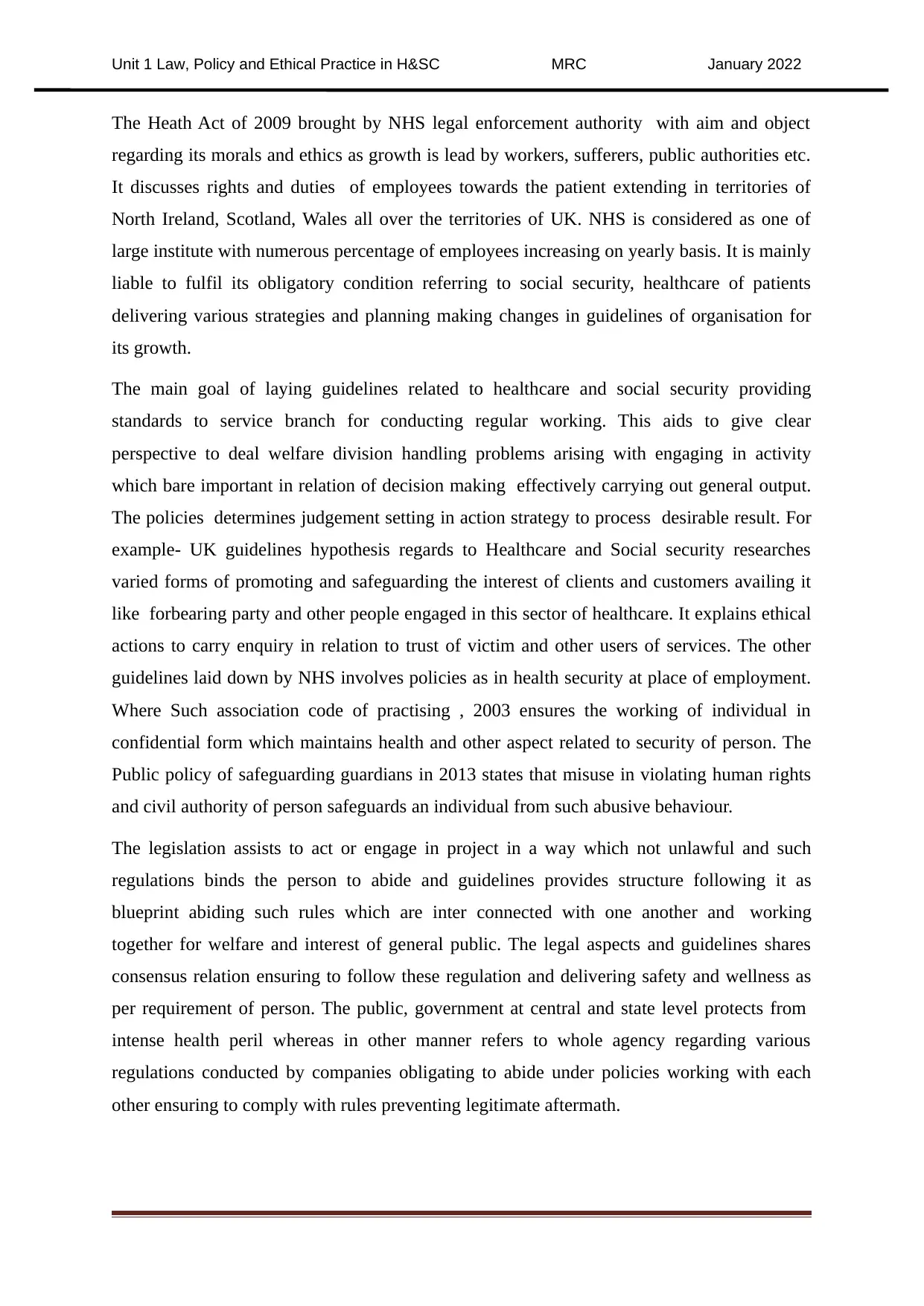
The Heath Act of 2009 brought by NHS legal enforcement authority with aim and object
regarding its morals and ethics as growth is lead by workers, sufferers, public authorities etc.
It discusses rights and duties of employees towards the patient extending in territories of
North Ireland, Scotland, Wales all over the territories of UK. NHS is considered as one of
large institute with numerous percentage of employees increasing on yearly basis. It is mainly
liable to fulfil its obligatory condition referring to social security, healthcare of patients
delivering various strategies and planning making changes in guidelines of organisation for
its growth.
The main goal of laying guidelines related to healthcare and social security providing
standards to service branch for conducting regular working. This aids to give clear
perspective to deal welfare division handling problems arising with engaging in activity
which bare important in relation of decision making effectively carrying out general output.
The policies determines judgement setting in action strategy to process desirable result. For
example- UK guidelines hypothesis regards to Healthcare and Social security researches
varied forms of promoting and safeguarding the interest of clients and customers availing it
like forbearing party and other people engaged in this sector of healthcare. It explains ethical
actions to carry enquiry in relation to trust of victim and other users of services. The other
guidelines laid down by NHS involves policies as in health security at place of employment.
Where Such association code of practising , 2003 ensures the working of individual in
confidential form which maintains health and other aspect related to security of person. The
Public policy of safeguarding guardians in 2013 states that misuse in violating human rights
and civil authority of person safeguards an individual from such abusive behaviour.
The legislation assists to act or engage in project in a way which not unlawful and such
regulations binds the person to abide and guidelines provides structure following it as
blueprint abiding such rules which are inter connected with one another and working
together for welfare and interest of general public. The legal aspects and guidelines shares
consensus relation ensuring to follow these regulation and delivering safety and wellness as
per requirement of person. The public, government at central and state level protects from
intense health peril whereas in other manner refers to whole agency regarding various
regulations conducted by companies obligating to abide under policies working with each
other ensuring to comply with rules preventing legitimate aftermath.
The Heath Act of 2009 brought by NHS legal enforcement authority with aim and object
regarding its morals and ethics as growth is lead by workers, sufferers, public authorities etc.
It discusses rights and duties of employees towards the patient extending in territories of
North Ireland, Scotland, Wales all over the territories of UK. NHS is considered as one of
large institute with numerous percentage of employees increasing on yearly basis. It is mainly
liable to fulfil its obligatory condition referring to social security, healthcare of patients
delivering various strategies and planning making changes in guidelines of organisation for
its growth.
The main goal of laying guidelines related to healthcare and social security providing
standards to service branch for conducting regular working. This aids to give clear
perspective to deal welfare division handling problems arising with engaging in activity
which bare important in relation of decision making effectively carrying out general output.
The policies determines judgement setting in action strategy to process desirable result. For
example- UK guidelines hypothesis regards to Healthcare and Social security researches
varied forms of promoting and safeguarding the interest of clients and customers availing it
like forbearing party and other people engaged in this sector of healthcare. It explains ethical
actions to carry enquiry in relation to trust of victim and other users of services. The other
guidelines laid down by NHS involves policies as in health security at place of employment.
Where Such association code of practising , 2003 ensures the working of individual in
confidential form which maintains health and other aspect related to security of person. The
Public policy of safeguarding guardians in 2013 states that misuse in violating human rights
and civil authority of person safeguards an individual from such abusive behaviour.
The legislation assists to act or engage in project in a way which not unlawful and such
regulations binds the person to abide and guidelines provides structure following it as
blueprint abiding such rules which are inter connected with one another and working
together for welfare and interest of general public. The legal aspects and guidelines shares
consensus relation ensuring to follow these regulation and delivering safety and wellness as
per requirement of person. The public, government at central and state level protects from
intense health peril whereas in other manner refers to whole agency regarding various
regulations conducted by companies obligating to abide under policies working with each
other ensuring to comply with rules preventing legitimate aftermath.
⊘ This is a preview!⊘
Do you want full access?
Subscribe today to unlock all pages.
Trusted by 1+ million students worldwide
Unit 1 Law, Policy and Ethical Practice in H&SC MRC January 2022
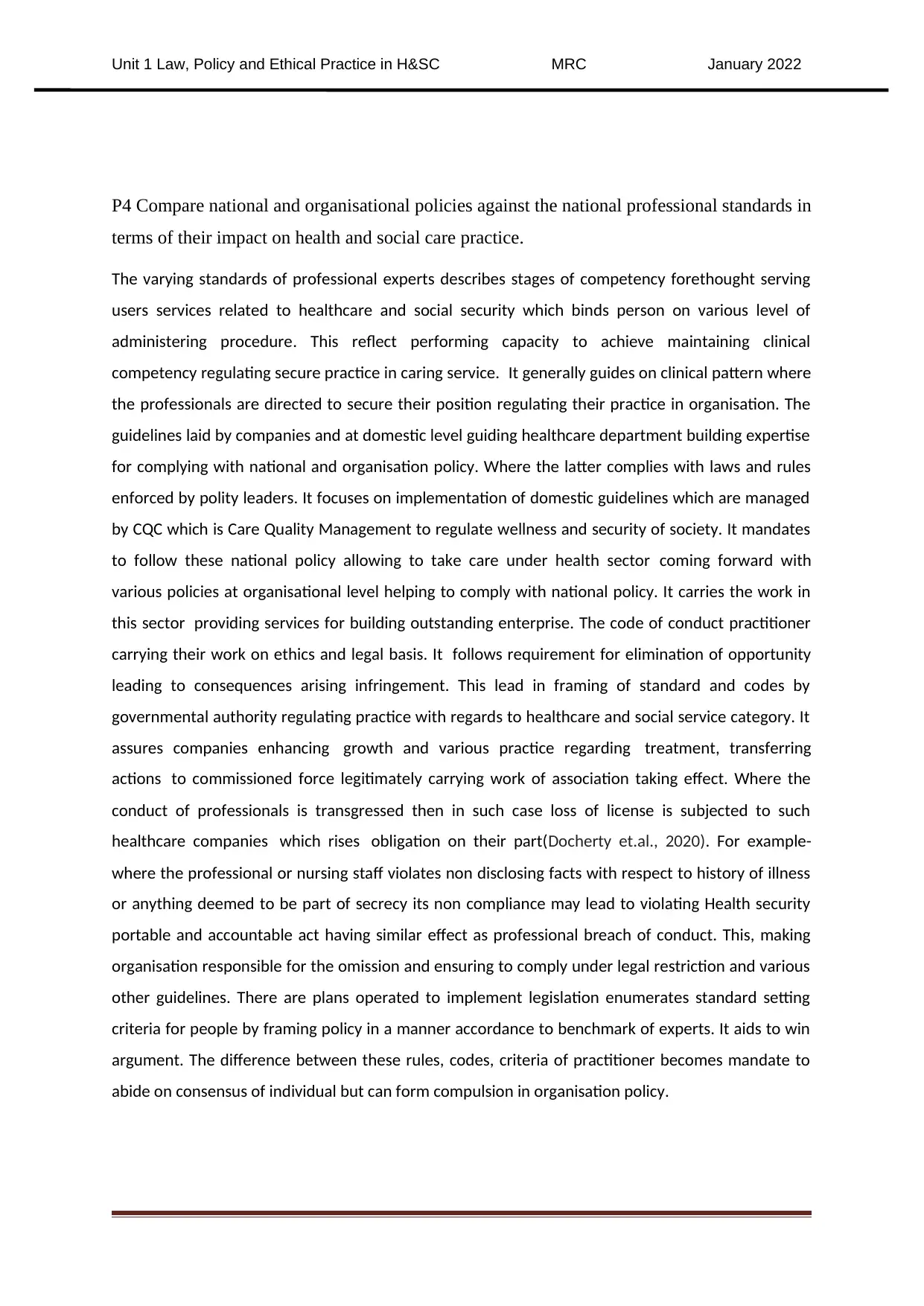
P4 Compare national and organisational policies against the national professional standards in
terms of their impact on health and social care practice.
The varying standards of professional experts describes stages of competency forethought serving
users services related to healthcare and social security which binds person on various level of
administering procedure. This reflect performing capacity to achieve maintaining clinical
competency regulating secure practice in caring service. It generally guides on clinical pattern where
the professionals are directed to secure their position regulating their practice in organisation. The
guidelines laid by companies and at domestic level guiding healthcare department building expertise
for complying with national and organisation policy. Where the latter complies with laws and rules
enforced by polity leaders. It focuses on implementation of domestic guidelines which are managed
by CQC which is Care Quality Management to regulate wellness and security of society. It mandates
to follow these national policy allowing to take care under health sector coming forward with
various policies at organisational level helping to comply with national policy. It carries the work in
this sector providing services for building outstanding enterprise. The code of conduct practitioner
carrying their work on ethics and legal basis. It follows requirement for elimination of opportunity
leading to consequences arising infringement. This lead in framing of standard and codes by
governmental authority regulating practice with regards to healthcare and social service category. It
assures companies enhancing growth and various practice regarding treatment, transferring
actions to commissioned force legitimately carrying work of association taking effect. Where the
conduct of professionals is transgressed then in such case loss of license is subjected to such
healthcare companies which rises obligation on their part(Docherty et.al., 2020). For example-
where the professional or nursing staff violates non disclosing facts with respect to history of illness
or anything deemed to be part of secrecy its non compliance may lead to violating Health security
portable and accountable act having similar effect as professional breach of conduct. This, making
organisation responsible for the omission and ensuring to comply under legal restriction and various
other guidelines. There are plans operated to implement legislation enumerates standard setting
criteria for people by framing policy in a manner accordance to benchmark of experts. It aids to win
argument. The difference between these rules, codes, criteria of practitioner becomes mandate to
abide on consensus of individual but can form compulsion in organisation policy.
P4 Compare national and organisational policies against the national professional standards in
terms of their impact on health and social care practice.
The varying standards of professional experts describes stages of competency forethought serving
users services related to healthcare and social security which binds person on various level of
administering procedure. This reflect performing capacity to achieve maintaining clinical
competency regulating secure practice in caring service. It generally guides on clinical pattern where
the professionals are directed to secure their position regulating their practice in organisation. The
guidelines laid by companies and at domestic level guiding healthcare department building expertise
for complying with national and organisation policy. Where the latter complies with laws and rules
enforced by polity leaders. It focuses on implementation of domestic guidelines which are managed
by CQC which is Care Quality Management to regulate wellness and security of society. It mandates
to follow these national policy allowing to take care under health sector coming forward with
various policies at organisational level helping to comply with national policy. It carries the work in
this sector providing services for building outstanding enterprise. The code of conduct practitioner
carrying their work on ethics and legal basis. It follows requirement for elimination of opportunity
leading to consequences arising infringement. This lead in framing of standard and codes by
governmental authority regulating practice with regards to healthcare and social service category. It
assures companies enhancing growth and various practice regarding treatment, transferring
actions to commissioned force legitimately carrying work of association taking effect. Where the
conduct of professionals is transgressed then in such case loss of license is subjected to such
healthcare companies which rises obligation on their part(Docherty et.al., 2020). For example-
where the professional or nursing staff violates non disclosing facts with respect to history of illness
or anything deemed to be part of secrecy its non compliance may lead to violating Health security
portable and accountable act having similar effect as professional breach of conduct. This, making
organisation responsible for the omission and ensuring to comply under legal restriction and various
other guidelines. There are plans operated to implement legislation enumerates standard setting
criteria for people by framing policy in a manner accordance to benchmark of experts. It aids to win
argument. The difference between these rules, codes, criteria of practitioner becomes mandate to
abide on consensus of individual but can form compulsion in organisation policy.
Paraphrase This Document
Need a fresh take? Get an instant paraphrase of this document with our AI Paraphraser
Unit 1 Law, Policy and Ethical Practice in H&SC MRC January 2022
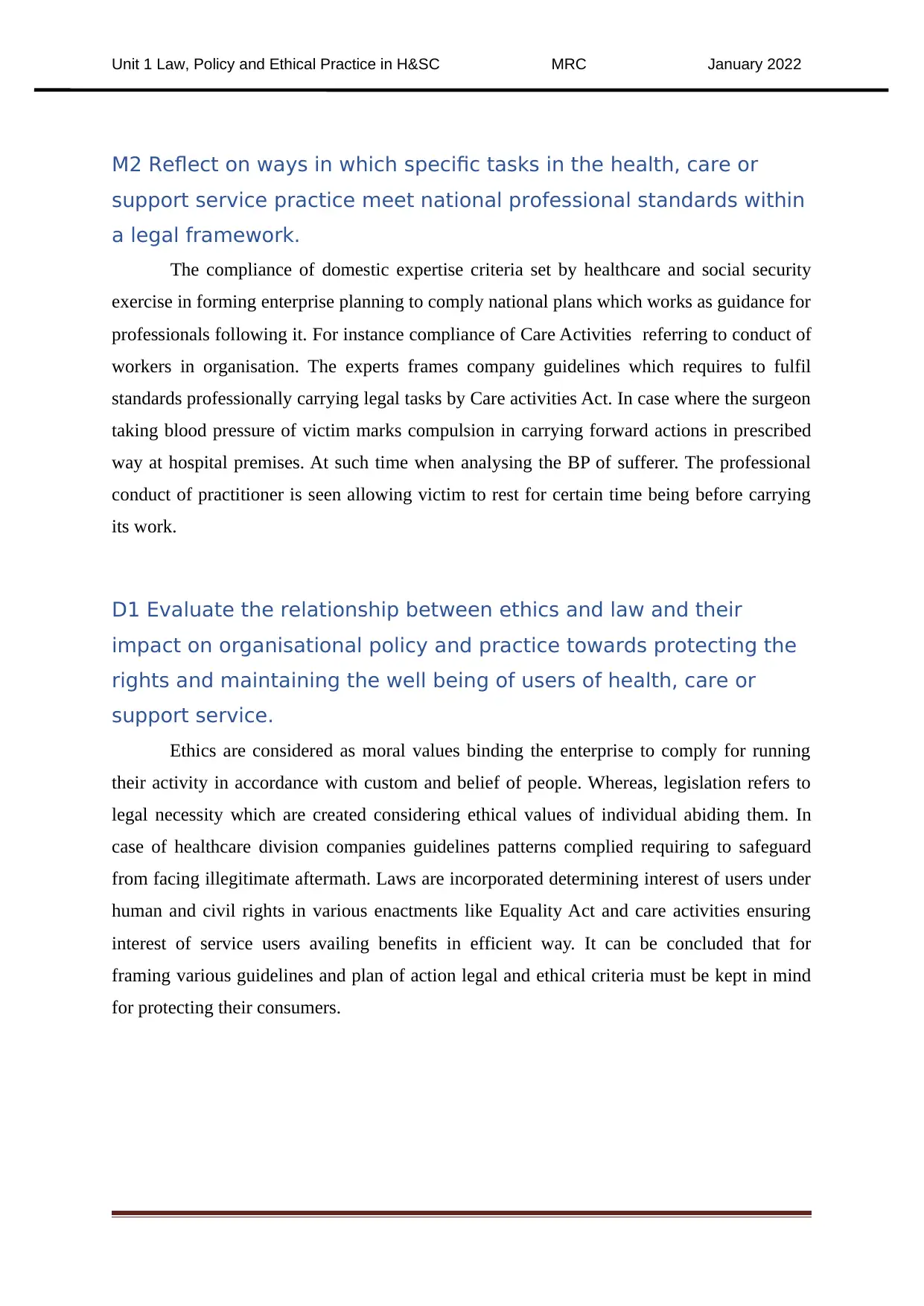
M2 Reflect on ways in which specific tasks in the health, care or
support service practice meet national professional standards within
a legal framework.
The compliance of domestic expertise criteria set by healthcare and social security
exercise in forming enterprise planning to comply national plans which works as guidance for
professionals following it. For instance compliance of Care Activities referring to conduct of
workers in organisation. The experts frames company guidelines which requires to fulfil
standards professionally carrying legal tasks by Care activities Act. In case where the surgeon
taking blood pressure of victim marks compulsion in carrying forward actions in prescribed
way at hospital premises. At such time when analysing the BP of sufferer. The professional
conduct of practitioner is seen allowing victim to rest for certain time being before carrying
its work.
D1 Evaluate the relationship between ethics and law and their
impact on organisational policy and practice towards protecting the
rights and maintaining the well being of users of health, care or
support service.
Ethics are considered as moral values binding the enterprise to comply for running
their activity in accordance with custom and belief of people. Whereas, legislation refers to
legal necessity which are created considering ethical values of individual abiding them. In
case of healthcare division companies guidelines patterns complied requiring to safeguard
from facing illegitimate aftermath. Laws are incorporated determining interest of users under
human and civil rights in various enactments like Equality Act and care activities ensuring
interest of service users availing benefits in efficient way. It can be concluded that for
framing various guidelines and plan of action legal and ethical criteria must be kept in mind
for protecting their consumers.
M2 Reflect on ways in which specific tasks in the health, care or
support service practice meet national professional standards within
a legal framework.
The compliance of domestic expertise criteria set by healthcare and social security
exercise in forming enterprise planning to comply national plans which works as guidance for
professionals following it. For instance compliance of Care Activities referring to conduct of
workers in organisation. The experts frames company guidelines which requires to fulfil
standards professionally carrying legal tasks by Care activities Act. In case where the surgeon
taking blood pressure of victim marks compulsion in carrying forward actions in prescribed
way at hospital premises. At such time when analysing the BP of sufferer. The professional
conduct of practitioner is seen allowing victim to rest for certain time being before carrying
its work.
D1 Evaluate the relationship between ethics and law and their
impact on organisational policy and practice towards protecting the
rights and maintaining the well being of users of health, care or
support service.
Ethics are considered as moral values binding the enterprise to comply for running
their activity in accordance with custom and belief of people. Whereas, legislation refers to
legal necessity which are created considering ethical values of individual abiding them. In
case of healthcare division companies guidelines patterns complied requiring to safeguard
from facing illegitimate aftermath. Laws are incorporated determining interest of users under
human and civil rights in various enactments like Equality Act and care activities ensuring
interest of service users availing benefits in efficient way. It can be concluded that for
framing various guidelines and plan of action legal and ethical criteria must be kept in mind
for protecting their consumers.
Unit 1 Law, Policy and Ethical Practice in H&SC MRC January 2022
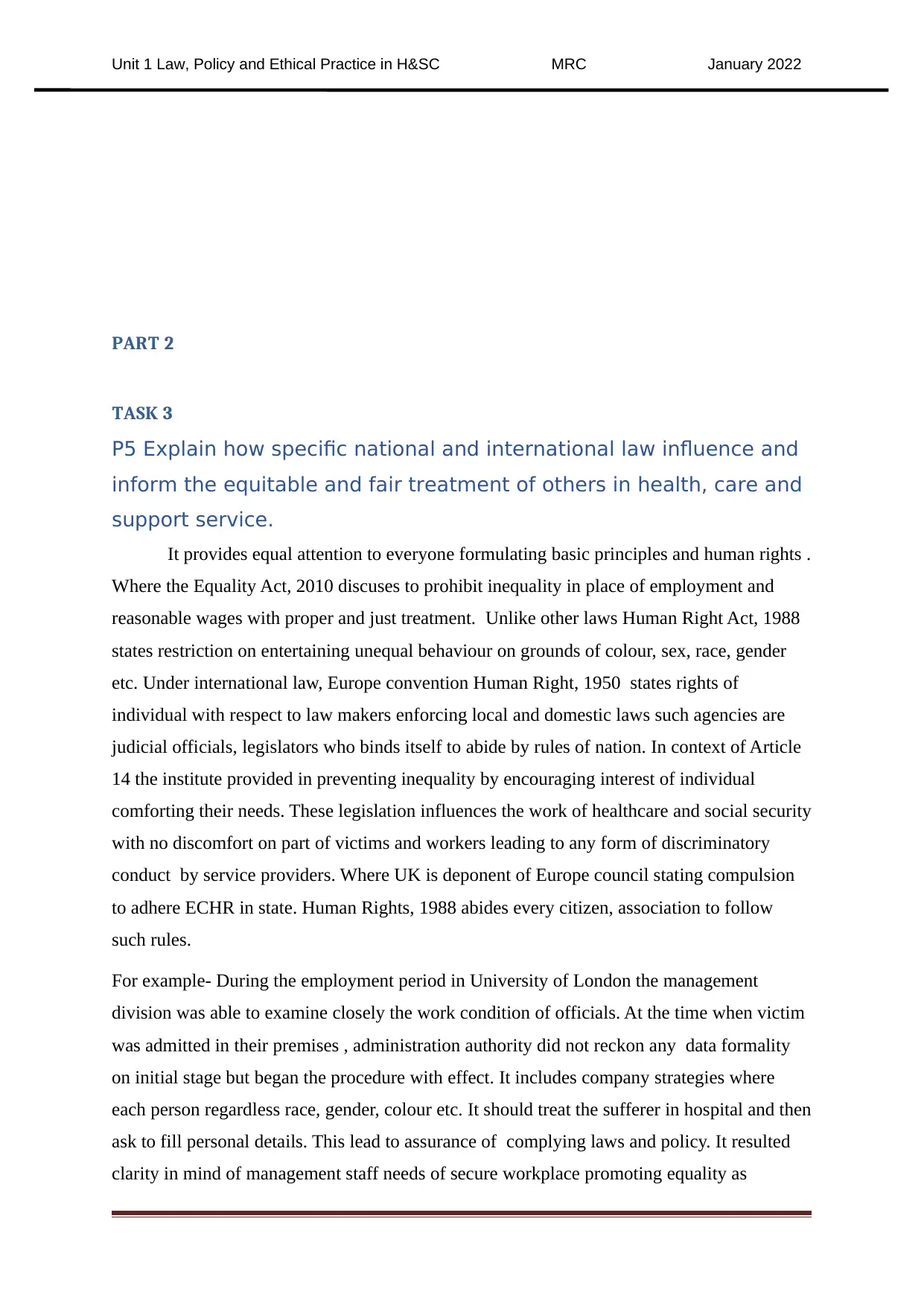
PART 2
TASK 3
P5 Explain how specific national and international law influence and
inform the equitable and fair treatment of others in health, care and
support service.
It provides equal attention to everyone formulating basic principles and human rights .
Where the Equality Act, 2010 discuses to prohibit inequality in place of employment and
reasonable wages with proper and just treatment. Unlike other laws Human Right Act, 1988
states restriction on entertaining unequal behaviour on grounds of colour, sex, race, gender
etc. Under international law, Europe convention Human Right, 1950 states rights of
individual with respect to law makers enforcing local and domestic laws such agencies are
judicial officials, legislators who binds itself to abide by rules of nation. In context of Article
14 the institute provided in preventing inequality by encouraging interest of individual
comforting their needs. These legislation influences the work of healthcare and social security
with no discomfort on part of victims and workers leading to any form of discriminatory
conduct by service providers. Where UK is deponent of Europe council stating compulsion
to adhere ECHR in state. Human Rights, 1988 abides every citizen, association to follow
such rules.
For example- During the employment period in University of London the management
division was able to examine closely the work condition of officials. At the time when victim
was admitted in their premises , administration authority did not reckon any data formality
on initial stage but began the procedure with effect. It includes company strategies where
each person regardless race, gender, colour etc. It should treat the sufferer in hospital and then
ask to fill personal details. This lead to assurance of complying laws and policy. It resulted
clarity in mind of management staff needs of secure workplace promoting equality as
PART 2
TASK 3
P5 Explain how specific national and international law influence and
inform the equitable and fair treatment of others in health, care and
support service.
It provides equal attention to everyone formulating basic principles and human rights .
Where the Equality Act, 2010 discuses to prohibit inequality in place of employment and
reasonable wages with proper and just treatment. Unlike other laws Human Right Act, 1988
states restriction on entertaining unequal behaviour on grounds of colour, sex, race, gender
etc. Under international law, Europe convention Human Right, 1950 states rights of
individual with respect to law makers enforcing local and domestic laws such agencies are
judicial officials, legislators who binds itself to abide by rules of nation. In context of Article
14 the institute provided in preventing inequality by encouraging interest of individual
comforting their needs. These legislation influences the work of healthcare and social security
with no discomfort on part of victims and workers leading to any form of discriminatory
conduct by service providers. Where UK is deponent of Europe council stating compulsion
to adhere ECHR in state. Human Rights, 1988 abides every citizen, association to follow
such rules.
For example- During the employment period in University of London the management
division was able to examine closely the work condition of officials. At the time when victim
was admitted in their premises , administration authority did not reckon any data formality
on initial stage but began the procedure with effect. It includes company strategies where
each person regardless race, gender, colour etc. It should treat the sufferer in hospital and then
ask to fill personal details. This lead to assurance of complying laws and policy. It resulted
clarity in mind of management staff needs of secure workplace promoting equality as
⊘ This is a preview!⊘
Do you want full access?
Subscribe today to unlock all pages.
Trusted by 1+ million students worldwide

1 out of 21


Related Documents


Your All-in-One AI-Powered Toolkit for Academic Success.
+13062052269
info@desklib.com
Available 24*7 on WhatsApp / Email
![[object Object]](/_next/static/media/star-bottom.7253800d.svg)
Unlock your academic potential
Copyright © 2020–2026 A2Z Services. All Rights Reserved. Developed and managed by ZUCOL.