LAWS20060 - Taxation Law of Australia Individual Assignment - Term 2
VerifiedAdded on 2023/01/05
|11
|3729
|92
Homework Assignment
AI Summary
This assignment solution addresses key aspects of Australian taxation law. It begins by analyzing various legal principles, including those related to business ventures, deductions for contributions and gifts, tax rates, CGT exemptions, and the taxability of assets. The solution then explores the significance of case law, such as Hayes v FCT, in determining the tax treatment of income from previous employers. Furthermore, it distinguishes between ordinary and statutory income, and explains the Medicare Levy and Medicare Levy Surcharge. The second part of the assignment delves into the concept of residency, outlining the tests used to determine residency status, including the 'resides', 'domicile', and '183-day' tests, and examines the meaning of 'permanent place of abode' and 'usual place of abode'. Finally, the assignment examines the deductibility of various expenses, such as HECS-HELP repayments, travel expenses, the cost of books, and childcare expenses, referencing relevant sections of the ITAA97 and case law like Lodge v Federal Commissioner of Taxation.
Running head: TAXATION
Taxation
Name of the Student
Name of the University
Author Note
Taxation
Name of the Student
Name of the University
Author Note

Paraphrase This Document
Need a fresh take? Get an instant paraphrase of this document with our AI Paraphraser
1TAXATION
Answer 1
a) The point of time during which a business venture is said to be carried out by a company is required to
be assessed by the legal principles enumerated in in Tax Ruling 2019-11.
b) The legal provision underlining the deduction with respect to contributions as well as gifts is contained
in ITAA97, div 302.
c) The maximum rate of tax that the taxable income of a person can be applied with as for the tax brackets
in the year 2019/20 is :
For the individuals earning more than $180,000, to be applied with an amount of $54,097 with another
45% on any amount exceeding the base amount3.
d) A motorcycle or a car is required to be allowed as an exemption from being subjected to CGT as per
the legal provisions mentioned in ITAA97, in s 118-54.
e) The owner of an asset under the CGT regime, which has been demolished or lost, is required to be
subjected to taxation as a C1 event as provided for in the legal rule mentioned in ITAA97, s 104.205.
f) The tax free threshold existing in the current tax period with respect to an individual resident is
applicable for an individual having an income below the threshold of 18,200 dollars6.
g) The decision arrived at in the case of Hayes v FCT (1956) 96 CLR 477 has a great significance with
respect to the taxability of the receipt received from previous employer against the past rendered services.
Under the general concepts any income received from an employer is required to be treated as an income
from personal exertion and the same is required to be subjected to taxation as an ordinary income.
1 TR 2019/1
2 The Income Tax Assessment Act 1997 (Cth), div 30
3 www.ato.gov.au, "Individual Income Tax Rates", Ato.Gov.Au (Webpage, 2019)
<https://www.ato.gov.au/Rates/Individual-income-tax-rates/>.
4 The Income Tax Assessment Act 1997 (Cth), s 118.5
5 The Income Tax Assessment Act 1997 (Cth), s 104.20
6 Barkoczy, Stephen. "Foundations of taxation law 2016." (OUP Catalogue 2016).
7 Hayes v FCT (1956) 96 CLR 47
Answer 1
a) The point of time during which a business venture is said to be carried out by a company is required to
be assessed by the legal principles enumerated in in Tax Ruling 2019-11.
b) The legal provision underlining the deduction with respect to contributions as well as gifts is contained
in ITAA97, div 302.
c) The maximum rate of tax that the taxable income of a person can be applied with as for the tax brackets
in the year 2019/20 is :
For the individuals earning more than $180,000, to be applied with an amount of $54,097 with another
45% on any amount exceeding the base amount3.
d) A motorcycle or a car is required to be allowed as an exemption from being subjected to CGT as per
the legal provisions mentioned in ITAA97, in s 118-54.
e) The owner of an asset under the CGT regime, which has been demolished or lost, is required to be
subjected to taxation as a C1 event as provided for in the legal rule mentioned in ITAA97, s 104.205.
f) The tax free threshold existing in the current tax period with respect to an individual resident is
applicable for an individual having an income below the threshold of 18,200 dollars6.
g) The decision arrived at in the case of Hayes v FCT (1956) 96 CLR 477 has a great significance with
respect to the taxability of the receipt received from previous employer against the past rendered services.
Under the general concepts any income received from an employer is required to be treated as an income
from personal exertion and the same is required to be subjected to taxation as an ordinary income.
1 TR 2019/1
2 The Income Tax Assessment Act 1997 (Cth), div 30
3 www.ato.gov.au, "Individual Income Tax Rates", Ato.Gov.Au (Webpage, 2019)
<https://www.ato.gov.au/Rates/Individual-income-tax-rates/>.
4 The Income Tax Assessment Act 1997 (Cth), s 118.5
5 The Income Tax Assessment Act 1997 (Cth), s 104.20
6 Barkoczy, Stephen. "Foundations of taxation law 2016." (OUP Catalogue 2016).
7 Hayes v FCT (1956) 96 CLR 47
2TAXATION
However, as per the decision of this case it has been rendered that being received from a former employer
for the past services the amount it's the essence of a capital asset and is required to be treated as a CGT
event. However, for the purpose of bringing that asset under the purview of capital gain taxation two
requisites are required to be considered. One of the requisites that requires consideration is the motive that
has been regulating the payment made by the employer. On the other hand, the sense in which the
payment has been received by the employee is also required to be considered for the purpose of assessing
such a receipt as having a capital nature.
h) All the receipts as well as income that are required to be considered for the purpose of taxation
pertaining to a resident individual can be classified into two categories. These two categories include
ordinary income as well as statutory income. The receipts that are required to be classified under the
ordinary income would be those receipts which does not need any recognition in the statue for the
purpose of being regarded as taxable income. On the contrary, there are certain receipts that are required
to be recognised by the statutes for the purpose of being able to subject to taxation. These are referred to
as statutory income owing to the fact that require statutory recognition for the purpose of being rendered
taxable. Hence, concept of ordinary income is assessable even in the absence of any statutory mandate.
However, the statutory income has no recognition in the absence of the statutory mandate. Income from
personal exertion is required to be treated as an ordinary income and the same does not require any statute
for the purpose of being subjected to taxation. On the other hand, the capital gain assets are required to be
subject to taxation as per the provisions of the taxation laws prevailing and has no recognition in its
absence8.
i) There are two levies that are imposed upon the tax liability of a person paying the tax in addition to the
income tax they have been remitting. These include the Medicare Levy as well as Medicare Levy
Surcharge. These additional rates are applicable for the taxpayers who are eligible to pay the same. The
Medicare Levy is a rate of tax that has been imposed upon the taxpayers for the purpose of aiding the
8 Barkoczy, Stephen. "Foundations of taxation law 2016." (OUP Catalogue 2016).
However, as per the decision of this case it has been rendered that being received from a former employer
for the past services the amount it's the essence of a capital asset and is required to be treated as a CGT
event. However, for the purpose of bringing that asset under the purview of capital gain taxation two
requisites are required to be considered. One of the requisites that requires consideration is the motive that
has been regulating the payment made by the employer. On the other hand, the sense in which the
payment has been received by the employee is also required to be considered for the purpose of assessing
such a receipt as having a capital nature.
h) All the receipts as well as income that are required to be considered for the purpose of taxation
pertaining to a resident individual can be classified into two categories. These two categories include
ordinary income as well as statutory income. The receipts that are required to be classified under the
ordinary income would be those receipts which does not need any recognition in the statue for the
purpose of being regarded as taxable income. On the contrary, there are certain receipts that are required
to be recognised by the statutes for the purpose of being able to subject to taxation. These are referred to
as statutory income owing to the fact that require statutory recognition for the purpose of being rendered
taxable. Hence, concept of ordinary income is assessable even in the absence of any statutory mandate.
However, the statutory income has no recognition in the absence of the statutory mandate. Income from
personal exertion is required to be treated as an ordinary income and the same does not require any statute
for the purpose of being subjected to taxation. On the other hand, the capital gain assets are required to be
subject to taxation as per the provisions of the taxation laws prevailing and has no recognition in its
absence8.
i) There are two levies that are imposed upon the tax liability of a person paying the tax in addition to the
income tax they have been remitting. These include the Medicare Levy as well as Medicare Levy
Surcharge. These additional rates are applicable for the taxpayers who are eligible to pay the same. The
Medicare Levy is a rate of tax that has been imposed upon the taxpayers for the purpose of aiding the
8 Barkoczy, Stephen. "Foundations of taxation law 2016." (OUP Catalogue 2016).
⊘ This is a preview!⊘
Do you want full access?
Subscribe today to unlock all pages.

Trusted by 1+ million students worldwide
3TAXATION
health system in Australia relating to the public. The tax liability of attack speed is required to be imposed
with this form of levy. Rate under this tax regime is limited to flat 2%. This levy is required to be
regulated by the provisions of ITAA36 and the Medicare Levy Act 1986. Again, the Medicare Levy
Surcharge is to be levied for the purpose of insisting the taxpayers belonging to higher tax brackets to
make payment towards the health insurance of private nature with a view to curb the burden upon the
Medicare. However, this levy is only applicable if the taxpayers are not covered by any other private
health Insurance. The tax liability that are covered for the purpose of computing this form of levy are the
fringe benefits tax and the income tax pertaining to a particular taxpayer. This form of tax can be levied at
a rate varying among 1%, 1.25% as well as 1.5%9.
Answer 2
Any person who has satisfy the conditions contained in ITAA36, s 6.110 would be considered as a resident
of Australia for the purpose of taxation. Under this section 3 examinations are required to be carried out
for the purpose of assessing the residency. These include the test relating to resides, domicile, 183 day
and superannuation. With respect to the domicile test and the resides test two concepts are required to be
analysed with respect to the striking similarities that it has apparently representing. These concepts are
‘permanent the place of abode' and ‘usual place of abode'. Again, the concept of place of abode is
required to be considered before the analysis of these two concepts. The term place of abode can be best
illustrated using the principles established during the judgement in I.R.C. v. Lysaght (1928) A.C.234 11.
The expression place of abode covers the residence of a person. Such a residence can be retained by a
person both by way of owning as well as renting. The weightage is required to be extended to the object
of the year residing in a particular place for the purpose of declaring the same as a place of abode.
9 Ibid.
10 The Income Tax Assessment Act 1936 (Cth), s 6.1
11 I.R.C. v. Lysaght (1928) A.C.234
health system in Australia relating to the public. The tax liability of attack speed is required to be imposed
with this form of levy. Rate under this tax regime is limited to flat 2%. This levy is required to be
regulated by the provisions of ITAA36 and the Medicare Levy Act 1986. Again, the Medicare Levy
Surcharge is to be levied for the purpose of insisting the taxpayers belonging to higher tax brackets to
make payment towards the health insurance of private nature with a view to curb the burden upon the
Medicare. However, this levy is only applicable if the taxpayers are not covered by any other private
health Insurance. The tax liability that are covered for the purpose of computing this form of levy are the
fringe benefits tax and the income tax pertaining to a particular taxpayer. This form of tax can be levied at
a rate varying among 1%, 1.25% as well as 1.5%9.
Answer 2
Any person who has satisfy the conditions contained in ITAA36, s 6.110 would be considered as a resident
of Australia for the purpose of taxation. Under this section 3 examinations are required to be carried out
for the purpose of assessing the residency. These include the test relating to resides, domicile, 183 day
and superannuation. With respect to the domicile test and the resides test two concepts are required to be
analysed with respect to the striking similarities that it has apparently representing. These concepts are
‘permanent the place of abode' and ‘usual place of abode'. Again, the concept of place of abode is
required to be considered before the analysis of these two concepts. The term place of abode can be best
illustrated using the principles established during the judgement in I.R.C. v. Lysaght (1928) A.C.234 11.
The expression place of abode covers the residence of a person. Such a residence can be retained by a
person both by way of owning as well as renting. The weightage is required to be extended to the object
of the year residing in a particular place for the purpose of declaring the same as a place of abode.
9 Ibid.
10 The Income Tax Assessment Act 1936 (Cth), s 6.1
11 I.R.C. v. Lysaght (1928) A.C.234
Paraphrase This Document
Need a fresh take? Get an instant paraphrase of this document with our AI Paraphraser
4TAXATION
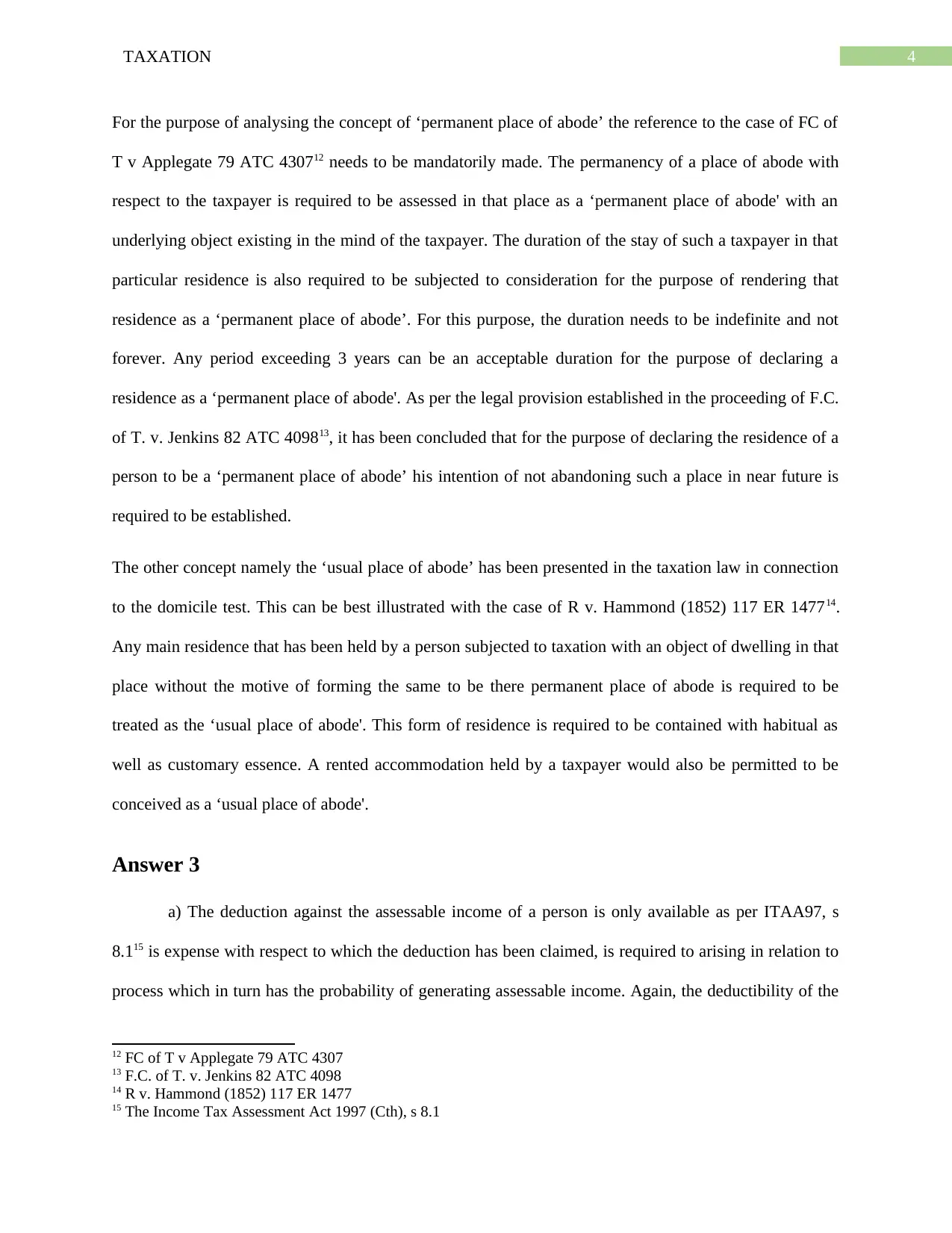
For the purpose of analysing the concept of ‘permanent place of abode’ the reference to the case of FC of
T v Applegate 79 ATC 430712 needs to be mandatorily made. The permanency of a place of abode with
respect to the taxpayer is required to be assessed in that place as a ‘permanent place of abode' with an
underlying object existing in the mind of the taxpayer. The duration of the stay of such a taxpayer in that
particular residence is also required to be subjected to consideration for the purpose of rendering that
residence as a ‘permanent place of abode’. For this purpose, the duration needs to be indefinite and not
forever. Any period exceeding 3 years can be an acceptable duration for the purpose of declaring a
residence as a ‘permanent place of abode'. As per the legal provision established in the proceeding of F.C.
of T. v. Jenkins 82 ATC 409813, it has been concluded that for the purpose of declaring the residence of a
person to be a ‘permanent place of abode’ his intention of not abandoning such a place in near future is
required to be established.
The other concept namely the ‘usual place of abode’ has been presented in the taxation law in connection
to the domicile test. This can be best illustrated with the case of R v. Hammond (1852) 117 ER 147714.
Any main residence that has been held by a person subjected to taxation with an object of dwelling in that
place without the motive of forming the same to be there permanent place of abode is required to be
treated as the ‘usual place of abode'. This form of residence is required to be contained with habitual as
well as customary essence. A rented accommodation held by a taxpayer would also be permitted to be
conceived as a ‘usual place of abode'.
Answer 3
a) The deduction against the assessable income of a person is only available as per ITAA97, s
8.115 is expense with respect to which the deduction has been claimed, is required to arising in relation to
process which in turn has the probability of generating assessable income. Again, the deductibility of the
12 FC of T v Applegate 79 ATC 4307
13 F.C. of T. v. Jenkins 82 ATC 4098
14 R v. Hammond (1852) 117 ER 1477
15 The Income Tax Assessment Act 1997 (Cth), s 8.1
For the purpose of analysing the concept of ‘permanent place of abode’ the reference to the case of FC of
T v Applegate 79 ATC 430712 needs to be mandatorily made. The permanency of a place of abode with
respect to the taxpayer is required to be assessed in that place as a ‘permanent place of abode' with an
underlying object existing in the mind of the taxpayer. The duration of the stay of such a taxpayer in that
particular residence is also required to be subjected to consideration for the purpose of rendering that
residence as a ‘permanent place of abode’. For this purpose, the duration needs to be indefinite and not
forever. Any period exceeding 3 years can be an acceptable duration for the purpose of declaring a
residence as a ‘permanent place of abode'. As per the legal provision established in the proceeding of F.C.
of T. v. Jenkins 82 ATC 409813, it has been concluded that for the purpose of declaring the residence of a
person to be a ‘permanent place of abode’ his intention of not abandoning such a place in near future is
required to be established.
The other concept namely the ‘usual place of abode’ has been presented in the taxation law in connection
to the domicile test. This can be best illustrated with the case of R v. Hammond (1852) 117 ER 147714.
Any main residence that has been held by a person subjected to taxation with an object of dwelling in that
place without the motive of forming the same to be there permanent place of abode is required to be
treated as the ‘usual place of abode'. This form of residence is required to be contained with habitual as
well as customary essence. A rented accommodation held by a taxpayer would also be permitted to be
conceived as a ‘usual place of abode'.
Answer 3
a) The deduction against the assessable income of a person is only available as per ITAA97, s
8.115 is expense with respect to which the deduction has been claimed, is required to arising in relation to
process which in turn has the probability of generating assessable income. Again, the deductibility of the
12 FC of T v Applegate 79 ATC 4307
13 F.C. of T. v. Jenkins 82 ATC 4098
14 R v. Hammond (1852) 117 ER 1477
15 The Income Tax Assessment Act 1997 (Cth), s 8.1
5TAXATION
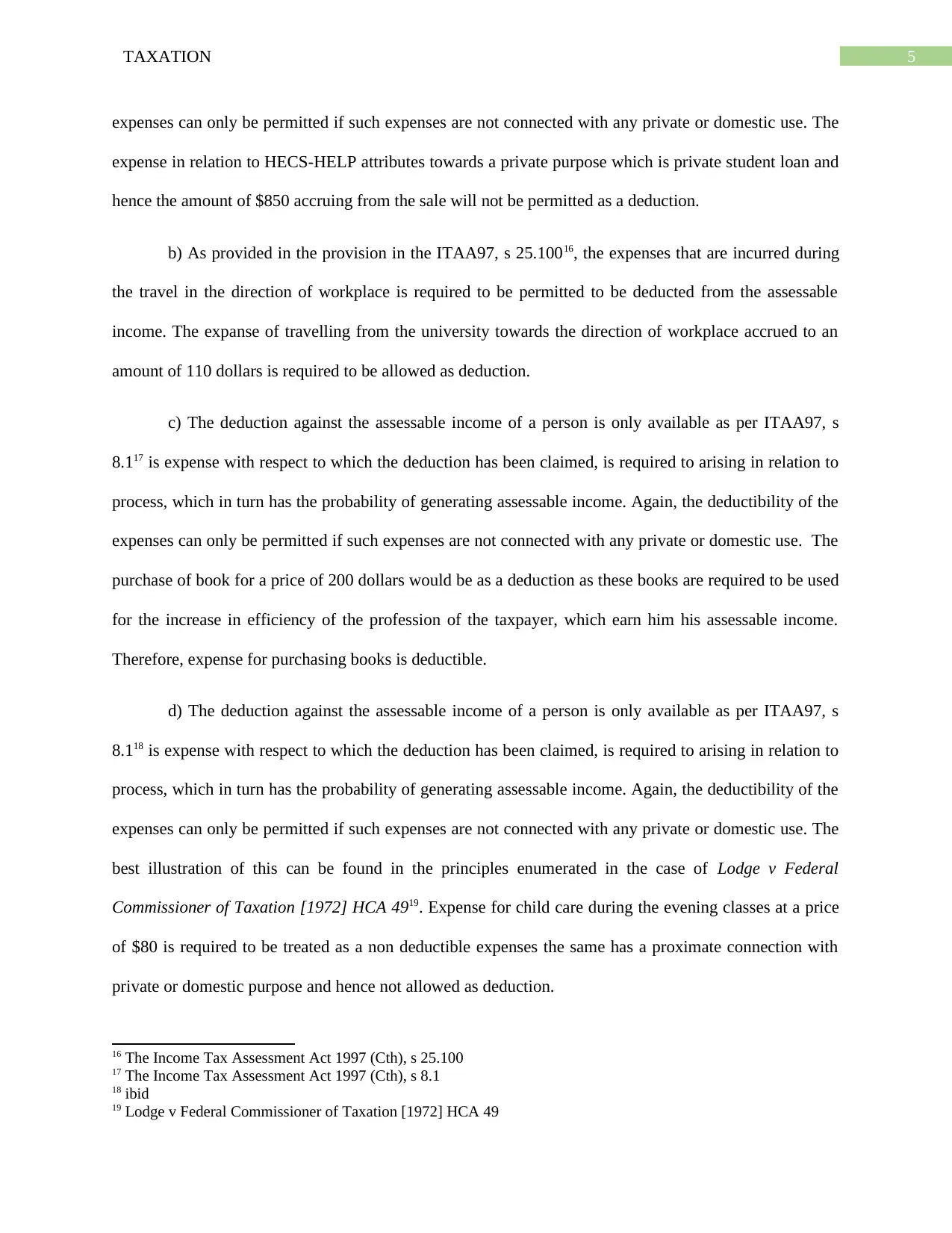
expenses can only be permitted if such expenses are not connected with any private or domestic use. The
expense in relation to HECS-HELP attributes towards a private purpose which is private student loan and
hence the amount of $850 accruing from the sale will not be permitted as a deduction.
b) As provided in the provision in the ITAA97, s 25.10016, the expenses that are incurred during
the travel in the direction of workplace is required to be permitted to be deducted from the assessable
income. The expanse of travelling from the university towards the direction of workplace accrued to an
amount of 110 dollars is required to be allowed as deduction.
c) The deduction against the assessable income of a person is only available as per ITAA97, s
8.117 is expense with respect to which the deduction has been claimed, is required to arising in relation to
process, which in turn has the probability of generating assessable income. Again, the deductibility of the
expenses can only be permitted if such expenses are not connected with any private or domestic use. The
purchase of book for a price of 200 dollars would be as a deduction as these books are required to be used
for the increase in efficiency of the profession of the taxpayer, which earn him his assessable income.
Therefore, expense for purchasing books is deductible.
d) The deduction against the assessable income of a person is only available as per ITAA97, s
8.118 is expense with respect to which the deduction has been claimed, is required to arising in relation to
process, which in turn has the probability of generating assessable income. Again, the deductibility of the
expenses can only be permitted if such expenses are not connected with any private or domestic use. The
best illustration of this can be found in the principles enumerated in the case of Lodge v Federal
Commissioner of Taxation [1972] HCA 4919. Expense for child care during the evening classes at a price
of $80 is required to be treated as a non deductible expenses the same has a proximate connection with
private or domestic purpose and hence not allowed as deduction.
16 The Income Tax Assessment Act 1997 (Cth), s 25.100
17 The Income Tax Assessment Act 1997 (Cth), s 8.1
18 ibid
19 Lodge v Federal Commissioner of Taxation [1972] HCA 49
expenses can only be permitted if such expenses are not connected with any private or domestic use. The
expense in relation to HECS-HELP attributes towards a private purpose which is private student loan and
hence the amount of $850 accruing from the sale will not be permitted as a deduction.
b) As provided in the provision in the ITAA97, s 25.10016, the expenses that are incurred during
the travel in the direction of workplace is required to be permitted to be deducted from the assessable
income. The expanse of travelling from the university towards the direction of workplace accrued to an
amount of 110 dollars is required to be allowed as deduction.
c) The deduction against the assessable income of a person is only available as per ITAA97, s
8.117 is expense with respect to which the deduction has been claimed, is required to arising in relation to
process, which in turn has the probability of generating assessable income. Again, the deductibility of the
expenses can only be permitted if such expenses are not connected with any private or domestic use. The
purchase of book for a price of 200 dollars would be as a deduction as these books are required to be used
for the increase in efficiency of the profession of the taxpayer, which earn him his assessable income.
Therefore, expense for purchasing books is deductible.
d) The deduction against the assessable income of a person is only available as per ITAA97, s
8.118 is expense with respect to which the deduction has been claimed, is required to arising in relation to
process, which in turn has the probability of generating assessable income. Again, the deductibility of the
expenses can only be permitted if such expenses are not connected with any private or domestic use. The
best illustration of this can be found in the principles enumerated in the case of Lodge v Federal
Commissioner of Taxation [1972] HCA 4919. Expense for child care during the evening classes at a price
of $80 is required to be treated as a non deductible expenses the same has a proximate connection with
private or domestic purpose and hence not allowed as deduction.
16 The Income Tax Assessment Act 1997 (Cth), s 25.100
17 The Income Tax Assessment Act 1997 (Cth), s 8.1
18 ibid
19 Lodge v Federal Commissioner of Taxation [1972] HCA 49
⊘ This is a preview!⊘
Do you want full access?
Subscribe today to unlock all pages.
Trusted by 1+ million students worldwide
6TAXATION
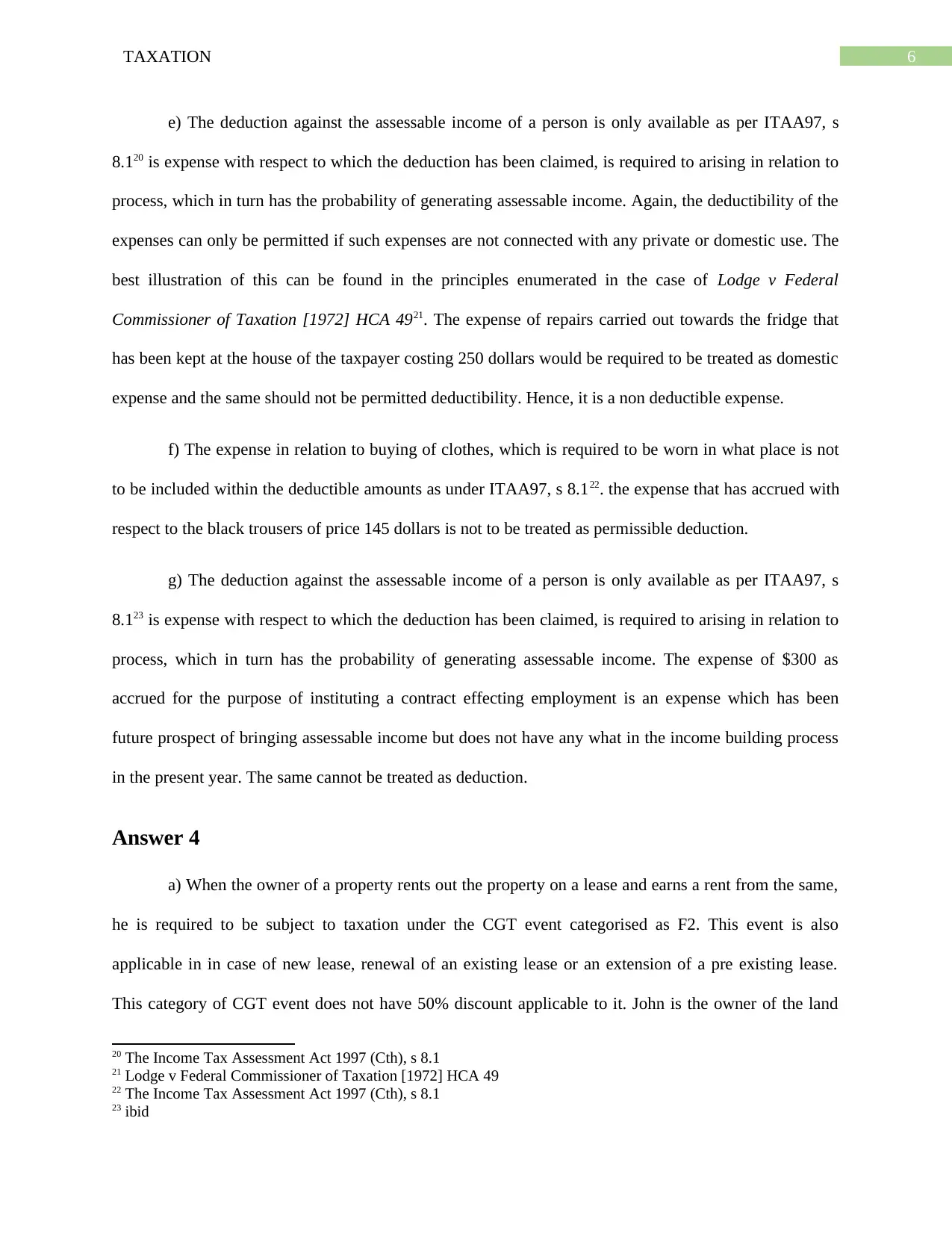
e) The deduction against the assessable income of a person is only available as per ITAA97, s
8.120 is expense with respect to which the deduction has been claimed, is required to arising in relation to
process, which in turn has the probability of generating assessable income. Again, the deductibility of the
expenses can only be permitted if such expenses are not connected with any private or domestic use. The
best illustration of this can be found in the principles enumerated in the case of Lodge v Federal
Commissioner of Taxation [1972] HCA 4921. The expense of repairs carried out towards the fridge that
has been kept at the house of the taxpayer costing 250 dollars would be required to be treated as domestic
expense and the same should not be permitted deductibility. Hence, it is a non deductible expense.
f) The expense in relation to buying of clothes, which is required to be worn in what place is not
to be included within the deductible amounts as under ITAA97, s 8.122. the expense that has accrued with
respect to the black trousers of price 145 dollars is not to be treated as permissible deduction.
g) The deduction against the assessable income of a person is only available as per ITAA97, s
8.123 is expense with respect to which the deduction has been claimed, is required to arising in relation to
process, which in turn has the probability of generating assessable income. The expense of $300 as
accrued for the purpose of instituting a contract effecting employment is an expense which has been
future prospect of bringing assessable income but does not have any what in the income building process
in the present year. The same cannot be treated as deduction.
Answer 4
a) When the owner of a property rents out the property on a lease and earns a rent from the same,
he is required to be subject to taxation under the CGT event categorised as F2. This event is also
applicable in in case of new lease, renewal of an existing lease or an extension of a pre existing lease.
This category of CGT event does not have 50% discount applicable to it. John is the owner of the land
20 The Income Tax Assessment Act 1997 (Cth), s 8.1
21 Lodge v Federal Commissioner of Taxation [1972] HCA 49
22 The Income Tax Assessment Act 1997 (Cth), s 8.1
23 ibid
e) The deduction against the assessable income of a person is only available as per ITAA97, s
8.120 is expense with respect to which the deduction has been claimed, is required to arising in relation to
process, which in turn has the probability of generating assessable income. Again, the deductibility of the
expenses can only be permitted if such expenses are not connected with any private or domestic use. The
best illustration of this can be found in the principles enumerated in the case of Lodge v Federal
Commissioner of Taxation [1972] HCA 4921. The expense of repairs carried out towards the fridge that
has been kept at the house of the taxpayer costing 250 dollars would be required to be treated as domestic
expense and the same should not be permitted deductibility. Hence, it is a non deductible expense.
f) The expense in relation to buying of clothes, which is required to be worn in what place is not
to be included within the deductible amounts as under ITAA97, s 8.122. the expense that has accrued with
respect to the black trousers of price 145 dollars is not to be treated as permissible deduction.
g) The deduction against the assessable income of a person is only available as per ITAA97, s
8.123 is expense with respect to which the deduction has been claimed, is required to arising in relation to
process, which in turn has the probability of generating assessable income. The expense of $300 as
accrued for the purpose of instituting a contract effecting employment is an expense which has been
future prospect of bringing assessable income but does not have any what in the income building process
in the present year. The same cannot be treated as deduction.
Answer 4
a) When the owner of a property rents out the property on a lease and earns a rent from the same,
he is required to be subject to taxation under the CGT event categorised as F2. This event is also
applicable in in case of new lease, renewal of an existing lease or an extension of a pre existing lease.
This category of CGT event does not have 50% discount applicable to it. John is the owner of the land
20 The Income Tax Assessment Act 1997 (Cth), s 8.1
21 Lodge v Federal Commissioner of Taxation [1972] HCA 49
22 The Income Tax Assessment Act 1997 (Cth), s 8.1
23 ibid
Paraphrase This Document
Need a fresh take? Get an instant paraphrase of this document with our AI Paraphraser
7TAXATION
that has been given to David on lease with a premium of $7000. This is a CGT event F2 and it is required
to be treated as CGT gain. 50% discount is not applicable in this case24.
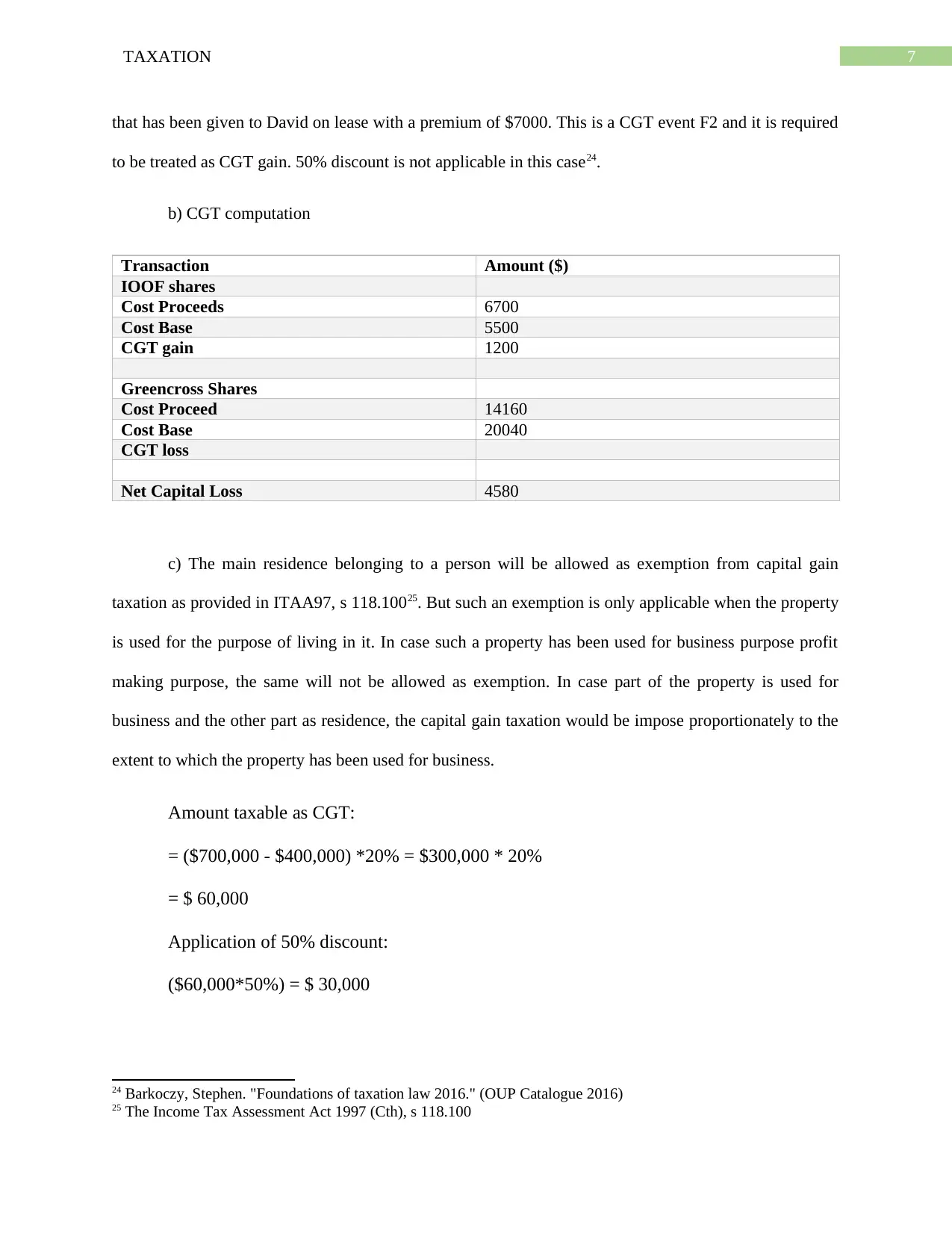
b) CGT computation
Transaction Amount ($)
IOOF shares
Cost Proceeds 6700
Cost Base 5500
CGT gain 1200
Greencross Shares
Cost Proceed 14160
Cost Base 20040
CGT loss
Net Capital Loss 4580
c) The main residence belonging to a person will be allowed as exemption from capital gain
taxation as provided in ITAA97, s 118.10025. But such an exemption is only applicable when the property
is used for the purpose of living in it. In case such a property has been used for business purpose profit
making purpose, the same will not be allowed as exemption. In case part of the property is used for
business and the other part as residence, the capital gain taxation would be impose proportionately to the
extent to which the property has been used for business.
Amount taxable as CGT:
= ($700,000 - $400,000) *20% = $300,000 * 20%
= $ 60,000
Application of 50% discount:
($60,000*50%) = $ 30,000
24 Barkoczy, Stephen. "Foundations of taxation law 2016." (OUP Catalogue 2016)
25 The Income Tax Assessment Act 1997 (Cth), s 118.100
that has been given to David on lease with a premium of $7000. This is a CGT event F2 and it is required
to be treated as CGT gain. 50% discount is not applicable in this case24.
b) CGT computation
Transaction Amount ($)
IOOF shares
Cost Proceeds 6700
Cost Base 5500
CGT gain 1200
Greencross Shares
Cost Proceed 14160
Cost Base 20040
CGT loss
Net Capital Loss 4580
c) The main residence belonging to a person will be allowed as exemption from capital gain
taxation as provided in ITAA97, s 118.10025. But such an exemption is only applicable when the property
is used for the purpose of living in it. In case such a property has been used for business purpose profit
making purpose, the same will not be allowed as exemption. In case part of the property is used for
business and the other part as residence, the capital gain taxation would be impose proportionately to the
extent to which the property has been used for business.
Amount taxable as CGT:
= ($700,000 - $400,000) *20% = $300,000 * 20%
= $ 60,000
Application of 50% discount:
($60,000*50%) = $ 30,000
24 Barkoczy, Stephen. "Foundations of taxation law 2016." (OUP Catalogue 2016)
25 The Income Tax Assessment Act 1997 (Cth), s 118.100
8TAXATION
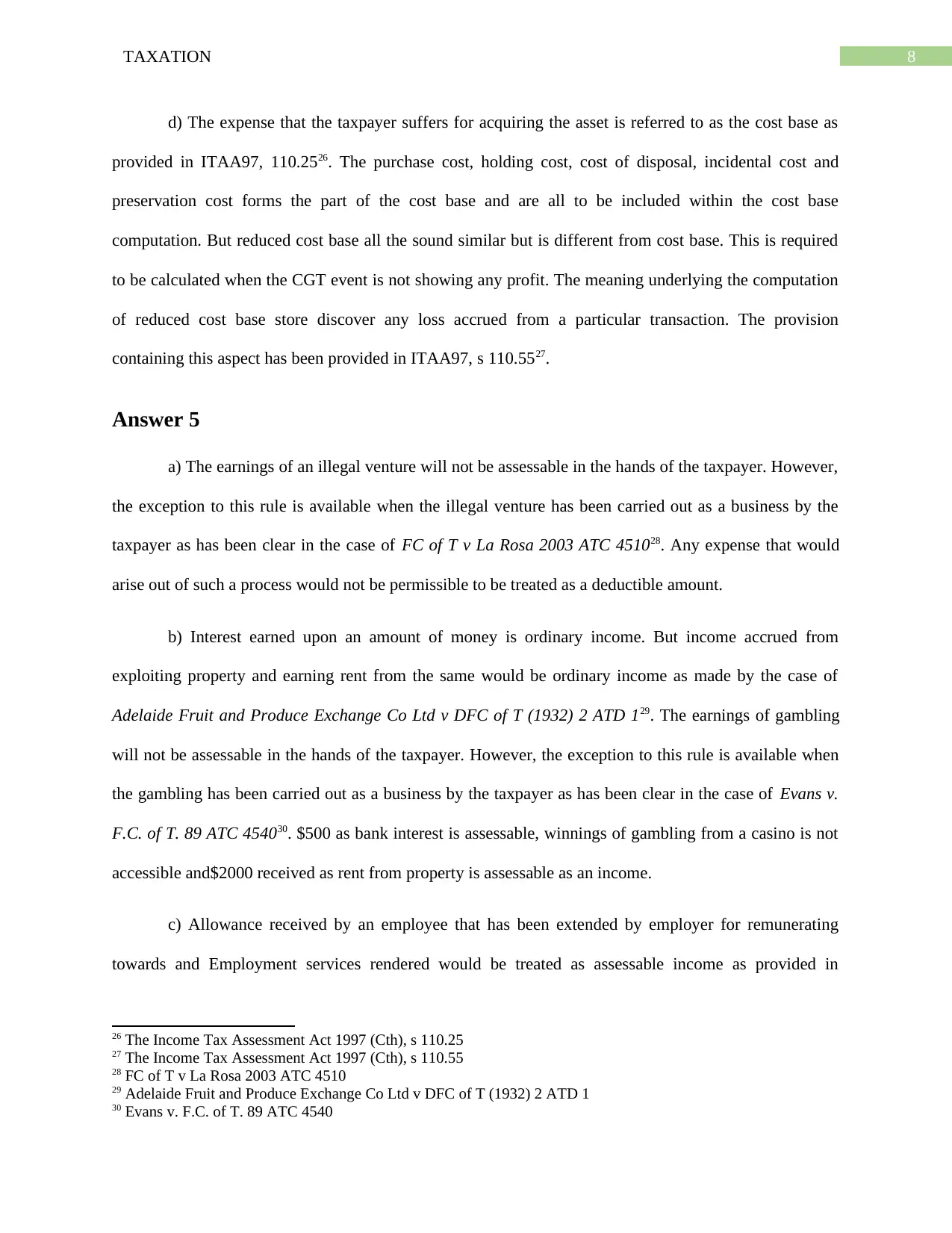
d) The expense that the taxpayer suffers for acquiring the asset is referred to as the cost base as
provided in ITAA97, 110.2526. The purchase cost, holding cost, cost of disposal, incidental cost and
preservation cost forms the part of the cost base and are all to be included within the cost base
computation. But reduced cost base all the sound similar but is different from cost base. This is required
to be calculated when the CGT event is not showing any profit. The meaning underlying the computation
of reduced cost base store discover any loss accrued from a particular transaction. The provision
containing this aspect has been provided in ITAA97, s 110.5527.
Answer 5
a) The earnings of an illegal venture will not be assessable in the hands of the taxpayer. However,
the exception to this rule is available when the illegal venture has been carried out as a business by the
taxpayer as has been clear in the case of FC of T v La Rosa 2003 ATC 451028. Any expense that would
arise out of such a process would not be permissible to be treated as a deductible amount.
b) Interest earned upon an amount of money is ordinary income. But income accrued from
exploiting property and earning rent from the same would be ordinary income as made by the case of
Adelaide Fruit and Produce Exchange Co Ltd v DFC of T (1932) 2 ATD 129. The earnings of gambling
will not be assessable in the hands of the taxpayer. However, the exception to this rule is available when
the gambling has been carried out as a business by the taxpayer as has been clear in the case of Evans v.
F.C. of T. 89 ATC 454030. $500 as bank interest is assessable, winnings of gambling from a casino is not
accessible and$2000 received as rent from property is assessable as an income.
c) Allowance received by an employee that has been extended by employer for remunerating
towards and Employment services rendered would be treated as assessable income as provided in
26 The Income Tax Assessment Act 1997 (Cth), s 110.25
27 The Income Tax Assessment Act 1997 (Cth), s 110.55
28 FC of T v La Rosa 2003 ATC 4510
29 Adelaide Fruit and Produce Exchange Co Ltd v DFC of T (1932) 2 ATD 1
30 Evans v. F.C. of T. 89 ATC 4540
d) The expense that the taxpayer suffers for acquiring the asset is referred to as the cost base as
provided in ITAA97, 110.2526. The purchase cost, holding cost, cost of disposal, incidental cost and
preservation cost forms the part of the cost base and are all to be included within the cost base
computation. But reduced cost base all the sound similar but is different from cost base. This is required
to be calculated when the CGT event is not showing any profit. The meaning underlying the computation
of reduced cost base store discover any loss accrued from a particular transaction. The provision
containing this aspect has been provided in ITAA97, s 110.5527.
Answer 5
a) The earnings of an illegal venture will not be assessable in the hands of the taxpayer. However,
the exception to this rule is available when the illegal venture has been carried out as a business by the
taxpayer as has been clear in the case of FC of T v La Rosa 2003 ATC 451028. Any expense that would
arise out of such a process would not be permissible to be treated as a deductible amount.
b) Interest earned upon an amount of money is ordinary income. But income accrued from
exploiting property and earning rent from the same would be ordinary income as made by the case of
Adelaide Fruit and Produce Exchange Co Ltd v DFC of T (1932) 2 ATD 129. The earnings of gambling
will not be assessable in the hands of the taxpayer. However, the exception to this rule is available when
the gambling has been carried out as a business by the taxpayer as has been clear in the case of Evans v.
F.C. of T. 89 ATC 454030. $500 as bank interest is assessable, winnings of gambling from a casino is not
accessible and$2000 received as rent from property is assessable as an income.
c) Allowance received by an employee that has been extended by employer for remunerating
towards and Employment services rendered would be treated as assessable income as provided in
26 The Income Tax Assessment Act 1997 (Cth), s 110.25
27 The Income Tax Assessment Act 1997 (Cth), s 110.55
28 FC of T v La Rosa 2003 ATC 4510
29 Adelaide Fruit and Produce Exchange Co Ltd v DFC of T (1932) 2 ATD 1
30 Evans v. F.C. of T. 89 ATC 4540
⊘ This is a preview!⊘
Do you want full access?
Subscribe today to unlock all pages.
Trusted by 1+ million students worldwide
9TAXATION
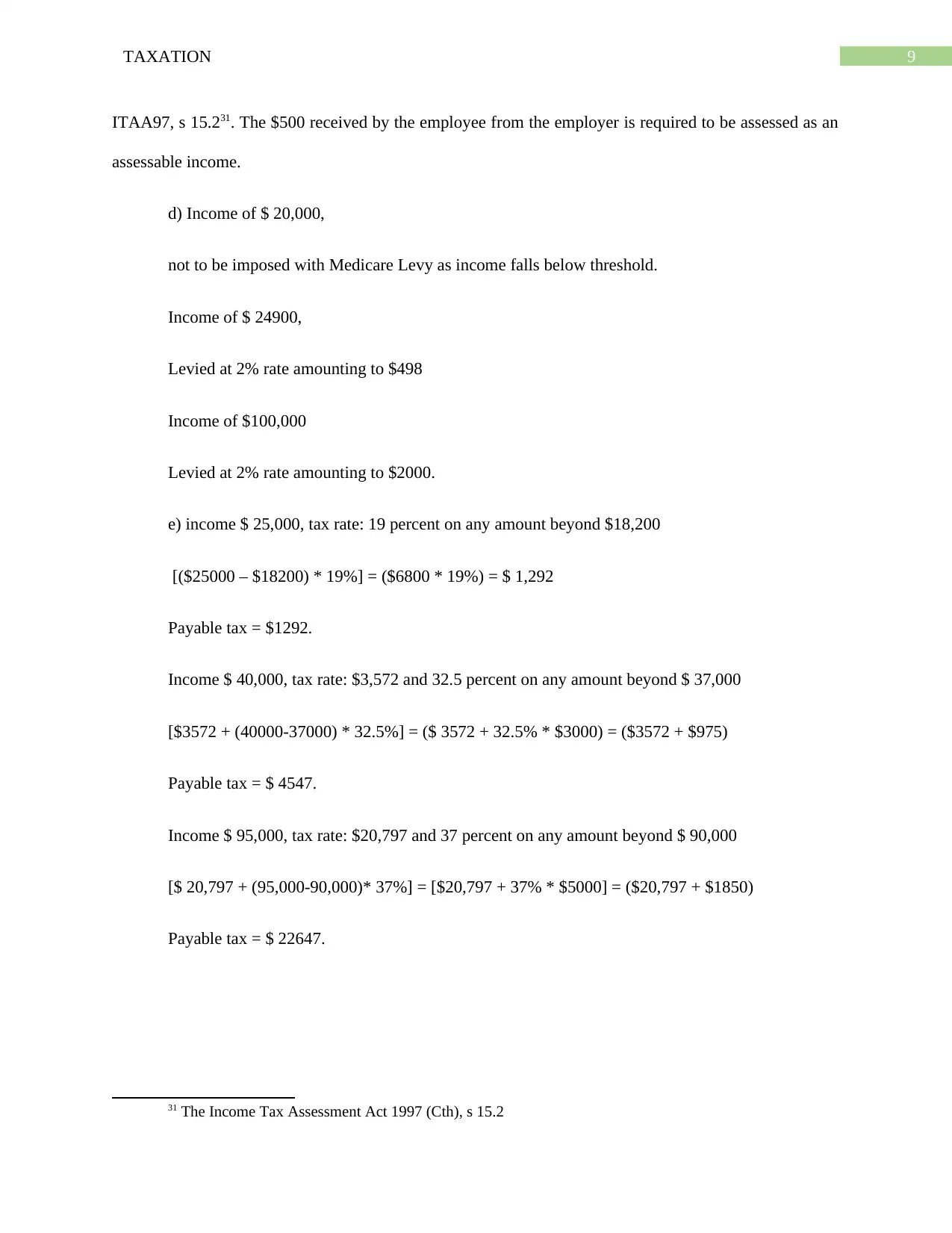
ITAA97, s 15.231. The $500 received by the employee from the employer is required to be assessed as an
assessable income.
d) Income of $ 20,000,
not to be imposed with Medicare Levy as income falls below threshold.
Income of $ 24900,
Levied at 2% rate amounting to $498
Income of $100,000
Levied at 2% rate amounting to $2000.
e) income $ 25,000, tax rate: 19 percent on any amount beyond $18,200
[($25000 – $18200) * 19%] = ($6800 * 19%) = $ 1,292
Payable tax = $1292.
Income $ 40,000, tax rate: $3,572 and 32.5 percent on any amount beyond $ 37,000
[$3572 + (40000-37000) * 32.5%] = ($ 3572 + 32.5% * $3000) = ($3572 + $975)
Payable tax = $ 4547.
Income $ 95,000, tax rate: $20,797 and 37 percent on any amount beyond $ 90,000
[$ 20,797 + (95,000-90,000)* 37%] = [$20,797 + 37% * $5000] = ($20,797 + $1850)
Payable tax = $ 22647.
31 The Income Tax Assessment Act 1997 (Cth), s 15.2
ITAA97, s 15.231. The $500 received by the employee from the employer is required to be assessed as an
assessable income.
d) Income of $ 20,000,
not to be imposed with Medicare Levy as income falls below threshold.
Income of $ 24900,
Levied at 2% rate amounting to $498
Income of $100,000
Levied at 2% rate amounting to $2000.
e) income $ 25,000, tax rate: 19 percent on any amount beyond $18,200
[($25000 – $18200) * 19%] = ($6800 * 19%) = $ 1,292
Payable tax = $1292.
Income $ 40,000, tax rate: $3,572 and 32.5 percent on any amount beyond $ 37,000
[$3572 + (40000-37000) * 32.5%] = ($ 3572 + 32.5% * $3000) = ($3572 + $975)
Payable tax = $ 4547.
Income $ 95,000, tax rate: $20,797 and 37 percent on any amount beyond $ 90,000
[$ 20,797 + (95,000-90,000)* 37%] = [$20,797 + 37% * $5000] = ($20,797 + $1850)
Payable tax = $ 22647.
31 The Income Tax Assessment Act 1997 (Cth), s 15.2
Paraphrase This Document
Need a fresh take? Get an instant paraphrase of this document with our AI Paraphraser
10TAXATION
Bibliography
Adelaide Fruit and Produce Exchange Co Ltd v DFC of T (1932) 2 ATD 1
Barkoczy, Stephen. "Foundations of taxation law 2016." (OUP Catalogue 2016).
Evans v. F.C. of T. 89 ATC 4540
F.C. of T. v. Jenkins 82 ATC 4098
FC of T v Applegate 79 ATC 4307
FC of T v La Rosa 2003 ATC 4510
Hayes v FCT (1956) 96 CLR 47
I.R.C. v. Lysaght (1928) A.C.234
Lodge v Federal Commissioner of Taxation [1972] HCA 49
R v. Hammond (1852) 117 ER 1477
The Income Tax Assessment Act 1936 (Cth)
The Income Tax Assessment Act 1997 (Cth)
The Medicare Levy Act 1986
TR 2019/1
www.ato.gov.au, "Individual Income Tax Rates", Ato.Gov.Au (Webpage, 2019)
https://www.ato.gov.au/Rates/Individual-income-tax-rates/
Bibliography
Adelaide Fruit and Produce Exchange Co Ltd v DFC of T (1932) 2 ATD 1
Barkoczy, Stephen. "Foundations of taxation law 2016." (OUP Catalogue 2016).
Evans v. F.C. of T. 89 ATC 4540
F.C. of T. v. Jenkins 82 ATC 4098
FC of T v Applegate 79 ATC 4307
FC of T v La Rosa 2003 ATC 4510
Hayes v FCT (1956) 96 CLR 47
I.R.C. v. Lysaght (1928) A.C.234
Lodge v Federal Commissioner of Taxation [1972] HCA 49
R v. Hammond (1852) 117 ER 1477
The Income Tax Assessment Act 1936 (Cth)
The Income Tax Assessment Act 1997 (Cth)
The Medicare Levy Act 1986
TR 2019/1
www.ato.gov.au, "Individual Income Tax Rates", Ato.Gov.Au (Webpage, 2019)
https://www.ato.gov.au/Rates/Individual-income-tax-rates/

1 out of 11


Related Documents


Your All-in-One AI-Powered Toolkit for Academic Success.
+13062052269
info@desklib.com
Available 24*7 on WhatsApp / Email
![[object Object]](/_next/static/media/star-bottom.7253800d.svg)
Unlock your academic potential
Copyright © 2020–2026 A2Z Services. All Rights Reserved. Developed and managed by ZUCOL.