Organizational Change Management Report: Le Chic Restaurant Analysis
VerifiedAdded on 2021/10/01
|14
|4118
|97
Report
AI Summary
This report provides a comprehensive analysis of organizational change management at Le Chic Restaurant. It begins with an introduction to the concept of organizational change and then delves into an analysis of the change context, utilizing PEST and SWOT analyses to evaluate internal and external factors influencing the implementation of a new business strategy. The report examines the nature of the proposed changes, including technological, task-related, and people-related aspects, and discusses potential employee reactions, such as fear, anger, ambivalence, and enthusiasm, linking these reactions to relevant theories like the Theory of Planned Behavior. Finally, the report offers recommendations for the management of Le Chic to ensure the successful implementation of the proposed changes, emphasizing the importance of communicating the necessity of change, addressing employee concerns, providing adequate training, and fostering open communication. The goal is to guide Le Chic through a transition that allows it to adapt to market changes and achieve its objectives.
Running Head: ORGANIZATIONAL CHANGE MANAGEMENT
Organizational Change Management
Organizational Change Management

Paraphrase This Document
Need a fresh take? Get an instant paraphrase of this document with our AI Paraphraser
ORGANIZATIONAL CHANGE MANAGEMENT 1
Contents
Introduction......................................................................................................................................2
Analysis of the Change Context......................................................................................................2
Analysis of Nature of Change Facing Le Chic................................................................................4
Possible Types of Possible Reactions to the Proposed Change.......................................................6
Recommendations............................................................................................................................7
Conclusion.......................................................................................................................................9
References......................................................................................................................................11
Contents
Introduction......................................................................................................................................2
Analysis of the Change Context......................................................................................................2
Analysis of Nature of Change Facing Le Chic................................................................................4
Possible Types of Possible Reactions to the Proposed Change.......................................................6
Recommendations............................................................................................................................7
Conclusion.......................................................................................................................................9
References......................................................................................................................................11
ORGANIZATIONAL CHANGE MANAGEMENT 2
Introduction
Organizational change can be defined as the management theory which focuses on the changes
undergone by them during their evolution. Both short term and long term changes are applicable
on the principles of organizational change theory. The adoption of the strategies relating to
organizational changes becomes easier when the organization is familiar with the various stages
of the organizational change (Kaufman, 2017).
The given scenario is about Le Chic Restaurant which is located in the centre of a major city on
the busy street. The layout of Le Chic is that of a basic restaurant along with having a fast- food
feel to it. Currently, the business is capable of meeting its objectives but it may not be able to
deal with the future circumstances in an appropriate manner. John, the new manager, has
proposed an aggressive change strategy for the purpose of demonstrating the ‘entrepreneurial
spirit’.
As the consultant of Le Chic, this report has been prepared for the purpose of addressing the key
change issues that significantly impact the implementation of the new business strategy by Le
Chic. This report contains the analysis of the change context, nature of change, possible types of
employee reactions to the proposed change along with the recommendations on how the
proposed change should be planned and executed by the management.
Analysis of the Change Context
There are some internal and external factors which will have a significant impact on the
implementation of change strategy by Le Chic. Such change can be evaluated with the help of
PEST Analysis and SWOT Analysis. The external drivers of change include factors such as
globalization, international constraints, technological innovations, hyper competition,
advancement in education, etc. On the other hand, the internal drivers of change include
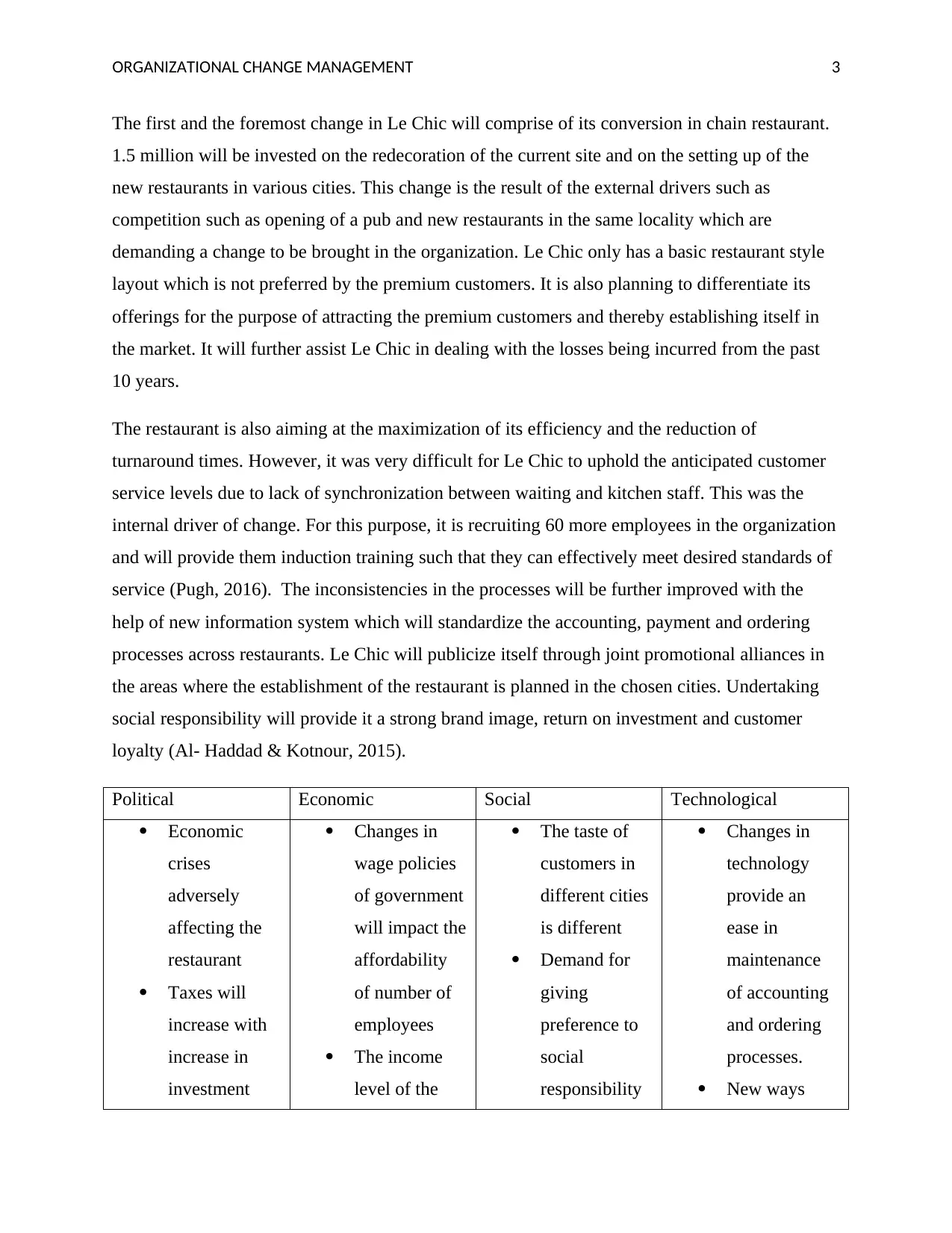
innovation and culture. PEST Analysis covers the political, economic, social and technological
influences that impact the organization. While the strengths weaknesses, opportunities and
strengths will be evaluated in the SWOT Analysis. The analysis of the change context provides
the following-
Introduction
Organizational change can be defined as the management theory which focuses on the changes
undergone by them during their evolution. Both short term and long term changes are applicable
on the principles of organizational change theory. The adoption of the strategies relating to
organizational changes becomes easier when the organization is familiar with the various stages
of the organizational change (Kaufman, 2017).
The given scenario is about Le Chic Restaurant which is located in the centre of a major city on
the busy street. The layout of Le Chic is that of a basic restaurant along with having a fast- food
feel to it. Currently, the business is capable of meeting its objectives but it may not be able to
deal with the future circumstances in an appropriate manner. John, the new manager, has
proposed an aggressive change strategy for the purpose of demonstrating the ‘entrepreneurial
spirit’.
As the consultant of Le Chic, this report has been prepared for the purpose of addressing the key
change issues that significantly impact the implementation of the new business strategy by Le
Chic. This report contains the analysis of the change context, nature of change, possible types of
employee reactions to the proposed change along with the recommendations on how the
proposed change should be planned and executed by the management.
Analysis of the Change Context
There are some internal and external factors which will have a significant impact on the
implementation of change strategy by Le Chic. Such change can be evaluated with the help of
PEST Analysis and SWOT Analysis. The external drivers of change include factors such as
globalization, international constraints, technological innovations, hyper competition,
advancement in education, etc. On the other hand, the internal drivers of change include
innovation and culture. PEST Analysis covers the political, economic, social and technological
influences that impact the organization. While the strengths weaknesses, opportunities and
strengths will be evaluated in the SWOT Analysis. The analysis of the change context provides
the following-
⊘ This is a preview!⊘
Do you want full access?
Subscribe today to unlock all pages.

Trusted by 1+ million students worldwide
ORGANIZATIONAL CHANGE MANAGEMENT 3
The first and the foremost change in Le Chic will comprise of its conversion in chain restaurant.
1.5 million will be invested on the redecoration of the current site and on the setting up of the
new restaurants in various cities. This change is the result of the external drivers such as
competition such as opening of a pub and new restaurants in the same locality which are
demanding a change to be brought in the organization. Le Chic only has a basic restaurant style
layout which is not preferred by the premium customers. It is also planning to differentiate its
offerings for the purpose of attracting the premium customers and thereby establishing itself in
the market. It will further assist Le Chic in dealing with the losses being incurred from the past
10 years.
The restaurant is also aiming at the maximization of its efficiency and the reduction of
turnaround times. However, it was very difficult for Le Chic to uphold the anticipated customer
service levels due to lack of synchronization between waiting and kitchen staff. This was the
internal driver of change. For this purpose, it is recruiting 60 more employees in the organization
and will provide them induction training such that they can effectively meet desired standards of
service (Pugh, 2016). The inconsistencies in the processes will be further improved with the
help of new information system which will standardize the accounting, payment and ordering
processes across restaurants. Le Chic will publicize itself through joint promotional alliances in
the areas where the establishment of the restaurant is planned in the chosen cities. Undertaking
social responsibility will provide it a strong brand image, return on investment and customer
loyalty (Al- Haddad & Kotnour, 2015).
Political Economic Social Technological
Economic
crises
adversely
affecting the
restaurant
Taxes will
increase with
increase in
investment
Changes in
wage policies
of government
will impact the
affordability
of number of
employees
The income
level of the
The taste of
customers in
different cities
is different
Demand for
giving
preference to
social
responsibility
Changes in
technology
provide an
ease in
maintenance
of accounting
and ordering
processes.
New ways
The first and the foremost change in Le Chic will comprise of its conversion in chain restaurant.
1.5 million will be invested on the redecoration of the current site and on the setting up of the
new restaurants in various cities. This change is the result of the external drivers such as
competition such as opening of a pub and new restaurants in the same locality which are
demanding a change to be brought in the organization. Le Chic only has a basic restaurant style
layout which is not preferred by the premium customers. It is also planning to differentiate its
offerings for the purpose of attracting the premium customers and thereby establishing itself in
the market. It will further assist Le Chic in dealing with the losses being incurred from the past
10 years.
The restaurant is also aiming at the maximization of its efficiency and the reduction of
turnaround times. However, it was very difficult for Le Chic to uphold the anticipated customer
service levels due to lack of synchronization between waiting and kitchen staff. This was the
internal driver of change. For this purpose, it is recruiting 60 more employees in the organization
and will provide them induction training such that they can effectively meet desired standards of
service (Pugh, 2016). The inconsistencies in the processes will be further improved with the
help of new information system which will standardize the accounting, payment and ordering
processes across restaurants. Le Chic will publicize itself through joint promotional alliances in
the areas where the establishment of the restaurant is planned in the chosen cities. Undertaking
social responsibility will provide it a strong brand image, return on investment and customer
loyalty (Al- Haddad & Kotnour, 2015).
Political Economic Social Technological
Economic
crises
adversely
affecting the
restaurant
Taxes will
increase with
increase in
investment
Changes in
wage policies
of government
will impact the
affordability
of number of
employees
The income
level of the
The taste of
customers in
different cities
is different
Demand for
giving
preference to
social
responsibility
Changes in
technology
provide an
ease in
maintenance
of accounting
and ordering
processes.
New ways
Paraphrase This Document
Need a fresh take? Get an instant paraphrase of this document with our AI Paraphraser
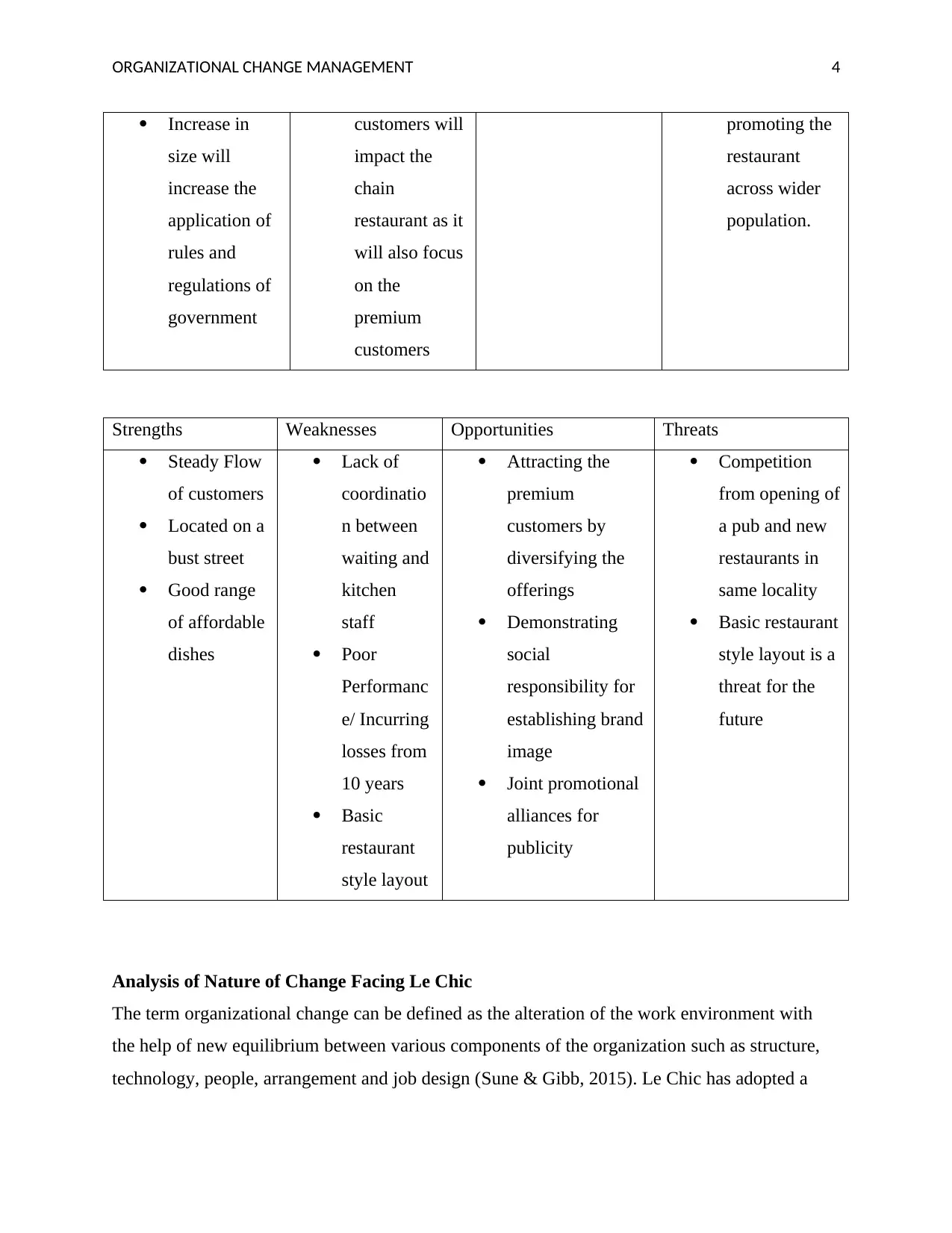
ORGANIZATIONAL CHANGE MANAGEMENT 4
Increase in
size will
increase the
application of
rules and
regulations of
government
customers will
impact the
chain
restaurant as it
will also focus
on the
premium
customers
promoting the
restaurant
across wider
population.
Strengths Weaknesses Opportunities Threats
Steady Flow
of customers
Located on a
bust street
Good range
of affordable
dishes
Lack of
coordinatio
n between
waiting and
kitchen
staff
Poor
Performanc
e/ Incurring
losses from
10 years
Basic
restaurant
style layout
Attracting the
premium
customers by
diversifying the
offerings
Demonstrating
social
responsibility for
establishing brand
image
Joint promotional
alliances for
publicity
Competition
from opening of
a pub and new
restaurants in
same locality
Basic restaurant
style layout is a
threat for the
future
Analysis of Nature of Change Facing Le Chic
The term organizational change can be defined as the alteration of the work environment with
the help of new equilibrium between various components of the organization such as structure,
technology, people, arrangement and job design (Sune & Gibb, 2015). Le Chic has adopted a
Increase in
size will
increase the
application of
rules and
regulations of
government
customers will
impact the
chain
restaurant as it
will also focus
on the
premium
customers
promoting the
restaurant
across wider
population.
Strengths Weaknesses Opportunities Threats
Steady Flow
of customers
Located on a
bust street
Good range
of affordable
dishes
Lack of
coordinatio
n between
waiting and
kitchen
staff
Poor
Performanc
e/ Incurring
losses from
10 years
Basic
restaurant
style layout
Attracting the
premium
customers by
diversifying the
offerings
Demonstrating
social
responsibility for
establishing brand
image
Joint promotional
alliances for
publicity
Competition
from opening of
a pub and new
restaurants in
same locality
Basic restaurant
style layout is a
threat for the
future
Analysis of Nature of Change Facing Le Chic
The term organizational change can be defined as the alteration of the work environment with
the help of new equilibrium between various components of the organization such as structure,
technology, people, arrangement and job design (Sune & Gibb, 2015). Le Chic has adopted a
ORGANIZATIONAL CHANGE MANAGEMENT 5
planned change for the purpose of adapting itself to the significant changes in the goals and
direction of the organization. Planned change adopted by Le Chic attempts at various aspects of
the organization that are interrelated.
Technology- Related Changes- Technology refers to the knowledge that provides ways for
performing various tasks. Inventions and techniques are included in the technology which, in
turn, affects the performance of tasks related to design, production and distribution of products.
Le Chic will adopt a new information system which will be linked to the suppliers and will
perform the function of standardizing the processes related to ordering, payment and accounting
across the restaurants. It will also make the use of multimedia website which will allow the
customers to make reservations, access menu, download discount vouchers, post feedback, and
take the advantage of the promotional events (Palmer, Dunford & Akin, 2016).
Task related Changes- some task related changes are also taking place at Le Chic as it will
convert into a chain restaurant and will aim at differentiating its offerings by way of revamping
more upmarket menu, a new bar area and a sumptuous décor for which the client will be ready to
pay premium (Bess, 2015).
People Related Changes- changes in the people working within an organization are required for
the purpose of bringing any kind of change. The changes needed are of two types- behavior and
skills. For bringing the change of this nature, approximately 60 employees are going to be
recruited and deployed across the three restaurants. Moreover, the existing members of the staff
along with the new members will be provided induction training in order to make them capable
of meeting the new standards of service. Further, some changes will also be made by transferring
skilled staff to the newly opened restaurants for the purpose of assisting the new recruits in their
on- the job training.
This can be linked with the teleological theories of change. Teleological theories are related to
the intentional change and are characterized by representing an organization directed towards a
particular objective (Burke, 2017). The objective of Le Chic is to overcome the effects of the
economic crises and the lack of coordination between the kitchen staff and the delivery of food
to the customers. This theory monitors the way such that the actions can be aimed at the end.
planned change for the purpose of adapting itself to the significant changes in the goals and
direction of the organization. Planned change adopted by Le Chic attempts at various aspects of
the organization that are interrelated.
Technology- Related Changes- Technology refers to the knowledge that provides ways for
performing various tasks. Inventions and techniques are included in the technology which, in
turn, affects the performance of tasks related to design, production and distribution of products.
Le Chic will adopt a new information system which will be linked to the suppliers and will
perform the function of standardizing the processes related to ordering, payment and accounting
across the restaurants. It will also make the use of multimedia website which will allow the
customers to make reservations, access menu, download discount vouchers, post feedback, and
take the advantage of the promotional events (Palmer, Dunford & Akin, 2016).
Task related Changes- some task related changes are also taking place at Le Chic as it will
convert into a chain restaurant and will aim at differentiating its offerings by way of revamping
more upmarket menu, a new bar area and a sumptuous décor for which the client will be ready to
pay premium (Bess, 2015).
People Related Changes- changes in the people working within an organization are required for
the purpose of bringing any kind of change. The changes needed are of two types- behavior and
skills. For bringing the change of this nature, approximately 60 employees are going to be
recruited and deployed across the three restaurants. Moreover, the existing members of the staff
along with the new members will be provided induction training in order to make them capable
of meeting the new standards of service. Further, some changes will also be made by transferring
skilled staff to the newly opened restaurants for the purpose of assisting the new recruits in their
on- the job training.
This can be linked with the teleological theories of change. Teleological theories are related to
the intentional change and are characterized by representing an organization directed towards a
particular objective (Burke, 2017). The objective of Le Chic is to overcome the effects of the
economic crises and the lack of coordination between the kitchen staff and the delivery of food
to the customers. This theory monitors the way such that the actions can be aimed at the end.
⊘ This is a preview!⊘
Do you want full access?
Subscribe today to unlock all pages.
Trusted by 1+ million students worldwide
ORGANIZATIONAL CHANGE MANAGEMENT 6
Moreover, Kotler’s theory is also of great use for adapting the business to the current climate
(Carnall, 2018).
Possible Types of Possible Reactions to the Proposed Change
There are different types of reactions which can be portrayed by the employees working with Le
Chic. For the purpose of facilitating successful organizational change, there is a need for
responding towards the needs of the employees during the process of transition by the
organization. Following are some of the possible reactions to the change proposed by Le Chic-
Fear- For any sort of change, fear is considered to be the most common human reaction. Fear
regarding the changes taking place in the organization can manifest into questions regarding job
satisfaction and security, pay cuts or demotions. However, in the cases where such fear faced by
the employees is severe, they often fail to believe in their capability of coping up with the
changes. This, in turn, often lead them to develop health concern as a result of stress or panic.
The part time workers may face fear as it will also impact their capacity of learning things
(Anderson, 2016).
Anger- Hostility can be sparked from the employees as a result of the status quo. The visibility of
such anger can be in the form of emotional outburst or repression. Moreover, the leadership of
the company can also be questioned by the frustrated employees. Backstabbing and gossip can
sabotage change efforts which are the results of the ignorance or mismanagement of the anger of
the employees. The full time employees express their anger when such changes take place
without their prior knowledge (Lord, Dinh & Hoffman, 2015).
Ambivalence- all the reactions to the change taking place in the organization is not negative. The
reaction of some employees towards the change is positive or neutral. Moreover, there is a
willing participation of some of the employees in the new policies and procedures specifically in
cases where commitment from the management is observed by them along with effective
communication with the leaders of the company which makes them feel that they are an
important part of the change process (Cameron & Green, 2015).
Enthusiasm- there are a number of employees who warmly embrace the call of the leader for
change as they see the change taking place in the organization as an opportunity for themselves
Moreover, Kotler’s theory is also of great use for adapting the business to the current climate
(Carnall, 2018).
Possible Types of Possible Reactions to the Proposed Change
There are different types of reactions which can be portrayed by the employees working with Le
Chic. For the purpose of facilitating successful organizational change, there is a need for
responding towards the needs of the employees during the process of transition by the
organization. Following are some of the possible reactions to the change proposed by Le Chic-
Fear- For any sort of change, fear is considered to be the most common human reaction. Fear
regarding the changes taking place in the organization can manifest into questions regarding job
satisfaction and security, pay cuts or demotions. However, in the cases where such fear faced by
the employees is severe, they often fail to believe in their capability of coping up with the
changes. This, in turn, often lead them to develop health concern as a result of stress or panic.
The part time workers may face fear as it will also impact their capacity of learning things
(Anderson, 2016).
Anger- Hostility can be sparked from the employees as a result of the status quo. The visibility of
such anger can be in the form of emotional outburst or repression. Moreover, the leadership of
the company can also be questioned by the frustrated employees. Backstabbing and gossip can
sabotage change efforts which are the results of the ignorance or mismanagement of the anger of
the employees. The full time employees express their anger when such changes take place
without their prior knowledge (Lord, Dinh & Hoffman, 2015).
Ambivalence- all the reactions to the change taking place in the organization is not negative. The
reaction of some employees towards the change is positive or neutral. Moreover, there is a
willing participation of some of the employees in the new policies and procedures specifically in
cases where commitment from the management is observed by them along with effective
communication with the leaders of the company which makes them feel that they are an
important part of the change process (Cameron & Green, 2015).
Enthusiasm- there are a number of employees who warmly embrace the call of the leader for
change as they see the change taking place in the organization as an opportunity for themselves
Paraphrase This Document
Need a fresh take? Get an instant paraphrase of this document with our AI Paraphraser
ORGANIZATIONAL CHANGE MANAGEMENT 7
and for the company. However, for some of the employees, the change is regarded as the
necessity for the survival of the company. The enthusiasm of the employees plays a great role in
the smooth transition of the company (Wee & Taylor, 2018).
These reactions determine whether the organizational change will be successful or not. Currently
there are only 35 employees working with Le Chic, 50% of whom are working on permanent
basis and 50% are the relief workers and the part timers who are responsible for working at the
time of busy shifts over the busy weekends. This can be linked with the Theory of Planned
Behavior which provides that the decisions are made by the individuals on the basis of the
information available to them. This theory will assist in providing a better direction to research
regarding the actual nature of the attitudes and behavior of the employees that are confronted
with an organizational change. Moreover, certain beliefs such as normative, behavioral and
control beliefs are held by the change recipients. The employees of Le Chi will also portray the
four types of reactions mentioned above. Mostly, the effect of the change will be on the
employees working on permanent basis with the organization. This is due to the fact that they
have to spend their entire day in the organization, while the part time workers only work for a
limited time during the day. Moreover, the opinion of the part-time workers is not given prime
importance by the organization itself (Hayes, 2018).
Recommendations
Following are the recommendations to be used by the management in the process of their
planning and execution of the proposed change for the purpose of ensuring its successful
implementation.
Message for Necessity of Change- While communicating the implementation of the change
process in the Le Chic, the management should ensure that a feeling of inconsistency or a belief
is created in the organization regarding the necessity of change. In this way, all the employees
will belief that the changes being brought within the organization is necessary for the purpose of
dealing with the challenges and current situations (Sharif & Scandura, 2014).
Efficiency- the message of change spread by Le Chic should be focused on the creation of a
feeling of efficiency which focuses on the ability of the individuals to cope up with the changes
taking place in the workplace (Benn, Edwards & Williams, 2014).
and for the company. However, for some of the employees, the change is regarded as the
necessity for the survival of the company. The enthusiasm of the employees plays a great role in
the smooth transition of the company (Wee & Taylor, 2018).
These reactions determine whether the organizational change will be successful or not. Currently
there are only 35 employees working with Le Chic, 50% of whom are working on permanent
basis and 50% are the relief workers and the part timers who are responsible for working at the
time of busy shifts over the busy weekends. This can be linked with the Theory of Planned
Behavior which provides that the decisions are made by the individuals on the basis of the
information available to them. This theory will assist in providing a better direction to research
regarding the actual nature of the attitudes and behavior of the employees that are confronted
with an organizational change. Moreover, certain beliefs such as normative, behavioral and
control beliefs are held by the change recipients. The employees of Le Chi will also portray the
four types of reactions mentioned above. Mostly, the effect of the change will be on the
employees working on permanent basis with the organization. This is due to the fact that they
have to spend their entire day in the organization, while the part time workers only work for a
limited time during the day. Moreover, the opinion of the part-time workers is not given prime
importance by the organization itself (Hayes, 2018).
Recommendations
Following are the recommendations to be used by the management in the process of their
planning and execution of the proposed change for the purpose of ensuring its successful
implementation.
Message for Necessity of Change- While communicating the implementation of the change
process in the Le Chic, the management should ensure that a feeling of inconsistency or a belief
is created in the organization regarding the necessity of change. In this way, all the employees
will belief that the changes being brought within the organization is necessary for the purpose of
dealing with the challenges and current situations (Sharif & Scandura, 2014).
Efficiency- the message of change spread by Le Chic should be focused on the creation of a
feeling of efficiency which focuses on the ability of the individuals to cope up with the changes
taking place in the workplace (Benn, Edwards & Williams, 2014).
ORGANIZATIONAL CHANGE MANAGEMENT 8
Initial Support- Initially, Le Chic is also required to support the employees working in the
organization through which the organization will be able to create trust in the minds of the
individuals by offering the needed information and resources. This will enhance the ability of the
employees to deal with the changes and learning new things (Yousef, 2017).
This can be made possible with the help of Kurt Lewin change theory or three step model. Le
Chic should implement changes with the help of this change management model in the three
stages namely unfreeze, change and freeze:
Unfreeze- This will be the preparation stage. At this stage, the employees of Le Chic will be
made aware regarding the importance of change in the organization and why it is needed in Le
Chic. This stage will be difficult for Le Chic in the entire process of implementation of change.
Furthermore, it will present a number of challenges for the organization and the employees
which may further lead to uncertainties (Smollan, 2015).
Change- This will be the next stage where the employees of Le Chic will begin accepting and
adopting the change. At this step, le Chic needs to ensure that support is provided to the
employees during the process of change so that they can deal with it in an effective manner
(Stouten, Rousseau & De Cremer, 2018).
Freeze- the adoption of this stage will assist Le Chic in stabilizing the way in which the company
will operate while going forward (Cummings, Bridgman & Brown, 2016). When Le Chin will
become a chain restaurant then a number of new business processes will initiate and the
employees will also be required to perform new duties (Cameron & Green, 2015).
The adoption of Lewin change management model is therefore recommended to be adopted by
Le Chic for the smooth implementation of the process of change. Moreover, the use of Kubler-
Ross five stage model can also be made by Le Chic. This will assist Le Chic in the formation of
a change curve with the help of which it can empathize with the employees while implementing
change. The change curve will represent the five steps such as anger, denial, depression,
bargaining and acceptance (Beech & MacIntosh, 2017). All these steps should be addressed by
the change management plan of Le Chic for the smooth implementation of change.
Initial Support- Initially, Le Chic is also required to support the employees working in the
organization through which the organization will be able to create trust in the minds of the
individuals by offering the needed information and resources. This will enhance the ability of the
employees to deal with the changes and learning new things (Yousef, 2017).
This can be made possible with the help of Kurt Lewin change theory or three step model. Le
Chic should implement changes with the help of this change management model in the three
stages namely unfreeze, change and freeze:
Unfreeze- This will be the preparation stage. At this stage, the employees of Le Chic will be
made aware regarding the importance of change in the organization and why it is needed in Le
Chic. This stage will be difficult for Le Chic in the entire process of implementation of change.
Furthermore, it will present a number of challenges for the organization and the employees
which may further lead to uncertainties (Smollan, 2015).
Change- This will be the next stage where the employees of Le Chic will begin accepting and
adopting the change. At this step, le Chic needs to ensure that support is provided to the
employees during the process of change so that they can deal with it in an effective manner
(Stouten, Rousseau & De Cremer, 2018).
Freeze- the adoption of this stage will assist Le Chic in stabilizing the way in which the company
will operate while going forward (Cummings, Bridgman & Brown, 2016). When Le Chin will
become a chain restaurant then a number of new business processes will initiate and the
employees will also be required to perform new duties (Cameron & Green, 2015).
The adoption of Lewin change management model is therefore recommended to be adopted by
Le Chic for the smooth implementation of the process of change. Moreover, the use of Kubler-
Ross five stage model can also be made by Le Chic. This will assist Le Chic in the formation of
a change curve with the help of which it can empathize with the employees while implementing
change. The change curve will represent the five steps such as anger, denial, depression,
bargaining and acceptance (Beech & MacIntosh, 2017). All these steps should be addressed by
the change management plan of Le Chic for the smooth implementation of change.
⊘ This is a preview!⊘
Do you want full access?
Subscribe today to unlock all pages.
Trusted by 1+ million students worldwide
ORGANIZATIONAL CHANGE MANAGEMENT 9
The planning for change will act as the roadmap which will identify the beginning, the route to
be adopted and the ultimate destination. It is recommended that the planning stage of change
management takes proper consideration of the resources needed for the purpose of undertaking
change, objective, scope and costs of the plan. Measurable incentives, targets, analysis and
measurements should be made clear in advance such that problems do not arise in future (Elstak,
Bhatt, Van Riel, Pratt & Berens, 2015). Furthermore, another important step in the successful
implementation of change comprise of continuous improvement. This implies that the process of
change implementation will become successful only when it will continuously monitor that the
requirements of the internal and external forces are being met accordingly. This can be ensured
with the help of ADKAR model or theory of change which provides that the new manager, John,
should implement the change strategy with the help of formulating change management teams
who will perform the task of focusing on the activities that will lead Le Chic towards its goals.
ADKAR model stands for awareness, desire, knowledge, ability and reinforcement. This model
will further assist in finding the gaps in the change management process which can be adequately
met with the help of offering training to the employees (Cameron & McNaughtan, 2014).
Conclusion
Therefore, it can be concluded that organizational change is a management theory which focuses
on the changes undergone by them during their evolution. The term organizational change can be
defined as the alteration of the work environment with the help of new equilibrium between
various components of the organization such as structure, technology, people, arrangement and
job design. This report focused on the Le Chic restaurant which is implementing a change
management strategy for the purpose of achieving success in the market and establishing a strong
brand image. As the consultant of Le Chic, this report has been prepared for the purpose of
addressing the key change issues that will significantly impact the implementation of the new
business strategy by Le Chic. This report contains the analysis of the change context, nature of
change, possible types of employee reactions to the proposed change along with the
recommendations on how the proposed change should be planned and executed by the
management.
The planning for change will act as the roadmap which will identify the beginning, the route to
be adopted and the ultimate destination. It is recommended that the planning stage of change
management takes proper consideration of the resources needed for the purpose of undertaking
change, objective, scope and costs of the plan. Measurable incentives, targets, analysis and
measurements should be made clear in advance such that problems do not arise in future (Elstak,
Bhatt, Van Riel, Pratt & Berens, 2015). Furthermore, another important step in the successful
implementation of change comprise of continuous improvement. This implies that the process of
change implementation will become successful only when it will continuously monitor that the
requirements of the internal and external forces are being met accordingly. This can be ensured
with the help of ADKAR model or theory of change which provides that the new manager, John,
should implement the change strategy with the help of formulating change management teams
who will perform the task of focusing on the activities that will lead Le Chic towards its goals.
ADKAR model stands for awareness, desire, knowledge, ability and reinforcement. This model
will further assist in finding the gaps in the change management process which can be adequately
met with the help of offering training to the employees (Cameron & McNaughtan, 2014).
Conclusion
Therefore, it can be concluded that organizational change is a management theory which focuses
on the changes undergone by them during their evolution. The term organizational change can be
defined as the alteration of the work environment with the help of new equilibrium between
various components of the organization such as structure, technology, people, arrangement and
job design. This report focused on the Le Chic restaurant which is implementing a change
management strategy for the purpose of achieving success in the market and establishing a strong
brand image. As the consultant of Le Chic, this report has been prepared for the purpose of
addressing the key change issues that will significantly impact the implementation of the new
business strategy by Le Chic. This report contains the analysis of the change context, nature of
change, possible types of employee reactions to the proposed change along with the
recommendations on how the proposed change should be planned and executed by the
management.
Paraphrase This Document
Need a fresh take? Get an instant paraphrase of this document with our AI Paraphraser
ORGANIZATIONAL CHANGE MANAGEMENT 10
The analysis of the change context provided that there are some internal and external drivers
such as competition, lack of efficiency and coordination, etc. which forced Le Chic for
implementing change. Along with this, the strengths, weaknesses, opportunities and threats have
been highlighted in the report. Furthermore, the analysis of the nature of change provides that Le
Chic is undergoing technology, task and people related changes in the organization. Moreover,
the possible reactions of the employees to the proposed change include fear, anger, ambivalence
and enthusiasm. Moreover, the experiences of the part- time and full time employees regarding
the proposed change will be different (Cullen, Edwards, Casper & Gue, 2014).
At the end of this report, some recommendations have been provided which should be taken into
consideration by Le Chic for the purpose of planning and successful implementation of the plan.
The recommendations also take into account the consideration of certain change management
theories and models Kurt Lewin change theory and ADKAR model.
The analysis of the change context provided that there are some internal and external drivers
such as competition, lack of efficiency and coordination, etc. which forced Le Chic for
implementing change. Along with this, the strengths, weaknesses, opportunities and threats have
been highlighted in the report. Furthermore, the analysis of the nature of change provides that Le
Chic is undergoing technology, task and people related changes in the organization. Moreover,
the possible reactions of the employees to the proposed change include fear, anger, ambivalence
and enthusiasm. Moreover, the experiences of the part- time and full time employees regarding
the proposed change will be different (Cullen, Edwards, Casper & Gue, 2014).
At the end of this report, some recommendations have been provided which should be taken into
consideration by Le Chic for the purpose of planning and successful implementation of the plan.
The recommendations also take into account the consideration of certain change management
theories and models Kurt Lewin change theory and ADKAR model.
ORGANIZATIONAL CHANGE MANAGEMENT 11
References
Al- Haddad, S., & Kotnour, T. (2015). Integrating the organizational change literature: a model
for successful change. Journal of Organizational Change Management, 28(2), 234-262.
Anderson, D. L. (2016). Organization development: The process of leading organizational
change. Sage Publications.
Beech, N., & MacIntosh, R. (2017). Managing change: Enquiry and action. Cambridge
University Press.
Benn, S., Edwards, M., & Williams, T. (2014). Organizational change for corporate
sustainability. Routledge.
Bess, K. D. (2015). The Impact of Everyday Experiences on Planned Organizational Change:
Applying Schematic Change Theory to the Study of Narratives in Community‐Based
Organizations. Journal of Community Psychology, 43(6), 739-759.
Burke, W. W. (2017). Organization change: Theory and practice. Sage Publications.
Cameron, E., & Green, M. (2015). Making sense of change management: A complete guide to
the models, tools and techniques of organizational change. Kogan Page Publishers.
Cameron, E., & Green, M. (2015). Making sense of change management: A complete guide to
the models, tools and techniques of organizational change. Kogan Page Publishers.
Cameron, K., & McNaughtan, J. (2014). Positive organizational change. The Journal of Applied
Behavioral Science, 50(4), 445-462.
Carnall, C. (2018). Managing change. Routledge.
Cullen, K. L., Edwards, B. D., Casper, W. C., & Gue, K. R. (2014). Employees’ adaptability and
perceptions of change-related uncertainty: Implications for perceived organizational
support, job satisfaction, and performance. Journal of Business and Psychology, 29(2),
269-280.
References
Al- Haddad, S., & Kotnour, T. (2015). Integrating the organizational change literature: a model
for successful change. Journal of Organizational Change Management, 28(2), 234-262.
Anderson, D. L. (2016). Organization development: The process of leading organizational
change. Sage Publications.
Beech, N., & MacIntosh, R. (2017). Managing change: Enquiry and action. Cambridge
University Press.
Benn, S., Edwards, M., & Williams, T. (2014). Organizational change for corporate
sustainability. Routledge.
Bess, K. D. (2015). The Impact of Everyday Experiences on Planned Organizational Change:
Applying Schematic Change Theory to the Study of Narratives in Community‐Based
Organizations. Journal of Community Psychology, 43(6), 739-759.
Burke, W. W. (2017). Organization change: Theory and practice. Sage Publications.
Cameron, E., & Green, M. (2015). Making sense of change management: A complete guide to
the models, tools and techniques of organizational change. Kogan Page Publishers.
Cameron, E., & Green, M. (2015). Making sense of change management: A complete guide to
the models, tools and techniques of organizational change. Kogan Page Publishers.
Cameron, K., & McNaughtan, J. (2014). Positive organizational change. The Journal of Applied
Behavioral Science, 50(4), 445-462.
Carnall, C. (2018). Managing change. Routledge.
Cullen, K. L., Edwards, B. D., Casper, W. C., & Gue, K. R. (2014). Employees’ adaptability and
perceptions of change-related uncertainty: Implications for perceived organizational
support, job satisfaction, and performance. Journal of Business and Psychology, 29(2),
269-280.
⊘ This is a preview!⊘
Do you want full access?
Subscribe today to unlock all pages.
Trusted by 1+ million students worldwide

1 out of 14


Related Documents


Your All-in-One AI-Powered Toolkit for Academic Success.
+13062052269
info@desklib.com
Available 24*7 on WhatsApp / Email
![[object Object]](/_next/static/media/star-bottom.7253800d.svg)
Unlock your academic potential
Copyright © 2020–2026 A2Z Services. All Rights Reserved. Developed and managed by ZUCOL.