Detailed Report: Lead Analysis in Soil Using Atomic Absorption
VerifiedAdded on 2023/04/22
|7
|1592
|330
Report
AI Summary
This report discusses lead analysis in soil samples using Atomic Absorption Spectrometry (AAS). It highlights the significance of monitoring lead levels due to its toxicity and environmental persistence. The report references the EPA's standards for lead in soil and the potential health risks associated with lead contamination, especially for children. The AAS technique is explained, emphasizing its accuracy and ability to quantify lead concentrations. The discussion section covers trace metal studies, anthropogenic impacts on metal concentrations, and the application of AAS in environmental analysis. The experimental results, though showing negative values potentially due to incomplete extraction or matrix effects, underscore the importance of proper sample preparation and calibration techniques. The report concludes by suggesting methods to improve accuracy, such as harsher digestion conditions and matrix-matching standards. Desklib provides students with access to this assignment and many more solved papers.
Running head: LEAD ANALYSIS BY AAS
1
Lead analysis by AAS
Name:
Institution:
1
Lead analysis by AAS
Name:
Institution:
Paraphrase This Document
Need a fresh take? Get an instant paraphrase of this document with our AI Paraphraser

LEAD ANALYSIS BY AAS 2
Introduction
Lead (Pb) occurs naturally in the soil in level ranging from 10 to 50 parts per million. But, with
the widespread application of lead in gasoline, paint, contamination by industry and urban soil
frequently have lead concentration significantly than background level up to 10,000 ppm in
certain zones (Nazir et al., 2015). Continuous difficulties arise from the fact that Pb does not
biodegrade, and instead rests in the soil. Acute health perils are linked with Pb poisoning, where
kids are specifically at a threat. Millions of children are unprotected to soil holding lead. This
contact can result to growth and behavioural difficulties in youngsters. The glitches comprise
inattention, learning disabilities, brain damage and delayed growth. The Environmental
Protection Agency (EPA) has put up a standard for lead in topsoil at 400 ppm for play zones and
1,200 ppm for non-play parts (Demtröder, 2013).
Similarly, Pb is a major concern in the earth, when it is utilised for horticultural. Plant can take
the Pb from the soil which causes the Pb poisoning from the leaves. Additionally, polluted soil
fragments can be inhaled or carried to the household by the footwear or clothing. It is
commended that soils with Pb concentration higher than 400 ppm should not be utilised for
garden (Pomeranz, 2013). Moreover, it is suggested that topsoil with lead strengths from 100 to
400 ppm should not be utilised for leafy vegetable as lead can be stowed in the foliage. Also,
root vegetables should not be developed in this soil as lead can accumulate in plant roots
(McHale, 2017).
AAS is an elemental analysis method that offers quantifiable info on above 50 diverse elements.
Concentration as small as parts per billion and parts per million can be used to determine the
concentration of elements. This technique has numerous benefits. For example, the method
Introduction
Lead (Pb) occurs naturally in the soil in level ranging from 10 to 50 parts per million. But, with
the widespread application of lead in gasoline, paint, contamination by industry and urban soil
frequently have lead concentration significantly than background level up to 10,000 ppm in
certain zones (Nazir et al., 2015). Continuous difficulties arise from the fact that Pb does not
biodegrade, and instead rests in the soil. Acute health perils are linked with Pb poisoning, where
kids are specifically at a threat. Millions of children are unprotected to soil holding lead. This
contact can result to growth and behavioural difficulties in youngsters. The glitches comprise
inattention, learning disabilities, brain damage and delayed growth. The Environmental
Protection Agency (EPA) has put up a standard for lead in topsoil at 400 ppm for play zones and
1,200 ppm for non-play parts (Demtröder, 2013).
Similarly, Pb is a major concern in the earth, when it is utilised for horticultural. Plant can take
the Pb from the soil which causes the Pb poisoning from the leaves. Additionally, polluted soil
fragments can be inhaled or carried to the household by the footwear or clothing. It is
commended that soils with Pb concentration higher than 400 ppm should not be utilised for
garden (Pomeranz, 2013). Moreover, it is suggested that topsoil with lead strengths from 100 to
400 ppm should not be utilised for leafy vegetable as lead can be stowed in the foliage. Also,
root vegetables should not be developed in this soil as lead can accumulate in plant roots
(McHale, 2017).
AAS is an elemental analysis method that offers quantifiable info on above 50 diverse elements.
Concentration as small as parts per billion and parts per million can be used to determine the
concentration of elements. This technique has numerous benefits. For example, the method

LEAD ANALYSIS BY AAS 3
measures the total concentration of a substance, irrespective of its form. Also, the wavelength
utilised is precise to the element being tested, so there is no interfering from other elements in the
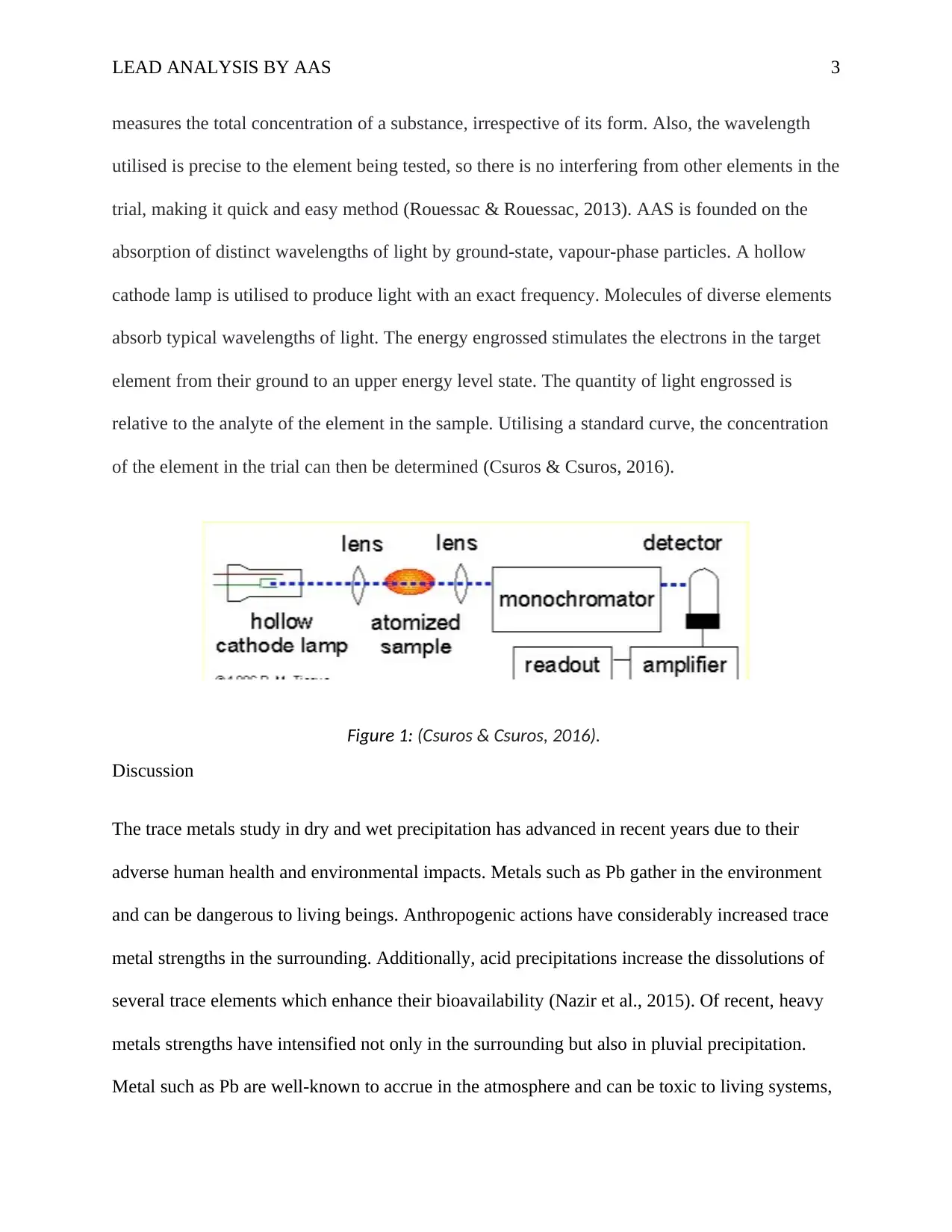
trial, making it quick and easy method (Rouessac & Rouessac, 2013). AAS is founded on the
absorption of distinct wavelengths of light by ground-state, vapour-phase particles. A hollow
cathode lamp is utilised to produce light with an exact frequency. Molecules of diverse elements
absorb typical wavelengths of light. The energy engrossed stimulates the electrons in the target
element from their ground to an upper energy level state. The quantity of light engrossed is
relative to the analyte of the element in the sample. Utilising a standard curve, the concentration
of the element in the trial can then be determined (Csuros & Csuros, 2016).
Figure 1: (Csuros & Csuros, 2016).
Discussion
The trace metals study in dry and wet precipitation has advanced in recent years due to their
adverse human health and environmental impacts. Metals such as Pb gather in the environment
and can be dangerous to living beings. Anthropogenic actions have considerably increased trace
metal strengths in the surrounding. Additionally, acid precipitations increase the dissolutions of
several trace elements which enhance their bioavailability (Nazir et al., 2015). Of recent, heavy
metals strengths have intensified not only in the surrounding but also in pluvial precipitation.
Metal such as Pb are well-known to accrue in the atmosphere and can be toxic to living systems,
measures the total concentration of a substance, irrespective of its form. Also, the wavelength
utilised is precise to the element being tested, so there is no interfering from other elements in the
trial, making it quick and easy method (Rouessac & Rouessac, 2013). AAS is founded on the
absorption of distinct wavelengths of light by ground-state, vapour-phase particles. A hollow
cathode lamp is utilised to produce light with an exact frequency. Molecules of diverse elements
absorb typical wavelengths of light. The energy engrossed stimulates the electrons in the target
element from their ground to an upper energy level state. The quantity of light engrossed is
relative to the analyte of the element in the sample. Utilising a standard curve, the concentration
of the element in the trial can then be determined (Csuros & Csuros, 2016).
Figure 1: (Csuros & Csuros, 2016).
Discussion
The trace metals study in dry and wet precipitation has advanced in recent years due to their
adverse human health and environmental impacts. Metals such as Pb gather in the environment
and can be dangerous to living beings. Anthropogenic actions have considerably increased trace
metal strengths in the surrounding. Additionally, acid precipitations increase the dissolutions of
several trace elements which enhance their bioavailability (Nazir et al., 2015). Of recent, heavy
metals strengths have intensified not only in the surrounding but also in pluvial precipitation.
Metal such as Pb are well-known to accrue in the atmosphere and can be toxic to living systems,
⊘ This is a preview!⊘
Do you want full access?
Subscribe today to unlock all pages.

Trusted by 1+ million students worldwide

LEAD ANALYSIS BY AAS 4
even at lower concentrations. Numerous human processes take part in regional and global trace
elements budgets. Moreover, when present above certain levels, trace elements are potentially
dangerous to terrestrial and marine life. For that reason, biogeochemical trepidations are matter
of big focus in science (Nazir et al., 2015).
Atomic Absorption Spectrometry is a useful technique to analyse a wide range of environmental
samples, for example, water, soil, sludge, and sediment for a large number of elements. The
calibration curve and the samples’ concentration were determined automatically by the software.
The values given on the worksheet are in ppm of Pb in the samples. Both sample A and B
showed a low level of Pb contamination (less than 150ppm) but with negative values.
The experiment illustrates the application of AAS to determine the Pb content in the soil. In this
experiment, the content of lead in environmental samples was determined using a suitable
extraction method to prepare the sample for analysis. The following was done; soil collection
and preparation, sample digestion and analysing of sample with AAS.
If the calibration curve is C = A + Bx, where C is the measured signal for a sample(s) and x is its
concentration value. One can calculate the "x" from the equation, x = (C - A) / B; there are two
alternatives for the computation, (1) if A has a negative sign, in that case, x will always be
positive, (2) if A has a positive sign, and C is higher than A, one will get positive concentration
values, otherwise, if it is C < A, you will always get concentration values with negative sign
(Nazir et al., 2015). Consequently, samples have low analytes concentrations which are lower
than the quantification limit value. The reason for the deviation could be attributed to other
reasons other than calibration standards as the intercept values for the calibration curves shown is
"zero" or near the zero (Skoog, Holler & Crouch, 2017).
even at lower concentrations. Numerous human processes take part in regional and global trace
elements budgets. Moreover, when present above certain levels, trace elements are potentially
dangerous to terrestrial and marine life. For that reason, biogeochemical trepidations are matter
of big focus in science (Nazir et al., 2015).
Atomic Absorption Spectrometry is a useful technique to analyse a wide range of environmental
samples, for example, water, soil, sludge, and sediment for a large number of elements. The
calibration curve and the samples’ concentration were determined automatically by the software.
The values given on the worksheet are in ppm of Pb in the samples. Both sample A and B
showed a low level of Pb contamination (less than 150ppm) but with negative values.
The experiment illustrates the application of AAS to determine the Pb content in the soil. In this
experiment, the content of lead in environmental samples was determined using a suitable
extraction method to prepare the sample for analysis. The following was done; soil collection
and preparation, sample digestion and analysing of sample with AAS.
If the calibration curve is C = A + Bx, where C is the measured signal for a sample(s) and x is its
concentration value. One can calculate the "x" from the equation, x = (C - A) / B; there are two
alternatives for the computation, (1) if A has a negative sign, in that case, x will always be
positive, (2) if A has a positive sign, and C is higher than A, one will get positive concentration
values, otherwise, if it is C < A, you will always get concentration values with negative sign
(Nazir et al., 2015). Consequently, samples have low analytes concentrations which are lower
than the quantification limit value. The reason for the deviation could be attributed to other
reasons other than calibration standards as the intercept values for the calibration curves shown is
"zero" or near the zero (Skoog, Holler & Crouch, 2017).
Paraphrase This Document
Need a fresh take? Get an instant paraphrase of this document with our AI Paraphraser

LEAD ANALYSIS BY AAS 5
The negative results could be from several reasons: Incomplete extraction of sample: it results in
lower concentrations in the digested solutions to be measured. It is worth checking with harsher
conditions for digestion such as increasing time, temperature, stronger oxidising reagents. Matrix
effects: usually the matrix depresses signal in AAS as well as in ICP (even though ICP provides
high-temperature plasma). This could be overcome by matrix-matching standards such as a
method of addition. This means that if one still have not found a suitable solution, and it is well
known that samples contain lead, one can use the Method of Standard Additions. However, it is
tedious but quite precise (Robinson, 2017).
The negative results could be from several reasons: Incomplete extraction of sample: it results in
lower concentrations in the digested solutions to be measured. It is worth checking with harsher
conditions for digestion such as increasing time, temperature, stronger oxidising reagents. Matrix
effects: usually the matrix depresses signal in AAS as well as in ICP (even though ICP provides
high-temperature plasma). This could be overcome by matrix-matching standards such as a
method of addition. This means that if one still have not found a suitable solution, and it is well
known that samples contain lead, one can use the Method of Standard Additions. However, it is
tedious but quite precise (Robinson, 2017).

LEAD ANALYSIS BY AAS 6
References
Csuros, M., & Csuros, C. (2016). Environmental sampling and analysis for metals. CRC Press.
[Online]. Available from: https://www.taylorfrancis.com/books/9781420032345
Demtröder, W. (2013). Laser spectroscopy: basic concepts and instrumentation. Springer
Science & Business Media. [Online]. Available from: https://books.google.com/books?
hl=en&lr=&id=lfTxCAAAQBAJ&oi=fnd&pg=PA1&dq=atomic+absorption+spectrosco
py&ots=O5gSKiG5db&sig=c-sPVEAbRigYmHYJWaUM2Hr86Xc
McHale, J. L. (2017). Molecular spectroscopy. CRC Press. [Online]. Available from:
https://www.taylorfrancis.com/books/9781466586598
Nazir, R., Khan, M., Masab, M., Rehman, H. U., Rauf, N. U., Shahab, S., ... & Shaheen, Z.
(2015). Accumulation of heavy metals (Ni, Cu, Cd, Cr, Pb, Zn, Fe) in the soil, water and
plants and analysis of physico-chemical parameters of soil and water collected from
Tanda Dam Kohat. Journal of Pharmaceutical Sciences and Research, 7(3), 89. [Online].
Available from:
https://www.researchgate.net/profile/Hameed_Rehman2/publication/282268391_Accumu
lation_of_Heavy_Metals_Ni_Cu_Cd_Cr_Pb_Zn_Fe_in_the_soil_water_and_plants_and_
analysis_of_physico-
chemical_parameters_of_soil_and_water_Collected_from_Tanda_Dam_kohat/links/
562f4d1408ae04c2aeb6fb0f.pdf
Pomeranz, Y. (Ed.). (2013). Food analysis: theory and practice. Springer Science & Business
Media. [Online]. Available from: https://books.google.com/books?
References
Csuros, M., & Csuros, C. (2016). Environmental sampling and analysis for metals. CRC Press.
[Online]. Available from: https://www.taylorfrancis.com/books/9781420032345
Demtröder, W. (2013). Laser spectroscopy: basic concepts and instrumentation. Springer
Science & Business Media. [Online]. Available from: https://books.google.com/books?
hl=en&lr=&id=lfTxCAAAQBAJ&oi=fnd&pg=PA1&dq=atomic+absorption+spectrosco
py&ots=O5gSKiG5db&sig=c-sPVEAbRigYmHYJWaUM2Hr86Xc
McHale, J. L. (2017). Molecular spectroscopy. CRC Press. [Online]. Available from:
https://www.taylorfrancis.com/books/9781466586598
Nazir, R., Khan, M., Masab, M., Rehman, H. U., Rauf, N. U., Shahab, S., ... & Shaheen, Z.
(2015). Accumulation of heavy metals (Ni, Cu, Cd, Cr, Pb, Zn, Fe) in the soil, water and
plants and analysis of physico-chemical parameters of soil and water collected from
Tanda Dam Kohat. Journal of Pharmaceutical Sciences and Research, 7(3), 89. [Online].
Available from:
https://www.researchgate.net/profile/Hameed_Rehman2/publication/282268391_Accumu
lation_of_Heavy_Metals_Ni_Cu_Cd_Cr_Pb_Zn_Fe_in_the_soil_water_and_plants_and_
analysis_of_physico-
chemical_parameters_of_soil_and_water_Collected_from_Tanda_Dam_kohat/links/
562f4d1408ae04c2aeb6fb0f.pdf
Pomeranz, Y. (Ed.). (2013). Food analysis: theory and practice. Springer Science & Business
Media. [Online]. Available from: https://books.google.com/books?
⊘ This is a preview!⊘
Do you want full access?
Subscribe today to unlock all pages.

Trusted by 1+ million students worldwide

LEAD ANALYSIS BY AAS 7
hl=en&lr=&id=uOjiBwAAQBAJ&oi=fnd&pg=PR13&dq=lead+analysis+by+atomic+ab
sorption+spectroscopy&ots=1rlYa4oMgY&sig=LU2tu3p1DGv6LO87cS6QbY9t-tA
Robinson, J. W. (2017). Practical handbook of spectroscopy. Routledge. [Online]. Available
from: https://www.taylorfrancis.com/books/9781351422789
Rouessac, F., & Rouessac, A. (2013). Chemical analysis: modern instrumentation methods and
techniques. John Wiley & Sons. [Online]. Available from:
https://books.google.com/books?
hl=en&lr=&id=4XmjFLkJGygC&oi=fnd&pg=PT14&dq=lead+analysis+by+atomic+abs
orption+spectroscopy&ots=JNOUOPzSWN&sig=b2uiSaFLtUs9OkWFWSvBiAqNOw4
Skoog, D. A., Holler, F. J., & Crouch, S. R. (2017). Principles of instrumental analysis. Cengage
learning. [Online]. Available from: https://books.google.com/books?
hl=en&lr=&id=n1zEDQAAQBAJ&oi=fnd&pg=PP1&dq=lead+analysis+by+atomic+abs
orption+spectroscopy&ots=jPBLn39YDP&sig=dCXtWmiNzLkNl2MKc3lWRTfwUdY
hl=en&lr=&id=uOjiBwAAQBAJ&oi=fnd&pg=PR13&dq=lead+analysis+by+atomic+ab
sorption+spectroscopy&ots=1rlYa4oMgY&sig=LU2tu3p1DGv6LO87cS6QbY9t-tA
Robinson, J. W. (2017). Practical handbook of spectroscopy. Routledge. [Online]. Available
from: https://www.taylorfrancis.com/books/9781351422789
Rouessac, F., & Rouessac, A. (2013). Chemical analysis: modern instrumentation methods and
techniques. John Wiley & Sons. [Online]. Available from:
https://books.google.com/books?
hl=en&lr=&id=4XmjFLkJGygC&oi=fnd&pg=PT14&dq=lead+analysis+by+atomic+abs
orption+spectroscopy&ots=JNOUOPzSWN&sig=b2uiSaFLtUs9OkWFWSvBiAqNOw4
Skoog, D. A., Holler, F. J., & Crouch, S. R. (2017). Principles of instrumental analysis. Cengage
learning. [Online]. Available from: https://books.google.com/books?
hl=en&lr=&id=n1zEDQAAQBAJ&oi=fnd&pg=PP1&dq=lead+analysis+by+atomic+abs
orption+spectroscopy&ots=jPBLn39YDP&sig=dCXtWmiNzLkNl2MKc3lWRTfwUdY
1 out of 7
Your All-in-One AI-Powered Toolkit for Academic Success.
+13062052269
info@desklib.com
Available 24*7 on WhatsApp / Email
Unlock your academic potential
Copyright © 2020–2026 A2Z Services. All Rights Reserved. Developed and managed by ZUCOL.