University Assignment: Lead and Manage Team Effectiveness Report
VerifiedAdded on 2023/04/22
|9
|2669
|489
Report
AI Summary
This report, focusing on "Lead and Manage Team Effectiveness," examines the crucial role of employee cohesion in retail businesses, particularly at Macy's. The report outlines policies and procedures for ensuring team unity, including establishing a clear mission, promoting diversity, practicing teamwork, utilizing individual strengths, effective communication, and providing constructive feedback. It analyzes three case studies, contrasting autocratic and transformational leadership styles, and assessing their impact on employee motivation and organizational success. The final section addresses a memo scenario, evaluating a manager's approach to employee relations, and discussing the strengths, weaknesses, and potential power dynamics within a supervisory role, emphasizing the importance of balancing business goals with employee well-being. The report provides a comprehensive overview of leadership principles and their practical application in a retail setting, offering valuable insights for students of leadership and management.
Running head: LEAD AND MANAGE TEAM EFFECTIVENESS
Lead and Manage Team Effectiveness
Name of the Student
Name of the University
Author Note
Lead and Manage Team Effectiveness
Name of the Student
Name of the University
Author Note

Paraphrase This Document
Need a fresh take? Get an instant paraphrase of this document with our AI Paraphraser
1LEAD AND MANAGE TEAM EFFECTIVENESS
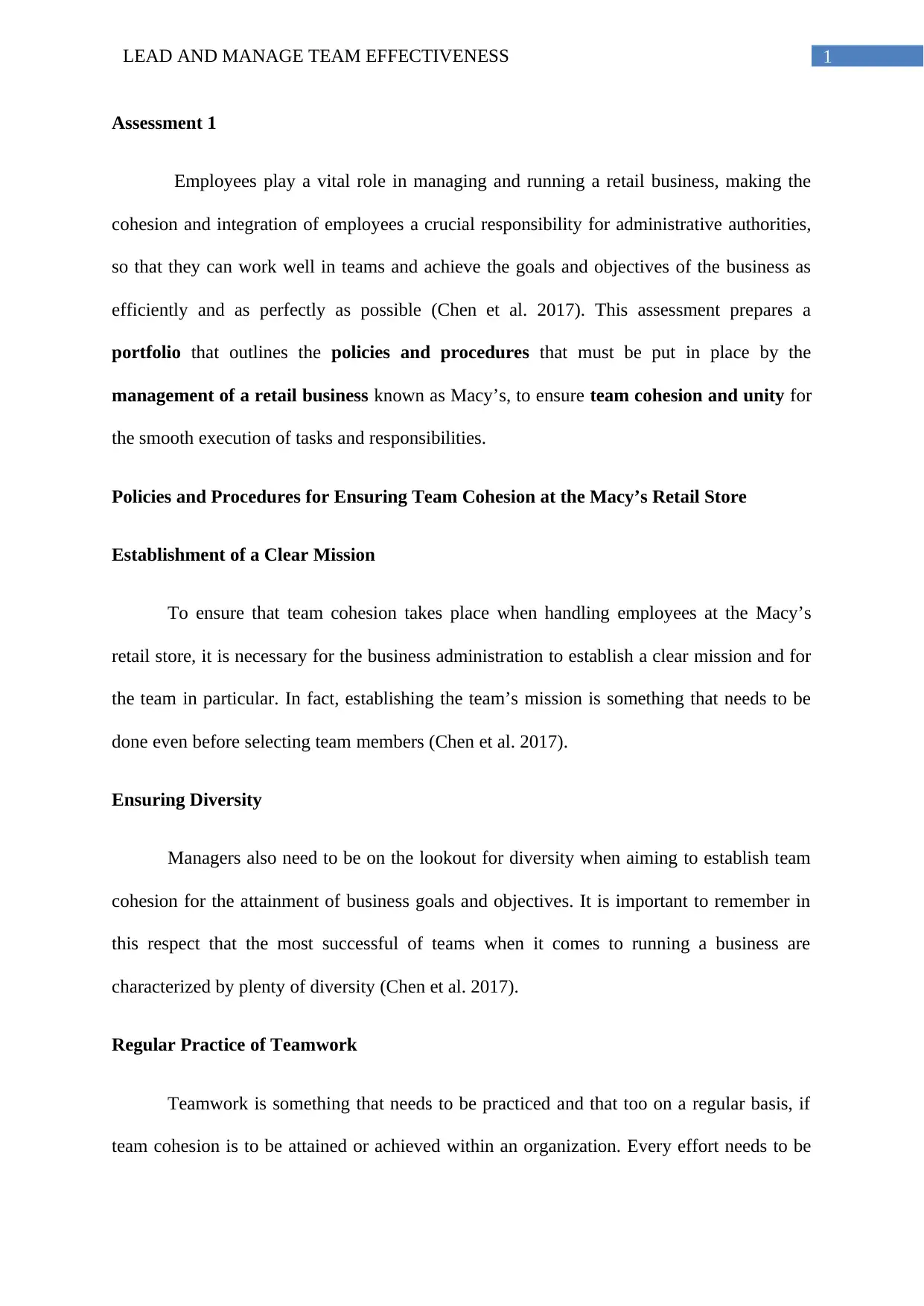
Assessment 1
Employees play a vital role in managing and running a retail business, making the
cohesion and integration of employees a crucial responsibility for administrative authorities,
so that they can work well in teams and achieve the goals and objectives of the business as
efficiently and as perfectly as possible (Chen et al. 2017). This assessment prepares a
portfolio that outlines the policies and procedures that must be put in place by the
management of a retail business known as Macy’s, to ensure team cohesion and unity for
the smooth execution of tasks and responsibilities.
Policies and Procedures for Ensuring Team Cohesion at the Macy’s Retail Store
Establishment of a Clear Mission
To ensure that team cohesion takes place when handling employees at the Macy’s
retail store, it is necessary for the business administration to establish a clear mission and for
the team in particular. In fact, establishing the team’s mission is something that needs to be
done even before selecting team members (Chen et al. 2017).
Ensuring Diversity
Managers also need to be on the lookout for diversity when aiming to establish team
cohesion for the attainment of business goals and objectives. It is important to remember in
this respect that the most successful of teams when it comes to running a business are
characterized by plenty of diversity (Chen et al. 2017).
Regular Practice of Teamwork
Teamwork is something that needs to be practiced and that too on a regular basis, if
team cohesion is to be attained or achieved within an organization. Every effort needs to be
Assessment 1
Employees play a vital role in managing and running a retail business, making the
cohesion and integration of employees a crucial responsibility for administrative authorities,
so that they can work well in teams and achieve the goals and objectives of the business as
efficiently and as perfectly as possible (Chen et al. 2017). This assessment prepares a
portfolio that outlines the policies and procedures that must be put in place by the
management of a retail business known as Macy’s, to ensure team cohesion and unity for
the smooth execution of tasks and responsibilities.
Policies and Procedures for Ensuring Team Cohesion at the Macy’s Retail Store
Establishment of a Clear Mission
To ensure that team cohesion takes place when handling employees at the Macy’s
retail store, it is necessary for the business administration to establish a clear mission and for
the team in particular. In fact, establishing the team’s mission is something that needs to be
done even before selecting team members (Chen et al. 2017).
Ensuring Diversity
Managers also need to be on the lookout for diversity when aiming to establish team
cohesion for the attainment of business goals and objectives. It is important to remember in
this respect that the most successful of teams when it comes to running a business are
characterized by plenty of diversity (Chen et al. 2017).
Regular Practice of Teamwork
Teamwork is something that needs to be practiced and that too on a regular basis, if
team cohesion is to be attained or achieved within an organization. Every effort needs to be
2LEAD AND MANAGE TEAM EFFECTIVENESS
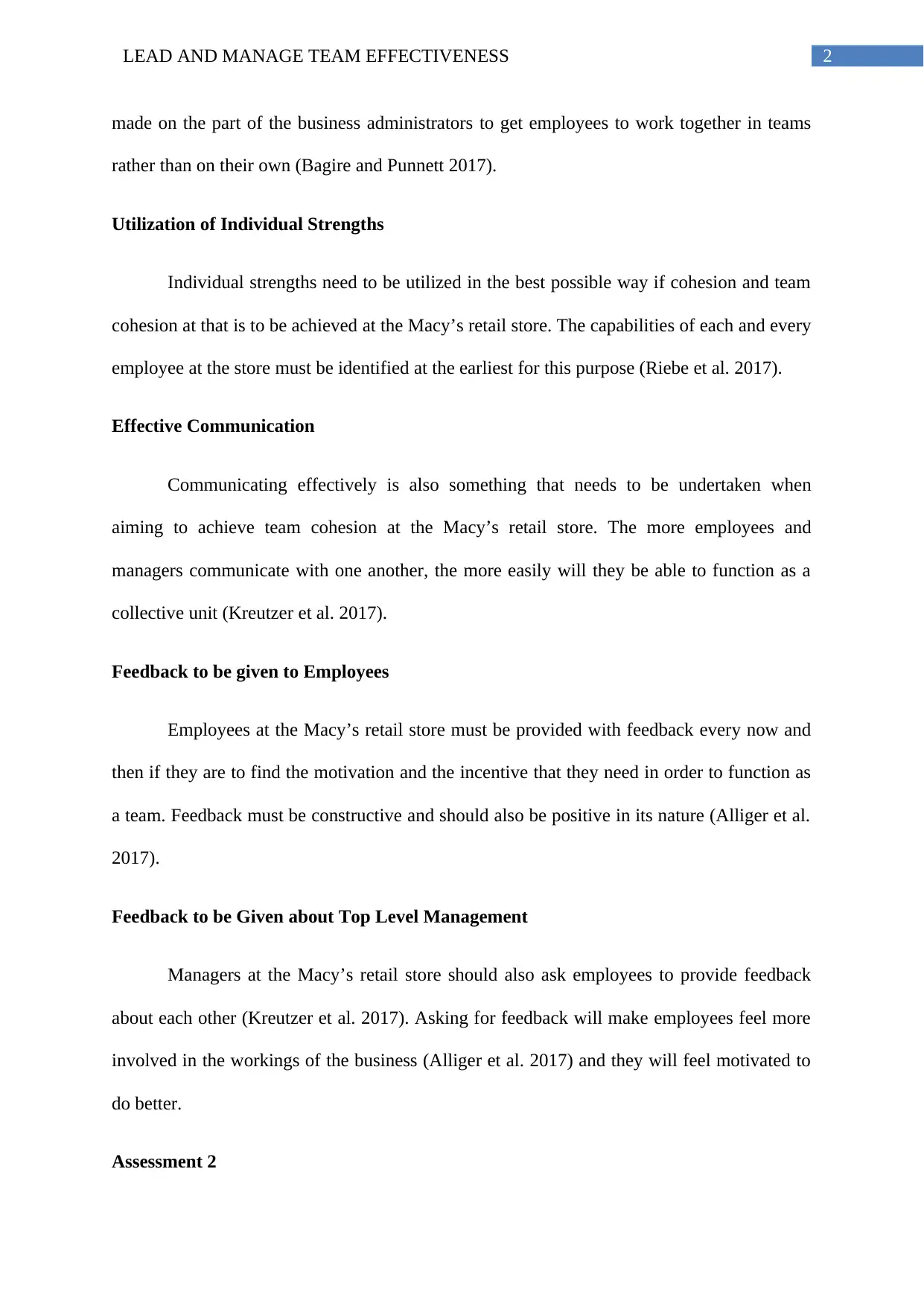
made on the part of the business administrators to get employees to work together in teams
rather than on their own (Bagire and Punnett 2017).
Utilization of Individual Strengths
Individual strengths need to be utilized in the best possible way if cohesion and team
cohesion at that is to be achieved at the Macy’s retail store. The capabilities of each and every
employee at the store must be identified at the earliest for this purpose (Riebe et al. 2017).
Effective Communication
Communicating effectively is also something that needs to be undertaken when
aiming to achieve team cohesion at the Macy’s retail store. The more employees and
managers communicate with one another, the more easily will they be able to function as a
collective unit (Kreutzer et al. 2017).
Feedback to be given to Employees
Employees at the Macy’s retail store must be provided with feedback every now and
then if they are to find the motivation and the incentive that they need in order to function as
a team. Feedback must be constructive and should also be positive in its nature (Alliger et al.
2017).
Feedback to be Given about Top Level Management
Managers at the Macy’s retail store should also ask employees to provide feedback
about each other (Kreutzer et al. 2017). Asking for feedback will make employees feel more
involved in the workings of the business (Alliger et al. 2017) and they will feel motivated to
do better.
Assessment 2
made on the part of the business administrators to get employees to work together in teams
rather than on their own (Bagire and Punnett 2017).
Utilization of Individual Strengths
Individual strengths need to be utilized in the best possible way if cohesion and team
cohesion at that is to be achieved at the Macy’s retail store. The capabilities of each and every
employee at the store must be identified at the earliest for this purpose (Riebe et al. 2017).
Effective Communication
Communicating effectively is also something that needs to be undertaken when
aiming to achieve team cohesion at the Macy’s retail store. The more employees and
managers communicate with one another, the more easily will they be able to function as a
collective unit (Kreutzer et al. 2017).
Feedback to be given to Employees
Employees at the Macy’s retail store must be provided with feedback every now and
then if they are to find the motivation and the incentive that they need in order to function as
a team. Feedback must be constructive and should also be positive in its nature (Alliger et al.
2017).
Feedback to be Given about Top Level Management
Managers at the Macy’s retail store should also ask employees to provide feedback
about each other (Kreutzer et al. 2017). Asking for feedback will make employees feel more
involved in the workings of the business (Alliger et al. 2017) and they will feel motivated to
do better.
Assessment 2
⊘ This is a preview!⊘
Do you want full access?
Subscribe today to unlock all pages.

Trusted by 1+ million students worldwide
3LEAD AND MANAGE TEAM EFFECTIVENESS
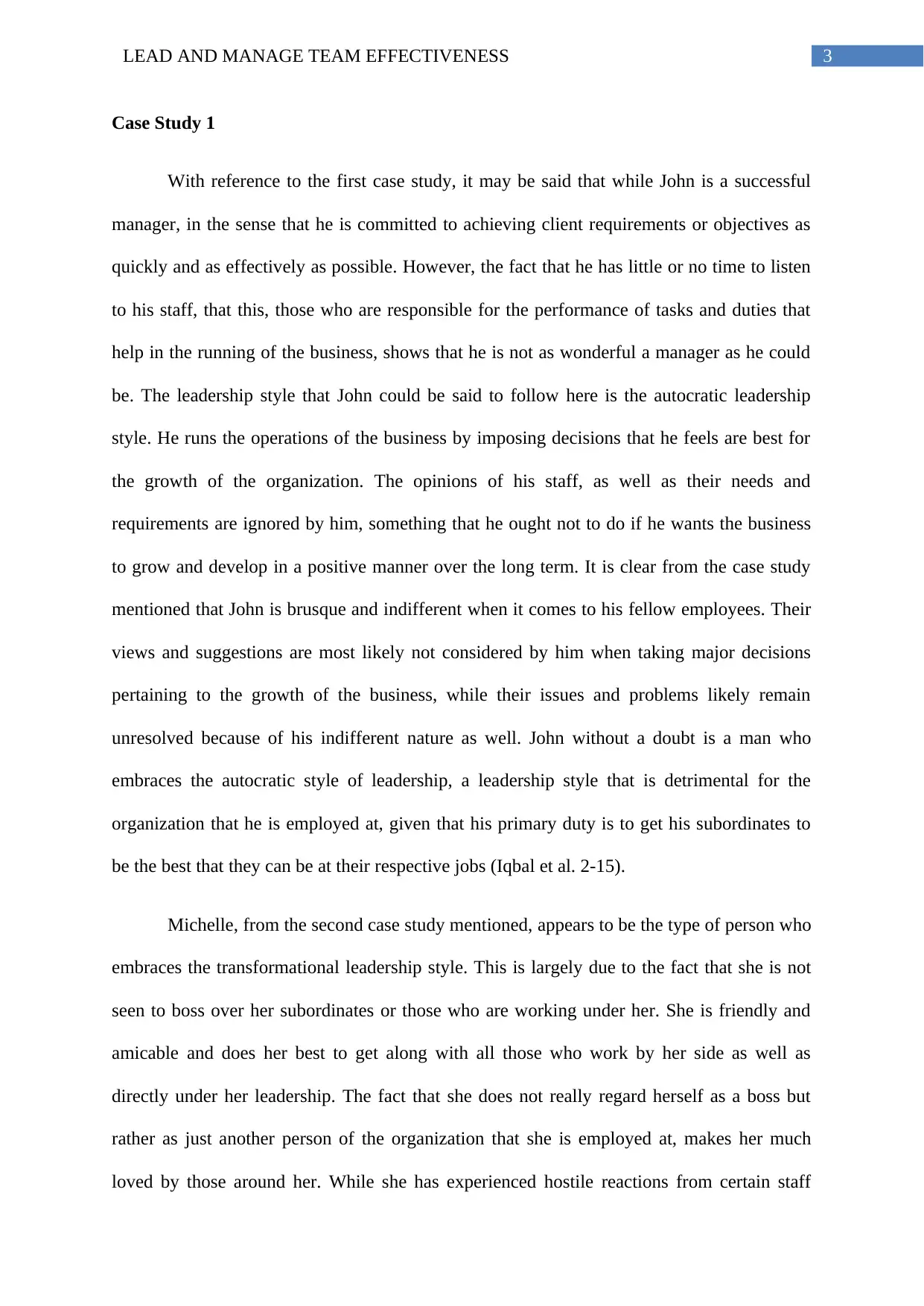
Case Study 1
With reference to the first case study, it may be said that while John is a successful
manager, in the sense that he is committed to achieving client requirements or objectives as
quickly and as effectively as possible. However, the fact that he has little or no time to listen
to his staff, that this, those who are responsible for the performance of tasks and duties that
help in the running of the business, shows that he is not as wonderful a manager as he could
be. The leadership style that John could be said to follow here is the autocratic leadership
style. He runs the operations of the business by imposing decisions that he feels are best for
the growth of the organization. The opinions of his staff, as well as their needs and
requirements are ignored by him, something that he ought not to do if he wants the business
to grow and develop in a positive manner over the long term. It is clear from the case study
mentioned that John is brusque and indifferent when it comes to his fellow employees. Their
views and suggestions are most likely not considered by him when taking major decisions
pertaining to the growth of the business, while their issues and problems likely remain
unresolved because of his indifferent nature as well. John without a doubt is a man who
embraces the autocratic style of leadership, a leadership style that is detrimental for the
organization that he is employed at, given that his primary duty is to get his subordinates to
be the best that they can be at their respective jobs (Iqbal et al. 2-15).
Michelle, from the second case study mentioned, appears to be the type of person who
embraces the transformational leadership style. This is largely due to the fact that she is not
seen to boss over her subordinates or those who are working under her. She is friendly and
amicable and does her best to get along with all those who work by her side as well as
directly under her leadership. The fact that she does not really regard herself as a boss but
rather as just another person of the organization that she is employed at, makes her much
loved by those around her. While she has experienced hostile reactions from certain staff
Case Study 1
With reference to the first case study, it may be said that while John is a successful
manager, in the sense that he is committed to achieving client requirements or objectives as
quickly and as effectively as possible. However, the fact that he has little or no time to listen
to his staff, that this, those who are responsible for the performance of tasks and duties that
help in the running of the business, shows that he is not as wonderful a manager as he could
be. The leadership style that John could be said to follow here is the autocratic leadership
style. He runs the operations of the business by imposing decisions that he feels are best for
the growth of the organization. The opinions of his staff, as well as their needs and
requirements are ignored by him, something that he ought not to do if he wants the business
to grow and develop in a positive manner over the long term. It is clear from the case study
mentioned that John is brusque and indifferent when it comes to his fellow employees. Their
views and suggestions are most likely not considered by him when taking major decisions
pertaining to the growth of the business, while their issues and problems likely remain
unresolved because of his indifferent nature as well. John without a doubt is a man who
embraces the autocratic style of leadership, a leadership style that is detrimental for the
organization that he is employed at, given that his primary duty is to get his subordinates to
be the best that they can be at their respective jobs (Iqbal et al. 2-15).
Michelle, from the second case study mentioned, appears to be the type of person who
embraces the transformational leadership style. This is largely due to the fact that she is not
seen to boss over her subordinates or those who are working under her. She is friendly and
amicable and does her best to get along with all those who work by her side as well as
directly under her leadership. The fact that she does not really regard herself as a boss but
rather as just another person of the organization that she is employed at, makes her much
loved by those around her. While she has experienced hostile reactions from certain staff
Paraphrase This Document
Need a fresh take? Get an instant paraphrase of this document with our AI Paraphraser
4LEAD AND MANAGE TEAM EFFECTIVENESS
members of late, her subordinates, by and large like and accept her leadership. Michelle it can
be said, follows the transformational leadership style as she takes the views and opinions of
other staff members into account when making or taking any decision on behalf of the
organization. Employee perceptions and thoughts and even suggestions regarding the
outcome of the business are always considered by her. She is able to motivate her peers and
her subordinates to work collectively in order to achieve the goals and objectives of the
organization, something that is quite characteristic of the transformational leadership style.
Transformational leaders also have a long term vision of the organization and seldom focus
on short term goals. This enables Michelle to view herself as a member of the organization
rather than as a boss. She intends on helping the organization to grow and prosper rather than
boss over her subordinates and make them less motivated to do the work that they do
(Goleman 2017).
With regard to the third case study, when it comes to Maria, it can be said that the
leadership style that she follows is one that is a combination of both autocratic leadership and
transformational leadership. It is autocratic in the sense that Maria is a hard task master and is
often seen to make her fellow employees and subordinates work very hard for little or no
extra pay (Sudha et al. 2016). This is not fair at all, given that workers have the right to extra
pay if they work beyond their shift timings. Yet the fact that Maria is greatly concerned about
the wellbeing of each and every person who is working under her leadership and that she has
given them the option to reach out to her as and when they need to goes to show that she
reflects elements of the transformational style of leadership in the manner that she governs
the organization as well. Maria gives her employees the right to reach out to her with their
queries and concerns as and when they need to by simply knocking on her door in their free
time (Alonso-Almeida et al. 2017).
Assessment 3
members of late, her subordinates, by and large like and accept her leadership. Michelle it can
be said, follows the transformational leadership style as she takes the views and opinions of
other staff members into account when making or taking any decision on behalf of the
organization. Employee perceptions and thoughts and even suggestions regarding the
outcome of the business are always considered by her. She is able to motivate her peers and
her subordinates to work collectively in order to achieve the goals and objectives of the
organization, something that is quite characteristic of the transformational leadership style.
Transformational leaders also have a long term vision of the organization and seldom focus
on short term goals. This enables Michelle to view herself as a member of the organization
rather than as a boss. She intends on helping the organization to grow and prosper rather than
boss over her subordinates and make them less motivated to do the work that they do
(Goleman 2017).
With regard to the third case study, when it comes to Maria, it can be said that the
leadership style that she follows is one that is a combination of both autocratic leadership and
transformational leadership. It is autocratic in the sense that Maria is a hard task master and is
often seen to make her fellow employees and subordinates work very hard for little or no
extra pay (Sudha et al. 2016). This is not fair at all, given that workers have the right to extra
pay if they work beyond their shift timings. Yet the fact that Maria is greatly concerned about
the wellbeing of each and every person who is working under her leadership and that she has
given them the option to reach out to her as and when they need to goes to show that she
reflects elements of the transformational style of leadership in the manner that she governs
the organization as well. Maria gives her employees the right to reach out to her with their
queries and concerns as and when they need to by simply knocking on her door in their free
time (Alonso-Almeida et al. 2017).
Assessment 3
5LEAD AND MANAGE TEAM EFFECTIVENESS
1. What Sean should say in his memo to the employees is to reiterate his commitment to
the business goals and objectives of the organization that intends on making him
Department Manager, while re-affirming his commitment to looking into the
wellbeing of the employees at the same time, given that both are crucial for the proper
running of the business.
2. By writing his memo, the results that Sean is likely to achieve is to win the confidence
and the support of his employees. Given that Sean is a hard worker, his employees
will likely want him to be in a leadership position anyway, and the fact that he
mentions in his memo that is committed to both the business as well as the wellbeing
of employees will certainly go down well with those are going to work under his
supervision.
3. The strengths that Sean is seen to possess in his new supervisory role is the fact that
he is willing to work hard and that too without extra pay to achieve the goals and
objectives of the organization. The latter can also be regarded as a weakness. Since he
himself is willing to forego extra pay to perform additional responsibilities for the
business, he is likely to encourage his subordinates to do the same. The fact that Sea is
innovative and skilled will serve as a major strength to him at his place of work. His
dedication to the job coupled with his ability to do the job well, will make him an
excellent manager. However, he needs to understand that if an organization is to grow
and prosper over the long term, it needs to look into the wellbeing of its employees.
Additional work or chores must be paid for by the company, and this is a truth that
Sean needs to accept, else it is likely to go against him completely at the workplace.
4. Given that Sean is skilled and innovative in nature, he might be able to design duties
and responsibilities for subordinates that get them to feel positively about the work
that they do and about the business in general. However, his attitude to extra work for
1. What Sean should say in his memo to the employees is to reiterate his commitment to
the business goals and objectives of the organization that intends on making him
Department Manager, while re-affirming his commitment to looking into the
wellbeing of the employees at the same time, given that both are crucial for the proper
running of the business.
2. By writing his memo, the results that Sean is likely to achieve is to win the confidence
and the support of his employees. Given that Sean is a hard worker, his employees
will likely want him to be in a leadership position anyway, and the fact that he
mentions in his memo that is committed to both the business as well as the wellbeing
of employees will certainly go down well with those are going to work under his
supervision.
3. The strengths that Sean is seen to possess in his new supervisory role is the fact that
he is willing to work hard and that too without extra pay to achieve the goals and
objectives of the organization. The latter can also be regarded as a weakness. Since he
himself is willing to forego extra pay to perform additional responsibilities for the
business, he is likely to encourage his subordinates to do the same. The fact that Sea is
innovative and skilled will serve as a major strength to him at his place of work. His
dedication to the job coupled with his ability to do the job well, will make him an
excellent manager. However, he needs to understand that if an organization is to grow
and prosper over the long term, it needs to look into the wellbeing of its employees.
Additional work or chores must be paid for by the company, and this is a truth that
Sean needs to accept, else it is likely to go against him completely at the workplace.
4. Given that Sean is skilled and innovative in nature, he might be able to design duties
and responsibilities for subordinates that get them to feel positively about the work
that they do and about the business in general. However, his attitude to extra work for
⊘ This is a preview!⊘
Do you want full access?
Subscribe today to unlock all pages.
Trusted by 1+ million students worldwide
6LEAD AND MANAGE TEAM EFFECTIVENESS
no pay will not go down well with his juniors. They may feel the company is
exploiting them while he on the other hand may be of the view that they should also
work selflessly to achieve the business goals of the company. As a result, this is
something that is likely to generate a lot of conflict between Sean and his subordinates
at some point of time or the other, leading some of his subordinates to resign from the
job, something that will leave a terrible mark on his reputation.
5. It is likely that Sean will have a lot of power as a supervisor. This is because of the
fact that Sean is wholly committed to working hard and working selfless to meet the
business goals of the organization. Hence the proprietors of the business are likely to
have full faith in him and his abilities and will give him all the power and the
authority that he needs to take the company in forward direction. It is important to
remember that Sean has the skills and the abilities and the innovative mind that is
needed to bring in good business. He is also willing to work for the company for long
hours at a stretch, without demanding that the company pay him an overtime fee for
this purpose. The company owners will invest a lot of power in him, as they will hope
that he will be able to convince his subordinates to work as hard as he does, getting
the company in the bargain to get a lot of work done for profit without having to make
any additional investment for the same. Sean will most certainly be given
considerable power as a Departmental Manager, given his readiness and willingness
to oblige the company owners and look into the business requirements in selfless
fashion. The management will firmly believe that giving him power is the right thing
to do as he will be wholly committed to the interests of the organization and will
function in a way that those who are working under him are either motivated or feel
compelled to do the same. He may even become autocratic as a result.
no pay will not go down well with his juniors. They may feel the company is
exploiting them while he on the other hand may be of the view that they should also
work selflessly to achieve the business goals of the company. As a result, this is
something that is likely to generate a lot of conflict between Sean and his subordinates
at some point of time or the other, leading some of his subordinates to resign from the
job, something that will leave a terrible mark on his reputation.
5. It is likely that Sean will have a lot of power as a supervisor. This is because of the
fact that Sean is wholly committed to working hard and working selfless to meet the
business goals of the organization. Hence the proprietors of the business are likely to
have full faith in him and his abilities and will give him all the power and the
authority that he needs to take the company in forward direction. It is important to
remember that Sean has the skills and the abilities and the innovative mind that is
needed to bring in good business. He is also willing to work for the company for long
hours at a stretch, without demanding that the company pay him an overtime fee for
this purpose. The company owners will invest a lot of power in him, as they will hope
that he will be able to convince his subordinates to work as hard as he does, getting
the company in the bargain to get a lot of work done for profit without having to make
any additional investment for the same. Sean will most certainly be given
considerable power as a Departmental Manager, given his readiness and willingness
to oblige the company owners and look into the business requirements in selfless
fashion. The management will firmly believe that giving him power is the right thing
to do as he will be wholly committed to the interests of the organization and will
function in a way that those who are working under him are either motivated or feel
compelled to do the same. He may even become autocratic as a result.
Paraphrase This Document
Need a fresh take? Get an instant paraphrase of this document with our AI Paraphraser
7LEAD AND MANAGE TEAM EFFECTIVENESS
References
Alliger, G.M., Cerasoli, C.P., Tannenbaum, S.I. and Vessey, W.B., 2015. Team
resilience. Organizational Dynamics, 44(3), pp.176-184.
Alonso‐Almeida, M.D.M., Perramon, J. and Bagur‐Femenias, L., 2017. Leadership styles and
corporate social responsibility management: Analysis from a gender perspective. Business
Ethics: A European Review, 26(2), pp.147-161.
Bagire, V. and Punnett, B.J., 2017. The team process: Insights from the LEAD
experience. AIB Insights, 17(1), p.7
Boyd, B., Henning, N., Reyna, E., Wang, D., Welch, M. and Hoffman, A.J., 2017. Hybrid
organizations: New business models for environmental leadership. Routledge
Chen, M.H., Chang, Y.Y. and Chang, Y.C., 2017. The trinity of entrepreneurial team
dynamics: cognition, conflicts and cohesion. International Journal of Entrepreneurial
Behavior & Research, 23(6), pp.934-951.
Goleman, D., 2017. Leadership that gets results (Harvard business review classics). Harvard
Business Press.
Iqbal, N., Anwar, S. and Haider, N., 2015. Effect of leadership style on employee
performance. Arabian Journal of Business and Management Review, 5(5), pp.1-6.
Kreutzer, R.T., Neugebauer, T. and Pattloch, A., 2017. Digital business leadership.
In Digitale Transformation-Geschäftsmodell-Innovation-Agile Organisation-Change
Management, 1. Auflage. Springer Gabler
Ren, S., Wood, R. and Zhu, Y., 2015. Business leadership development in China. Routledge.
References
Alliger, G.M., Cerasoli, C.P., Tannenbaum, S.I. and Vessey, W.B., 2015. Team
resilience. Organizational Dynamics, 44(3), pp.176-184.
Alonso‐Almeida, M.D.M., Perramon, J. and Bagur‐Femenias, L., 2017. Leadership styles and
corporate social responsibility management: Analysis from a gender perspective. Business
Ethics: A European Review, 26(2), pp.147-161.
Bagire, V. and Punnett, B.J., 2017. The team process: Insights from the LEAD
experience. AIB Insights, 17(1), p.7
Boyd, B., Henning, N., Reyna, E., Wang, D., Welch, M. and Hoffman, A.J., 2017. Hybrid
organizations: New business models for environmental leadership. Routledge
Chen, M.H., Chang, Y.Y. and Chang, Y.C., 2017. The trinity of entrepreneurial team
dynamics: cognition, conflicts and cohesion. International Journal of Entrepreneurial
Behavior & Research, 23(6), pp.934-951.
Goleman, D., 2017. Leadership that gets results (Harvard business review classics). Harvard
Business Press.
Iqbal, N., Anwar, S. and Haider, N., 2015. Effect of leadership style on employee
performance. Arabian Journal of Business and Management Review, 5(5), pp.1-6.
Kreutzer, R.T., Neugebauer, T. and Pattloch, A., 2017. Digital business leadership.
In Digitale Transformation-Geschäftsmodell-Innovation-Agile Organisation-Change
Management, 1. Auflage. Springer Gabler
Ren, S., Wood, R. and Zhu, Y., 2015. Business leadership development in China. Routledge.
8LEAD AND MANAGE TEAM EFFECTIVENESS
Riebe, L., Girardi, A. and Whitsed, C., 2017. Teaching teamwork in Australian university
business disciplines: Evidence from a systematic literature review. Issues in Educational
Research, 27(1), p.134.
Rosenbach, W.E., 2018. Contemporary issues in leadership. Routledge
Steinhouse, R., 2017. Mindful business leadership. Routledge
Sudha, K.S., Shahnawaz, M.G. and Farhat, A., 2016. Leadership styles, leader’s effectiveness
and well-being: Exploring collective efficacy as a mediator. Vision, 20(2), pp.111-120
Visser, W., 2017. Sustainable frontiers: Unlocking change through business, leadership and
innovation. Routledge.
Vogel, D.J., 2017. Haas research on leadership: an introduction. California Management
Review, 60(1), pp.5-7.
Riebe, L., Girardi, A. and Whitsed, C., 2017. Teaching teamwork in Australian university
business disciplines: Evidence from a systematic literature review. Issues in Educational
Research, 27(1), p.134.
Rosenbach, W.E., 2018. Contemporary issues in leadership. Routledge
Steinhouse, R., 2017. Mindful business leadership. Routledge
Sudha, K.S., Shahnawaz, M.G. and Farhat, A., 2016. Leadership styles, leader’s effectiveness
and well-being: Exploring collective efficacy as a mediator. Vision, 20(2), pp.111-120
Visser, W., 2017. Sustainable frontiers: Unlocking change through business, leadership and
innovation. Routledge.
Vogel, D.J., 2017. Haas research on leadership: an introduction. California Management
Review, 60(1), pp.5-7.
⊘ This is a preview!⊘
Do you want full access?
Subscribe today to unlock all pages.
Trusted by 1+ million students worldwide

1 out of 9


Related Documents

![Analysis of Strategies for Building Effective Teams - [Module Name]](/_next/image/?url=https%3A%2F%2Fdesklib.com%2Fmedia%2Fimages%2Fjk%2F70a24cedef7f46c8af8c6ce542c83c8c.jpg&w=256&q=75)


Your All-in-One AI-Powered Toolkit for Academic Success.
+13062052269
info@desklib.com
Available 24*7 on WhatsApp / Email
![[object Object]](/_next/static/media/star-bottom.7253800d.svg)
Unlock your academic potential
Copyright © 2020–2026 A2Z Services. All Rights Reserved. Developed and managed by ZUCOL.