Analysing Leader Behaviours in Change Management During Transition
VerifiedAdded on 2023/04/21
|18
|6972
|122
Literature Review
AI Summary
This literature review delves into the crucial role of leader behaviors in managing organizational change. It explores the overall concepts of leadership and change management, highlighting the significance of leadership in driving successful transitions. The review examines various leadership styles and strategies employed during change periods, including participative and autocratic approaches, and their impact on employee satisfaction and organizational effectiveness. It also discusses the positive and negative impacts of change on businesses, such as increased competitiveness, innovation, and employee stress. Ultimately, the review emphasizes the importance of adapting to changing market conditions and customer demands through effective change management and leadership.
ANALYSING LEADER BEHAVIOURS IN THE MANAGEMENT OF
CHANGE DURING THE CHANGE PERIOD
CHANGE DURING THE CHANGE PERIOD

Paraphrase This Document
Need a fresh take? Get an instant paraphrase of this document with our AI Paraphraser
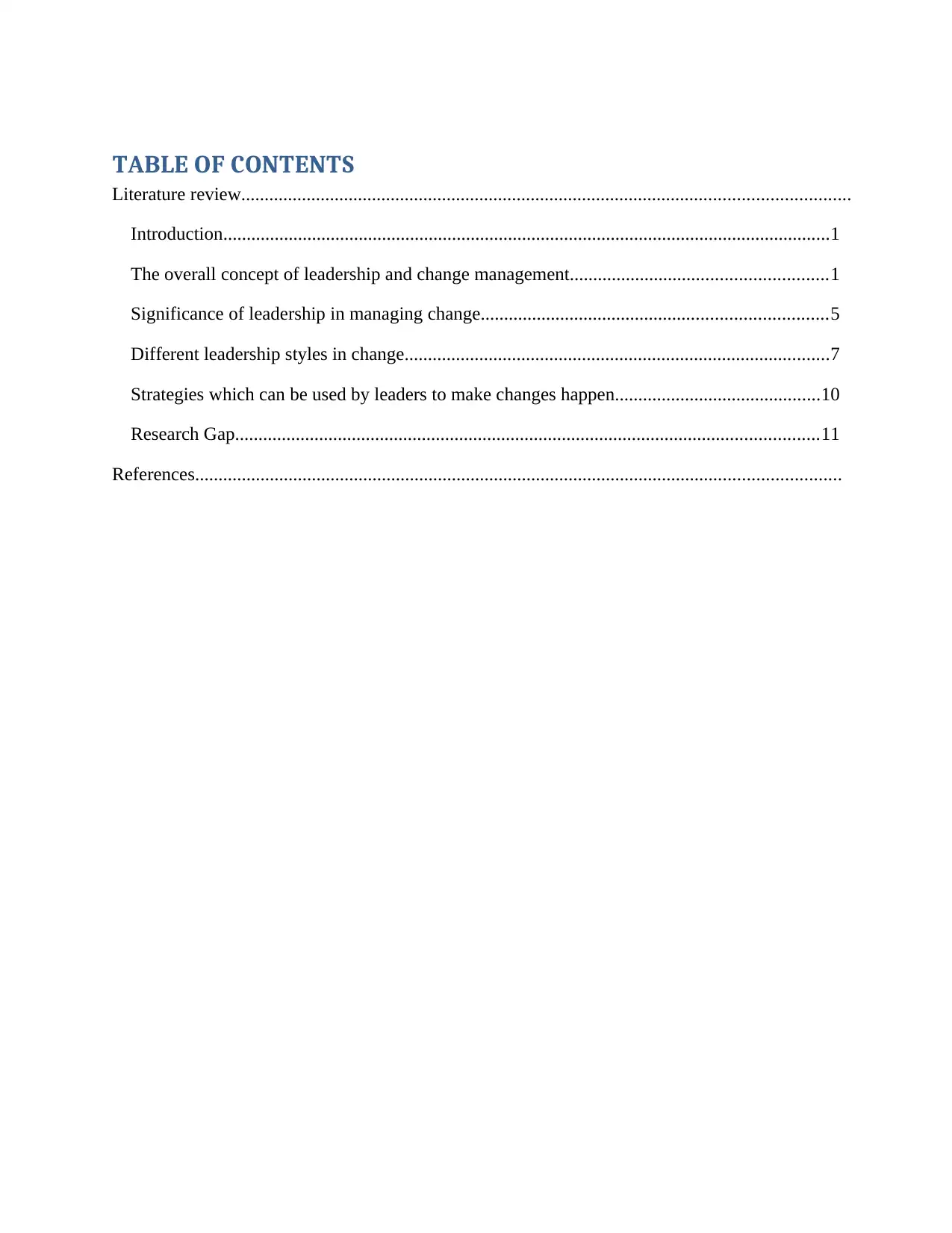
TABLE OF CONTENTS
Literature review..................................................................................................................................
Introduction..................................................................................................................................1
The overall concept of leadership and change management.......................................................1
Significance of leadership in managing change..........................................................................5
Different leadership styles in change...........................................................................................7
Strategies which can be used by leaders to make changes happen............................................10
Research Gap.............................................................................................................................11
References..........................................................................................................................................
Literature review..................................................................................................................................
Introduction..................................................................................................................................1
The overall concept of leadership and change management.......................................................1
Significance of leadership in managing change..........................................................................5
Different leadership styles in change...........................................................................................7
Strategies which can be used by leaders to make changes happen............................................10
Research Gap.............................................................................................................................11
References..........................................................................................................................................
LITERATURE REVIEW
Introduction
Literature review is one of the important section of research as it helps the investigator to
develop suitable theoretical base on the selected topic so that he/she can make in-depth analysis
of related aspects and enhance their knowledge in terms of generating best possible outcomes.
Herein, the main focus of researcher is to indulge studies and researches made by different
authors and scholars on the related topics so on the basis of which secondary analysis can be
carried out. In the present study, investigator aims at analysing leader behaviours in the
management of change during the change period. However, different aspects has been
considered to carry out the literature review as it focuses on change management, leadership
styles, its effectiveness and importance in bringing change within the organisation.
The overall concept of leadership and change management
In the present era, leadership has become very important for the growth and success of an
organization. In simpler terms, it is defined as the process of leading and directing efforts of
people within a company towards accomplishment of their objective and goals. In addition to
this, good and strong leadership also play very crucial role in getting competitive advantage over
other market players. According to Williams and Turnbull, (2015) leaders are termed as one of
the most valuable human resources in the business enterprise (Williams and Turnbull, 2015).
Nowadays businesses have started focusing more and more on establishment of appropriate
leadership which can contribute a lot in the growth of companies. Leadership is important for
management because it helps in development of better and effective personnels which can further
support in developing satisfactory products to all customers The most important characteristic of
leadership is that it is an interpersonal process which supports leaders in guiding and influencing
efforts of employees towards accomplishment of common goals and objectives. On the other side
of this, Zaccaro, (2007) has explained that leadership is important for businesses because it
directly influences the behaviour of people within an organization (Zaccaro, 2007). Management
can be termed as the process of getting various activities and things done by people. Therefore,
good and effective leaders are required to encourage employees in accomplishment of their task.
As per the view of, Hackman and Wageman, (2007) the significance of leadership can be
understood by the fact that it initiates actions within a business enterprise (Hackman and
Wageman, 2007). The top management performs the function of formulating strategic plans and
1
Introduction
Literature review is one of the important section of research as it helps the investigator to
develop suitable theoretical base on the selected topic so that he/she can make in-depth analysis
of related aspects and enhance their knowledge in terms of generating best possible outcomes.
Herein, the main focus of researcher is to indulge studies and researches made by different
authors and scholars on the related topics so on the basis of which secondary analysis can be
carried out. In the present study, investigator aims at analysing leader behaviours in the
management of change during the change period. However, different aspects has been
considered to carry out the literature review as it focuses on change management, leadership
styles, its effectiveness and importance in bringing change within the organisation.
The overall concept of leadership and change management
In the present era, leadership has become very important for the growth and success of an
organization. In simpler terms, it is defined as the process of leading and directing efforts of
people within a company towards accomplishment of their objective and goals. In addition to
this, good and strong leadership also play very crucial role in getting competitive advantage over
other market players. According to Williams and Turnbull, (2015) leaders are termed as one of
the most valuable human resources in the business enterprise (Williams and Turnbull, 2015).
Nowadays businesses have started focusing more and more on establishment of appropriate
leadership which can contribute a lot in the growth of companies. Leadership is important for
management because it helps in development of better and effective personnels which can further
support in developing satisfactory products to all customers The most important characteristic of
leadership is that it is an interpersonal process which supports leaders in guiding and influencing
efforts of employees towards accomplishment of common goals and objectives. On the other side
of this, Zaccaro, (2007) has explained that leadership is important for businesses because it
directly influences the behaviour of people within an organization (Zaccaro, 2007). Management
can be termed as the process of getting various activities and things done by people. Therefore,
good and effective leaders are required to encourage employees in accomplishment of their task.
As per the view of, Hackman and Wageman, (2007) the significance of leadership can be
understood by the fact that it initiates actions within a business enterprise (Hackman and
Wageman, 2007). The top management performs the function of formulating strategic plans and
1
⊘ This is a preview!⊘
Do you want full access?
Subscribe today to unlock all pages.

Trusted by 1+ million students worldwide
strategies further, it can be stated that leaders are the one which communicates those strategies to
employee at lower and middle level. Another importance of leadership is that it helps in
enhancing motivational level of all staff members (Kilburg and Donohue, 2014). There are
various kinds of monetary and non-monetary rewards which are provided by leaders to employee
against their outstanding performance. This creates a sense of satisfaction among workers and
also encourages them to deliver better performance in the future. However, MacKie, (2014) has
argued that leadership is not an easy task and leaders are required to deal with various challenges
(MacKie, 2014). Effective leaders are the one which are able to understand and meet the needs of
their respective team members. It can be stated that addressing and recognition of each team
members needs is very complicated. On the other hand, there are different styles of leadership
which are available in front of leaders. Selection of appropriate and most suitable style is a
difficult task for all leaders (Nowack and Mashihi, 2012). In the present scenario, the rate of
employee turnover relies on leader and leadership style to a great extent. Styles such as
participative creates sense of satisfaction among workers and also encourages them to stay
within organizations for long period. On other side, the use of autocratic leadership style can
results in creating dissatisfaction within people in organizations (Kaiser and Overfield, 2011).
This is due to the fact that employee are not involved in the decision making process. Therefore,
it can be expressed that leadership is not an easy but its right use can provide organizations with
several kinds of benefits.
As per the view point of, Perkins, (2009) change management can be termed as the
process of implementing changes and getting positive outcomes from the same. In the present
scenario changes at regular intervals has become vital for companies. Nowadays, need and
demand of people in market changes very drastically (Perkins, 2009). Therefore, it is required by
businesses to make modification in their existing products and services in order to meet
customers demand. This helps in creating sense of satisfaction among customers and also
encourages long term loyalty for them. The reason why changes have become essential for
companies is that it makes them capable of satisfying the dynamic needs of customers. On the
other hand, Kombarakaran and et.al., (2008) has asserted that nowadays changes at regular
intervals has become necessity for organizations. Further, modification in strategies, products
and operations results in making business competent and sustain in the marketplace
(Kombarakaran and et.al., 2008).
2
employee at lower and middle level. Another importance of leadership is that it helps in
enhancing motivational level of all staff members (Kilburg and Donohue, 2014). There are
various kinds of monetary and non-monetary rewards which are provided by leaders to employee
against their outstanding performance. This creates a sense of satisfaction among workers and
also encourages them to deliver better performance in the future. However, MacKie, (2014) has
argued that leadership is not an easy task and leaders are required to deal with various challenges
(MacKie, 2014). Effective leaders are the one which are able to understand and meet the needs of
their respective team members. It can be stated that addressing and recognition of each team
members needs is very complicated. On the other hand, there are different styles of leadership
which are available in front of leaders. Selection of appropriate and most suitable style is a
difficult task for all leaders (Nowack and Mashihi, 2012). In the present scenario, the rate of
employee turnover relies on leader and leadership style to a great extent. Styles such as
participative creates sense of satisfaction among workers and also encourages them to stay
within organizations for long period. On other side, the use of autocratic leadership style can
results in creating dissatisfaction within people in organizations (Kaiser and Overfield, 2011).
This is due to the fact that employee are not involved in the decision making process. Therefore,
it can be expressed that leadership is not an easy but its right use can provide organizations with
several kinds of benefits.
As per the view point of, Perkins, (2009) change management can be termed as the
process of implementing changes and getting positive outcomes from the same. In the present
scenario changes at regular intervals has become vital for companies. Nowadays, need and
demand of people in market changes very drastically (Perkins, 2009). Therefore, it is required by
businesses to make modification in their existing products and services in order to meet
customers demand. This helps in creating sense of satisfaction among customers and also
encourages long term loyalty for them. The reason why changes have become essential for
companies is that it makes them capable of satisfying the dynamic needs of customers. On the
other hand, Kombarakaran and et.al., (2008) has asserted that nowadays changes at regular
intervals has become necessity for organizations. Further, modification in strategies, products
and operations results in making business competent and sustain in the marketplace
(Kombarakaran and et.al., 2008).
2
Paraphrase This Document
Need a fresh take? Get an instant paraphrase of this document with our AI Paraphraser
Changes in technology helps organizations to deliver better and more satisfactory
products to their customers. It can be also stated that frequent changes results in enhancing
activities of businesses and smooth flow of all operations. Firms which adapt the latest
technology are able to lower down their cost of production which is very beneficial for long term
success of a business enterprise (Wasylyshyn, Gronsky and Haas, 2006). According to, Hallinger
and Chen, (2015) changes are not restricted to a particular field of technology but are also
important in other aspects of management (Hallinger and Chen, 2015). Changes can be done in
culture, structure, funding modes, strategies, products, services etc. The other areas where
business can make respective changes includes employees, customer base, suppliers etc. It can be
stated that existing employee can be provided with new roles and responsibilities which they
need to accomplish. In addition to this, organizations can also make modification in their
customer base by targeting customers in new market and new segment (Harman, 2011). Firms
can also change their suppliers and can seek for new ones. On the other side of this, it can be
expressed that businesses cannot sustain in long run by offering same kind of services and
products to customers (Jaiswal and Bhal, 2014). They are required to make sure that
modifications in products are carried out at regular intervals as per the changing customer
demand. This results in maintaining interest of customers and make them more loyal towards a
particular brand, service or product.
On the other side of this, Fuller, B. and et.al., (2015) has argued that management and
successful implementation of changes is one of the most complex task for businesses (Fuller and
et.al., 2015). Organizations encounters a variety of issues and challenges at the time of making
changes happen. This includes determining changes to be made, selective appropriate changes
management tools, encouraging efforts of employee and making the changes happen. Therefore,
it can be expressed that in order to sustain in long run and earn adequate profits, organizations
needs to make changes in different areas at frequent intervals. Furthermore, appropriate use of
change management model, tools and strategies is also very important in order to make changes
happen and obtain desired results.
Impact of effective change on businesses
As per the view of, Simmonds and Tsui, (2010) management of activities of a business
enterprise a very complicated task for organizations but implementation and management of
change is more difficult one (Simmonds and Tsui, 2010). Huge amount of resources such as
3
products to their customers. It can be also stated that frequent changes results in enhancing
activities of businesses and smooth flow of all operations. Firms which adapt the latest
technology are able to lower down their cost of production which is very beneficial for long term
success of a business enterprise (Wasylyshyn, Gronsky and Haas, 2006). According to, Hallinger
and Chen, (2015) changes are not restricted to a particular field of technology but are also
important in other aspects of management (Hallinger and Chen, 2015). Changes can be done in
culture, structure, funding modes, strategies, products, services etc. The other areas where
business can make respective changes includes employees, customer base, suppliers etc. It can be
stated that existing employee can be provided with new roles and responsibilities which they
need to accomplish. In addition to this, organizations can also make modification in their
customer base by targeting customers in new market and new segment (Harman, 2011). Firms
can also change their suppliers and can seek for new ones. On the other side of this, it can be
expressed that businesses cannot sustain in long run by offering same kind of services and
products to customers (Jaiswal and Bhal, 2014). They are required to make sure that
modifications in products are carried out at regular intervals as per the changing customer
demand. This results in maintaining interest of customers and make them more loyal towards a
particular brand, service or product.
On the other side of this, Fuller, B. and et.al., (2015) has argued that management and
successful implementation of changes is one of the most complex task for businesses (Fuller and
et.al., 2015). Organizations encounters a variety of issues and challenges at the time of making
changes happen. This includes determining changes to be made, selective appropriate changes
management tools, encouraging efforts of employee and making the changes happen. Therefore,
it can be expressed that in order to sustain in long run and earn adequate profits, organizations
needs to make changes in different areas at frequent intervals. Furthermore, appropriate use of
change management model, tools and strategies is also very important in order to make changes
happen and obtain desired results.
Impact of effective change on businesses
As per the view of, Simmonds and Tsui, (2010) management of activities of a business
enterprise a very complicated task for organizations but implementation and management of
change is more difficult one (Simmonds and Tsui, 2010). Huge amount of resources such as
3
human, financial and technological are invested by companies to make changes happen and
therefore positive impacts are being expected by the same. Furthermore, it can be stated that it is
not necessary that changes always provide positive results and they can result in impacting
business in negative sense (Kets De Vries and et.al., 2010). Resistance to change from some
employee can make entire process of change as a complete failure. In terms of negative impact, it
can be stated that changes may lower down the morale and motivational level of all workers. It is
not necessary that each and every employee easily cope up with changes. Employees morale gets
lower down when other workers cope with changes and they are not (Kim, 2014). They become
more optimistic in nature and starts perceiving the fact that they do not have any kind of long
term future with their respective organization. Further, such kind of situation also results in
lowering down the overall productivity and effectiveness of employee Boekhorst, (2015) has
expressed that changes can results in disruptive working environment which is its another major
negative impact (Boekhorst, 2015).
Employees needs to understand the needs and benefits of changes in order to adapt
changes and become more competent. There are several reasons because of which organizations
may be required to make different type of changes. This includes changes in market conditions,
competitor strategies etc. According to the view point of Levasseur, (2009) organizational
changes at frequent intervals directly results in increasing the mental stress of employee
(Levasseur, 2009). It can be stated that changes which are broad in nature affect the overall stress
level of workers to a great extent. In addition to this, as it has been already discussed that
changes sometimes leads to cutting down the salaries and wages of employee. This results in
sense of dissatisfaction among people in the business enterprise. Cutting down of wages is
generally done to meet the cost which is incurred in making changes happen in organizations.
According to the view of De Poel, Stoker and Van der Zee, (2012) there are several kinds
of positive impact which changes can have on companies. One of the major among those is that
it helps businesses to stay competitive in marketplace (De Poel, Stoker and Van der Zee, 2012). It
helps in delivering products and services according to the market trends and taste of customers.
In addition to this, changes also supports in making products and services capable of giving
tough competition to all the major players in the industry. Another positive impact which
changes offer is that it provides companies with new opportunities in terms of growth and
development. Changes at regular intervals make the workers aware about new technological
4
therefore positive impacts are being expected by the same. Furthermore, it can be stated that it is
not necessary that changes always provide positive results and they can result in impacting
business in negative sense (Kets De Vries and et.al., 2010). Resistance to change from some
employee can make entire process of change as a complete failure. In terms of negative impact, it
can be stated that changes may lower down the morale and motivational level of all workers. It is
not necessary that each and every employee easily cope up with changes. Employees morale gets
lower down when other workers cope with changes and they are not (Kim, 2014). They become
more optimistic in nature and starts perceiving the fact that they do not have any kind of long
term future with their respective organization. Further, such kind of situation also results in
lowering down the overall productivity and effectiveness of employee Boekhorst, (2015) has
expressed that changes can results in disruptive working environment which is its another major
negative impact (Boekhorst, 2015).
Employees needs to understand the needs and benefits of changes in order to adapt
changes and become more competent. There are several reasons because of which organizations
may be required to make different type of changes. This includes changes in market conditions,
competitor strategies etc. According to the view point of Levasseur, (2009) organizational
changes at frequent intervals directly results in increasing the mental stress of employee
(Levasseur, 2009). It can be stated that changes which are broad in nature affect the overall stress
level of workers to a great extent. In addition to this, as it has been already discussed that
changes sometimes leads to cutting down the salaries and wages of employee. This results in
sense of dissatisfaction among people in the business enterprise. Cutting down of wages is
generally done to meet the cost which is incurred in making changes happen in organizations.
According to the view of De Poel, Stoker and Van der Zee, (2012) there are several kinds
of positive impact which changes can have on companies. One of the major among those is that
it helps businesses to stay competitive in marketplace (De Poel, Stoker and Van der Zee, 2012). It
helps in delivering products and services according to the market trends and taste of customers.
In addition to this, changes also supports in making products and services capable of giving
tough competition to all the major players in the industry. Another positive impact which
changes offer is that it provides companies with new opportunities in terms of growth and
development. Changes at regular intervals make the workers aware about new technological
4
⊘ This is a preview!⊘
Do you want full access?
Subscribe today to unlock all pages.
Trusted by 1+ million students worldwide
tools and techniques in market (Fuller and et.al., 2015). In situations of changes, workers may
help others which are not able to cope up with changes. This results in making them more
responsibilities and provide them with new opportunities in terms of employment.
According to, Harman, (2011) changes also encourages innovations within a business
organization. It results in enhancing organizations capabilities to delivering products and services
which are innovative. This not only helps in getting high degree of customer satisfaction but also
provides competitive advantage to business. Those companies which implement and manage
changes successfully are the one which are able to deliver products and services which are not
offered by any other market players. Nowadays the competition among business has become so
intense that it is not easy for them to achieve higher sales and profitability. Furthermore,
customers are now available with wide variety of options available with them in order to satisfy
their needs and demands. It is almost impossible to sustain and increase market share by
delivering same kind of products and services to customers for long period.
Changes supports in innovative products and services which differ from other market
players. This assists businesses in attracting more and more customers and enhances their overall
market share. On the other hand Hallinger and Chen, (2015) has explained that the positive
impact of change is that it improves efficiency and productivity of workers (Hallinger and Chen,
2015). The rate of customer satisfaction can be increased with the help of employee which are
highlight skilled and efficient. It can be stated that changes at regular interval leads to
improvement in overall Kombarakaran and et.al., 2008 productivity of people in the
organization. Changes in technologies, strategies and operations can results in making employee
aware about new tools and techniques to carry out their respective work in the best possible
manner. Therefore, by carrying out changes workers become more capable of doing their work
and achieving higher degree of customer satisfaction. Other than this, it can be also expressed
that changes can have positive implications on mental level and attitude of people. Modifications
at regular intervals creates a better workplace, which enhances motivational level of workers.
Significance of leadership in managing change
According to the study of Muratbekova-Touron (2009), change management has become
essential areas for the companies to embrace. However, there are several companies irrespective
to their sectors are facing the disruption from new social forces due which they are forced to
undergo constant change for maintain their level of business in accordance with demand
5
help others which are not able to cope up with changes. This results in making them more
responsibilities and provide them with new opportunities in terms of employment.
According to, Harman, (2011) changes also encourages innovations within a business
organization. It results in enhancing organizations capabilities to delivering products and services
which are innovative. This not only helps in getting high degree of customer satisfaction but also
provides competitive advantage to business. Those companies which implement and manage
changes successfully are the one which are able to deliver products and services which are not
offered by any other market players. Nowadays the competition among business has become so
intense that it is not easy for them to achieve higher sales and profitability. Furthermore,
customers are now available with wide variety of options available with them in order to satisfy
their needs and demands. It is almost impossible to sustain and increase market share by
delivering same kind of products and services to customers for long period.
Changes supports in innovative products and services which differ from other market
players. This assists businesses in attracting more and more customers and enhances their overall
market share. On the other hand Hallinger and Chen, (2015) has explained that the positive
impact of change is that it improves efficiency and productivity of workers (Hallinger and Chen,
2015). The rate of customer satisfaction can be increased with the help of employee which are
highlight skilled and efficient. It can be stated that changes at regular interval leads to
improvement in overall Kombarakaran and et.al., 2008 productivity of people in the
organization. Changes in technologies, strategies and operations can results in making employee
aware about new tools and techniques to carry out their respective work in the best possible
manner. Therefore, by carrying out changes workers become more capable of doing their work
and achieving higher degree of customer satisfaction. Other than this, it can be also expressed
that changes can have positive implications on mental level and attitude of people. Modifications
at regular intervals creates a better workplace, which enhances motivational level of workers.
Significance of leadership in managing change
According to the study of Muratbekova-Touron (2009), change management has become
essential areas for the companies to embrace. However, there are several companies irrespective
to their sectors are facing the disruption from new social forces due which they are forced to
undergo constant change for maintain their level of business in accordance with demand
5
Paraphrase This Document
Need a fresh take? Get an instant paraphrase of this document with our AI Paraphraser
(Muratbekova-Touron, 2009). From the above it has been assessed that, leaders play crucial role
in bringing change within the company as it is their duty to ensure each and every department or
area is being modified as per the needs and wants of market so that demand or expectations from
customers can be met adequately. Arguing to this Stoker and et.al, (2001) states that, bring
change is necessary but in context to leaders it is one of the biggest challenge as they are
responsible for developing suitable and reliable strategies to manager the change process along
with this, they also need to engage the staff members throughout the process for implementing
change effectively. In this regard, researcher portray the significance of leadership in managing
change (Stoker and et.al, 2001).
According to Shin and et.al, (2015), different manager uses different leadership styles to
lead people and make them work accordingly to generate desired result. Therefore, there
approach towards bringing change also differs as they focus on different ways to lead people
according to situation, workforce capability and resources available. Supporting to this Griffin,
Parker and Mason (2010) states that, leadership before, during and after change implementation
is the key to getting through swamp. However, it is because of the fact that, workforce during the
change period look towards the leaders for a number of things. In this regard study of Zohar and
Tenne-Gazit (2008), employee during the drastic change times expect effective and sensible
planning, confident and effective decision making and regular and complete communication
which is efficient. All these aspects can be fulfilled if leader or manager have undertaken suitable
and reliable leadership style for the situation (Griffin, Parker and Mason, 2010). Following
appropriate style will help the course of individual to plan effectively within the tough periods as
well as assist in making adequate use of workers to carry out the tasks in reliable manner.
Apart from this research made by Furst and Cable (2008) inculcate that, during the time
of change workforce perceive leadership as supportive, concerned and committed to their
welfare so that smart decisions can be made. Leaders involving employees in decision making
process by encouraging their views and thoughts on situation as they are the one who are in
contact with the condition directly and understand the need of change more adequately (Furst
and Cable, 2008). During this significance of leadership is taken into account when manager lead
people by taking them along which motivates them to work more effectively and implement
alterations in the best possible way.
6
in bringing change within the company as it is their duty to ensure each and every department or
area is being modified as per the needs and wants of market so that demand or expectations from
customers can be met adequately. Arguing to this Stoker and et.al, (2001) states that, bring
change is necessary but in context to leaders it is one of the biggest challenge as they are
responsible for developing suitable and reliable strategies to manager the change process along
with this, they also need to engage the staff members throughout the process for implementing
change effectively. In this regard, researcher portray the significance of leadership in managing
change (Stoker and et.al, 2001).
According to Shin and et.al, (2015), different manager uses different leadership styles to
lead people and make them work accordingly to generate desired result. Therefore, there
approach towards bringing change also differs as they focus on different ways to lead people
according to situation, workforce capability and resources available. Supporting to this Griffin,
Parker and Mason (2010) states that, leadership before, during and after change implementation
is the key to getting through swamp. However, it is because of the fact that, workforce during the
change period look towards the leaders for a number of things. In this regard study of Zohar and
Tenne-Gazit (2008), employee during the drastic change times expect effective and sensible
planning, confident and effective decision making and regular and complete communication
which is efficient. All these aspects can be fulfilled if leader or manager have undertaken suitable
and reliable leadership style for the situation (Griffin, Parker and Mason, 2010). Following
appropriate style will help the course of individual to plan effectively within the tough periods as
well as assist in making adequate use of workers to carry out the tasks in reliable manner.
Apart from this research made by Furst and Cable (2008) inculcate that, during the time
of change workforce perceive leadership as supportive, concerned and committed to their
welfare so that smart decisions can be made. Leaders involving employees in decision making
process by encouraging their views and thoughts on situation as they are the one who are in
contact with the condition directly and understand the need of change more adequately (Furst
and Cable, 2008). During this significance of leadership is taken into account when manager lead
people by taking them along which motivates them to work more effectively and implement
alterations in the best possible way.
6
In the article of Higgs and Rowland, (2010) researcher identified that, important element
for a success change in any organisation is leadership where leaders are the role model
personalities in any community. In theoretical prospects there are several leadership system
explained by different theorists and every style has its own impact on the change management. In
this context, transformational leadership focuses on organisational development whereas servant
leadership concern about the development of followers (Higgs and Rowland, 2010). Supporting
to this Mehta, Maheshwari and Sharma (2014) states that, the best leaderships approach for
change management is transformational leadership model because it encourages leaders to work
with employees to identify the required change and accordingly creating vision to guide the
change through inspiration and commitment.
Furthermore, from the book of Houmanfar and et.al, (2015) understood that, without
strong leadership effective organisation change won’t be possible. Managing change effectively
requires leader that can lead a team which have courage to drive the change properly in an
existing system. As change is considered as transformation process thus, agents of change are
leaders and management. Pearce and Herbik (2004) states that, considering the nature of
competition that businesses are facing in their respective industry, change management is the
core competency for the management in 21st Century. Further author illustrates that, leadership
style and employees trust in top level management are highly positively related to behaviour
involved in bringing innovation for maintaining the position of firm in constantly changing
environment as well as meeting the expectations of customers (Houmanfar and et.al, 2015). In
this context, research from the article of Lawler (2012) identified that, only charismatic leader
that has specialized quality to mobilize and sustain activity within an organisation through
specific personal actions combined with perceived personal characteristics. In addition to this,
even after implementing the change duty of leader does not end as alteration is considered as the
constant and once can easily anticipate (Lawler, 2012). Contradicting of this Bangari (2014)
states that, in term of business it is important for the mangers or leaders to build to change and
select management approach through which they are focusing on implementing both expected
and unexpected changes.
Therefore, on the basis of above study it can be said that, leadership play vital role in
managing change as leaders are reliable to bring innovation within the firm in appropriate way
7
for a success change in any organisation is leadership where leaders are the role model
personalities in any community. In theoretical prospects there are several leadership system
explained by different theorists and every style has its own impact on the change management. In
this context, transformational leadership focuses on organisational development whereas servant
leadership concern about the development of followers (Higgs and Rowland, 2010). Supporting
to this Mehta, Maheshwari and Sharma (2014) states that, the best leaderships approach for
change management is transformational leadership model because it encourages leaders to work
with employees to identify the required change and accordingly creating vision to guide the
change through inspiration and commitment.
Furthermore, from the book of Houmanfar and et.al, (2015) understood that, without
strong leadership effective organisation change won’t be possible. Managing change effectively
requires leader that can lead a team which have courage to drive the change properly in an
existing system. As change is considered as transformation process thus, agents of change are
leaders and management. Pearce and Herbik (2004) states that, considering the nature of
competition that businesses are facing in their respective industry, change management is the
core competency for the management in 21st Century. Further author illustrates that, leadership
style and employees trust in top level management are highly positively related to behaviour
involved in bringing innovation for maintaining the position of firm in constantly changing
environment as well as meeting the expectations of customers (Houmanfar and et.al, 2015). In
this context, research from the article of Lawler (2012) identified that, only charismatic leader
that has specialized quality to mobilize and sustain activity within an organisation through
specific personal actions combined with perceived personal characteristics. In addition to this,
even after implementing the change duty of leader does not end as alteration is considered as the
constant and once can easily anticipate (Lawler, 2012). Contradicting of this Bangari (2014)
states that, in term of business it is important for the mangers or leaders to build to change and
select management approach through which they are focusing on implementing both expected
and unexpected changes.
Therefore, on the basis of above study it can be said that, leadership play vital role in
managing change as leaders are reliable to bring innovation within the firm in appropriate way
7
⊘ This is a preview!⊘
Do you want full access?
Subscribe today to unlock all pages.
Trusted by 1+ million students worldwide
for dealing within the constantly fluctuating market conditions and maintain the position of
business within the market for long period.
Different leadership behaviour in change
According to Zohar and Tenne-Gazit (2008), there are different leadership styles that
exist in the work environment. However, each behaviour has its own advantages and
disadvantages but it leaders mainly adopts the behaviour on the basis of organisation culture and
goals. Furthermore, every organisation experience change in regards to its size, geography or
industry. Supporting to this fact Stoker and et.al, (2001) states that, in fact change is inevitable
and desirable aspect of business life. In order to maintain the position of firm in competitive
corporate environment, managers or leaders have to undertake effective leadership behaviours as
to ensure better execution of change and accomplishment of activities (Bangari, 2014).
In this regard, Griffin, Parker and Mason (2010) defined different leadership styles that
an individual can use for carrying out operations or bring change within the organisation. It is
because of the fact that, suitable leadership behaviour assist leader in providing direction,
implementing plan and motivating people for attaining the goals and objectives. Following are
the leadership’s styles that can be employed to bring change effectively:
Autocratic:
Higgs and Rowland (2010) states that, autocratic leadership behaviour assist the
managers to make decisions alone without the input of others. Herein, leaders possess full
authority regarding execution of operations as well as command over the employees. According
to Lewin’s experiment, this leadership behaviour possess dissatisfaction to different level.
Supporting to this Houmanfar and et.al, (2015) illustrates that, autocratic leadership behaviourist
used when there is no need of any input of consultancy on the decision. Arguing to this
Muratbekova-Touron (2009) states that, this type of leadership behaviour is not as effective in
bringing or managing change because commanding authority may negatively affect the
motivation level of employees which is one of the biggest asset that leader have in term of
implementing change. Contradicting to this Furst and Cable (2008) present that, at the time of
quick change or making instant decisions, autocratic leadership behaviour is one of the effective
approach because it provide authority to leader to make decision on his own which indeed leads
to save the time and quick decisions can be made.
Democratic:
8
business within the market for long period.
Different leadership behaviour in change
According to Zohar and Tenne-Gazit (2008), there are different leadership styles that
exist in the work environment. However, each behaviour has its own advantages and
disadvantages but it leaders mainly adopts the behaviour on the basis of organisation culture and
goals. Furthermore, every organisation experience change in regards to its size, geography or
industry. Supporting to this fact Stoker and et.al, (2001) states that, in fact change is inevitable
and desirable aspect of business life. In order to maintain the position of firm in competitive
corporate environment, managers or leaders have to undertake effective leadership behaviours as
to ensure better execution of change and accomplishment of activities (Bangari, 2014).
In this regard, Griffin, Parker and Mason (2010) defined different leadership styles that
an individual can use for carrying out operations or bring change within the organisation. It is
because of the fact that, suitable leadership behaviour assist leader in providing direction,
implementing plan and motivating people for attaining the goals and objectives. Following are
the leadership’s styles that can be employed to bring change effectively:
Autocratic:
Higgs and Rowland (2010) states that, autocratic leadership behaviour assist the
managers to make decisions alone without the input of others. Herein, leaders possess full
authority regarding execution of operations as well as command over the employees. According
to Lewin’s experiment, this leadership behaviour possess dissatisfaction to different level.
Supporting to this Houmanfar and et.al, (2015) illustrates that, autocratic leadership behaviourist
used when there is no need of any input of consultancy on the decision. Arguing to this
Muratbekova-Touron (2009) states that, this type of leadership behaviour is not as effective in
bringing or managing change because commanding authority may negatively affect the
motivation level of employees which is one of the biggest asset that leader have in term of
implementing change. Contradicting to this Furst and Cable (2008) present that, at the time of
quick change or making instant decisions, autocratic leadership behaviour is one of the effective
approach because it provide authority to leader to make decision on his own which indeed leads
to save the time and quick decisions can be made.
Democratic:
8
Paraphrase This Document
Need a fresh take? Get an instant paraphrase of this document with our AI Paraphraser
Democratic leadership behaviour is also known as participative approach in which leader
given great values to the inputs of team members or peers, but responsibility of making the final
decisions rests with the leader. Lawler (2012) states that, in several context democratic
leadership behaviour is considered as the best approach of managing or leading people because it
given them platform to share their views and thoughts that ultimately influence the decision of
leader. By the means of this leadership style, motivation level of employees is enhanced to great
extent as they are contributing in decision making process which indeed causes them to feel like
their opinions or views are considered or matter. In terms of making change within organisation,
participative leadership behaviour assist the course of employees to accept the changes easily
because they are involved in the process from the first stage (Bangari, 2014). Contradicting to
this Mehta Maheshwari and Sharma (2014) states that, looking at the present condition of
corporate market where constant change is needed by the organisations irrespective to their
sector thus, participative leadership approach is challenged in such situation as it is incapable of
making decision in a short span of period.
Laissez-Faire:
Pearce and Herbik (2004) illustrates that, under this leadership behaviour all the authority
and decision making power is given to worker. However, it provide complete freedom to the
followers to make decisions concerning the completion of work. Laissez-faire promotes the self-
rule while at the same time offering guidance and support when required. This type of leadership
behaviour is highly effective in retail store as employees are the one who directly interacts with
the customers thus, solving their problem at the same point of time requires authority. Therefore,
with use of this leadership style, store manager allows the workers to deal with customer on their
own and whenever there is major issue of concern, they are also welcome by the store manager
with effective and smart solutions. Contradicting to this Griffin, Parker and Mason (2010), in
terms of change such leadership behaviour is not at all effective and it is because of the fact that,
bringing change is the decision of management as they forecast market and conditions in which
company operates therefore, leaders and peers have more knowledge about what is right and
wrong. Henceforth giving authority to employees while bringing change is not smart decision as
it may leads to ineffective and poor results for the firm (Griffin, Parker and Mason, 2010).
Transformational:
9
given great values to the inputs of team members or peers, but responsibility of making the final
decisions rests with the leader. Lawler (2012) states that, in several context democratic
leadership behaviour is considered as the best approach of managing or leading people because it
given them platform to share their views and thoughts that ultimately influence the decision of
leader. By the means of this leadership style, motivation level of employees is enhanced to great
extent as they are contributing in decision making process which indeed causes them to feel like
their opinions or views are considered or matter. In terms of making change within organisation,
participative leadership behaviour assist the course of employees to accept the changes easily
because they are involved in the process from the first stage (Bangari, 2014). Contradicting to
this Mehta Maheshwari and Sharma (2014) states that, looking at the present condition of
corporate market where constant change is needed by the organisations irrespective to their
sector thus, participative leadership approach is challenged in such situation as it is incapable of
making decision in a short span of period.
Laissez-Faire:
Pearce and Herbik (2004) illustrates that, under this leadership behaviour all the authority
and decision making power is given to worker. However, it provide complete freedom to the
followers to make decisions concerning the completion of work. Laissez-faire promotes the self-
rule while at the same time offering guidance and support when required. This type of leadership
behaviour is highly effective in retail store as employees are the one who directly interacts with
the customers thus, solving their problem at the same point of time requires authority. Therefore,
with use of this leadership style, store manager allows the workers to deal with customer on their
own and whenever there is major issue of concern, they are also welcome by the store manager
with effective and smart solutions. Contradicting to this Griffin, Parker and Mason (2010), in
terms of change such leadership behaviour is not at all effective and it is because of the fact that,
bringing change is the decision of management as they forecast market and conditions in which
company operates therefore, leaders and peers have more knowledge about what is right and
wrong. Henceforth giving authority to employees while bringing change is not smart decision as
it may leads to ineffective and poor results for the firm (Griffin, Parker and Mason, 2010).
Transformational:
9
The transformational leadership styles depends on the high level of communication from
the management to attain the defined targets and objectives. In the study of Stoker and et.al,
(2001) researcher illustrates that, leaders motivates employees and enhance the productivity and
efficiency through effective communication and high visibility. Furthermore, this leadership
behaviour requires the involvement of management to meet the goals. In the study of Griffin,
Parker and Mason, (2010) investigator evaluates that, in terms of change management
transformational leadership behaviour is one of the best approach. Further, author defines the
rationale behind success of change management is transformational leadership model because it
encourages leaders to work with employees to identify the required change and accordingly
creating vision to guide the change through inspiration and commitment. In term of bringing
innovation within the firm, managers concentrates on big picture and delegate smaller tasks or
operations to the team member so that they can carry out the work in the best possible manner
(Griffin, Parker and Mason, 2010). Arguing on this Zohar and Tenne-Gazit, (2008) states that,
this can be a time consuming approach as in case of emergency this leadership behaviour may
possess hindrance or obstacles which may affects the course of decision making or bringing
change smoothly.
These are some of the leadership styles which can be used in bringing change but is the
duty of manager to make sure that they assess situation and conditions before selecting any
approach so that risks and issues associated with the styles can be avoided.
Leadership behaviour during change
There are several researchers who identified that leadership behaviours specifically
related to change are likely to be different from those of traditional leadership and not be stable
over time or across the entire change situation. In this regard Higgs (2009), identify that there are
three types of leader behaviour associated specifically with change i.e. shaping behaviour,
framing change and creating capacity. However, in this shaping behaviour consist of leader
communication and actions that are directly associated with the change. While on the other hand
author defines framing change behaviour consist of establishing journey and communicating
guiding principles. Further, creating capacity behaviours includes development of individual and
organisational capabilities and interacting and creating connections.
Highly relying on the traditional leadership, several researcher indirectly assumes that
leader’s behaviour are relatively stable or constant in different situations of change. But there are
10
the management to attain the defined targets and objectives. In the study of Stoker and et.al,
(2001) researcher illustrates that, leaders motivates employees and enhance the productivity and
efficiency through effective communication and high visibility. Furthermore, this leadership
behaviour requires the involvement of management to meet the goals. In the study of Griffin,
Parker and Mason, (2010) investigator evaluates that, in terms of change management
transformational leadership behaviour is one of the best approach. Further, author defines the
rationale behind success of change management is transformational leadership model because it
encourages leaders to work with employees to identify the required change and accordingly
creating vision to guide the change through inspiration and commitment. In term of bringing
innovation within the firm, managers concentrates on big picture and delegate smaller tasks or
operations to the team member so that they can carry out the work in the best possible manner
(Griffin, Parker and Mason, 2010). Arguing on this Zohar and Tenne-Gazit, (2008) states that,
this can be a time consuming approach as in case of emergency this leadership behaviour may
possess hindrance or obstacles which may affects the course of decision making or bringing
change smoothly.
These are some of the leadership styles which can be used in bringing change but is the
duty of manager to make sure that they assess situation and conditions before selecting any
approach so that risks and issues associated with the styles can be avoided.
Leadership behaviour during change
There are several researchers who identified that leadership behaviours specifically
related to change are likely to be different from those of traditional leadership and not be stable
over time or across the entire change situation. In this regard Higgs (2009), identify that there are
three types of leader behaviour associated specifically with change i.e. shaping behaviour,
framing change and creating capacity. However, in this shaping behaviour consist of leader
communication and actions that are directly associated with the change. While on the other hand
author defines framing change behaviour consist of establishing journey and communicating
guiding principles. Further, creating capacity behaviours includes development of individual and
organisational capabilities and interacting and creating connections.
Highly relying on the traditional leadership, several researcher indirectly assumes that
leader’s behaviour are relatively stable or constant in different situations of change. But there are
10
⊘ This is a preview!⊘
Do you want full access?
Subscribe today to unlock all pages.
Trusted by 1+ million students worldwide

1 out of 18


Related Documents


Your All-in-One AI-Powered Toolkit for Academic Success.
+13062052269
info@desklib.com
Available 24*7 on WhatsApp / Email
![[object Object]](/_next/static/media/star-bottom.7253800d.svg)
Unlock your academic potential
Copyright © 2020–2026 A2Z Services. All Rights Reserved. Developed and managed by ZUCOL.