BTEC Unit 4 Report: Roles and Functions of Leaders and Managers
VerifiedAdded on 2023/03/24
|6
|1692
|73
Report
AI Summary
This report, prepared for the CEO of Rays of Sunshine by the Human Resource Manager, meticulously contrasts the roles and functions of leaders and managers. It begins with an executive summary outlining the report's objective: to differentiate leadership and management roles, focusing on the practical application of relevant theories to enhance human relations within the organization. The introduction distinguishes between managers, who assign tasks, and leaders, who inspire and guide. The report then details the characteristics of both managers and leaders, highlighting key attributes such as positive attitudes, self-motivation, and calmness for managers, and honesty, communication, and commitment for leaders. A comparative analysis underscores the differences, such as managers solving problems and implementing strategies, while leaders focus on empowering people and fostering long-term vision. The report examines management theories like Taylor's scientific management, Fayol's administrative theory, and Mayo's human relations theory, alongside leadership theories including Adair's action-centered theory, transformational, and transactional leadership. The application section explores the functions of managers and leaders in various situations. Finally, the report applies situational, contingency, and system theories to Rays of Sunshine, concluding with recommendations for improved leadership and management practices.
Task 1
Report on the roles and functions of leaders and managers in Rays of Sunshine.
To: CEO
From: Human Resource Manager
Date: 21.11.2017
Subject: A comparison between roles and functions of leaders and managers by effective
application of a range of theories and concepts.
Executive Summary
The aim of the report is to make the individual task on the basis of the differentiation of roles
and functions of a leader and a manager with the context of the penalised form of the theories
and its usages that makes the effective application of the concepts of human relations. In this
context, it can be stated that the report would focus on the different leadership roles in order
to identify proper leadership style of a company. Therefore, this could be taken as the
expectation or goal of the research. In addition to that, it is also to be cited that the leaders
focuses on the human resource of a company and therefore effective leadership could
enhance the efficiency of the employees in that organisation.
1.0 Introduction
The report can be analysis on the basis of the gap of difference between a Leader and a
Manager. In case of manager, he has his own people to work whereas, leaders have people to
follow them. But Leadership and Management must go hand in hand to manage the entity and
to grow the entity over a period of time. Workers need managers to assign tasks (Johnston
and Marshall, 2016).
Who is a manager: A manager is a person who manages or is in charge of something.
Managers can control departments in companies, or guide the people who work for them and
must often make decisions about things.
Who is a Leader: A leader is a person or thing that holds a dominant or superior position
within its field, and is able to exercise a high degree of control or influence over others.
Report on the roles and functions of leaders and managers in Rays of Sunshine.
To: CEO
From: Human Resource Manager
Date: 21.11.2017
Subject: A comparison between roles and functions of leaders and managers by effective
application of a range of theories and concepts.
Executive Summary
The aim of the report is to make the individual task on the basis of the differentiation of roles
and functions of a leader and a manager with the context of the penalised form of the theories
and its usages that makes the effective application of the concepts of human relations. In this
context, it can be stated that the report would focus on the different leadership roles in order
to identify proper leadership style of a company. Therefore, this could be taken as the
expectation or goal of the research. In addition to that, it is also to be cited that the leaders
focuses on the human resource of a company and therefore effective leadership could
enhance the efficiency of the employees in that organisation.
1.0 Introduction
The report can be analysis on the basis of the gap of difference between a Leader and a
Manager. In case of manager, he has his own people to work whereas, leaders have people to
follow them. But Leadership and Management must go hand in hand to manage the entity and
to grow the entity over a period of time. Workers need managers to assign tasks (Johnston
and Marshall, 2016).
Who is a manager: A manager is a person who manages or is in charge of something.
Managers can control departments in companies, or guide the people who work for them and
must often make decisions about things.
Who is a Leader: A leader is a person or thing that holds a dominant or superior position
within its field, and is able to exercise a high degree of control or influence over others.
Paraphrase This Document
Need a fresh take? Get an instant paraphrase of this document with our AI Paraphraser

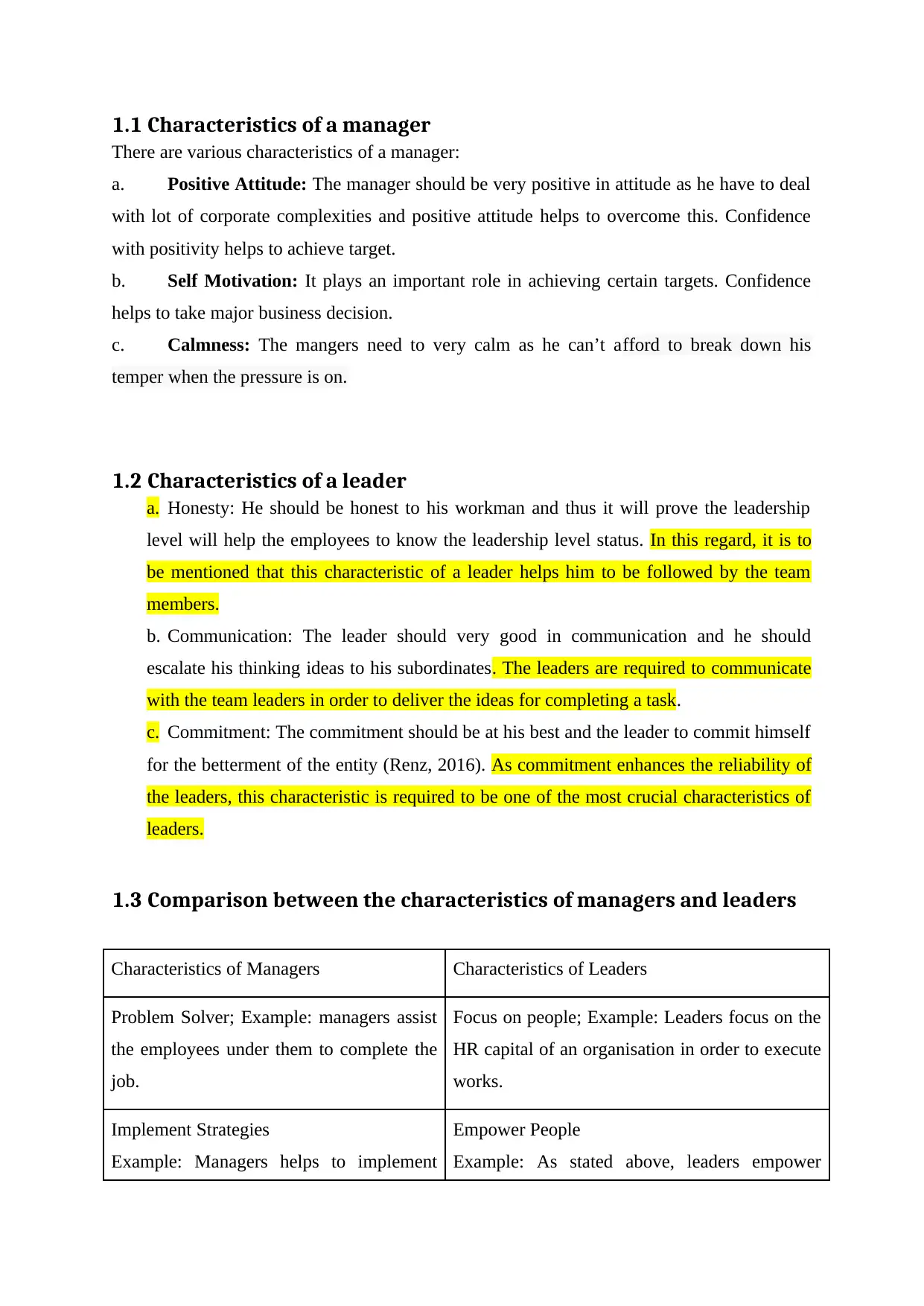
1.1 Characteristics of a manager
There are various characteristics of a manager:
a. Positive Attitude: The manager should be very positive in attitude as he have to deal
with lot of corporate complexities and positive attitude helps to overcome this. Confidence
with positivity helps to achieve target.
b. Self Motivation: It plays an important role in achieving certain targets. Confidence
helps to take major business decision.
c. Calmness: The mangers need to very calm as he can’t afford to break down his
temper when the pressure is on.
1.2 Characteristics of a leader
a. Honesty: He should be honest to his workman and thus it will prove the leadership
level will help the employees to know the leadership level status. In this regard, it is to
be mentioned that this characteristic of a leader helps him to be followed by the team
members.
b. Communication: The leader should very good in communication and he should
escalate his thinking ideas to his subordinates. The leaders are required to communicate
with the team leaders in order to deliver the ideas for completing a task.
c. Commitment: The commitment should be at his best and the leader to commit himself
for the betterment of the entity (Renz, 2016). As commitment enhances the reliability of
the leaders, this characteristic is required to be one of the most crucial characteristics of
leaders.
1.3 Comparison between the characteristics of managers and leaders
Characteristics of Managers Characteristics of Leaders
Problem Solver; Example: managers assist
the employees under them to complete the
job.
Focus on people; Example: Leaders focus on the
HR capital of an organisation in order to execute
works.
Implement Strategies
Example: Managers helps to implement
Empower People
Example: As stated above, leaders empower
There are various characteristics of a manager:
a. Positive Attitude: The manager should be very positive in attitude as he have to deal
with lot of corporate complexities and positive attitude helps to overcome this. Confidence
with positivity helps to achieve target.
b. Self Motivation: It plays an important role in achieving certain targets. Confidence
helps to take major business decision.
c. Calmness: The mangers need to very calm as he can’t afford to break down his
temper when the pressure is on.
1.2 Characteristics of a leader
a. Honesty: He should be honest to his workman and thus it will prove the leadership
level will help the employees to know the leadership level status. In this regard, it is to
be mentioned that this characteristic of a leader helps him to be followed by the team
members.
b. Communication: The leader should very good in communication and he should
escalate his thinking ideas to his subordinates. The leaders are required to communicate
with the team leaders in order to deliver the ideas for completing a task.
c. Commitment: The commitment should be at his best and the leader to commit himself
for the betterment of the entity (Renz, 2016). As commitment enhances the reliability of
the leaders, this characteristic is required to be one of the most crucial characteristics of
leaders.
1.3 Comparison between the characteristics of managers and leaders
Characteristics of Managers Characteristics of Leaders
Problem Solver; Example: managers assist
the employees under them to complete the
job.
Focus on people; Example: Leaders focus on the
HR capital of an organisation in order to execute
works.
Implement Strategies
Example: Managers helps to implement
Empower People
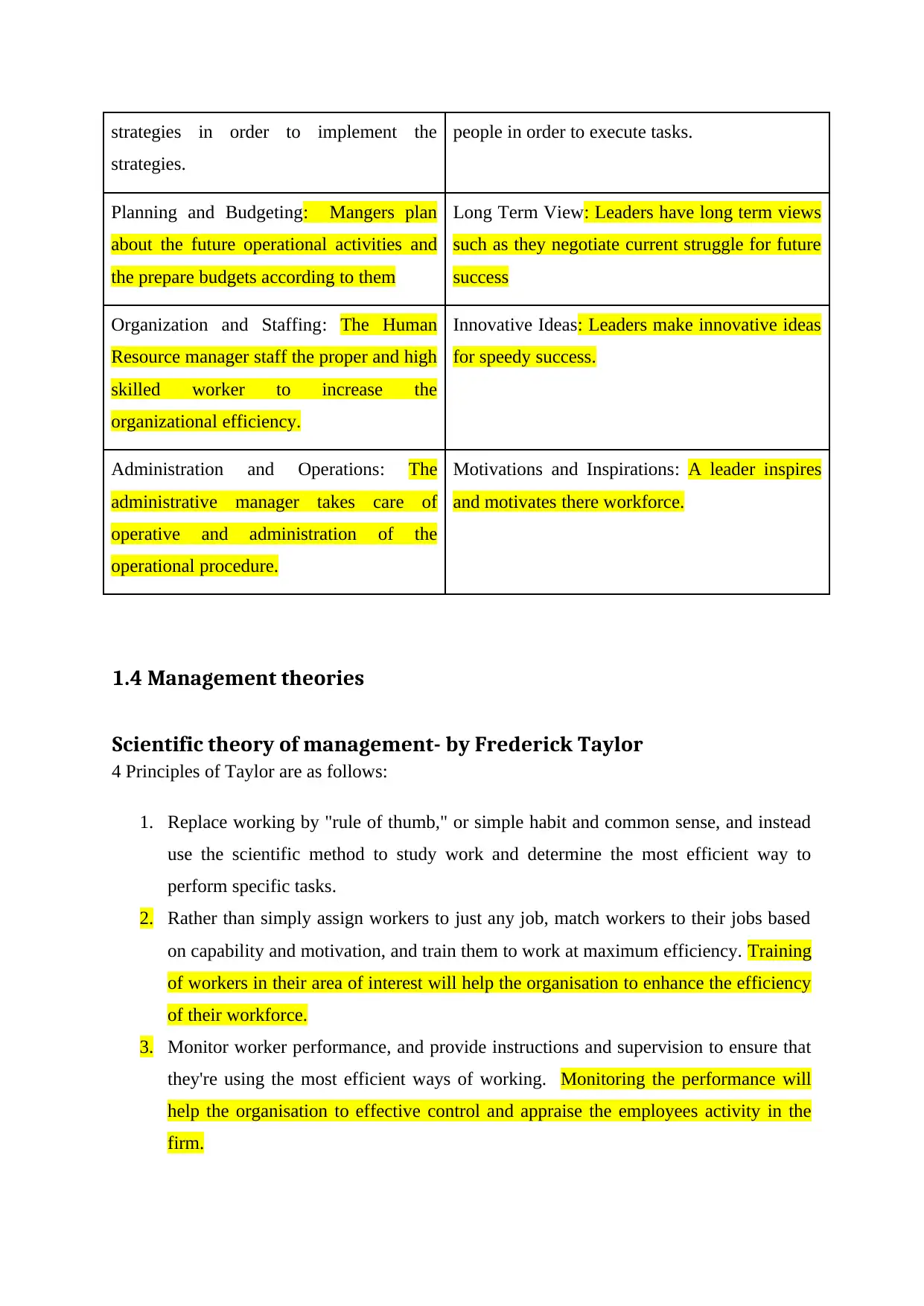
Example: As stated above, leaders empower

strategies in order to implement the
strategies.
people in order to execute tasks.
Planning and Budgeting: Mangers plan
about the future operational activities and
the prepare budgets according to them
Long Term View: Leaders have long term views
such as they negotiate current struggle for future
success
Organization and Staffing: The Human
Resource manager staff the proper and high
skilled worker to increase the
organizational efficiency.
Innovative Ideas: Leaders make innovative ideas
for speedy success.
Administration and Operations: The
administrative manager takes care of
operative and administration of the
operational procedure.
Motivations and Inspirations: A leader inspires
and motivates there workforce.
1.4 Management theories
Scientific theory of management- by Frederick Taylor
4 Principles of Taylor are as follows:
1. Replace working by "rule of thumb," or simple habit and common sense, and instead
use the scientific method to study work and determine the most efficient way to
perform specific tasks.
2. Rather than simply assign workers to just any job, match workers to their jobs based
on capability and motivation, and train them to work at maximum efficiency. Training
of workers in their area of interest will help the organisation to enhance the efficiency
of their workforce.
3. Monitor worker performance, and provide instructions and supervision to ensure that
they're using the most efficient ways of working. Monitoring the performance will
help the organisation to effective control and appraise the employees activity in the
firm.
strategies.
people in order to execute tasks.
Planning and Budgeting: Mangers plan
about the future operational activities and
the prepare budgets according to them
Long Term View: Leaders have long term views
such as they negotiate current struggle for future
success
Organization and Staffing: The Human
Resource manager staff the proper and high
skilled worker to increase the
organizational efficiency.
Innovative Ideas: Leaders make innovative ideas
for speedy success.
Administration and Operations: The
administrative manager takes care of
operative and administration of the
operational procedure.
Motivations and Inspirations: A leader inspires
and motivates there workforce.
1.4 Management theories
Scientific theory of management- by Frederick Taylor
4 Principles of Taylor are as follows:
1. Replace working by "rule of thumb," or simple habit and common sense, and instead
use the scientific method to study work and determine the most efficient way to
perform specific tasks.
2. Rather than simply assign workers to just any job, match workers to their jobs based
on capability and motivation, and train them to work at maximum efficiency. Training
of workers in their area of interest will help the organisation to enhance the efficiency
of their workforce.
3. Monitor worker performance, and provide instructions and supervision to ensure that
they're using the most efficient ways of working. Monitoring the performance will
help the organisation to effective control and appraise the employees activity in the
firm.
⊘ This is a preview!⊘
Do you want full access?
Subscribe today to unlock all pages.

Trusted by 1+ million students worldwide

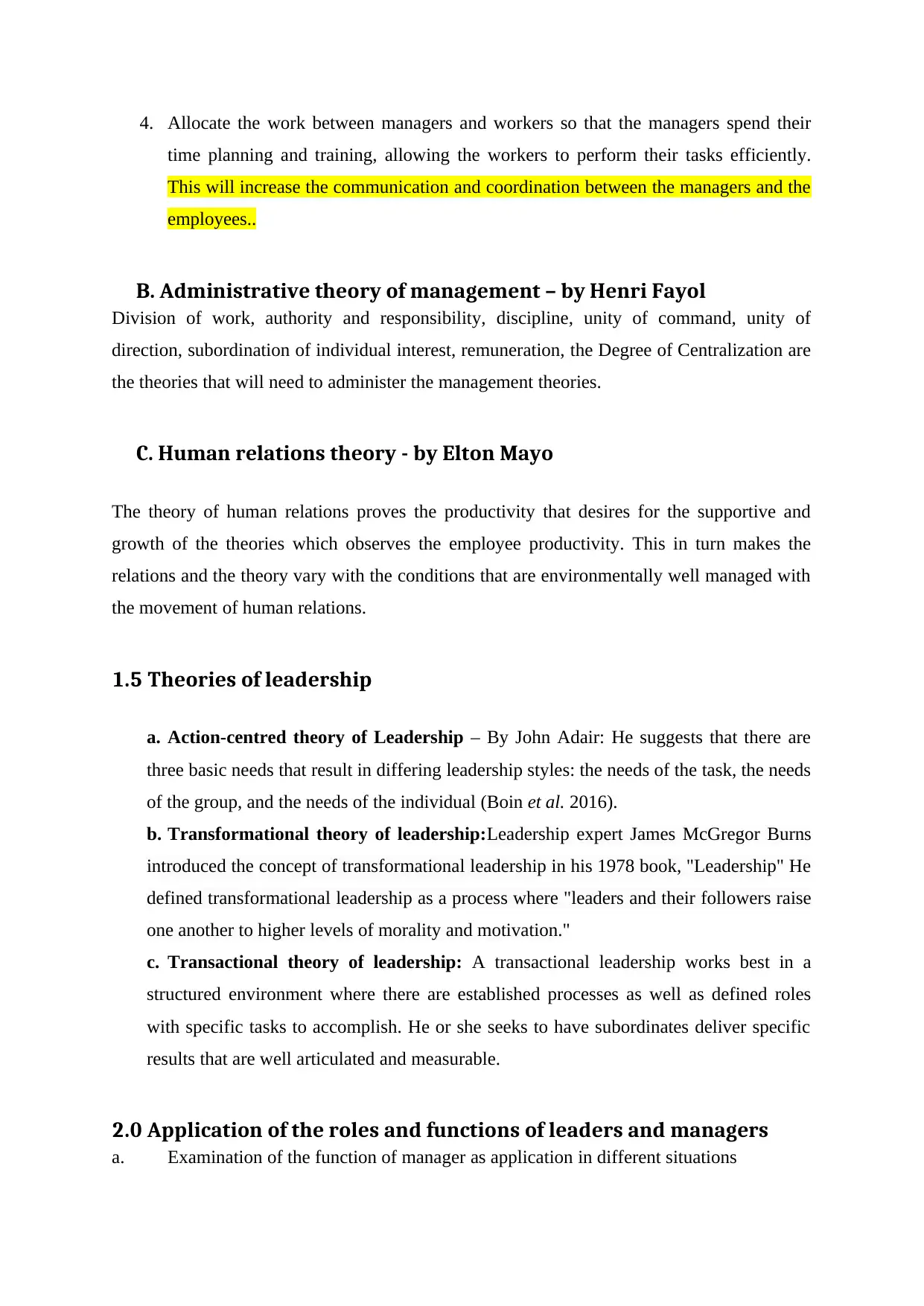
4. Allocate the work between managers and workers so that the managers spend their
time planning and training, allowing the workers to perform their tasks efficiently.
This will increase the communication and coordination between the managers and the
employees..
B. Administrative theory of management – by Henri Fayol
Division of work, authority and responsibility, discipline, unity of command, unity of
direction, subordination of individual interest, remuneration, the Degree of Centralization are
the theories that will need to administer the management theories.
C. Human relations theory - by Elton Mayo
The theory of human relations proves the productivity that desires for the supportive and
growth of the theories which observes the employee productivity. This in turn makes the
relations and the theory vary with the conditions that are environmentally well managed with
the movement of human relations.
1.5 Theories of leadership
a. Action-centred theory of Leadership – By John Adair: He suggests that there are
three basic needs that result in differing leadership styles: the needs of the task, the needs
of the group, and the needs of the individual (Boin et al. 2016).
b. Transformational theory of leadership:Leadership expert James McGregor Burns
introduced the concept of transformational leadership in his 1978 book, "Leadership" He
defined transformational leadership as a process where "leaders and their followers raise
one another to higher levels of morality and motivation."
c. Transactional theory of leadership: A transactional leadership works best in a
structured environment where there are established processes as well as defined roles
with specific tasks to accomplish. He or she seeks to have subordinates deliver specific
results that are well articulated and measurable.
2.0 Application of the roles and functions of leaders and managers
a. Examination of the function of manager as application in different situations
time planning and training, allowing the workers to perform their tasks efficiently.
This will increase the communication and coordination between the managers and the
employees..
B. Administrative theory of management – by Henri Fayol
Division of work, authority and responsibility, discipline, unity of command, unity of
direction, subordination of individual interest, remuneration, the Degree of Centralization are
the theories that will need to administer the management theories.
C. Human relations theory - by Elton Mayo
The theory of human relations proves the productivity that desires for the supportive and
growth of the theories which observes the employee productivity. This in turn makes the
relations and the theory vary with the conditions that are environmentally well managed with
the movement of human relations.
1.5 Theories of leadership
a. Action-centred theory of Leadership – By John Adair: He suggests that there are
three basic needs that result in differing leadership styles: the needs of the task, the needs
of the group, and the needs of the individual (Boin et al. 2016).
b. Transformational theory of leadership:Leadership expert James McGregor Burns
introduced the concept of transformational leadership in his 1978 book, "Leadership" He
defined transformational leadership as a process where "leaders and their followers raise
one another to higher levels of morality and motivation."
c. Transactional theory of leadership: A transactional leadership works best in a
structured environment where there are established processes as well as defined roles
with specific tasks to accomplish. He or she seeks to have subordinates deliver specific
results that are well articulated and measurable.
2.0 Application of the roles and functions of leaders and managers
a. Examination of the function of manager as application in different situations
Paraphrase This Document
Need a fresh take? Get an instant paraphrase of this document with our AI Paraphraser

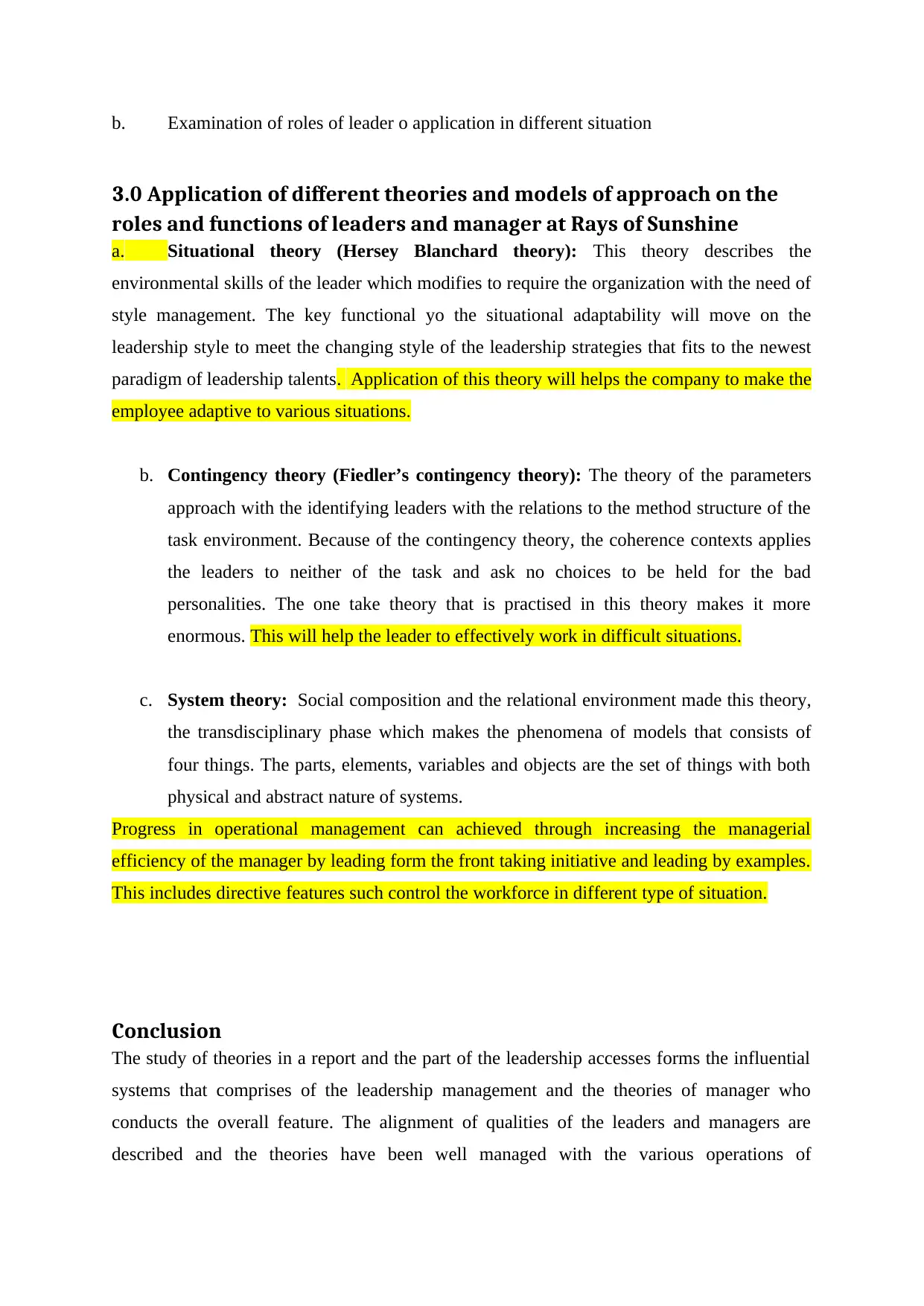
b. Examination of roles of leader o application in different situation
3.0 Application of different theories and models of approach on the
roles and functions of leaders and manager at Rays of Sunshine
a. Situational theory (Hersey Blanchard theory): This theory describes the
environmental skills of the leader which modifies to require the organization with the need of
style management. The key functional yo the situational adaptability will move on the
leadership style to meet the changing style of the leadership strategies that fits to the newest
paradigm of leadership talents. Application of this theory will helps the company to make the
employee adaptive to various situations.
b. Contingency theory (Fiedler’s contingency theory): The theory of the parameters
approach with the identifying leaders with the relations to the method structure of the
task environment. Because of the contingency theory, the coherence contexts applies
the leaders to neither of the task and ask no choices to be held for the bad
personalities. The one take theory that is practised in this theory makes it more
enormous. This will help the leader to effectively work in difficult situations.
c. System theory: Social composition and the relational environment made this theory,
the transdisciplinary phase which makes the phenomena of models that consists of
four things. The parts, elements, variables and objects are the set of things with both
physical and abstract nature of systems.
Progress in operational management can achieved through increasing the managerial
efficiency of the manager by leading form the front taking initiative and leading by examples.
This includes directive features such control the workforce in different type of situation.
Conclusion
The study of theories in a report and the part of the leadership accesses forms the influential
systems that comprises of the leadership management and the theories of manager who
conducts the overall feature. The alignment of qualities of the leaders and managers are
described and the theories have been well managed with the various operations of
3.0 Application of different theories and models of approach on the
roles and functions of leaders and manager at Rays of Sunshine
a. Situational theory (Hersey Blanchard theory): This theory describes the
environmental skills of the leader which modifies to require the organization with the need of
style management. The key functional yo the situational adaptability will move on the
leadership style to meet the changing style of the leadership strategies that fits to the newest
paradigm of leadership talents. Application of this theory will helps the company to make the
employee adaptive to various situations.
b. Contingency theory (Fiedler’s contingency theory): The theory of the parameters
approach with the identifying leaders with the relations to the method structure of the
task environment. Because of the contingency theory, the coherence contexts applies
the leaders to neither of the task and ask no choices to be held for the bad
personalities. The one take theory that is practised in this theory makes it more
enormous. This will help the leader to effectively work in difficult situations.
c. System theory: Social composition and the relational environment made this theory,
the transdisciplinary phase which makes the phenomena of models that consists of
four things. The parts, elements, variables and objects are the set of things with both
physical and abstract nature of systems.
Progress in operational management can achieved through increasing the managerial
efficiency of the manager by leading form the front taking initiative and leading by examples.
This includes directive features such control the workforce in different type of situation.
Conclusion
The study of theories in a report and the part of the leadership accesses forms the influential
systems that comprises of the leadership management and the theories of manager who
conducts the overall feature. The alignment of qualities of the leaders and managers are
described and the theories have been well managed with the various operations of

understanding for the whole task. The practised rules and the reasonable resources are
arranged to provide the specification of human relations.
Recommendations
The study can be concluded with the individual reporting for the appropriate functioning and
the leadership talents. The managerial part of the system can be supported with the provision
of the work that supports the researches and the reporting that aims on the given theories of
leadership and management.
arranged to provide the specification of human relations.
Recommendations
The study can be concluded with the individual reporting for the appropriate functioning and
the leadership talents. The managerial part of the system can be supported with the provision
of the work that supports the researches and the reporting that aims on the given theories of
leadership and management.
⊘ This is a preview!⊘
Do you want full access?
Subscribe today to unlock all pages.

Trusted by 1+ million students worldwide
1 out of 6
Related Documents
Your All-in-One AI-Powered Toolkit for Academic Success.
+13062052269
info@desklib.com
Available 24*7 on WhatsApp / Email
Unlock your academic potential
Copyright © 2020–2025 A2Z Services. All Rights Reserved. Developed and managed by ZUCOL.