The Role of Leaders in Driving Innovation and Creativity at Work
VerifiedAdded on 2022/08/23
|11
|3071
|16
Essay
AI Summary
This essay critically examines the role of leaders in driving creativity and innovation within the workplace, emphasizing the increasing recognition of innovation as a key factor for competitive advantage. It discusses how traditional organizational processes are often inadequate in today's rapidly changing environment, necessitating creative and consistently motivated leadership. The essay highlights that while organizational structure, culture, and technology are important, they are insufficient without leaders who can foster a culture of renewal, encourage creativity, and embrace diversity. It explores the leader's role in shaping organizational culture, implementing strategies, and inspiring employees, while also addressing counterarguments that emphasize the importance of organizational culture and management tools. Furthermore, the essay contrasts heroic leadership with collaborative approaches, advocating for shared leadership models that empower employees and foster a more innovative and productive work environment. The importance of leaders in motivating creativity by creating a supportive and inclusive environment is also emphasized.
Running head: ORGANISATIONS AND LEADERSHIP
ORGANISATIONS AND LEADERSHIP
Name of the Student:
Name of the University:
Author Note:
ORGANISATIONS AND LEADERSHIP
Name of the Student:
Name of the University:
Author Note:

Paraphrase This Document
Need a fresh take? Get an instant paraphrase of this document with our AI Paraphraser
1ORGANISATIONS AND LEADERSHIP
Essay Topic: “As organisations have recognized innovation as the critical gateway to gain
competitive advantage and maintain prosperity, managers are counted on to be leaders and
champions of innovation
The process which many organisations tends to utilize in the earlier days do not seem to
be very much adequate for efficiency and success in the present scenario of the 21st century. In
many organisations, the processes of the work are changing at a very fast rate as these
organisations are facing the challenges of fast changing form of the technology, indecision,
Commotion, globalization, impulsiveness etc. therefore, it can be said that because of the volatile
environment, many of the organisations or the companies are failing and are in requirement of
the creativity and consistent standard of motivation in order to be very much successful and give
a significant rate of competition to the others (Amabile & Pratt, 2016). It must however be
noted that the strategic design, culture, technology and the organisational strategy might not be
good enough to sustain the company or the organisations for a longer period of time until and
unless organizatons tends to create a structure that tends to develop the leaders who can run and
sustain the process. It can be said that this is the strategy that will help the organisations to create
environment or culture that are favorable for renewal , build the organizational culture that tends
to encourage the creativity and even establish the diversity in the organisation that will keep the
organisations remain successful and very much competitive (Arena & Uhl-Bien, 2016). This
essay will be focusing on the role or the importance of the leaders in the development of
innovation and creativity in the workplace.
Though it is been noted that the organisational structure, technology culture and other
tools of the management tends to bring efficiency and competitive advantage to organisations, it
is to be noted that that the creativity and the effective organisation’s cannot develop through any
Essay Topic: “As organisations have recognized innovation as the critical gateway to gain
competitive advantage and maintain prosperity, managers are counted on to be leaders and
champions of innovation
The process which many organisations tends to utilize in the earlier days do not seem to
be very much adequate for efficiency and success in the present scenario of the 21st century. In
many organisations, the processes of the work are changing at a very fast rate as these
organisations are facing the challenges of fast changing form of the technology, indecision,
Commotion, globalization, impulsiveness etc. therefore, it can be said that because of the volatile
environment, many of the organisations or the companies are failing and are in requirement of
the creativity and consistent standard of motivation in order to be very much successful and give
a significant rate of competition to the others (Amabile & Pratt, 2016). It must however be
noted that the strategic design, culture, technology and the organisational strategy might not be
good enough to sustain the company or the organisations for a longer period of time until and
unless organizatons tends to create a structure that tends to develop the leaders who can run and
sustain the process. It can be said that this is the strategy that will help the organisations to create
environment or culture that are favorable for renewal , build the organizational culture that tends
to encourage the creativity and even establish the diversity in the organisation that will keep the
organisations remain successful and very much competitive (Arena & Uhl-Bien, 2016). This
essay will be focusing on the role or the importance of the leaders in the development of
innovation and creativity in the workplace.
Though it is been noted that the organisational structure, technology culture and other
tools of the management tends to bring efficiency and competitive advantage to organisations, it
is to be noted that that the creativity and the effective organisation’s cannot develop through any
2ORGANISATIONS AND LEADERSHIP
form of accident. It is because of this, leaders are required so that they can drive and govern
cautious fluctuations in the assembly , philosophy and the procedure in order to change them into
innovation, efficient and industrious ones. Studies that have been done in this field tend to
indicate that the leadership is the significant source of competitive advantage. (Azanza, Moriano,
& Molero, 2013). The leaders of the organisation are generally the ones who tends to decide
what generally going to happen in the organisation. They tend to give the course, visualization
and even the motion that tends to carry the triumph for the company in the future (Chen et al
2013). Therefore, it can be said that the leaders are the compound or reagent that tends to create
and even manage the culture and environment of the organisation or the company and make
policies that would inspire and endure creativity, efficiency and achievement in the company or
the organisation.
When the plan and the procedures of the work is being established by the organisation, it
is the responsibility of the leaders to direct the implementation plan so that accomplishment can
be gained. The right culture, technology and the correct strategy are necessary for the smooth
running of the company (Choi et al., 2015). However, in order to have the real benefits, the
leaders must support, encourage and inspire the followers so that the strategies tends to work.
Therefore, it can be said that in order to implement the innovation process in an organisation, the
organisation firstly must put the correct leaders and structure of the leadership into place (Chang,
Bai & Li, 2015). On the other hand, it is the responsibility of the leaders in itself to be very
much interested in creativity. Thus, it can be said that if the objectives of the leader is dynamic,
ambitious and even innovative then the leaders can bring about creativity, renewal and success or
profits to the organisation or the company as well.
form of accident. It is because of this, leaders are required so that they can drive and govern
cautious fluctuations in the assembly , philosophy and the procedure in order to change them into
innovation, efficient and industrious ones. Studies that have been done in this field tend to
indicate that the leadership is the significant source of competitive advantage. (Azanza, Moriano,
& Molero, 2013). The leaders of the organisation are generally the ones who tends to decide
what generally going to happen in the organisation. They tend to give the course, visualization
and even the motion that tends to carry the triumph for the company in the future (Chen et al
2013). Therefore, it can be said that the leaders are the compound or reagent that tends to create
and even manage the culture and environment of the organisation or the company and make
policies that would inspire and endure creativity, efficiency and achievement in the company or
the organisation.
When the plan and the procedures of the work is being established by the organisation, it
is the responsibility of the leaders to direct the implementation plan so that accomplishment can
be gained. The right culture, technology and the correct strategy are necessary for the smooth
running of the company (Choi et al., 2015). However, in order to have the real benefits, the
leaders must support, encourage and inspire the followers so that the strategies tends to work.
Therefore, it can be said that in order to implement the innovation process in an organisation, the
organisation firstly must put the correct leaders and structure of the leadership into place (Chang,
Bai & Li, 2015). On the other hand, it is the responsibility of the leaders in itself to be very
much interested in creativity. Thus, it can be said that if the objectives of the leader is dynamic,
ambitious and even innovative then the leaders can bring about creativity, renewal and success or
profits to the organisation or the company as well.
⊘ This is a preview!⊘
Do you want full access?
Subscribe today to unlock all pages.

Trusted by 1+ million students worldwide
3ORGANISATIONS AND LEADERSHIP
On the other hand various theorists are of the opinion that the strategy, culture and the
processes of work and other organization tools and not management tends to control the
achievement of the organisation. In order to prove this point, they tend to take the example of
the Japanese auto industry and even the technology to represent how the strong business culture
tend to help in the accomplishment of the organisation. On the other hand, the empirical
research tends to represent the reputation of the philosophy in the performance of the
organisation. However, schein tends to claim that the main reason behind the development of the
culture of the organisation is that of the leaders (Dawson & Andriopoulos, 2014). The example
of the company IBM can be taken into account here. In order to renew the organisation of the
IBM, the company had to change its culture. It is because of this,; the company had to bring
about a new CEO named Lou Gerstner for the company. Similarly, to change the culture of the
general electric, Jack Welch was being appointed as the CEO to bring more innovations and
success for the company. According to various other theorists, the change in the culture of an
organisation is not about to take place without the involvement , active support and the
commitment of the leaders who consistently work in order to please the members of the
organisation about the various profits and requirements of the cultural change of an organisation.
On the other hand, it is to be noted the weak leaders in an makes the company or the
organisation very much less effective. It is because of the weaker leadership in an organisation
the organisation or the company has the tendency towards constant rearrangement and
economizing in order to resolve their concerned difficulties. On the other hand, the imaginative
and the operative leaders in the organisation helps the organisation to prevent the need for major
rearrangement and economizing (Gundry, Ofstein & Kickul, 2014). According to the
corporations like Compaq, General Electric and Motorola, they executed the effective
On the other hand various theorists are of the opinion that the strategy, culture and the
processes of work and other organization tools and not management tends to control the
achievement of the organisation. In order to prove this point, they tend to take the example of
the Japanese auto industry and even the technology to represent how the strong business culture
tend to help in the accomplishment of the organisation. On the other hand, the empirical
research tends to represent the reputation of the philosophy in the performance of the
organisation. However, schein tends to claim that the main reason behind the development of the
culture of the organisation is that of the leaders (Dawson & Andriopoulos, 2014). The example
of the company IBM can be taken into account here. In order to renew the organisation of the
IBM, the company had to change its culture. It is because of this,; the company had to bring
about a new CEO named Lou Gerstner for the company. Similarly, to change the culture of the
general electric, Jack Welch was being appointed as the CEO to bring more innovations and
success for the company. According to various other theorists, the change in the culture of an
organisation is not about to take place without the involvement , active support and the
commitment of the leaders who consistently work in order to please the members of the
organisation about the various profits and requirements of the cultural change of an organisation.
On the other hand, it is to be noted the weak leaders in an makes the company or the
organisation very much less effective. It is because of the weaker leadership in an organisation
the organisation or the company has the tendency towards constant rearrangement and
economizing in order to resolve their concerned difficulties. On the other hand, the imaginative
and the operative leaders in the organisation helps the organisation to prevent the need for major
rearrangement and economizing (Gundry, Ofstein & Kickul, 2014). According to the
corporations like Compaq, General Electric and Motorola, they executed the effective
Paraphrase This Document
Need a fresh take? Get an instant paraphrase of this document with our AI Paraphraser
4ORGANISATIONS AND LEADERSHIP
reengineering initiative as they claim to have innovative and efficient leaders in order to manage
the process. A consulting firm whose name is Rath and Strong have made a survey among the
500 companies who have realized the TQM creativities. It is being established that out that only
20 percent of the companies are actually able to achieve their aims or the goals. Similarly, a
survey that is being conducted by the American management association indicates the fact that a
less than 45 percent of the downsized companies did not report any form of increase in the
profits since the last decade (Gupta & Singh, 2013). Thus, it can be said by observing the
statistics that the companies which have undergone through the reengineering initiative have
mainly failed because of the lack of the innovative and effective leadership in order to manage
the process of the work. This, however indicates the fact that the tools of the management cannot
ensure the creativity in an organisation that tends to lead towards innovation, success and
effectiveness. Thus, the organisations requires the creative as well as the effective leaders in
order to help the management tools to operate accurately.
However, it is to be noted that though efficient leaders are required for the success of the
company, many organisation’s or company are lacking the kind of leaders that tends to
encourage the creativity and brig about huge success for the company. According to the various
theorist, many problems tends to rise in the organisation because the organisation’s lack the
leaders who are sufficient enough to bring the necessary changes (Hausman & Johnston, 2014).
As per the study that is being conducted by Andersen Consulting, the stock price of the
companies which are being led by the creative leaders tends to increase with 900 percent over the
last 10 years in comparison to the 74 percent of the companies with the lack of leaders who are
creative leaders.
reengineering initiative as they claim to have innovative and efficient leaders in order to manage
the process. A consulting firm whose name is Rath and Strong have made a survey among the
500 companies who have realized the TQM creativities. It is being established that out that only
20 percent of the companies are actually able to achieve their aims or the goals. Similarly, a
survey that is being conducted by the American management association indicates the fact that a
less than 45 percent of the downsized companies did not report any form of increase in the
profits since the last decade (Gupta & Singh, 2013). Thus, it can be said by observing the
statistics that the companies which have undergone through the reengineering initiative have
mainly failed because of the lack of the innovative and effective leadership in order to manage
the process of the work. This, however indicates the fact that the tools of the management cannot
ensure the creativity in an organisation that tends to lead towards innovation, success and
effectiveness. Thus, the organisations requires the creative as well as the effective leaders in
order to help the management tools to operate accurately.
However, it is to be noted that though efficient leaders are required for the success of the
company, many organisation’s or company are lacking the kind of leaders that tends to
encourage the creativity and brig about huge success for the company. According to the various
theorist, many problems tends to rise in the organisation because the organisation’s lack the
leaders who are sufficient enough to bring the necessary changes (Hausman & Johnston, 2014).
As per the study that is being conducted by Andersen Consulting, the stock price of the
companies which are being led by the creative leaders tends to increase with 900 percent over the
last 10 years in comparison to the 74 percent of the companies with the lack of leaders who are
creative leaders.
5ORGANISATIONS AND LEADERSHIP
However, it is to be noted that not all kinds of leadership tends to support innovation and
creativity in an organisation. Various researches that have been conducted indicates the fact that
the shared as well as the collaborative leadership rather than that of the heroic or the
authoritarian management helps in unlocking the successful budding of an organisation (Hughes
et al, 2018). On the other hand, the organisations that tends to work from the demanding,
classified, facility and the switch model where the leaders tends to control the work, choices,
informations and even the distribution of the resources tends to yield the employees who are
very much less powered, less innovative and even less productive. The heroic standard of the
leadership was very much famous in the 19th century and is still prevalent in many organisations
in the present scenario. However, it is to be noted that the heroic method to leadership tends to
have little opportunity in bringing innovations because a single leader cannot bring success. The
another form of leadership is not the aptitude of an individual to take the responsibility but the
capability of motivate, authorize and exercise the effect in the organisation. The leaders of the
present scenario understands the fact that no individual is good enough to possess all the
qualities that will help in the smooth running of the organisation (Jaiswal & Dhar, 2015). The
leaders of the present scenario understands the fact that the success of the organisation will not
be for long if the leadership quality is confined to the top leaders only because the opportunities
of the leadership tends to exist at every level of the organisation. Therefore, it must be noted that
creativity must be welcomed from all the members of the organisation in order to gin profits and
success for the organisation.
For the development of creativity and spirit of inventiveness in an organisation, it must
understand the responsibility and the function of the leaders in motivating creativity. The leaders
can effectively motivate the organisational imagination and revolution by designing the company
However, it is to be noted that not all kinds of leadership tends to support innovation and
creativity in an organisation. Various researches that have been conducted indicates the fact that
the shared as well as the collaborative leadership rather than that of the heroic or the
authoritarian management helps in unlocking the successful budding of an organisation (Hughes
et al, 2018). On the other hand, the organisations that tends to work from the demanding,
classified, facility and the switch model where the leaders tends to control the work, choices,
informations and even the distribution of the resources tends to yield the employees who are
very much less powered, less innovative and even less productive. The heroic standard of the
leadership was very much famous in the 19th century and is still prevalent in many organisations
in the present scenario. However, it is to be noted that the heroic method to leadership tends to
have little opportunity in bringing innovations because a single leader cannot bring success. The
another form of leadership is not the aptitude of an individual to take the responsibility but the
capability of motivate, authorize and exercise the effect in the organisation. The leaders of the
present scenario understands the fact that no individual is good enough to possess all the
qualities that will help in the smooth running of the organisation (Jaiswal & Dhar, 2015). The
leaders of the present scenario understands the fact that the success of the organisation will not
be for long if the leadership quality is confined to the top leaders only because the opportunities
of the leadership tends to exist at every level of the organisation. Therefore, it must be noted that
creativity must be welcomed from all the members of the organisation in order to gin profits and
success for the organisation.
For the development of creativity and spirit of inventiveness in an organisation, it must
understand the responsibility and the function of the leaders in motivating creativity. The leaders
can effectively motivate the organisational imagination and revolution by designing the company
⊘ This is a preview!⊘
Do you want full access?
Subscribe today to unlock all pages.
Trusted by 1+ million students worldwide
6ORGANISATIONS AND LEADERSHIP
that would nurture an environment that will be conductive for the creation of the flourishment of
the creativity. This is possible by the leaders through the creation of responsive and wide-
ranging conditions of working for the employees of the organisation. Creativity tends to get
flourished when the social structure of the organisation helps the workers to feel very much
secured and even accepted (Li, Mitchell & Boyle, 2016). Similarly, it must be noted that the
leaders of the organisation or the company must learn to respect, value and even connect the
richness of the ideas, circumstances and even the point of view of every employees. They must
even permit them to utilize their own personal possessions and even the experiences in order to
work for the organisation. However, it is to be noted that the top leadership of an company or
organisation tends to value the creativity by themselves and they therefore tends to be passionate
for the creative employees in the organisation (Li & Zheng, 2014). This perspective and the
strategic aim of the leadership tends to determine whether the organisation nurtures creativity in
itself. hence, an significant vision can help to produce a good working environment where all
the employees can actively participate and even acquire growth both personally and
professionally in the quest of the common goal or aim. It is in this situation, the leader tends to
encourage the remaining of the employees in the organisation in order to bring out their
imagination through the creation of the shared vision of the different type of organisation that
they must establish. The leaders tends to inspire the other employees in the organisation with a
purpose and with a bigger sense of undertaking (Li et al., 2017). This type of work environment
is very much favorable for creativity, while this type of leadership also tends to cause changes in
the followers that tends to change them into efficient and innovative leaders.
On the other hand, it is to be noted that creativity is being nurtured in the organisation by
the leaders simply by the stimulation of it. They do this by permitting the employees to deliver
that would nurture an environment that will be conductive for the creation of the flourishment of
the creativity. This is possible by the leaders through the creation of responsive and wide-
ranging conditions of working for the employees of the organisation. Creativity tends to get
flourished when the social structure of the organisation helps the workers to feel very much
secured and even accepted (Li, Mitchell & Boyle, 2016). Similarly, it must be noted that the
leaders of the organisation or the company must learn to respect, value and even connect the
richness of the ideas, circumstances and even the point of view of every employees. They must
even permit them to utilize their own personal possessions and even the experiences in order to
work for the organisation. However, it is to be noted that the top leadership of an company or
organisation tends to value the creativity by themselves and they therefore tends to be passionate
for the creative employees in the organisation (Li & Zheng, 2014). This perspective and the
strategic aim of the leadership tends to determine whether the organisation nurtures creativity in
itself. hence, an significant vision can help to produce a good working environment where all
the employees can actively participate and even acquire growth both personally and
professionally in the quest of the common goal or aim. It is in this situation, the leader tends to
encourage the remaining of the employees in the organisation in order to bring out their
imagination through the creation of the shared vision of the different type of organisation that
they must establish. The leaders tends to inspire the other employees in the organisation with a
purpose and with a bigger sense of undertaking (Li et al., 2017). This type of work environment
is very much favorable for creativity, while this type of leadership also tends to cause changes in
the followers that tends to change them into efficient and innovative leaders.
On the other hand, it is to be noted that creativity is being nurtured in the organisation by
the leaders simply by the stimulation of it. They do this by permitting the employees to deliver
Paraphrase This Document
Need a fresh take? Get an instant paraphrase of this document with our AI Paraphraser
7ORGANISATIONS AND LEADERSHIP
new solution to the problems (Overstreet et al., 2013) The stimulating leaders to create
challenges that tends to create the work in an organisation very much creative. However,
diversity must be maintained by the leaders so that all the employees feels a sense of
belongingness.
In conclusion, it can be said that management is the most significant aspect of the
organisational imagination and undercurrents of innovation. No organisation can tend to convert
or reintroduce itself until and unless the leaders tends to put the procedure in the set of motion
and even withstand it. Therefore, the organisations requires the innovative leaders for the
management of the creative and the innovative process.
new solution to the problems (Overstreet et al., 2013) The stimulating leaders to create
challenges that tends to create the work in an organisation very much creative. However,
diversity must be maintained by the leaders so that all the employees feels a sense of
belongingness.
In conclusion, it can be said that management is the most significant aspect of the
organisational imagination and undercurrents of innovation. No organisation can tend to convert
or reintroduce itself until and unless the leaders tends to put the procedure in the set of motion
and even withstand it. Therefore, the organisations requires the innovative leaders for the
management of the creative and the innovative process.
8ORGANISATIONS AND LEADERSHIP
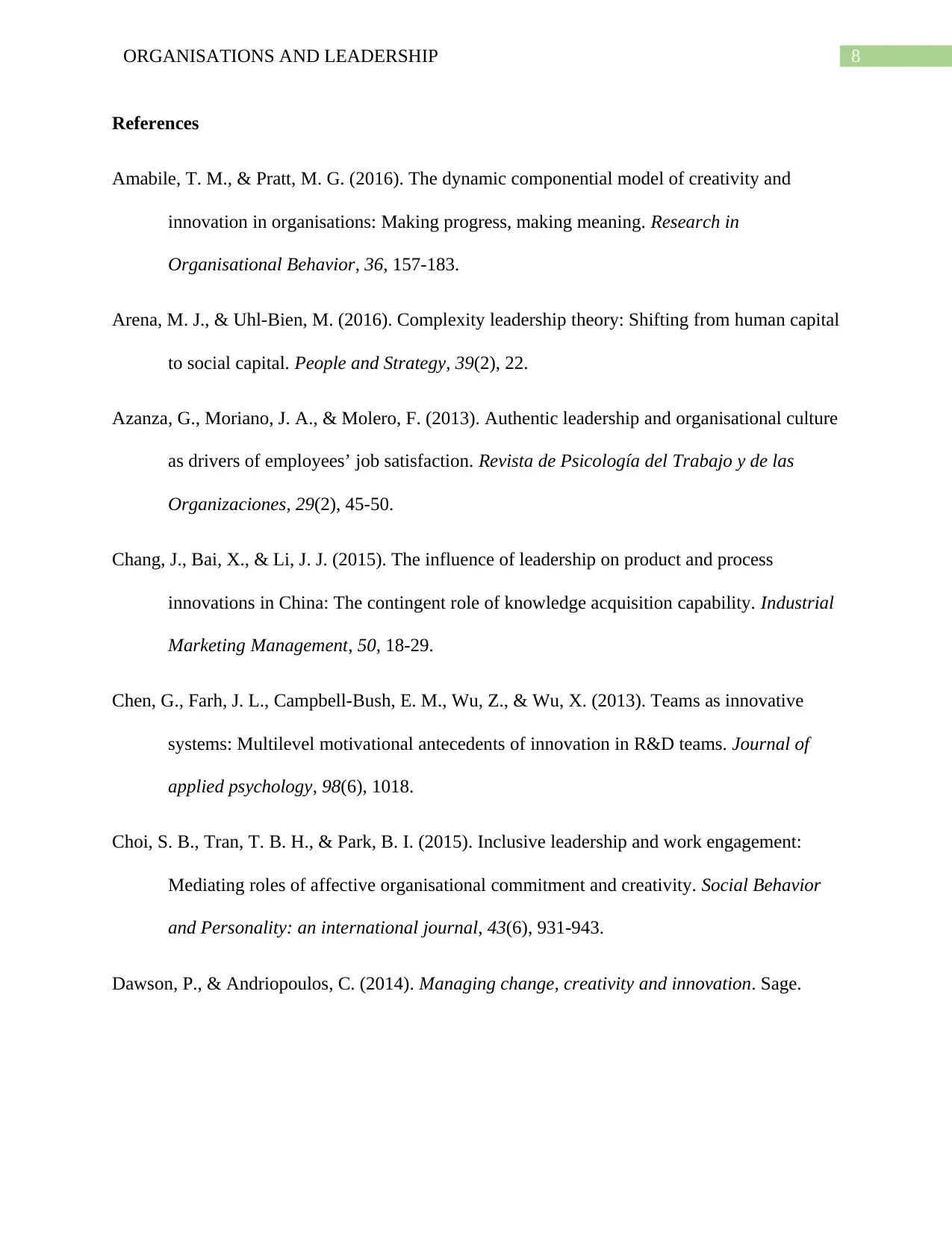
References
Amabile, T. M., & Pratt, M. G. (2016). The dynamic componential model of creativity and
innovation in organisations: Making progress, making meaning. Research in
Organisational Behavior, 36, 157-183.
Arena, M. J., & Uhl-Bien, M. (2016). Complexity leadership theory: Shifting from human capital
to social capital. People and Strategy, 39(2), 22.
Azanza, G., Moriano, J. A., & Molero, F. (2013). Authentic leadership and organisational culture
as drivers of employees’ job satisfaction. Revista de Psicología del Trabajo y de las
Organizaciones, 29(2), 45-50.
Chang, J., Bai, X., & Li, J. J. (2015). The influence of leadership on product and process
innovations in China: The contingent role of knowledge acquisition capability. Industrial
Marketing Management, 50, 18-29.
Chen, G., Farh, J. L., Campbell-Bush, E. M., Wu, Z., & Wu, X. (2013). Teams as innovative
systems: Multilevel motivational antecedents of innovation in R&D teams. Journal of
applied psychology, 98(6), 1018.
Choi, S. B., Tran, T. B. H., & Park, B. I. (2015). Inclusive leadership and work engagement:
Mediating roles of affective organisational commitment and creativity. Social Behavior
and Personality: an international journal, 43(6), 931-943.
Dawson, P., & Andriopoulos, C. (2014). Managing change, creativity and innovation. Sage.
References
Amabile, T. M., & Pratt, M. G. (2016). The dynamic componential model of creativity and
innovation in organisations: Making progress, making meaning. Research in
Organisational Behavior, 36, 157-183.
Arena, M. J., & Uhl-Bien, M. (2016). Complexity leadership theory: Shifting from human capital
to social capital. People and Strategy, 39(2), 22.
Azanza, G., Moriano, J. A., & Molero, F. (2013). Authentic leadership and organisational culture
as drivers of employees’ job satisfaction. Revista de Psicología del Trabajo y de las
Organizaciones, 29(2), 45-50.
Chang, J., Bai, X., & Li, J. J. (2015). The influence of leadership on product and process
innovations in China: The contingent role of knowledge acquisition capability. Industrial
Marketing Management, 50, 18-29.
Chen, G., Farh, J. L., Campbell-Bush, E. M., Wu, Z., & Wu, X. (2013). Teams as innovative
systems: Multilevel motivational antecedents of innovation in R&D teams. Journal of
applied psychology, 98(6), 1018.
Choi, S. B., Tran, T. B. H., & Park, B. I. (2015). Inclusive leadership and work engagement:
Mediating roles of affective organisational commitment and creativity. Social Behavior
and Personality: an international journal, 43(6), 931-943.
Dawson, P., & Andriopoulos, C. (2014). Managing change, creativity and innovation. Sage.
⊘ This is a preview!⊘
Do you want full access?
Subscribe today to unlock all pages.
Trusted by 1+ million students worldwide
9ORGANISATIONS AND LEADERSHIP
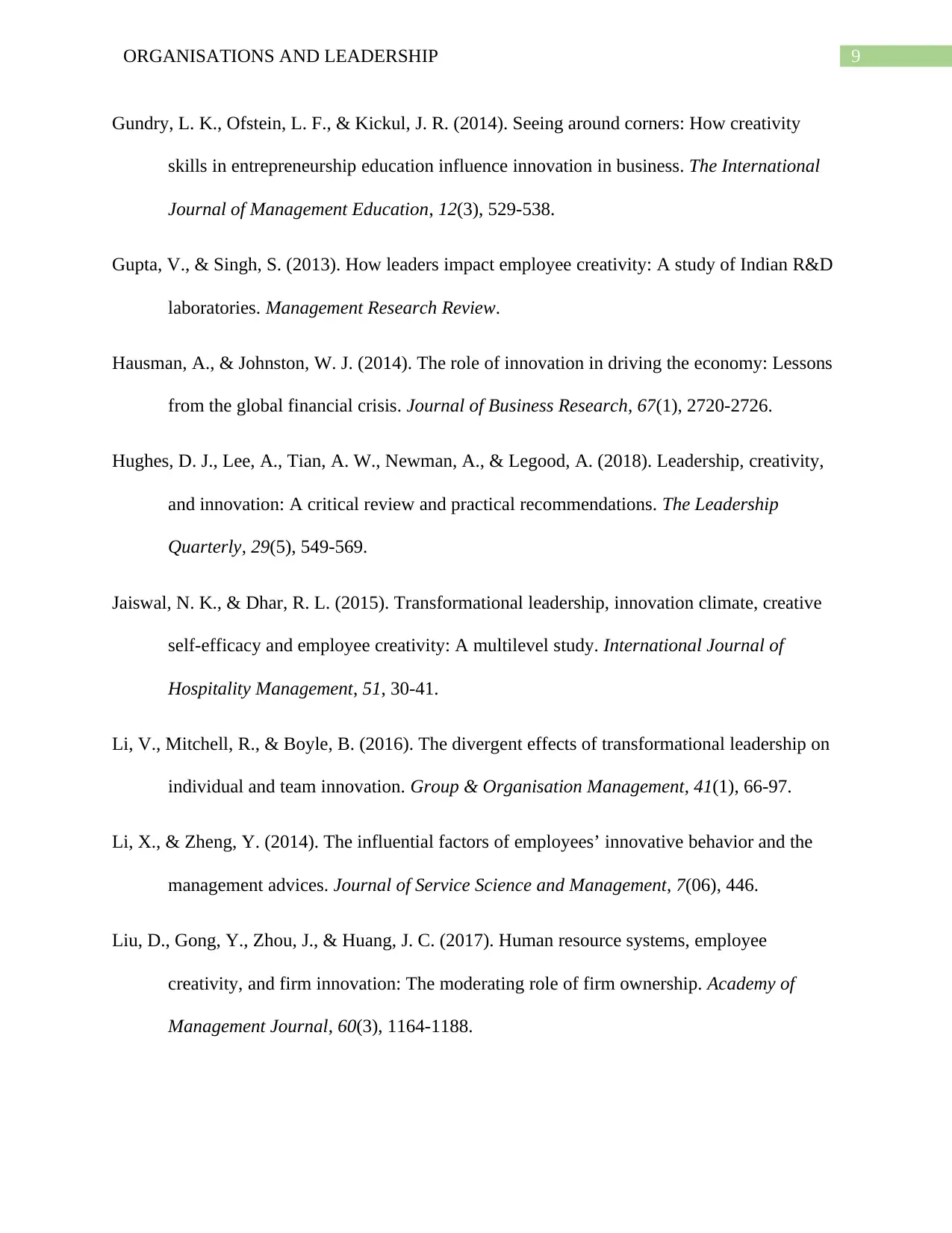
Gundry, L. K., Ofstein, L. F., & Kickul, J. R. (2014). Seeing around corners: How creativity
skills in entrepreneurship education influence innovation in business. The International
Journal of Management Education, 12(3), 529-538.
Gupta, V., & Singh, S. (2013). How leaders impact employee creativity: A study of Indian R&D
laboratories. Management Research Review.
Hausman, A., & Johnston, W. J. (2014). The role of innovation in driving the economy: Lessons
from the global financial crisis. Journal of Business Research, 67(1), 2720-2726.
Hughes, D. J., Lee, A., Tian, A. W., Newman, A., & Legood, A. (2018). Leadership, creativity,
and innovation: A critical review and practical recommendations. The Leadership
Quarterly, 29(5), 549-569.
Jaiswal, N. K., & Dhar, R. L. (2015). Transformational leadership, innovation climate, creative
self-efficacy and employee creativity: A multilevel study. International Journal of
Hospitality Management, 51, 30-41.
Li, V., Mitchell, R., & Boyle, B. (2016). The divergent effects of transformational leadership on
individual and team innovation. Group & Organisation Management, 41(1), 66-97.
Li, X., & Zheng, Y. (2014). The influential factors of employees’ innovative behavior and the
management advices. Journal of Service Science and Management, 7(06), 446.
Liu, D., Gong, Y., Zhou, J., & Huang, J. C. (2017). Human resource systems, employee
creativity, and firm innovation: The moderating role of firm ownership. Academy of
Management Journal, 60(3), 1164-1188.
Gundry, L. K., Ofstein, L. F., & Kickul, J. R. (2014). Seeing around corners: How creativity
skills in entrepreneurship education influence innovation in business. The International
Journal of Management Education, 12(3), 529-538.
Gupta, V., & Singh, S. (2013). How leaders impact employee creativity: A study of Indian R&D
laboratories. Management Research Review.
Hausman, A., & Johnston, W. J. (2014). The role of innovation in driving the economy: Lessons
from the global financial crisis. Journal of Business Research, 67(1), 2720-2726.
Hughes, D. J., Lee, A., Tian, A. W., Newman, A., & Legood, A. (2018). Leadership, creativity,
and innovation: A critical review and practical recommendations. The Leadership
Quarterly, 29(5), 549-569.
Jaiswal, N. K., & Dhar, R. L. (2015). Transformational leadership, innovation climate, creative
self-efficacy and employee creativity: A multilevel study. International Journal of
Hospitality Management, 51, 30-41.
Li, V., Mitchell, R., & Boyle, B. (2016). The divergent effects of transformational leadership on
individual and team innovation. Group & Organisation Management, 41(1), 66-97.
Li, X., & Zheng, Y. (2014). The influential factors of employees’ innovative behavior and the
management advices. Journal of Service Science and Management, 7(06), 446.
Liu, D., Gong, Y., Zhou, J., & Huang, J. C. (2017). Human resource systems, employee
creativity, and firm innovation: The moderating role of firm ownership. Academy of
Management Journal, 60(3), 1164-1188.
Paraphrase This Document
Need a fresh take? Get an instant paraphrase of this document with our AI Paraphraser

10ORGANISATIONS AND LEADERSHIP
Overstreet, R. E., Hanna, J. B., Byrd, T. A., Cegielski, C. G., & Hazen, B. T. (2013). Leadership
style and organisational innovativeness drive motor carriers toward sustained
performance. The International Journal of Logistics Management.
Overstreet, R. E., Hanna, J. B., Byrd, T. A., Cegielski, C. G., & Hazen, B. T. (2013). Leadership
style and organisational innovativeness drive motor carriers toward sustained
performance. The International Journal of Logistics Management.

1 out of 11


Related Documents


Your All-in-One AI-Powered Toolkit for Academic Success.
+13062052269
info@desklib.com
Available 24*7 on WhatsApp / Email
![[object Object]](/_next/static/media/star-bottom.7253800d.svg)
Unlock your academic potential
Copyright © 2020–2026 A2Z Services. All Rights Reserved. Developed and managed by ZUCOL.