Leadership Theory: A Review of Evolution and Applicability
VerifiedAdded on 2023/01/17
|11
|3058
|60
Report
AI Summary
This report presents a comprehensive literature review on the evolution and applicability of leadership theories. It begins by defining leadership and tracing its historical roots, starting with Max Weber's foundational work. The paper explores various leadership theories, including trait theory, behavioral theory, contingency theories, transformational and transactional leadership, participative leadership, goal setting theory, and need theories. Each theory is examined in detail, highlighting its core concepts, strengths, and weaknesses. The review synthesizes findings, comparing and contrasting different perspectives to provide a nuanced understanding of leadership styles and models. The report concludes by discussing the relevance of these theories in contemporary leadership practices, emphasizing their impact on employee motivation, organizational effectiveness, and overall leadership success. The paper utilizes numerous peer-reviewed journal articles to support its analysis, offering a robust and well-researched overview of the subject.
Running head: LEADERSHIP THEORY 1
LEADERSHIP THEORY
Student’s name
Date
Institution Affiliation
LEADERSHIP THEORY
Student’s name
Date
Institution Affiliation

Paraphrase This Document
Need a fresh take? Get an instant paraphrase of this document with our AI Paraphraser
LEADERSHIP THEORY 2
Leadership Theory
Thesis Statement
This summary examines the evolution and background of leadership theories and their
applicability in the current world. It emphasizes various leadership definitions and their several
theories that explain the history of this leadership.
Introduction
Various diverse studies discuss the origin of leadership. However, multiple topics such as
the power of leadership, decision making, and many more have enabled us to have a brief
understanding of leadership. Studies show that Max Weber is the father of leadership theory.
Weber expounds various leadership aspects such as status, authority, and legitimacy in the field
of military, region, and politics (Carasco, M & Kim,2015, Pg. 42). Furth more, he devoted
himself to ease the tension between leaders and bureaucracies.
For many years’ leadership theories has been the basis of the most studies. Even today,
many scholars have made more effort to define and expound what makes a true leader lead with
diligence. Thus, many theories have evolved, which try to explain the qualities of a kind and
useful leadership style. Various researchers, philosophers, and professors have come up and
published their theories which try to explain the contest of leadership(Northouse,2018).
Origin of Leadership
Scholars argue that before understanding the basis of formation of an organization and
society, it is good to think sensibly about the origin of that particular leadership (Cumerland et
al.,2016. Pg. 305). However, in leadership, the human relationship exists between two
Leadership Theory
Thesis Statement
This summary examines the evolution and background of leadership theories and their
applicability in the current world. It emphasizes various leadership definitions and their several
theories that explain the history of this leadership.
Introduction
Various diverse studies discuss the origin of leadership. However, multiple topics such as
the power of leadership, decision making, and many more have enabled us to have a brief
understanding of leadership. Studies show that Max Weber is the father of leadership theory.
Weber expounds various leadership aspects such as status, authority, and legitimacy in the field
of military, region, and politics (Carasco, M & Kim,2015, Pg. 42). Furth more, he devoted
himself to ease the tension between leaders and bureaucracies.
For many years’ leadership theories has been the basis of the most studies. Even today,
many scholars have made more effort to define and expound what makes a true leader lead with
diligence. Thus, many theories have evolved, which try to explain the qualities of a kind and
useful leadership style. Various researchers, philosophers, and professors have come up and
published their theories which try to explain the contest of leadership(Northouse,2018).
Origin of Leadership
Scholars argue that before understanding the basis of formation of an organization and
society, it is good to think sensibly about the origin of that particular leadership (Cumerland et
al.,2016. Pg. 305). However, in leadership, the human relationship exists between two
LEADERSHIP THEORY 3
individuals. Thus there is a perceived difference between the two. That difference may exist
when one individual has some qualities which the other person lacks. For example, one may be
competent or possess some other unique personal traits. Studies show that the difference leads to
the establishment of levels of hierarchy. Therefore, this makes it possible for a person to rule and
guide in particular areas and at the same limit him to rule in a different environment.
On the other hand, when they are no hierarchical difference, anarchy comes in. Anarchy
means leading without rules or sovereignty. Findings show that anarchy exists in two forms, that
is constructive and destructive anarchy. According to studies constructive anarchy is when
everyone supports any action taken, whereas, in destructive anarchy, people fight each other to
defend their own will (R, Hughes & Ford,2016). Thus, in hierarchical difference neither person
will dominate their will; they will agree on whatever decision comes through. Therefore, this is
the basis of organizations and states formation.
Evolution of Leadership Theories
Trait Theory
In the early 1920’s leadership, scholars tried to classify the traits that may differentiate
leaders and non-leaders. Basing on their research they found that the early leadership theories
focus mainly on how effective leader is, but they didn’t expound on how leaders should
effectively lead. Thus, they concluded that the certain social, physical and personal traits are
crucial in leaders (Wyatt & Silvester, 2018, pg. 620).
Lee (2018) conducted a study on the attributes of good leaders. In his research, he
suggested that leadership is about inherent qualities that a person possess when he is born. He
also suggested the need to identify good leadership traits; that differentiate between a leader and
individuals. Thus there is a perceived difference between the two. That difference may exist
when one individual has some qualities which the other person lacks. For example, one may be
competent or possess some other unique personal traits. Studies show that the difference leads to
the establishment of levels of hierarchy. Therefore, this makes it possible for a person to rule and
guide in particular areas and at the same limit him to rule in a different environment.
On the other hand, when they are no hierarchical difference, anarchy comes in. Anarchy
means leading without rules or sovereignty. Findings show that anarchy exists in two forms, that
is constructive and destructive anarchy. According to studies constructive anarchy is when
everyone supports any action taken, whereas, in destructive anarchy, people fight each other to
defend their own will (R, Hughes & Ford,2016). Thus, in hierarchical difference neither person
will dominate their will; they will agree on whatever decision comes through. Therefore, this is
the basis of organizations and states formation.
Evolution of Leadership Theories
Trait Theory
In the early 1920’s leadership, scholars tried to classify the traits that may differentiate
leaders and non-leaders. Basing on their research they found that the early leadership theories
focus mainly on how effective leader is, but they didn’t expound on how leaders should
effectively lead. Thus, they concluded that the certain social, physical and personal traits are
crucial in leaders (Wyatt & Silvester, 2018, pg. 620).
Lee (2018) conducted a study on the attributes of good leaders. In his research, he
suggested that leadership is about inherent qualities that a person possess when he is born. He
also suggested the need to identify good leadership traits; that differentiate between a leader and
⊘ This is a preview!⊘
Do you want full access?
Subscribe today to unlock all pages.

Trusted by 1+ million students worldwide
LEADERSHIP THEORY 4
a follower. Thus with this knowledge, great leaders can be identified and put in a leadership
position. In their research, they examined the physical, mental and personal characteristics of an
effective leader. However, the basis of their study was that great leaders were born, not made.
Thus, they suggested that the key to a successful organization aiming to get a great leader is to
identify those people that were born leaders not those who are made to be leaders.
However, the research on traits did not come into a better conclusion, on the best quality
that a great leader should possess. On the other hand, the traits theory examined dominant traits a
successful leader should possess. A successful leader should have self-drive, self-confidence,
knowledgeable, integrity, intelligence and desire to lead (Nawaz & Khan, 2016). However, the
traits theory does not give a piece of clear evidence as to whether these traits are inherent to
people or whether they acquire them through education and training. Thus this theory proves that
all leaders are not the same and they cannot have similar traits.
Behavioral Theory
Theorist conducted numerous research on the foundation of good leadership through
behavioral theory. Thus, they examined the determinants that a good leader should possess.
Therefore, they observed that people need the training to maintain the best leadership behaviors
(Bettinazzi, Massa & Neumann, 2019). To achieve the same, they performed a personality test
and compared the outcomes against those possessed by leaders. After conducting these research,
they developed a very long list of perceived traits from a variety of psychological studies:
However, through this method, they faced two major problems: first, the traits identified did not
predict the exact situation in leadership. Secondly, the qualities made a list to be huge as they
continued with their research.
a follower. Thus with this knowledge, great leaders can be identified and put in a leadership
position. In their research, they examined the physical, mental and personal characteristics of an
effective leader. However, the basis of their study was that great leaders were born, not made.
Thus, they suggested that the key to a successful organization aiming to get a great leader is to
identify those people that were born leaders not those who are made to be leaders.
However, the research on traits did not come into a better conclusion, on the best quality
that a great leader should possess. On the other hand, the traits theory examined dominant traits a
successful leader should possess. A successful leader should have self-drive, self-confidence,
knowledgeable, integrity, intelligence and desire to lead (Nawaz & Khan, 2016). However, the
traits theory does not give a piece of clear evidence as to whether these traits are inherent to
people or whether they acquire them through education and training. Thus this theory proves that
all leaders are not the same and they cannot have similar traits.
Behavioral Theory
Theorist conducted numerous research on the foundation of good leadership through
behavioral theory. Thus, they examined the determinants that a good leader should possess.
Therefore, they observed that people need the training to maintain the best leadership behaviors
(Bettinazzi, Massa & Neumann, 2019). To achieve the same, they performed a personality test
and compared the outcomes against those possessed by leaders. After conducting these research,
they developed a very long list of perceived traits from a variety of psychological studies:
However, through this method, they faced two major problems: first, the traits identified did not
predict the exact situation in leadership. Secondly, the qualities made a list to be huge as they
continued with their research.
Paraphrase This Document
Need a fresh take? Get an instant paraphrase of this document with our AI Paraphraser
LEADERSHIP THEORY 5
The behavioral theory also examines another major thrust which studies the leaders’
behavior to determine what precisely productive and successful leaders do. This study examines
the context under which leaders applies behavioral traits in the specific organization they are
working. According to the reviews, leaders should possess certain behaviors in immediate the
environment they work to enhance effectiveness in their leadership positions. Therefore, to
achieve the best leadership ever, theorist trained leaders through various training forums which
aim at empowering leaders to change their behavioral traits and provide effective leadership
ever. Research from the University of Michigan and Ohio leadership studies proved these
statement to be true (Swain, Cao & Gardner, 2018, pg. 122).
Contingency Theories
This theory argues that leadership is about the situation in which a leader exercise
leadership. It means that every leadership style depends on particular situations. Studies show
that specific individuals perform better in some places, but when taken to another site perform
they play very poor. Therefore, this theory is somehow related to trait theory; this is because
individual traits depend on the situation in which the individual is exercising the leadership.
However, according to contingency theory, individuals are more likely to use their leadership
better when they feel that their followers respond to the situation (Bachrach & Mullins, 2019,
pg.201).
Fiedler researched the concept of situational favorability, where he identified eight
categories of situational favorability. Additionally, he established a questionnaire which was
aimed to correct information which would measure leadership styles. In his research, he noted
that some leadership styles are more effective and efficient only in certain situations. Thus this
theory aided at categorizing leaders to situation environment that is conducive to them which
The behavioral theory also examines another major thrust which studies the leaders’
behavior to determine what precisely productive and successful leaders do. This study examines
the context under which leaders applies behavioral traits in the specific organization they are
working. According to the reviews, leaders should possess certain behaviors in immediate the
environment they work to enhance effectiveness in their leadership positions. Therefore, to
achieve the best leadership ever, theorist trained leaders through various training forums which
aim at empowering leaders to change their behavioral traits and provide effective leadership
ever. Research from the University of Michigan and Ohio leadership studies proved these
statement to be true (Swain, Cao & Gardner, 2018, pg. 122).
Contingency Theories
This theory argues that leadership is about the situation in which a leader exercise
leadership. It means that every leadership style depends on particular situations. Studies show
that specific individuals perform better in some places, but when taken to another site perform
they play very poor. Therefore, this theory is somehow related to trait theory; this is because
individual traits depend on the situation in which the individual is exercising the leadership.
However, according to contingency theory, individuals are more likely to use their leadership
better when they feel that their followers respond to the situation (Bachrach & Mullins, 2019,
pg.201).
Fiedler researched the concept of situational favorability, where he identified eight
categories of situational favorability. Additionally, he established a questionnaire which was
aimed to correct information which would measure leadership styles. In his research, he noted
that some leadership styles are more effective and efficient only in certain situations. Thus this
theory aided at categorizing leaders to situation environment that is conducive to them which
LEADERSHIP THEORY 6
enhance a leader practice his leadership style most effectively. Scholars argued that the managers
might have the best attitudes, but on the other hand, they cannot practice suitable leadership
style.
Transformational Leadership Theories
This theory shows that when individuals interact with one another, they develop a
mutual relationship. In return, the individual build trust with each other which motivates both
leaders and followers. Transformation theory shows how leaders transform and inspire their
followers. Also, the leader makes sure that the rules and regulation are flexible to favor the
followers. Thus, they make followers develop a sense of belonging and can collaborate with the
leader to make decisions (Hoch et al.,2018, Pg. 511).
Transactional leadership theories
These theories are also known as exchange theories. It means that leaders and followers
develop a transaction between them. Thus these theories are aimed at developing a beneficial
relationship between the leader and the followers. However, the transactional approach should be
practical; therefore, the leader should improve a rewarding and enforcement environment;
rewards are given to subordinates when they perform better (Cho et al.,2019, Pg. 13). Finally, the
individual goals should be integrated with the organization goals to achieve a balance between
the two.
Participative Leadership Theory
Various Scholars have evaluated and proposed participative leadership theory. Thus they
argued that participative leadership theory describes distinct leadership style. Firstly, a leader
should have exploitative authority (Evan et al.,2019, Pg. 77). In this style, a leader makes
enhance a leader practice his leadership style most effectively. Scholars argued that the managers
might have the best attitudes, but on the other hand, they cannot practice suitable leadership
style.
Transformational Leadership Theories
This theory shows that when individuals interact with one another, they develop a
mutual relationship. In return, the individual build trust with each other which motivates both
leaders and followers. Transformation theory shows how leaders transform and inspire their
followers. Also, the leader makes sure that the rules and regulation are flexible to favor the
followers. Thus, they make followers develop a sense of belonging and can collaborate with the
leader to make decisions (Hoch et al.,2018, Pg. 511).
Transactional leadership theories
These theories are also known as exchange theories. It means that leaders and followers
develop a transaction between them. Thus these theories are aimed at developing a beneficial
relationship between the leader and the followers. However, the transactional approach should be
practical; therefore, the leader should improve a rewarding and enforcement environment;
rewards are given to subordinates when they perform better (Cho et al.,2019, Pg. 13). Finally, the
individual goals should be integrated with the organization goals to achieve a balance between
the two.
Participative Leadership Theory
Various Scholars have evaluated and proposed participative leadership theory. Thus they
argued that participative leadership theory describes distinct leadership style. Firstly, a leader
should have exploitative authority (Evan et al.,2019, Pg. 77). In this style, a leader makes
⊘ This is a preview!⊘
Do you want full access?
Subscribe today to unlock all pages.
Trusted by 1+ million students worldwide
LEADERSHIP THEORY 7
significant decisions without consulting the followers or subordinates. Secondly, the leader
should be benevolent authoritative; it means a leader is concerned with employees and their
reward, but he makes all the decisions alone.
Also, the leader develops a consultative approach; thus he listens to ideas from the subordinates,
but he makes ultimate decisions. Finally, the leader develops a participative approach; in this
approach, he listens to employees’ grievances, listens to their ideas and includes them when
making decisions. Thus participative readership is a vital aspect to any leader.
Goal Setting Theory
Research shows that the goal setting theory focuses on the fact that leaders and
individuals are motivated to achieve their desired goals. Also, it suggests that people have
various intentions that compel their behaviors. A theorist of this theory carried research on this
theory. They found that when leaders set high individual goals, they are more likely to perform
effectively in their respective organizations, rather than when a leader has no set goals or setting
“do your self-goals.” However, they also found that there is a close relationship between
performance and the difficulties which a leader encounters on those goals (Weissbrod, 2019,
P.g.143). Therefore, when a leader sets higher goals, those goals will drive him to perform more
effective, thus attain the desired goals.
On the other hand, various variables determine the performance of a leader; for instance,
participation in decision making, competition; and feedback. Therefore, these variables guide
and help a leader to set higher goals which ultimately leads to higher performance and
commitment to the set goals. Moreover, they suggested that there are three significant
determinants of effective leadership; that is persistence, effort, and motivation. These
significant decisions without consulting the followers or subordinates. Secondly, the leader
should be benevolent authoritative; it means a leader is concerned with employees and their
reward, but he makes all the decisions alone.
Also, the leader develops a consultative approach; thus he listens to ideas from the subordinates,
but he makes ultimate decisions. Finally, the leader develops a participative approach; in this
approach, he listens to employees’ grievances, listens to their ideas and includes them when
making decisions. Thus participative readership is a vital aspect to any leader.
Goal Setting Theory
Research shows that the goal setting theory focuses on the fact that leaders and
individuals are motivated to achieve their desired goals. Also, it suggests that people have
various intentions that compel their behaviors. A theorist of this theory carried research on this
theory. They found that when leaders set high individual goals, they are more likely to perform
effectively in their respective organizations, rather than when a leader has no set goals or setting
“do your self-goals.” However, they also found that there is a close relationship between
performance and the difficulties which a leader encounters on those goals (Weissbrod, 2019,
P.g.143). Therefore, when a leader sets higher goals, those goals will drive him to perform more
effective, thus attain the desired goals.
On the other hand, various variables determine the performance of a leader; for instance,
participation in decision making, competition; and feedback. Therefore, these variables guide
and help a leader to set higher goals which ultimately leads to higher performance and
commitment to the set goals. Moreover, they suggested that there are three significant
determinants of effective leadership; that is persistence, effort, and motivation. These
Paraphrase This Document
Need a fresh take? Get an instant paraphrase of this document with our AI Paraphraser
LEADERSHIP THEORY 8
determinants also drive a leader to set a higher goal. They concluded that there are specific
moderators that have an impact on the purpose of effective performance — for example, ability,
dealing with situational constrictions, task difficulty, and feedback (Locke & Latham, 2015,
Pg.103).
Need Theories
In these theories, people will always have needs to attain particular objectives. Therefore,
these needs drive them to get better satisfaction on those needs. In this study, Maslow
recommended that there is a need to have a hierarchy of needs whereby needs vary from the
most important one to the least important one. For example, he suggested that safety and
physiological needs motivate people to acquire and satisfy their needs. On the other hand, self-
actualization, belongingness, and self-esteem should not be necessarily essential to obtain.
A theorist researched the need theories. He found that three primary needs should drive
anybody aspiring to lead. These needs are; the growth needs, existence needs and relatedness
needs. He further observed that people could move hierarchically according to those needs; thus
they, get enough motivation to achieve the desired requirements (Jensen & Bro, 2018, Pg. 533).
Murray’s also come up with another need theory in 1938. In his opinion, he suggested
that people always have a wide range of needs. For instance, they may experience the need for
power, the need for achievement and the need for affiliation. He also observed that people’s
needs are not always the same. However, people’s needs mainly depend on the surrounding or
the environment in which a person is working. Thus, concerning leadership, various jobs always
satisfy specific needs. However, the question would be to whether a leader can fill satisfaction in
an environment where he is supposed to meet people immediate needs (Miner, 2015).
determinants also drive a leader to set a higher goal. They concluded that there are specific
moderators that have an impact on the purpose of effective performance — for example, ability,
dealing with situational constrictions, task difficulty, and feedback (Locke & Latham, 2015,
Pg.103).
Need Theories
In these theories, people will always have needs to attain particular objectives. Therefore,
these needs drive them to get better satisfaction on those needs. In this study, Maslow
recommended that there is a need to have a hierarchy of needs whereby needs vary from the
most important one to the least important one. For example, he suggested that safety and
physiological needs motivate people to acquire and satisfy their needs. On the other hand, self-
actualization, belongingness, and self-esteem should not be necessarily essential to obtain.
A theorist researched the need theories. He found that three primary needs should drive
anybody aspiring to lead. These needs are; the growth needs, existence needs and relatedness
needs. He further observed that people could move hierarchically according to those needs; thus
they, get enough motivation to achieve the desired requirements (Jensen & Bro, 2018, Pg. 533).
Murray’s also come up with another need theory in 1938. In his opinion, he suggested
that people always have a wide range of needs. For instance, they may experience the need for
power, the need for achievement and the need for affiliation. He also observed that people’s
needs are not always the same. However, people’s needs mainly depend on the surrounding or
the environment in which a person is working. Thus, concerning leadership, various jobs always
satisfy specific needs. However, the question would be to whether a leader can fill satisfaction in
an environment where he is supposed to meet people immediate needs (Miner, 2015).
LEADERSHIP THEORY 9
Conclusion
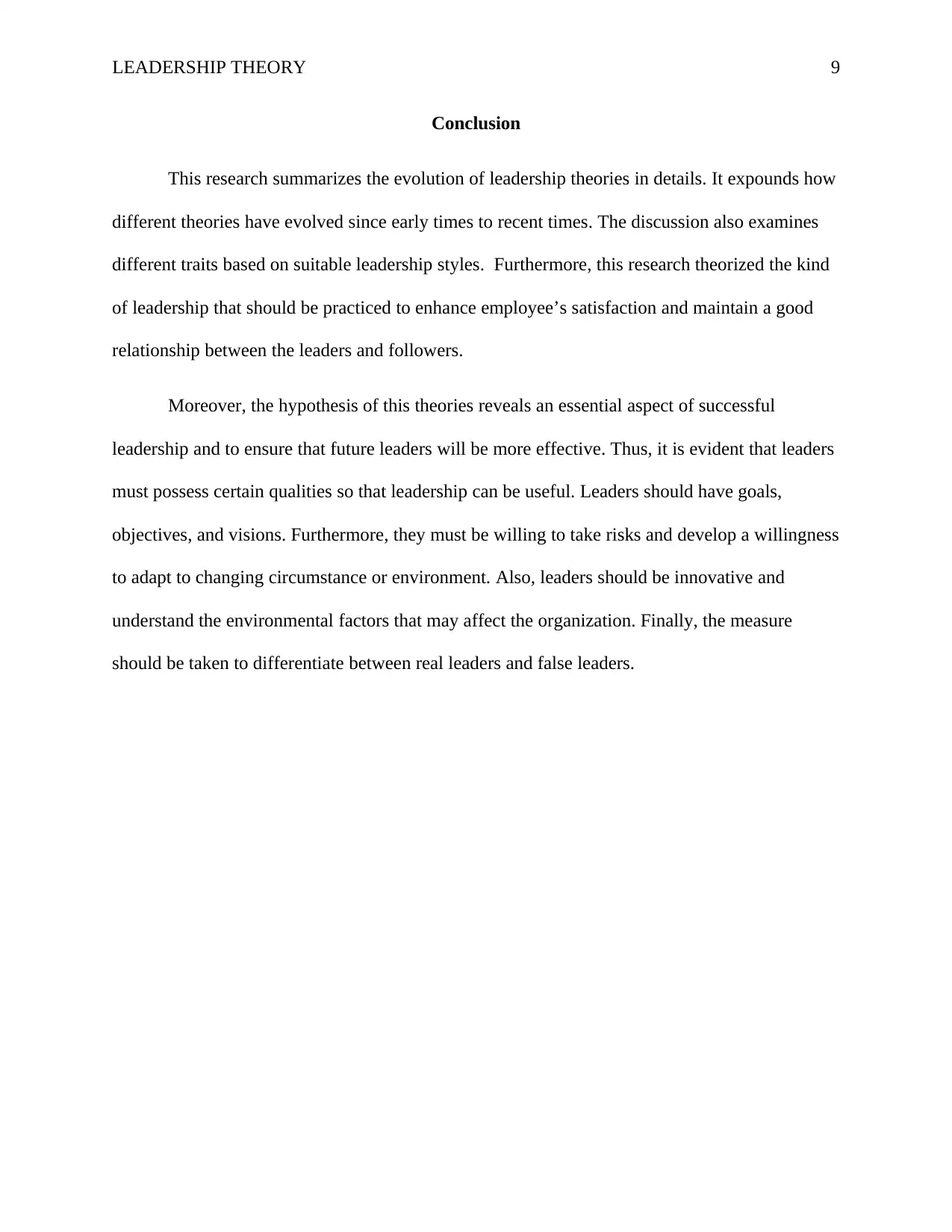
This research summarizes the evolution of leadership theories in details. It expounds how
different theories have evolved since early times to recent times. The discussion also examines
different traits based on suitable leadership styles. Furthermore, this research theorized the kind
of leadership that should be practiced to enhance employee’s satisfaction and maintain a good
relationship between the leaders and followers.
Moreover, the hypothesis of this theories reveals an essential aspect of successful
leadership and to ensure that future leaders will be more effective. Thus, it is evident that leaders
must possess certain qualities so that leadership can be useful. Leaders should have goals,
objectives, and visions. Furthermore, they must be willing to take risks and develop a willingness
to adapt to changing circumstance or environment. Also, leaders should be innovative and
understand the environmental factors that may affect the organization. Finally, the measure
should be taken to differentiate between real leaders and false leaders.
Conclusion
This research summarizes the evolution of leadership theories in details. It expounds how
different theories have evolved since early times to recent times. The discussion also examines
different traits based on suitable leadership styles. Furthermore, this research theorized the kind
of leadership that should be practiced to enhance employee’s satisfaction and maintain a good
relationship between the leaders and followers.
Moreover, the hypothesis of this theories reveals an essential aspect of successful
leadership and to ensure that future leaders will be more effective. Thus, it is evident that leaders
must possess certain qualities so that leadership can be useful. Leaders should have goals,
objectives, and visions. Furthermore, they must be willing to take risks and develop a willingness
to adapt to changing circumstance or environment. Also, leaders should be innovative and
understand the environmental factors that may affect the organization. Finally, the measure
should be taken to differentiate between real leaders and false leaders.
⊘ This is a preview!⊘
Do you want full access?
Subscribe today to unlock all pages.
Trusted by 1+ million students worldwide
LEADERSHIP THEORY 10
References
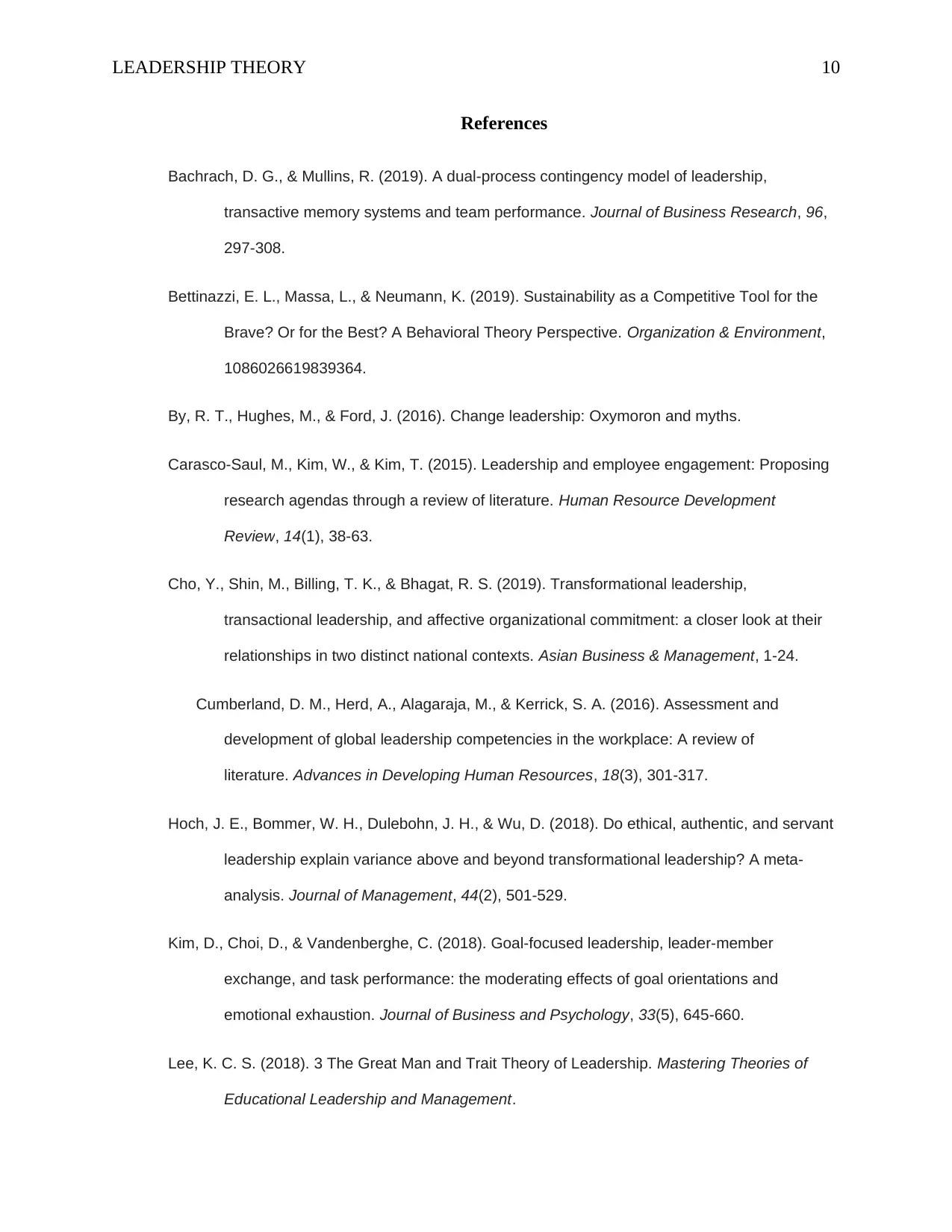
Bachrach, D. G., & Mullins, R. (2019). A dual-process contingency model of leadership,
transactive memory systems and team performance. Journal of Business Research, 96,
297-308.
Bettinazzi, E. L., Massa, L., & Neumann, K. (2019). Sustainability as a Competitive Tool for the
Brave? Or for the Best? A Behavioral Theory Perspective. Organization & Environment,
1086026619839364.
By, R. T., Hughes, M., & Ford, J. (2016). Change leadership: Oxymoron and myths.
Carasco-Saul, M., Kim, W., & Kim, T. (2015). Leadership and employee engagement: Proposing
research agendas through a review of literature. Human Resource Development
Review, 14(1), 38-63.
Cho, Y., Shin, M., Billing, T. K., & Bhagat, R. S. (2019). Transformational leadership,
transactional leadership, and affective organizational commitment: a closer look at their
relationships in two distinct national contexts. Asian Business & Management, 1-24.
Cumberland, D. M., Herd, A., Alagaraja, M., & Kerrick, S. A. (2016). Assessment and
development of global leadership competencies in the workplace: A review of
literature. Advances in Developing Human Resources, 18(3), 301-317.
Hoch, J. E., Bommer, W. H., Dulebohn, J. H., & Wu, D. (2018). Do ethical, authentic, and servant
leadership explain variance above and beyond transformational leadership? A meta-
analysis. Journal of Management, 44(2), 501-529.
Kim, D., Choi, D., & Vandenberghe, C. (2018). Goal-focused leadership, leader-member
exchange, and task performance: the moderating effects of goal orientations and
emotional exhaustion. Journal of Business and Psychology, 33(5), 645-660.
Lee, K. C. S. (2018). 3 The Great Man and Trait Theory of Leadership. Mastering Theories of
Educational Leadership and Management.
References
Bachrach, D. G., & Mullins, R. (2019). A dual-process contingency model of leadership,
transactive memory systems and team performance. Journal of Business Research, 96,
297-308.
Bettinazzi, E. L., Massa, L., & Neumann, K. (2019). Sustainability as a Competitive Tool for the
Brave? Or for the Best? A Behavioral Theory Perspective. Organization & Environment,
1086026619839364.
By, R. T., Hughes, M., & Ford, J. (2016). Change leadership: Oxymoron and myths.
Carasco-Saul, M., Kim, W., & Kim, T. (2015). Leadership and employee engagement: Proposing
research agendas through a review of literature. Human Resource Development
Review, 14(1), 38-63.
Cho, Y., Shin, M., Billing, T. K., & Bhagat, R. S. (2019). Transformational leadership,
transactional leadership, and affective organizational commitment: a closer look at their
relationships in two distinct national contexts. Asian Business & Management, 1-24.
Cumberland, D. M., Herd, A., Alagaraja, M., & Kerrick, S. A. (2016). Assessment and
development of global leadership competencies in the workplace: A review of
literature. Advances in Developing Human Resources, 18(3), 301-317.
Hoch, J. E., Bommer, W. H., Dulebohn, J. H., & Wu, D. (2018). Do ethical, authentic, and servant
leadership explain variance above and beyond transformational leadership? A meta-
analysis. Journal of Management, 44(2), 501-529.
Kim, D., Choi, D., & Vandenberghe, C. (2018). Goal-focused leadership, leader-member
exchange, and task performance: the moderating effects of goal orientations and
emotional exhaustion. Journal of Business and Psychology, 33(5), 645-660.
Lee, K. C. S. (2018). 3 The Great Man and Trait Theory of Leadership. Mastering Theories of
Educational Leadership and Management.
Paraphrase This Document
Need a fresh take? Get an instant paraphrase of this document with our AI Paraphraser
LEADERSHIP THEORY 11
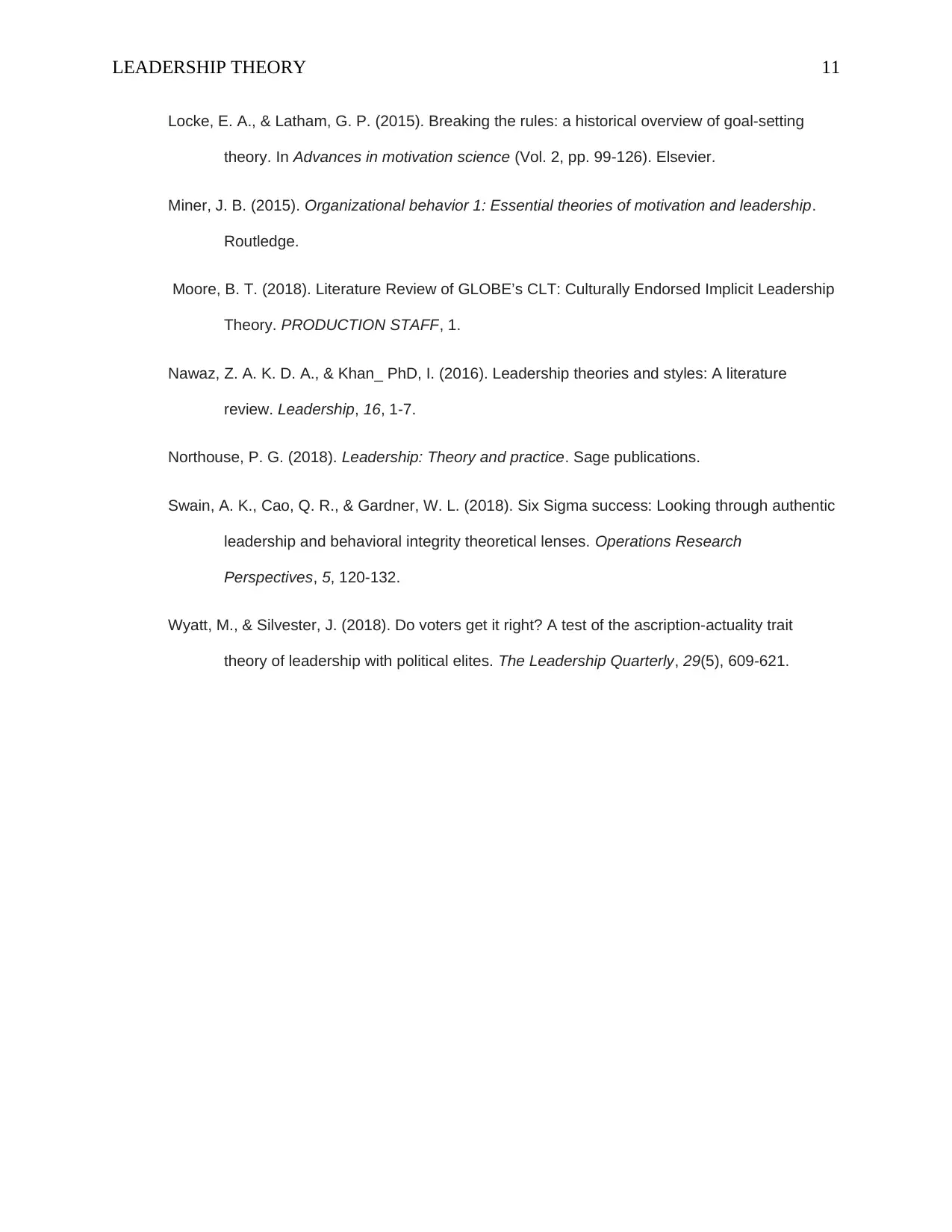
Locke, E. A., & Latham, G. P. (2015). Breaking the rules: a historical overview of goal-setting
theory. In Advances in motivation science (Vol. 2, pp. 99-126). Elsevier.
Miner, J. B. (2015). Organizational behavior 1: Essential theories of motivation and leadership.
Routledge.
Moore, B. T. (2018). Literature Review of GLOBE’s CLT: Culturally Endorsed Implicit Leadership
Theory. PRODUCTION STAFF, 1.
Nawaz, Z. A. K. D. A., & Khan_ PhD, I. (2016). Leadership theories and styles: A literature
review. Leadership, 16, 1-7.
Northouse, P. G. (2018). Leadership: Theory and practice. Sage publications.
Swain, A. K., Cao, Q. R., & Gardner, W. L. (2018). Six Sigma success: Looking through authentic
leadership and behavioral integrity theoretical lenses. Operations Research
Perspectives, 5, 120-132.
Wyatt, M., & Silvester, J. (2018). Do voters get it right? A test of the ascription-actuality trait
theory of leadership with political elites. The Leadership Quarterly, 29(5), 609-621.
Locke, E. A., & Latham, G. P. (2015). Breaking the rules: a historical overview of goal-setting
theory. In Advances in motivation science (Vol. 2, pp. 99-126). Elsevier.
Miner, J. B. (2015). Organizational behavior 1: Essential theories of motivation and leadership.
Routledge.
Moore, B. T. (2018). Literature Review of GLOBE’s CLT: Culturally Endorsed Implicit Leadership
Theory. PRODUCTION STAFF, 1.
Nawaz, Z. A. K. D. A., & Khan_ PhD, I. (2016). Leadership theories and styles: A literature
review. Leadership, 16, 1-7.
Northouse, P. G. (2018). Leadership: Theory and practice. Sage publications.
Swain, A. K., Cao, Q. R., & Gardner, W. L. (2018). Six Sigma success: Looking through authentic
leadership and behavioral integrity theoretical lenses. Operations Research
Perspectives, 5, 120-132.
Wyatt, M., & Silvester, J. (2018). Do voters get it right? A test of the ascription-actuality trait
theory of leadership with political elites. The Leadership Quarterly, 29(5), 609-621.

1 out of 11


Related Documents


Your All-in-One AI-Powered Toolkit for Academic Success.
+13062052269
info@desklib.com
Available 24*7 on WhatsApp / Email
![[object Object]](/_next/static/media/star-bottom.7253800d.svg)
Unlock your academic potential
Copyright © 2020–2026 A2Z Services. All Rights Reserved. Developed and managed by ZUCOL.