Analysis of Behavioral Approaches to Work and Society: Leadership
VerifiedAdded on 2021/06/17
|9
|3213
|466
Essay
AI Summary
This essay delves into the multifaceted realm of leadership, examining its crucial role in guiding individuals and organizations towards achieving long-term objectives. It explores various leadership styles and theories, including trait theory, behavioral theory, transactional theory, transformational leadership theory, contingency theory, and path-goal theory, highlighting their unique characteristics and applications in the workplace. The essay emphasizes the importance of leadership in fostering employee engagement, innovation, and productivity. It also provides real-world examples of effective leaders and their approaches. The essay discusses the impact of leadership on maintaining a competitive edge in the global market. The essay underscores the significance of communication, motivation, and delegation in building strong relationships with employees and achieving organizational success. The work also considers the importance of adapting leadership styles to different situations to address the challenges and risks associated with globalization and technological changes.

Running head: Behavioral approaches to work and society
Behavioral approaches to work and society
Behavioral approaches to work and society

Paraphrase This Document
Need a fresh take? Get an instant paraphrase of this document with our AI Paraphraser
Behavioral approaches to work and society
Leaders are the motivated and communicator who provides support to their followers.
Various leadership styles and theories are initiated by the leaders at the workplace. Leadership
provides right and suitable direction in the firm and set the favorable examples for their workers.
On the other hand, leadership may be defined as an ability to set the goals and attain these goals
by monitoring the challenges and risks. The paper explains that how leaders influence the
capacity and potential of the workers by using dynamic leadership theories. Coordination plays
an effective role in leadership which is maintained by the leader in the workplace to conduct
business in a hassle-free manner. Some examples of effective leaders have been explained in the
task. More detail of the task has been discussed below.
Leadership is the action and process of leading a group of people or an organization to
attain long-term goals and objectives. Leadership is an art to guide and assist the employees for
doing work effectively and efficiently (Jackson & Parry, 2011). As an entrepreneur, leadership is
the most significant part of the job and employment. Along with this, globalization is placing
new desires and demands on today’s corporate and effective leaders. The organizations continue
to expand, flourish and operate in a more virtual and dynamic environment, executives are being
asked to provide assistance and guidance to teams working across the time zones and distances
(Summerfield, 2014). Furthermore, the modern environment is required leaders to make sense of
maximizing disparate sources of facts, information and make effective decisions quickly. One of
the effective and dynamic factors that affect employee innovation and creativity is leadership.
However, raising globalization, competition, and pace of technological change hamper’s efforts
in incorporating the essential work environment for the innovation and creativity of the workers.
Leadership plays an empirical role in each and every organization to gain the competitive
advantages in the marketplace (Bolman & Deal, 2017). It shall be noted that leadership is a
function which is most significant at all levels of the management. In the top level, it is
significant for getting cooperation and coordination in the formulation of policies and plans
(Jackson, 2011). In the middle and lower level, it is essential for completion and interpretation of
programmers, plans, and policies designed by the top management. Along with this, it shall be
stated that leadership can be initiated through counseling and direction of the employees at the
execution of time (Antonakis & Day, 2017).
2
Leaders are the motivated and communicator who provides support to their followers.
Various leadership styles and theories are initiated by the leaders at the workplace. Leadership
provides right and suitable direction in the firm and set the favorable examples for their workers.
On the other hand, leadership may be defined as an ability to set the goals and attain these goals
by monitoring the challenges and risks. The paper explains that how leaders influence the
capacity and potential of the workers by using dynamic leadership theories. Coordination plays
an effective role in leadership which is maintained by the leader in the workplace to conduct
business in a hassle-free manner. Some examples of effective leaders have been explained in the
task. More detail of the task has been discussed below.
Leadership is the action and process of leading a group of people or an organization to
attain long-term goals and objectives. Leadership is an art to guide and assist the employees for
doing work effectively and efficiently (Jackson & Parry, 2011). As an entrepreneur, leadership is
the most significant part of the job and employment. Along with this, globalization is placing
new desires and demands on today’s corporate and effective leaders. The organizations continue
to expand, flourish and operate in a more virtual and dynamic environment, executives are being
asked to provide assistance and guidance to teams working across the time zones and distances
(Summerfield, 2014). Furthermore, the modern environment is required leaders to make sense of
maximizing disparate sources of facts, information and make effective decisions quickly. One of
the effective and dynamic factors that affect employee innovation and creativity is leadership.
However, raising globalization, competition, and pace of technological change hamper’s efforts
in incorporating the essential work environment for the innovation and creativity of the workers.
Leadership plays an empirical role in each and every organization to gain the competitive
advantages in the marketplace (Bolman & Deal, 2017). It shall be noted that leadership is a
function which is most significant at all levels of the management. In the top level, it is
significant for getting cooperation and coordination in the formulation of policies and plans
(Jackson, 2011). In the middle and lower level, it is essential for completion and interpretation of
programmers, plans, and policies designed by the top management. Along with this, it shall be
stated that leadership can be initiated through counseling and direction of the employees at the
execution of time (Antonakis & Day, 2017).
2
Behavioral approaches to work and society
It is noted that a manager and leader is said to the representative of the company. Leader
has to represent the concern and issue at conferences, seminars, and general meetings etc.
Moreover, he is also representative of the own department which he operates and leads. In this
way, an organization has been able to accomplish the long-term goals and objectives. It will also
help in overcoming the competitors in the global market (Vaccaro, Jansen, Van Den Bosch &
Volberda, 2012). A leader is a manager who invites and entertains cooperation and support of the
employees. This can be done by leader’s personality, maturity, talent, skills, intelligence and
experience which can provide them positive outcomes and result. In this regard, leaders
investigate and identify plans, policies, and strategies to stay in the competitive market. Apart
from this, it is stated that maintaining and creating sustainable and effective business require an
understanding and identifying the role of the leadership in addressing the personal outputs of the
subordinates (Hatch, 2018). It should be analyzed that leaders are individuals who set up
direction and assistance for the employees and who attain obligation from this group of members
to established assistance and who then encourage the employees for attaining the desired
objectives and goals. They treat their workers with respect and on the other hand, they provide
motivation to the workers for improving their performance and productivity. Apart from this,
leadership establishes core values and principles within the organization. Leaders also motivate
and encourage professional and personal growth. People can easily become demotivated and
frustrated if the manager and leaders are constantly shutting down any new recommendations
and suggestions (Selznick, 2011). The leaders also communicate with subordinates to conduct
business operations and activities. In the modern world, the company rely on their managers and
leaders to facilitate the innovation and changes essential to stay in the competitive market. The
leader is the person who creates an order of chaos and navigates the company through effective
leadership. It shall be noted that leader influence the subordinates in many ways including
communicating, rewarding, motivating, training and coordinating. It is argued that leadership is a
tool to meet the long-term mission and vision. The growth and success of the company are
reliant on the managers and leaders capability to utilize the human resources and capital. There is
a close relationship between leadership and employee engagement. The leaders provide training
and development coaching to the employees for improving and enhancing the employee
engagement in the organization (Chemers, 2014).
3
It is noted that a manager and leader is said to the representative of the company. Leader
has to represent the concern and issue at conferences, seminars, and general meetings etc.
Moreover, he is also representative of the own department which he operates and leads. In this
way, an organization has been able to accomplish the long-term goals and objectives. It will also
help in overcoming the competitors in the global market (Vaccaro, Jansen, Van Den Bosch &
Volberda, 2012). A leader is a manager who invites and entertains cooperation and support of the
employees. This can be done by leader’s personality, maturity, talent, skills, intelligence and
experience which can provide them positive outcomes and result. In this regard, leaders
investigate and identify plans, policies, and strategies to stay in the competitive market. Apart
from this, it is stated that maintaining and creating sustainable and effective business require an
understanding and identifying the role of the leadership in addressing the personal outputs of the
subordinates (Hatch, 2018). It should be analyzed that leaders are individuals who set up
direction and assistance for the employees and who attain obligation from this group of members
to established assistance and who then encourage the employees for attaining the desired
objectives and goals. They treat their workers with respect and on the other hand, they provide
motivation to the workers for improving their performance and productivity. Apart from this,
leadership establishes core values and principles within the organization. Leaders also motivate
and encourage professional and personal growth. People can easily become demotivated and
frustrated if the manager and leaders are constantly shutting down any new recommendations
and suggestions (Selznick, 2011). The leaders also communicate with subordinates to conduct
business operations and activities. In the modern world, the company rely on their managers and
leaders to facilitate the innovation and changes essential to stay in the competitive market. The
leader is the person who creates an order of chaos and navigates the company through effective
leadership. It shall be noted that leader influence the subordinates in many ways including
communicating, rewarding, motivating, training and coordinating. It is argued that leadership is a
tool to meet the long-term mission and vision. The growth and success of the company are
reliant on the managers and leaders capability to utilize the human resources and capital. There is
a close relationship between leadership and employee engagement. The leaders provide training
and development coaching to the employees for improving and enhancing the employee
engagement in the organization (Chemers, 2014).
3
⊘ This is a preview!⊘
Do you want full access?
Subscribe today to unlock all pages.

Trusted by 1+ million students worldwide
Behavioral approaches to work and society
Let’s talk about the theories, various effective and unique theories are initiated by the
leaders at the workplace in order to encourage and inspire the followers for doing work in a
hassle-free manner. Some of the leadership theories have been stated below.
Trait theory: This theory may be defined as an approach to the study of human personality and
traits. This theory measures and analyzes the traits and characteristics of individuals that can be
defined as a behavior, emotion, and thoughts (Chemers, 2014). Under this theory, leaders share
their traits, ideas, and opinion with subordinates to motivate and inspire them for bettering and
improving the productivity and performance. The leadership traits include energy, height,
appearance, adaptability, aggressiveness, self-confidence, morale, cooperation and
communication (Miner, 2015).
Behavioral theory: One of the significant and essential theories is a behavioral theory which
helps in boosting and developing the morale and confidence of the workers. After the various
studied, it shall be noted that this theory tries to study and analyze the behavioral aspect of
dynamic and effective leaders and managers. It analyzes and measures whether how the leaders
delegate tasks, how they motivate and communicate with workers and how they hold their tasks
and duties. This theory is beneficial for both leaders and employees as well. In this way, this
leadership plays an empirical role in each and every company for the maximizing the outputs and
results (Chhokar, Brodbeck & House, 2013).
Transactional theory: This theory focuses on the organization, supervision, and performance of
the workers as well as leaders. It is an effective theory of leadership in which leaders and
managers promote and encourage compliance by subordinates through punishments and rewards.
This theory is dynamic in motivating and inspiring the workers in becoming efficient and
productive within the organization. This theory follows the principles of punishment and rewards
in which an act and action that is good will merit a reward and bonus while the opposite can
result to a disciplinary action. This type of leadership includes structure and framework that
employees need to follow. It makes employees responsible towards their roles and
responsibilities. Based on reward and punishment, this leadership theory is dynamic and
effective in encouraging the workers at the workplace. Short term planning is done by the leaders
by using transactional leadership theory. Apart from this, transactional leadership theory has also
comprised a structure or framework that is concise and effective for the workers. This framework
4
Let’s talk about the theories, various effective and unique theories are initiated by the
leaders at the workplace in order to encourage and inspire the followers for doing work in a
hassle-free manner. Some of the leadership theories have been stated below.
Trait theory: This theory may be defined as an approach to the study of human personality and
traits. This theory measures and analyzes the traits and characteristics of individuals that can be
defined as a behavior, emotion, and thoughts (Chemers, 2014). Under this theory, leaders share
their traits, ideas, and opinion with subordinates to motivate and inspire them for bettering and
improving the productivity and performance. The leadership traits include energy, height,
appearance, adaptability, aggressiveness, self-confidence, morale, cooperation and
communication (Miner, 2015).
Behavioral theory: One of the significant and essential theories is a behavioral theory which
helps in boosting and developing the morale and confidence of the workers. After the various
studied, it shall be noted that this theory tries to study and analyze the behavioral aspect of
dynamic and effective leaders and managers. It analyzes and measures whether how the leaders
delegate tasks, how they motivate and communicate with workers and how they hold their tasks
and duties. This theory is beneficial for both leaders and employees as well. In this way, this
leadership plays an empirical role in each and every company for the maximizing the outputs and
results (Chhokar, Brodbeck & House, 2013).
Transactional theory: This theory focuses on the organization, supervision, and performance of
the workers as well as leaders. It is an effective theory of leadership in which leaders and
managers promote and encourage compliance by subordinates through punishments and rewards.
This theory is dynamic in motivating and inspiring the workers in becoming efficient and
productive within the organization. This theory follows the principles of punishment and rewards
in which an act and action that is good will merit a reward and bonus while the opposite can
result to a disciplinary action. This type of leadership includes structure and framework that
employees need to follow. It makes employees responsible towards their roles and
responsibilities. Based on reward and punishment, this leadership theory is dynamic and
effective in encouraging the workers at the workplace. Short term planning is done by the leaders
by using transactional leadership theory. Apart from this, transactional leadership theory has also
comprised a structure or framework that is concise and effective for the workers. This framework
4
Paraphrase This Document
Need a fresh take? Get an instant paraphrase of this document with our AI Paraphraser
Behavioral approaches to work and society
helps the employees for doing without facing any issue and challenge at the workplace. It shall
be noted that this leadership theory is effective and unique when it comes to maximize
productivity and reduce the costs of the firm. In this leadership theory, goals and objectives are
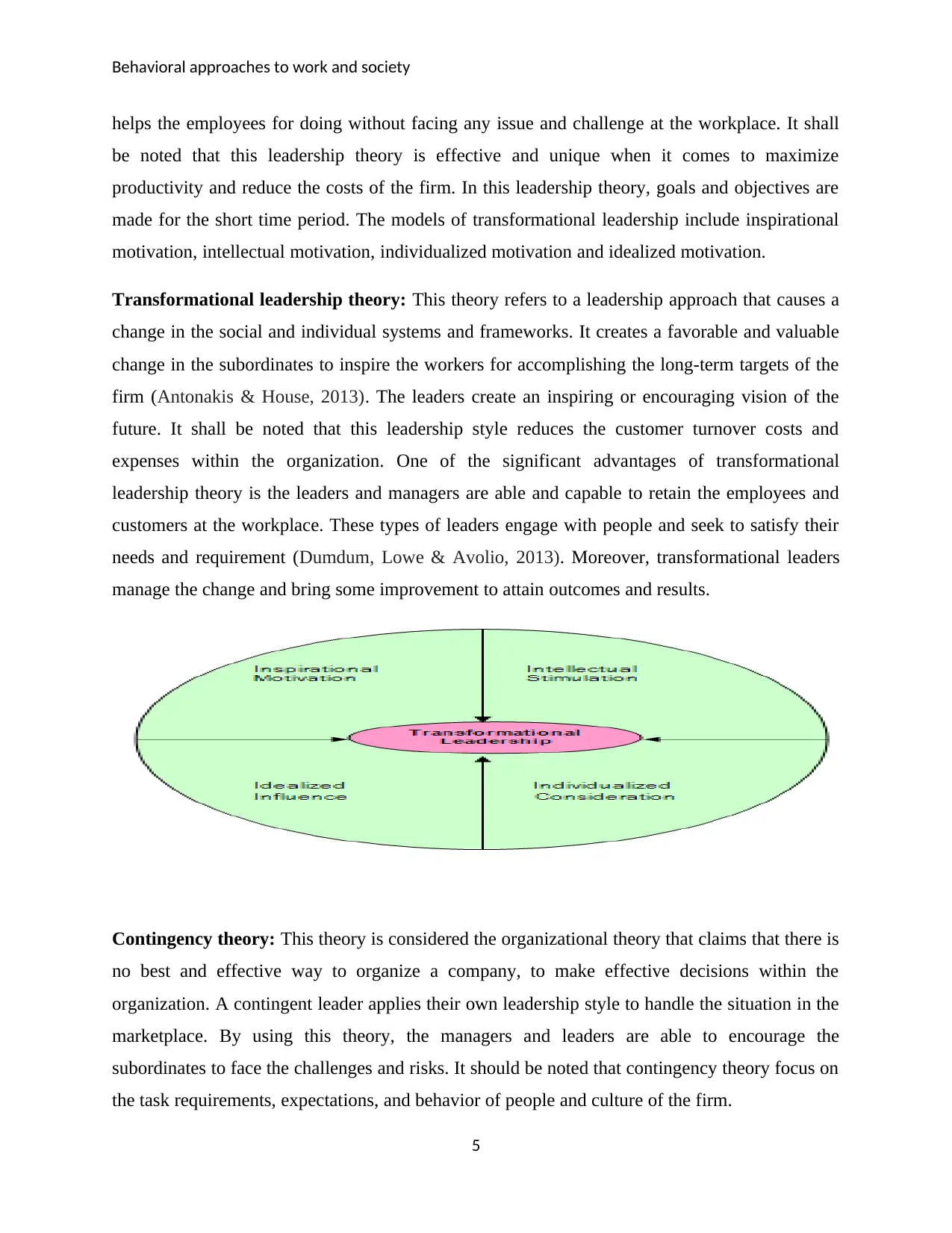
made for the short time period. The models of transformational leadership include inspirational
motivation, intellectual motivation, individualized motivation and idealized motivation.
Transformational leadership theory: This theory refers to a leadership approach that causes a
change in the social and individual systems and frameworks. It creates a favorable and valuable
change in the subordinates to inspire the workers for accomplishing the long-term targets of the
firm (Antonakis & House, 2013). The leaders create an inspiring or encouraging vision of the
future. It shall be noted that this leadership style reduces the customer turnover costs and
expenses within the organization. One of the significant advantages of transformational
leadership theory is the leaders and managers are able and capable to retain the employees and
customers at the workplace. These types of leaders engage with people and seek to satisfy their
needs and requirement (Dumdum, Lowe & Avolio, 2013). Moreover, transformational leaders
manage the change and bring some improvement to attain outcomes and results.
Contingency theory: This theory is considered the organizational theory that claims that there is
no best and effective way to organize a company, to make effective decisions within the
organization. A contingent leader applies their own leadership style to handle the situation in the
marketplace. By using this theory, the managers and leaders are able to encourage the
subordinates to face the challenges and risks. It should be noted that contingency theory focus on
the task requirements, expectations, and behavior of people and culture of the firm.
5
helps the employees for doing without facing any issue and challenge at the workplace. It shall
be noted that this leadership theory is effective and unique when it comes to maximize
productivity and reduce the costs of the firm. In this leadership theory, goals and objectives are
made for the short time period. The models of transformational leadership include inspirational
motivation, intellectual motivation, individualized motivation and idealized motivation.
Transformational leadership theory: This theory refers to a leadership approach that causes a
change in the social and individual systems and frameworks. It creates a favorable and valuable
change in the subordinates to inspire the workers for accomplishing the long-term targets of the
firm (Antonakis & House, 2013). The leaders create an inspiring or encouraging vision of the
future. It shall be noted that this leadership style reduces the customer turnover costs and
expenses within the organization. One of the significant advantages of transformational
leadership theory is the leaders and managers are able and capable to retain the employees and
customers at the workplace. These types of leaders engage with people and seek to satisfy their
needs and requirement (Dumdum, Lowe & Avolio, 2013). Moreover, transformational leaders
manage the change and bring some improvement to attain outcomes and results.
Contingency theory: This theory is considered the organizational theory that claims that there is
no best and effective way to organize a company, to make effective decisions within the
organization. A contingent leader applies their own leadership style to handle the situation in the
marketplace. By using this theory, the managers and leaders are able to encourage the
subordinates to face the challenges and risks. It should be noted that contingency theory focus on
the task requirements, expectations, and behavior of people and culture of the firm.
5
Behavioral approaches to work and society
Path-goal theory: The path-goal theory is initiated by the managers to achieve the goals of the
company. The goal theory increases employee’s motivation, satisfaction, and empowerment so
they become more effective and productive members of the organization. Under the path-goal
theory, the main objective of the leaders is to inspire the followers and subordinates by
maximizing or increasing the personal benefits of striving for achieving the group goals and
clarifying the right path. Along with this, this theory is appropriate for situations and
emergencies where there is a time constraint. It is flexible and easy to understand (Daft, 2014).
Now it is assumed that leadership plays a most significant role in the organization.
Leadership helps in building and developing a relationship with employees in the workplace.
Effective and dynamic leadership gives workers the capability to speak and be verbal about their
ideas and thoughts. Great and unique leaders in the workplace can harmonize organization with
protecting the rights and interests of the workers. Unique leaders maintain a reciprocal
relationship with employees to know and understand the problems, issues, and conflicts of the
workers. It will help to attain success and growth of the company in the global market. In the 21st
century, leaders improve seriousness and charisma in business activities and operations and on
the other hand, they develop and boost morale, loyalty, and trust among the workers for
performing roles and responsibilities in a hassle-free manner. Delegation of authority among the
followers is done by the leaders so that they meet goals and targets with maintaining
sustainability at the workplace. By using leadership theory, leaders or managers are able to
maintain good and strong communication with subordinates and enhance innovation in the
organization. In this way, leaders play a significant and vital role to enhance and improve the
employee engagement and performance of the workers (Birasnav, Rangnekar & Dalpati, 2011).
Let’s talk about leadership examples, Richard Goyder come in first who is the CEO of
Wesfarmers company. The business of the company is enhancing and increasing due to effective
leadership. Richard Goyder uses democratic leadership style to delegate the roles and
responsibilities among the followers. Under democratic leadership style, Richard Goyder allows
to their workers to make unique and dynamic decisions towards the achievement of goals and
targets (Rosoff, 2012).
If talks about another example, Steve Job is the dynamic leader who was the founder of
Apple Inc. He was the good player or leader in the marketplace who inspired managers by using
6
Path-goal theory: The path-goal theory is initiated by the managers to achieve the goals of the
company. The goal theory increases employee’s motivation, satisfaction, and empowerment so
they become more effective and productive members of the organization. Under the path-goal
theory, the main objective of the leaders is to inspire the followers and subordinates by
maximizing or increasing the personal benefits of striving for achieving the group goals and
clarifying the right path. Along with this, this theory is appropriate for situations and
emergencies where there is a time constraint. It is flexible and easy to understand (Daft, 2014).
Now it is assumed that leadership plays a most significant role in the organization.
Leadership helps in building and developing a relationship with employees in the workplace.
Effective and dynamic leadership gives workers the capability to speak and be verbal about their
ideas and thoughts. Great and unique leaders in the workplace can harmonize organization with
protecting the rights and interests of the workers. Unique leaders maintain a reciprocal
relationship with employees to know and understand the problems, issues, and conflicts of the
workers. It will help to attain success and growth of the company in the global market. In the 21st
century, leaders improve seriousness and charisma in business activities and operations and on
the other hand, they develop and boost morale, loyalty, and trust among the workers for
performing roles and responsibilities in a hassle-free manner. Delegation of authority among the
followers is done by the leaders so that they meet goals and targets with maintaining
sustainability at the workplace. By using leadership theory, leaders or managers are able to
maintain good and strong communication with subordinates and enhance innovation in the
organization. In this way, leaders play a significant and vital role to enhance and improve the
employee engagement and performance of the workers (Birasnav, Rangnekar & Dalpati, 2011).
Let’s talk about leadership examples, Richard Goyder come in first who is the CEO of
Wesfarmers company. The business of the company is enhancing and increasing due to effective
leadership. Richard Goyder uses democratic leadership style to delegate the roles and
responsibilities among the followers. Under democratic leadership style, Richard Goyder allows
to their workers to make unique and dynamic decisions towards the achievement of goals and
targets (Rosoff, 2012).
If talks about another example, Steve Job is the dynamic leader who was the founder of
Apple Inc. He was the good player or leader in the marketplace who inspired managers by using
6
⊘ This is a preview!⊘
Do you want full access?
Subscribe today to unlock all pages.
Trusted by 1+ million students worldwide
Behavioral approaches to work and society
autocratic leadership at the workplace (Bolton & Thompson, 2013). By using this leadership
styles, Steve Job focused on the activities and operations of the workers as well as the company.
Apart from this, transformational leadership style is used by Steve Job in the organization to set
the rules and standards for growth and success of the Corporation. He also used democratic
leadership style to pursue vision and mission with team members in the workplace. He retained
all the power and authorities to control the workers (Sharma & Grant, 2011).
On the other hand, Alan Joseph is also an effective and dynamic leader; he is the CEO of
the Australian airline Qantas. He is an Australian businessman was born on 30 June 1966. He is
famous as a most influential business leader in the world. Alan Joseph uses democratic
leadership style to flourish the business operation widely. He provides power and responsibilities
to the employees to make unique and dynamic decisions in the company.
Mr. Bradford Leon is also a good leader in the world who is the CEO of Woolworths.
The leadership style used by Mr. Bradford Leon is democratic leadership style. He sets the long-
term objectives and goals to maximize the revenue and returns within the organization. He is the
right and suitable leader for the company in order to attain competence and returns across the
world. Apart from this, he protects the rights and interests of the stakeholders to carry out
corporate social responsibilities successfully (Cameron, 2012).
On the above-mentioned study, it can be revealed that leaders play a critical role in each
and every industry for monitoring the business activities. The leader is the person who
encourages and motivates their subordinates to participate so their hesitation and stress can be
eliminated. It is possible only to have several types of leadership styles within the organization.
Leaders bring changes in the organization to explore and flourish the business operation
worldwide. Apart from this, they also encourage and maintain favorable working environment at
the workplace for boosting and enhancing the productivity of the followers. It shall be noted that
supporting and directing is an essential part of the leadership to reduce the issues and conflicts of
the workers.
7
autocratic leadership at the workplace (Bolton & Thompson, 2013). By using this leadership
styles, Steve Job focused on the activities and operations of the workers as well as the company.
Apart from this, transformational leadership style is used by Steve Job in the organization to set
the rules and standards for growth and success of the Corporation. He also used democratic
leadership style to pursue vision and mission with team members in the workplace. He retained
all the power and authorities to control the workers (Sharma & Grant, 2011).
On the other hand, Alan Joseph is also an effective and dynamic leader; he is the CEO of
the Australian airline Qantas. He is an Australian businessman was born on 30 June 1966. He is
famous as a most influential business leader in the world. Alan Joseph uses democratic
leadership style to flourish the business operation widely. He provides power and responsibilities
to the employees to make unique and dynamic decisions in the company.
Mr. Bradford Leon is also a good leader in the world who is the CEO of Woolworths.
The leadership style used by Mr. Bradford Leon is democratic leadership style. He sets the long-
term objectives and goals to maximize the revenue and returns within the organization. He is the
right and suitable leader for the company in order to attain competence and returns across the
world. Apart from this, he protects the rights and interests of the stakeholders to carry out
corporate social responsibilities successfully (Cameron, 2012).
On the above-mentioned study, it can be revealed that leaders play a critical role in each
and every industry for monitoring the business activities. The leader is the person who
encourages and motivates their subordinates to participate so their hesitation and stress can be
eliminated. It is possible only to have several types of leadership styles within the organization.
Leaders bring changes in the organization to explore and flourish the business operation
worldwide. Apart from this, they also encourage and maintain favorable working environment at
the workplace for boosting and enhancing the productivity of the followers. It shall be noted that
supporting and directing is an essential part of the leadership to reduce the issues and conflicts of
the workers.
7
Paraphrase This Document
Need a fresh take? Get an instant paraphrase of this document with our AI Paraphraser
Behavioral approaches to work and society
References
Antonakis, J., & Day, D. V. (Eds.). (2017). The nature of leadership. Sage publications.
Antonakis, J., & House, R. J. (2013). The full-range leadership theory: The way forward.
In Transformational and Charismatic Leadership: The Road Ahead 10th Anniversary
Edition (pp. 3-33). Emerald Group Publishing Limited.
Birasnav, M., Rangnekar, S., & Dalpati, A. (2011). Transformational leadership and human
capital benefits: The role of knowledge management. Leadership & Organization
Development Journal, 32(2), 106-126.
Bolman, L. G., & Deal, T. E. (2017). Reframing organizations: Artistry, choice, and leadership.
John Wiley & Sons.
Bolton, W., & Thompson, J. (2013). Entrepreneurs: Talent, temperament and opportunity.
Routledge.
Cameron, K. (2012). Positive leadership: Strategies for extraordinary performance. Berrett-
Koehler Publishers.
Chemers, M. (2014). An integrative theory of leadership. Psychology Press.
Chemers, M. (2014). An integrative theory of leadership. Psychology Press.
Chhokar, J. S., Brodbeck, F. C., & House, R. J. (Eds.). (2013). Culture and leadership across the
world: The GLOBE book of in-depth studies of 25 societies. Routledge.
Daft, R. L. (2014). The leadership experience. Cengage Learning.
Dumdum, U. R., Lowe, K. B., & Avolio, B. J. (2013). A meta-analysis of transformational and
transactional leadership correlates of effectiveness and satisfaction: An update and
extension. In Transformational and Charismatic Leadership: The Road Ahead 10th
Anniversary Edition (pp. 39-70). Emerald Group Publishing Limited.
8
References
Antonakis, J., & Day, D. V. (Eds.). (2017). The nature of leadership. Sage publications.
Antonakis, J., & House, R. J. (2013). The full-range leadership theory: The way forward.
In Transformational and Charismatic Leadership: The Road Ahead 10th Anniversary
Edition (pp. 3-33). Emerald Group Publishing Limited.
Birasnav, M., Rangnekar, S., & Dalpati, A. (2011). Transformational leadership and human
capital benefits: The role of knowledge management. Leadership & Organization
Development Journal, 32(2), 106-126.
Bolman, L. G., & Deal, T. E. (2017). Reframing organizations: Artistry, choice, and leadership.
John Wiley & Sons.
Bolton, W., & Thompson, J. (2013). Entrepreneurs: Talent, temperament and opportunity.
Routledge.
Cameron, K. (2012). Positive leadership: Strategies for extraordinary performance. Berrett-
Koehler Publishers.
Chemers, M. (2014). An integrative theory of leadership. Psychology Press.
Chemers, M. (2014). An integrative theory of leadership. Psychology Press.
Chhokar, J. S., Brodbeck, F. C., & House, R. J. (Eds.). (2013). Culture and leadership across the
world: The GLOBE book of in-depth studies of 25 societies. Routledge.
Daft, R. L. (2014). The leadership experience. Cengage Learning.
Dumdum, U. R., Lowe, K. B., & Avolio, B. J. (2013). A meta-analysis of transformational and
transactional leadership correlates of effectiveness and satisfaction: An update and
extension. In Transformational and Charismatic Leadership: The Road Ahead 10th
Anniversary Edition (pp. 39-70). Emerald Group Publishing Limited.
8
Behavioral approaches to work and society
Hatch, M. J. (2018). Organization theory: Modern, symbolic, and postmodern perspectives.
Oxford university press.
Jackson, B., & Parry, K. (2011). A very short fairly interesting and reasonably cheap book about
studying leadership. Sage.
Jackson, B., & Parry, K. (2011). A very short fairly interesting and reasonably cheap book about
studying leadership. Sage.
Miner, J. B. (2015). Organizational behavior 1: Essential theories of motivation and leadership.
Routledge.
Rosoff, N. (2012). The Power of Paradox: The Protean Leader and Leading in Uncertain Times.
Routledge.
Selznick, P. (2011). Leadership in administration: A sociological interpretation. Quid Pro
Books.
Sharma, A., & Grant, D. (2011). Narrative, drama and charismatic leadership: The case of
Apple’s Steve Jobs. Leadership, 7(1), 3-26.
Summerfield, M. R. (2014). Leadership: A simple definition. American Journal of Health-
System Pharmacy, 71(3), 251-253.
Vaccaro, I. G., Jansen, J. J., Van Den Bosch, F. A., & Volberda, H. W. (2012). Management
innovation and leadership: The moderating role of organizational size. Journal of
Management Studies, 49(1), 28-51.
9
Hatch, M. J. (2018). Organization theory: Modern, symbolic, and postmodern perspectives.
Oxford university press.
Jackson, B., & Parry, K. (2011). A very short fairly interesting and reasonably cheap book about
studying leadership. Sage.
Jackson, B., & Parry, K. (2011). A very short fairly interesting and reasonably cheap book about
studying leadership. Sage.
Miner, J. B. (2015). Organizational behavior 1: Essential theories of motivation and leadership.
Routledge.
Rosoff, N. (2012). The Power of Paradox: The Protean Leader and Leading in Uncertain Times.
Routledge.
Selznick, P. (2011). Leadership in administration: A sociological interpretation. Quid Pro
Books.
Sharma, A., & Grant, D. (2011). Narrative, drama and charismatic leadership: The case of
Apple’s Steve Jobs. Leadership, 7(1), 3-26.
Summerfield, M. R. (2014). Leadership: A simple definition. American Journal of Health-
System Pharmacy, 71(3), 251-253.
Vaccaro, I. G., Jansen, J. J., Van Den Bosch, F. A., & Volberda, H. W. (2012). Management
innovation and leadership: The moderating role of organizational size. Journal of
Management Studies, 49(1), 28-51.
9
⊘ This is a preview!⊘
Do you want full access?
Subscribe today to unlock all pages.
Trusted by 1+ million students worldwide

1 out of 9


Related Documents


Your All-in-One AI-Powered Toolkit for Academic Success.
+13062052269
info@desklib.com
Available 24*7 on WhatsApp / Email
![[object Object]](/_next/static/media/star-bottom.7253800d.svg)
Unlock your academic potential
Copyright © 2020–2026 A2Z Services. All Rights Reserved. Developed and managed by ZUCOL.