LEADERSHIP 0 System04121: Personal Leadership Concepts Assignment
VerifiedAdded on 2022/08/16
|6
|1382
|13
Homework Assignment
AI Summary
This assignment delves into the student's understanding of leadership, exploring its meaning, current leadership style, and future aspirations. The student defines a good leader as someone who prioritizes others, demonstrates kindness, and inspires. The student identifies as a participative leader, emphasizing employee involvement in decision-making. The assignment outlines the benefits of this style, such as increased acceptance of decisions and improved employee morale. The student's goal is to become an entrepreneur and leader, focusing on motivating others. To achieve this, the student highlights the need for active participation, open-mindedness, team-building, and empowerment. The assignment includes references to support the concepts discussed.

LEADERSHIP
0
LEADERSHIP
System04121
2/11/2020
0
LEADERSHIP
System04121
2/11/2020
Paraphrase This Document
Need a fresh take? Get an instant paraphrase of this document with our AI Paraphraser

LEADERSHIP
1
Q1-what does leadership mean to you
According to me, a decent leader is the one who is continuously ahead of the 3 steps of the
others. He looks out for the people beforehand himself. They are the leader who takes a little
more than his blame and less of their credit. The leaders are always kind and motivating and
they are also always anxious about the other being. They built fineness and achieve this by
the first structure character. Apart from this, they should be reliable so that the people aspect
up to them and also esteem them. The one who struggles to be a decent leader who has to be
truthful, inspirational, bright and stand firm for whatever they believe in, they are the one
who is truly committed and know skills. According to me a good leader develops skilled by
the learning, subsequent the errors and success of the other people. Putting himself out there
and in the real world they are also able to recount to the others in their everyday lives and I
also believe that there is no such thing as an impeccable leader and the job must still be done
to the best of their aptitude (Zhang and Brundrett, 2010).
Q2-where are you now with respect to this leadership concept.
I believe that I am a participative leadership; it is a kind of managerial style that calls the
inputs from the employee on all the choices of the company. The staff is given relevant info
concerning the subjects of the company and mainstream of the vote state that the sequence of
an act the business wants to take (Duden, 2011). Participative leadership although have the
leisurely form of result making, but has various compensations that make it the right
managerial method of the business. Participative leadership can sometimes be a slower form
of decision-making, but it has numerous compensations that may make it the right decision-
making method for the business. According to me, I am an effective leader as I believe in
the following points:
1
Q1-what does leadership mean to you
According to me, a decent leader is the one who is continuously ahead of the 3 steps of the
others. He looks out for the people beforehand himself. They are the leader who takes a little
more than his blame and less of their credit. The leaders are always kind and motivating and
they are also always anxious about the other being. They built fineness and achieve this by
the first structure character. Apart from this, they should be reliable so that the people aspect
up to them and also esteem them. The one who struggles to be a decent leader who has to be
truthful, inspirational, bright and stand firm for whatever they believe in, they are the one
who is truly committed and know skills. According to me a good leader develops skilled by
the learning, subsequent the errors and success of the other people. Putting himself out there
and in the real world they are also able to recount to the others in their everyday lives and I
also believe that there is no such thing as an impeccable leader and the job must still be done
to the best of their aptitude (Zhang and Brundrett, 2010).
Q2-where are you now with respect to this leadership concept.
I believe that I am a participative leadership; it is a kind of managerial style that calls the
inputs from the employee on all the choices of the company. The staff is given relevant info
concerning the subjects of the company and mainstream of the vote state that the sequence of
an act the business wants to take (Duden, 2011). Participative leadership although have the
leisurely form of result making, but has various compensations that make it the right
managerial method of the business. Participative leadership can sometimes be a slower form
of decision-making, but it has numerous compensations that may make it the right decision-
making method for the business. According to me, I am an effective leader as I believe in
the following points:

LEADERSHIP
2
1. Acceptance of Decisions More Likely
I always include all my employees and ask for their personal stake in the success of the
new policies of the company, I always allow them in the procedure of approving as well
as creating the policies that help the company in adjusting to the rapid policy changes and
this way the employees very readily accept the decisions and the policies that are reached
to them and this also helps in cutting down on the resistance that the new policies of the
company usually experiences and also helps in speeding up the process of implementing
the new ideas (Moore, Grabsch, and Rotter, 2010).
2. Improves Employee Morale
I always allow the employees to voice up there opinions regarding the operations of
the company and in such cases, the morale of the staff remains high as there is a
gratitude for the accidental to be a portion of the business and its decision creation
procedure. The staffs also take a livelier role in refining the work circumstances when
they know that they can directly impact the policies that direct the workplace (Stead
and Elliott, 2013).
Q3-where do you want to go?
I want to become an Entrepreneur, I want to have a mission for the team and the organization
and that is the main reason for becoming a leader. I want to become a good leader and put
most of my time and energy towards helping other people in order to motivate them in
becoming successful by making connections, giving feedbacks and providing the resource
that they need (Hanson, 2013).
O4-what do you need to get there?
2
1. Acceptance of Decisions More Likely
I always include all my employees and ask for their personal stake in the success of the
new policies of the company, I always allow them in the procedure of approving as well
as creating the policies that help the company in adjusting to the rapid policy changes and
this way the employees very readily accept the decisions and the policies that are reached
to them and this also helps in cutting down on the resistance that the new policies of the
company usually experiences and also helps in speeding up the process of implementing
the new ideas (Moore, Grabsch, and Rotter, 2010).
2. Improves Employee Morale
I always allow the employees to voice up there opinions regarding the operations of
the company and in such cases, the morale of the staff remains high as there is a
gratitude for the accidental to be a portion of the business and its decision creation
procedure. The staffs also take a livelier role in refining the work circumstances when
they know that they can directly impact the policies that direct the workplace (Stead
and Elliott, 2013).
Q3-where do you want to go?
I want to become an Entrepreneur, I want to have a mission for the team and the organization
and that is the main reason for becoming a leader. I want to become a good leader and put
most of my time and energy towards helping other people in order to motivate them in
becoming successful by making connections, giving feedbacks and providing the resource
that they need (Hanson, 2013).
O4-what do you need to get there?
⊘ This is a preview!⊘
Do you want full access?
Subscribe today to unlock all pages.

Trusted by 1+ million students worldwide

LEADERSHIP
3
As a participative leader, the most important thing for me is the involvement of the leader. I
need to be present physically with the employees during all the workdays and I should also
encourage the staff in order to come ahead with ideas for working on the tasks. Following
are the things that I would like to take care of in order to reach the position of being a leader
Involved
The principal story of a participative leader is his participation. If the leader is physically
existent with his staff during an abundance of the workday. His participation inspires the staff
to come composed in employed on errands. They know he/she will be available causative
with his Labor, thoughts, and provision. A participative leader is continuously in the
combination of what is successful on so he is competent to assist work finished matters when
they first arise.
Open to Suggestion
An organization of leadership involves the leaders to listen to others and reflect their
thoughts. As a leader, I will understand my own methods and concepts are not the only ones
that are valued. I would also try to accept when somebody else presents an improved idea or
a better alternative. I will always focus on respecting my staff and will keep an open-door
policy where the employees can discuss their issues and ideas (Allen and Roberts, 2011).
Team Builder
I strongly believe that collaborative efforts help me in defining a participative environment.
As a leader, I will direct my team to create an enterprise that will outcome in group
achievement and in order to do this I will meld a mix of varied workers with occasionally
conflicting the methods and the ideas. I will also work by using that difference to form a team
that would work in an effective manner through all the issues as well as the challenges both
personal and material (Edwards, Elliott, Iszatt-White, and Schedlitzki, 2013).
3
As a participative leader, the most important thing for me is the involvement of the leader. I
need to be present physically with the employees during all the workdays and I should also
encourage the staff in order to come ahead with ideas for working on the tasks. Following
are the things that I would like to take care of in order to reach the position of being a leader
Involved
The principal story of a participative leader is his participation. If the leader is physically
existent with his staff during an abundance of the workday. His participation inspires the staff
to come composed in employed on errands. They know he/she will be available causative
with his Labor, thoughts, and provision. A participative leader is continuously in the
combination of what is successful on so he is competent to assist work finished matters when
they first arise.
Open to Suggestion
An organization of leadership involves the leaders to listen to others and reflect their
thoughts. As a leader, I will understand my own methods and concepts are not the only ones
that are valued. I would also try to accept when somebody else presents an improved idea or
a better alternative. I will always focus on respecting my staff and will keep an open-door
policy where the employees can discuss their issues and ideas (Allen and Roberts, 2011).
Team Builder
I strongly believe that collaborative efforts help me in defining a participative environment.
As a leader, I will direct my team to create an enterprise that will outcome in group
achievement and in order to do this I will meld a mix of varied workers with occasionally
conflicting the methods and the ideas. I will also work by using that difference to form a team
that would work in an effective manner through all the issues as well as the challenges both
personal and material (Edwards, Elliott, Iszatt-White, and Schedlitzki, 2013).
Paraphrase This Document
Need a fresh take? Get an instant paraphrase of this document with our AI Paraphraser

LEADERSHIP
4
Empowering
As participative leaders, I will always focus on empowering the other people I will always be
somebody who will be eager to part the attention by giving the staff the chance to make chief
choices. I will also be there to provide these workers when they will make any kind of
mistakes and whenever they will be in need of help in solving difficulties. I will capitalize
much of my own achievement by placing it in the fingers of those who I will supervise. As a
consequence of my wide efforts and time, I will detect the expert development of my staff.
4
Empowering
As participative leaders, I will always focus on empowering the other people I will always be
somebody who will be eager to part the attention by giving the staff the chance to make chief
choices. I will also be there to provide these workers when they will make any kind of
mistakes and whenever they will be in need of help in solving difficulties. I will capitalize
much of my own achievement by placing it in the fingers of those who I will supervise. As a
consequence of my wide efforts and time, I will detect the expert development of my staff.

LEADERSHIP
5
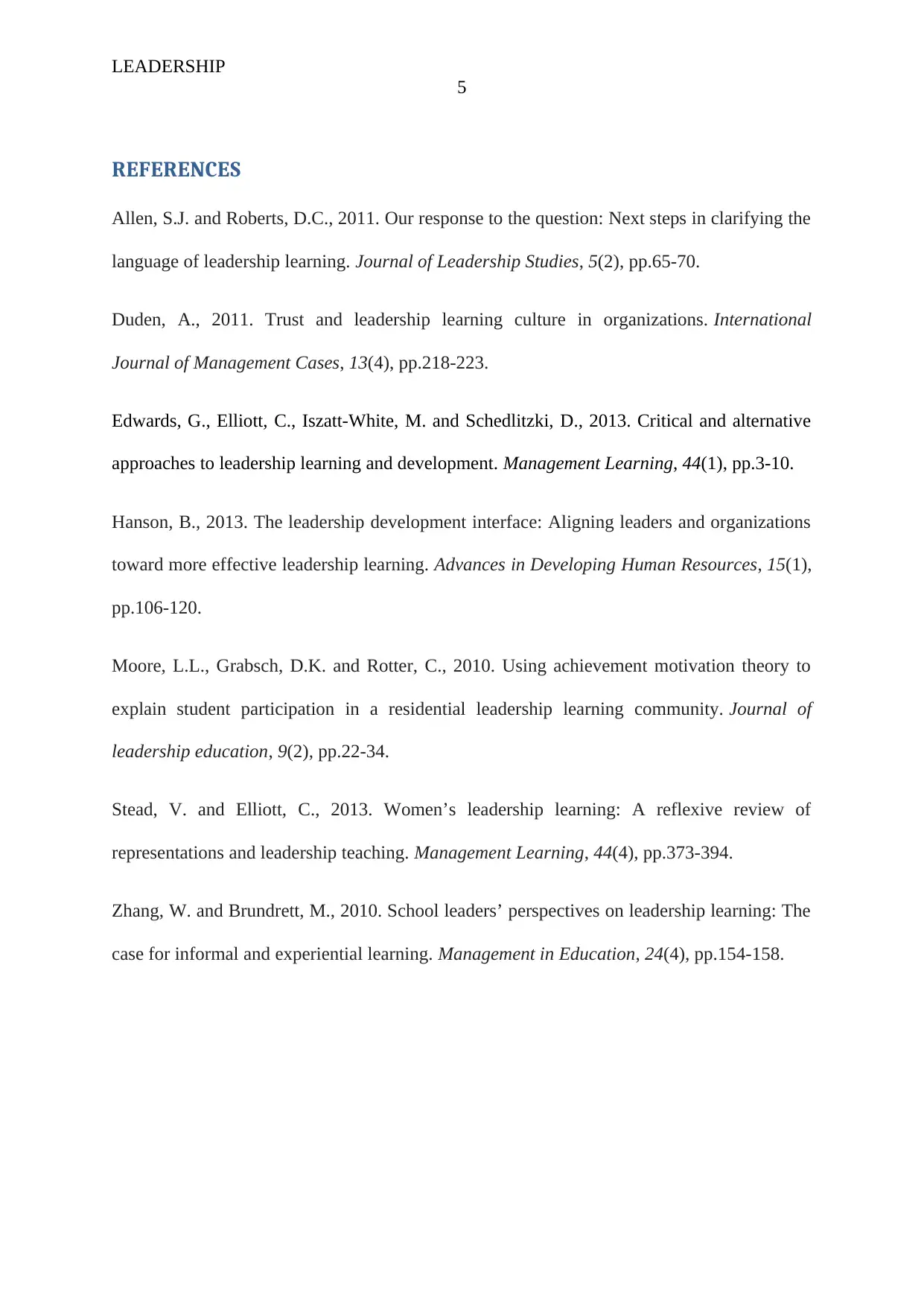
REFERENCES
Allen, S.J. and Roberts, D.C., 2011. Our response to the question: Next steps in clarifying the
language of leadership learning. Journal of Leadership Studies, 5(2), pp.65-70.
Duden, A., 2011. Trust and leadership learning culture in organizations. International
Journal of Management Cases, 13(4), pp.218-223.
Edwards, G., Elliott, C., Iszatt-White, M. and Schedlitzki, D., 2013. Critical and alternative
approaches to leadership learning and development. Management Learning, 44(1), pp.3-10.
Hanson, B., 2013. The leadership development interface: Aligning leaders and organizations
toward more effective leadership learning. Advances in Developing Human Resources, 15(1),
pp.106-120.
Moore, L.L., Grabsch, D.K. and Rotter, C., 2010. Using achievement motivation theory to
explain student participation in a residential leadership learning community. Journal of
leadership education, 9(2), pp.22-34.
Stead, V. and Elliott, C., 2013. Women’s leadership learning: A reflexive review of
representations and leadership teaching. Management Learning, 44(4), pp.373-394.
Zhang, W. and Brundrett, M., 2010. School leaders’ perspectives on leadership learning: The
case for informal and experiential learning. Management in Education, 24(4), pp.154-158.
5
REFERENCES
Allen, S.J. and Roberts, D.C., 2011. Our response to the question: Next steps in clarifying the
language of leadership learning. Journal of Leadership Studies, 5(2), pp.65-70.
Duden, A., 2011. Trust and leadership learning culture in organizations. International
Journal of Management Cases, 13(4), pp.218-223.
Edwards, G., Elliott, C., Iszatt-White, M. and Schedlitzki, D., 2013. Critical and alternative
approaches to leadership learning and development. Management Learning, 44(1), pp.3-10.
Hanson, B., 2013. The leadership development interface: Aligning leaders and organizations
toward more effective leadership learning. Advances in Developing Human Resources, 15(1),
pp.106-120.
Moore, L.L., Grabsch, D.K. and Rotter, C., 2010. Using achievement motivation theory to
explain student participation in a residential leadership learning community. Journal of
leadership education, 9(2), pp.22-34.
Stead, V. and Elliott, C., 2013. Women’s leadership learning: A reflexive review of
representations and leadership teaching. Management Learning, 44(4), pp.373-394.
Zhang, W. and Brundrett, M., 2010. School leaders’ perspectives on leadership learning: The
case for informal and experiential learning. Management in Education, 24(4), pp.154-158.
⊘ This is a preview!⊘
Do you want full access?
Subscribe today to unlock all pages.

Trusted by 1+ million students worldwide
1 out of 6
Related Documents
Your All-in-One AI-Powered Toolkit for Academic Success.
+13062052269
info@desklib.com
Available 24*7 on WhatsApp / Email
Unlock your academic potential
Copyright © 2020–2026 A2Z Services. All Rights Reserved. Developed and managed by ZUCOL.