Analyzing Leadership Attributes and Employee Performance: Project

Verified

Added on  2020/05/28

|6
|817
|37
Report
AI Summary
This report examines the impact of leadership attributes on employee performance. It begins by outlining the problem statement, which highlights how effective leadership fosters a learning environment for employees, while ineffective leadership can negatively impact performance. The research aims to identify specific leadership styles that can enhance organizational excellence and improve employee performance. The report analyzes various leadership styles, including autocratic, democratic, transactional, laissez-faire, and transformational leadership, with a secondary analysis emphasizing the benefits of transformational leadership in promoting employee satisfaction and high performance. The recommendation suggests adopting a transformational leadership style to motivate employees, improve skills, and boost performance. References from academic journals support the findings and recommendations.
Document Page
Running head: PROFESSIONAL PROJECT
Professional Project
Name of the Student:
Name of the University:
Author Note:
tabler-icon-diamond-filled.svg

Paraphrase This Document

Need a fresh take? Get an instant paraphrase of this document with our AI Paraphraser
Document Page
1
PROFESSIONAL PROJECT
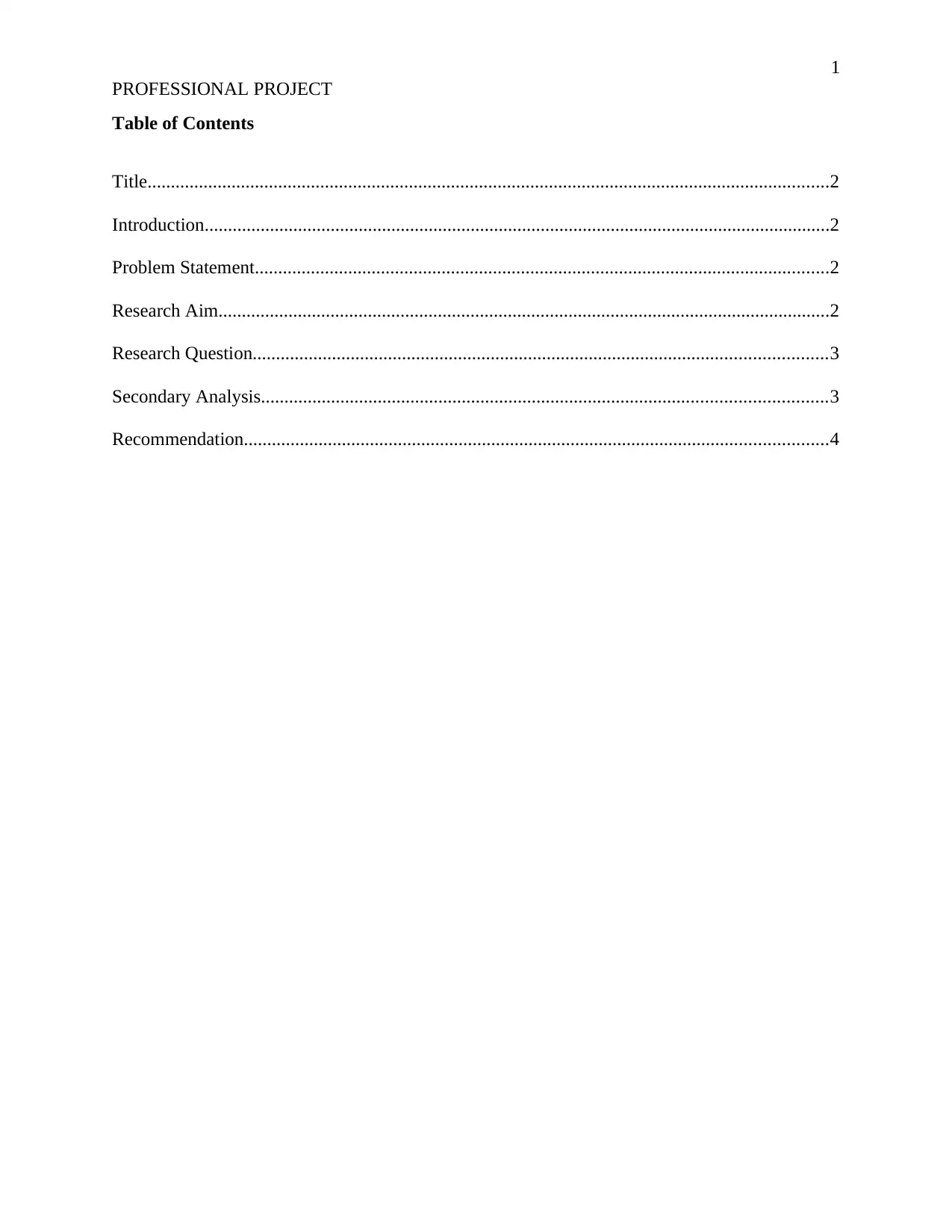
Table of Contents
Title..................................................................................................................................................2
Introduction......................................................................................................................................2
Problem Statement...........................................................................................................................2
Research Aim...................................................................................................................................2
Research Question...........................................................................................................................3
Secondary Analysis.........................................................................................................................3
Recommendation.............................................................................................................................4
Document Page
2
PROFESSIONAL PROJECT
Title
Impact of Leadership Attributes on Employees’ Performance
Introduction
The project highlights the impacts of the right leadership style that can help in improving
the employees’ performance parameter to determine the accomplishment of the corporate goals
and ensure the organisational success.
Problem Statement
The efficient leadership approach helps in developing the organisational context in
developing the learning environment for the employees that helps in developing their
performance parameter. On the contrary, the ineffective leadership characteristics can even affect
the employees’ work performance as well. The current advancements in the business field
develop the flexible approaches in the workplace. The leaders often become much dependent to
the employees due to which the lack the closer supervision (Chen et al., 2014). It affects the
work performance in a significant way. It is thus necessary for the leaders to adopt the right
approach to guide the employees that can motivate them to work in a better way and increase the
performance level as well.
Research Aim
The research aims to identify the impact of the appropriate leadership trait to improve the
performance parameter of the employees.
Document Page
3
PROFESSIONAL PROJECT
Research Question
What are the specific leadership styles can be adopted to achieve organisational
excellence?
How the effective leadership attributes create impacts on the employees’ performance?
What are the major challenges faced in developing the effective performance level of the
employees?
Secondary Analysis
The effective leadership style promotes the employee satisfaction that eventually leads to
develop the efficient performance outcome. A leader is responsible in motivating the workforce
and leading them towards the right direction to ensure success. According to Mulki, Caemmerer
and Heggde (2015), a leader should be differentiated from others by judging the qualities and
attributes. An efficient leader maintains the balance between the performance, business foresight,
and characteristic values. The leadership styles are generally categorized into five forms. First is
Autocratic Leader, who has the right to take the individual decision without seeking help from
any other employee. On the other hand, democratic leaders are collaborative in nature and
undertake the organisational decision by consulting with others. The next is the transactional
leaders, who decide either to punish or reward the employee that depends on the performance
outcome. The laissez faire leaders provide the full authority to the employees and depend on
their ability. It often lacks the closer supervision that affect the performance level of the
associated workers (Nanjundeswaraswamy & Swamy, 2014). Finally, the transformational
leaders help the employees improve their personal and professional attributes (Breevaart et al.,
2016). This leadership style is quite effective to promote a learning based scenario within an
organisation and develop the high level of performance.
tabler-icon-diamond-filled.svg

Paraphrase This Document

Need a fresh take? Get an instant paraphrase of this document with our AI Paraphraser
Document Page
4
PROFESSIONAL PROJECT
Recommendation
The research problem is widely focusing on the ineffective attributes of the laissez faire
leaders that prevent the employees from learning the innovative approaches and developing their
professional skills. However, observing the outcome of the secondary information, it can be
interpreted that the leaders can adopt transformational leadership style for leading the associated
workers. It would motivate the employees to learn innovative work functions and improve both
the professional and personal skills. In addition to this, this leadership style would even promote
the high level of performance parameter that comes out of higher job satisfaction.
Document Page
5
PROFESSIONAL PROJECT
References
Breevaart, K., Bakker, A. B., Demerouti, E., & Derks, D. (2016). Who takes the lead? A multi
source diary study on leadership, work engagement, and job performance. Journal of
Organizational Behavior, 37(3), 309-325.
Chen, X. P., Eberly, M. B., Chiang, T. J., Farh, J. L., & Cheng, B. S. (2014). Affective trust in
Chinese leaders: Linking paternalistic leadership to employee performance. Journal of
management, 40(3), 796-819.
Mulki, J. P., Caemmerer, B., & Heggde, G. S. (2015). Leadership style, salesperson's work effort
and job performance: the influence of power distance. Journal of Personal Selling &
Sales Management, 35(1), 3-22.
Nanjundeswaraswamy, T. S., & Swamy, D. R. (2014). Leadership styles. Advances in
management, 7(2), 57.
chevron_up_icon
1 out of 6
circle_padding
hide_on_mobile
zoom_out_icon
[object Object]