Leadership in Organisational Behaviour: A Comprehensive Report
VerifiedAdded on 2020/06/04
|12
|3315
|348
Report
AI Summary
This report delves into the multifaceted domain of leadership within organizational behavior. It begins by defining leadership and its significance, distinguishing it from management. The report explores implicit leadership theories, examining the assumptions individuals hold about effective leaders. It then contrasts transformational and transactional leadership styles, highlighting their distinct approaches to motivating and managing employees. Contingency theories are analyzed, emphasizing the situational nature of leadership and the need for adaptable approaches. Authentic, ethical, and prosocial leadership are discussed, emphasizing the importance of values, trust, and ethical conduct. The report also covers shared leadership and negotiation skills crucial for effective organizational management. Finally, the report touches on leader development and the role of communication in fostering successful leadership. The report provides a comprehensive overview of leadership principles, theories, and practices, providing valuable insights for managers and students alike.
ORGANISATIONAL
BEHAVIOUR: LEADERSHIP
BEHAVIOUR: LEADERSHIP

Paraphrase This Document
Need a fresh take? Get an instant paraphrase of this document with our AI Paraphraser
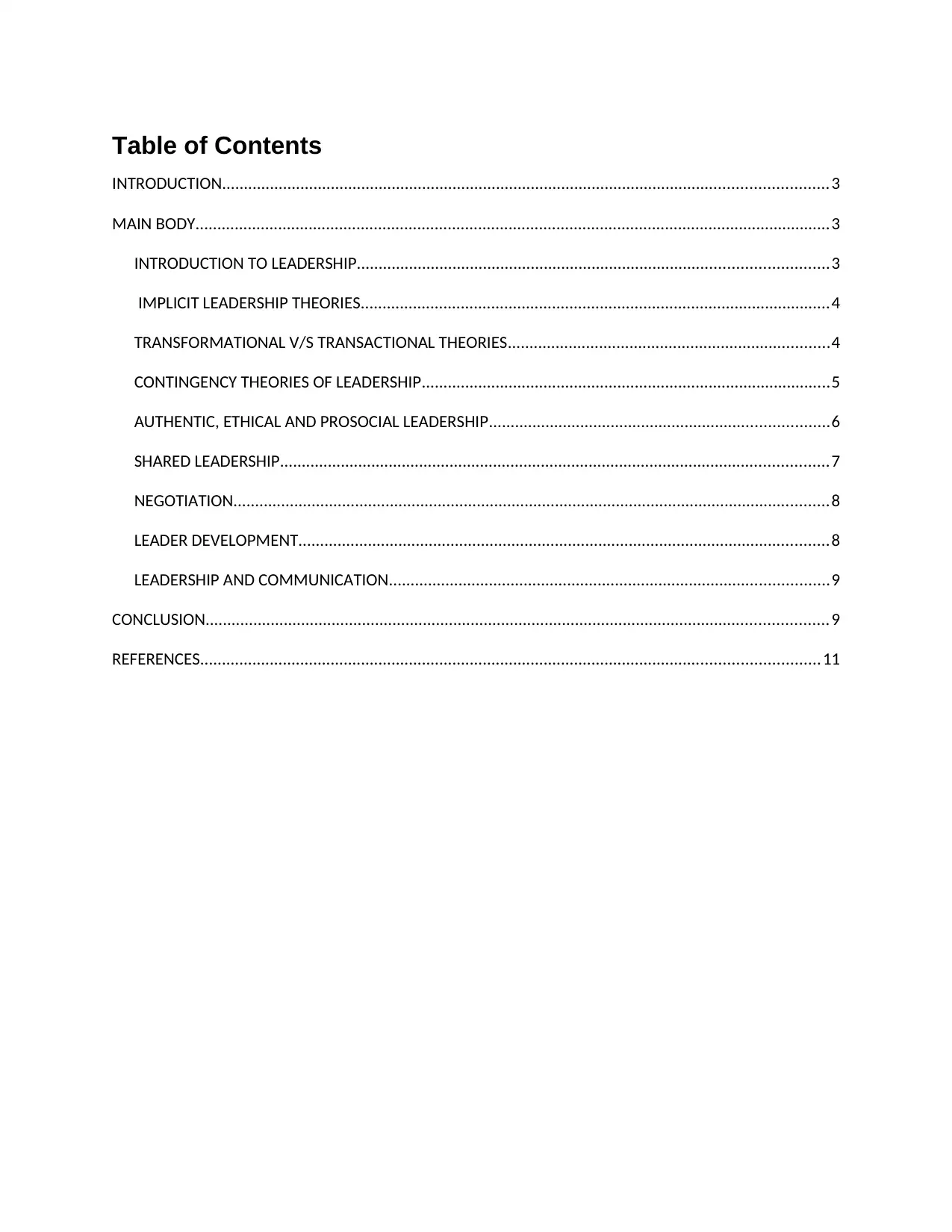
Table of Contents
INTRODUCTION...........................................................................................................................................3
MAIN BODY..................................................................................................................................................3
INTRODUCTION TO LEADERSHIP............................................................................................................3
IMPLICIT LEADERSHIP THEORIES............................................................................................................4
TRANSFORMATIONAL V/S TRANSACTIONAL THEORIES..........................................................................4
CONTINGENCY THEORIES OF LEADERSHIP..............................................................................................5
AUTHENTIC, ETHICAL AND PROSOCIAL LEADERSHIP..............................................................................6
SHARED LEADERSHIP..............................................................................................................................7
NEGOTIATION.........................................................................................................................................8
LEADER DEVELOPMENT..........................................................................................................................8
LEADERSHIP AND COMMUNICATION.....................................................................................................9
CONCLUSION...............................................................................................................................................9
REFERENCES..............................................................................................................................................11
INTRODUCTION...........................................................................................................................................3
MAIN BODY..................................................................................................................................................3
INTRODUCTION TO LEADERSHIP............................................................................................................3
IMPLICIT LEADERSHIP THEORIES............................................................................................................4
TRANSFORMATIONAL V/S TRANSACTIONAL THEORIES..........................................................................4
CONTINGENCY THEORIES OF LEADERSHIP..............................................................................................5
AUTHENTIC, ETHICAL AND PROSOCIAL LEADERSHIP..............................................................................6
SHARED LEADERSHIP..............................................................................................................................7
NEGOTIATION.........................................................................................................................................8
LEADER DEVELOPMENT..........................................................................................................................8
LEADERSHIP AND COMMUNICATION.....................................................................................................9
CONCLUSION...............................................................................................................................................9
REFERENCES..............................................................................................................................................11
INTRODUCTION
Organisational behavior can be defined as a study of behavior of people inside the
organization. This is normally studied so as to make organization a better place to work at. There
are so many principles as well as approaches that are used in the business so as to make it more
efficient. One of the main factors which is required to be considered here is Leadership (Bolman
and Deal, 2017) . If good leadership is present in the company then the employees will be able to
work in a better manner and productivity of the organization will also increase. Through
leadership theories, managers can try to achieve all the goals and objectives of the organization.
This report will discuss about various elements about leaders and leadership and will also explain
the importance of leadership in the company.
MAIN BODY
INTRODUCTION TO LEADERSHIP
Leadership can be defined as a factor through which management gains the ability to
make good decisions for the company so as to inspire the team to perform well in the company.
In this process, employees are given direction which they have to follow so as to achieve the
goals and objectives of the company. Therefore, it can be said that in leadership work is done
through others. It is a very important factor which needs to be present in the company so as to
develop the performance of team members by providing them good motivation and increasing
their creativity as well.
Through leadership, management can even assign responsibility as well as accountability among
team members so as to increase their value and bring success to the company. A leader is having
a very important place in an organization but it is very much different from a manager.
Leadership is considered as a part of management and thus leadership is done for improving the
work of management (Babcock-Roberson and Strickland, 2010).
While performing leadership, a leader guides and directs other people who are working in
the company as they are given the task to improve the productivity id employees as well as the
company. Managers directs the leaders what they have to do and also a leader handles
Organisational behavior can be defined as a study of behavior of people inside the
organization. This is normally studied so as to make organization a better place to work at. There
are so many principles as well as approaches that are used in the business so as to make it more
efficient. One of the main factors which is required to be considered here is Leadership (Bolman
and Deal, 2017) . If good leadership is present in the company then the employees will be able to
work in a better manner and productivity of the organization will also increase. Through
leadership theories, managers can try to achieve all the goals and objectives of the organization.
This report will discuss about various elements about leaders and leadership and will also explain
the importance of leadership in the company.
MAIN BODY
INTRODUCTION TO LEADERSHIP
Leadership can be defined as a factor through which management gains the ability to
make good decisions for the company so as to inspire the team to perform well in the company.
In this process, employees are given direction which they have to follow so as to achieve the
goals and objectives of the company. Therefore, it can be said that in leadership work is done
through others. It is a very important factor which needs to be present in the company so as to
develop the performance of team members by providing them good motivation and increasing
their creativity as well.
Through leadership, management can even assign responsibility as well as accountability among
team members so as to increase their value and bring success to the company. A leader is having
a very important place in an organization but it is very much different from a manager.
Leadership is considered as a part of management and thus leadership is done for improving the
work of management (Babcock-Roberson and Strickland, 2010).
While performing leadership, a leader guides and directs other people who are working in
the company as they are given the task to improve the productivity id employees as well as the
company. Managers directs the leaders what they have to do and also a leader handles
⊘ This is a preview!⊘
Do you want full access?
Subscribe today to unlock all pages.

Trusted by 1+ million students worldwide
communication, credibility, and empowerment whereas a manager deals with organizing and
staffing. Therefore, it can be said that leadership is a very important activity that needs to be
implemented by the managers of the company so as to improve the performance of company in
the market.
IMPLICIT LEADERSHIP THEORIES
This theory was basically developed by Robert Lord and his colleagues and it was formed
after analyzing the real experiences of leaders in the company. These theories basically tell about
the beliefs and assumptions that are taken by an effective leader. In this theory it is also
determined that each and every person who is working in the organization assumes an image of
an ideal leader and then if the leader who is appointed by the company fits in that image then it is
said that the leader is effective and if not then they are said to be a bad leader.
This theory is basically based on the idea in which individuals make cognitive reflection of the
world and then they used their assumed philosophy in interpreting each and every activity that is
happening around them (Nam Nguyen and Mohamed, 2011). Implicit leadership theory
basically gives suggestions about the assumptions and expectations about the characteristics an
traits that are required to e present in the leader and then these assumptions only decide their
behavior towards the leader who is working in their company. It also varies between individuals
to individuals as everyone is having their own perceptions and they are judging the leaders on the
basis of their perceptions only. It can also vary if the leader is male or a female.
So, in an organization, it is very important to take care that no such biasness is happening in
between the leader and their followers and it also be prescribed that leaders should not be judged
by personal interests or perception rather they should give them a chance to prove themselves
and if the results are good then it means that the leader is effective.
TRANSFORMATIONAL V/S TRANSACTIONAL THEORIES
Leadership can be defined as a factor of influencing the behavior of individuals in an
organization so as to complete the goals of the organization. There are so many management
experts who have come up with so many various leadership theories regarding behavior, traits,
nature etc. few of them are like Authoritarian, Laissez-faire, Transactional, Transformational,
Paternalistic and Democratic (Yukl, 2013). Our of these, transactional leadership is also known
staffing. Therefore, it can be said that leadership is a very important activity that needs to be
implemented by the managers of the company so as to improve the performance of company in
the market.
IMPLICIT LEADERSHIP THEORIES
This theory was basically developed by Robert Lord and his colleagues and it was formed
after analyzing the real experiences of leaders in the company. These theories basically tell about
the beliefs and assumptions that are taken by an effective leader. In this theory it is also
determined that each and every person who is working in the organization assumes an image of
an ideal leader and then if the leader who is appointed by the company fits in that image then it is
said that the leader is effective and if not then they are said to be a bad leader.
This theory is basically based on the idea in which individuals make cognitive reflection of the
world and then they used their assumed philosophy in interpreting each and every activity that is
happening around them (Nam Nguyen and Mohamed, 2011). Implicit leadership theory
basically gives suggestions about the assumptions and expectations about the characteristics an
traits that are required to e present in the leader and then these assumptions only decide their
behavior towards the leader who is working in their company. It also varies between individuals
to individuals as everyone is having their own perceptions and they are judging the leaders on the
basis of their perceptions only. It can also vary if the leader is male or a female.
So, in an organization, it is very important to take care that no such biasness is happening in
between the leader and their followers and it also be prescribed that leaders should not be judged
by personal interests or perception rather they should give them a chance to prove themselves
and if the results are good then it means that the leader is effective.
TRANSFORMATIONAL V/S TRANSACTIONAL THEORIES
Leadership can be defined as a factor of influencing the behavior of individuals in an
organization so as to complete the goals of the organization. There are so many management
experts who have come up with so many various leadership theories regarding behavior, traits,
nature etc. few of them are like Authoritarian, Laissez-faire, Transactional, Transformational,
Paternalistic and Democratic (Yukl, 2013). Our of these, transactional leadership is also known
Paraphrase This Document
Need a fresh take? Get an instant paraphrase of this document with our AI Paraphraser
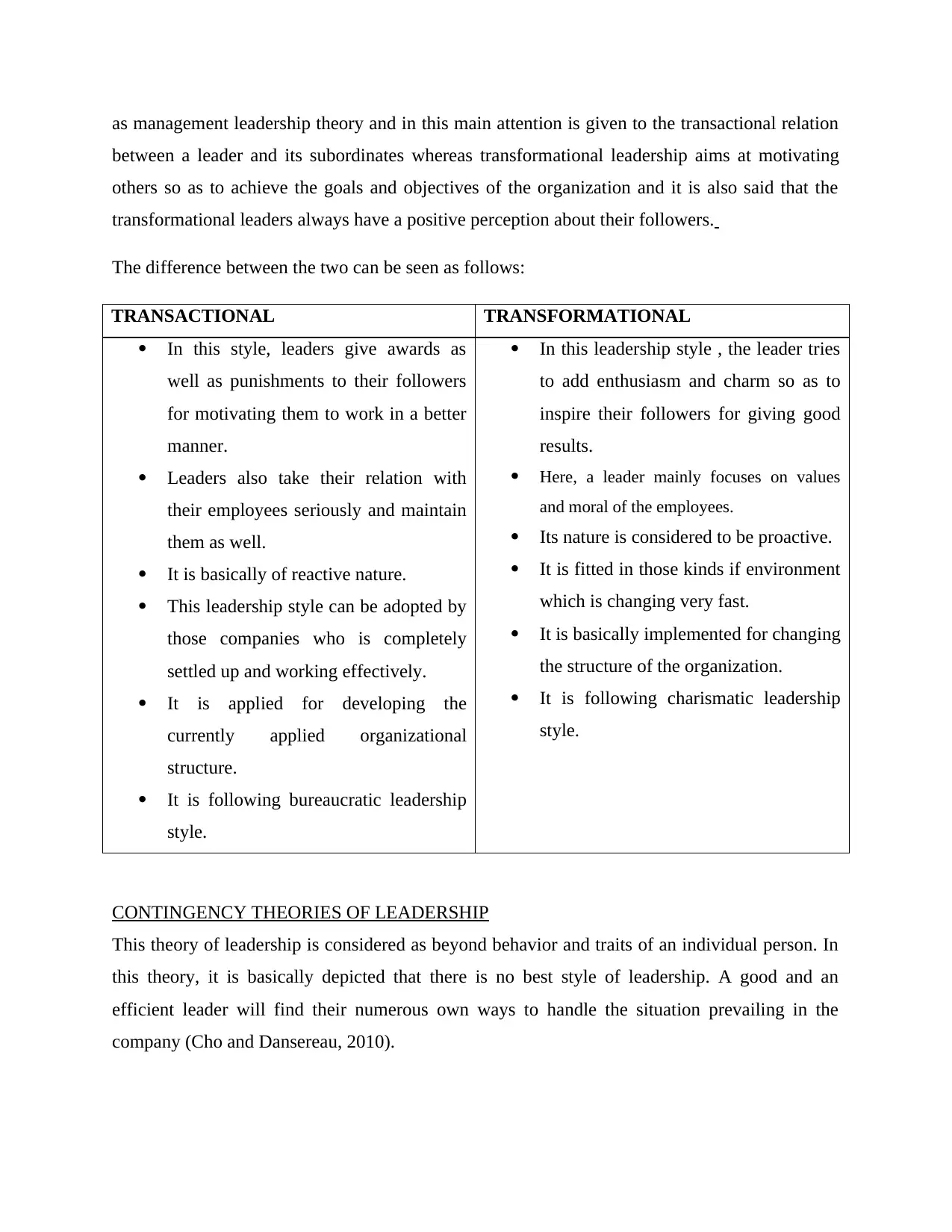
as management leadership theory and in this main attention is given to the transactional relation
between a leader and its subordinates whereas transformational leadership aims at motivating
others so as to achieve the goals and objectives of the organization and it is also said that the
transformational leaders always have a positive perception about their followers.
The difference between the two can be seen as follows:
TRANSACTIONAL TRANSFORMATIONAL
In this style, leaders give awards as
well as punishments to their followers
for motivating them to work in a better
manner.
Leaders also take their relation with
their employees seriously and maintain
them as well.
It is basically of reactive nature.
This leadership style can be adopted by
those companies who is completely
settled up and working effectively.
It is applied for developing the
currently applied organizational
structure.
It is following bureaucratic leadership
style.
In this leadership style , the leader tries
to add enthusiasm and charm so as to
inspire their followers for giving good
results.
Here, a leader mainly focuses on values
and moral of the employees.
Its nature is considered to be proactive.
It is fitted in those kinds if environment
which is changing very fast.
It is basically implemented for changing
the structure of the organization.
It is following charismatic leadership
style.
CONTINGENCY THEORIES OF LEADERSHIP
This theory of leadership is considered as beyond behavior and traits of an individual person. In
this theory, it is basically depicted that there is no best style of leadership. A good and an
efficient leader will find their numerous own ways to handle the situation prevailing in the
company (Cho and Dansereau, 2010).
between a leader and its subordinates whereas transformational leadership aims at motivating
others so as to achieve the goals and objectives of the organization and it is also said that the
transformational leaders always have a positive perception about their followers.
The difference between the two can be seen as follows:
TRANSACTIONAL TRANSFORMATIONAL
In this style, leaders give awards as
well as punishments to their followers
for motivating them to work in a better
manner.
Leaders also take their relation with
their employees seriously and maintain
them as well.
It is basically of reactive nature.
This leadership style can be adopted by
those companies who is completely
settled up and working effectively.
It is applied for developing the
currently applied organizational
structure.
It is following bureaucratic leadership
style.
In this leadership style , the leader tries
to add enthusiasm and charm so as to
inspire their followers for giving good
results.
Here, a leader mainly focuses on values
and moral of the employees.
Its nature is considered to be proactive.
It is fitted in those kinds if environment
which is changing very fast.
It is basically implemented for changing
the structure of the organization.
It is following charismatic leadership
style.
CONTINGENCY THEORIES OF LEADERSHIP
This theory of leadership is considered as beyond behavior and traits of an individual person. In
this theory, it is basically depicted that there is no best style of leadership. A good and an
efficient leader will find their numerous own ways to handle the situation prevailing in the
company (Cho and Dansereau, 2010).
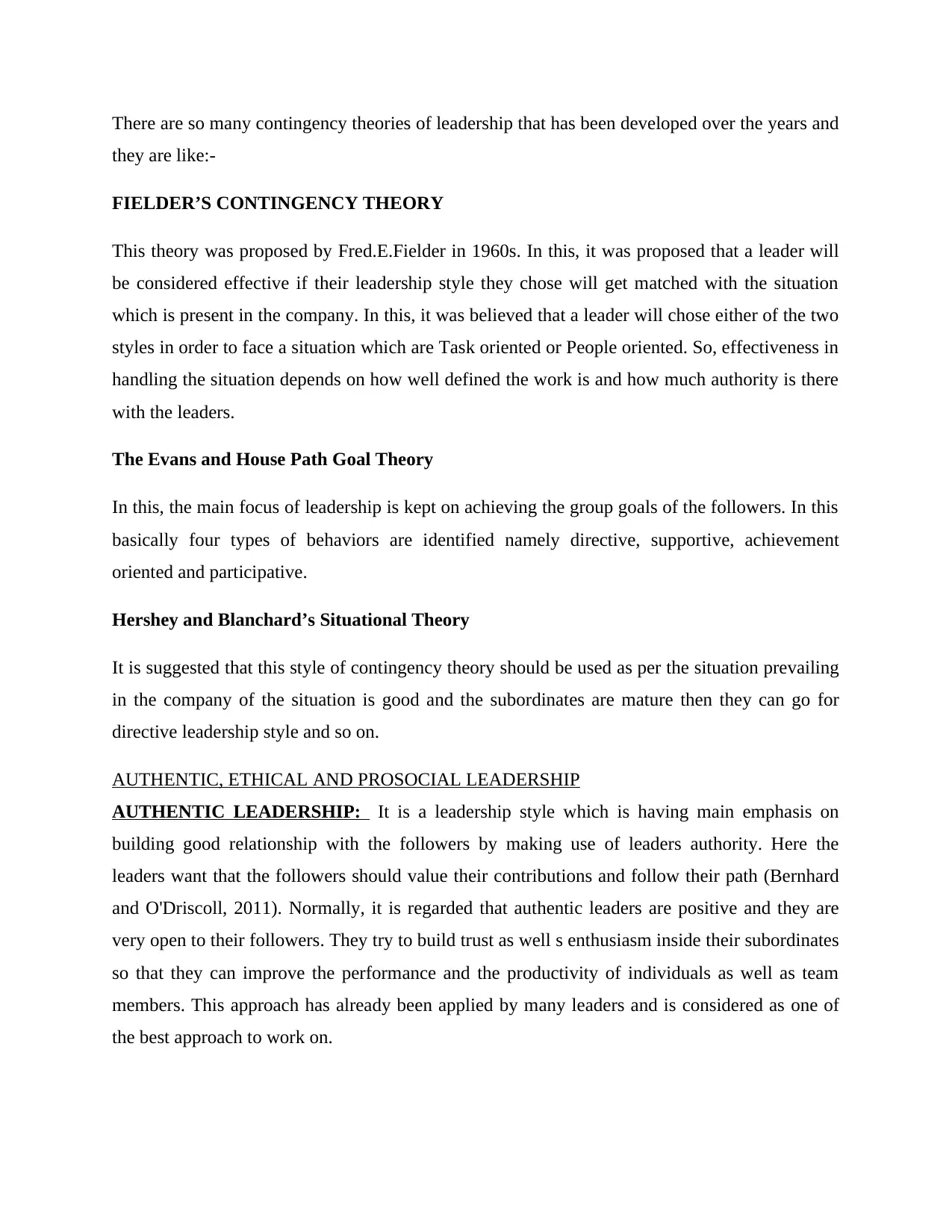
There are so many contingency theories of leadership that has been developed over the years and
they are like:-
FIELDER’S CONTINGENCY THEORY
This theory was proposed by Fred.E.Fielder in 1960s. In this, it was proposed that a leader will
be considered effective if their leadership style they chose will get matched with the situation
which is present in the company. In this, it was believed that a leader will chose either of the two
styles in order to face a situation which are Task oriented or People oriented. So, effectiveness in
handling the situation depends on how well defined the work is and how much authority is there
with the leaders.
The Evans and House Path Goal Theory
In this, the main focus of leadership is kept on achieving the group goals of the followers. In this
basically four types of behaviors are identified namely directive, supportive, achievement
oriented and participative.
Hershey and Blanchard’s Situational Theory
It is suggested that this style of contingency theory should be used as per the situation prevailing
in the company of the situation is good and the subordinates are mature then they can go for
directive leadership style and so on.
AUTHENTIC, ETHICAL AND PROSOCIAL LEADERSHIP
AUTHENTIC LEADERSHIP: It is a leadership style which is having main emphasis on
building good relationship with the followers by making use of leaders authority. Here the
leaders want that the followers should value their contributions and follow their path (Bernhard
and O'Driscoll, 2011). Normally, it is regarded that authentic leaders are positive and they are
very open to their followers. They try to build trust as well s enthusiasm inside their subordinates
so that they can improve the performance and the productivity of individuals as well as team
members. This approach has already been applied by many leaders and is considered as one of
the best approach to work on.
they are like:-
FIELDER’S CONTINGENCY THEORY
This theory was proposed by Fred.E.Fielder in 1960s. In this, it was proposed that a leader will
be considered effective if their leadership style they chose will get matched with the situation
which is present in the company. In this, it was believed that a leader will chose either of the two
styles in order to face a situation which are Task oriented or People oriented. So, effectiveness in
handling the situation depends on how well defined the work is and how much authority is there
with the leaders.
The Evans and House Path Goal Theory
In this, the main focus of leadership is kept on achieving the group goals of the followers. In this
basically four types of behaviors are identified namely directive, supportive, achievement
oriented and participative.
Hershey and Blanchard’s Situational Theory
It is suggested that this style of contingency theory should be used as per the situation prevailing
in the company of the situation is good and the subordinates are mature then they can go for
directive leadership style and so on.
AUTHENTIC, ETHICAL AND PROSOCIAL LEADERSHIP
AUTHENTIC LEADERSHIP: It is a leadership style which is having main emphasis on
building good relationship with the followers by making use of leaders authority. Here the
leaders want that the followers should value their contributions and follow their path (Bernhard
and O'Driscoll, 2011). Normally, it is regarded that authentic leaders are positive and they are
very open to their followers. They try to build trust as well s enthusiasm inside their subordinates
so that they can improve the performance and the productivity of individuals as well as team
members. This approach has already been applied by many leaders and is considered as one of
the best approach to work on.
⊘ This is a preview!⊘
Do you want full access?
Subscribe today to unlock all pages.
Trusted by 1+ million students worldwide
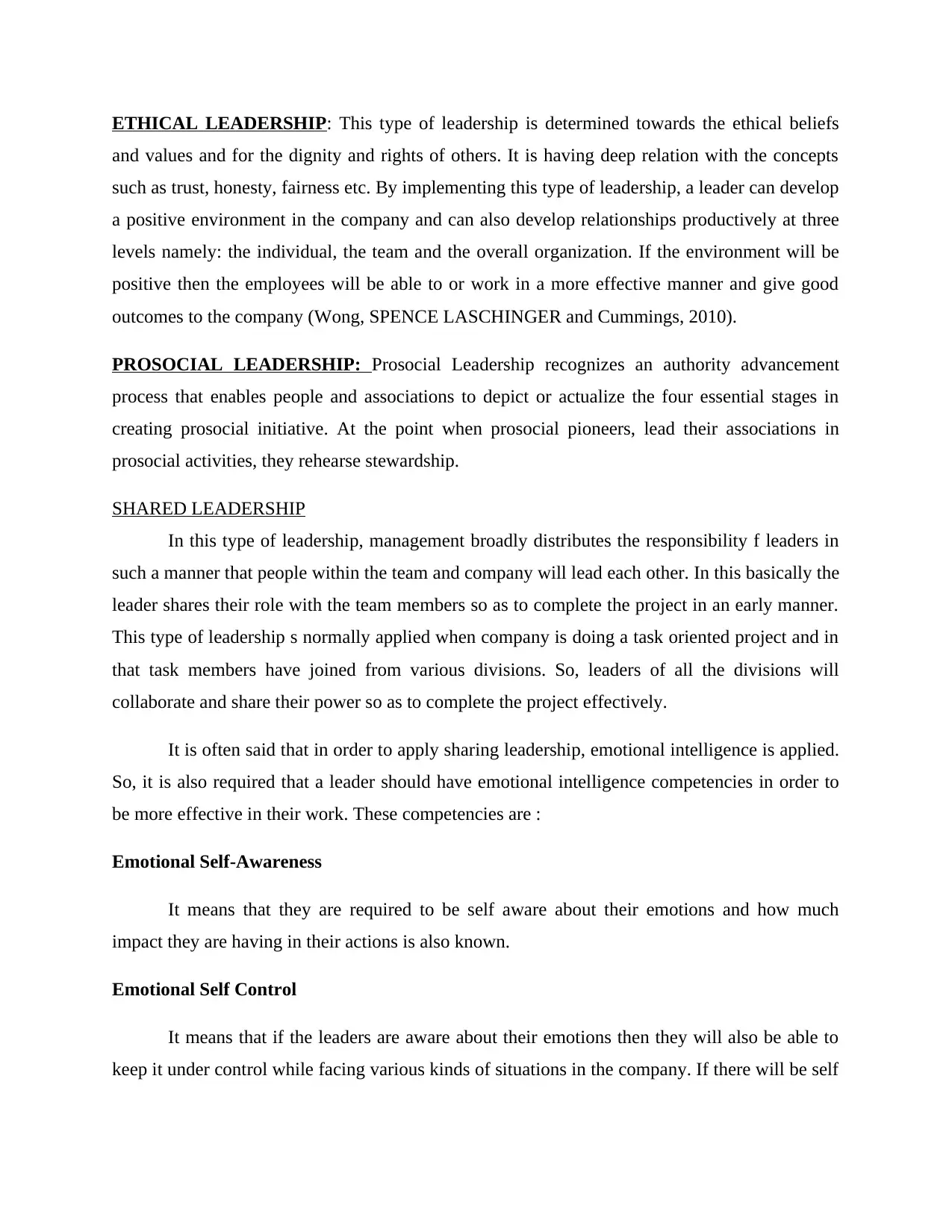
ETHICAL LEADERSHIP: This type of leadership is determined towards the ethical beliefs
and values and for the dignity and rights of others. It is having deep relation with the concepts
such as trust, honesty, fairness etc. By implementing this type of leadership, a leader can develop
a positive environment in the company and can also develop relationships productively at three
levels namely: the individual, the team and the overall organization. If the environment will be
positive then the employees will be able to or work in a more effective manner and give good
outcomes to the company (Wong, SPENCE LASCHINGER and Cummings, 2010).
PROSOCIAL LEADERSHIP: Prosocial Leadership recognizes an authority advancement
process that enables people and associations to depict or actualize the four essential stages in
creating prosocial initiative. At the point when prosocial pioneers, lead their associations in
prosocial activities, they rehearse stewardship.
SHARED LEADERSHIP
In this type of leadership, management broadly distributes the responsibility f leaders in
such a manner that people within the team and company will lead each other. In this basically the
leader shares their role with the team members so as to complete the project in an early manner.
This type of leadership s normally applied when company is doing a task oriented project and in
that task members have joined from various divisions. So, leaders of all the divisions will
collaborate and share their power so as to complete the project effectively.
It is often said that in order to apply sharing leadership, emotional intelligence is applied.
So, it is also required that a leader should have emotional intelligence competencies in order to
be more effective in their work. These competencies are :
Emotional Self-Awareness
It means that they are required to be self aware about their emotions and how much
impact they are having in their actions is also known.
Emotional Self Control
It means that if the leaders are aware about their emotions then they will also be able to
keep it under control while facing various kinds of situations in the company. If there will be self
and values and for the dignity and rights of others. It is having deep relation with the concepts
such as trust, honesty, fairness etc. By implementing this type of leadership, a leader can develop
a positive environment in the company and can also develop relationships productively at three
levels namely: the individual, the team and the overall organization. If the environment will be
positive then the employees will be able to or work in a more effective manner and give good
outcomes to the company (Wong, SPENCE LASCHINGER and Cummings, 2010).
PROSOCIAL LEADERSHIP: Prosocial Leadership recognizes an authority advancement
process that enables people and associations to depict or actualize the four essential stages in
creating prosocial initiative. At the point when prosocial pioneers, lead their associations in
prosocial activities, they rehearse stewardship.
SHARED LEADERSHIP
In this type of leadership, management broadly distributes the responsibility f leaders in
such a manner that people within the team and company will lead each other. In this basically the
leader shares their role with the team members so as to complete the project in an early manner.
This type of leadership s normally applied when company is doing a task oriented project and in
that task members have joined from various divisions. So, leaders of all the divisions will
collaborate and share their power so as to complete the project effectively.
It is often said that in order to apply sharing leadership, emotional intelligence is applied.
So, it is also required that a leader should have emotional intelligence competencies in order to
be more effective in their work. These competencies are :
Emotional Self-Awareness
It means that they are required to be self aware about their emotions and how much
impact they are having in their actions is also known.
Emotional Self Control
It means that if the leaders are aware about their emotions then they will also be able to
keep it under control while facing various kinds of situations in the company. If there will be self
Paraphrase This Document
Need a fresh take? Get an instant paraphrase of this document with our AI Paraphraser
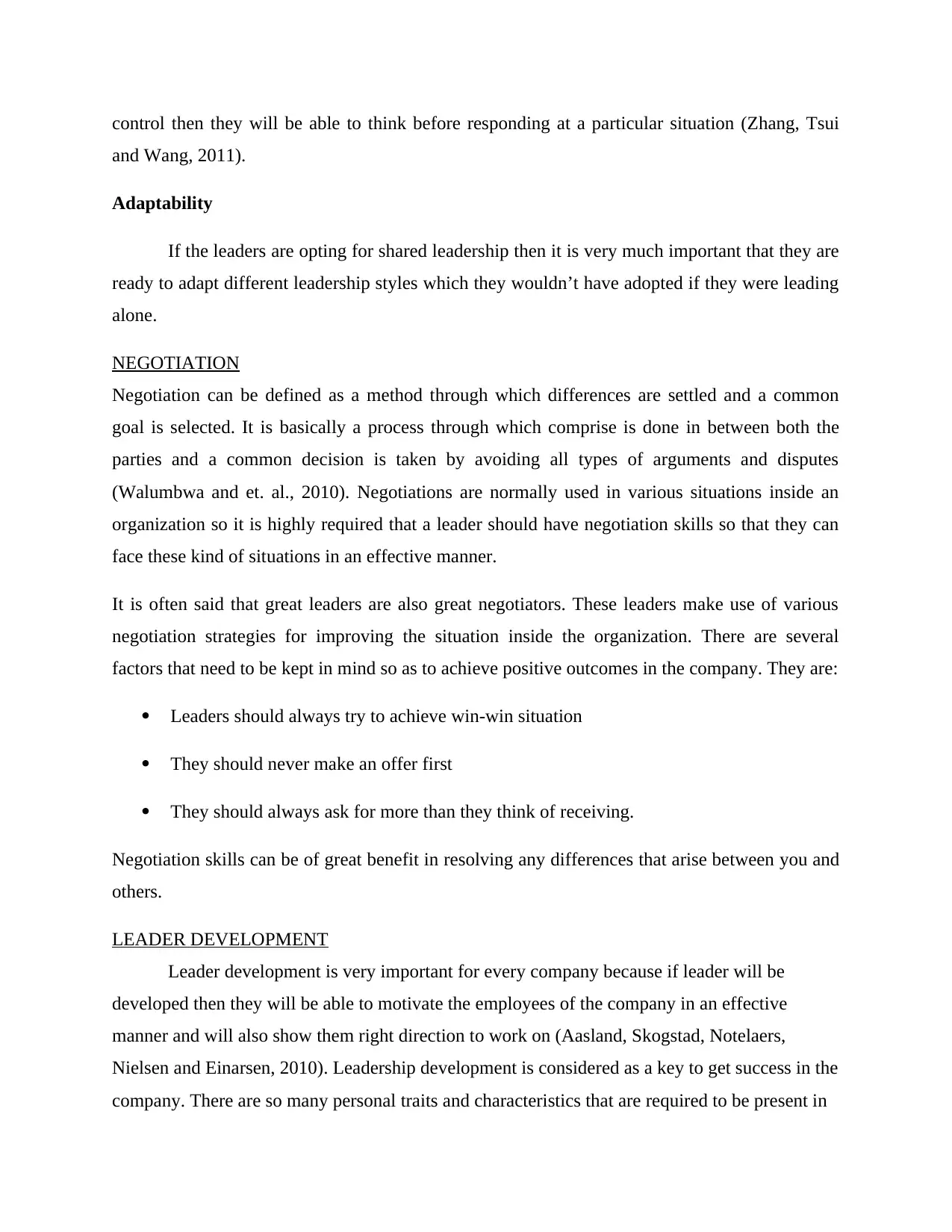
control then they will be able to think before responding at a particular situation (Zhang, Tsui
and Wang, 2011).
Adaptability
If the leaders are opting for shared leadership then it is very much important that they are
ready to adapt different leadership styles which they wouldn’t have adopted if they were leading
alone.
NEGOTIATION
Negotiation can be defined as a method through which differences are settled and a common
goal is selected. It is basically a process through which comprise is done in between both the
parties and a common decision is taken by avoiding all types of arguments and disputes
(Walumbwa and et. al., 2010). Negotiations are normally used in various situations inside an
organization so it is highly required that a leader should have negotiation skills so that they can
face these kind of situations in an effective manner.
It is often said that great leaders are also great negotiators. These leaders make use of various
negotiation strategies for improving the situation inside the organization. There are several
factors that need to be kept in mind so as to achieve positive outcomes in the company. They are:
Leaders should always try to achieve win-win situation
They should never make an offer first
They should always ask for more than they think of receiving.
Negotiation skills can be of great benefit in resolving any differences that arise between you and
others.
LEADER DEVELOPMENT
Leader development is very important for every company because if leader will be
developed then they will be able to motivate the employees of the company in an effective
manner and will also show them right direction to work on (Aasland, Skogstad, Notelaers,
Nielsen and Einarsen, 2010). Leadership development is considered as a key to get success in the
company. There are so many personal traits and characteristics that are required to be present in
and Wang, 2011).
Adaptability
If the leaders are opting for shared leadership then it is very much important that they are
ready to adapt different leadership styles which they wouldn’t have adopted if they were leading
alone.
NEGOTIATION
Negotiation can be defined as a method through which differences are settled and a common
goal is selected. It is basically a process through which comprise is done in between both the
parties and a common decision is taken by avoiding all types of arguments and disputes
(Walumbwa and et. al., 2010). Negotiations are normally used in various situations inside an
organization so it is highly required that a leader should have negotiation skills so that they can
face these kind of situations in an effective manner.
It is often said that great leaders are also great negotiators. These leaders make use of various
negotiation strategies for improving the situation inside the organization. There are several
factors that need to be kept in mind so as to achieve positive outcomes in the company. They are:
Leaders should always try to achieve win-win situation
They should never make an offer first
They should always ask for more than they think of receiving.
Negotiation skills can be of great benefit in resolving any differences that arise between you and
others.
LEADER DEVELOPMENT
Leader development is very important for every company because if leader will be
developed then they will be able to motivate the employees of the company in an effective
manner and will also show them right direction to work on (Aasland, Skogstad, Notelaers,
Nielsen and Einarsen, 2010). Leadership development is considered as a key to get success in the
company. There are so many personal traits and characteristics that are required to be present in
a leader so as to effectiveness in the company. So, in order to develop a leader, management can
organize various types of development programs through which new skills and attributes will be
added in the leader which can be used by them later on in performing their work (Wang, Tsui
and Xin, 2011).
If a leader will be developed then they will be able to inspire other employees also to
work in same manner like they are working. So, it is considered that in leadership development
various types of practices are acknowledged which is very essential for maximizing the potential
of an organization's human capital and growth capital and growth opportunities.
So, now more companies are focusing on developing their leaders from all the levels of
the organization which are being chosen as 'High potential'. Otherwise previously, the focus was
only on developing senior level leaders. It will also help in increasing the value of company in
the market as well.
LEADERSHIP AND COMMUNICATION
Both leadership and communication are the important factors which helps the
organization in gaining productivity in the company and making sure that the employees are
performing really well. It is very essential for the company that both these factors are present in
the company because if only leadership is present and communication is not there then the
leaders will not be able to develop their followers in an effective manner as their learning will
not be reached to their followers. So, it is very important that a leader should be a good
communicator so that they can communicate with their employees in an effective manner
(Walumbwa, Hartnell and Oke, 2010).
It is considered that for a leader communication is considered as a connection and
inspiration and it is not just transmission of information. Communication is considered as leaders
information highway and it is required to be flown from both the directions and if it is done then
goals and objectives of the company will be completed very easily.
INDIVIDUAL REFLECTION:
By studying leadership from a closed manner, I have learned that it a very important
process which is required to be applied in every company. I have also understood that there are
organize various types of development programs through which new skills and attributes will be
added in the leader which can be used by them later on in performing their work (Wang, Tsui
and Xin, 2011).
If a leader will be developed then they will be able to inspire other employees also to
work in same manner like they are working. So, it is considered that in leadership development
various types of practices are acknowledged which is very essential for maximizing the potential
of an organization's human capital and growth capital and growth opportunities.
So, now more companies are focusing on developing their leaders from all the levels of
the organization which are being chosen as 'High potential'. Otherwise previously, the focus was
only on developing senior level leaders. It will also help in increasing the value of company in
the market as well.
LEADERSHIP AND COMMUNICATION
Both leadership and communication are the important factors which helps the
organization in gaining productivity in the company and making sure that the employees are
performing really well. It is very essential for the company that both these factors are present in
the company because if only leadership is present and communication is not there then the
leaders will not be able to develop their followers in an effective manner as their learning will
not be reached to their followers. So, it is very important that a leader should be a good
communicator so that they can communicate with their employees in an effective manner
(Walumbwa, Hartnell and Oke, 2010).
It is considered that for a leader communication is considered as a connection and
inspiration and it is not just transmission of information. Communication is considered as leaders
information highway and it is required to be flown from both the directions and if it is done then
goals and objectives of the company will be completed very easily.
INDIVIDUAL REFLECTION:
By studying leadership from a closed manner, I have learned that it a very important
process which is required to be applied in every company. I have also understood that there are
⊘ This is a preview!⊘
Do you want full access?
Subscribe today to unlock all pages.
Trusted by 1+ million students worldwide
various theories of leadership which is applied by the companies but the best one is
Transnational leadership as I have observed that in this the employees are getting motivated to
perform their work in an effective manner. I have gained knowledge about of various styles of
leadership and the kind of behavior leaders should have in the company. So, if I will be a part of
the team then I will also want that my leaders should be efficient and will be able to take care of
all the members in an effective manner.
CONCLUSION
From the above report, it can be concluded that leadership is a very essential part o every
organization. If there will be good leaders then organization will be able to grow in a very fast
manner because leaders will motivate the employees to use their full strength while performing
their work and thus it will lead to increase their productivity and profitability of company as
well. In this report, there is detailed discussion on various theories and approaches of leadership
which are important to be implied in every company so as to make sure that all the wok is going
on in a smooth manner. Through this, companies will be able to achieve all their goals and
organization in an effective manner.
Transnational leadership as I have observed that in this the employees are getting motivated to
perform their work in an effective manner. I have gained knowledge about of various styles of
leadership and the kind of behavior leaders should have in the company. So, if I will be a part of
the team then I will also want that my leaders should be efficient and will be able to take care of
all the members in an effective manner.
CONCLUSION
From the above report, it can be concluded that leadership is a very essential part o every
organization. If there will be good leaders then organization will be able to grow in a very fast
manner because leaders will motivate the employees to use their full strength while performing
their work and thus it will lead to increase their productivity and profitability of company as
well. In this report, there is detailed discussion on various theories and approaches of leadership
which are important to be implied in every company so as to make sure that all the wok is going
on in a smooth manner. Through this, companies will be able to achieve all their goals and
organization in an effective manner.
Paraphrase This Document
Need a fresh take? Get an instant paraphrase of this document with our AI Paraphraser
REFERENCES
Books and Journals
Bolman, L. G. and Deal, T. E., 2017. Reframing organizations: Artistry, choice, and leadership.
John Wiley & Sons.
Babcock-Roberson, M. E. and Strickland, O.J., 2010. The relationship between charismatic
leadership, work engagement, and organizational citizenship behaviors. The Journal of
psychology. 144(3). pp.313-326.
Nam Nguyen, H. and Mohamed, S., 2011. Leadership behaviors, organizational culture and
knowledge management practices: An empirical investigation. Journal of Management
Development. 30(2). pp.206-221.
Yukl, G.A., 2013. Leadership in organizations. Pearson Education India.
Cho, J. and Dansereau, F., 2010. Are transformational leaders fair? A multi-level study of
transformational leadership, justice perceptions, and organizational citizenship
behaviors. The Leadership Quarterly. 21(3). pp.409-421.
Bernhard, F. and O'Driscoll, M.P., 2011. Psychological ownership in small family-owned
businesses: Leadership style and nonfamily-employees’ work attitudes and
behaviors. Group & Organization Management. 36(3). pp.345-384.
Wong, C.A., SPENCE LASCHINGER, H.K. and Cummings, G.G., 2010. Authentic leadership
and nurses' voice behaviour and perceptions of care quality. Journal of Nursing
Management. 18(8). pp.889-900.
Zhang, A. Y., Tsui, A.S. and Wang, D.X., 2011. Leadership behaviors and group creativity in
Chinese organizations: The role of group processes. The Leadership Quarterly. 22(5).
pp.851-862.
Walumbwa, F.O. and et. al., 2010. Retracted: Psychological processes linking authentic
leadership to follower behaviors.
Aasland, M.S., Skogstad, A., Notelaers, G., Nielsen, M.B. and Einarsen, S., 2010. The
prevalence of destructive leadership behaviour. British Journal of management. 21(2).
pp.438-452.
Wang, H., Tsui, A.S. and Xin, K.R., 2011. CEO leadership behaviors, organizational
performance, and employees' attitudes. The Leadership Quarterly. 22(1). pp.92-105.
Walumbwa, F. O., Hartnell, C. A. and Oke, A., 2010. Servant leadership, procedural justice
climate, service climate, employee attitudes, and organizational citizenship behavior: a
cross-level investigation. Journal of Applied Psychology. 95(3). p.517.
Books and Journals
Bolman, L. G. and Deal, T. E., 2017. Reframing organizations: Artistry, choice, and leadership.
John Wiley & Sons.
Babcock-Roberson, M. E. and Strickland, O.J., 2010. The relationship between charismatic
leadership, work engagement, and organizational citizenship behaviors. The Journal of
psychology. 144(3). pp.313-326.
Nam Nguyen, H. and Mohamed, S., 2011. Leadership behaviors, organizational culture and
knowledge management practices: An empirical investigation. Journal of Management
Development. 30(2). pp.206-221.
Yukl, G.A., 2013. Leadership in organizations. Pearson Education India.
Cho, J. and Dansereau, F., 2010. Are transformational leaders fair? A multi-level study of
transformational leadership, justice perceptions, and organizational citizenship
behaviors. The Leadership Quarterly. 21(3). pp.409-421.
Bernhard, F. and O'Driscoll, M.P., 2011. Psychological ownership in small family-owned
businesses: Leadership style and nonfamily-employees’ work attitudes and
behaviors. Group & Organization Management. 36(3). pp.345-384.
Wong, C.A., SPENCE LASCHINGER, H.K. and Cummings, G.G., 2010. Authentic leadership
and nurses' voice behaviour and perceptions of care quality. Journal of Nursing
Management. 18(8). pp.889-900.
Zhang, A. Y., Tsui, A.S. and Wang, D.X., 2011. Leadership behaviors and group creativity in
Chinese organizations: The role of group processes. The Leadership Quarterly. 22(5).
pp.851-862.
Walumbwa, F.O. and et. al., 2010. Retracted: Psychological processes linking authentic
leadership to follower behaviors.
Aasland, M.S., Skogstad, A., Notelaers, G., Nielsen, M.B. and Einarsen, S., 2010. The
prevalence of destructive leadership behaviour. British Journal of management. 21(2).
pp.438-452.
Wang, H., Tsui, A.S. and Xin, K.R., 2011. CEO leadership behaviors, organizational
performance, and employees' attitudes. The Leadership Quarterly. 22(1). pp.92-105.
Walumbwa, F. O., Hartnell, C. A. and Oke, A., 2010. Servant leadership, procedural justice
climate, service climate, employee attitudes, and organizational citizenship behavior: a
cross-level investigation. Journal of Applied Psychology. 95(3). p.517.

⊘ This is a preview!⊘
Do you want full access?
Subscribe today to unlock all pages.
Trusted by 1+ million students worldwide

1 out of 12


Related Documents


Your All-in-One AI-Powered Toolkit for Academic Success.
+13062052269
info@desklib.com
Available 24*7 on WhatsApp / Email
![[object Object]](/_next/static/media/star-bottom.7253800d.svg)
Unlock your academic potential
Copyright © 2020–2026 A2Z Services. All Rights Reserved. Developed and managed by ZUCOL.