Organisational Behaviour: The Role of Trust in Leadership

Verified

Added on  2023/01/19

|10
|439
|56
Report
AI Summary
This report examines the pivotal role of trust in leadership within the context of organisational behaviour. It explores how trust fosters effective employee relations and contributes to achieving organisational goals. The report highlights the significance of trust in influencing staff performance and the overall success of the business. It discusses the importance of good leadership in building and maintaining trust, which in turn drives employee motivation and the ability to meet customer demands. Furthermore, the report emphasizes that trust is a continuous process that develops over time. It also provides a concise overview of how leaders can leverage trust to enhance their team's performance and achieve their objectives. Finally, the report concludes with a summary of the key findings and includes a reference list to support its claims.
Document Page
Organisational
Behaviour
tabler-icon-diamond-filled.svg

Paraphrase This Document

Need a fresh take? Get an instant paraphrase of this document with our AI Paraphraser
Document Page
Content
Introduction
Main Body
Conclusion
References
Document Page
INTRODUCTION
Trust can be defined as an essential ingredient for developing good relations
among the people. Trust leaders use the support of their staff members in
order to achieve the common objectives as well as forms one of the most
important aspect of the company.
Document Page
Main Body
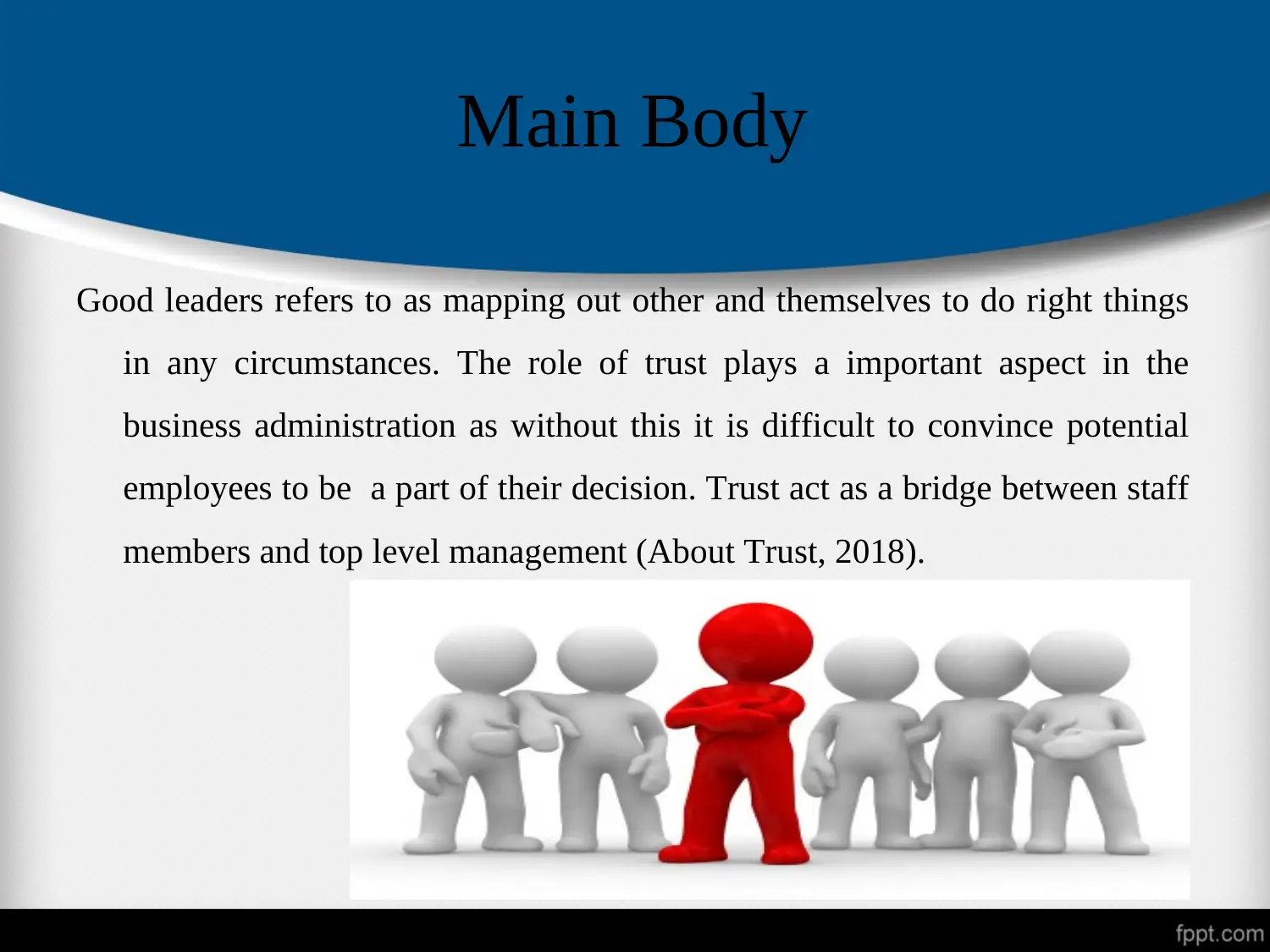
Good leaders refers to as mapping out other and themselves to do right things
in any circumstances. The role of trust plays a important aspect in the
business administration as without this it is difficult to convince potential
employees to be a part of their decision. Trust act as a bridge between staff
members and top level management (About Trust, 2018).
tabler-icon-diamond-filled.svg

Paraphrase This Document

Need a fresh take? Get an instant paraphrase of this document with our AI Paraphraser
Document Page
Continue..
To attain best outcomes in the global market business administration adopts
certain theories or models in their working premises. By doing so the skilled
and potential staff members of the company are encouraged to perform
effectively and efficiently in order to achieve goals. Every organisation
depending upon their type of business in the international market implement
theories and model accordingly.
Document Page
Continue...
Trust is the core element to build good and healthy relations in the organisation.
Without trust good leader can not push the employees to achieve the desire
goals and objective in the set time duration. Trust is not build in a day or
year it grows with the phase of time in the eyes of the staff members.
Document Page
Continue...
The role of the good leader is critically evaluated in order to improve the
weak area accordingly with the phase of time. By building trust it is
beneficial to the firm in every aspect as it aid in achieving the emerging
needs of the customers as employees work under the guidance of the
leader
tabler-icon-diamond-filled.svg

Paraphrase This Document

Need a fresh take? Get an instant paraphrase of this document with our AI Paraphraser
Document Page
Conclusion
From the above it can be summarized that good leaders in an administration
helps to retain capable employees in their working premises. Some
qualities of leaders are god gifted whereas, rest need to be developed with
the phase of time.
Document Page
References
Osei, B. A. and Abenyin, A. N., 2016. Applying the Engell–Kollat–
Blackwell model in understanding international tourists’ use of social
media for travel decision to Ghana. Information Technology &
Tourism. 16(3). pp.265-284.
East, R. and et.al., 2016. Consumer behaviour: Applications in marketing.
Sage.
Szmigin, I. and Piacentini, M., 2018. Consumer behaviour. Oxford
University Press.
Document Page
Thank You
chevron_up_icon
1 out of 10
circle_padding
hide_on_mobile
zoom_out_icon
[object Object]