Ethical Crisis Leadership: Ebola, New Orleans, Shackleton Case Studies

Verified

Added on  2022/08/30

|8
|1838
|17
Case Study
AI Summary
This assignment analyzes three case studies focusing on ethical crisis leadership. The first case study examines the Ebola outbreak in West Africa, discussing the responsibilities of medical personnel and the importance of international cooperation and cultural sensitivity in controlling the spread of the virus. The second case study focuses on the recovery of New Orleans after Hurricane Katrina, highlighting the resilience of the community and the role of leadership, both formal and informal, in rebuilding the city. The third case study explores the leadership of Ernest Shackleton during the Endurance expedition, identifying key virtues such as resilience, compassion, and decisiveness, and drawing lessons applicable to various leadership contexts. The analysis emphasizes the importance of ethical considerations, effective communication, and adaptability in navigating crises and achieving positive outcomes.
Document Page
Running head: TITLE OF PAPER IN CAPS 1
Paper Title Capitalized and Centered
Name of Student
Institution Affiliation
tabler-icon-diamond-filled.svg

Paraphrase This Document

Need a fresh take? Get an instant paraphrase of this document with our AI Paraphraser
Document Page
TITLE OF PAPER IN CAPS 2
Case Study 12.1.
1. Yes, the medical personnel were responsible for providing care to the patients
ignoring all kinds of risk. The doctors and volenteers and all the person helping with
that pandemic were brave souls as in spite of seeing their colleagues fall to the illness
they kept on working even under the harsh climates. They kept on working with the
millions of people affected by Ebola.
2. When an area is denoted as affected with a disease that spreads with touching the
bodies of the ill. Even when those ill people are dead, the virus spreads from the dead
bodies (Donovan, 2014). So for the betterment of public health should stop the local
cultural customs that needs people to touch the bodies of ill people or the dead for the
last rites.
3. The government leaders and citizens of the wealthy nations should help the people of
poorer regions. If the wealthy nations intervene the pandemic affected poorer states
with all the necessities, then the viral disease would not have spread to a critical level.
The primary reason for any disease reaching critical level is not having healthy means
of life. With the help from wealthy world leaders and citizens the diseases could have
been challenged properly.
4. The world leaders need to let aside their political differences and agendas and need to
come together for future possible epidemic. If the countries don’t work together,
Document Page
TITLE OF PAPER IN CAPS 3
humanity will not be able to face another pandemic. Big non profit organizations like
WHO should try raise these concerns in front of the world leaders to narrow the gaps
in medical care between healthy and poor countries (Gimm & Nichols, 2015).
5. To better prepare and respond to a future Ebola epidemic, primarily the big non profit
organizations like WHO should be well provided with all the help to fight with
another pandemic. Furthermore, the wealthy and poor countries should have network
of clinical activity always strengthen in between them this way the countries can
strengthen their defence to any future possible epidemic. Furthermore, the medicine
companies should be encouraging to make more Ebola vaccine and medicine. Finally,
a way of healthy life should be encouraged amongst all level of the society.
6. The government needs to provide certain facilities that will encourage the
corporations to keep on producing Ebola vaccines not caring about loss or profit. The
drug companies need to be encouraged by their ruling governments through any
means possible (Sengupta, 2015). If the drug companies, see the facilities they will
produce medication for unprofitable diseases like Ebola.
7. The world leaders and leaders of the people need to follow ethics unchanged by
anything else than compassion and empathy to other’s damnation. The countries need
Document Page
TITLE OF PAPER IN CAPS 4
to set aside their political differences and wars and prolonged hate in between and
come together to be prepared for pandemics.
Case Study 12. 2.
1. At any point of disaster occurred to any place, the recovery always outweighs the
failures. But in case of recovery of the New Orleans, it was significantly remarkable.
Without much help from other states or leaders, New Orleans bounced back on its
feet. They were quick to re align their daily lives (Rivlin, 2015). Normal citizens took
parts of leaders although they did not have any past experience or training of
leadership. Also all the people of New Orleans did their parts in the recovery.
Through this the successes of the New Orleans outweighs the failures due to hurricane
Katrina.
2. The resilience lab of New Orleans predicts the total time that is needed for complete
recovery from the disaster. As the damages to the place is severe. The recovery rate is
really astonishing. However, the daily life of the people of New Orleans almost back
to normal, the complete recovery will take ten prolonged years (Jervis, 2015). But it is
also stated that ten years is not long enough in respect to the damages incurred by
New Orleans due the disaster Katrina.
3. The disaster Katrina provided people with opportunities to become leaders or
examples for other people to follow in the path of recovery. The disaster made people
tabler-icon-diamond-filled.svg

Paraphrase This Document

Need a fresh take? Get an instant paraphrase of this document with our AI Paraphraser
Document Page
TITLE OF PAPER IN CAPS 5
of the New Orleans to come closer in spite of cultural and regional diversities.
Furthermore, the political leaders provided help to the people of the disaster affected
places. Also new Orleans got the group called Common Ground that helped the
people reclaim their daily life back.
4. When a natural disaster strikes. The political leaders need to come to aid the people of
the disaster affected place. They need to provide proper tools to the people for
mending their ways to regain the daily life and earnings (Bucktin, 2015).
Furthermore, the governments need to provide all the help and support to the
grassroots leaders in rescuing people and they also need to provide man power who
would volunteer under the command of the people’s leaders.
5. The government can do a lot of things to achieve the mentioned issue here, primarily
due to the disaster a lot of people’s house got devastated and these houses are still
vacant. Significantly the African American people from the black neighborhoods do
not have a house of their own. Specially in the Lower Ninth Ward. The government
need to look after this matter. Also there is a sound contrast between the earnings
from jobs that occurs with black and white people. White people generally lands high
paying jobs then the black people. Government should build temporary living
arrangements for the people. They also provide food and medicine aid to the people
until the local people are ready to stand on their own feet.
Document Page
TITLE OF PAPER IN CAPS 6
Case Study 12.3.
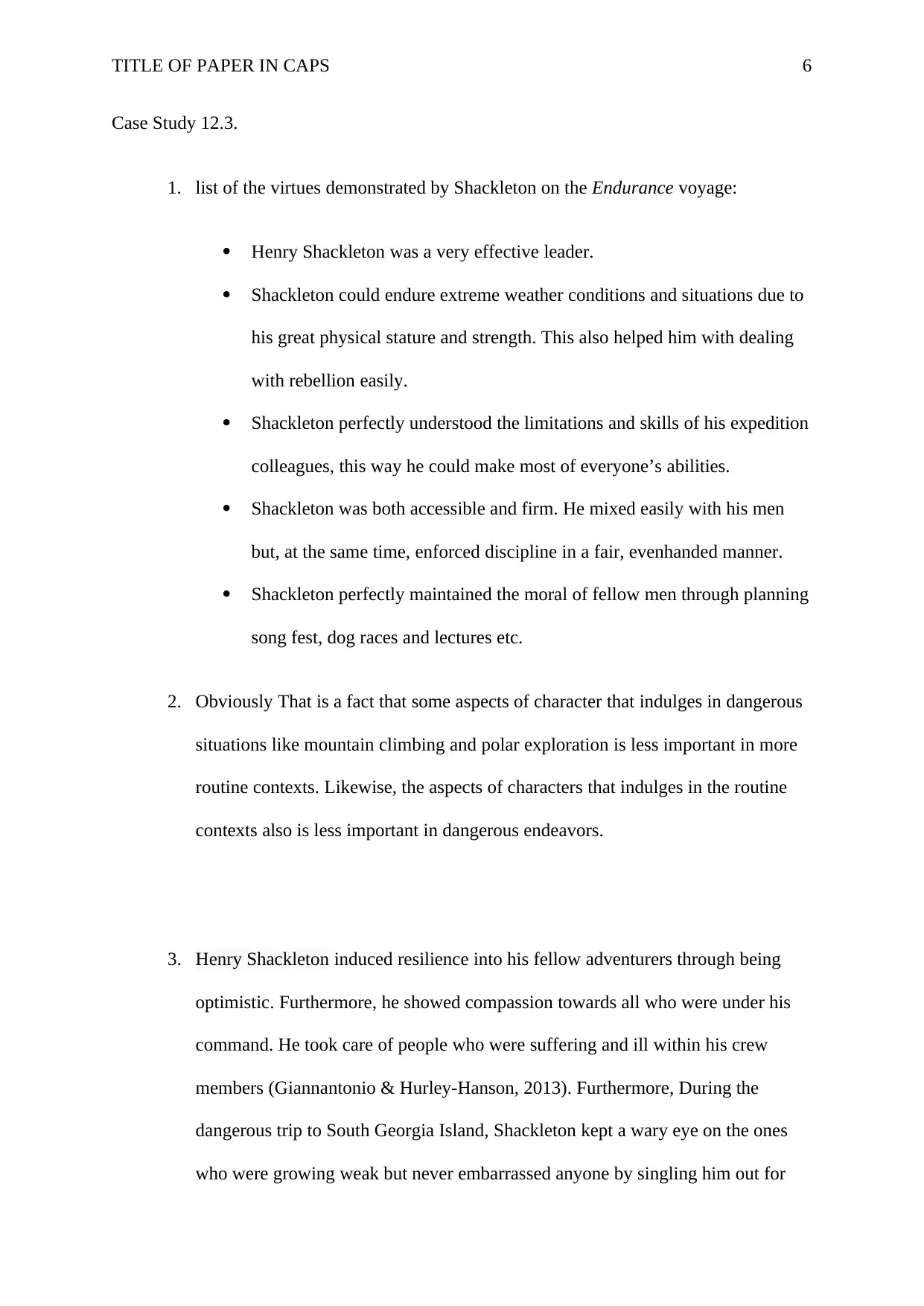
1. list of the virtues demonstrated by Shackleton on the Endurance voyage:
Henry Shackleton was a very effective leader.
Shackleton could endure extreme weather conditions and situations due to
his great physical stature and strength. This also helped him with dealing
with rebellion easily.
Shackleton perfectly understood the limitations and skills of his expedition
colleagues, this way he could make most of everyone’s abilities.
Shackleton was both accessible and firm. He mixed easily with his men
but, at the same time, enforced discipline in a fair, evenhanded manner.
Shackleton perfectly maintained the moral of fellow men through planning
song fest, dog races and lectures etc.
2. Obviously That is a fact that some aspects of character that indulges in dangerous
situations like mountain climbing and polar exploration is less important in more
routine contexts. Likewise, the aspects of characters that indulges in the routine
contexts also is less important in dangerous endeavors.
3. Henry Shackleton induced resilience into his fellow adventurers through being
optimistic. Furthermore, he showed compassion towards all who were under his
command. He took care of people who were suffering and ill within his crew
members (Giannantonio & Hurley-Hanson, 2013). Furthermore, During the
dangerous trip to South Georgia Island, Shackleton kept a wary eye on the ones
who were growing weak but never embarrassed anyone by singling him out for
Document Page
TITLE OF PAPER IN CAPS 7
special help. If one sailor appeared on the verge of collapse, he made sure that
everyone got warm milk or food to make sure the weak sailor does not collapse.
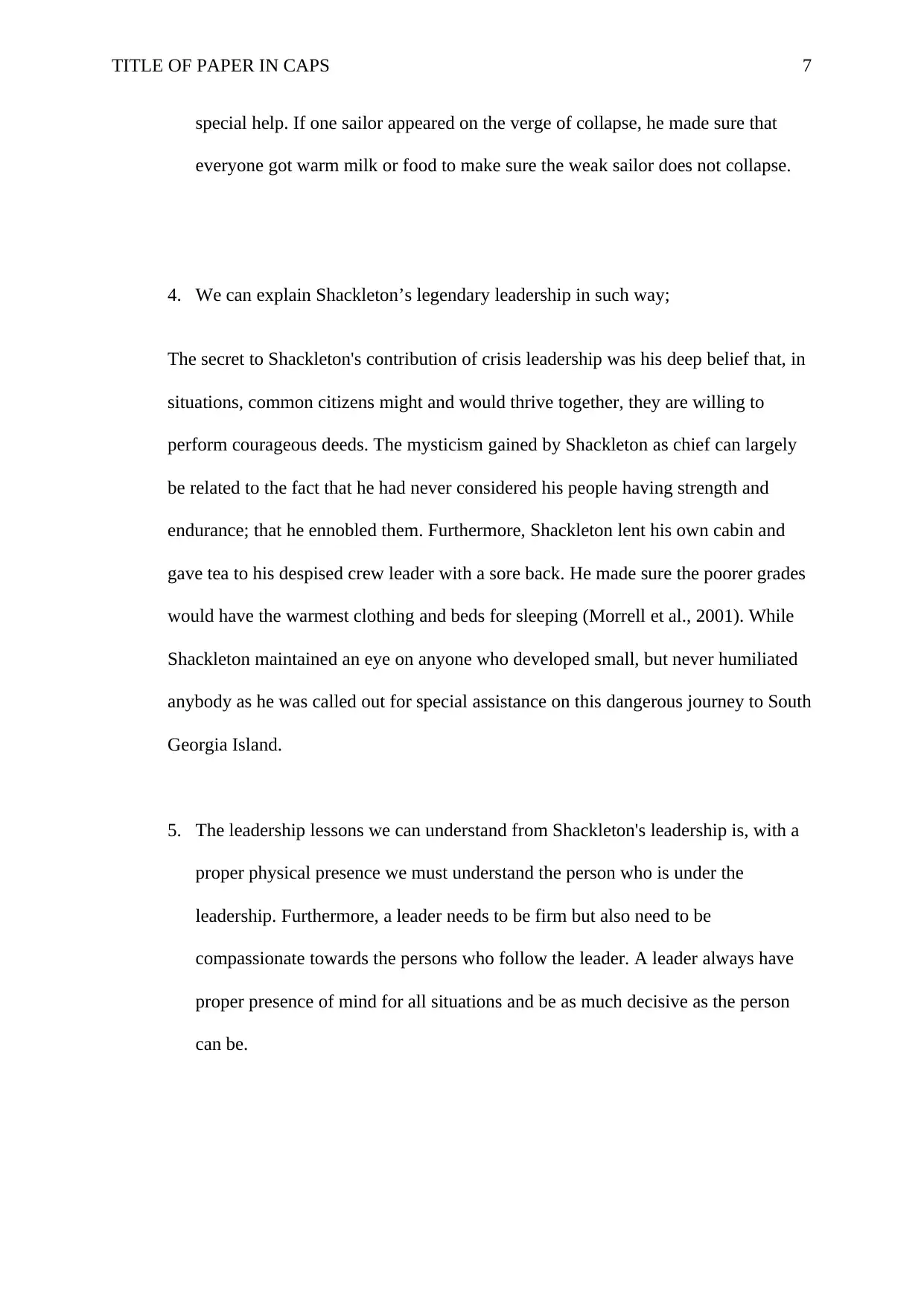
4. We can explain Shackleton’s legendary leadership in such way;
The secret to Shackleton's contribution of crisis leadership was his deep belief that, in
situations, common citizens might and would thrive together, they are willing to
perform courageous deeds. The mysticism gained by Shackleton as chief can largely
be related to the fact that he had never considered his people having strength and
endurance; that he ennobled them. Furthermore, Shackleton lent his own cabin and
gave tea to his despised crew leader with a sore back. He made sure the poorer grades
would have the warmest clothing and beds for sleeping (Morrell et al., 2001). While
Shackleton maintained an eye on anyone who developed small, but never humiliated
anybody as he was called out for special assistance on this dangerous journey to South
Georgia Island.
5. The leadership lessons we can understand from Shackleton's leadership is, with a
proper physical presence we must understand the person who is under the
leadership. Furthermore, a leader needs to be firm but also need to be
compassionate towards the persons who follow the leader. A leader always have
proper presence of mind for all situations and be as much decisive as the person
can be.
tabler-icon-diamond-filled.svg

Paraphrase This Document

Need a fresh take? Get an instant paraphrase of this document with our AI Paraphraser
Document Page
TITLE OF PAPER IN CAPS 8
References
Bucktin, C. (2015, August 16). Hurricane Katrina: Despair of the victims 10 years on. Daily
Mirror, News, 26–27.
Donovan, G. K. (2014). Ebola, epidemics, and ethics—what we have learned. Philosophy,
Ethics, and Humanities in Medicine, 9:15. (Online source)
Giannantonio, C. M., & Hurley-Hanson, A. E. (2013). Extreme leadership: Lessons from
Ernest Shackleton and the Endurance expedition. In C. M. Giannantonio & A. E.
Hurley-Hanson (Eds.), Extreme leadership: Leaders, teams and situations outside the
norm (pp. 3–14). Cheltenham, England: Edward Elgar.
Gimm, G., & Nichols, L. M. (2015, May). Ebola crisis of 2014: Are current strategies enough
to meet the long-run challenges ahead? American Journal of Public Health, 105(5),
E8–E10.
Morrell, M., Capparell, S., & Shackleton, A. (2001). Shackleton’s way: Leadership lessons
from the great Antarctic explorer. New York, NY: Viking Press.
Jervis, R. (2015, August 23). Nagging divide cuts through New Orleans. USA Today, p. 2A.
Rivlin, G. (2015). Katrina: After the flood. New York, NY: Simon & Schuster.
Sengupta, S. (2015, July 8). Panel calls W.H.O. unfit to handle a crisis like Ebola. The New
York Times, p. A7.
chevron_up_icon
1 out of 8
circle_padding
hide_on_mobile
zoom_out_icon
[object Object]