Comparing Leadership: CEO in Multinational Company and a Sports Coach
VerifiedAdded on 2023/01/16
|10
|2188
|25
Report
AI Summary
This report provides a comparative analysis of leadership styles, focusing on the contrasting roles of a CEO in a multinational company and a sports coach. The report explores the distinct demands and responsibilities inherent in each role, examining how CEOs develop and implement strategies, manage resources, and communicate with diverse stakeholders. It also investigates the leadership traits and approaches essential for sports coaches, including motivating athletes, fostering teamwork, and guiding performance improvement. The analysis highlights the importance of emotional intelligence, adaptability, and the ability to create a positive and supportive environment in both leadership contexts. The report concludes by emphasizing the significance of learning from mistakes, taking responsibility, and striving for excellence in achieving organizational and individual goals.

The Leadership

Paraphrase This Document
Need a fresh take? Get an instant paraphrase of this document with our AI Paraphraser
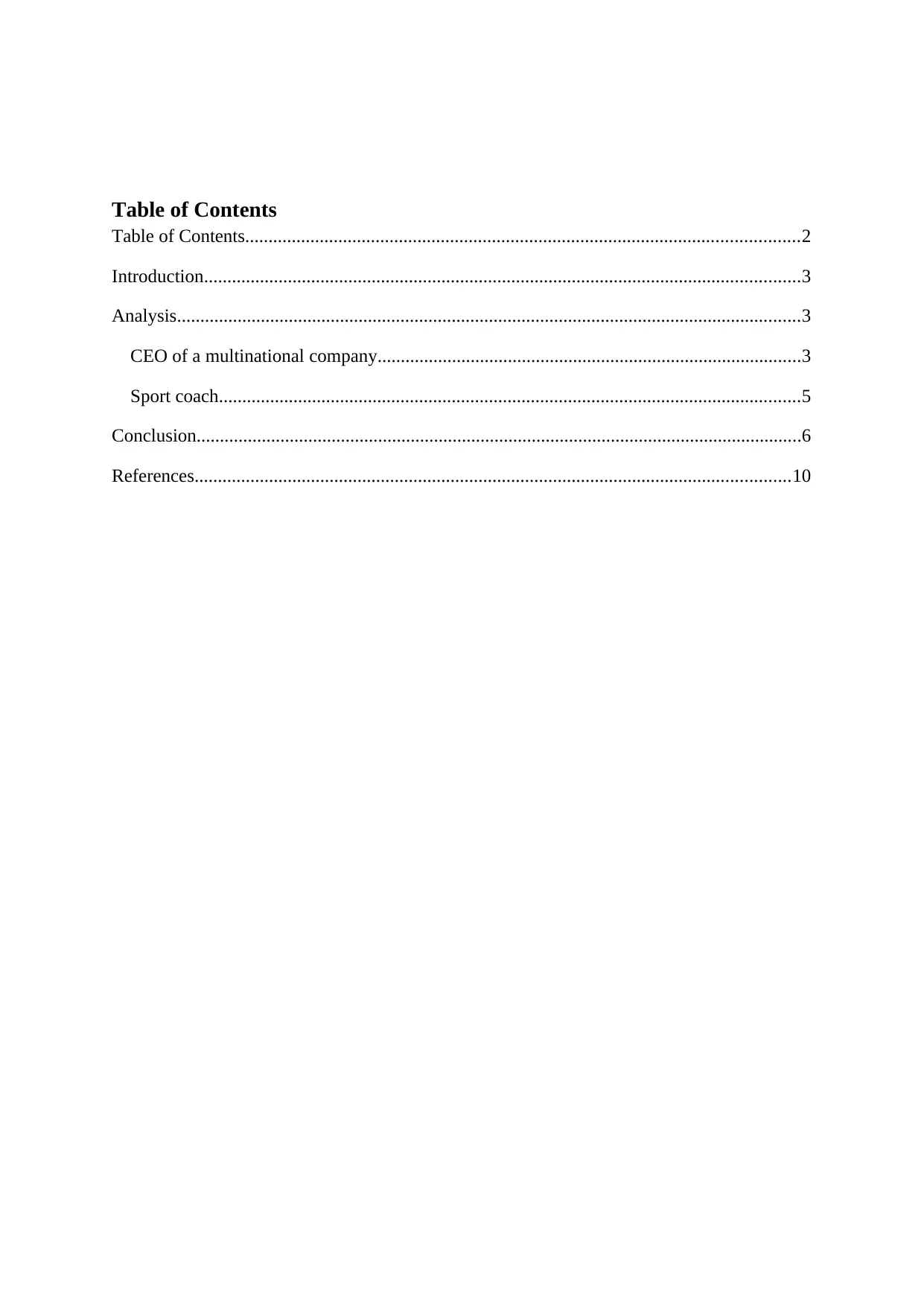
Table of Contents
Table of Contents.......................................................................................................................2
Introduction................................................................................................................................3
Analysis......................................................................................................................................3
CEO of a multinational company...........................................................................................3
Sport coach.............................................................................................................................5
Conclusion..................................................................................................................................6
References................................................................................................................................10
Table of Contents.......................................................................................................................2
Introduction................................................................................................................................3
Analysis......................................................................................................................................3
CEO of a multinational company...........................................................................................3
Sport coach.............................................................................................................................5
Conclusion..................................................................................................................................6
References................................................................................................................................10
Introduction
Great leaders are not born the way they are, but their behavior mark the best and lead them to
success in order to develop and refine over time. A successful leader is deeply committed for
making right conducts for right thing and continues to attempt the same, even though it is
difficult or unpopular to stay in course. It is important for a leader to assist the team members
in growing and attaining the objective or goals. A leader attempts for assessing the
requirements, abilities and goal of team members on individual basis; in order to uncover
their best skills and enhance them to another level. Present study emphasizes on leadership
behavior required in two different roles and situation. The two roles on which emphasis has
been made is CEO of multinational company and a sport’s coach. In primary part of the study
various approaches which can be applied by a CEO as a leader in difference circumstances
have been discussed. Further, in next phase of the study different situation which is dealt as a
leader by a sport’s coach has been discussed in order to assess the manner in which a leader
should react in specified scenarios.
Analysis
Leadership by CEO of a multinational company
The job of CEO in the multinational company is different from any other job in the
organization and their working is endless. It is the responsibility of CEO to make all the
decisions and actions for all the associates of the corporation. Furthermore they are also
performing their roles for the person those are not connected with the company (Mendenhall,
at.el, 2017). By the philosophy of over-arching the CEOs approach of leadership is
determined (Gehrke, and Claes, 2017). The major areas such as company’s strategies for
research and development, recruitment as well as strategicplanning are considered in this
approach.. An approach of leadership is rational, open form of management and is not at all
similar to personal lifestyle however there is a major difference (Ali, and Ivanov, 2015).
Strategy Development or Formation
Great leaders are not born the way they are, but their behavior mark the best and lead them to
success in order to develop and refine over time. A successful leader is deeply committed for
making right conducts for right thing and continues to attempt the same, even though it is
difficult or unpopular to stay in course. It is important for a leader to assist the team members
in growing and attaining the objective or goals. A leader attempts for assessing the
requirements, abilities and goal of team members on individual basis; in order to uncover
their best skills and enhance them to another level. Present study emphasizes on leadership
behavior required in two different roles and situation. The two roles on which emphasis has
been made is CEO of multinational company and a sport’s coach. In primary part of the study
various approaches which can be applied by a CEO as a leader in difference circumstances
have been discussed. Further, in next phase of the study different situation which is dealt as a
leader by a sport’s coach has been discussed in order to assess the manner in which a leader
should react in specified scenarios.
Analysis
Leadership by CEO of a multinational company
The job of CEO in the multinational company is different from any other job in the
organization and their working is endless. It is the responsibility of CEO to make all the
decisions and actions for all the associates of the corporation. Furthermore they are also
performing their roles for the person those are not connected with the company (Mendenhall,
at.el, 2017). By the philosophy of over-arching the CEOs approach of leadership is
determined (Gehrke, and Claes, 2017). The major areas such as company’s strategies for
research and development, recruitment as well as strategicplanning are considered in this
approach.. An approach of leadership is rational, open form of management and is not at all
similar to personal lifestyle however there is a major difference (Ali, and Ivanov, 2015).
Strategy Development or Formation
⊘ This is a preview!⊘
Do you want full access?
Subscribe today to unlock all pages.

Trusted by 1+ million students worldwide
The CEO is required to emphasize on build, test, plan and execution of long term strategies,
as well as expanding in various cases between the distant futures. All the areas of company
are controlled by them and they are required to provide them a different unique way to make
decisions regarding their company’s optimal directions and utilisation of resources (Chou,
and Liao, 2017). The CEO of company is required to select right people regardless of gender,
ethnicity and any other differences. Another main variant on which emphasis is made by the
leader is communication. The CEO attempts to communicate the goals and expectations in
clear manner. According to this approach it is strongly believed by the CEOs that formulation
of strategy is closely dependent upon the markets, in the companies unit. As per those CEOs,
there major job is to communicate to their companies their definite behaviours, values and
attitudes by strongly controlling the development and growth of peoples.
Leadership attributes
Adding value : It is considered that CEO add value by means of communication, producing,
supervising a clear set of control that is both cultural as well as financial which assure the
consistent, expected behaviours and knowledge for clientele and workers. (Björk, Browne-
Ferrigno, and Kowalski, 2018).
Encouragement: CEO is believed as source of motivation which provide energy to each
employee to reach next higher level.
Awareness: The CEO is aware of all the business operations and information relating to
same. He is expected to know about the next step to be taken after accomplishment of any
task, thus it would be appropriate to state him as base of knowledge of organization.
The Leadership Style
The CEOs are having most essential responsibility of making decisions and distributing the
same within the company according to sector of proficiency so that specific operation is
accomplished in appropriate manner. As per their schedule it is clear that they spend their
majority of time on actions that are linked with the cultivation and frequent development of
the proficiency. For example, learning new technical study, evaluating competitor’s items as
well as come together with consumers and engineers (Zona,2016).
as well as expanding in various cases between the distant futures. All the areas of company
are controlled by them and they are required to provide them a different unique way to make
decisions regarding their company’s optimal directions and utilisation of resources (Chou,
and Liao, 2017). The CEO of company is required to select right people regardless of gender,
ethnicity and any other differences. Another main variant on which emphasis is made by the
leader is communication. The CEO attempts to communicate the goals and expectations in
clear manner. According to this approach it is strongly believed by the CEOs that formulation
of strategy is closely dependent upon the markets, in the companies unit. As per those CEOs,
there major job is to communicate to their companies their definite behaviours, values and
attitudes by strongly controlling the development and growth of peoples.
Leadership attributes
Adding value : It is considered that CEO add value by means of communication, producing,
supervising a clear set of control that is both cultural as well as financial which assure the
consistent, expected behaviours and knowledge for clientele and workers. (Björk, Browne-
Ferrigno, and Kowalski, 2018).
Encouragement: CEO is believed as source of motivation which provide energy to each
employee to reach next higher level.
Awareness: The CEO is aware of all the business operations and information relating to
same. He is expected to know about the next step to be taken after accomplishment of any
task, thus it would be appropriate to state him as base of knowledge of organization.
The Leadership Style
The CEOs are having most essential responsibility of making decisions and distributing the
same within the company according to sector of proficiency so that specific operation is
accomplished in appropriate manner. As per their schedule it is clear that they spend their
majority of time on actions that are linked with the cultivation and frequent development of
the proficiency. For example, learning new technical study, evaluating competitor’s items as
well as come together with consumers and engineers (Zona,2016).
Paraphrase This Document
Need a fresh take? Get an instant paraphrase of this document with our AI Paraphraser
Leadership by : Sport coach
For the growth and development of an athlete coaching leadership is most significant. It is the
responsibility of the coach to plan, encourage and direct hundreds of athletes for all the age
group players as well as from around all sporting disciplines.
As per the Bureau of Labor Statistic in 2014 alone, approximately 250,600 coaches existed,
in whom 19,946 head coaches, as well as 45,948 are assistant coaches all around the NCAA
sports, divisions and conferences. Even, though it has been experienced that due to lack of
application of successful leadership approaches by sport coaches within their jobs, there are
lots of talented sports stars they left un-nurtured (Jowett, 2017).
Leadership Traits
Act as a guide: The most essential and successful factors that is used by the coach is to assist
athletes to get better their athletic ability for their great workings. From ,sequential expansion
and mastery of essential ability for new comers, to the more dedicated corporeal,
technological, strategic and psychological training of elite athletes; leadership skills have
played significant role in converting them from players to winners (Burton, Borland, and
Kane, 2019). All such operations are usually completed by the coach by performing their
leadership activities that successfully bring out suitable proceedings from the athlete for
achieving set objectives, in spirited or practice situation.
Passionate: The kind of leadership actions demonstrated by the coach can have an important
impact on the presentation and emotional security of the athlete. As a result, successful
coaching performance differs across precise background because the individuality of the
athletes and the arranged state of affairs can be modified. (Martin, Eys, and Spink, 2017). It
is necessary as a leader to be passionate about the objectives of the team.
Encouragement: The leader is require to motivate the team players and make them believe
in themselves so that they can perform well comparatively.
Leadership Style
The major objective of coaching behaviour as a leader is to enhance the athlete’s actions by
giving more emphasise and providing strict and strenuous learning. As well as their major
task is Guidance in their talent, techniques of sports as well as strategies, making the exact
For the growth and development of an athlete coaching leadership is most significant. It is the
responsibility of the coach to plan, encourage and direct hundreds of athletes for all the age
group players as well as from around all sporting disciplines.
As per the Bureau of Labor Statistic in 2014 alone, approximately 250,600 coaches existed,
in whom 19,946 head coaches, as well as 45,948 are assistant coaches all around the NCAA
sports, divisions and conferences. Even, though it has been experienced that due to lack of
application of successful leadership approaches by sport coaches within their jobs, there are
lots of talented sports stars they left un-nurtured (Jowett, 2017).
Leadership Traits
Act as a guide: The most essential and successful factors that is used by the coach is to assist
athletes to get better their athletic ability for their great workings. From ,sequential expansion
and mastery of essential ability for new comers, to the more dedicated corporeal,
technological, strategic and psychological training of elite athletes; leadership skills have
played significant role in converting them from players to winners (Burton, Borland, and
Kane, 2019). All such operations are usually completed by the coach by performing their
leadership activities that successfully bring out suitable proceedings from the athlete for
achieving set objectives, in spirited or practice situation.
Passionate: The kind of leadership actions demonstrated by the coach can have an important
impact on the presentation and emotional security of the athlete. As a result, successful
coaching performance differs across precise background because the individuality of the
athletes and the arranged state of affairs can be modified. (Martin, Eys, and Spink, 2017). It
is necessary as a leader to be passionate about the objectives of the team.
Encouragement: The leader is require to motivate the team players and make them believe
in themselves so that they can perform well comparatively.
Leadership Style
The major objective of coaching behaviour as a leader is to enhance the athlete’s actions by
giving more emphasise and providing strict and strenuous learning. As well as their major
task is Guidance in their talent, techniques of sports as well as strategies, making the exact
connection between the associates and coordinating and structuring the actions of the
performer (Ivashchenko, Yarmak, Galan, Nakonechnyi & Zoriy 2017). Coaching behaviour
is very significant for decision making in athlete participation. For example as in case of age
and competition level of athletes coaching action depends on type of sport. The focus of
democratic leader is on uniting group, technique of practice, strategies of playing and
appropriate approaches. All the players should be taken as a team and not individual
behaviour. In order to attain same it is necessary to get rid of solo mentality as it result into
power struggles as well as lowers the productivity. Leadership should be managed by the
coach in a manner where there is a concern for the well being of the person’s athletes,
optimistic environment, and healthy interpersonal connections with the associates. All this
variants provide social support to the player which eventually enhances its strength.
The leader of sport’s team should be managed in a manner where independence must be
considered while making decisions as well as that stresses personal ability. Even though, the
player is weak at some point or area, appropriate opportunity should be provide to work on
that area in order to prove and showcase its best skills. The leader should manage their
powers in a manner that strengthen an athlete by recognize and rewarding good performance
which further motivate players to perform well (Turnnidge, at.el, 2016). It can be done
through giving small indirect signals or appreciating them that they are doing well. For
instance, the conduct relating delegation should be done in appropriate manner because as a
sport’s coach it is necessary to take a step back in order to assess which player is weak or
strong at which point. The same assists in planning the whole game as well as support the
player to work on its weak areas.
Conclusion
It can be concluded that in case of a CEO, success can be attained only when the other
employees perform well along with the CEO of the company. The approach followed by the
company depends on the external as well as internal environment of the organization. Thus,
one of the major objectives of important goals of a coach is to develop adequate learning
situation where student-athletes can attain the technical skills required to succeed as
individuals and as a team. Further, in every approach which is applied as a CEO of the
multinational company it is necessary to have emotional intelligence skill in order to access
performer (Ivashchenko, Yarmak, Galan, Nakonechnyi & Zoriy 2017). Coaching behaviour
is very significant for decision making in athlete participation. For example as in case of age
and competition level of athletes coaching action depends on type of sport. The focus of
democratic leader is on uniting group, technique of practice, strategies of playing and
appropriate approaches. All the players should be taken as a team and not individual
behaviour. In order to attain same it is necessary to get rid of solo mentality as it result into
power struggles as well as lowers the productivity. Leadership should be managed by the
coach in a manner where there is a concern for the well being of the person’s athletes,
optimistic environment, and healthy interpersonal connections with the associates. All this
variants provide social support to the player which eventually enhances its strength.
The leader of sport’s team should be managed in a manner where independence must be
considered while making decisions as well as that stresses personal ability. Even though, the
player is weak at some point or area, appropriate opportunity should be provide to work on
that area in order to prove and showcase its best skills. The leader should manage their
powers in a manner that strengthen an athlete by recognize and rewarding good performance
which further motivate players to perform well (Turnnidge, at.el, 2016). It can be done
through giving small indirect signals or appreciating them that they are doing well. For
instance, the conduct relating delegation should be done in appropriate manner because as a
sport’s coach it is necessary to take a step back in order to assess which player is weak or
strong at which point. The same assists in planning the whole game as well as support the
player to work on its weak areas.
Conclusion
It can be concluded that in case of a CEO, success can be attained only when the other
employees perform well along with the CEO of the company. The approach followed by the
company depends on the external as well as internal environment of the organization. Thus,
one of the major objectives of important goals of a coach is to develop adequate learning
situation where student-athletes can attain the technical skills required to succeed as
individuals and as a team. Further, in every approach which is applied as a CEO of the
multinational company it is necessary to have emotional intelligence skill in order to access
⊘ This is a preview!⊘
Do you want full access?
Subscribe today to unlock all pages.
Trusted by 1+ million students worldwide

those things does not go in expected manner. Thus, it is necessary to take good with bad in
order to learn from mistakes and take responsibility of specific action or conduct. On the
other hand as a sport’s coach, striving for the gold medal is an important goal for both
coaches and athletes in order to evaluate success on their athletic performance. On the
contrary
order to learn from mistakes and take responsibility of specific action or conduct. On the
other hand as a sport’s coach, striving for the gold medal is an important goal for both
coaches and athletes in order to evaluate success on their athletic performance. On the
contrary
Paraphrase This Document
Need a fresh take? Get an instant paraphrase of this document with our AI Paraphraser

References
Ali, A., & Ivanov, S. (2015). Change management issues in a large multinational corporation:
A study of people and systems. International Journal of Organizational
Innovation, 8(1), 24-30.
Björk, L. G., Browne-Ferrigno, T., & Kowalski, T. J. (2018). Superintendent Roles as CEO
and Team Leader. Research in Educational Administration & Leadership (REAL), 3(2),
179-205.
Burton, L. J., Borland, J. F., & Kane, G. M. (2019). Sport leadership in the 21st century.
Jones & Bartlett Publishers.
Chou, T. C., & Liao, J. L. (2017). IT governance balancing global integration and local
responsiveness for multinational companies. Total Quality Management & Business
Excellence, 28(1-2), 32-46.
Gehrke, B., & Claes, M. T. (2017). Leadership and global understanding. In Leadership
today (pp. 371-385). Springer, Cham.
Ivashchenko, O., Yarmak, O., Galan, Y., Nakonechnyi, I., & Zoriy, Y. (2017). Leadership as
a fundamental aspect of the performance of student-athletes in university men's sports
teams. Journal of Physical Education and Sport, 17, 472.
Jowett, S. (2017). Coaching effectiveness: the coach–athlete relationship at its heart. Current
Opinion in Psychology, 16, 154-158.
Martin, L. J., Eys, M. A., & Spink, K. S. (2017). The social environment in sport
organizations. The organizational psychology of sport: Key issues and practical
applications, 217-234.
Mendenhall, M. E., Osland, J., Bird, A., Oddou, G. R., Stevens, M. J., Maznevski, M., &
Stahl, G. K. (Eds.). (2017). Global leadership: Research, practice, and development.
Routledge.
Ali, A., & Ivanov, S. (2015). Change management issues in a large multinational corporation:
A study of people and systems. International Journal of Organizational
Innovation, 8(1), 24-30.
Björk, L. G., Browne-Ferrigno, T., & Kowalski, T. J. (2018). Superintendent Roles as CEO
and Team Leader. Research in Educational Administration & Leadership (REAL), 3(2),
179-205.
Burton, L. J., Borland, J. F., & Kane, G. M. (2019). Sport leadership in the 21st century.
Jones & Bartlett Publishers.
Chou, T. C., & Liao, J. L. (2017). IT governance balancing global integration and local
responsiveness for multinational companies. Total Quality Management & Business
Excellence, 28(1-2), 32-46.
Gehrke, B., & Claes, M. T. (2017). Leadership and global understanding. In Leadership
today (pp. 371-385). Springer, Cham.
Ivashchenko, O., Yarmak, O., Galan, Y., Nakonechnyi, I., & Zoriy, Y. (2017). Leadership as
a fundamental aspect of the performance of student-athletes in university men's sports
teams. Journal of Physical Education and Sport, 17, 472.
Jowett, S. (2017). Coaching effectiveness: the coach–athlete relationship at its heart. Current
Opinion in Psychology, 16, 154-158.
Martin, L. J., Eys, M. A., & Spink, K. S. (2017). The social environment in sport
organizations. The organizational psychology of sport: Key issues and practical
applications, 217-234.
Mendenhall, M. E., Osland, J., Bird, A., Oddou, G. R., Stevens, M. J., Maznevski, M., &
Stahl, G. K. (Eds.). (2017). Global leadership: Research, practice, and development.
Routledge.
⊘ This is a preview!⊘
Do you want full access?
Subscribe today to unlock all pages.
Trusted by 1+ million students worldwide

Turnnidge, J., Evans, M., Vierimaa, M., Allan, V., Côté, J., & Holt, N. L. (2016). Coaching
for positive youth development. Positive youth development through sport, 137-150.
Zona, F. (2016). CEO leadership and board decision processes in family-controlled firms:
comparing family and non-family CEOs. Small Business Economics, 47(3), 735-753.
for positive youth development. Positive youth development through sport, 137-150.
Zona, F. (2016). CEO leadership and board decision processes in family-controlled firms:
comparing family and non-family CEOs. Small Business Economics, 47(3), 735-753.

1 out of 10


Related Documents


Your All-in-One AI-Powered Toolkit for Academic Success.
+13062052269
info@desklib.com
Available 24*7 on WhatsApp / Email
![[object Object]](/_next/static/media/star-bottom.7253800d.svg)
Unlock your academic potential
Copyright © 2020–2026 A2Z Services. All Rights Reserved. Developed and managed by ZUCOL.