MBA IT Dissertation: Analyzing Leadership at Sultan Qaboos Academy
VerifiedAdded on 2023/06/15
|113
|26536
|296
Thesis and Dissertation
AI Summary
This MBA dissertation submitted to Coventry University Middle East College examines the leadership challenges at Sultan Qaboos Air Academy in Oman. The research aims to identify the leadership styles used, the specific challenges faced, the impact of these challenges, and to recommend strategies for mitigation. The study employs a mixed-methods approach, utilizing both primary data collected through surveys and interviews, and secondary data from journals, articles, and governmental documents. The dissertation covers various aspects of leadership, including transactional and transformational leadership, relevant leadership theories, and the unique context of the Sultan Qaboos Air Academy. Key findings and recommendations are presented to address the identified leadership issues and improve the academy's performance.
Coventry University
Middle East College
Dissertation Submission
in Partial Fulfillment of the requirements for the degree of
MBA (IT)
"Analyzing the leadership challenges at Sultan Qaboos Air Academy"
By: Salim Bin Said Bin Juma AL-Ghatrifi
PG15F1480
To: Dr. Aaron Paul Pineda
Middle East College
Dissertation Submission
in Partial Fulfillment of the requirements for the degree of
MBA (IT)
"Analyzing the leadership challenges at Sultan Qaboos Air Academy"
By: Salim Bin Said Bin Juma AL-Ghatrifi
PG15F1480
To: Dr. Aaron Paul Pineda

Paraphrase This Document
Need a fresh take? Get an instant paraphrase of this document with our AI Paraphraser
1
Acknowledgement
First, I would like to thank my supervisorDr. Aaron Paul Pinedafor the constant guidance and
support provided to me during the process of this research. Without the assistance and
involvement of my supervisor in every step, this paper would have been accomplished. I would
like to thank for support and understanding from the past years. The contribution of the research
enhances my knowledge base and analytical skill to work in this research study. It will not be
justified if I did not thank the academic guides for their valuable assistance and encouragement
in the research process. Most importantly, nothing can be possible without the help of my family
members and friends. They provided me support and encourage me to conduct primary and
secondary data collection. The support of those people has inspired and enlightened throughout
process of research in this subject.
Salim Bin Said Bin Juma AL-Ghatrifi - (MBA Candidates)
Acknowledgement
First, I would like to thank my supervisorDr. Aaron Paul Pinedafor the constant guidance and
support provided to me during the process of this research. Without the assistance and
involvement of my supervisor in every step, this paper would have been accomplished. I would
like to thank for support and understanding from the past years. The contribution of the research
enhances my knowledge base and analytical skill to work in this research study. It will not be
justified if I did not thank the academic guides for their valuable assistance and encouragement
in the research process. Most importantly, nothing can be possible without the help of my family
members and friends. They provided me support and encourage me to conduct primary and
secondary data collection. The support of those people has inspired and enlightened throughout
process of research in this subject.
Salim Bin Said Bin Juma AL-Ghatrifi - (MBA Candidates)
2
Table of Contents
Chapter 1: Introduction....................................................................................................................1
1.1 Background of the research...................................................................................................1
1.2 Rationale of the research.......................................................................................................1
1.3 Problem Statement.................................................................................................................1
1.4 Research aim and objectives..................................................................................................1
1.5 Research Questions................................................................................................................1
1.6 Research Structure.................................................................................................................1
1.7 Summary................................................................................................................................1
Chapter 2: Literature Review...........................................................................................................1
2.1 Introduction............................................................................................................................1
2.2 Concept of Leadership...........................................................................................................1
2.2.1 Transactional leadership.................................................................................................1
2.2.2 Transformational leadership...........................................................................................1
2.2.3 Laissez-Faire Leadership................................................................................................1
2.3 Qaboos Air Academy............................................................................................................1
2.4 Theories of leadership............................................................................................................1
2.4.1 Trait Theory of leadership..............................................................................................1
2.4.2 Achievement Motivation Theory....................................................................................1
2.4.3 Need for Achievement (n Ach).......................................................................................1
2.4.4 The Need for Power (n Pow)..........................................................................................1
2.4.5 Theory X and Theory Y..................................................................................................1
2.5 Leadership challenges............................................................................................................1
2.6 Challenges in Sultan Qaboos Air Force Academy................................................................1
2.7 Relevant Activities and Aspects for resolving the Identified Challenges.............................1
2.8 Summary................................................................................................................................1
Chapter 3: Research Methodology..................................................................................................1
3.1 Introduction............................................................................................................................1
3.2 Research Approach................................................................................................................1
3.2.1 Justification for Chosen Approach.................................................................................1
3.3 Research Design....................................................................................................................1
3.3.1 Justification for Chosen Design......................................................................................1
3.4 Type of Research...................................................................................................................1
3.5 Sources of Data......................................................................................................................1
3.5.1 Primary Data...................................................................................................................1
3.5.2 Secondary Data...............................................................................................................1
3.6 Instruments for Data Collection.............................................................................................1
3.6.1 Questionnaire..................................................................................................................1
3.6.2 Telephonic Conversation................................................................................................1
3.6.3 Mail.................................................................................................................................1
3.6.4 Interview.........................................................................................................................1
3.7 Research Methods..................................................................................................................1
3.7.1 Survey Method................................................................................................................1
3.7.2 Observation Method.......................................................................................................1
3.8 Sampling................................................................................................................................1
3.8.1 Size, Process, and Technique..........................................................................................1
Table of Contents
Chapter 1: Introduction....................................................................................................................1
1.1 Background of the research...................................................................................................1
1.2 Rationale of the research.......................................................................................................1
1.3 Problem Statement.................................................................................................................1
1.4 Research aim and objectives..................................................................................................1
1.5 Research Questions................................................................................................................1
1.6 Research Structure.................................................................................................................1
1.7 Summary................................................................................................................................1
Chapter 2: Literature Review...........................................................................................................1
2.1 Introduction............................................................................................................................1
2.2 Concept of Leadership...........................................................................................................1
2.2.1 Transactional leadership.................................................................................................1
2.2.2 Transformational leadership...........................................................................................1
2.2.3 Laissez-Faire Leadership................................................................................................1
2.3 Qaboos Air Academy............................................................................................................1
2.4 Theories of leadership............................................................................................................1
2.4.1 Trait Theory of leadership..............................................................................................1
2.4.2 Achievement Motivation Theory....................................................................................1
2.4.3 Need for Achievement (n Ach).......................................................................................1
2.4.4 The Need for Power (n Pow)..........................................................................................1
2.4.5 Theory X and Theory Y..................................................................................................1
2.5 Leadership challenges............................................................................................................1
2.6 Challenges in Sultan Qaboos Air Force Academy................................................................1
2.7 Relevant Activities and Aspects for resolving the Identified Challenges.............................1
2.8 Summary................................................................................................................................1
Chapter 3: Research Methodology..................................................................................................1
3.1 Introduction............................................................................................................................1
3.2 Research Approach................................................................................................................1
3.2.1 Justification for Chosen Approach.................................................................................1
3.3 Research Design....................................................................................................................1
3.3.1 Justification for Chosen Design......................................................................................1
3.4 Type of Research...................................................................................................................1
3.5 Sources of Data......................................................................................................................1
3.5.1 Primary Data...................................................................................................................1
3.5.2 Secondary Data...............................................................................................................1
3.6 Instruments for Data Collection.............................................................................................1
3.6.1 Questionnaire..................................................................................................................1
3.6.2 Telephonic Conversation................................................................................................1
3.6.3 Mail.................................................................................................................................1
3.6.4 Interview.........................................................................................................................1
3.7 Research Methods..................................................................................................................1
3.7.1 Survey Method................................................................................................................1
3.7.2 Observation Method.......................................................................................................1
3.8 Sampling................................................................................................................................1
3.8.1 Size, Process, and Technique..........................................................................................1
⊘ This is a preview!⊘
Do you want full access?
Subscribe today to unlock all pages.

Trusted by 1+ million students worldwide
3
3.8.2 Statistical Tools for Data Analysis.................................................................................1
3.9 Ethical Aspects for Considerations........................................................................................1
3.10 Limitations of the Study......................................................................................................1
3.11 Timeline for the Study.........................................................................................................1
3.12 Summary..............................................................................................................................1
Chapter 4: Analysis and Discussion................................................................................................1
4.1 Introduction............................................................................................................................1
4.2 Primary Data Analysis...........................................................................................................1
4.2.1 Demographic Data Analysis...........................................................................................1
4.2.2 Quantitative Data Analysis.............................................................................................1
4.2.3 Qualitative Data Analysis...............................................................................................1
4.3 Secondary Data Analysis.......................................................................................................1
4.4 Summary................................................................................................................................1
Chapter 5: Conclusion and Recommendations................................................................................1
5.1 Summary of the Study...........................................................................................................1
5.2 Alignment with Research Objectives....................................................................................1
5.2.1 Identification of leadership styles used in the Sultan Qaboos Air Academy.................1
5.2.2 Identification of leadership challenges in the Sultan Qaboos Air Academy..................1
5.2.3 Analysis of impact of identified challenges in Sultan Qaboos Air Academy................1
5.2.4 Recommendation of Strategies for mitigating Identified Leadership Challenges..........1
5.3 Limitations of the Study........................................................................................................1
5.4 Future Scope of the Study......................................................................................................1
5.5 Recommendations and further Implications..........................................................................1
References........................................................................................................................................1
3.8.2 Statistical Tools for Data Analysis.................................................................................1
3.9 Ethical Aspects for Considerations........................................................................................1
3.10 Limitations of the Study......................................................................................................1
3.11 Timeline for the Study.........................................................................................................1
3.12 Summary..............................................................................................................................1
Chapter 4: Analysis and Discussion................................................................................................1
4.1 Introduction............................................................................................................................1
4.2 Primary Data Analysis...........................................................................................................1
4.2.1 Demographic Data Analysis...........................................................................................1
4.2.2 Quantitative Data Analysis.............................................................................................1
4.2.3 Qualitative Data Analysis...............................................................................................1
4.3 Secondary Data Analysis.......................................................................................................1
4.4 Summary................................................................................................................................1
Chapter 5: Conclusion and Recommendations................................................................................1
5.1 Summary of the Study...........................................................................................................1
5.2 Alignment with Research Objectives....................................................................................1
5.2.1 Identification of leadership styles used in the Sultan Qaboos Air Academy.................1
5.2.2 Identification of leadership challenges in the Sultan Qaboos Air Academy..................1
5.2.3 Analysis of impact of identified challenges in Sultan Qaboos Air Academy................1
5.2.4 Recommendation of Strategies for mitigating Identified Leadership Challenges..........1
5.3 Limitations of the Study........................................................................................................1
5.4 Future Scope of the Study......................................................................................................1
5.5 Recommendations and further Implications..........................................................................1
References........................................................................................................................................1
Paraphrase This Document
Need a fresh take? Get an instant paraphrase of this document with our AI Paraphraser
4
List of Figures
Figure 1.1: Dissertation Structure....................................................................................................1
Figure 2.1: Leadership traits............................................................................................................1
Figure 3.1: Research Design............................................................................................................1
Figure 4.1: Age group of participants..............................................................................................1
Figure 4.2: Type of profession.........................................................................................................1
Figure 4.3: Types of experience......................................................................................................1
Figure 4.4: Current Leadership Challenges in Considered Case of Sultan Qaboos Air Academy. 1
Figure 4.5: Impact factors of Leadership in Considered Case of Sultan Qaboos Air Academy.....1
List of Figures
Figure 1.1: Dissertation Structure....................................................................................................1
Figure 2.1: Leadership traits............................................................................................................1
Figure 3.1: Research Design............................................................................................................1
Figure 4.1: Age group of participants..............................................................................................1
Figure 4.2: Type of profession.........................................................................................................1
Figure 4.3: Types of experience......................................................................................................1
Figure 4.4: Current Leadership Challenges in Considered Case of Sultan Qaboos Air Academy. 1
Figure 4.5: Impact factors of Leadership in Considered Case of Sultan Qaboos Air Academy.....1
5
List of Tables
Table 3.1: Timeline consideration for the study..............................................................................1
Table 4.1: Age group of participants...............................................................................................1
Table 4.2: Type of profession..........................................................................................................1
Table 4.3: Types of experience........................................................................................................1
List of Tables
Table 3.1: Timeline consideration for the study..............................................................................1
Table 4.1: Age group of participants...............................................................................................1
Table 4.2: Type of profession..........................................................................................................1
Table 4.3: Types of experience........................................................................................................1
⊘ This is a preview!⊘
Do you want full access?
Subscribe today to unlock all pages.
Trusted by 1+ million students worldwide
6
Chapter 1: Introduction
1.1 Background of the research
Leadership studies in the Middle East countries have been an important research topic for the
understanding different perspective of leadership. As commented by Valeri (2015), leadership
issues have been established in various institutions in Oman. There has been crucial analysis of
the leadership styles in institution for various purposes. Political development of the country has
been maintained by the use of various strategies in the country. Oman is a small country having
less population nearly 3.5 million spread over Arabian Peninsula. As mentioned by Allen
andRigsbee (2014), various cultural diversities have been found in the country depending upon
various factors. This research deals with the analyzing factors affecting leadership in various
institutions in the country. This particular research deals with identified issues and challenges of
leadership in Sultan Qaboos Air Academy, Oman. The air academy has been suffering with
various problems including leadership and its styles. However, Omanis are well educated and
engaged in their daily duties and jobs. They also play an important role in determining future of
development of country. As mentioned by Allen and Rigsbee (2014), the Sultan of the country
have been continuously tested on leadership skills for providing better services in the air
academy.
This research deals with identifying challenges and issues at the Sultan Qaboos Air Academy.
These challenges have been properly analyzed in this research. This research talks about
traditional culture of the Oman in the airline industry. Therefore, the use of various theories and
models related to challenges in the leadership has been discussed in the research. The use of
proper methodology has been reflected in the research. The research has used positivism
Chapter 1: Introduction
1.1 Background of the research
Leadership studies in the Middle East countries have been an important research topic for the
understanding different perspective of leadership. As commented by Valeri (2015), leadership
issues have been established in various institutions in Oman. There has been crucial analysis of
the leadership styles in institution for various purposes. Political development of the country has
been maintained by the use of various strategies in the country. Oman is a small country having
less population nearly 3.5 million spread over Arabian Peninsula. As mentioned by Allen
andRigsbee (2014), various cultural diversities have been found in the country depending upon
various factors. This research deals with the analyzing factors affecting leadership in various
institutions in the country. This particular research deals with identified issues and challenges of
leadership in Sultan Qaboos Air Academy, Oman. The air academy has been suffering with
various problems including leadership and its styles. However, Omanis are well educated and
engaged in their daily duties and jobs. They also play an important role in determining future of
development of country. As mentioned by Allen and Rigsbee (2014), the Sultan of the country
have been continuously tested on leadership skills for providing better services in the air
academy.
This research deals with identifying challenges and issues at the Sultan Qaboos Air Academy.
These challenges have been properly analyzed in this research. This research talks about
traditional culture of the Oman in the airline industry. Therefore, the use of various theories and
models related to challenges in the leadership has been discussed in the research. The use of
proper methodology has been reflected in the research. The research has used positivism
Paraphrase This Document
Need a fresh take? Get an instant paraphrase of this document with our AI Paraphraser
7
philosophy with descriptive approach. The research has used both primary and secondary data
collection method. Data and information has been collected from organizing online survey and
from online journals, articles, databases and governmental documents. Collected data and
information have been properly analyzed by both qualitative and quantitative data analysis
method. This research has helped in maintaining the proper approach towards mitigating the
challenges in the leadership at Sultan Qaboos Air Academy. As commented by Gardner (2015),
the strategies used for mitigating these challenges and issues in leadership have been reflected
with proper analysis. The use of various models and theories has helped in providing current
literature about the research topic. The limitations in the current literature have been focused in
this research. This research paper has helped in mitigating the limitations in the current literature.
1.2 Rationale of the research
Leadership has played the most important important role in managing and monitoring any
organization in the market. Two types of leadership styles have been discussed in this research
paper as transactional and transformational leadership. This paper focuses on the challenges
faced in the air academy in Oman. The utilization of the leadership styles in the organization has
been discussed in the paper. Oman Air has been designated as carrier of Sultanate of Oman in the
country. As commented by Allen Jr (2016), there is an increment in the labor cost of the
company by around RO 8 Million. Total labor cost in 2011 was RO 87.3 Million. There have
been massive changes in the airline academy of Sultan Qaboos. Various challenges have been
identified in the Sultan Qaboos Air academy related to the leadership perspective. The cost
reduction policy in the academy has been failed miserably. As commented by Al-Maqbali(2017),
the leadership style followed by Sultan Qaboos has been failed and unable to mitigate challenges
rising in the air academy.
philosophy with descriptive approach. The research has used both primary and secondary data
collection method. Data and information has been collected from organizing online survey and
from online journals, articles, databases and governmental documents. Collected data and
information have been properly analyzed by both qualitative and quantitative data analysis
method. This research has helped in maintaining the proper approach towards mitigating the
challenges in the leadership at Sultan Qaboos Air Academy. As commented by Gardner (2015),
the strategies used for mitigating these challenges and issues in leadership have been reflected
with proper analysis. The use of various models and theories has helped in providing current
literature about the research topic. The limitations in the current literature have been focused in
this research. This research paper has helped in mitigating the limitations in the current literature.
1.2 Rationale of the research
Leadership has played the most important important role in managing and monitoring any
organization in the market. Two types of leadership styles have been discussed in this research
paper as transactional and transformational leadership. This paper focuses on the challenges
faced in the air academy in Oman. The utilization of the leadership styles in the organization has
been discussed in the paper. Oman Air has been designated as carrier of Sultanate of Oman in the
country. As commented by Allen Jr (2016), there is an increment in the labor cost of the
company by around RO 8 Million. Total labor cost in 2011 was RO 87.3 Million. There have
been massive changes in the airline academy of Sultan Qaboos. Various challenges have been
identified in the Sultan Qaboos Air academy related to the leadership perspective. The cost
reduction policy in the academy has been failed miserably. As commented by Al-Maqbali(2017),
the leadership style followed by Sultan Qaboos has been failed and unable to mitigate challenges
rising in the air academy.
8
This has created major problem for the air academy in recent years. Retention in the admission
of new candidates in the air academy has a major problem for the context. The poor leadership
style followed by the leader has ignited retention policy for employees in the air academy. The
results from the air academy have been low in this context. The training provided in the air
academy has been depleted in the context of quality and performance.
1.3 Problem Statement
This research has thrown light in mitigating the challenges and issues related to the leadership at
Sultan Qaboos Air Academy, Oman. There have been leadership issues and challenges in the air
academy of Sultan Qaboos. Therefore, this problem has creating various problems in the market.
The trainees and candidates are not well trained in the training academy. As commented by
Pervez et al. (2014), lack in proper leadership styles has created differences in maintaining and
monitoring employees and candidates in the air academy. Therefore, this creates major problem
in focusing in the goals and objectives of the air academy. As mentioned by Yan & Galloway
(2017), in recent years, the productivity of the air academy have been reduced from its average
mark. Therefore, this research has helped in mitigating leadership challenges in the Sultan
Qaboos Air academy.
This does not cause any change in the future. The leaders who have opted for this type of
leadership always pay attentions to their followers for finding the faults in their works. In
Laissez-Faire Leadership perspective, the success factor should be followed to form an effective
team with staying on track. The Laissez-Faire Leadership can work with advertising agencies,
companies like startup social media, the departments of development and research, Project
Capital Investment companies, and high-profile architectural engineering firms.
This has created major problem for the air academy in recent years. Retention in the admission
of new candidates in the air academy has a major problem for the context. The poor leadership
style followed by the leader has ignited retention policy for employees in the air academy. The
results from the air academy have been low in this context. The training provided in the air
academy has been depleted in the context of quality and performance.
1.3 Problem Statement
This research has thrown light in mitigating the challenges and issues related to the leadership at
Sultan Qaboos Air Academy, Oman. There have been leadership issues and challenges in the air
academy of Sultan Qaboos. Therefore, this problem has creating various problems in the market.
The trainees and candidates are not well trained in the training academy. As commented by
Pervez et al. (2014), lack in proper leadership styles has created differences in maintaining and
monitoring employees and candidates in the air academy. Therefore, this creates major problem
in focusing in the goals and objectives of the air academy. As mentioned by Yan & Galloway
(2017), in recent years, the productivity of the air academy have been reduced from its average
mark. Therefore, this research has helped in mitigating leadership challenges in the Sultan
Qaboos Air academy.
This does not cause any change in the future. The leaders who have opted for this type of
leadership always pay attentions to their followers for finding the faults in their works. In
Laissez-Faire Leadership perspective, the success factor should be followed to form an effective
team with staying on track. The Laissez-Faire Leadership can work with advertising agencies,
companies like startup social media, the departments of development and research, Project
Capital Investment companies, and high-profile architectural engineering firms.
⊘ This is a preview!⊘
Do you want full access?
Subscribe today to unlock all pages.
Trusted by 1+ million students worldwide
9
1.4 Research aim and objectives
The objective of the research is to simply analyze the challenges of leadership in the Sultan
Qaboos Air Academy. Following are the objectives of the research:
A. To identify leadership styles used in the Sultan Qaboos Air Academy
B. To identify leadership challenges in the Sultan Qaboos Air Academy
C. To critically analyze the impact of these challenges in the Sultan Qaboos Air
Academy
D. To recommend strategies for mitigating these leadership challenges in the Sultan
Qaboos Air Academy
1.5 Research Questions
Following are the research questions:
a) Which leadership style is used in the Sultan Qaboos Air Academy?
b) What are the challenges in leadership in the Sultan Qaboos Air Academy?
c) How these leadership challenges have been affecting the Sultan Qaboos Air
Academy?
d) What strategies can be taken for mitigating leadership challenges in the Sultan
Qaboos Air Academy?
1.4 Research aim and objectives
The objective of the research is to simply analyze the challenges of leadership in the Sultan
Qaboos Air Academy. Following are the objectives of the research:
A. To identify leadership styles used in the Sultan Qaboos Air Academy
B. To identify leadership challenges in the Sultan Qaboos Air Academy
C. To critically analyze the impact of these challenges in the Sultan Qaboos Air
Academy
D. To recommend strategies for mitigating these leadership challenges in the Sultan
Qaboos Air Academy
1.5 Research Questions
Following are the research questions:
a) Which leadership style is used in the Sultan Qaboos Air Academy?
b) What are the challenges in leadership in the Sultan Qaboos Air Academy?
c) How these leadership challenges have been affecting the Sultan Qaboos Air
Academy?
d) What strategies can be taken for mitigating leadership challenges in the Sultan
Qaboos Air Academy?
Paraphrase This Document
Need a fresh take? Get an instant paraphrase of this document with our AI Paraphraser
10
1.6 Research Structure
Various chapters involved in this research paper including Introduction, Literature Review,
Methodology, Data Findings and Analysis and Conclusion and Recommendation. These chapters
have been properly addressed in this paper. The first chapters describes about the basic
introduction about research topic. The basic introduction of research topic includes background
of the research and rationale of research. The second chapter mainly focuses on the literature
review of the variables included in the research topic.
There literature includes the concept of the leadership and its various styles including
transactional and transformational respectively. Therefore, this literature has helped in
understanding basic dilemma of the research topic. The identification of the challenges in
leadership has been done with the help of literature and various theories and models related to
the leadership. These theories and models have helped in maintaining controlling the theoretical
aspects of leadership in the context. The third chapter deals with methodology followed by the
research. The methodology of the research includes various elements including the research
philosophy, research approach, design of research, data collection method, data and analysis of
collected data and information and recommendations. The proper sample size for the method of
collection of data has been chosen in this particular chapter.
The fourth chapter deals with the data findings and analysis. In this chapter, the collected data
and information are properly analyzed with the help of various methods including qualitative and
quantitative data analysis method. The last chapter is conclusion and recommendations. This
chapter concludes al the finding and analysis of the whole research. The objective linking is an
important part of this chapter. The main aim of the research is to fulfill its goals and objectives.
There are some recommendations provided at the end of the research that might help in
1.6 Research Structure
Various chapters involved in this research paper including Introduction, Literature Review,
Methodology, Data Findings and Analysis and Conclusion and Recommendation. These chapters
have been properly addressed in this paper. The first chapters describes about the basic
introduction about research topic. The basic introduction of research topic includes background
of the research and rationale of research. The second chapter mainly focuses on the literature
review of the variables included in the research topic.
There literature includes the concept of the leadership and its various styles including
transactional and transformational respectively. Therefore, this literature has helped in
understanding basic dilemma of the research topic. The identification of the challenges in
leadership has been done with the help of literature and various theories and models related to
the leadership. These theories and models have helped in maintaining controlling the theoretical
aspects of leadership in the context. The third chapter deals with methodology followed by the
research. The methodology of the research includes various elements including the research
philosophy, research approach, design of research, data collection method, data and analysis of
collected data and information and recommendations. The proper sample size for the method of
collection of data has been chosen in this particular chapter.
The fourth chapter deals with the data findings and analysis. In this chapter, the collected data
and information are properly analyzed with the help of various methods including qualitative and
quantitative data analysis method. The last chapter is conclusion and recommendations. This
chapter concludes al the finding and analysis of the whole research. The objective linking is an
important part of this chapter. The main aim of the research is to fulfill its goals and objectives.
There are some recommendations provided at the end of the research that might help in
11
mitigating challenges in the leadership in Sultan Qaboos Air Academy. The future work on this
topic has been provided at the need of the research. The future related work is suggested
regarding this research topic.
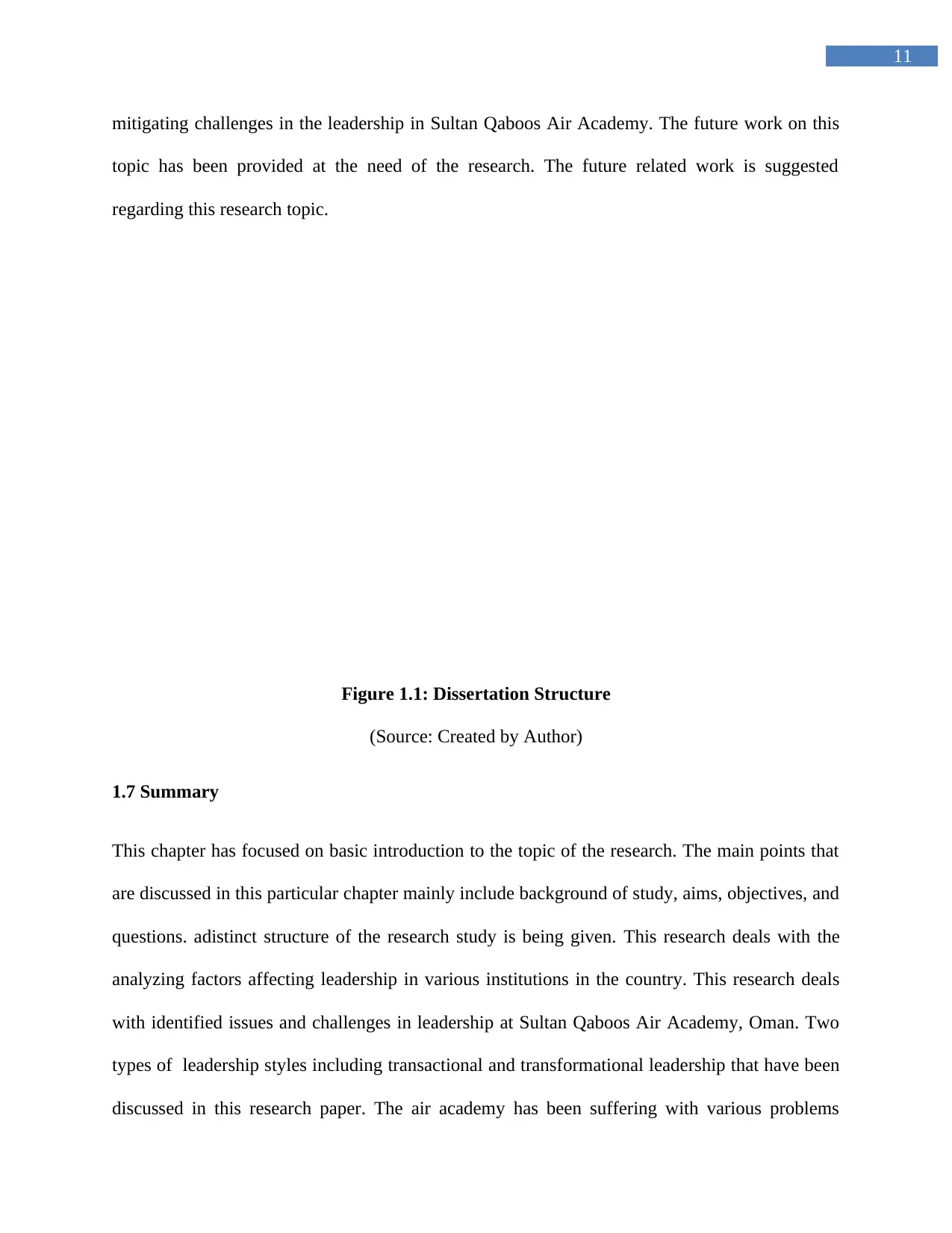
Figure 1.1: Dissertation Structure
(Source: Created by Author)
1.7 Summary
This chapter has focused on basic introduction to the topic of the research. The main points that
are discussed in this particular chapter mainly include background of study, aims, objectives, and
questions. adistinct structure of the research study is being given. This research deals with the
analyzing factors affecting leadership in various institutions in the country. This research deals
with identified issues and challenges in leadership at Sultan Qaboos Air Academy, Oman. Two
types of leadership styles including transactional and transformational leadership that have been
discussed in this research paper. The air academy has been suffering with various problems
Chapter1:IntroductionChapter2:LiteratureReviewChapter3:ResearchMethodologyChapter4:DataFindingsandAnalysisChapter5:ConclusionandRecommendations
mitigating challenges in the leadership in Sultan Qaboos Air Academy. The future work on this
topic has been provided at the need of the research. The future related work is suggested
regarding this research topic.
Figure 1.1: Dissertation Structure
(Source: Created by Author)
1.7 Summary
This chapter has focused on basic introduction to the topic of the research. The main points that
are discussed in this particular chapter mainly include background of study, aims, objectives, and
questions. adistinct structure of the research study is being given. This research deals with the
analyzing factors affecting leadership in various institutions in the country. This research deals
with identified issues and challenges in leadership at Sultan Qaboos Air Academy, Oman. Two
types of leadership styles including transactional and transformational leadership that have been
discussed in this research paper. The air academy has been suffering with various problems
Chapter1:IntroductionChapter2:LiteratureReviewChapter3:ResearchMethodologyChapter4:DataFindingsandAnalysisChapter5:ConclusionandRecommendations
⊘ This is a preview!⊘
Do you want full access?
Subscribe today to unlock all pages.
Trusted by 1+ million students worldwide

1 out of 113


Related Documents


Your All-in-One AI-Powered Toolkit for Academic Success.
+13062052269
info@desklib.com
Available 24*7 on WhatsApp / Email
![[object Object]](/_next/static/media/star-bottom.7253800d.svg)
Unlock your academic potential
Copyright © 2020–2026 A2Z Services. All Rights Reserved. Developed and managed by ZUCOL.