Analyzing Leadership & Change Management at Palm Rivera Resort
VerifiedAdded on 2023/06/13
|14
|3793
|74
Case Study
AI Summary
This case study examines the challenges faced by Palm Rivera Resort, a subsidiary of a global hospitality group, in adapting to increased competitive pressures. The report analyzes the resort's leadership and recommends change management models, specifically the Problem Centric Model and Kurt Lewin's three-step model (Unfreezing, Changing, Refreezing), to foster a competitive environment. It evaluates employee resistance to proposed changes, highlighting issues such as lack of middle management support, competency gaps, and low morale. The report also explores how the CEO can mitigate this resistance by effectively communicating the need for change, providing support and training, and reinforcing new behaviors within the organizational culture. The analysis emphasizes the importance of aligning organizational goals and strategies to ensure successful implementation of change initiatives and sustained competitiveness.
Leadership and Change

Paraphrase This Document
Need a fresh take? Get an instant paraphrase of this document with our AI Paraphraser
Executive Summary
The overall report talks about a case study of hospitality sector where there is discussion about
Palm Rivera Resort which is a subsidiary of global resorts and that is headquartered in Europe.
The report will cover discussion about the model of change which can be utilised in order to
develop an environment which allows an organisation to be competitive. The report also covers
analysis about the major resistance from employees with support of interventions and change
models. The report talks about the way in which CEO mitigate the employee resistance.
The overall report talks about a case study of hospitality sector where there is discussion about
Palm Rivera Resort which is a subsidiary of global resorts and that is headquartered in Europe.
The report will cover discussion about the model of change which can be utilised in order to
develop an environment which allows an organisation to be competitive. The report also covers
analysis about the major resistance from employees with support of interventions and change
models. The report talks about the way in which CEO mitigate the employee resistance.
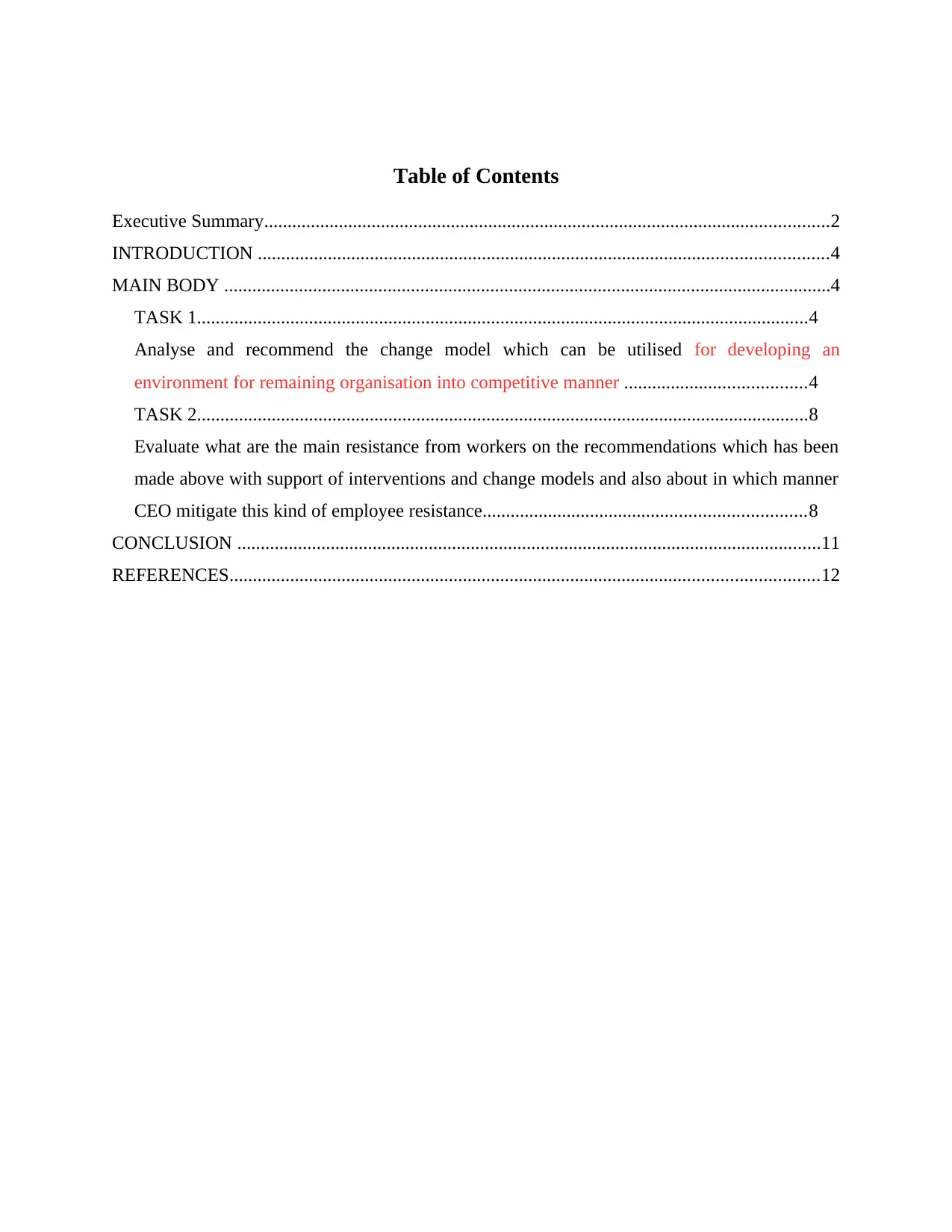
Table of Contents
Executive Summary.........................................................................................................................2
INTRODUCTION ..........................................................................................................................4
MAIN BODY ..................................................................................................................................4
TASK 1...................................................................................................................................4
Analyse and recommend the change model which can be utilised for developing an
environment for remaining organisation into competitive manner .......................................4
TASK 2...................................................................................................................................8
Evaluate what are the main resistance from workers on the recommendations which has been
made above with support of interventions and change models and also about in which manner
CEO mitigate this kind of employee resistance.....................................................................8
CONCLUSION .............................................................................................................................11
REFERENCES..............................................................................................................................12
Executive Summary.........................................................................................................................2
INTRODUCTION ..........................................................................................................................4
MAIN BODY ..................................................................................................................................4
TASK 1...................................................................................................................................4
Analyse and recommend the change model which can be utilised for developing an
environment for remaining organisation into competitive manner .......................................4
TASK 2...................................................................................................................................8
Evaluate what are the main resistance from workers on the recommendations which has been
made above with support of interventions and change models and also about in which manner
CEO mitigate this kind of employee resistance.....................................................................8
CONCLUSION .............................................................................................................................11
REFERENCES..............................................................................................................................12
⊘ This is a preview!⊘
Do you want full access?
Subscribe today to unlock all pages.

Trusted by 1+ million students worldwide
INTRODUCTION
Leadership refers to that action which leads group of people or an organisation in order to
bring change at the organisational level for positive growth and development. It is basically the
social influence process which increases the efforts of others in terms of achievement of a goal
(Arthur-Mensah and Zimmerman., 2017). In the present report, a case study is taken into
consideration which about the hospitality sector. The case study is about Palm Rivera Resort
which is a subsidiary of global resorts and that is headquartered in Europe. Their strategy is that
to highly focus on exceptional customer care and smooth experience of customers. The present
report will cover discussion about the change model which can be used in terms of development
of an environment which allows an organisation to be competitive. In addition to this, the report
will cover analysis about the major resistance from employees with support of interventions and
change models. Moreover, the report will cover discussion about the way in which CEO mitigate
the employee resistance.
MAIN BODY
TASK 1
Analyse and recommend the change model which can be utilised for developing an environment
for remaining organisation into competitive manner
According to the case study, there is a discussion about a resort named as Palm Rivera
whose performance is growing at faster pace until there is no competitive pressure. They also
earning good profits by serving to the group's client in the Chinese market and became more
profitable than the group's similar sized resort in Cappadocia, Turkey. When pressure of
competition has raised on a very large scale then they can't earn more profits on the large scale
and for the purpose of change they have replaced the General Manager with the younger General
Manager(Charteris and et.al., 2016).When the younger Manager can't change the situation then a
third Manager has been hired with the expectations of making changes into their performance of
Resort. The reason behind this kind of leadership is due to the bad leadership through top
management complacency who neglects the continuous development and improvement for many
years.
Leadership refers to that action which leads group of people or an organisation in order to
bring change at the organisational level for positive growth and development. It is basically the
social influence process which increases the efforts of others in terms of achievement of a goal
(Arthur-Mensah and Zimmerman., 2017). In the present report, a case study is taken into
consideration which about the hospitality sector. The case study is about Palm Rivera Resort
which is a subsidiary of global resorts and that is headquartered in Europe. Their strategy is that
to highly focus on exceptional customer care and smooth experience of customers. The present
report will cover discussion about the change model which can be used in terms of development
of an environment which allows an organisation to be competitive. In addition to this, the report
will cover analysis about the major resistance from employees with support of interventions and
change models. Moreover, the report will cover discussion about the way in which CEO mitigate
the employee resistance.
MAIN BODY
TASK 1
Analyse and recommend the change model which can be utilised for developing an environment
for remaining organisation into competitive manner
According to the case study, there is a discussion about a resort named as Palm Rivera
whose performance is growing at faster pace until there is no competitive pressure. They also
earning good profits by serving to the group's client in the Chinese market and became more
profitable than the group's similar sized resort in Cappadocia, Turkey. When pressure of
competition has raised on a very large scale then they can't earn more profits on the large scale
and for the purpose of change they have replaced the General Manager with the younger General
Manager(Charteris and et.al., 2016).When the younger Manager can't change the situation then a
third Manager has been hired with the expectations of making changes into their performance of
Resort. The reason behind this kind of leadership is due to the bad leadership through top
management complacency who neglects the continuous development and improvement for many
years.
Paraphrase This Document
Need a fresh take? Get an instant paraphrase of this document with our AI Paraphraser
For making the change into the situation they have hired most of the directors and it has
been observed that the new management team also agrees on this aspect that change is required.
To make the situation more effective, a change model can be implemented at the organisational
level for achieving the positive results. At the organisational level, Problem Centric Model can
be implemented into positive manner. It is a model which talks about the change situation has
been designed as space of problem. This kind of diagnosis of problem is focused on variant
positivism and logical empiricism(Grote., 2019). Positivism on local based is focused on the
science philosophy which is based on this belief that knowledge is valid up to that extent when it
is supported by the measurement and quantification. There are two interrelated steps which
makes the fundamental premise of logical empiricism. In the first step, it is about conducting
diagnosis by searching for and then verify the symptoms into logical manner through
measurement, experimentation, measurement and data gathering. In the second step, attributing
symptoms to some designated cause or reason.
According to this model of problem centric, the model becomes result oriented when it is
aimd for specific objective and it is presented in a sensitive and competitive manner. It is also
guided by this premise that there is single reality which can be discovered through the use of
objective of solving the problems through methods that have support system of data and is based
on the data(Heinen and et.al., 2019). In context to Palm Rivera Resort, it is important that the
specific objective is that they have to maintain the profits even at the time of competition so for
that purpose problem centric model help in terms of achieving the positive results. For solving
the problem, it is important that to do the diagnosis into positive manner which guided by the
view of organisations as open systems. A theory of open system has helped in terms of achieving
the desired results.
There is another model which can be implemented at the organisational level for solving
the problem into positive manner of earning profits event at the high pressure of competition.
Kurt Lewin has created a model of three-step which includes changing, unfreezing and
refreezing. This is a model which talks about the change process which has a perception that
there is requirement of change and then move towards the behaviour of desired level and new
aspects as well. In the final manner, it solidifies the norm in the form of new behaviour.
been observed that the new management team also agrees on this aspect that change is required.
To make the situation more effective, a change model can be implemented at the organisational
level for achieving the positive results. At the organisational level, Problem Centric Model can
be implemented into positive manner. It is a model which talks about the change situation has
been designed as space of problem. This kind of diagnosis of problem is focused on variant
positivism and logical empiricism(Grote., 2019). Positivism on local based is focused on the
science philosophy which is based on this belief that knowledge is valid up to that extent when it
is supported by the measurement and quantification. There are two interrelated steps which
makes the fundamental premise of logical empiricism. In the first step, it is about conducting
diagnosis by searching for and then verify the symptoms into logical manner through
measurement, experimentation, measurement and data gathering. In the second step, attributing
symptoms to some designated cause or reason.
According to this model of problem centric, the model becomes result oriented when it is
aimd for specific objective and it is presented in a sensitive and competitive manner. It is also
guided by this premise that there is single reality which can be discovered through the use of
objective of solving the problems through methods that have support system of data and is based
on the data(Heinen and et.al., 2019). In context to Palm Rivera Resort, it is important that the
specific objective is that they have to maintain the profits even at the time of competition so for
that purpose problem centric model help in terms of achieving the positive results. For solving
the problem, it is important that to do the diagnosis into positive manner which guided by the
view of organisations as open systems. A theory of open system has helped in terms of achieving
the desired results.
There is another model which can be implemented at the organisational level for solving
the problem into positive manner of earning profits event at the high pressure of competition.
Kurt Lewin has created a model of three-step which includes changing, unfreezing and
refreezing. This is a model which talks about the change process which has a perception that
there is requirement of change and then move towards the behaviour of desired level and new
aspects as well. In the final manner, it solidifies the norm in the form of new behaviour.
Unfreezing: Under this head, before implementing change at the organisational level it
must have an idea about the step at initial level of unfreezing. There are lots of people
who resist for the change and main focus of stage of unfreezing is to have an awareness
that in which manner the status or acceptability of current level is having a problem the
organisation into certain manner. There are certain aspects which needs to be examined
carefully that includes ways of thinking, old behaviours, processes, organisational
structures and people as well(Hopen., 2015). Through this examination, it has been
shown that in which manner a change is necessary is for the company for maintaining the
advantage at competitive level into the place of market. Under this stage, communication
is very significant because employees have an awareness about the imminent change.
Changing: Under this head, the process of change where the company has to move into
new being of new stage. This kind of step is also known as moving or transitioning that is
marked by change implementation. It is a time which is marked by the fear and
uncertainty which makes the step difficult to have an resolution. Under this step, people
start to learn the new behaviours, processes and thinking ways as well(Mjames-Ward and
Abuyen., 2015). The change can be easily completed when they are more prepared for
this step. There are certain aspect which is critical for an individual which includes
communication, education support and time as well. Change is basically the process of
planning and execution. Throughout the process of change it is important that workers
should have an awareness about the reasons for change and in which manner it will be
beneficial when they are fully implemented.
must have an idea about the step at initial level of unfreezing. There are lots of people
who resist for the change and main focus of stage of unfreezing is to have an awareness
that in which manner the status or acceptability of current level is having a problem the
organisation into certain manner. There are certain aspects which needs to be examined
carefully that includes ways of thinking, old behaviours, processes, organisational
structures and people as well(Hopen., 2015). Through this examination, it has been
shown that in which manner a change is necessary is for the company for maintaining the
advantage at competitive level into the place of market. Under this stage, communication
is very significant because employees have an awareness about the imminent change.
Changing: Under this head, the process of change where the company has to move into
new being of new stage. This kind of step is also known as moving or transitioning that is
marked by change implementation. It is a time which is marked by the fear and
uncertainty which makes the step difficult to have an resolution. Under this step, people
start to learn the new behaviours, processes and thinking ways as well(Mjames-Ward and
Abuyen., 2015). The change can be easily completed when they are more prepared for
this step. There are certain aspect which is critical for an individual which includes
communication, education support and time as well. Change is basically the process of
planning and execution. Throughout the process of change it is important that workers
should have an awareness about the reasons for change and in which manner it will be
beneficial when they are fully implemented.
⊘ This is a preview!⊘
Do you want full access?
Subscribe today to unlock all pages.
Trusted by 1+ million students worldwide
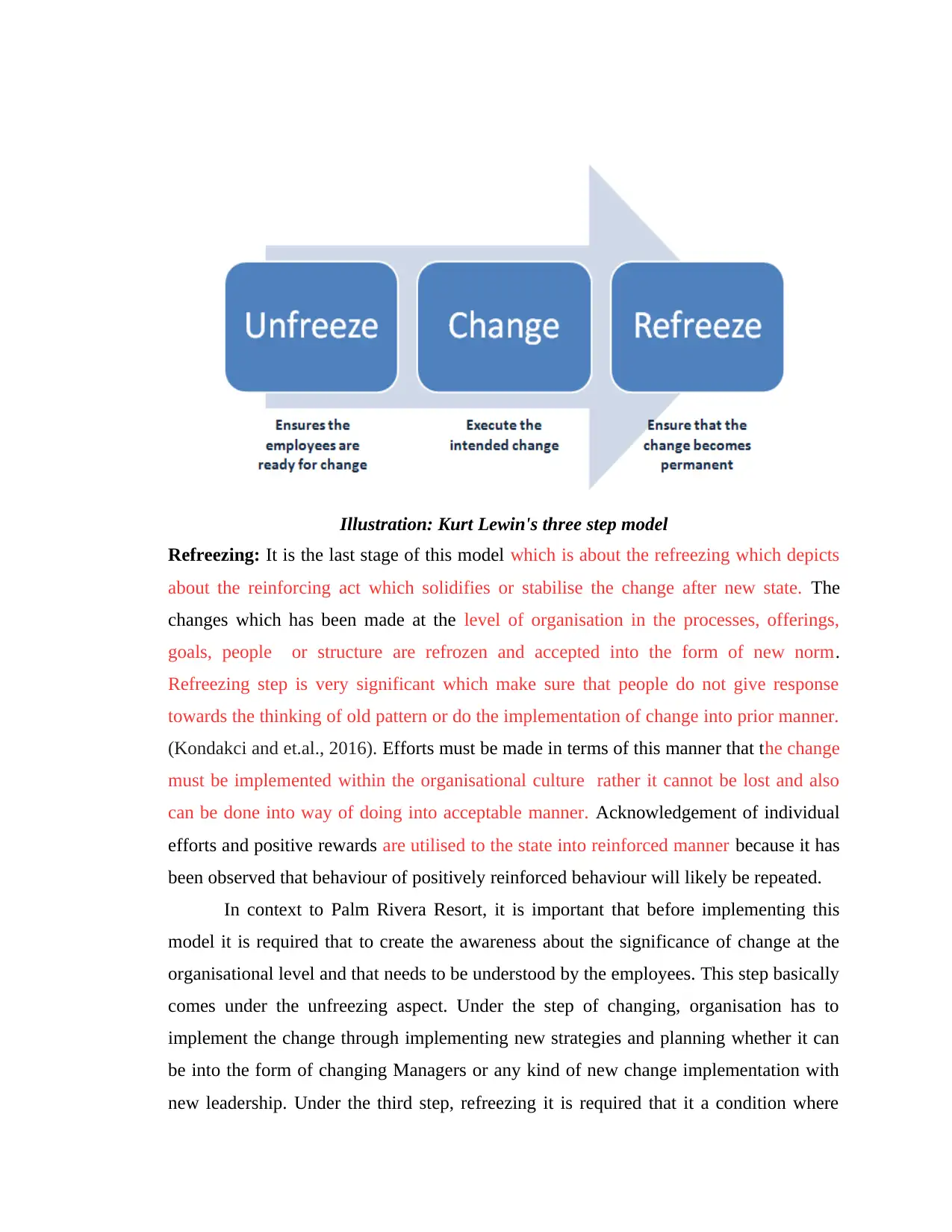
Illustration: Kurt Lewin's three step model
Refreezing: It is the last stage of this model which is about the refreezing which depicts
about the reinforcing act which solidifies or stabilise the change after new state. The
changes which has been made at the level of organisation in the processes, offerings,
goals, people or structure are refrozen and accepted into the form of new norm.
Refreezing step is very significant which make sure that people do not give response
towards the thinking of old pattern or do the implementation of change into prior manner.
(Kondakci and et.al., 2016). Efforts must be made in terms of this manner that the change
must be implemented within the organisational culture rather it cannot be lost and also
can be done into way of doing into acceptable manner. Acknowledgement of individual
efforts and positive rewards are utilised to the state into reinforced manner because it has
been observed that behaviour of positively reinforced behaviour will likely be repeated.
In context to Palm Rivera Resort, it is important that before implementing this
model it is required that to create the awareness about the significance of change at the
organisational level and that needs to be understood by the employees. This step basically
comes under the unfreezing aspect. Under the step of changing, organisation has to
implement the change through implementing new strategies and planning whether it can
be into the form of changing Managers or any kind of new change implementation with
new leadership. Under the third step, refreezing it is required that it a condition where
Refreezing: It is the last stage of this model which is about the refreezing which depicts
about the reinforcing act which solidifies or stabilise the change after new state. The
changes which has been made at the level of organisation in the processes, offerings,
goals, people or structure are refrozen and accepted into the form of new norm.
Refreezing step is very significant which make sure that people do not give response
towards the thinking of old pattern or do the implementation of change into prior manner.
(Kondakci and et.al., 2016). Efforts must be made in terms of this manner that the change
must be implemented within the organisational culture rather it cannot be lost and also
can be done into way of doing into acceptable manner. Acknowledgement of individual
efforts and positive rewards are utilised to the state into reinforced manner because it has
been observed that behaviour of positively reinforced behaviour will likely be repeated.
In context to Palm Rivera Resort, it is important that before implementing this
model it is required that to create the awareness about the significance of change at the
organisational level and that needs to be understood by the employees. This step basically
comes under the unfreezing aspect. Under the step of changing, organisation has to
implement the change through implementing new strategies and planning whether it can
be into the form of changing Managers or any kind of new change implementation with
new leadership. Under the third step, refreezing it is required that it a condition where
Paraphrase This Document
Need a fresh take? Get an instant paraphrase of this document with our AI Paraphraser
change has been implemented into positive manner and it is a kind of state of new being
after the implementation of change. So through this process can be implemented at the
organisational level of Palm Rivera Resort.
These are the two models which reinforce the resort to implement changes into
positive manner with proper planning and support of different kinds of models. These
models help in terms of giving an understanding that how change should be followed
with certain kinds of steps and with proper objective(Kužnin and Walker., 2017). So
these two models has been recommended for the purpose of creating an environment
which can be utilised at the organisational level in terms of remaining competitive. In
order to remain competitive at the organisational level it is important that to have proper
support of change models so that it can be easily implemented into practical manner at
the organisational level.
TASK 2
Evaluate what are the main resistance from workers on the recommendations which has been
made above with support of interventions and change models and also about in which
manner CEO mitigate this kind of employee resistance
According to the case study, there are certain changes which has been resisted by the
employees of resort named as Palm Rivera. They have to face challenges and it is difficult to
implement into the current situation. The major resistance is that Middle Managers are not
supporting for the change and it also seems that they don’t to understand the new direction.
According to the observation of HRD it has been observed that many people have very low
competencies and leadership(Lynham and et.al., 2017).The resistance of change is also from
the context of employees because the management team has consensus about the direction
but the new business process and future organisational structure has not been clarified into
appropriate manner. Employees of the resort also have not confidence level on the Middle
line Managers because they have competency gap. They basically do not think about the
aspects of human and communication strategy of change management. The morale level of
employees is also very low due to which they are not ready to accept the new changes. The
planned changes has put pressure on them and income level is also not increasing according
to their desired requirements.
after the implementation of change. So through this process can be implemented at the
organisational level of Palm Rivera Resort.
These are the two models which reinforce the resort to implement changes into
positive manner with proper planning and support of different kinds of models. These
models help in terms of giving an understanding that how change should be followed
with certain kinds of steps and with proper objective(Kužnin and Walker., 2017). So
these two models has been recommended for the purpose of creating an environment
which can be utilised at the organisational level in terms of remaining competitive. In
order to remain competitive at the organisational level it is important that to have proper
support of change models so that it can be easily implemented into practical manner at
the organisational level.
TASK 2
Evaluate what are the main resistance from workers on the recommendations which has been
made above with support of interventions and change models and also about in which
manner CEO mitigate this kind of employee resistance
According to the case study, there are certain changes which has been resisted by the
employees of resort named as Palm Rivera. They have to face challenges and it is difficult to
implement into the current situation. The major resistance is that Middle Managers are not
supporting for the change and it also seems that they don’t to understand the new direction.
According to the observation of HRD it has been observed that many people have very low
competencies and leadership(Lynham and et.al., 2017).The resistance of change is also from
the context of employees because the management team has consensus about the direction
but the new business process and future organisational structure has not been clarified into
appropriate manner. Employees of the resort also have not confidence level on the Middle
line Managers because they have competency gap. They basically do not think about the
aspects of human and communication strategy of change management. The morale level of
employees is also very low due to which they are not ready to accept the new changes. The
planned changes has put pressure on them and income level is also not increasing according
to their desired requirements.
With support of different models, it has been observed that the change can implemented
into positive manner by giving the understanding of Kurt Lewin’s three step model and
problem centric model. The first model talks about the change which brings at
organisational level through following three certain steps. In the first step of model the basic
understanding about the change and its significance has been given due to which employees
can understand about the requirement of change within the organisation. In the second step,
change has been implemented with a proper process and the resort has moved towards the
phase of new transition(Montgomery., 2020). In context to as Palm Rivera resort, the
management team has planned to do certain changes through following certain actions
which includes workforce will be reduced to 600 and staff has to be trained for purpose of
handling multiple positions.
In addition to this, business process has been streamlined into effective manner where
profit and loss has been calculated for every kind of service has been offered. There are also
more key performance indicators through resort can analyse their current position into the
market. Through standard employee benefit overtime fee has been provided to their employees
so that they work with their full potential. In this manner, the new change can be implemented at
the organisational level(Popli and Rizvi., 2016). These are the changes which can be
implemented into Palm Rivera Resort according to the second step of Kurt Lewin three step
model. In the further third step, the changes has been accepted at the organisational level whether
it is into the process, people and goals. When changes has been accepted at the organisational
level into positive manner then it is easier to take actions for further growth and development of
the resort. So according to this model, it is easier to convince employees about the new changes
and its related significance.
According to the problem centric model, it is important to set the particular objective so
that problems at the organisational level can be resolved into positive manner. When Palm
Rivera resort employees get the confidence level of the objectives set by the organisation needs
to be implemented with positive implementation of change. The employees also get serious
about the new changes and perform a kind of behaviour at the organisational level that they
accept the new changes and ready to face them as well. So this is a model which act as support
system in terms of change at the organisational level.
into positive manner by giving the understanding of Kurt Lewin’s three step model and
problem centric model. The first model talks about the change which brings at
organisational level through following three certain steps. In the first step of model the basic
understanding about the change and its significance has been given due to which employees
can understand about the requirement of change within the organisation. In the second step,
change has been implemented with a proper process and the resort has moved towards the
phase of new transition(Montgomery., 2020). In context to as Palm Rivera resort, the
management team has planned to do certain changes through following certain actions
which includes workforce will be reduced to 600 and staff has to be trained for purpose of
handling multiple positions.
In addition to this, business process has been streamlined into effective manner where
profit and loss has been calculated for every kind of service has been offered. There are also
more key performance indicators through resort can analyse their current position into the
market. Through standard employee benefit overtime fee has been provided to their employees
so that they work with their full potential. In this manner, the new change can be implemented at
the organisational level(Popli and Rizvi., 2016). These are the changes which can be
implemented into Palm Rivera Resort according to the second step of Kurt Lewin three step
model. In the further third step, the changes has been accepted at the organisational level whether
it is into the process, people and goals. When changes has been accepted at the organisational
level into positive manner then it is easier to take actions for further growth and development of
the resort. So according to this model, it is easier to convince employees about the new changes
and its related significance.
According to the problem centric model, it is important to set the particular objective so
that problems at the organisational level can be resolved into positive manner. When Palm
Rivera resort employees get the confidence level of the objectives set by the organisation needs
to be implemented with positive implementation of change. The employees also get serious
about the new changes and perform a kind of behaviour at the organisational level that they
accept the new changes and ready to face them as well. So this is a model which act as support
system in terms of change at the organisational level.
⊘ This is a preview!⊘
Do you want full access?
Subscribe today to unlock all pages.
Trusted by 1+ million students worldwide
The above mentioned are the resistance which has been made by the employees and other
people towards the new change implementation with support of new models. The employees
resistance can be mitigated by the CEO by following certain actions of management and these
changes can be implemented into positive manner through certain actions(Richter and et.al.,
2015).They can provide extra payment for the over time so that they can adopt changes into
positive manner. When resort give proper assurance to the employees that they have been trained
with proper training and development programs then they can showcase their positive attitude
towards the new change. When business process gets smoother then it gives motivation to the
employees about the new change implementation and also the positive and motivating
environment supports the employees of Palm Rivera resort for the new change implementation.
There are certain mitigation strategies that can be implemented at the organisation level
towards the acceptance of change and they don’t resist for the new changes. There are
majorly five mitigation strategies which can be helpful for the resort in terms of further
growth and development. These are defined into the following manner:
Assume and accept risk: The acceptance strategy is basically that which involves the
collaboration between members of team in order to identify the possible risks of the new
change implementation(Sow and Aborbie., 2018). For identify the related consequences
and risks the members of team also finds and also vulnerabilities of possible manner into
assumed ways that shows the risks.
Risk Avoidance: The strategy of avoidance is that the assumed risks and accepted or of
project consequences and also shows about the opportunities in terms of avoiding the
risks into accepted manner. There are certain ways of strategy avoidance in terms of
implementation manner which includes risk planning and taking steps for avoiding it
into positive manner.
Controlling Risk: When mitigating risks to a project or new change implementation at
the organisational level, team members also implement the control strategy. This kind of
strategy works when they take into account the accepted and identified risks. After that
they take actions to reduce or eliminate the risks impact.
Transference of risk: The consequences can be mitigated through transference which
can be an important strategy when risks have been identified and taken into account into
people towards the new change implementation with support of new models. The employees
resistance can be mitigated by the CEO by following certain actions of management and these
changes can be implemented into positive manner through certain actions(Richter and et.al.,
2015).They can provide extra payment for the over time so that they can adopt changes into
positive manner. When resort give proper assurance to the employees that they have been trained
with proper training and development programs then they can showcase their positive attitude
towards the new change. When business process gets smoother then it gives motivation to the
employees about the new change implementation and also the positive and motivating
environment supports the employees of Palm Rivera resort for the new change implementation.
There are certain mitigation strategies that can be implemented at the organisation level
towards the acceptance of change and they don’t resist for the new changes. There are
majorly five mitigation strategies which can be helpful for the resort in terms of further
growth and development. These are defined into the following manner:
Assume and accept risk: The acceptance strategy is basically that which involves the
collaboration between members of team in order to identify the possible risks of the new
change implementation(Sow and Aborbie., 2018). For identify the related consequences
and risks the members of team also finds and also vulnerabilities of possible manner into
assumed ways that shows the risks.
Risk Avoidance: The strategy of avoidance is that the assumed risks and accepted or of
project consequences and also shows about the opportunities in terms of avoiding the
risks into accepted manner. There are certain ways of strategy avoidance in terms of
implementation manner which includes risk planning and taking steps for avoiding it
into positive manner.
Controlling Risk: When mitigating risks to a project or new change implementation at
the organisational level, team members also implement the control strategy. This kind of
strategy works when they take into account the accepted and identified risks. After that
they take actions to reduce or eliminate the risks impact.
Transference of risk: The consequences can be mitigated through transference which
can be an important strategy when risks have been identified and taken into account into
Paraphrase This Document
Need a fresh take? Get an instant paraphrase of this document with our AI Paraphraser
positive manner(van Diggele and et.al., 20200.This kind of strategy works well when
transferring the risk of strain. This strategy can be presented into their own negative
points when the organisation mitigate and implements the risk of strategy. It should be
also in this manner that which is acceptable to the all parties which are involved.
Monitor and watch risk: Monitoring of projects or change for consequences and risks
which involves the identifying the changes which can affect the impact of risk. At the
organisational level, for implementing the change, there are certain aspects which needs
to be taken into consideration and it includes scheduling, cost and performance or
productivity.
These are the mitigation strategies which can be used by the CEO for convincing the
employees towards the new change and accept the employees for not resisting towards the
change (Žibert and Starc., 2018). In this manner, CEO has mitigate the new kind of employees
resistance. So at the organisational level, it is important to accept the changes rather than
resisting towards it so that it can lead towards the positive growth and development of the
organisation.
CONCLUSION
It has been concluded that leadership and change plays an important role into the context
of positive growth and development of the organisation. It has been concluded that models of
change are very important for the development of an environment which allows the organisation
to be remaining in terms of competitive manner. It has been determined that there are certain
major resistance from employees on the changes mentioned into the case study. These changes
can be fully accomplished through support of change models and interventions as well. There are
certain parameters, actions and strategies through which change can be implemented into
positive manner. The higher authorities and management can easily mitigate the employee
resistance through adopting certain strategies for positive growth and development of the
organisation. So at the organisational level, it is important to have proper leadership in order to
adopt the changes into positive manner. These changes are not into the negative spectrum but
also contribute into the context of proper development of the organisation.
transferring the risk of strain. This strategy can be presented into their own negative
points when the organisation mitigate and implements the risk of strategy. It should be
also in this manner that which is acceptable to the all parties which are involved.
Monitor and watch risk: Monitoring of projects or change for consequences and risks
which involves the identifying the changes which can affect the impact of risk. At the
organisational level, for implementing the change, there are certain aspects which needs
to be taken into consideration and it includes scheduling, cost and performance or
productivity.
These are the mitigation strategies which can be used by the CEO for convincing the
employees towards the new change and accept the employees for not resisting towards the
change (Žibert and Starc., 2018). In this manner, CEO has mitigate the new kind of employees
resistance. So at the organisational level, it is important to accept the changes rather than
resisting towards it so that it can lead towards the positive growth and development of the
organisation.
CONCLUSION
It has been concluded that leadership and change plays an important role into the context
of positive growth and development of the organisation. It has been concluded that models of
change are very important for the development of an environment which allows the organisation
to be remaining in terms of competitive manner. It has been determined that there are certain
major resistance from employees on the changes mentioned into the case study. These changes
can be fully accomplished through support of change models and interventions as well. There are
certain parameters, actions and strategies through which change can be implemented into
positive manner. The higher authorities and management can easily mitigate the employee
resistance through adopting certain strategies for positive growth and development of the
organisation. So at the organisational level, it is important to have proper leadership in order to
adopt the changes into positive manner. These changes are not into the negative spectrum but
also contribute into the context of proper development of the organisation.
REFERENCES
Books and Journals
Arthur-Mensah, N. and Zimmerman, J., 2017. Changing through turbulent times–why adaptive
leadership matters. The Journal of Student Leadership, 1(2), pp.1-13.
Charteris and et.al., 2016. Innovative learning environments and discourses of leadership: Is
physical change out of step with pedagogical development?. Journal of Educational
Leadership, Policy and Practice, 31(1/2), pp.33-47.
Grote, G., 2019. Leadership in resilient organizations. In Exploring resilience (pp. 59-67).
Springer, Cham.
Heinen and et.al., 2019. An integrative review of leadership competencies and attributes in
advanced nursing practice. Journal of advanced nursing, 75(11), pp.2378-2392.
Hopen, D., 2015. Finding your leadership style. The Journal for Quality and
Participation, 38(3), p.3.
James-Ward, C. and Abuyen, J., 2015. McREL Leadership Responsibilities through the Lens of
Data: The Critical Nine. Global Education Review, 2(3), pp.82-93.
Kondakci and et.al., 2016. The mediating roles of internal context variables in the relationship
between distributed leadership perceptions and continuous change behaviours of public
school teachers. Educational Studies, 42(4), pp.410-426.
Kužnin, M. and Walker, J. K., 2017, October. Contemporary leadership challenges in hospitality
organizations in times of uncertainty and change. In DIEM: Dubrovnik International
Economic Meeting (Vol. 3, No. 1, pp. 455-468). Sveučilište u Dubrovniku.
Lynham and et.al., 2017. Corporate leadership for economic, social and political change:
Lessons from South Africa. In Corporate Citizenship in Africa (pp. 30-42). Routledge.
Montgomery, B. L., 2020. Academic leadership: gatekeeping or groundskeeping?. The Journal
of Values-Based Leadership, 13(2), p.16.
Popli, S. and Rizvi, I. A., 2016. Drivers of employee engagement: The role of leadership
style. Global Business Review, 17(4), pp.965-979.
Richter and et.al., 2015. iLead—a transformational leadership intervention to train healthcare
managers’ implementation leadership. Implementation Science, 11(1), pp.1-13.
Sow, M. and Aborbie, S., 2018. Impact of leadership on digital transformation. Business and
Economic Research, 8(3), pp.139-148.
van Diggele and et.al., 2020. Leadership in healthcare education. BMC Medical
Education, 20(2), pp.1-6.
Žibert, A. and Starc, A., 2018. Healthcare organizations and decision-making: leadership style
for growth and development. Journal of Applied Health Sciences= Časopis za
primijenjene zdravstvene znanosti, 4(2), pp.209-224.
Books and Journals
Arthur-Mensah, N. and Zimmerman, J., 2017. Changing through turbulent times–why adaptive
leadership matters. The Journal of Student Leadership, 1(2), pp.1-13.
Charteris and et.al., 2016. Innovative learning environments and discourses of leadership: Is
physical change out of step with pedagogical development?. Journal of Educational
Leadership, Policy and Practice, 31(1/2), pp.33-47.
Grote, G., 2019. Leadership in resilient organizations. In Exploring resilience (pp. 59-67).
Springer, Cham.
Heinen and et.al., 2019. An integrative review of leadership competencies and attributes in
advanced nursing practice. Journal of advanced nursing, 75(11), pp.2378-2392.
Hopen, D., 2015. Finding your leadership style. The Journal for Quality and
Participation, 38(3), p.3.
James-Ward, C. and Abuyen, J., 2015. McREL Leadership Responsibilities through the Lens of
Data: The Critical Nine. Global Education Review, 2(3), pp.82-93.
Kondakci and et.al., 2016. The mediating roles of internal context variables in the relationship
between distributed leadership perceptions and continuous change behaviours of public
school teachers. Educational Studies, 42(4), pp.410-426.
Kužnin, M. and Walker, J. K., 2017, October. Contemporary leadership challenges in hospitality
organizations in times of uncertainty and change. In DIEM: Dubrovnik International
Economic Meeting (Vol. 3, No. 1, pp. 455-468). Sveučilište u Dubrovniku.
Lynham and et.al., 2017. Corporate leadership for economic, social and political change:
Lessons from South Africa. In Corporate Citizenship in Africa (pp. 30-42). Routledge.
Montgomery, B. L., 2020. Academic leadership: gatekeeping or groundskeeping?. The Journal
of Values-Based Leadership, 13(2), p.16.
Popli, S. and Rizvi, I. A., 2016. Drivers of employee engagement: The role of leadership
style. Global Business Review, 17(4), pp.965-979.
Richter and et.al., 2015. iLead—a transformational leadership intervention to train healthcare
managers’ implementation leadership. Implementation Science, 11(1), pp.1-13.
Sow, M. and Aborbie, S., 2018. Impact of leadership on digital transformation. Business and
Economic Research, 8(3), pp.139-148.
van Diggele and et.al., 2020. Leadership in healthcare education. BMC Medical
Education, 20(2), pp.1-6.
Žibert, A. and Starc, A., 2018. Healthcare organizations and decision-making: leadership style
for growth and development. Journal of Applied Health Sciences= Časopis za
primijenjene zdravstvene znanosti, 4(2), pp.209-224.
⊘ This is a preview!⊘
Do you want full access?
Subscribe today to unlock all pages.
Trusted by 1+ million students worldwide

1 out of 14


Related Documents


Your All-in-One AI-Powered Toolkit for Academic Success.
+13062052269
info@desklib.com
Available 24*7 on WhatsApp / Email
![[object Object]](/_next/static/media/star-bottom.7253800d.svg)
Unlock your academic potential
Copyright © 2020–2026 A2Z Services. All Rights Reserved. Developed and managed by ZUCOL.