Leadership Styles, Ethics, and Conflict Management Strategies
VerifiedAdded on 2023/06/03
|6
|1621
|97
Case Study
AI Summary
This case study analyzes the leadership styles of three directors—Peter Proskin (democratic), Alice Alston (transformational), and Hal Harwick (transactional)—within Federated Industries. It addresses potential conflicts arising from selecting one director for a company-wide conference and proposes a competing strategy for conflict management. The study emphasizes the importance of ethics in leadership, highlighting its role in fostering ethical behavior, open communication, and a people-oriented approach. It also recommends appropriate leadership styles for an entrepreneur starting a social media company (delegating) and a secondary school history teacher (coaching), detailing the advantages and disadvantages of each. The document concludes with a list of references to support its analysis of leadership and management concepts. Desklib provides access to similar solved assignments and study tools for students.

Leadership in Business 1
LEADERSHIP IN BUSINESS
By
Course
Tutor
Institution
Location
Date
LEADERSHIP IN BUSINESS
By
Course
Tutor
Institution
Location
Date
Paraphrase This Document
Need a fresh take? Get an instant paraphrase of this document with our AI Paraphraser

Leadership in Business 2
Describe the leadership styles of the 3 directors:-
Peter Proskin is seen to have adopted the democratic style of leadership in which he
provides his employees with the opportunity to get involved in the decision making processes.
He does this to improve the productivity status of the organization. Through this style of
leadership, the employees are given the power to share their ideas, needs, and opinions that the
management may require. Under this style of leadership, he has organized workshops and
seminars in such a way that the employees choose the perfect section for them so that they can
have the liberty to improve their skills. Though the democratic leadership is seen to be a success
in his leadership we can see that it also costs the company since Peter Proskin allows employees
to get other employment alternatives that they prefer. This is has resulted to negative impacts on
the human resource and the financial situation of the company.
Alice Alston on the hand has adopted a transformational leadership approach. This
leadership style involves developing the organization in the conventional aspect by creating an
environment that greatly embraces the simulation and intellectual promotion of employees
(McCleskey, 2014). Under this style, she focuses majorly on identifying the potential of the
employees and tapping them with a view to have them perform to their level best. In her case,
she dwells on a system that involves identifying what her subordinates can do best and then
helping them improve in terms of their skills and general productivity. This leadership offers a
great opportunity for employee advancement in the organization which to some extent reduces
the employee turnover (Nanjundeswaraswamy & Swamy, 2014). Through her leadership style,
she is able to make sure that there is uniformity and that every employee stays motivated to
enable the organization achieve its objectives and goals.
Describe the leadership styles of the 3 directors:-
Peter Proskin is seen to have adopted the democratic style of leadership in which he
provides his employees with the opportunity to get involved in the decision making processes.
He does this to improve the productivity status of the organization. Through this style of
leadership, the employees are given the power to share their ideas, needs, and opinions that the
management may require. Under this style of leadership, he has organized workshops and
seminars in such a way that the employees choose the perfect section for them so that they can
have the liberty to improve their skills. Though the democratic leadership is seen to be a success
in his leadership we can see that it also costs the company since Peter Proskin allows employees
to get other employment alternatives that they prefer. This is has resulted to negative impacts on
the human resource and the financial situation of the company.
Alice Alston on the hand has adopted a transformational leadership approach. This
leadership style involves developing the organization in the conventional aspect by creating an
environment that greatly embraces the simulation and intellectual promotion of employees
(McCleskey, 2014). Under this style, she focuses majorly on identifying the potential of the
employees and tapping them with a view to have them perform to their level best. In her case,
she dwells on a system that involves identifying what her subordinates can do best and then
helping them improve in terms of their skills and general productivity. This leadership offers a
great opportunity for employee advancement in the organization which to some extent reduces
the employee turnover (Nanjundeswaraswamy & Swamy, 2014). Through her leadership style,
she is able to make sure that there is uniformity and that every employee stays motivated to
enable the organization achieve its objectives and goals.

Leadership in Business 3
Lastly, Hal Harwick has relied on the transactional leadership style. In this style,
management is based on the creation of a chain of command which is similarly copied and
pasted in every other department in the organization (McCleskey, 2014). Hal, therefore, has a
group of six managers who are well trained and capable to lead so that they can lead. Under this,
the managers are provided with internal and external training that helps them apply this
knowledge to their respective departments. As seen in most cases, this leadership is more of a
reward provided to the employees who are obliged to the organization while punishing those
who do not show responsibility to the organization.
Communication/Conflict Management Strategy
All the three managers basically deserve a chance to represent their organization. Since it
is only one of the three who has been selected, this will upset the others as they all had put effort
in their roles. This also means that they may conflict with the top management. Due to this, the
managers need conflict management skills and strategies through which their anger and
frustration will be managed. Some of the conflict management strategies include collaboration,
accommodation, avoiding, and compromising strategies (Jauro et al., Barwa, 2017). In this case,
the best way to handle this is through the competing strategy.
Under this strategy, it will be explained to the two managers that the opportunity was
limited to only one manager and the company opted for the best one among them. They will also
be reminded that there are many opportunities in the future and that the best manager will also be
selected when that time comes. Since they all understand the aspects of competition and
management, they will therefore ensure that they put effort and enthusiasm in their work after
this. In this case, they need to be satisfied with the reasons and this will be done by making sure
that the selection decision is made ethically and in a straightforward manner.
Lastly, Hal Harwick has relied on the transactional leadership style. In this style,
management is based on the creation of a chain of command which is similarly copied and
pasted in every other department in the organization (McCleskey, 2014). Hal, therefore, has a
group of six managers who are well trained and capable to lead so that they can lead. Under this,
the managers are provided with internal and external training that helps them apply this
knowledge to their respective departments. As seen in most cases, this leadership is more of a
reward provided to the employees who are obliged to the organization while punishing those
who do not show responsibility to the organization.
Communication/Conflict Management Strategy
All the three managers basically deserve a chance to represent their organization. Since it
is only one of the three who has been selected, this will upset the others as they all had put effort
in their roles. This also means that they may conflict with the top management. Due to this, the
managers need conflict management skills and strategies through which their anger and
frustration will be managed. Some of the conflict management strategies include collaboration,
accommodation, avoiding, and compromising strategies (Jauro et al., Barwa, 2017). In this case,
the best way to handle this is through the competing strategy.
Under this strategy, it will be explained to the two managers that the opportunity was
limited to only one manager and the company opted for the best one among them. They will also
be reminded that there are many opportunities in the future and that the best manager will also be
selected when that time comes. Since they all understand the aspects of competition and
management, they will therefore ensure that they put effort and enthusiasm in their work after
this. In this case, they need to be satisfied with the reasons and this will be done by making sure
that the selection decision is made ethically and in a straightforward manner.
⊘ This is a preview!⊘
Do you want full access?
Subscribe today to unlock all pages.

Trusted by 1+ million students worldwide

Leadership in Business 4
Is ethics an important aspect of leadership?
Ethics is definitely a crucial aspect of leadership for various reasons. One, an ethical
leader ensures that they behave in the best way possible through which they make decisions that
basically embrace ethical considerations which can be followed by his or her employees (Shin et
al., 2015). Secondly, ethics makes leaders act ethically in which they make their followers
identify with them. They even make the organization an entity that can be embraced by everyone
who associates with it hence forming a robust leader-follower establishment which is also a
foundation for higher self-efficacy (Chughtai et al., 2015). The ethical leaders create and
establish an ethical culture through which it influences the behavior of employees to also behave
in an ethical manner.
Thirdly, ethics provides the leader with an opportunity to establish an environment that
embraces open conversations and a working culture. It is through this culture and environment
that everyone in the organization is able to share their ideas freely, their knowledge, and their
vision. Through ethics, leaders are able to forsake their personal success in order to make sure
that they influence everyone in the organization to focus on the goals and objectives that they
share as a group (Eisenbeiss et al., 2015). Leaders who are not ethical in their actions cannot,
therefore, make sure that their employees are ethical and are maintaining ethical practices as
required by the organization. Indeed, it is through ethics that leaders become people oriented and
basically consider what each member of the organization is doing.
The best style for two of the following persons
An entrepreneur beginning a social media company with 2 associates
The best style that I think would fit them is the delegating style of leadership which is
called the laissez-faire which needs experienced people with minimal supervision.
Is ethics an important aspect of leadership?
Ethics is definitely a crucial aspect of leadership for various reasons. One, an ethical
leader ensures that they behave in the best way possible through which they make decisions that
basically embrace ethical considerations which can be followed by his or her employees (Shin et
al., 2015). Secondly, ethics makes leaders act ethically in which they make their followers
identify with them. They even make the organization an entity that can be embraced by everyone
who associates with it hence forming a robust leader-follower establishment which is also a
foundation for higher self-efficacy (Chughtai et al., 2015). The ethical leaders create and
establish an ethical culture through which it influences the behavior of employees to also behave
in an ethical manner.
Thirdly, ethics provides the leader with an opportunity to establish an environment that
embraces open conversations and a working culture. It is through this culture and environment
that everyone in the organization is able to share their ideas freely, their knowledge, and their
vision. Through ethics, leaders are able to forsake their personal success in order to make sure
that they influence everyone in the organization to focus on the goals and objectives that they
share as a group (Eisenbeiss et al., 2015). Leaders who are not ethical in their actions cannot,
therefore, make sure that their employees are ethical and are maintaining ethical practices as
required by the organization. Indeed, it is through ethics that leaders become people oriented and
basically consider what each member of the organization is doing.
The best style for two of the following persons
An entrepreneur beginning a social media company with 2 associates
The best style that I think would fit them is the delegating style of leadership which is
called the laissez-faire which needs experienced people with minimal supervision.
Paraphrase This Document
Need a fresh take? Get an instant paraphrase of this document with our AI Paraphraser

Leadership in Business 5
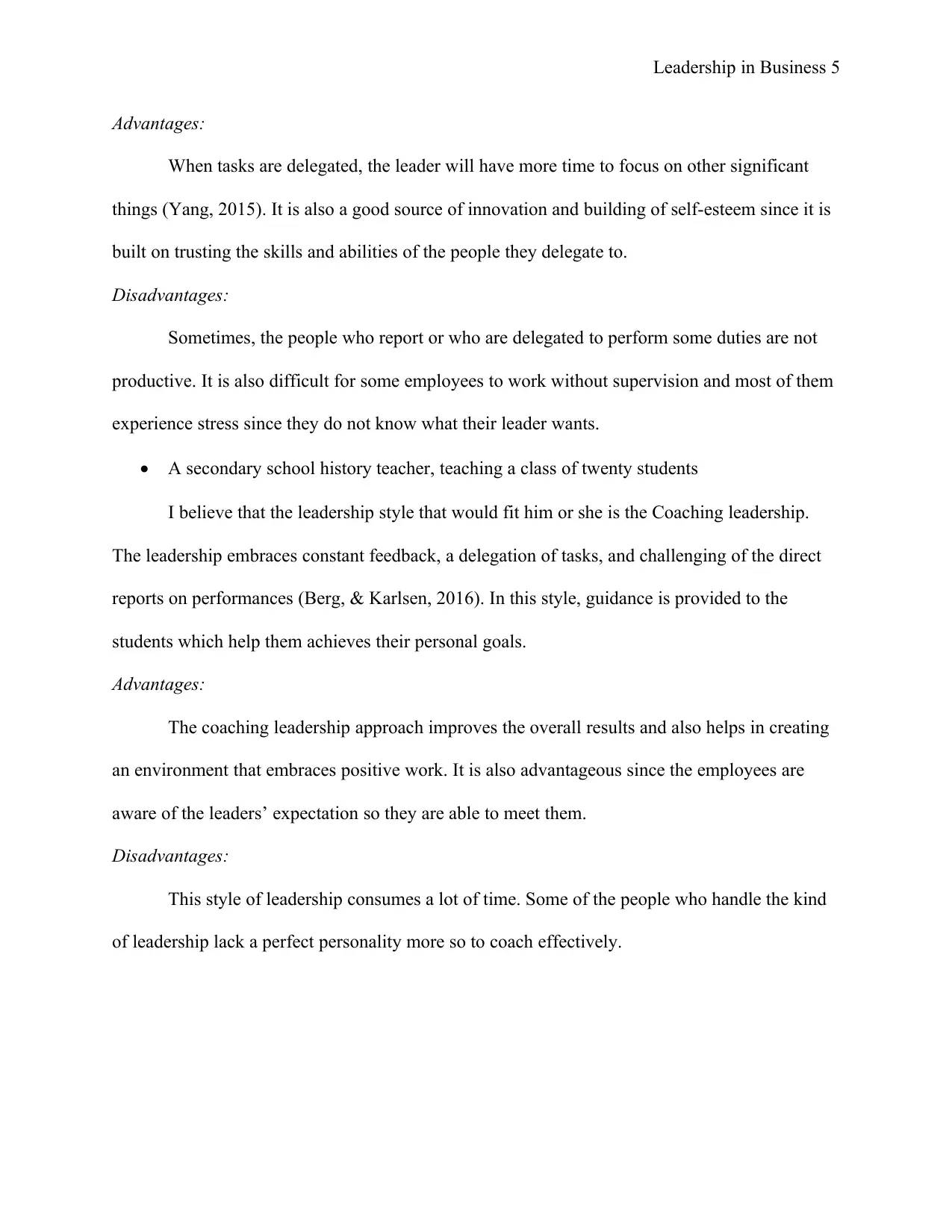
Advantages:
When tasks are delegated, the leader will have more time to focus on other significant
things (Yang, 2015). It is also a good source of innovation and building of self-esteem since it is
built on trusting the skills and abilities of the people they delegate to.
Disadvantages:
Sometimes, the people who report or who are delegated to perform some duties are not
productive. It is also difficult for some employees to work without supervision and most of them
experience stress since they do not know what their leader wants.
A secondary school history teacher, teaching a class of twenty students
I believe that the leadership style that would fit him or she is the Coaching leadership.
The leadership embraces constant feedback, a delegation of tasks, and challenging of the direct
reports on performances (Berg, & Karlsen, 2016). In this style, guidance is provided to the
students which help them achieves their personal goals.
Advantages:
The coaching leadership approach improves the overall results and also helps in creating
an environment that embraces positive work. It is also advantageous since the employees are
aware of the leaders’ expectation so they are able to meet them.
Disadvantages:
This style of leadership consumes a lot of time. Some of the people who handle the kind
of leadership lack a perfect personality more so to coach effectively.
Advantages:
When tasks are delegated, the leader will have more time to focus on other significant
things (Yang, 2015). It is also a good source of innovation and building of self-esteem since it is
built on trusting the skills and abilities of the people they delegate to.
Disadvantages:
Sometimes, the people who report or who are delegated to perform some duties are not
productive. It is also difficult for some employees to work without supervision and most of them
experience stress since they do not know what their leader wants.
A secondary school history teacher, teaching a class of twenty students
I believe that the leadership style that would fit him or she is the Coaching leadership.
The leadership embraces constant feedback, a delegation of tasks, and challenging of the direct
reports on performances (Berg, & Karlsen, 2016). In this style, guidance is provided to the
students which help them achieves their personal goals.
Advantages:
The coaching leadership approach improves the overall results and also helps in creating
an environment that embraces positive work. It is also advantageous since the employees are
aware of the leaders’ expectation so they are able to meet them.
Disadvantages:
This style of leadership consumes a lot of time. Some of the people who handle the kind
of leadership lack a perfect personality more so to coach effectively.

Leadership in Business 6
References
Berg, M.E. and Karlsen, J.T., 2016. A study of coaching leadership style practice in
projects. Management Research Review, 39(9), pp.1122-1142.
Chughtai, A., Byrne, M. and Flood, B., 2015. Linking ethical leadership to employee well-being:
The role of trust in supervisor. Journal of Business Ethics, 128(3), pp.653-663.
Eisenbeiss, S.A., Van Knippenberg, D. and Fahrbach, C.M., 2015. Doing well by doing good?
Analyzing the relationship between CEO ethical leadership and firm
performance. Journal of Business Ethics, 128(3), pp.635-651.
Jauro, A.M., Bambale, A.J.A. and Barwa, T.M., 2017. Conflict Management Strategy and
Employees Performance in Private Sector Organizations In Kano State: A Proposed
Moderating Model. Journal of Marketing and Management, 8(1), p.41.
McCleskey, J.A., 2014. Situational, transformational, and transactional leadership and leadership
development. Journal of Business Studies Quarterly, 5(4), p.117.
Nanjundeswaraswamy, T.S. and Swamy, D.R., 2014. Leadership styles. Advances in
management, 7(2), p.57.
Shin, Y., Sung, S. Y., Choi, J. N., & Kim, M. S. (2015). Top management ethical leadership and
firm performance: Mediating role of ethical and procedural justice climate. Journal of
Business Ethics, 129(1), 43-57.
Yang, I., 2015. Positive effects of laissez-faire leadership: conceptual exploration. Journal of
Management Development, 34(10), pp.1246-1261.
References
Berg, M.E. and Karlsen, J.T., 2016. A study of coaching leadership style practice in
projects. Management Research Review, 39(9), pp.1122-1142.
Chughtai, A., Byrne, M. and Flood, B., 2015. Linking ethical leadership to employee well-being:
The role of trust in supervisor. Journal of Business Ethics, 128(3), pp.653-663.
Eisenbeiss, S.A., Van Knippenberg, D. and Fahrbach, C.M., 2015. Doing well by doing good?
Analyzing the relationship between CEO ethical leadership and firm
performance. Journal of Business Ethics, 128(3), pp.635-651.
Jauro, A.M., Bambale, A.J.A. and Barwa, T.M., 2017. Conflict Management Strategy and
Employees Performance in Private Sector Organizations In Kano State: A Proposed
Moderating Model. Journal of Marketing and Management, 8(1), p.41.
McCleskey, J.A., 2014. Situational, transformational, and transactional leadership and leadership
development. Journal of Business Studies Quarterly, 5(4), p.117.
Nanjundeswaraswamy, T.S. and Swamy, D.R., 2014. Leadership styles. Advances in
management, 7(2), p.57.
Shin, Y., Sung, S. Y., Choi, J. N., & Kim, M. S. (2015). Top management ethical leadership and
firm performance: Mediating role of ethical and procedural justice climate. Journal of
Business Ethics, 129(1), 43-57.
Yang, I., 2015. Positive effects of laissez-faire leadership: conceptual exploration. Journal of
Management Development, 34(10), pp.1246-1261.
⊘ This is a preview!⊘
Do you want full access?
Subscribe today to unlock all pages.

Trusted by 1+ million students worldwide
1 out of 6
Related Documents
Your All-in-One AI-Powered Toolkit for Academic Success.
+13062052269
info@desklib.com
Available 24*7 on WhatsApp / Email
Unlock your academic potential
Copyright © 2020–2025 A2Z Services. All Rights Reserved. Developed and managed by ZUCOL.