Leadership & Conflict Management: Case Study of Resolution
VerifiedAdded on 2023/06/05
|6
|1074
|296
Case Study
AI Summary
This case study explores interpersonal conflict between a branch manager (Tom) and a marketing manager (Kristy). It identifies the conflict's roots in differing perceptions and personalities. The solution involves conflict mapping, which includes defining the issue (cold calling responsibilities), identifying the parties (Tom and Kristy), listing their needs and concerns, and analyzing the map to find common ground (acquiring new clients). By understanding each other's perspectives and dividing responsibilities, both parties can work towards a constructive resolution. The study emphasizes the importance of constructive responses, such as flexibility and cooperation, in effective conflict management.
Running head: CONFLICT MANAGEMENT
Conflict management
Name of the student
Name of the university
Conflict management
Name of the student
Name of the university
Paraphrase This Document
Need a fresh take? Get an instant paraphrase of this document with our AI Paraphraser

1CONFLICT MANAGEMENT
Table of Contents
Question 1..................................................................................................................................2
Question 2..................................................................................................................................2
Question 3..................................................................................................................................3
Question 4..................................................................................................................................4
References:.................................................................................................................................5
Table of Contents
Question 1..................................................................................................................................2
Question 2..................................................................................................................................2
Question 3..................................................................................................................................3
Question 4..................................................................................................................................4
References:.................................................................................................................................5

2CONFLICT MANAGEMENT
Question 1
There are usually five levels of conflict that can occur. They are – intrapersonal
conflict, interpersonal conflict, intragroup conflict, intergroup conflict and interorganizational
conflict. In the case study provided, the branch manager, Tom and marketing manager, Kristy
demonstrate interpersonal conflict. Interpersonal conflicts occur between two or more
individuals (two, in this case) and could be due to a variety of reasons (Kessler et al.). In this
particular case, it can be said that the main causes behind their interpersonal conflict would
be differences in perceptions and personalities. While Kristy is more dominating and prefers
to have employees work according to her principles, Tom is of the opinion that he should be
burdened with every responsibility and that Kristy is responsible for the cold calls to the
clients, since she is in charge of marketing.
Question 2
The first step in conflict resolution is conflict mapping, which enables the individuals
involved to grasp the complete picture and devise wholesome solutions to it (Brown and
Raymond). There are usually a few steps to conflict mapping, which both Tom and Kristy
could follow.
The first step would be to define the issue. The issue in this case is cold calling and
who, in the company, would be responsible for this task. Both Kristy and Tom need to
ensure that no individual is held responsible for the issue in this phase.
The major parties would be identified in the next step. In this case, it is an
interpersonal conflict between two individuals, Kristy and Tom. Thus, both the parties
would be included in the map. Since both parties are stakeholders and stand to be
affected by the issue, the needs and concerns of both will be considered.
Question 1
There are usually five levels of conflict that can occur. They are – intrapersonal
conflict, interpersonal conflict, intragroup conflict, intergroup conflict and interorganizational
conflict. In the case study provided, the branch manager, Tom and marketing manager, Kristy
demonstrate interpersonal conflict. Interpersonal conflicts occur between two or more
individuals (two, in this case) and could be due to a variety of reasons (Kessler et al.). In this
particular case, it can be said that the main causes behind their interpersonal conflict would
be differences in perceptions and personalities. While Kristy is more dominating and prefers
to have employees work according to her principles, Tom is of the opinion that he should be
burdened with every responsibility and that Kristy is responsible for the cold calls to the
clients, since she is in charge of marketing.
Question 2
The first step in conflict resolution is conflict mapping, which enables the individuals
involved to grasp the complete picture and devise wholesome solutions to it (Brown and
Raymond). There are usually a few steps to conflict mapping, which both Tom and Kristy
could follow.
The first step would be to define the issue. The issue in this case is cold calling and
who, in the company, would be responsible for this task. Both Kristy and Tom need to
ensure that no individual is held responsible for the issue in this phase.
The major parties would be identified in the next step. In this case, it is an
interpersonal conflict between two individuals, Kristy and Tom. Thus, both the parties
would be included in the map. Since both parties are stakeholders and stand to be
affected by the issue, the needs and concerns of both will be considered.
⊘ This is a preview!⊘
Do you want full access?
Subscribe today to unlock all pages.

Trusted by 1+ million students worldwide

3CONFLICT MANAGEMENT
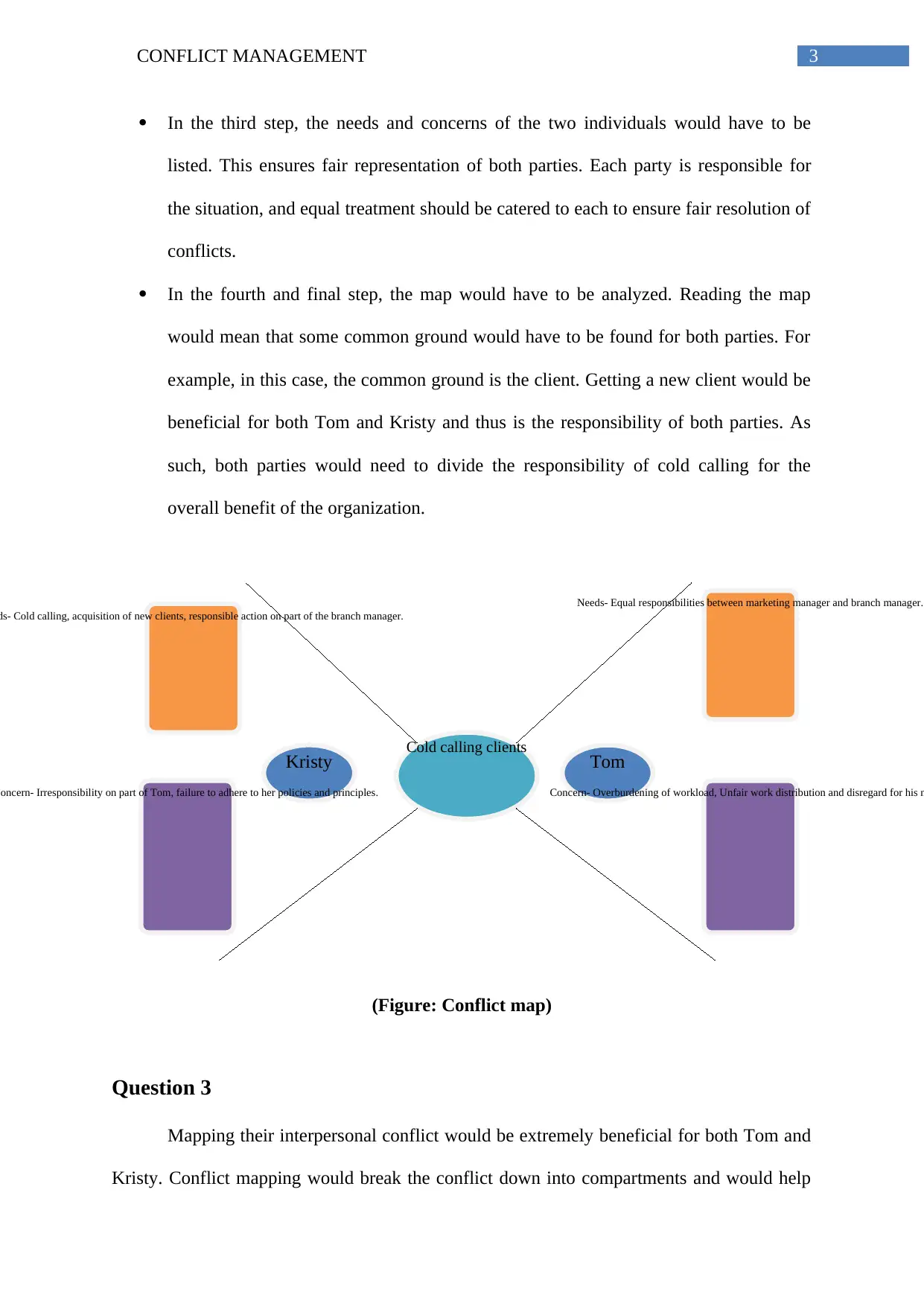
Cold calling clients TomKristy
Needs- Equal responsibilities between marketing manager and branch manager.
Concern- Overburdening of workload, Unfair work distribution and disregard for his n
ds- Cold calling, acquisition of new clients, responsible action on part of the branch manager.
Concern- Irresponsibility on part of Tom, failure to adhere to her policies and principles.
In the third step, the needs and concerns of the two individuals would have to be
listed. This ensures fair representation of both parties. Each party is responsible for
the situation, and equal treatment should be catered to each to ensure fair resolution of
conflicts.
In the fourth and final step, the map would have to be analyzed. Reading the map
would mean that some common ground would have to be found for both parties. For
example, in this case, the common ground is the client. Getting a new client would be
beneficial for both Tom and Kristy and thus is the responsibility of both parties. As
such, both parties would need to divide the responsibility of cold calling for the
overall benefit of the organization.
(Figure: Conflict map)
Question 3
Mapping their interpersonal conflict would be extremely beneficial for both Tom and
Kristy. Conflict mapping would break the conflict down into compartments and would help
Cold calling clients TomKristy
Needs- Equal responsibilities between marketing manager and branch manager.
Concern- Overburdening of workload, Unfair work distribution and disregard for his n
ds- Cold calling, acquisition of new clients, responsible action on part of the branch manager.
Concern- Irresponsibility on part of Tom, failure to adhere to her policies and principles.
In the third step, the needs and concerns of the two individuals would have to be
listed. This ensures fair representation of both parties. Each party is responsible for
the situation, and equal treatment should be catered to each to ensure fair resolution of
conflicts.
In the fourth and final step, the map would have to be analyzed. Reading the map
would mean that some common ground would have to be found for both parties. For
example, in this case, the common ground is the client. Getting a new client would be
beneficial for both Tom and Kristy and thus is the responsibility of both parties. As
such, both parties would need to divide the responsibility of cold calling for the
overall benefit of the organization.
(Figure: Conflict map)
Question 3
Mapping their interpersonal conflict would be extremely beneficial for both Tom and
Kristy. Conflict mapping would break the conflict down into compartments and would help
Paraphrase This Document
Need a fresh take? Get an instant paraphrase of this document with our AI Paraphraser

4CONFLICT MANAGEMENT
the concerned parties better understand the root causes for the unrest. It would also help them
find common ground. For instance, Kristy and Tom both realize that cold calling and getting
hold of clients is the bigger picture here. Instead of arguing about who is responsible for
gathering more potential clients, both should divide partnership and pay more attention to the
cold calling of clients since that would be better for business. Having come to the conclusion
that the needs and concerns of both Tom and Kristy are on the same page, they would be able
to divide responsibility for cold calling the client. For instance, Kristy would have to be more
accommodating and take into account the priorities of others before imposing her decisions
on them. Tom too would need to cooperate with Kristy more and focus on the immediate task
in hand.
Question 4
Constructive response, with respect to conflict management, may be defined as
behavioural patterns which are more suited to effective conflict resolution. In situations of
conflict, an individual’s response may be termed constructive or destructive, depending on
the damage caused due to the conflict. Constructive responses would be a step towards
conflict resolution (Folger, Poole and Stutman). Post the conversation presented in the case
study, Kristy would be expected to reply to Tom. A constructive response on her part would
be one that reflects flexibility. For instance, she could ask him if anyone on his team was
available to be sent to Carlton to greet the client. Simply imposing her decision on Tom
would not help; Kristy would have to be flexible when it comes to her decisions. A more
constructive and proactive response to Kristy on Tom’s part would have been one that
suggests adaptability and cooperation. Instead of lashing out, he could have calmly replied
stating that he would look into it, assuring Kristy that the client was top priority.
the concerned parties better understand the root causes for the unrest. It would also help them
find common ground. For instance, Kristy and Tom both realize that cold calling and getting
hold of clients is the bigger picture here. Instead of arguing about who is responsible for
gathering more potential clients, both should divide partnership and pay more attention to the
cold calling of clients since that would be better for business. Having come to the conclusion
that the needs and concerns of both Tom and Kristy are on the same page, they would be able
to divide responsibility for cold calling the client. For instance, Kristy would have to be more
accommodating and take into account the priorities of others before imposing her decisions
on them. Tom too would need to cooperate with Kristy more and focus on the immediate task
in hand.
Question 4
Constructive response, with respect to conflict management, may be defined as
behavioural patterns which are more suited to effective conflict resolution. In situations of
conflict, an individual’s response may be termed constructive or destructive, depending on
the damage caused due to the conflict. Constructive responses would be a step towards
conflict resolution (Folger, Poole and Stutman). Post the conversation presented in the case
study, Kristy would be expected to reply to Tom. A constructive response on her part would
be one that reflects flexibility. For instance, she could ask him if anyone on his team was
available to be sent to Carlton to greet the client. Simply imposing her decision on Tom
would not help; Kristy would have to be flexible when it comes to her decisions. A more
constructive and proactive response to Kristy on Tom’s part would have been one that
suggests adaptability and cooperation. Instead of lashing out, he could have calmly replied
stating that he would look into it, assuring Kristy that the client was top priority.

5CONFLICT MANAGEMENT
References:
Brown, Greg, and Christopher M. Raymond. "Methods for identifying land use conflict
potential using participatory mapping." Landscape and Urban Planning 122 (2014): 196-208.
Folger, Joseph, Marshall Scott Poole, and Randall K. Stutman. Working through conflict:
Strategies for relationships, groups, and organizations. Routledge, 2017.
Kessler, Stacey R., et al. "Leadership, interpersonal conflict, and counterproductive work
behavior: An examination of the stressor–strain process." Negotiation and Conflict
Management Research 6.3 (2013): 180-190.
References:
Brown, Greg, and Christopher M. Raymond. "Methods for identifying land use conflict
potential using participatory mapping." Landscape and Urban Planning 122 (2014): 196-208.
Folger, Joseph, Marshall Scott Poole, and Randall K. Stutman. Working through conflict:
Strategies for relationships, groups, and organizations. Routledge, 2017.
Kessler, Stacey R., et al. "Leadership, interpersonal conflict, and counterproductive work
behavior: An examination of the stressor–strain process." Negotiation and Conflict
Management Research 6.3 (2013): 180-190.
⊘ This is a preview!⊘
Do you want full access?
Subscribe today to unlock all pages.

Trusted by 1+ million students worldwide
1 out of 6
Related Documents
Your All-in-One AI-Powered Toolkit for Academic Success.
+13062052269
info@desklib.com
Available 24*7 on WhatsApp / Email
Unlock your academic potential
Copyright © 2020–2025 A2Z Services. All Rights Reserved. Developed and managed by ZUCOL.