A Critical Review of Leadership Theories and Leader Evaluation
VerifiedAdded on 2020/10/22
|25
|8709
|346
Essay
AI Summary
This essay delves into the multifaceted realm of leadership, commencing with an abstract that underscores the importance of training and a flexible work environment for organizational growth. It then presents a detailed literature review of various leadership theories, including transformational, transactional, Great Man, Trait, Behavioral, Skills, Contingency, Participative, Power and Influence, Emotional Intelligence, and Maslow's theories, providing a comparative analysis of each. The essay proceeds to critically evaluate two leaders, Wendy A. and Steve B., assessing their behaviors and leadership styles. Furthermore, it encapsulates the key learnings derived from the review and evaluation, alongside a discussion on areas for further personal development in leadership. The essay concludes by synthesizing the key insights and arguments presented throughout, offering a comprehensive understanding of leadership theories and their practical implications.
Title: The Essence of
Leadership
Leadership

Paraphrase This Document
Need a fresh take? Get an instant paraphrase of this document with our AI Paraphraser
Abstract
The basic survival technique of the organisations is to provide the training to their
workers from the beginning stage. An organisation needs to maintain good and flexible working
environment for gaining the desired growth. Leadership is a basic survival instinct in men and
women which provide them potential to resolve issues more effectively and in anticipating future
needs of an organisation. This paper helps in addressing the critical Literature Review of
different theory and a critical evaluation of two Leaders I have worked with. Moreover, a
summary of Learning and Further Development is also being explained.
The basic survival technique of the organisations is to provide the training to their
workers from the beginning stage. An organisation needs to maintain good and flexible working
environment for gaining the desired growth. Leadership is a basic survival instinct in men and
women which provide them potential to resolve issues more effectively and in anticipating future
needs of an organisation. This paper helps in addressing the critical Literature Review of
different theory and a critical evaluation of two Leaders I have worked with. Moreover, a
summary of Learning and Further Development is also being explained.
Table of Contents
Abstract...........................................................................................................................................2
INTRODUCTION ..........................................................................................................................5
Chapter 1 - A Critical Review........................................................................................................6
1.1 Introduction......................................................................................................................6
1.2 Transformational Theory: ...............................................................................................6
1.3 Transactional Theory: ......................................................................................................7
1.4 Great Man Theory:...........................................................................................................8
1.5 Trait Theory: ....................................................................................................................8
1.6 Behavioural Theory: ........................................................................................................9
1.7 Skills Theory: ................................................................................................................10
1.8 Contingency Theory: .....................................................................................................10
1.9 Participative Theory: .....................................................................................................11
1.10 Power and Influence Theory: ......................................................................................12
1.11 Emotional intelligence theory:.....................................................................................13
1.12 Maslow’s theory: ........................................................................................................14
1.13 Summary.......................................................................................................................15
Chapter 2 - A Critical Evaluation .................................................................................................15
2.1 Introduction....................................................................................................................15
2.2 LEADER 1 – Wendy A. ................................................................................................16
2.3 Critical evaluation on Wendy's behaviour: ...................................................................17
2.4 LEADER- 2 - Steve B....................................................................................................17
2.5 Critical evaluation of Steve's behaviour:........................................................................18
2.6 Summary.........................................................................................................................18
Chapter 3 - A Summary of Learning.............................................................................................19
3.1 Introduction....................................................................................................................19
3.2 A Summary of the learning............................................................................................19
3.3 Further development ......................................................................................................20
3.4 Summary:.......................................................................................................................21
CONCLUSION..............................................................................................................................22
Abstract...........................................................................................................................................2
INTRODUCTION ..........................................................................................................................5
Chapter 1 - A Critical Review........................................................................................................6
1.1 Introduction......................................................................................................................6
1.2 Transformational Theory: ...............................................................................................6
1.3 Transactional Theory: ......................................................................................................7
1.4 Great Man Theory:...........................................................................................................8
1.5 Trait Theory: ....................................................................................................................8
1.6 Behavioural Theory: ........................................................................................................9
1.7 Skills Theory: ................................................................................................................10
1.8 Contingency Theory: .....................................................................................................10
1.9 Participative Theory: .....................................................................................................11
1.10 Power and Influence Theory: ......................................................................................12
1.11 Emotional intelligence theory:.....................................................................................13
1.12 Maslow’s theory: ........................................................................................................14
1.13 Summary.......................................................................................................................15
Chapter 2 - A Critical Evaluation .................................................................................................15
2.1 Introduction....................................................................................................................15
2.2 LEADER 1 – Wendy A. ................................................................................................16
2.3 Critical evaluation on Wendy's behaviour: ...................................................................17
2.4 LEADER- 2 - Steve B....................................................................................................17
2.5 Critical evaluation of Steve's behaviour:........................................................................18
2.6 Summary.........................................................................................................................18
Chapter 3 - A Summary of Learning.............................................................................................19
3.1 Introduction....................................................................................................................19
3.2 A Summary of the learning............................................................................................19
3.3 Further development ......................................................................................................20
3.4 Summary:.......................................................................................................................21
CONCLUSION..............................................................................................................................22
⊘ This is a preview!⊘
Do you want full access?
Subscribe today to unlock all pages.

Trusted by 1+ million students worldwide

REFERENCES..............................................................................................................................23
Paraphrase This Document
Need a fresh take? Get an instant paraphrase of this document with our AI Paraphraser
INTRODUCTION
While the concept of leadership has been around since earlier times, the actual creation, and
analysation of comparable theories did not initiate until the early 20th century. It can be said
that there are almost as many definitions of leadership, as those who have attempted to define it.
Dr. Gary Yukl (a successful Author, and Professor of Psychology at the University of Albany)
describes leadership as: “The process of influencing others, and agreeing about what needs to be
done, and how to do it.” (Yukl 2013, pg.23)
One of the main arguments in leadership though, is whether great leaders are created, or born.
My research will review, compare and contrast the main theories, as they relate to the
effectiveness of leaders, within an organisation, previous leaders I have worked with, and finally,
how I can contribute to my own personal growth.
While the concept of leadership has been around since earlier times, the actual creation, and
analysation of comparable theories did not initiate until the early 20th century. It can be said
that there are almost as many definitions of leadership, as those who have attempted to define it.
Dr. Gary Yukl (a successful Author, and Professor of Psychology at the University of Albany)
describes leadership as: “The process of influencing others, and agreeing about what needs to be
done, and how to do it.” (Yukl 2013, pg.23)
One of the main arguments in leadership though, is whether great leaders are created, or born.
My research will review, compare and contrast the main theories, as they relate to the
effectiveness of leaders, within an organisation, previous leaders I have worked with, and finally,
how I can contribute to my own personal growth.
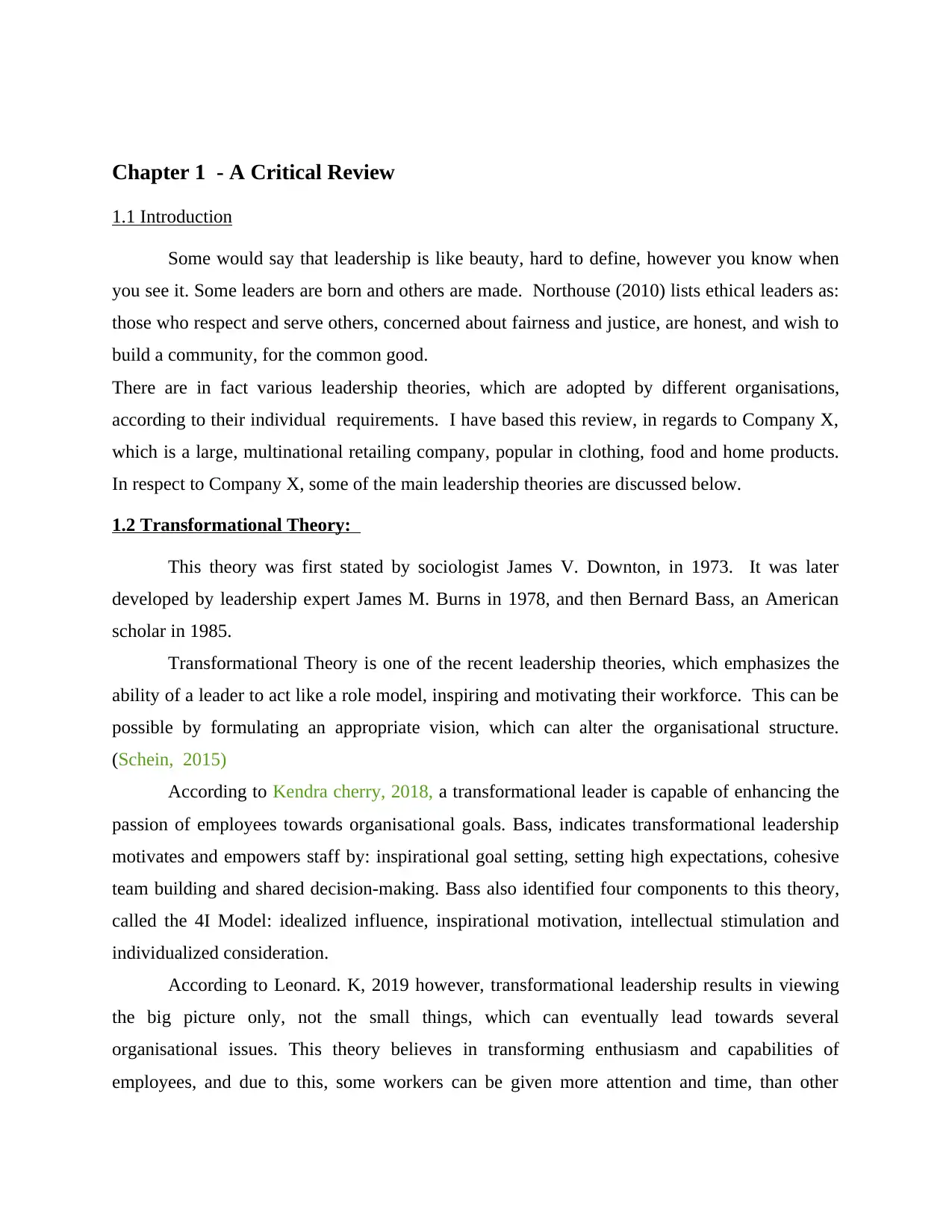
Chapter 1 - A Critical Review
1.1 Introduction
Some would say that leadership is like beauty, hard to define, however you know when
you see it. Some leaders are born and others are made. Northouse (2010) lists ethical leaders as:
those who respect and serve others, concerned about fairness and justice, are honest, and wish to
build a community, for the common good.
There are in fact various leadership theories, which are adopted by different organisations,
according to their individual requirements. I have based this review, in regards to Company X,
which is a large, multinational retailing company, popular in clothing, food and home products.
In respect to Company X, some of the main leadership theories are discussed below.
1.2 Transformational Theory:
This theory was first stated by sociologist James V. Downton, in 1973. It was later
developed by leadership expert James M. Burns in 1978, and then Bernard Bass, an American
scholar in 1985.
Transformational Theory is one of the recent leadership theories, which emphasizes the
ability of a leader to act like a role model, inspiring and motivating their workforce. This can be
possible by formulating an appropriate vision, which can alter the organisational structure.
(Schein, 2015)
According to Kendra cherry, 2018, a transformational leader is capable of enhancing the
passion of employees towards organisational goals. Bass, indicates transformational leadership
motivates and empowers staff by: inspirational goal setting, setting high expectations, cohesive
team building and shared decision-making. Bass also identified four components to this theory,
called the 4I Model: idealized influence, inspirational motivation, intellectual stimulation and
individualized consideration.
According to Leonard. K, 2019 however, transformational leadership results in viewing
the big picture only, not the small things, which can eventually lead towards several
organisational issues. This theory believes in transforming enthusiasm and capabilities of
employees, and due to this, some workers can be given more attention and time, than other
1.1 Introduction
Some would say that leadership is like beauty, hard to define, however you know when
you see it. Some leaders are born and others are made. Northouse (2010) lists ethical leaders as:
those who respect and serve others, concerned about fairness and justice, are honest, and wish to
build a community, for the common good.
There are in fact various leadership theories, which are adopted by different organisations,
according to their individual requirements. I have based this review, in regards to Company X,
which is a large, multinational retailing company, popular in clothing, food and home products.
In respect to Company X, some of the main leadership theories are discussed below.
1.2 Transformational Theory:
This theory was first stated by sociologist James V. Downton, in 1973. It was later
developed by leadership expert James M. Burns in 1978, and then Bernard Bass, an American
scholar in 1985.
Transformational Theory is one of the recent leadership theories, which emphasizes the
ability of a leader to act like a role model, inspiring and motivating their workforce. This can be
possible by formulating an appropriate vision, which can alter the organisational structure.
(Schein, 2015)
According to Kendra cherry, 2018, a transformational leader is capable of enhancing the
passion of employees towards organisational goals. Bass, indicates transformational leadership
motivates and empowers staff by: inspirational goal setting, setting high expectations, cohesive
team building and shared decision-making. Bass also identified four components to this theory,
called the 4I Model: idealized influence, inspirational motivation, intellectual stimulation and
individualized consideration.
According to Leonard. K, 2019 however, transformational leadership results in viewing
the big picture only, not the small things, which can eventually lead towards several
organisational issues. This theory believes in transforming enthusiasm and capabilities of
employees, and due to this, some workers can be given more attention and time, than other
⊘ This is a preview!⊘
Do you want full access?
Subscribe today to unlock all pages.
Trusted by 1+ million students worldwide
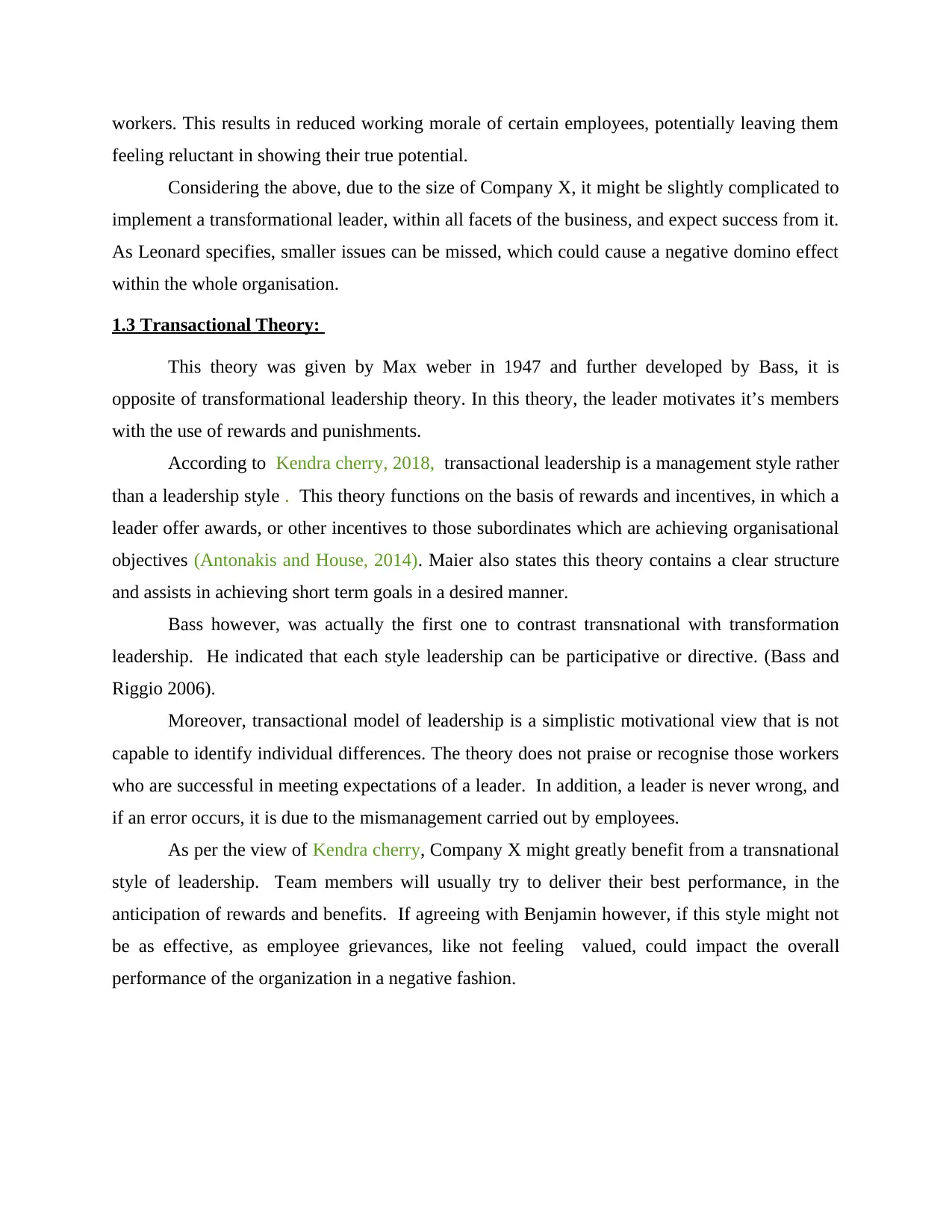
workers. This results in reduced working morale of certain employees, potentially leaving them
feeling reluctant in showing their true potential.
Considering the above, due to the size of Company X, it might be slightly complicated to
implement a transformational leader, within all facets of the business, and expect success from it.
As Leonard specifies, smaller issues can be missed, which could cause a negative domino effect
within the whole organisation.
1.3 Transactional Theory:
This theory was given by Max weber in 1947 and further developed by Bass, it is
opposite of transformational leadership theory. In this theory, the leader motivates it’s members
with the use of rewards and punishments.
According to Kendra cherry, 2018, transactional leadership is a management style rather
than a leadership style . This theory functions on the basis of rewards and incentives, in which a
leader offer awards, or other incentives to those subordinates which are achieving organisational
objectives (Antonakis and House, 2014). Maier also states this theory contains a clear structure
and assists in achieving short term goals in a desired manner.
Bass however, was actually the first one to contrast transnational with transformation
leadership. He indicated that each style leadership can be participative or directive. (Bass and
Riggio 2006).
Moreover, transactional model of leadership is a simplistic motivational view that is not
capable to identify individual differences. The theory does not praise or recognise those workers
who are successful in meeting expectations of a leader. In addition, a leader is never wrong, and
if an error occurs, it is due to the mismanagement carried out by employees.
As per the view of Kendra cherry, Company X might greatly benefit from a transnational
style of leadership. Team members will usually try to deliver their best performance, in the
anticipation of rewards and benefits. If agreeing with Benjamin however, if this style might not
be as effective, as employee grievances, like not feeling valued, could impact the overall
performance of the organization in a negative fashion.
feeling reluctant in showing their true potential.
Considering the above, due to the size of Company X, it might be slightly complicated to
implement a transformational leader, within all facets of the business, and expect success from it.
As Leonard specifies, smaller issues can be missed, which could cause a negative domino effect
within the whole organisation.
1.3 Transactional Theory:
This theory was given by Max weber in 1947 and further developed by Bass, it is
opposite of transformational leadership theory. In this theory, the leader motivates it’s members
with the use of rewards and punishments.
According to Kendra cherry, 2018, transactional leadership is a management style rather
than a leadership style . This theory functions on the basis of rewards and incentives, in which a
leader offer awards, or other incentives to those subordinates which are achieving organisational
objectives (Antonakis and House, 2014). Maier also states this theory contains a clear structure
and assists in achieving short term goals in a desired manner.
Bass however, was actually the first one to contrast transnational with transformation
leadership. He indicated that each style leadership can be participative or directive. (Bass and
Riggio 2006).
Moreover, transactional model of leadership is a simplistic motivational view that is not
capable to identify individual differences. The theory does not praise or recognise those workers
who are successful in meeting expectations of a leader. In addition, a leader is never wrong, and
if an error occurs, it is due to the mismanagement carried out by employees.
As per the view of Kendra cherry, Company X might greatly benefit from a transnational
style of leadership. Team members will usually try to deliver their best performance, in the
anticipation of rewards and benefits. If agreeing with Benjamin however, if this style might not
be as effective, as employee grievances, like not feeling valued, could impact the overall
performance of the organization in a negative fashion.
Paraphrase This Document
Need a fresh take? Get an instant paraphrase of this document with our AI Paraphraser
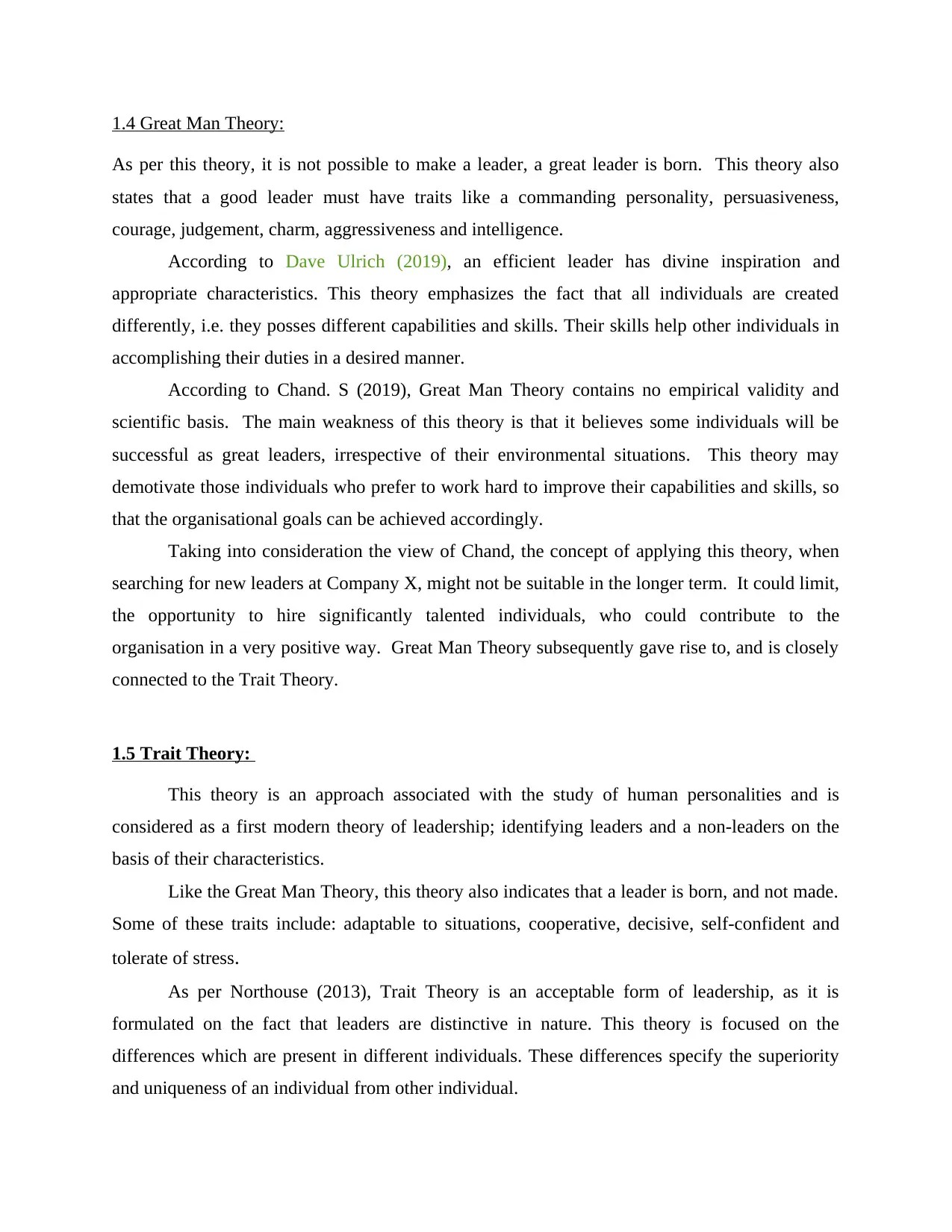
1.4 Great Man Theory:
As per this theory, it is not possible to make a leader, a great leader is born. This theory also
states that a good leader must have traits like a commanding personality, persuasiveness,
courage, judgement, charm, aggressiveness and intelligence.
According to Dave Ulrich (2019), an efficient leader has divine inspiration and
appropriate characteristics. This theory emphasizes the fact that all individuals are created
differently, i.e. they posses different capabilities and skills. Their skills help other individuals in
accomplishing their duties in a desired manner.
According to Chand. S (2019), Great Man Theory contains no empirical validity and
scientific basis. The main weakness of this theory is that it believes some individuals will be
successful as great leaders, irrespective of their environmental situations. This theory may
demotivate those individuals who prefer to work hard to improve their capabilities and skills, so
that the organisational goals can be achieved accordingly.
Taking into consideration the view of Chand, the concept of applying this theory, when
searching for new leaders at Company X, might not be suitable in the longer term. It could limit,
the opportunity to hire significantly talented individuals, who could contribute to the
organisation in a very positive way. Great Man Theory subsequently gave rise to, and is closely
connected to the Trait Theory.
1.5 Trait Theory:
This theory is an approach associated with the study of human personalities and is
considered as a first modern theory of leadership; identifying leaders and a non-leaders on the
basis of their characteristics.
Like the Great Man Theory, this theory also indicates that a leader is born, and not made.
Some of these traits include: adaptable to situations, cooperative, decisive, self-confident and
tolerate of stress.
As per Northouse (2013), Trait Theory is an acceptable form of leadership, as it is
formulated on the fact that leaders are distinctive in nature. This theory is focused on the
differences which are present in different individuals. These differences specify the superiority
and uniqueness of an individual from other individual.
As per this theory, it is not possible to make a leader, a great leader is born. This theory also
states that a good leader must have traits like a commanding personality, persuasiveness,
courage, judgement, charm, aggressiveness and intelligence.
According to Dave Ulrich (2019), an efficient leader has divine inspiration and
appropriate characteristics. This theory emphasizes the fact that all individuals are created
differently, i.e. they posses different capabilities and skills. Their skills help other individuals in
accomplishing their duties in a desired manner.
According to Chand. S (2019), Great Man Theory contains no empirical validity and
scientific basis. The main weakness of this theory is that it believes some individuals will be
successful as great leaders, irrespective of their environmental situations. This theory may
demotivate those individuals who prefer to work hard to improve their capabilities and skills, so
that the organisational goals can be achieved accordingly.
Taking into consideration the view of Chand, the concept of applying this theory, when
searching for new leaders at Company X, might not be suitable in the longer term. It could limit,
the opportunity to hire significantly talented individuals, who could contribute to the
organisation in a very positive way. Great Man Theory subsequently gave rise to, and is closely
connected to the Trait Theory.
1.5 Trait Theory:
This theory is an approach associated with the study of human personalities and is
considered as a first modern theory of leadership; identifying leaders and a non-leaders on the
basis of their characteristics.
Like the Great Man Theory, this theory also indicates that a leader is born, and not made.
Some of these traits include: adaptable to situations, cooperative, decisive, self-confident and
tolerate of stress.
As per Northouse (2013), Trait Theory is an acceptable form of leadership, as it is
formulated on the fact that leaders are distinctive in nature. This theory is focused on the
differences which are present in different individuals. These differences specify the superiority
and uniqueness of an individual from other individual.
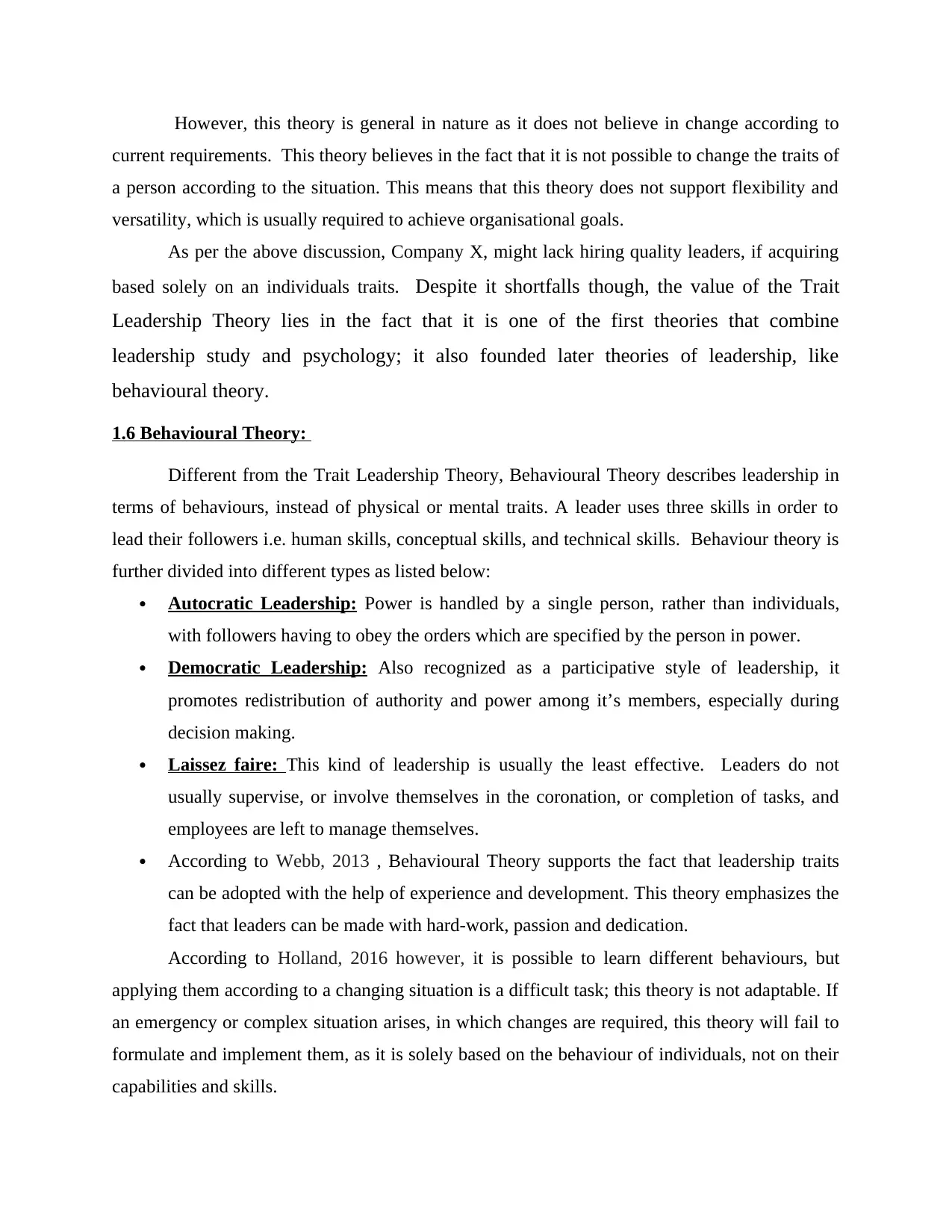
However, this theory is general in nature as it does not believe in change according to
current requirements. This theory believes in the fact that it is not possible to change the traits of
a person according to the situation. This means that this theory does not support flexibility and
versatility, which is usually required to achieve organisational goals.
As per the above discussion, Company X, might lack hiring quality leaders, if acquiring
based solely on an individuals traits. Despite it shortfalls though, the value of the Trait
Leadership Theory lies in the fact that it is one of the first theories that combine
leadership study and psychology; it also founded later theories of leadership, like
behavioural theory.
1.6 Behavioural Theory:
Different from the Trait Leadership Theory, Behavioural Theory describes leadership in
terms of behaviours, instead of physical or mental traits. A leader uses three skills in order to
lead their followers i.e. human skills, conceptual skills, and technical skills. Behaviour theory is
further divided into different types as listed below:
· Autocratic Leadership: Power is handled by a single person, rather than individuals,
with followers having to obey the orders which are specified by the person in power.
· Democratic Leadership: Also recognized as a participative style of leadership, it
promotes redistribution of authority and power among it’s members, especially during
decision making.
· Laissez faire: This kind of leadership is usually the least effective. Leaders do not
usually supervise, or involve themselves in the coronation, or completion of tasks, and
employees are left to manage themselves.
· According to Webb, 2013 , Behavioural Theory supports the fact that leadership traits
can be adopted with the help of experience and development. This theory emphasizes the
fact that leaders can be made with hard-work, passion and dedication.
According to Holland, 2016 however, it is possible to learn different behaviours, but
applying them according to a changing situation is a difficult task; this theory is not adaptable. If
an emergency or complex situation arises, in which changes are required, this theory will fail to
formulate and implement them, as it is solely based on the behaviour of individuals, not on their
capabilities and skills.
current requirements. This theory believes in the fact that it is not possible to change the traits of
a person according to the situation. This means that this theory does not support flexibility and
versatility, which is usually required to achieve organisational goals.
As per the above discussion, Company X, might lack hiring quality leaders, if acquiring
based solely on an individuals traits. Despite it shortfalls though, the value of the Trait
Leadership Theory lies in the fact that it is one of the first theories that combine
leadership study and psychology; it also founded later theories of leadership, like
behavioural theory.
1.6 Behavioural Theory:
Different from the Trait Leadership Theory, Behavioural Theory describes leadership in
terms of behaviours, instead of physical or mental traits. A leader uses three skills in order to
lead their followers i.e. human skills, conceptual skills, and technical skills. Behaviour theory is
further divided into different types as listed below:
· Autocratic Leadership: Power is handled by a single person, rather than individuals,
with followers having to obey the orders which are specified by the person in power.
· Democratic Leadership: Also recognized as a participative style of leadership, it
promotes redistribution of authority and power among it’s members, especially during
decision making.
· Laissez faire: This kind of leadership is usually the least effective. Leaders do not
usually supervise, or involve themselves in the coronation, or completion of tasks, and
employees are left to manage themselves.
· According to Webb, 2013 , Behavioural Theory supports the fact that leadership traits
can be adopted with the help of experience and development. This theory emphasizes the
fact that leaders can be made with hard-work, passion and dedication.
According to Holland, 2016 however, it is possible to learn different behaviours, but
applying them according to a changing situation is a difficult task; this theory is not adaptable. If
an emergency or complex situation arises, in which changes are required, this theory will fail to
formulate and implement them, as it is solely based on the behaviour of individuals, not on their
capabilities and skills.
⊘ This is a preview!⊘
Do you want full access?
Subscribe today to unlock all pages.
Trusted by 1+ million students worldwide
If siding with Webb, the recognition and application of Behavioural Theory, might be
suitable for Company X, in order to motivate those employees, who believe they can work hard
and passionately to achieve their individualistic goals, hence adding to the success of the
organisation.
1.7 Skills Theory:
This theory is somewhat similar to the Behavioural Theory of leadership, however it
places an emphasis on skills, rather than the behaviour of an individual.
According to Gibb, (2014), this theory denotes that any person can become a leader by working
hard and improving their managing and leading skills. This is a huge encouragement for those
dreaming of a higher position, or wishing to take their careers to a higher level.
According to Germain, (2012), though, development and formulation of skills is only
possible if an individual posses effective personal traits. This theory is suitable for those who are
extrovert and have empathy. However those individuals which are introvert, will not be able to
showcase their skills in a desired manner. This theory focuses on identifying skills, however not
the specific manner in which these skills will impact the leadership within an organisation.
Talented individuals, with the right skills, are always a positive factor when seeking effective
leaders in within an organisation like Company X. A leader who displays, and exercises the
right skills can be an excellent role model for others. Not to mention, a valuable asset to the
company, if they posses, or have the will to improve, if agreeing with the view of Germain.
1.8 Contingency Theory:
This theory was formulated by scientist Fred Fielder in 1958. The Fiedler Contingency model
states that a leader’s style used, and effectiveness, is based on the situation. The theory further
explains that an effective leader will chooses their own leadership style to deal with difficult
these scenarios as they occur (Freeman, 2015).
In addition to this there is a direct relation between traits and effectiveness of a leader. If
a leader posses specific capabilities and skills, then it will be easier for an organisation to
perform well in challenging times. Contingency theory will allow the leader to follow any action
which is suitable for that particular situation. This denotes flexibility and versatility which is
very essential while performing business activities or operations.
suitable for Company X, in order to motivate those employees, who believe they can work hard
and passionately to achieve their individualistic goals, hence adding to the success of the
organisation.
1.7 Skills Theory:
This theory is somewhat similar to the Behavioural Theory of leadership, however it
places an emphasis on skills, rather than the behaviour of an individual.
According to Gibb, (2014), this theory denotes that any person can become a leader by working
hard and improving their managing and leading skills. This is a huge encouragement for those
dreaming of a higher position, or wishing to take their careers to a higher level.
According to Germain, (2012), though, development and formulation of skills is only
possible if an individual posses effective personal traits. This theory is suitable for those who are
extrovert and have empathy. However those individuals which are introvert, will not be able to
showcase their skills in a desired manner. This theory focuses on identifying skills, however not
the specific manner in which these skills will impact the leadership within an organisation.
Talented individuals, with the right skills, are always a positive factor when seeking effective
leaders in within an organisation like Company X. A leader who displays, and exercises the
right skills can be an excellent role model for others. Not to mention, a valuable asset to the
company, if they posses, or have the will to improve, if agreeing with the view of Germain.
1.8 Contingency Theory:
This theory was formulated by scientist Fred Fielder in 1958. The Fiedler Contingency model
states that a leader’s style used, and effectiveness, is based on the situation. The theory further
explains that an effective leader will chooses their own leadership style to deal with difficult
these scenarios as they occur (Freeman, 2015).
In addition to this there is a direct relation between traits and effectiveness of a leader. If
a leader posses specific capabilities and skills, then it will be easier for an organisation to
perform well in challenging times. Contingency theory will allow the leader to follow any action
which is suitable for that particular situation. This denotes flexibility and versatility which is
very essential while performing business activities or operations.
Paraphrase This Document
Need a fresh take? Get an instant paraphrase of this document with our AI Paraphraser
Company X, may experience challenging situations, on a daily basis. Dealing with
customer complaints, external circumstances, such as poor publicity and extreme competition,
are all potential grievances it’s leaders have to tackle wisely . There may not always be a one
size fits all solution, thus the organisation might offer flexibility to it’s senior team, to diffuse
situations with a style, or technique they deem fit for that particular situation, as long it is in
accordance with companies policies. The perspective presented by Rodriguez appears to make
practical sense.
1.9 Participative Theory:
The main developers of this theory, were Gary Yukl and Dr. Rensis Likert. As Likert is
best known for the Likert Scale, which he created for his doctoral thesis in 1932. This five point
scale, is the most widely used employee questioner, and encourages participatory feedback. This
type of knowledge gives organisations like Company X, useful information, like the opinions
and recommendations of it’s team, which it can then inject into it’s operations if desired.
The basis of the actual theory though, is the fact that an ideal leadership style is one in
which ideas, concepts and opinions of others are considered. Leaders adopting this kind of
leadership style encourage contributions and participation of others, when performing activities
within the organisation. By using this approach, employees tend to feel more appreciated and
deliver higher results, feeling closely associated with decisions, and contributing to the progress.
According to Murray, 2013, Participative Theory is preferred, because it makes
employees feel valued. In this kind of leadership, employees will try to deliver their best
performance, even if the leader is not present as they personally feel apart of the outcome. Due
to this kind commitment, employees can take the organization to new heights.
According to Heinle, 2013, this leadership style is not suitable for an organisation. This is
because this style considers the opinions of different people, before taking a decision, which can
be time consuming process.
Taking into considering the above, this type of leadership style can enhance the value of
work, in the mind of employees in Company X. If their opinions are given consideration, several
might give their best performance and treat organisational goals as one of their personal goals.
Alternatively, it might also become difficult for a large firm, like Company X, to accomplish
their objectives in a timely manner, if consistently asking for, or relying upon the input of several
customer complaints, external circumstances, such as poor publicity and extreme competition,
are all potential grievances it’s leaders have to tackle wisely . There may not always be a one
size fits all solution, thus the organisation might offer flexibility to it’s senior team, to diffuse
situations with a style, or technique they deem fit for that particular situation, as long it is in
accordance with companies policies. The perspective presented by Rodriguez appears to make
practical sense.
1.9 Participative Theory:
The main developers of this theory, were Gary Yukl and Dr. Rensis Likert. As Likert is
best known for the Likert Scale, which he created for his doctoral thesis in 1932. This five point
scale, is the most widely used employee questioner, and encourages participatory feedback. This
type of knowledge gives organisations like Company X, useful information, like the opinions
and recommendations of it’s team, which it can then inject into it’s operations if desired.
The basis of the actual theory though, is the fact that an ideal leadership style is one in
which ideas, concepts and opinions of others are considered. Leaders adopting this kind of
leadership style encourage contributions and participation of others, when performing activities
within the organisation. By using this approach, employees tend to feel more appreciated and
deliver higher results, feeling closely associated with decisions, and contributing to the progress.
According to Murray, 2013, Participative Theory is preferred, because it makes
employees feel valued. In this kind of leadership, employees will try to deliver their best
performance, even if the leader is not present as they personally feel apart of the outcome. Due
to this kind commitment, employees can take the organization to new heights.
According to Heinle, 2013, this leadership style is not suitable for an organisation. This is
because this style considers the opinions of different people, before taking a decision, which can
be time consuming process.
Taking into considering the above, this type of leadership style can enhance the value of
work, in the mind of employees in Company X. If their opinions are given consideration, several
might give their best performance and treat organisational goals as one of their personal goals.
Alternatively, it might also become difficult for a large firm, like Company X, to accomplish
their objectives in a timely manner, if consistently asking for, or relying upon the input of several
others, other then senior management. Subordinates, may also not share the same vision, as the
investors, and shareholders, which may cause conflict.
1.10 Power and Influence Theory:
Power is defined as the capacity of an individual to implement their will on other
individuals. It is the ability by which a person makes things happen so that all the tasks and
projects can be accomplished in a desired and effective manner. There are different sources of
power which are mentioned below:
· Legitimate power: The leader, or manager is followed, or acknowledged by
subordinates, and others, due to the official title, or position held.
· Reward power: The ability to reward employees according to their performance and
contribution.
· Coercive power: This power is opposite to the reward power and uses punishments and
threats to accomplish tasks.
· Referent power: When leaders are seen as a role model, and other wish to emulate
them.
· Expert power: Individuals possessing this type of power, carry special knowledge in
their specific field.
Moreover, to perform leadership responsibilities in a desired manner, it is important for
the leader to have some power within organisation. Power will influence the workforce in
achieving personal as well as organisational goals. Power such as expert, and referent, inspire the
employees to most likely be loyal and committed to their work. Power and influence also helps
in reducing the bureaucratic obstacles within the firm, this will assist in sustaining a healthy, and
more organized working environment.
According to Treadway, 2013, when a person possess high power, they might take
decisions without considering all the consequences. This condition is regarded as power abuse
or corruption. Power corruption can take place when the senior leaders, and or managers within
an organisation, starts misusing their powers and force others to follow their orders, even if the
decision is potentially wrong. This theory basically involves the use legitimate power, in which
employees are forced to follow even if not acceptable my a larger audience.
By analysing the listed points of view, it is determined that if the right kind of power
exerted by leaders in Company X, it can increase the cohesiveness and morale of it’s employees
investors, and shareholders, which may cause conflict.
1.10 Power and Influence Theory:
Power is defined as the capacity of an individual to implement their will on other
individuals. It is the ability by which a person makes things happen so that all the tasks and
projects can be accomplished in a desired and effective manner. There are different sources of
power which are mentioned below:
· Legitimate power: The leader, or manager is followed, or acknowledged by
subordinates, and others, due to the official title, or position held.
· Reward power: The ability to reward employees according to their performance and
contribution.
· Coercive power: This power is opposite to the reward power and uses punishments and
threats to accomplish tasks.
· Referent power: When leaders are seen as a role model, and other wish to emulate
them.
· Expert power: Individuals possessing this type of power, carry special knowledge in
their specific field.
Moreover, to perform leadership responsibilities in a desired manner, it is important for
the leader to have some power within organisation. Power will influence the workforce in
achieving personal as well as organisational goals. Power such as expert, and referent, inspire the
employees to most likely be loyal and committed to their work. Power and influence also helps
in reducing the bureaucratic obstacles within the firm, this will assist in sustaining a healthy, and
more organized working environment.
According to Treadway, 2013, when a person possess high power, they might take
decisions without considering all the consequences. This condition is regarded as power abuse
or corruption. Power corruption can take place when the senior leaders, and or managers within
an organisation, starts misusing their powers and force others to follow their orders, even if the
decision is potentially wrong. This theory basically involves the use legitimate power, in which
employees are forced to follow even if not acceptable my a larger audience.
By analysing the listed points of view, it is determined that if the right kind of power
exerted by leaders in Company X, it can increase the cohesiveness and morale of it’s employees
⊘ This is a preview!⊘
Do you want full access?
Subscribe today to unlock all pages.
Trusted by 1+ million students worldwide

1 out of 25


Related Documents


Your All-in-One AI-Powered Toolkit for Academic Success.
+13062052269
info@desklib.com
Available 24*7 on WhatsApp / Email
![[object Object]](/_next/static/media/star-bottom.7253800d.svg)
Unlock your academic potential
Copyright © 2020–2026 A2Z Services. All Rights Reserved. Developed and managed by ZUCOL.