Leadership & Decision Making: Skills, Development Plan & Alibaba Group
VerifiedAdded on 2023/04/06
|16
|3157
|242
Report
AI Summary
This report provides a comprehensive analysis of leadership and decision-making, incorporating personal experiences and observations of a prominent Chinese business leader. It delves into the leader's traits, qualities, and behaviors, applying leadership theories such as trait theory, autocratic theory, and democratic theory. The report includes a self-reflection on the author's leadership abilities, identifying strengths and weaknesses, and outlines a leadership development plan using diagnostic tools to assess self-confidence, team working skills, and emotional intelligence. The plan focuses on improving areas such as digital communication skills and emotional connectivity with team members, aiming to enhance overall leadership effectiveness within the context of Alibaba Group. Desklib offers a wide range of resources, including past papers and solved assignments, to support students in their academic endeavors.
Running head: LEADERSHIP AND DECISION MAKING
Leadership and Decision Making
Name of the Student
Name of the University
Author’s Note:
Leadership and Decision Making
Name of the Student
Name of the University
Author’s Note:

Paraphrase This Document
Need a fresh take? Get an instant paraphrase of this document with our AI Paraphraser
1
LEADERSHIP AND DECISION MAKING
Table of Contents
Introduction................................................................................................................................2
Discussion..................................................................................................................................2
Stage 1: Observation..............................................................................................................2
1.1 Critical Analysis of My Role Model being a Good Leader.........................................3
1.2 Leadership Traits, Qualities and Behaviours of My Role Model................................3
1.3 Process of My Role Model using Power and Influence for making him an Effective
Leader.................................................................................................................................5
Stage 2: Leadership Development Plan.................................................................................5
2.2 Diagnostic Tools..........................................................................................................7
2.3 Leadership Development Plan.....................................................................................8
Stage 3: Feedback................................................................................................................10
Conclusion................................................................................................................................10
References................................................................................................................................12
Appendix..................................................................................................................................14
LEADERSHIP AND DECISION MAKING
Table of Contents
Introduction................................................................................................................................2
Discussion..................................................................................................................................2
Stage 1: Observation..............................................................................................................2
1.1 Critical Analysis of My Role Model being a Good Leader.........................................3
1.2 Leadership Traits, Qualities and Behaviours of My Role Model................................3
1.3 Process of My Role Model using Power and Influence for making him an Effective
Leader.................................................................................................................................5
Stage 2: Leadership Development Plan.................................................................................5
2.2 Diagnostic Tools..........................................................................................................7
2.3 Leadership Development Plan.....................................................................................8
Stage 3: Feedback................................................................................................................10
Conclusion................................................................................................................................10
References................................................................................................................................12
Appendix..................................................................................................................................14
2
LEADERSHIP AND DECISION MAKING
Introduction
Leadership is stated as the core capability of any specific individual or rather a team
of few individuals for influencing as well as guiding followers and even other members
within an organization (Bolman and Deal 2017). Leadership includes making sound and
difficult decisions after creation and articulation of clearer vision, establishment of achievable
goals and providing the followers with proper knowledge as well as tools required for the
successful achievement of these specific goals.
It is termed as the practical skill that eventually encompasses the major capability of
any person or organization for guiding as well as leading other individuals or an entire
company (Goleman, Boyatzis and McKee 2013). My chosen role leader for this task is a
Chinese businessman, philanthropist and investor. He is the executive chairman and co-
founder of a MNC and is termed as one of the most prominent leaders, who is responsible for
making the entire business extremely successful and popular. The following report outlines a
brief discussion on the leadership and decision making after inclusion of leadership skills of
my role leader and personal experiences. Relevant details will be provided in this report.
Discussion
Stage 1: Observation
The selected role model or leader for this task is executive chairman and co-founder
of a MNC, Alibaba Group and is one of the richest men in China and the entire world (Daft
2014). His primary vision is for a market driven and open economy. Being one of the most
prominent business figure, he is often seen as the global ambassador for Chinese businesses.
He has a major role in making the entire business extremely popular and significant.
LEADERSHIP AND DECISION MAKING
Introduction
Leadership is stated as the core capability of any specific individual or rather a team
of few individuals for influencing as well as guiding followers and even other members
within an organization (Bolman and Deal 2017). Leadership includes making sound and
difficult decisions after creation and articulation of clearer vision, establishment of achievable
goals and providing the followers with proper knowledge as well as tools required for the
successful achievement of these specific goals.
It is termed as the practical skill that eventually encompasses the major capability of
any person or organization for guiding as well as leading other individuals or an entire
company (Goleman, Boyatzis and McKee 2013). My chosen role leader for this task is a
Chinese businessman, philanthropist and investor. He is the executive chairman and co-
founder of a MNC and is termed as one of the most prominent leaders, who is responsible for
making the entire business extremely successful and popular. The following report outlines a
brief discussion on the leadership and decision making after inclusion of leadership skills of
my role leader and personal experiences. Relevant details will be provided in this report.
Discussion
Stage 1: Observation
The selected role model or leader for this task is executive chairman and co-founder
of a MNC, Alibaba Group and is one of the richest men in China and the entire world (Daft
2014). His primary vision is for a market driven and open economy. Being one of the most
prominent business figure, he is often seen as the global ambassador for Chinese businesses.
He has a major role in making the entire business extremely popular and significant.
⊘ This is a preview!⊘
Do you want full access?
Subscribe today to unlock all pages.

Trusted by 1+ million students worldwide
3
LEADERSHIP AND DECISION MAKING
1.1 Critical Analysis of My Role Model being a Good Leader
He, being a prominent leaders in China is intended to use the major influence of his
business and Internet for facilitating more globalized trades in the borders beyond China and
also helping the Small and Medium Enterprises of SMEs across the entire world. In the year
of 2014, my role model was eventually ranked as 30th most powerful individual within the
world. Moreover, in the year of 2017, he was also ranked as 2nd on the World’s 50 Great
Leaders List by Fortune (Tannenbaum and Schmidt 2017). According to him, he is not only
doing business or money, but also he is on a mission to change the manner of business being
done in China or for improving the e commerce system in the country. This particular feature
proves that he is an excellent leader and he comprises of several qualities, skills and styles.
1.2 Leadership Traits, Qualities and Behaviours of My Role Model
The leadership traits, qualities and behaviours that I have learnt about this leader from
my leadership course that could be perceived are as follows:
i) Being an Authentic Leader: The first and the foremost leadership trait and quality
of my chosen leader is being an authentic leader (Hackman and Johnson 2013). He possesses
a stronger sense of character that eventually helps him in building stronger foundation and
loyalty on which he has grown the business.
ii) Seeing through Customer’s Vision: The second quality that he possesses is seeing
through the customers’ eyes. He is running an e commerce business and he has obtained in
his business as he is helping his business to provide the best services.
iii) Developing a Mission: Another important and significant quality or trait that my
role leader comprises is developing a mission (Antonakis and Day 2017). The major mission
of this leader is to regenerate the culture and sense of purpose of China and he has given
equity shares to the employees for getting benefits.
LEADERSHIP AND DECISION MAKING
1.1 Critical Analysis of My Role Model being a Good Leader
He, being a prominent leaders in China is intended to use the major influence of his
business and Internet for facilitating more globalized trades in the borders beyond China and
also helping the Small and Medium Enterprises of SMEs across the entire world. In the year
of 2014, my role model was eventually ranked as 30th most powerful individual within the
world. Moreover, in the year of 2017, he was also ranked as 2nd on the World’s 50 Great
Leaders List by Fortune (Tannenbaum and Schmidt 2017). According to him, he is not only
doing business or money, but also he is on a mission to change the manner of business being
done in China or for improving the e commerce system in the country. This particular feature
proves that he is an excellent leader and he comprises of several qualities, skills and styles.
1.2 Leadership Traits, Qualities and Behaviours of My Role Model
The leadership traits, qualities and behaviours that I have learnt about this leader from
my leadership course that could be perceived are as follows:
i) Being an Authentic Leader: The first and the foremost leadership trait and quality
of my chosen leader is being an authentic leader (Hackman and Johnson 2013). He possesses
a stronger sense of character that eventually helps him in building stronger foundation and
loyalty on which he has grown the business.
ii) Seeing through Customer’s Vision: The second quality that he possesses is seeing
through the customers’ eyes. He is running an e commerce business and he has obtained in
his business as he is helping his business to provide the best services.
iii) Developing a Mission: Another important and significant quality or trait that my
role leader comprises is developing a mission (Antonakis and Day 2017). The major mission
of this leader is to regenerate the culture and sense of purpose of China and he has given
equity shares to the employees for getting benefits.
Paraphrase This Document
Need a fresh take? Get an instant paraphrase of this document with our AI Paraphraser
4
LEADERSHIP AND DECISION MAKING
iv) Uniting People under Single Goal: He has even convinced every single
employee, investor and business partner for growing their business in an effective manner.
He unites them under a common goal of organization.
v) Hiring People with Skills: He only hires people with excellent skills for making
the conglomerate successful (Chemers 2014).
vi) Being Tenacious: The next distinctive and important leadership skill that my
selected leader comprises of is being tenacious in comparison to others. He, being a leader is
both tenacious ad have a clear vision. He even wants to inspire other individuals for better
achievement of goals and objectives.
I can described him with some of the core and important leadership theories and these
are as follows:
i) Leadership Trait Theory: As per this particular theory, an effective leader
comprises of several significant traits or characteristics for his work (Ciulla 2014). He
consists of few significant traits that make him completely different from the rest.
ii) Autocratic Theory: The second theory that can describe my role model as a leader
is autocratic theory. He is capable of making decisions for undertaking better decisions in his
work. Moreover, he is able to take decisions quickly and thus team management is much
easier.
iii) Democratic Theory: According to this particular theory, he allows his team
members to provide input even before making any type of decision and hence the degree of
input is varying (Tschannen-Moran 2014). It has helped him in managing the teams in an
effective manner.
LEADERSHIP AND DECISION MAKING
iv) Uniting People under Single Goal: He has even convinced every single
employee, investor and business partner for growing their business in an effective manner.
He unites them under a common goal of organization.
v) Hiring People with Skills: He only hires people with excellent skills for making
the conglomerate successful (Chemers 2014).
vi) Being Tenacious: The next distinctive and important leadership skill that my
selected leader comprises of is being tenacious in comparison to others. He, being a leader is
both tenacious ad have a clear vision. He even wants to inspire other individuals for better
achievement of goals and objectives.
I can described him with some of the core and important leadership theories and these
are as follows:
i) Leadership Trait Theory: As per this particular theory, an effective leader
comprises of several significant traits or characteristics for his work (Ciulla 2014). He
consists of few significant traits that make him completely different from the rest.
ii) Autocratic Theory: The second theory that can describe my role model as a leader
is autocratic theory. He is capable of making decisions for undertaking better decisions in his
work. Moreover, he is able to take decisions quickly and thus team management is much
easier.
iii) Democratic Theory: According to this particular theory, he allows his team
members to provide input even before making any type of decision and hence the degree of
input is varying (Tschannen-Moran 2014). It has helped him in managing the teams in an
effective manner.
5
LEADERSHIP AND DECISION MAKING
iv) Laissez Faire Leadership Theory: This particular theory based leaders allow their
team members in the team for making most of the decisions and thus he makes his team
extremely motivated in comparison to others.
1.3 Process of My Role Model using Power and Influence for making him an Effective
Leader
My role model has been using power and influence for making him an extremely
effective leader. For making things much better and different for his business, he has been
using his power and influence and following few leadership theories and models. The first
model for using power and influence is French and Raven’s Five Forms of Power (Priest and
Gass 2017). As per this specific model, three kinds of positional power, which are coercive,
rewards as well as legitimate and two distinctive sources of personal power that are expert
and referent are being used by him. Being an efficient leader, he is also using transactional
leadership for his employees. With this approach of power and influence, the individuals will
be doing work after getting motivation from rewards. Hence, a highly motivated work
environment is being made.
Stage 2: Leadership Development Plan
2.1 Self Reflection
I have got the opportunity for reflecting on my leadership abilities while completing
this course. I have been working a team leader in the Alibaba Group and have been leading a
team of five members as my current position. I am able to use my leadership experiences or
betterment of work (Avolio and Yammarino 2013). I am lucky that I got a close encounter
with my role model and this encounter has helped me to identify some of the major aspects of
my personality, which I will have to change. One of the major advantages and trait that I
comprise of is self confidence. I am extremely self confident and for this trait, I have been
LEADERSHIP AND DECISION MAKING
iv) Laissez Faire Leadership Theory: This particular theory based leaders allow their
team members in the team for making most of the decisions and thus he makes his team
extremely motivated in comparison to others.
1.3 Process of My Role Model using Power and Influence for making him an Effective
Leader
My role model has been using power and influence for making him an extremely
effective leader. For making things much better and different for his business, he has been
using his power and influence and following few leadership theories and models. The first
model for using power and influence is French and Raven’s Five Forms of Power (Priest and
Gass 2017). As per this specific model, three kinds of positional power, which are coercive,
rewards as well as legitimate and two distinctive sources of personal power that are expert
and referent are being used by him. Being an efficient leader, he is also using transactional
leadership for his employees. With this approach of power and influence, the individuals will
be doing work after getting motivation from rewards. Hence, a highly motivated work
environment is being made.
Stage 2: Leadership Development Plan
2.1 Self Reflection
I have got the opportunity for reflecting on my leadership abilities while completing
this course. I have been working a team leader in the Alibaba Group and have been leading a
team of five members as my current position. I am able to use my leadership experiences or
betterment of work (Avolio and Yammarino 2013). I am lucky that I got a close encounter
with my role model and this encounter has helped me to identify some of the major aspects of
my personality, which I will have to change. One of the major advantages and trait that I
comprise of is self confidence. I am extremely self confident and for this trait, I have been
⊘ This is a preview!⊘
Do you want full access?
Subscribe today to unlock all pages.
Trusted by 1+ million students worldwide
6
LEADERSHIP AND DECISION MAKING
using this trait while leading any team or group. I have led several groups in my school and
college and this is required for my growth in career and leadership skills. I understood that a
great leader comprises of the core capability to make several visionary and strategic decisions
for convincing others in following the decisions.
Leaders are responsible for create a vision and can successfully get others in working
towards the achievement of goals and objectives (Cameron et al. 2014). They do this after
setting subsequent direction and even by inspiring others in wanting to succeed to obtain the
respective end result. Furthermore, these leaders have the capability to get people excited as
well as motivated for working towards the vision. The leaders are both found as well as
required in most of the aspects of society from businesses to even community based
organizations. An effective leader eventually possesses some of the basic characteristics of
strong communication, creativity and innovative thinking, self confidence, acceptance to
changes, willingness in taking risks, perseverance within the face of failure, reactiveness in
crisis and level headedness (Blanchard 2015). The individuals, who exhibit any of the
leadership qualities are termed as leaders and can obtain managerial positions in a business.
I am able to identify my weaknesses in this process. My first and the foremost
weakness is getting involved with digital communication. I personally prefer face to face
communication with my group members as I believe that it is required for better effectiveness
of team. Digital communication is although important as well for being innovative and
getting involved with digital means (Frohlich and Oppenheimer 2015). Hence, I need to work
on my digital communication skills so that my team does not get lacked from the digital
intimacy. Another significant weakness that I comprise of is excessive connectivity. I have
gained basic leadership skills from my role model to help the team members and getting
subsequent and effective output from the group. On the contrary, he has also taught me to not
to get attached to the team members excessively as emotional attachment can lead to
LEADERSHIP AND DECISION MAKING
using this trait while leading any team or group. I have led several groups in my school and
college and this is required for my growth in career and leadership skills. I understood that a
great leader comprises of the core capability to make several visionary and strategic decisions
for convincing others in following the decisions.
Leaders are responsible for create a vision and can successfully get others in working
towards the achievement of goals and objectives (Cameron et al. 2014). They do this after
setting subsequent direction and even by inspiring others in wanting to succeed to obtain the
respective end result. Furthermore, these leaders have the capability to get people excited as
well as motivated for working towards the vision. The leaders are both found as well as
required in most of the aspects of society from businesses to even community based
organizations. An effective leader eventually possesses some of the basic characteristics of
strong communication, creativity and innovative thinking, self confidence, acceptance to
changes, willingness in taking risks, perseverance within the face of failure, reactiveness in
crisis and level headedness (Blanchard 2015). The individuals, who exhibit any of the
leadership qualities are termed as leaders and can obtain managerial positions in a business.
I am able to identify my weaknesses in this process. My first and the foremost
weakness is getting involved with digital communication. I personally prefer face to face
communication with my group members as I believe that it is required for better effectiveness
of team. Digital communication is although important as well for being innovative and
getting involved with digital means (Frohlich and Oppenheimer 2015). Hence, I need to work
on my digital communication skills so that my team does not get lacked from the digital
intimacy. Another significant weakness that I comprise of is excessive connectivity. I have
gained basic leadership skills from my role model to help the team members and getting
subsequent and effective output from the group. On the contrary, he has also taught me to not
to get attached to the team members excessively as emotional attachment can lead to
Paraphrase This Document
Need a fresh take? Get an instant paraphrase of this document with our AI Paraphraser
7
LEADERSHIP AND DECISION MAKING
leadership failure. Moreover, this type of weakness is responsible for stagnancy in the team
production as I might get demotivated with the lower production from one of my team
members (Klenke 2016). Since, Alibaba Group is a promising organization, I have to
overcome all of my weaknesses so that I do not fail in setting clear expectations.
One of the major strengths that has made me a good leader in comparison to others is
honesty and integrity. I am absolutely honest and I do not take any type of dishonest decision
for my team and hence ensuring integrity. The second strength that I have for my team is
commitment and passion (Grint et al. 2016). I am devoted and committed to my work and
under any circumstance, I do not lose my focus from the work. I am extremely creative and
innovative and have decision making capabilities. I also strongly believe in transparency and
openness of communication and hence I am able to create a positive work culture and
environment for my team members.
After considering my leader’s guidance regarding leadership attributes, I have also
known that I need to work on my patience level. I often get impatient while working with a
team member from different culture (Shamir and Eilam-Shamir 2018). This is mainly
because of the fact that languages are not same and I get extremely impatient while
management of the team.
2.2 Diagnostic Tools
For understanding my efficiency as a leader, I have considered three diagnostic tools,
which have the core ability of judging me based on self-confidence, team working skills and
finally emotional intelligence. After completing the confidence test, I got the score of 56 that
eventually depicted that I have a higher and desirable level of self-confidence (Rice 2013). I
got to know that I am quite confident while completion of my work and I never become
LEADERSHIP AND DECISION MAKING
leadership failure. Moreover, this type of weakness is responsible for stagnancy in the team
production as I might get demotivated with the lower production from one of my team
members (Klenke 2016). Since, Alibaba Group is a promising organization, I have to
overcome all of my weaknesses so that I do not fail in setting clear expectations.
One of the major strengths that has made me a good leader in comparison to others is
honesty and integrity. I am absolutely honest and I do not take any type of dishonest decision
for my team and hence ensuring integrity. The second strength that I have for my team is
commitment and passion (Grint et al. 2016). I am devoted and committed to my work and
under any circumstance, I do not lose my focus from the work. I am extremely creative and
innovative and have decision making capabilities. I also strongly believe in transparency and
openness of communication and hence I am able to create a positive work culture and
environment for my team members.
After considering my leader’s guidance regarding leadership attributes, I have also
known that I need to work on my patience level. I often get impatient while working with a
team member from different culture (Shamir and Eilam-Shamir 2018). This is mainly
because of the fact that languages are not same and I get extremely impatient while
management of the team.
2.2 Diagnostic Tools
For understanding my efficiency as a leader, I have considered three diagnostic tools,
which have the core ability of judging me based on self-confidence, team working skills and
finally emotional intelligence. After completing the confidence test, I got the score of 56 that
eventually depicted that I have a higher and desirable level of self-confidence (Rice 2013). I
got to know that I am quite confident while completion of my work and I never become
8
LEADERSHIP AND DECISION MAKING
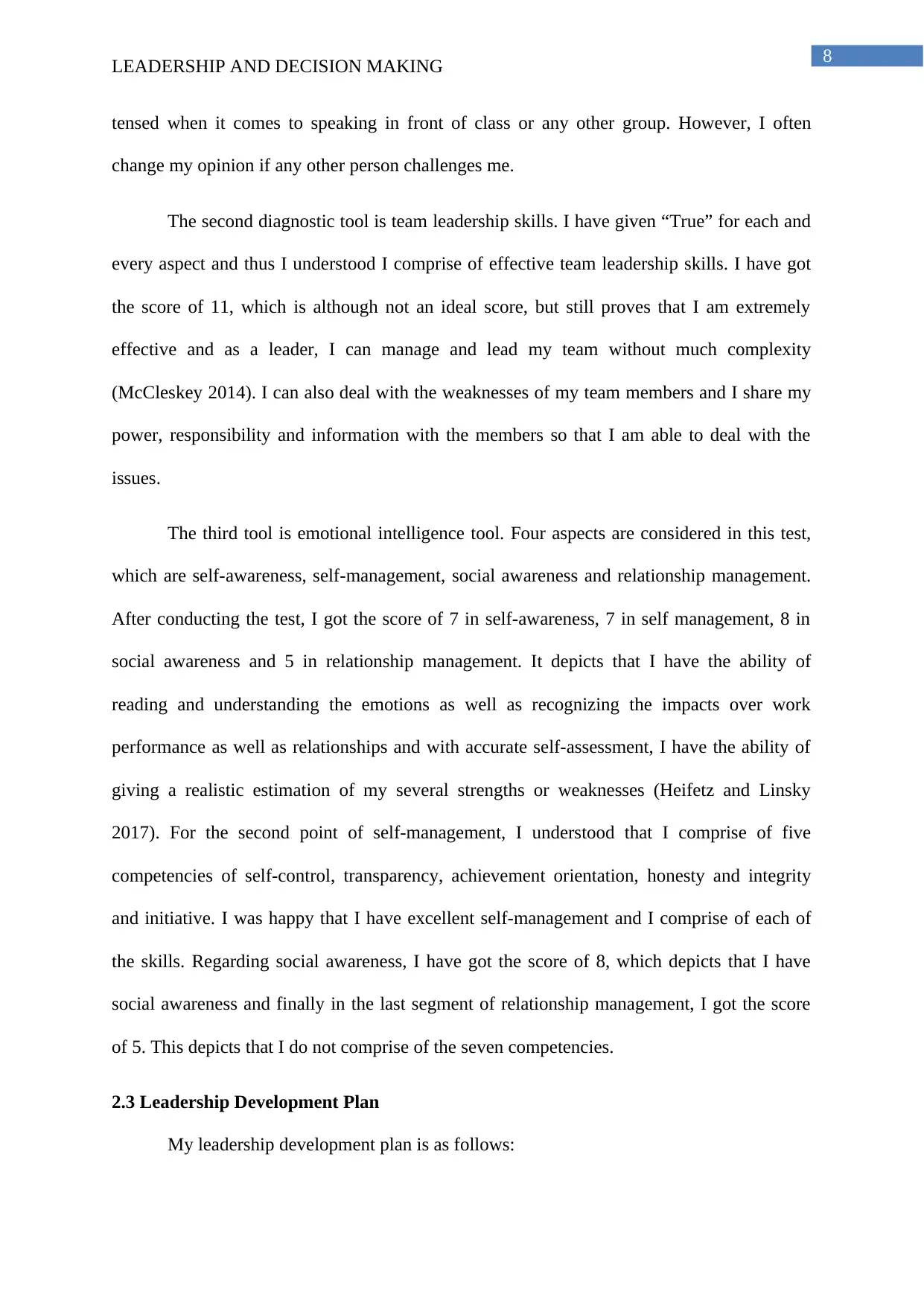
tensed when it comes to speaking in front of class or any other group. However, I often
change my opinion if any other person challenges me.
The second diagnostic tool is team leadership skills. I have given “True” for each and
every aspect and thus I understood I comprise of effective team leadership skills. I have got
the score of 11, which is although not an ideal score, but still proves that I am extremely
effective and as a leader, I can manage and lead my team without much complexity
(McCleskey 2014). I can also deal with the weaknesses of my team members and I share my
power, responsibility and information with the members so that I am able to deal with the
issues.
The third tool is emotional intelligence tool. Four aspects are considered in this test,
which are self-awareness, self-management, social awareness and relationship management.
After conducting the test, I got the score of 7 in self-awareness, 7 in self management, 8 in
social awareness and 5 in relationship management. It depicts that I have the ability of
reading and understanding the emotions as well as recognizing the impacts over work
performance as well as relationships and with accurate self-assessment, I have the ability of
giving a realistic estimation of my several strengths or weaknesses (Heifetz and Linsky
2017). For the second point of self-management, I understood that I comprise of five
competencies of self-control, transparency, achievement orientation, honesty and integrity
and initiative. I was happy that I have excellent self-management and I comprise of each of
the skills. Regarding social awareness, I have got the score of 8, which depicts that I have
social awareness and finally in the last segment of relationship management, I got the score
of 5. This depicts that I do not comprise of the seven competencies.
2.3 Leadership Development Plan
My leadership development plan is as follows:
LEADERSHIP AND DECISION MAKING
tensed when it comes to speaking in front of class or any other group. However, I often
change my opinion if any other person challenges me.
The second diagnostic tool is team leadership skills. I have given “True” for each and
every aspect and thus I understood I comprise of effective team leadership skills. I have got
the score of 11, which is although not an ideal score, but still proves that I am extremely
effective and as a leader, I can manage and lead my team without much complexity
(McCleskey 2014). I can also deal with the weaknesses of my team members and I share my
power, responsibility and information with the members so that I am able to deal with the
issues.
The third tool is emotional intelligence tool. Four aspects are considered in this test,
which are self-awareness, self-management, social awareness and relationship management.
After conducting the test, I got the score of 7 in self-awareness, 7 in self management, 8 in
social awareness and 5 in relationship management. It depicts that I have the ability of
reading and understanding the emotions as well as recognizing the impacts over work
performance as well as relationships and with accurate self-assessment, I have the ability of
giving a realistic estimation of my several strengths or weaknesses (Heifetz and Linsky
2017). For the second point of self-management, I understood that I comprise of five
competencies of self-control, transparency, achievement orientation, honesty and integrity
and initiative. I was happy that I have excellent self-management and I comprise of each of
the skills. Regarding social awareness, I have got the score of 8, which depicts that I have
social awareness and finally in the last segment of relationship management, I got the score
of 5. This depicts that I do not comprise of the seven competencies.
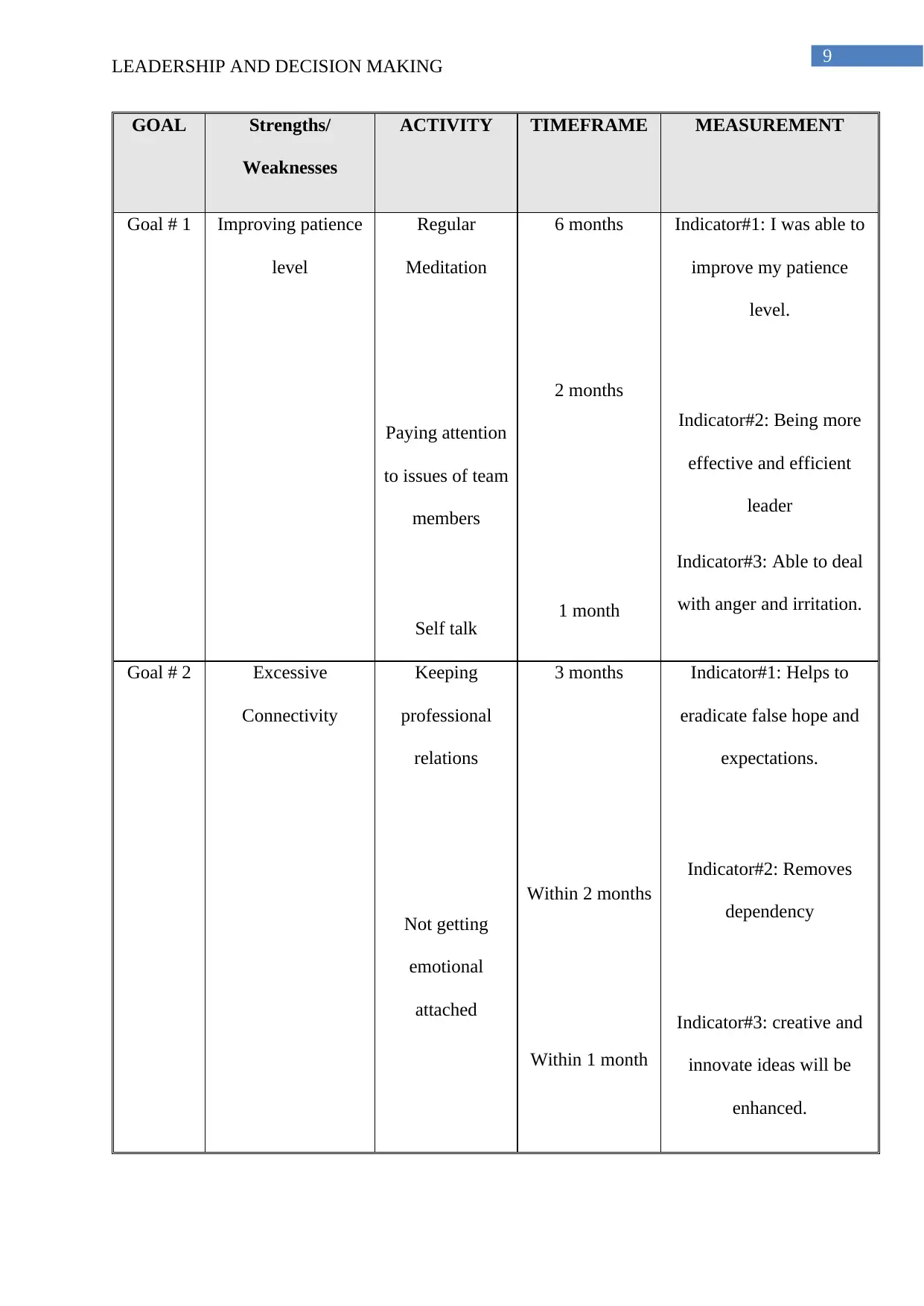
2.3 Leadership Development Plan
My leadership development plan is as follows:
⊘ This is a preview!⊘
Do you want full access?
Subscribe today to unlock all pages.
Trusted by 1+ million students worldwide
9
LEADERSHIP AND DECISION MAKING
GOAL Strengths/
Weaknesses
ACTIVITY TIMEFRAME MEASUREMENT
Goal # 1 Improving patience
level
Regular
Meditation
Paying attention
to issues of team
members
Self talk
6 months
2 months
1 month
Indicator#1: I was able to
improve my patience
level.
Indicator#2: Being more
effective and efficient
leader
Indicator#3: Able to deal
with anger and irritation.
Goal # 2 Excessive
Connectivity
Keeping
professional
relations
Not getting
emotional
attached
3 months
Within 2 months
Within 1 month
Indicator#1: Helps to
eradicate false hope and
expectations.
Indicator#2: Removes
dependency
Indicator#3: creative and
innovate ideas will be
enhanced.
LEADERSHIP AND DECISION MAKING
GOAL Strengths/
Weaknesses
ACTIVITY TIMEFRAME MEASUREMENT
Goal # 1 Improving patience
level
Regular
Meditation
Paying attention
to issues of team
members
Self talk
6 months
2 months
1 month
Indicator#1: I was able to
improve my patience
level.
Indicator#2: Being more
effective and efficient
leader
Indicator#3: Able to deal
with anger and irritation.
Goal # 2 Excessive
Connectivity
Keeping
professional
relations
Not getting
emotional
attached
3 months
Within 2 months
Within 1 month
Indicator#1: Helps to
eradicate false hope and
expectations.
Indicator#2: Removes
dependency
Indicator#3: creative and
innovate ideas will be
enhanced.
Paraphrase This Document
Need a fresh take? Get an instant paraphrase of this document with our AI Paraphraser
10
LEADERSHIP AND DECISION MAKING
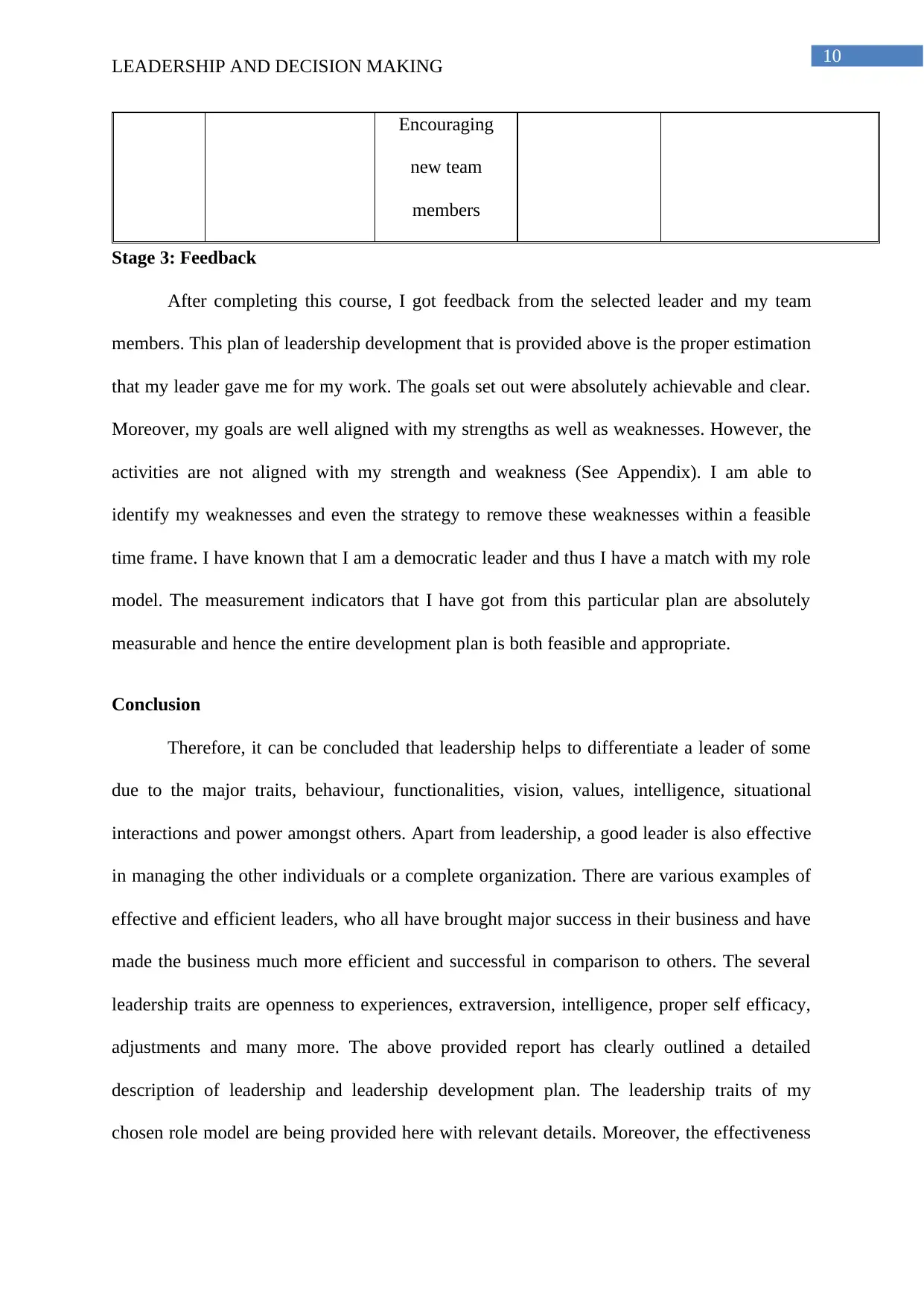
Encouraging
new team
members
Stage 3: Feedback
After completing this course, I got feedback from the selected leader and my team
members. This plan of leadership development that is provided above is the proper estimation
that my leader gave me for my work. The goals set out were absolutely achievable and clear.
Moreover, my goals are well aligned with my strengths as well as weaknesses. However, the
activities are not aligned with my strength and weakness (See Appendix). I am able to
identify my weaknesses and even the strategy to remove these weaknesses within a feasible
time frame. I have known that I am a democratic leader and thus I have a match with my role
model. The measurement indicators that I have got from this particular plan are absolutely
measurable and hence the entire development plan is both feasible and appropriate.
Conclusion
Therefore, it can be concluded that leadership helps to differentiate a leader of some
due to the major traits, behaviour, functionalities, vision, values, intelligence, situational
interactions and power amongst others. Apart from leadership, a good leader is also effective
in managing the other individuals or a complete organization. There are various examples of
effective and efficient leaders, who all have brought major success in their business and have
made the business much more efficient and successful in comparison to others. The several
leadership traits are openness to experiences, extraversion, intelligence, proper self efficacy,
adjustments and many more. The above provided report has clearly outlined a detailed
description of leadership and leadership development plan. The leadership traits of my
chosen role model are being provided here with relevant details. Moreover, the effectiveness
LEADERSHIP AND DECISION MAKING
Encouraging
new team
members
Stage 3: Feedback
After completing this course, I got feedback from the selected leader and my team
members. This plan of leadership development that is provided above is the proper estimation
that my leader gave me for my work. The goals set out were absolutely achievable and clear.
Moreover, my goals are well aligned with my strengths as well as weaknesses. However, the
activities are not aligned with my strength and weakness (See Appendix). I am able to
identify my weaknesses and even the strategy to remove these weaknesses within a feasible
time frame. I have known that I am a democratic leader and thus I have a match with my role
model. The measurement indicators that I have got from this particular plan are absolutely
measurable and hence the entire development plan is both feasible and appropriate.
Conclusion
Therefore, it can be concluded that leadership helps to differentiate a leader of some
due to the major traits, behaviour, functionalities, vision, values, intelligence, situational
interactions and power amongst others. Apart from leadership, a good leader is also effective
in managing the other individuals or a complete organization. There are various examples of
effective and efficient leaders, who all have brought major success in their business and have
made the business much more efficient and successful in comparison to others. The several
leadership traits are openness to experiences, extraversion, intelligence, proper self efficacy,
adjustments and many more. The above provided report has clearly outlined a detailed
description of leadership and leadership development plan. The leadership traits of my
chosen role model are being provided here with relevant details. Moreover, the effectiveness
11
LEADERSHIP AND DECISION MAKING
of leadership is also described here and even the effects of these traits on other individuals are
provided in this report with major details.
LEADERSHIP AND DECISION MAKING
of leadership is also described here and even the effects of these traits on other individuals are
provided in this report with major details.
⊘ This is a preview!⊘
Do you want full access?
Subscribe today to unlock all pages.
Trusted by 1+ million students worldwide

1 out of 16


Related Documents


Your All-in-One AI-Powered Toolkit for Academic Success.
+13062052269
info@desklib.com
Available 24*7 on WhatsApp / Email
![[object Object]](/_next/static/media/star-bottom.7253800d.svg)
Unlock your academic potential
Copyright © 2020–2026 A2Z Services. All Rights Reserved. Developed and managed by ZUCOL.