Cultural Intelligence Toolkit for Leadership Development Analysis
VerifiedAdded on 2023/06/04
|3
|936
|491
Report
AI Summary
This report presents a critical incident analysis using the cultural intelligence toolkit to explore personal competencies and leadership development. The incident involves a communication barrier during a group discussion where team members from Spain communicated in Spanish, excluding others. The author reflects on their initial reaction and subsequent attempt to facilitate inclusive communication by suggesting written notes. The analysis connects the author's behavior to the MCI Personal Competencies Model, highlighting ethical conduct and respect for others. The report further discusses how the author will use this learning to foster teamwork, manage conflicts, and encourage innovation as a future leader, emphasizing the importance of integrity and providing resources for team creativity, referencing relevant literature to support these points.
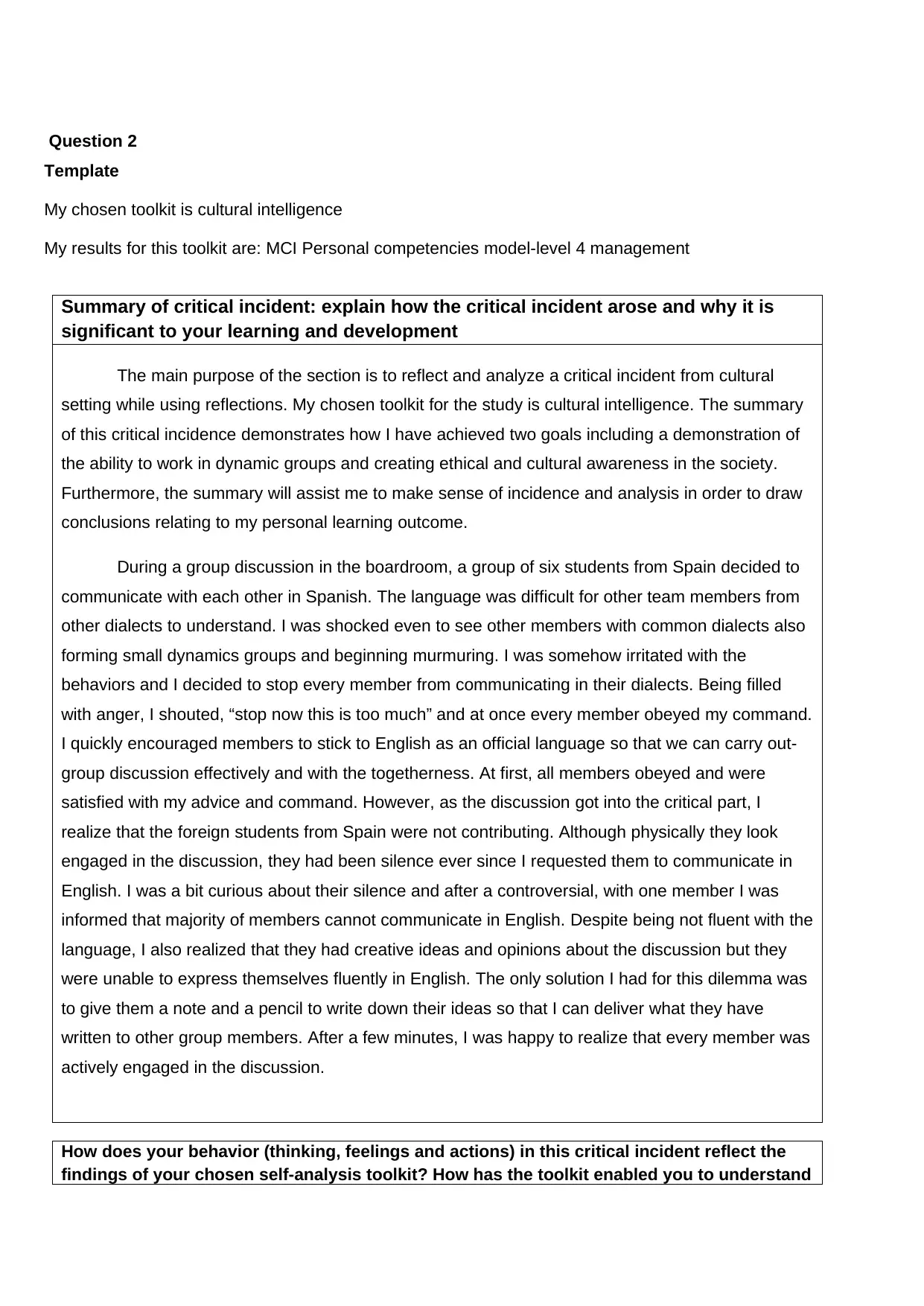
Question 2
Template
My chosen toolkit is cultural intelligence
My results for this toolkit are: MCI Personal competencies model-level 4 management
Summary of critical incident: explain how the critical incident arose and why it is
significant to your learning and development
The main purpose of the section is to reflect and analyze a critical incident from cultural
setting while using reflections. My chosen toolkit for the study is cultural intelligence. The summary
of this critical incidence demonstrates how I have achieved two goals including a demonstration of
the ability to work in dynamic groups and creating ethical and cultural awareness in the society.
Furthermore, the summary will assist me to make sense of incidence and analysis in order to draw
conclusions relating to my personal learning outcome.
During a group discussion in the boardroom, a group of six students from Spain decided to
communicate with each other in Spanish. The language was difficult for other team members from
other dialects to understand. I was shocked even to see other members with common dialects also
forming small dynamics groups and beginning murmuring. I was somehow irritated with the
behaviors and I decided to stop every member from communicating in their dialects. Being filled
with anger, I shouted, “stop now this is too much” and at once every member obeyed my command.
I quickly encouraged members to stick to English as an official language so that we can carry out-
group discussion effectively and with the togetherness. At first, all members obeyed and were
satisfied with my advice and command. However, as the discussion got into the critical part, I
realize that the foreign students from Spain were not contributing. Although physically they look
engaged in the discussion, they had been silence ever since I requested them to communicate in
English. I was a bit curious about their silence and after a controversial, with one member I was
informed that majority of members cannot communicate in English. Despite being not fluent with the
language, I also realized that they had creative ideas and opinions about the discussion but they
were unable to express themselves fluently in English. The only solution I had for this dilemma was
to give them a note and a pencil to write down their ideas so that I can deliver what they have
written to other group members. After a few minutes, I was happy to realize that every member was
actively engaged in the discussion.
How does your behavior (thinking, feelings and actions) in this critical incident reflect the
findings of your chosen self-analysis toolkit? How has the toolkit enabled you to understand
Template
My chosen toolkit is cultural intelligence
My results for this toolkit are: MCI Personal competencies model-level 4 management
Summary of critical incident: explain how the critical incident arose and why it is
significant to your learning and development
The main purpose of the section is to reflect and analyze a critical incident from cultural
setting while using reflections. My chosen toolkit for the study is cultural intelligence. The summary
of this critical incidence demonstrates how I have achieved two goals including a demonstration of
the ability to work in dynamic groups and creating ethical and cultural awareness in the society.
Furthermore, the summary will assist me to make sense of incidence and analysis in order to draw
conclusions relating to my personal learning outcome.
During a group discussion in the boardroom, a group of six students from Spain decided to
communicate with each other in Spanish. The language was difficult for other team members from
other dialects to understand. I was shocked even to see other members with common dialects also
forming small dynamics groups and beginning murmuring. I was somehow irritated with the
behaviors and I decided to stop every member from communicating in their dialects. Being filled
with anger, I shouted, “stop now this is too much” and at once every member obeyed my command.
I quickly encouraged members to stick to English as an official language so that we can carry out-
group discussion effectively and with the togetherness. At first, all members obeyed and were
satisfied with my advice and command. However, as the discussion got into the critical part, I
realize that the foreign students from Spain were not contributing. Although physically they look
engaged in the discussion, they had been silence ever since I requested them to communicate in
English. I was a bit curious about their silence and after a controversial, with one member I was
informed that majority of members cannot communicate in English. Despite being not fluent with the
language, I also realized that they had creative ideas and opinions about the discussion but they
were unable to express themselves fluently in English. The only solution I had for this dilemma was
to give them a note and a pencil to write down their ideas so that I can deliver what they have
written to other group members. After a few minutes, I was happy to realize that every member was
actively engaged in the discussion.
How does your behavior (thinking, feelings and actions) in this critical incident reflect the
findings of your chosen self-analysis toolkit? How has the toolkit enabled you to understand
Paraphrase This Document
Need a fresh take? Get an instant paraphrase of this document with our AI Paraphraser

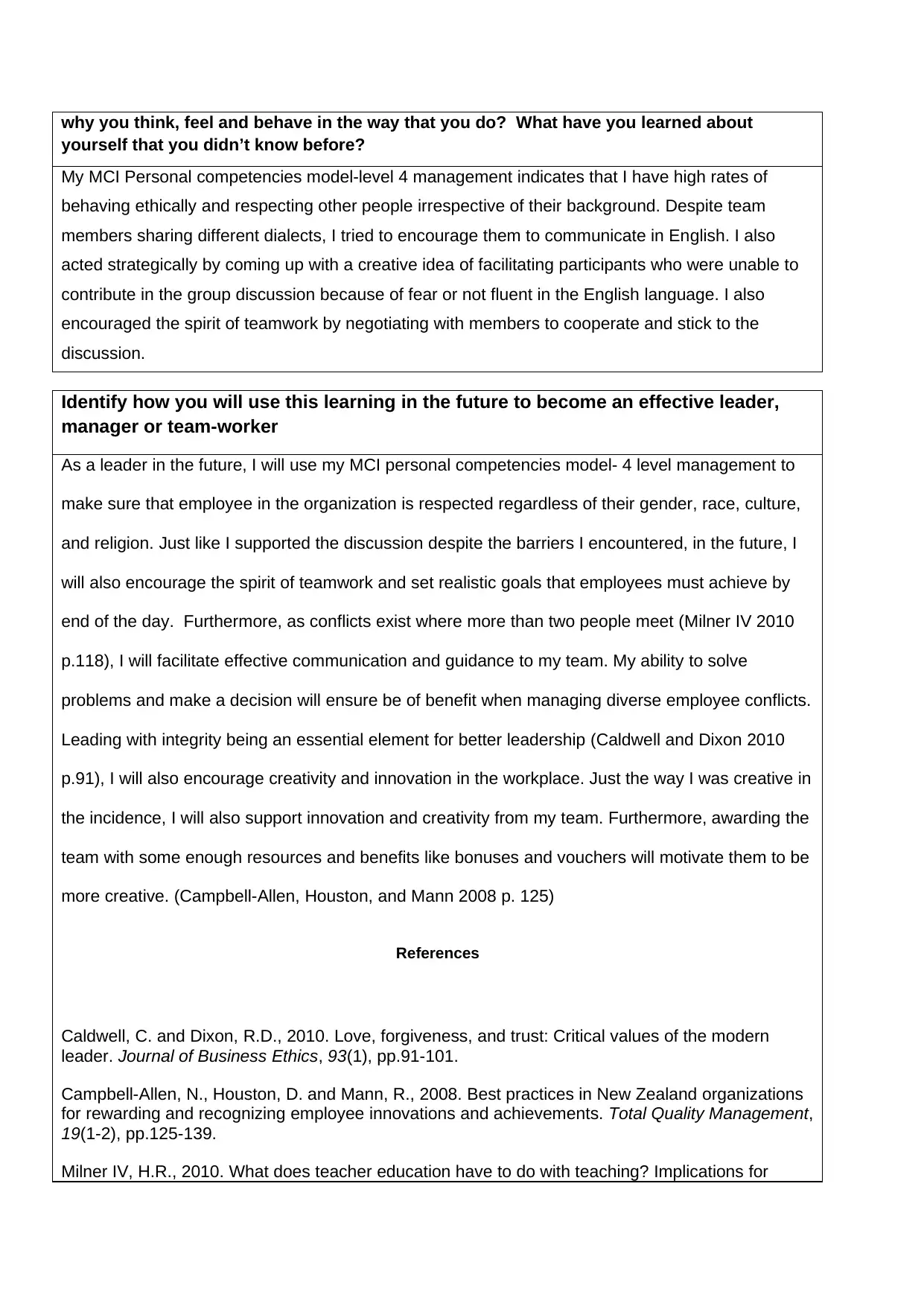
why you think, feel and behave in the way that you do? What have you learned about
yourself that you didn’t know before?
My MCI Personal competencies model-level 4 management indicates that I have high rates of
behaving ethically and respecting other people irrespective of their background. Despite team
members sharing different dialects, I tried to encourage them to communicate in English. I also
acted strategically by coming up with a creative idea of facilitating participants who were unable to
contribute in the group discussion because of fear or not fluent in the English language. I also
encouraged the spirit of teamwork by negotiating with members to cooperate and stick to the
discussion.
Identify how you will use this learning in the future to become an effective leader,
manager or team-worker
As a leader in the future, I will use my MCI personal competencies model- 4 level management to
make sure that employee in the organization is respected regardless of their gender, race, culture,
and religion. Just like I supported the discussion despite the barriers I encountered, in the future, I
will also encourage the spirit of teamwork and set realistic goals that employees must achieve by
end of the day. Furthermore, as conflicts exist where more than two people meet (Milner IV 2010
p.118), I will facilitate effective communication and guidance to my team. My ability to solve
problems and make a decision will ensure be of benefit when managing diverse employee conflicts.
Leading with integrity being an essential element for better leadership (Caldwell and Dixon 2010
p.91), I will also encourage creativity and innovation in the workplace. Just the way I was creative in
the incidence, I will also support innovation and creativity from my team. Furthermore, awarding the
team with some enough resources and benefits like bonuses and vouchers will motivate them to be
more creative. (Campbell-Allen, Houston, and Mann 2008 p. 125)
References
Caldwell, C. and Dixon, R.D., 2010. Love, forgiveness, and trust: Critical values of the modern
leader. Journal of Business Ethics, 93(1), pp.91-101.
Campbell-Allen, N., Houston, D. and Mann, R., 2008. Best practices in New Zealand organizations
for rewarding and recognizing employee innovations and achievements. Total Quality Management,
19(1-2), pp.125-139.
Milner IV, H.R., 2010. What does teacher education have to do with teaching? Implications for
yourself that you didn’t know before?
My MCI Personal competencies model-level 4 management indicates that I have high rates of
behaving ethically and respecting other people irrespective of their background. Despite team
members sharing different dialects, I tried to encourage them to communicate in English. I also
acted strategically by coming up with a creative idea of facilitating participants who were unable to
contribute in the group discussion because of fear or not fluent in the English language. I also
encouraged the spirit of teamwork by negotiating with members to cooperate and stick to the
discussion.
Identify how you will use this learning in the future to become an effective leader,
manager or team-worker
As a leader in the future, I will use my MCI personal competencies model- 4 level management to
make sure that employee in the organization is respected regardless of their gender, race, culture,
and religion. Just like I supported the discussion despite the barriers I encountered, in the future, I
will also encourage the spirit of teamwork and set realistic goals that employees must achieve by
end of the day. Furthermore, as conflicts exist where more than two people meet (Milner IV 2010
p.118), I will facilitate effective communication and guidance to my team. My ability to solve
problems and make a decision will ensure be of benefit when managing diverse employee conflicts.
Leading with integrity being an essential element for better leadership (Caldwell and Dixon 2010
p.91), I will also encourage creativity and innovation in the workplace. Just the way I was creative in
the incidence, I will also support innovation and creativity from my team. Furthermore, awarding the
team with some enough resources and benefits like bonuses and vouchers will motivate them to be
more creative. (Campbell-Allen, Houston, and Mann 2008 p. 125)
References
Caldwell, C. and Dixon, R.D., 2010. Love, forgiveness, and trust: Critical values of the modern
leader. Journal of Business Ethics, 93(1), pp.91-101.
Campbell-Allen, N., Houston, D. and Mann, R., 2008. Best practices in New Zealand organizations
for rewarding and recognizing employee innovations and achievements. Total Quality Management,
19(1-2), pp.125-139.
Milner IV, H.R., 2010. What does teacher education have to do with teaching? Implications for

diversity studies. Journal of Teacher Education, 61(1-2), pp.118-131.
⊘ This is a preview!⊘
Do you want full access?
Subscribe today to unlock all pages.

Trusted by 1+ million students worldwide
1 out of 3
Related Documents
Your All-in-One AI-Powered Toolkit for Academic Success.
+13062052269
info@desklib.com
Available 24*7 on WhatsApp / Email
Unlock your academic potential
Copyright © 2020–2025 A2Z Services. All Rights Reserved. Developed and managed by ZUCOL.