Leadership Reflection Journal: Analyzing Leadership Practices
VerifiedAdded on 2022/12/30
|12
|2844
|310
Journal and Reflective Writing
AI Summary
This leadership reflection journal provides a comprehensive exploration of leadership concepts, styles, and practices within an organizational context. The journal delves into various aspects of leadership, including the impact of globalization on businesses, the importance of decision-making, and the influence of different leadership styles such as transformational and ethical leadership. It examines the significance of authentic leadership, positive leadership qualities, and the challenges of managing a diverse workforce. The journal also discusses the role of leaders in non-profit organizations and the importance of adapting to change. Through weekly reflections, the author analyzes personal experiences, explores leadership theories, and addresses relevant questions related to leadership development, providing insights into the complexities of influencing employees and achieving organizational goals. The document also includes references to support the analysis and findings.
Running Head: LEADERSHIP REFLECTION
LEADERSHIP REFLECTION
Name of the Student:
Name of University:
Author Note:
LEADERSHIP REFLECTION
Name of the Student:
Name of University:
Author Note:

Paraphrase This Document
Need a fresh take? Get an instant paraphrase of this document with our AI Paraphraser
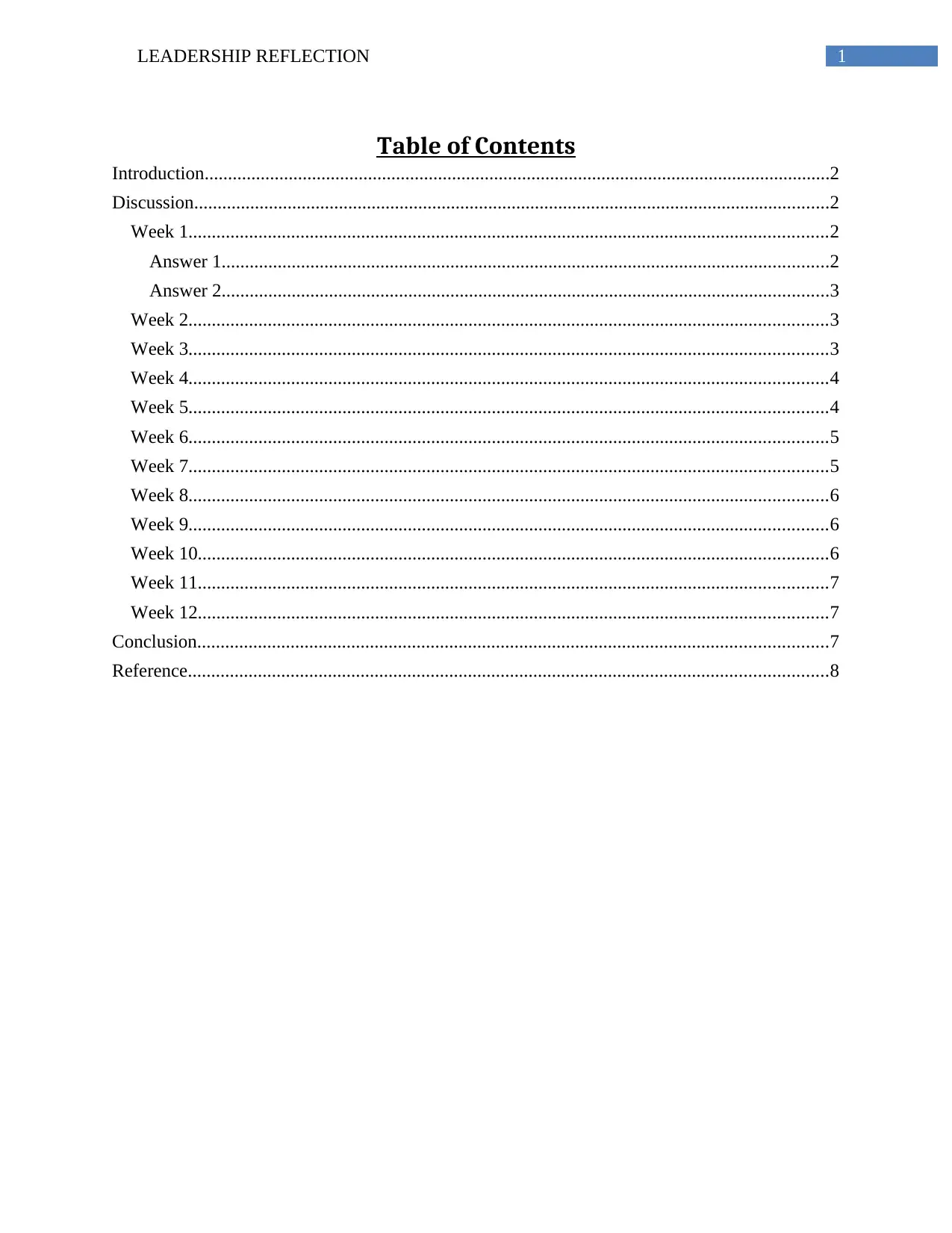
1LEADERSHIP REFLECTION
Table of Contents
Introduction......................................................................................................................................2
Discussion........................................................................................................................................2
Week 1.........................................................................................................................................2
Answer 1..................................................................................................................................2
Answer 2..................................................................................................................................3
Week 2.........................................................................................................................................3
Week 3.........................................................................................................................................3
Week 4.........................................................................................................................................4
Week 5.........................................................................................................................................4
Week 6.........................................................................................................................................5
Week 7.........................................................................................................................................5
Week 8.........................................................................................................................................6
Week 9.........................................................................................................................................6
Week 10.......................................................................................................................................6
Week 11.......................................................................................................................................7
Week 12.......................................................................................................................................7
Conclusion.......................................................................................................................................7
Reference.........................................................................................................................................8
Table of Contents
Introduction......................................................................................................................................2
Discussion........................................................................................................................................2
Week 1.........................................................................................................................................2
Answer 1..................................................................................................................................2
Answer 2..................................................................................................................................3
Week 2.........................................................................................................................................3
Week 3.........................................................................................................................................3
Week 4.........................................................................................................................................4
Week 5.........................................................................................................................................4
Week 6.........................................................................................................................................5
Week 7.........................................................................................................................................5
Week 8.........................................................................................................................................6
Week 9.........................................................................................................................................6
Week 10.......................................................................................................................................6
Week 11.......................................................................................................................................7
Week 12.......................................................................................................................................7
Conclusion.......................................................................................................................................7
Reference.........................................................................................................................................8
2LEADERSHIP REFLECTION
Introduction
Leadership is considered to be one of the major aspect nowadays that is associated with
the practice of guidance and fulfil the objectives in personal development and in profession as
well. As a result of that it is important to get insights into the practice of leadership in
organisation and facilitate a clear perception regarding different aspects and attributes of
leadership. Moreover, it can be stated that leadership is an important part of success that
connotes better practices and elucidates the desired behaviour so that it will create a proper and
better development as a person and a professional entity. In this regard, this reflective journal is
trying to highlight the notion of leadership and intends to find out the desired measures that are
inclined to usher a healthy and strategic development for a person. In fact, the report also cares to
answer the questions highlighted in the weekly module that can help to understand different
characteristics of leadership in family and organisation.
Discussion
Week 1
Answer 1
In my opinion, the advent of globalisation transforms the exposure of the business
organisations to a great extent and increase the dimension of the global business organisations to
a rapid scale. Uusi-Kakkuri and Brandt (2015) opined that globalisation developed intense
competition among the business organisations both in the domestic and global level that
escalated the importance of organisational objectives and visions. Moreover, the customers
become aware of the ethical and sustainable business practice due to the role of the companies in
Introduction
Leadership is considered to be one of the major aspect nowadays that is associated with
the practice of guidance and fulfil the objectives in personal development and in profession as
well. As a result of that it is important to get insights into the practice of leadership in
organisation and facilitate a clear perception regarding different aspects and attributes of
leadership. Moreover, it can be stated that leadership is an important part of success that
connotes better practices and elucidates the desired behaviour so that it will create a proper and
better development as a person and a professional entity. In this regard, this reflective journal is
trying to highlight the notion of leadership and intends to find out the desired measures that are
inclined to usher a healthy and strategic development for a person. In fact, the report also cares to
answer the questions highlighted in the weekly module that can help to understand different
characteristics of leadership in family and organisation.
Discussion
Week 1
Answer 1
In my opinion, the advent of globalisation transforms the exposure of the business
organisations to a great extent and increase the dimension of the global business organisations to
a rapid scale. Uusi-Kakkuri and Brandt (2015) opined that globalisation developed intense
competition among the business organisations both in the domestic and global level that
escalated the importance of organisational objectives and visions. Moreover, the customers
become aware of the ethical and sustainable business practice due to the role of the companies in
⊘ This is a preview!⊘
Do you want full access?
Subscribe today to unlock all pages.

Trusted by 1+ million students worldwide
3LEADERSHIP REFLECTION
damaging the environment. Therefore, it requires the help of a leader who can guide people to
resolve issues.
Answer 2
I presume that in my organisation the employees become more sensitive about their own
interests and expect from the organisation to meet their demands as far as possible. Offermann,
Kennedy and Wirtz (1994) argued that the change in the behaviour of the employees is also a
major phenomenon in current business practice. Therefore, as a leader it is my responsibility to
ensure the safety of the employees interests and assure them to fulfil most of their demands so
that they will highly be motivated and maximise the proficiency in business.
Week 2
Decision making is part and parcel of leadership that develops an understanding related
to the efficacy of the leader in a complex situation. Since time immemorial we are facing
problems in decision making. However, the context and types of the problems are different from
each other but the situation of crisis is remained the same where the leaders in society or
organisation have to take all the important decision making (Nicholson, 2013). Based on the
understanding of Maak, Pless and Voegtlin (2016) I may assume that the nature and power of the
leaders in course of establishing a better practice in decision making resembled with impartiality
and transparency. The ancestors are also helped in this regard in order to influence the employees
to take adequate measures.
Week 3
As far as my organisation is concerned, the leadership practice is generally associated
with the collective practices. It means the senior executive or the CEO is the leader of the
damaging the environment. Therefore, it requires the help of a leader who can guide people to
resolve issues.
Answer 2
I presume that in my organisation the employees become more sensitive about their own
interests and expect from the organisation to meet their demands as far as possible. Offermann,
Kennedy and Wirtz (1994) argued that the change in the behaviour of the employees is also a
major phenomenon in current business practice. Therefore, as a leader it is my responsibility to
ensure the safety of the employees interests and assure them to fulfil most of their demands so
that they will highly be motivated and maximise the proficiency in business.
Week 2
Decision making is part and parcel of leadership that develops an understanding related
to the efficacy of the leader in a complex situation. Since time immemorial we are facing
problems in decision making. However, the context and types of the problems are different from
each other but the situation of crisis is remained the same where the leaders in society or
organisation have to take all the important decision making (Nicholson, 2013). Based on the
understanding of Maak, Pless and Voegtlin (2016) I may assume that the nature and power of the
leaders in course of establishing a better practice in decision making resembled with impartiality
and transparency. The ancestors are also helped in this regard in order to influence the employees
to take adequate measures.
Week 3
As far as my organisation is concerned, the leadership practice is generally associated
with the collective practices. It means the senior executive or the CEO is the leader of the
Paraphrase This Document
Need a fresh take? Get an instant paraphrase of this document with our AI Paraphraser
4LEADERSHIP REFLECTION
organisation and the managers are following the path of the CEO. However, the CEO is putting a
great deal of focus on the collective vision that copes with the objectives of the organisation and
also fulfil the interests of the employees. Overall (2015) opined that it is essential for the
corporate enterprises to harness the interests of the organisation and the employees. From the
research of Bass (1999) I can presume that both the reward power and the legitimate power are
played simultaneously for the leadership practice in my organisation that paves the way for a
controlled and well-designed organisational leadership.
Week 4
There is a stereotype among people about the notion and paradigm of leadership and its
characteristics. In this regard, the most popular stereotype is resembled with the Great man
theory where the belief underlines the natural birth of the leaders. In this regard, different natures
of the leadership can be highlighted in terms of the non-hierarchical, rational and situational
(Kirkpatrick and Locke, 1991). Among those characters the situational leadership is identified as
the most significant nature of leadership that is entitled to establish an effective measure for the
benefit of organisation and personal development also. Thompson and Glasø (2015) stated that
the situation leadership is highly flexible to resolve the issues properly. Moreover, the addition of
emotional intelligence further helps to create a better practice for the leaders to enhance the
quality of awareness, control and management.
Week 5
As far as the ethical leadership is concerned, it can be stated that honesty and integrity are
the common factor of ethical leadership (Demirtas & Akdogan, 2015). For example, if the leader
of an organisation engage the employees into the decision making process and respect the
viewpoints of the employees then it can be stated that the leader is honest and tries to bring an
organisation and the managers are following the path of the CEO. However, the CEO is putting a
great deal of focus on the collective vision that copes with the objectives of the organisation and
also fulfil the interests of the employees. Overall (2015) opined that it is essential for the
corporate enterprises to harness the interests of the organisation and the employees. From the
research of Bass (1999) I can presume that both the reward power and the legitimate power are
played simultaneously for the leadership practice in my organisation that paves the way for a
controlled and well-designed organisational leadership.
Week 4
There is a stereotype among people about the notion and paradigm of leadership and its
characteristics. In this regard, the most popular stereotype is resembled with the Great man
theory where the belief underlines the natural birth of the leaders. In this regard, different natures
of the leadership can be highlighted in terms of the non-hierarchical, rational and situational
(Kirkpatrick and Locke, 1991). Among those characters the situational leadership is identified as
the most significant nature of leadership that is entitled to establish an effective measure for the
benefit of organisation and personal development also. Thompson and Glasø (2015) stated that
the situation leadership is highly flexible to resolve the issues properly. Moreover, the addition of
emotional intelligence further helps to create a better practice for the leaders to enhance the
quality of awareness, control and management.
Week 5
As far as the ethical leadership is concerned, it can be stated that honesty and integrity are
the common factor of ethical leadership (Demirtas & Akdogan, 2015). For example, if the leader
of an organisation engage the employees into the decision making process and respect the
viewpoints of the employees then it can be stated that the leader is honest and tries to bring an
5LEADERSHIP REFLECTION
integrity into the workforce of the entire organisation. On the other hand, having an opaque
practice in organisation where the employees are not informed adequately about the
organisations decision (Sarros & Santora, 2001). As a result of that it will generate a mistrust
among the employees towards the leadership approach.
Week 6
I can say that it is a privilege for me to have the experience of both male and female
leaders in my organisation. My first manager was a woman and most of my skills were
developed under her guidance. Therefore, I really thankful to her from the bottom of my heart.
However, my current manager is a male and he is more focused on the action rather than skill
development. I can say that there are some differences between the leadership of both of them. It
can be stated that the female manager was more like a transformational leader who put more
focus on the development of the employees (Burke & Collins, 2001). A transformational
leadership is associated with this nature where the leaders try to fulfil the interests of the
employees (Hoch et al., 2018). Therefore, difference in type and attributes can be identified in
different leader gender in my opinion.
Week 7
In my early professional days, I worked in a BPO and my organisation was firmly
resistant to change. Once, we got a crisis situation due to the business process and the company
was on the verge of huge financial loss. The senior management was suggested to change the
organisational environment but he refused to change the tradition (Muls et al., 2015). As a result
of that many of the employees terminated in order to cope with the annual revenue of the
organisation. Based on this Mohelska and Sokolova (2015) argued that resistant to change in
integrity into the workforce of the entire organisation. On the other hand, having an opaque
practice in organisation where the employees are not informed adequately about the
organisations decision (Sarros & Santora, 2001). As a result of that it will generate a mistrust
among the employees towards the leadership approach.
Week 6
I can say that it is a privilege for me to have the experience of both male and female
leaders in my organisation. My first manager was a woman and most of my skills were
developed under her guidance. Therefore, I really thankful to her from the bottom of my heart.
However, my current manager is a male and he is more focused on the action rather than skill
development. I can say that there are some differences between the leadership of both of them. It
can be stated that the female manager was more like a transformational leader who put more
focus on the development of the employees (Burke & Collins, 2001). A transformational
leadership is associated with this nature where the leaders try to fulfil the interests of the
employees (Hoch et al., 2018). Therefore, difference in type and attributes can be identified in
different leader gender in my opinion.
Week 7
In my early professional days, I worked in a BPO and my organisation was firmly
resistant to change. Once, we got a crisis situation due to the business process and the company
was on the verge of huge financial loss. The senior management was suggested to change the
organisational environment but he refused to change the tradition (Muls et al., 2015). As a result
of that many of the employees terminated in order to cope with the annual revenue of the
organisation. Based on this Mohelska and Sokolova (2015) argued that resistant to change in
⊘ This is a preview!⊘
Do you want full access?
Subscribe today to unlock all pages.
Trusted by 1+ million students worldwide
6LEADERSHIP REFLECTION
organisational culture was considered to be a serious threat for the SMEs. Moreover, the
resistance can create dissatisfaction among the employees.
Week 8
The positive leadership is resembled with the notions of self-efficacy, optimism, hope
and resilience (Luthans et al., 2007). In fact, the positive leaders are tried to be more pragmatic
and resourceful so that both the interests of the organisation and the followers will be fulfilled
(Barling, Akers & Beiko, 2018). Therefore, I would like to go with the positive leadership
qualities because apart from creating a positive working environment the positive leadership
practice creates a better proficiency and self-development.
Week 9
In my opinion, the most critical part of a manager is to manage diverse workforce. As
Hopkins and Scott (2016) opined that in the diverse workplace the manager has to keep in touch
with different cultures and set practices accordingly. For me it is really a challenge to understand
each of the culture and implement a universal measure for the employees. Moreover, Javidan et
al. (2006) articulated that the diverse workplace is the most critical part of an organisation.
Therefore, I feel more responsible as a leader to manager the human resource effectively.
Week 10
I want to deal with the educational and training practice and focus on the formal
management roles. It will help me to make better relation with the clients and employees in order
to enhance the efficacy of the organisation. It is important for the leaders to check their abilities
and enhance skills before influencing the team members (Dong et al., 2017). On the contrary,
organisational culture was considered to be a serious threat for the SMEs. Moreover, the
resistance can create dissatisfaction among the employees.
Week 8
The positive leadership is resembled with the notions of self-efficacy, optimism, hope
and resilience (Luthans et al., 2007). In fact, the positive leaders are tried to be more pragmatic
and resourceful so that both the interests of the organisation and the followers will be fulfilled
(Barling, Akers & Beiko, 2018). Therefore, I would like to go with the positive leadership
qualities because apart from creating a positive working environment the positive leadership
practice creates a better proficiency and self-development.
Week 9
In my opinion, the most critical part of a manager is to manage diverse workforce. As
Hopkins and Scott (2016) opined that in the diverse workplace the manager has to keep in touch
with different cultures and set practices accordingly. For me it is really a challenge to understand
each of the culture and implement a universal measure for the employees. Moreover, Javidan et
al. (2006) articulated that the diverse workplace is the most critical part of an organisation.
Therefore, I feel more responsible as a leader to manager the human resource effectively.
Week 10
I want to deal with the educational and training practice and focus on the formal
management roles. It will help me to make better relation with the clients and employees in order
to enhance the efficacy of the organisation. It is important for the leaders to check their abilities
and enhance skills before influencing the team members (Dong et al., 2017). On the contrary,
Paraphrase This Document
Need a fresh take? Get an instant paraphrase of this document with our AI Paraphraser
7LEADERSHIP REFLECTION
Huda et al. (2018) mentioned that evaluation is also important for the leaders. Therefore, I will
set a feedback form where the employees will put their comments.
Week 11
The role of the leaders in non-profit organisation are immensely complex and points out a
number of skills in terms of the leadership, decision making, conflict resolution and the
commitment to the clients (Ahmed, 2005). It will be an effective measure for the leaders to
create some practices that will develop more efficacy by putting a great deal of emphasis on the
values and ethics. O’Boyle, Shilbury and Ferkins (2019) argued that for the non-profit
organisations it is not important to earn profitability therefore shaping the organisational practice
ethically strong is a key point to focus.
Week 12
The authentic leadership qualities are considered to be the most important part for the
business organisations (Leroy et al., 2015). It is essential for the companies to establish an
authentic leadership with the help of the high morality, self-awareness and commitment to the
employees (Sendjaya et al., 2016). It is important for the corporate enterprises to follow
authentic leadership to get strategic advantage in highly competitive market.
Conclusion
The above discussion is trying to highlight different attributes of leadership and try to
figure out the risks and issues that contemporary leaders can face while influencing the
employees. Moreover, the report also discusses importance of the authentic leadership in
business in order to retain high performance.
Huda et al. (2018) mentioned that evaluation is also important for the leaders. Therefore, I will
set a feedback form where the employees will put their comments.
Week 11
The role of the leaders in non-profit organisation are immensely complex and points out a
number of skills in terms of the leadership, decision making, conflict resolution and the
commitment to the clients (Ahmed, 2005). It will be an effective measure for the leaders to
create some practices that will develop more efficacy by putting a great deal of emphasis on the
values and ethics. O’Boyle, Shilbury and Ferkins (2019) argued that for the non-profit
organisations it is not important to earn profitability therefore shaping the organisational practice
ethically strong is a key point to focus.
Week 12
The authentic leadership qualities are considered to be the most important part for the
business organisations (Leroy et al., 2015). It is essential for the companies to establish an
authentic leadership with the help of the high morality, self-awareness and commitment to the
employees (Sendjaya et al., 2016). It is important for the corporate enterprises to follow
authentic leadership to get strategic advantage in highly competitive market.
Conclusion
The above discussion is trying to highlight different attributes of leadership and try to
figure out the risks and issues that contemporary leaders can face while influencing the
employees. Moreover, the report also discusses importance of the authentic leadership in
business in order to retain high performance.
8LEADERSHIP REFLECTION
Reference
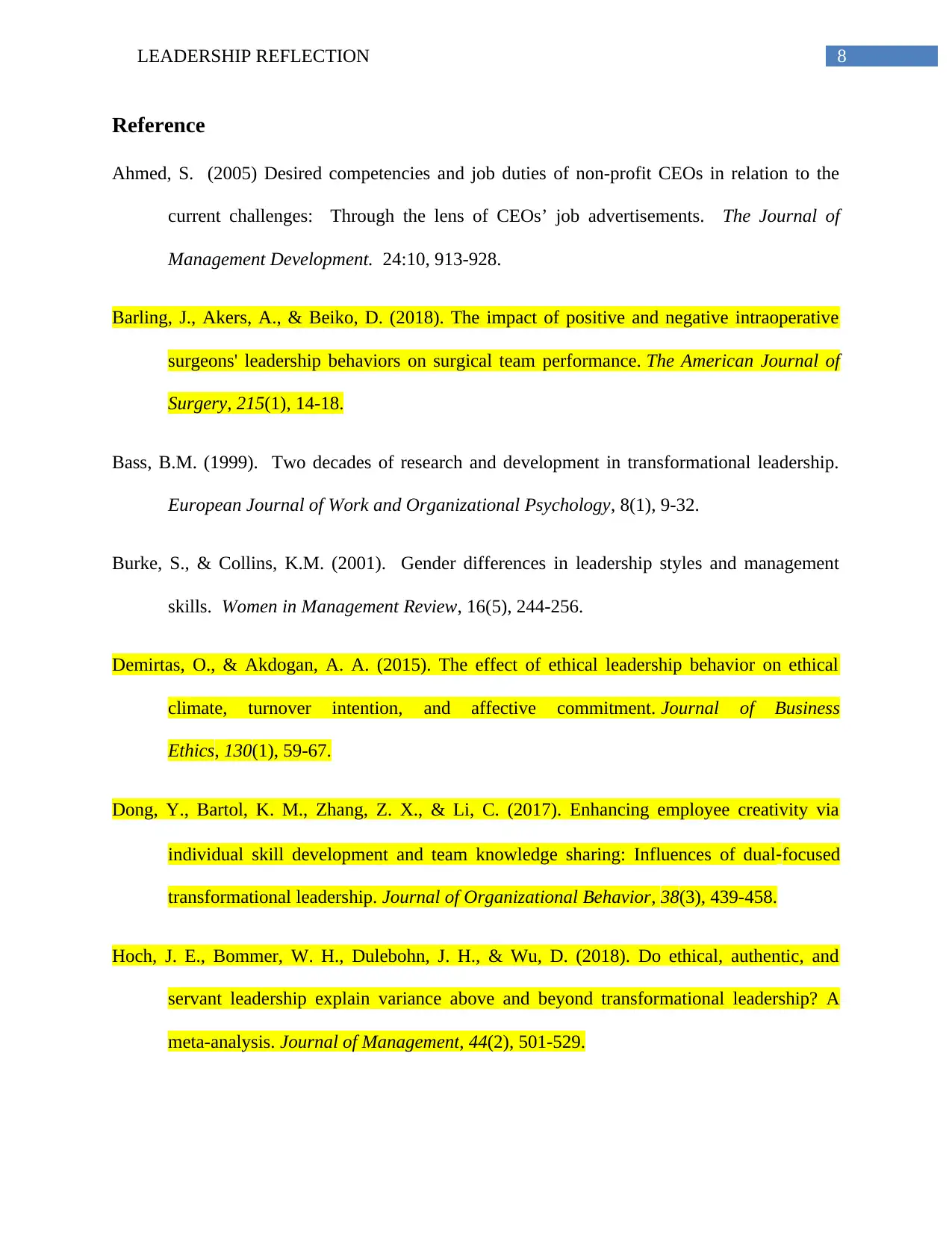
Ahmed, S. (2005) Desired competencies and job duties of non-profit CEOs in relation to the
current challenges: Through the lens of CEOs’ job advertisements. The Journal of
Management Development. 24:10, 913-928.
Barling, J., Akers, A., & Beiko, D. (2018). The impact of positive and negative intraoperative
surgeons' leadership behaviors on surgical team performance. The American Journal of
Surgery, 215(1), 14-18.
Bass, B.M. (1999). Two decades of research and development in transformational leadership.
European Journal of Work and Organizational Psychology, 8(1), 9-32.
Burke, S., & Collins, K.M. (2001). Gender differences in leadership styles and management
skills. Women in Management Review, 16(5), 244-256.
Demirtas, O., & Akdogan, A. A. (2015). The effect of ethical leadership behavior on ethical
climate, turnover intention, and affective commitment. Journal of Business
Ethics, 130(1), 59-67.
Dong, Y., Bartol, K. M., Zhang, Z. X., & Li, C. (2017). Enhancing employee creativity via
individual skill development and team knowledge sharing: Influences of dual‐focused
transformational leadership. Journal of Organizational Behavior, 38(3), 439-458.
Hoch, J. E., Bommer, W. H., Dulebohn, J. H., & Wu, D. (2018). Do ethical, authentic, and
servant leadership explain variance above and beyond transformational leadership? A
meta-analysis. Journal of Management, 44(2), 501-529.
Reference
Ahmed, S. (2005) Desired competencies and job duties of non-profit CEOs in relation to the
current challenges: Through the lens of CEOs’ job advertisements. The Journal of
Management Development. 24:10, 913-928.
Barling, J., Akers, A., & Beiko, D. (2018). The impact of positive and negative intraoperative
surgeons' leadership behaviors on surgical team performance. The American Journal of
Surgery, 215(1), 14-18.
Bass, B.M. (1999). Two decades of research and development in transformational leadership.
European Journal of Work and Organizational Psychology, 8(1), 9-32.
Burke, S., & Collins, K.M. (2001). Gender differences in leadership styles and management
skills. Women in Management Review, 16(5), 244-256.
Demirtas, O., & Akdogan, A. A. (2015). The effect of ethical leadership behavior on ethical
climate, turnover intention, and affective commitment. Journal of Business
Ethics, 130(1), 59-67.
Dong, Y., Bartol, K. M., Zhang, Z. X., & Li, C. (2017). Enhancing employee creativity via
individual skill development and team knowledge sharing: Influences of dual‐focused
transformational leadership. Journal of Organizational Behavior, 38(3), 439-458.
Hoch, J. E., Bommer, W. H., Dulebohn, J. H., & Wu, D. (2018). Do ethical, authentic, and
servant leadership explain variance above and beyond transformational leadership? A
meta-analysis. Journal of Management, 44(2), 501-529.
⊘ This is a preview!⊘
Do you want full access?
Subscribe today to unlock all pages.
Trusted by 1+ million students worldwide
9LEADERSHIP REFLECTION
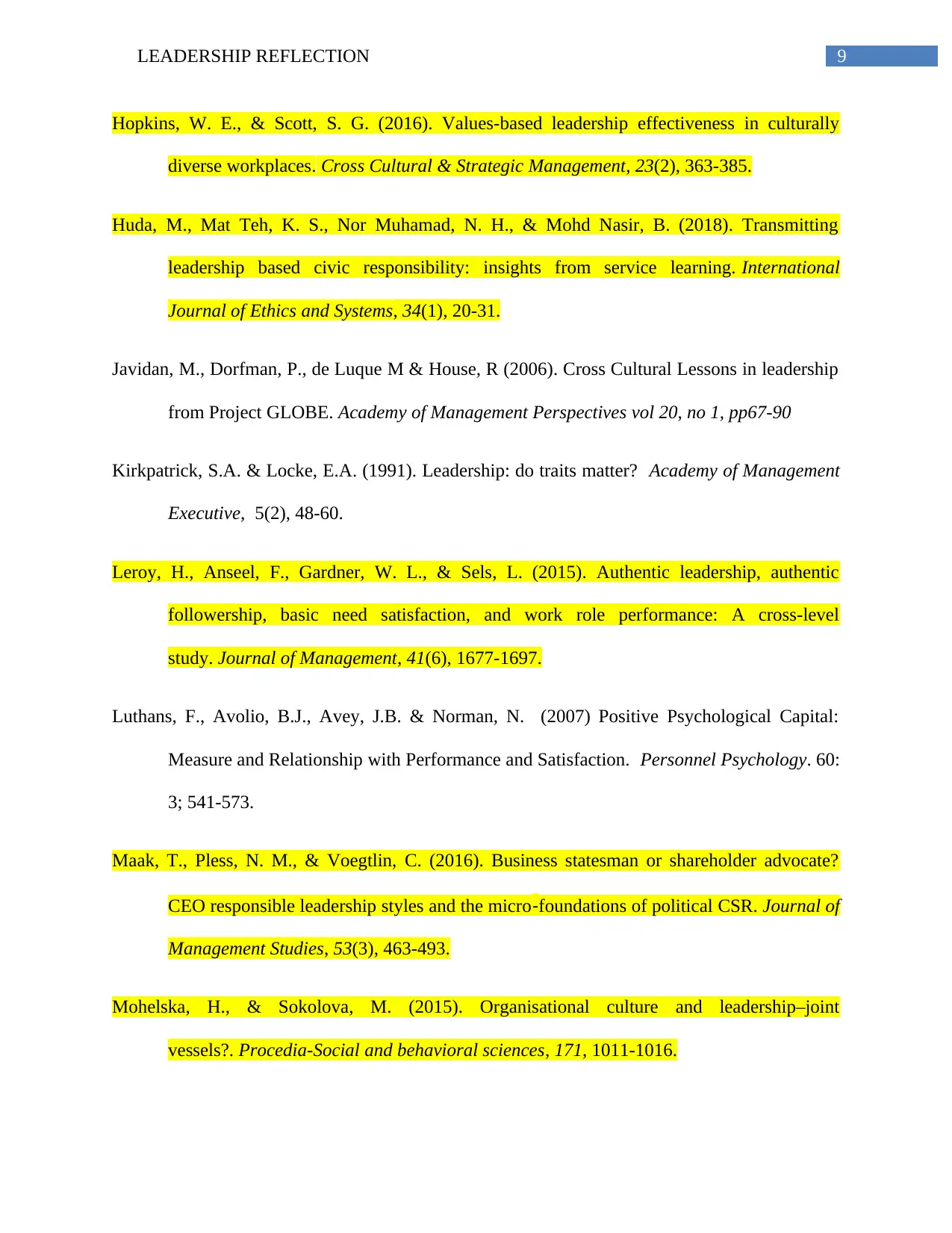
Hopkins, W. E., & Scott, S. G. (2016). Values-based leadership effectiveness in culturally
diverse workplaces. Cross Cultural & Strategic Management, 23(2), 363-385.
Huda, M., Mat Teh, K. S., Nor Muhamad, N. H., & Mohd Nasir, B. (2018). Transmitting
leadership based civic responsibility: insights from service learning. International
Journal of Ethics and Systems, 34(1), 20-31.
Javidan, M., Dorfman, P., de Luque M & House, R (2006). Cross Cultural Lessons in leadership
from Project GLOBE. Academy of Management Perspectives vol 20, no 1, pp67-90
Kirkpatrick, S.A. & Locke, E.A. (1991). Leadership: do traits matter? Academy of Management
Executive, 5(2), 48-60.
Leroy, H., Anseel, F., Gardner, W. L., & Sels, L. (2015). Authentic leadership, authentic
followership, basic need satisfaction, and work role performance: A cross-level
study. Journal of Management, 41(6), 1677-1697.
Luthans, F., Avolio, B.J., Avey, J.B. & Norman, N. (2007) Positive Psychological Capital:
Measure and Relationship with Performance and Satisfaction. Personnel Psychology. 60:
3; 541-573.
Maak, T., Pless, N. M., & Voegtlin, C. (2016). Business statesman or shareholder advocate?
CEO responsible leadership styles and the micro‐foundations of political CSR. Journal of
Management Studies, 53(3), 463-493.
Mohelska, H., & Sokolova, M. (2015). Organisational culture and leadership–joint
vessels?. Procedia-Social and behavioral sciences, 171, 1011-1016.
Hopkins, W. E., & Scott, S. G. (2016). Values-based leadership effectiveness in culturally
diverse workplaces. Cross Cultural & Strategic Management, 23(2), 363-385.
Huda, M., Mat Teh, K. S., Nor Muhamad, N. H., & Mohd Nasir, B. (2018). Transmitting
leadership based civic responsibility: insights from service learning. International
Journal of Ethics and Systems, 34(1), 20-31.
Javidan, M., Dorfman, P., de Luque M & House, R (2006). Cross Cultural Lessons in leadership
from Project GLOBE. Academy of Management Perspectives vol 20, no 1, pp67-90
Kirkpatrick, S.A. & Locke, E.A. (1991). Leadership: do traits matter? Academy of Management
Executive, 5(2), 48-60.
Leroy, H., Anseel, F., Gardner, W. L., & Sels, L. (2015). Authentic leadership, authentic
followership, basic need satisfaction, and work role performance: A cross-level
study. Journal of Management, 41(6), 1677-1697.
Luthans, F., Avolio, B.J., Avey, J.B. & Norman, N. (2007) Positive Psychological Capital:
Measure and Relationship with Performance and Satisfaction. Personnel Psychology. 60:
3; 541-573.
Maak, T., Pless, N. M., & Voegtlin, C. (2016). Business statesman or shareholder advocate?
CEO responsible leadership styles and the micro‐foundations of political CSR. Journal of
Management Studies, 53(3), 463-493.
Mohelska, H., & Sokolova, M. (2015). Organisational culture and leadership–joint
vessels?. Procedia-Social and behavioral sciences, 171, 1011-1016.
Paraphrase This Document
Need a fresh take? Get an instant paraphrase of this document with our AI Paraphraser
10LEADERSHIP REFLECTION
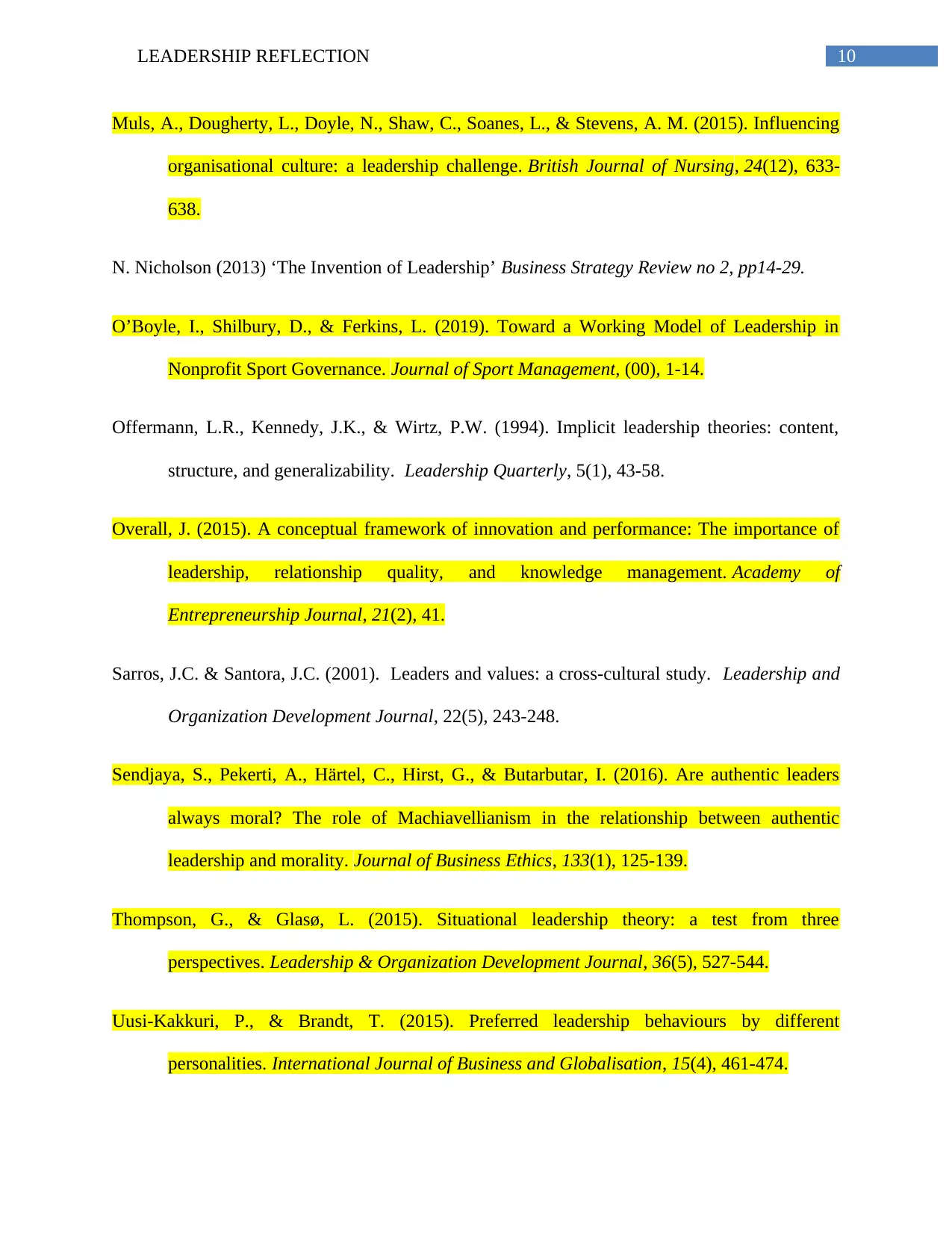
Muls, A., Dougherty, L., Doyle, N., Shaw, C., Soanes, L., & Stevens, A. M. (2015). Influencing
organisational culture: a leadership challenge. British Journal of Nursing, 24(12), 633-
638.
N. Nicholson (2013) ‘The Invention of Leadership’ Business Strategy Review no 2, pp14-29.
O’Boyle, I., Shilbury, D., & Ferkins, L. (2019). Toward a Working Model of Leadership in
Nonprofit Sport Governance. Journal of Sport Management, (00), 1-14.
Offermann, L.R., Kennedy, J.K., & Wirtz, P.W. (1994). Implicit leadership theories: content,
structure, and generalizability. Leadership Quarterly, 5(1), 43-58.
Overall, J. (2015). A conceptual framework of innovation and performance: The importance of
leadership, relationship quality, and knowledge management. Academy of
Entrepreneurship Journal, 21(2), 41.
Sarros, J.C. & Santora, J.C. (2001). Leaders and values: a cross-cultural study. Leadership and
Organization Development Journal, 22(5), 243-248.
Sendjaya, S., Pekerti, A., Härtel, C., Hirst, G., & Butarbutar, I. (2016). Are authentic leaders
always moral? The role of Machiavellianism in the relationship between authentic
leadership and morality. Journal of Business Ethics, 133(1), 125-139.
Thompson, G., & Glasø, L. (2015). Situational leadership theory: a test from three
perspectives. Leadership & Organization Development Journal, 36(5), 527-544.
Uusi-Kakkuri, P., & Brandt, T. (2015). Preferred leadership behaviours by different
personalities. International Journal of Business and Globalisation, 15(4), 461-474.
Muls, A., Dougherty, L., Doyle, N., Shaw, C., Soanes, L., & Stevens, A. M. (2015). Influencing
organisational culture: a leadership challenge. British Journal of Nursing, 24(12), 633-
638.
N. Nicholson (2013) ‘The Invention of Leadership’ Business Strategy Review no 2, pp14-29.
O’Boyle, I., Shilbury, D., & Ferkins, L. (2019). Toward a Working Model of Leadership in
Nonprofit Sport Governance. Journal of Sport Management, (00), 1-14.
Offermann, L.R., Kennedy, J.K., & Wirtz, P.W. (1994). Implicit leadership theories: content,
structure, and generalizability. Leadership Quarterly, 5(1), 43-58.
Overall, J. (2015). A conceptual framework of innovation and performance: The importance of
leadership, relationship quality, and knowledge management. Academy of
Entrepreneurship Journal, 21(2), 41.
Sarros, J.C. & Santora, J.C. (2001). Leaders and values: a cross-cultural study. Leadership and
Organization Development Journal, 22(5), 243-248.
Sendjaya, S., Pekerti, A., Härtel, C., Hirst, G., & Butarbutar, I. (2016). Are authentic leaders
always moral? The role of Machiavellianism in the relationship between authentic
leadership and morality. Journal of Business Ethics, 133(1), 125-139.
Thompson, G., & Glasø, L. (2015). Situational leadership theory: a test from three
perspectives. Leadership & Organization Development Journal, 36(5), 527-544.
Uusi-Kakkuri, P., & Brandt, T. (2015). Preferred leadership behaviours by different
personalities. International Journal of Business and Globalisation, 15(4), 461-474.

11LEADERSHIP REFLECTION
⊘ This is a preview!⊘
Do you want full access?
Subscribe today to unlock all pages.
Trusted by 1+ million students worldwide

1 out of 12


Related Documents


Your All-in-One AI-Powered Toolkit for Academic Success.
+13062052269
info@desklib.com
Available 24*7 on WhatsApp / Email
![[object Object]](/_next/static/media/star-bottom.7253800d.svg)
Unlock your academic potential
Copyright © 2020–2026 A2Z Services. All Rights Reserved. Developed and managed by ZUCOL.