Designing an Effective Leadership Development Program for ECU
VerifiedAdded on 2023/06/03
|8
|1366
|53
Report
AI Summary
This report details a leadership development program designed to enhance managers' skills within a medium-sized business, fostering a coaching culture to improve organizational performance. It addresses the need for internal skill development due to funding constraints for external training. The program emphasizes coaching skills for managers and aims to disseminate these skills throughout the workplace. The report includes a curriculum plan focusing on technical and soft skills, and product and service training. It outlines session plans, detailing activities, coach involvement, and timelines for various learning areas. The program aims to build a strong coaching culture, promote active feedback, and leverage diversity for collaborative decision-making and change implementation, ultimately improving employee engagement and revenue growth. Desklib provides access to similar solved assignments and resources for students.
Running head: LEADERSHIP DEVELOPMENT PROGRAM
Leadership Development Program
Name of the Student
Name of the University
Author Note
Leadership Development Program
Name of the Student
Name of the University
Author Note
Paraphrase This Document
Need a fresh take? Get an instant paraphrase of this document with our AI Paraphraser

1LEADERSHIP DEVELOPMENT PROGRAM
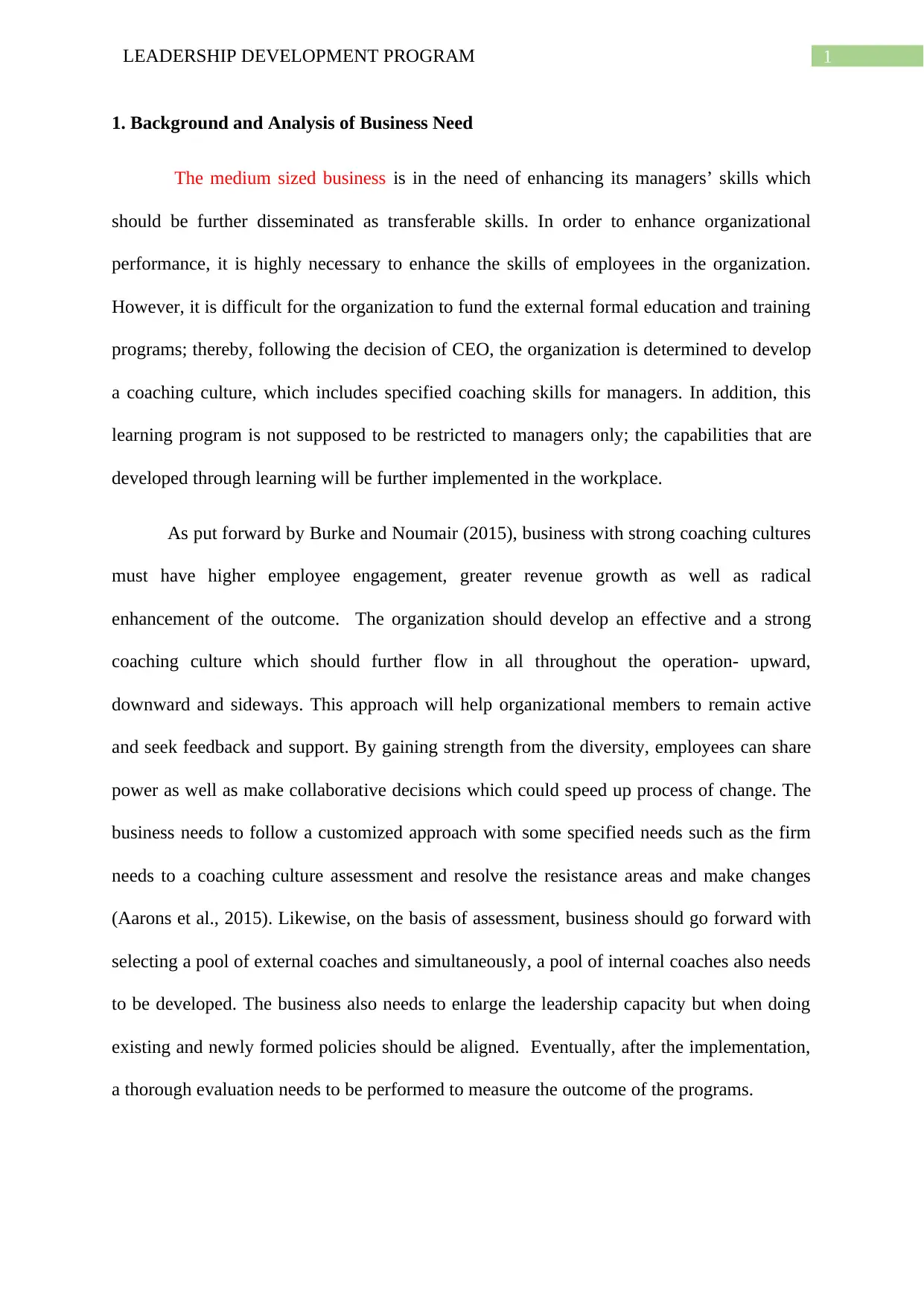
1. Background and Analysis of Business Need
The medium sized business is in the need of enhancing its managers’ skills which
should be further disseminated as transferable skills. In order to enhance organizational
performance, it is highly necessary to enhance the skills of employees in the organization.
However, it is difficult for the organization to fund the external formal education and training
programs; thereby, following the decision of CEO, the organization is determined to develop
a coaching culture, which includes specified coaching skills for managers. In addition, this
learning program is not supposed to be restricted to managers only; the capabilities that are
developed through learning will be further implemented in the workplace.
As put forward by Burke and Noumair (2015), business with strong coaching cultures
must have higher employee engagement, greater revenue growth as well as radical
enhancement of the outcome. The organization should develop an effective and a strong
coaching culture which should further flow in all throughout the operation- upward,
downward and sideways. This approach will help organizational members to remain active
and seek feedback and support. By gaining strength from the diversity, employees can share
power as well as make collaborative decisions which could speed up process of change. The
business needs to follow a customized approach with some specified needs such as the firm
needs to a coaching culture assessment and resolve the resistance areas and make changes
(Aarons et al., 2015). Likewise, on the basis of assessment, business should go forward with
selecting a pool of external coaches and simultaneously, a pool of internal coaches also needs
to be developed. The business also needs to enlarge the leadership capacity but when doing
existing and newly formed policies should be aligned. Eventually, after the implementation,
a thorough evaluation needs to be performed to measure the outcome of the programs.
1. Background and Analysis of Business Need
The medium sized business is in the need of enhancing its managers’ skills which
should be further disseminated as transferable skills. In order to enhance organizational
performance, it is highly necessary to enhance the skills of employees in the organization.
However, it is difficult for the organization to fund the external formal education and training
programs; thereby, following the decision of CEO, the organization is determined to develop
a coaching culture, which includes specified coaching skills for managers. In addition, this
learning program is not supposed to be restricted to managers only; the capabilities that are
developed through learning will be further implemented in the workplace.
As put forward by Burke and Noumair (2015), business with strong coaching cultures
must have higher employee engagement, greater revenue growth as well as radical
enhancement of the outcome. The organization should develop an effective and a strong
coaching culture which should further flow in all throughout the operation- upward,
downward and sideways. This approach will help organizational members to remain active
and seek feedback and support. By gaining strength from the diversity, employees can share
power as well as make collaborative decisions which could speed up process of change. The
business needs to follow a customized approach with some specified needs such as the firm
needs to a coaching culture assessment and resolve the resistance areas and make changes
(Aarons et al., 2015). Likewise, on the basis of assessment, business should go forward with
selecting a pool of external coaches and simultaneously, a pool of internal coaches also needs
to be developed. The business also needs to enlarge the leadership capacity but when doing
existing and newly formed policies should be aligned. Eventually, after the implementation,
a thorough evaluation needs to be performed to measure the outcome of the programs.

2LEADERSHIP DEVELOPMENT PROGRAM
According to Ellinger and Kim (2014) the coaching culture assessments should reveal
strengths and opportunities and then business needs to find out the barriers of building a
coaching culture. Nonetheless, before getting into the plan, organization should consider the
basic areas to determine such as how effectively is coaching understood and integrated into
performance as well as talent management. This assessment will also help to learn the kind of
the competencies that organization should develop in the coming years or within a specified
time period. In this context, Ladegard and Gjerde (2014) commented that most of the
businesses deal with several change initiatives at once as the part of the initiative they go on
undertaking six sigma audits along with launching a bold diversity approach. Therefore,
organization needs to be serious about the social responsibility. In order to implement
coaching culture, the organization should apply rigorous selection criteria to generate a pool
of extraordinary coaches who should work primarily with senior managers and altogether, the
business needs to select a diverse group of external coaches who must possess credibility,
culture awareness, emotional intelligence as well as a broad range of experience.
2. Overview of the interventions
The basics of the session plan
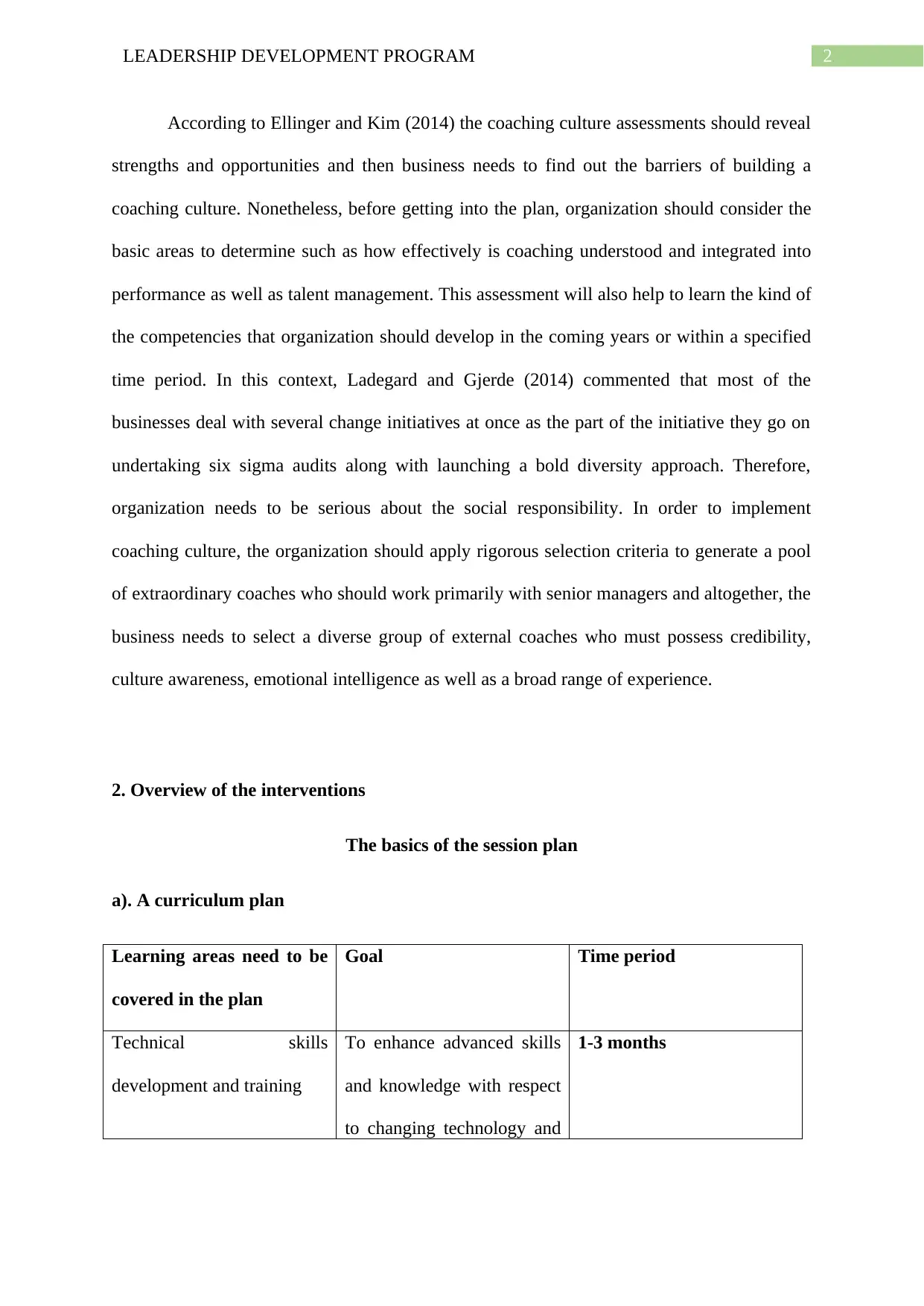
a). A curriculum plan
Learning areas need to be
covered in the plan
Goal Time period
Technical skills
development and training
To enhance advanced skills
and knowledge with respect
to changing technology and
1-3 months
According to Ellinger and Kim (2014) the coaching culture assessments should reveal
strengths and opportunities and then business needs to find out the barriers of building a
coaching culture. Nonetheless, before getting into the plan, organization should consider the
basic areas to determine such as how effectively is coaching understood and integrated into
performance as well as talent management. This assessment will also help to learn the kind of
the competencies that organization should develop in the coming years or within a specified
time period. In this context, Ladegard and Gjerde (2014) commented that most of the
businesses deal with several change initiatives at once as the part of the initiative they go on
undertaking six sigma audits along with launching a bold diversity approach. Therefore,
organization needs to be serious about the social responsibility. In order to implement
coaching culture, the organization should apply rigorous selection criteria to generate a pool
of extraordinary coaches who should work primarily with senior managers and altogether, the
business needs to select a diverse group of external coaches who must possess credibility,
culture awareness, emotional intelligence as well as a broad range of experience.
2. Overview of the interventions
The basics of the session plan
a). A curriculum plan
Learning areas need to be
covered in the plan
Goal Time period
Technical skills
development and training
To enhance advanced skills
and knowledge with respect
to changing technology and
1-3 months
⊘ This is a preview!⊘
Do you want full access?
Subscribe today to unlock all pages.

Trusted by 1+ million students worldwide

3LEADERSHIP DEVELOPMENT PROGRAM
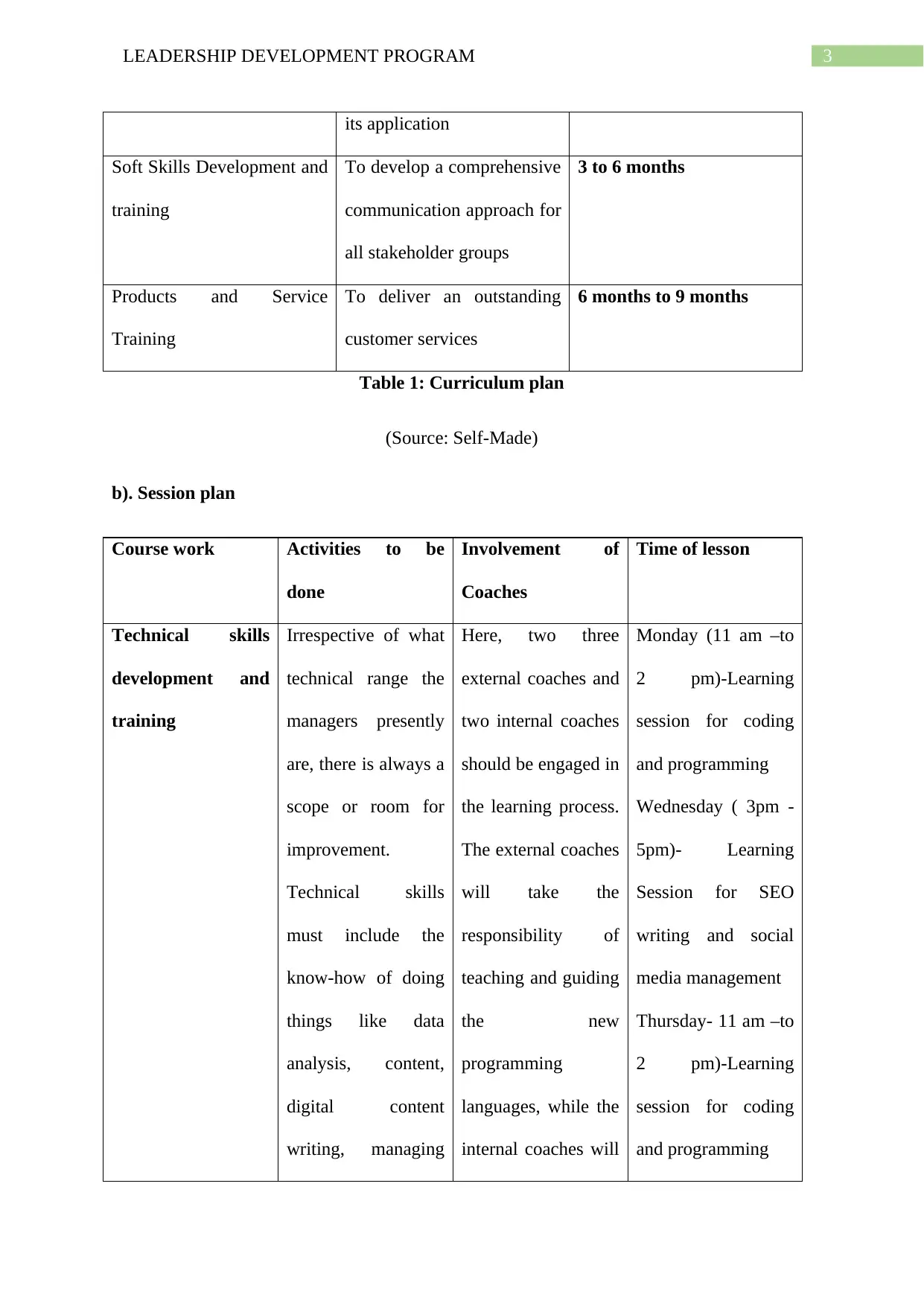
its application
Soft Skills Development and
training
To develop a comprehensive
communication approach for
all stakeholder groups
3 to 6 months
Products and Service
Training
To deliver an outstanding
customer services
6 months to 9 months
Table 1: Curriculum plan
(Source: Self-Made)
b). Session plan
Course work Activities to be
done
Involvement of
Coaches
Time of lesson
Technical skills
development and
training
Irrespective of what
technical range the
managers presently
are, there is always a
scope or room for
improvement.
Technical skills
must include the
know-how of doing
things like data
analysis, content,
digital content
writing, managing
Here, two three
external coaches and
two internal coaches
should be engaged in
the learning process.
The external coaches
will take the
responsibility of
teaching and guiding
the new
programming
languages, while the
internal coaches will
Monday (11 am –to
2 pm)-Learning
session for coding
and programming
Wednesday ( 3pm -
5pm)- Learning
Session for SEO
writing and social
media management
Thursday- 11 am –to
2 pm)-Learning
session for coding
and programming
its application
Soft Skills Development and
training
To develop a comprehensive
communication approach for
all stakeholder groups
3 to 6 months
Products and Service
Training
To deliver an outstanding
customer services
6 months to 9 months
Table 1: Curriculum plan
(Source: Self-Made)
b). Session plan
Course work Activities to be
done
Involvement of
Coaches
Time of lesson
Technical skills
development and
training
Irrespective of what
technical range the
managers presently
are, there is always a
scope or room for
improvement.
Technical skills
must include the
know-how of doing
things like data
analysis, content,
digital content
writing, managing
Here, two three
external coaches and
two internal coaches
should be engaged in
the learning process.
The external coaches
will take the
responsibility of
teaching and guiding
the new
programming
languages, while the
internal coaches will
Monday (11 am –to
2 pm)-Learning
session for coding
and programming
Wednesday ( 3pm -
5pm)- Learning
Session for SEO
writing and social
media management
Thursday- 11 am –to
2 pm)-Learning
session for coding
and programming
Paraphrase This Document
Need a fresh take? Get an instant paraphrase of this document with our AI Paraphraser

4LEADERSHIP DEVELOPMENT PROGRAM
social media,
website designs,
coding and
programming. Here,
the learners who
already have
knowledge in these
areas are ensured
that they will learn
more. The managers
must be engaged in
this learning
program on a regular
basis to remain
updated with the
regular
development.
take responsibility of
teaching digital
content writing and
performing and
monitoring activities
in the social media.
The rest areas of
learning in this field
will be performed by
both categories of
coaches.
Saturday- Learning
Session for SEO
writing and social
media management
The same will repeat
for three months
(June-Aug)
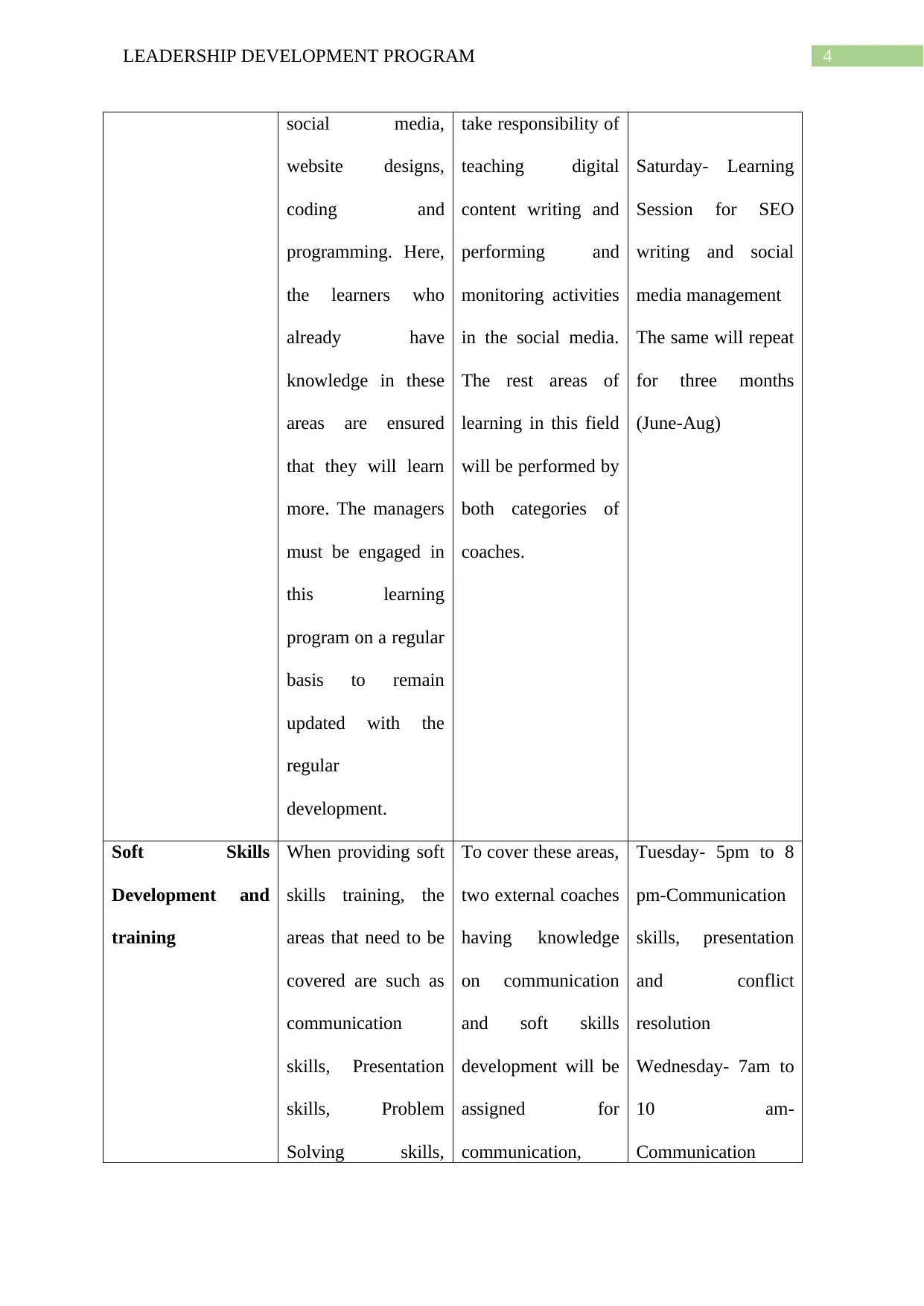
Soft Skills
Development and
training
When providing soft
skills training, the
areas that need to be
covered are such as
communication
skills, Presentation
skills, Problem
Solving skills,
To cover these areas,
two external coaches
having knowledge
on communication
and soft skills
development will be
assigned for
communication,
Tuesday- 5pm to 8
pm-Communication
skills, presentation
and conflict
resolution
Wednesday- 7am to
10 am-
Communication
social media,
website designs,
coding and
programming. Here,
the learners who
already have
knowledge in these
areas are ensured
that they will learn
more. The managers
must be engaged in
this learning
program on a regular
basis to remain
updated with the
regular
development.
take responsibility of
teaching digital
content writing and
performing and
monitoring activities
in the social media.
The rest areas of
learning in this field
will be performed by
both categories of
coaches.
Saturday- Learning
Session for SEO
writing and social
media management
The same will repeat
for three months
(June-Aug)
Soft Skills
Development and
training
When providing soft
skills training, the
areas that need to be
covered are such as
communication
skills, Presentation
skills, Problem
Solving skills,
To cover these areas,
two external coaches
having knowledge
on communication
and soft skills
development will be
assigned for
communication,
Tuesday- 5pm to 8
pm-Communication
skills, presentation
and conflict
resolution
Wednesday- 7am to
10 am-
Communication

5LEADERSHIP DEVELOPMENT PROGRAM
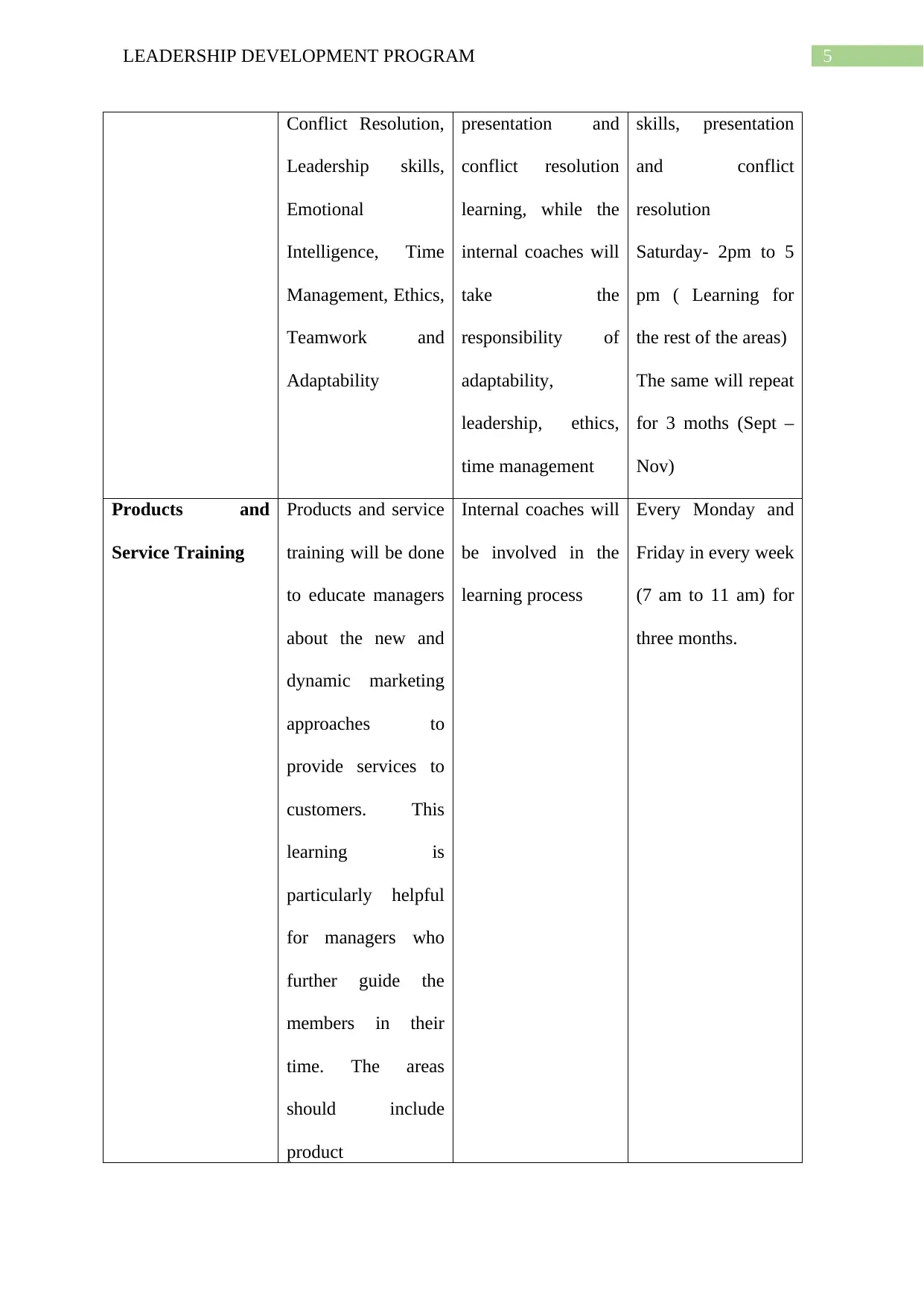
Conflict Resolution,
Leadership skills,
Emotional
Intelligence, Time
Management, Ethics,
Teamwork and
Adaptability
presentation and
conflict resolution
learning, while the
internal coaches will
take the
responsibility of
adaptability,
leadership, ethics,
time management
skills, presentation
and conflict
resolution
Saturday- 2pm to 5
pm ( Learning for
the rest of the areas)
The same will repeat
for 3 moths (Sept –
Nov)
Products and
Service Training
Products and service
training will be done
to educate managers
about the new and
dynamic marketing
approaches to
provide services to
customers. This
learning is
particularly helpful
for managers who
further guide the
members in their
time. The areas
should include
product
Internal coaches will
be involved in the
learning process
Every Monday and
Friday in every week
(7 am to 11 am) for
three months.
Conflict Resolution,
Leadership skills,
Emotional
Intelligence, Time
Management, Ethics,
Teamwork and
Adaptability
presentation and
conflict resolution
learning, while the
internal coaches will
take the
responsibility of
adaptability,
leadership, ethics,
time management
skills, presentation
and conflict
resolution
Saturday- 2pm to 5
pm ( Learning for
the rest of the areas)
The same will repeat
for 3 moths (Sept –
Nov)
Products and
Service Training
Products and service
training will be done
to educate managers
about the new and
dynamic marketing
approaches to
provide services to
customers. This
learning is
particularly helpful
for managers who
further guide the
members in their
time. The areas
should include
product
Internal coaches will
be involved in the
learning process
Every Monday and
Friday in every week
(7 am to 11 am) for
three months.
⊘ This is a preview!⊘
Do you want full access?
Subscribe today to unlock all pages.

Trusted by 1+ million students worldwide

6LEADERSHIP DEVELOPMENT PROGRAM
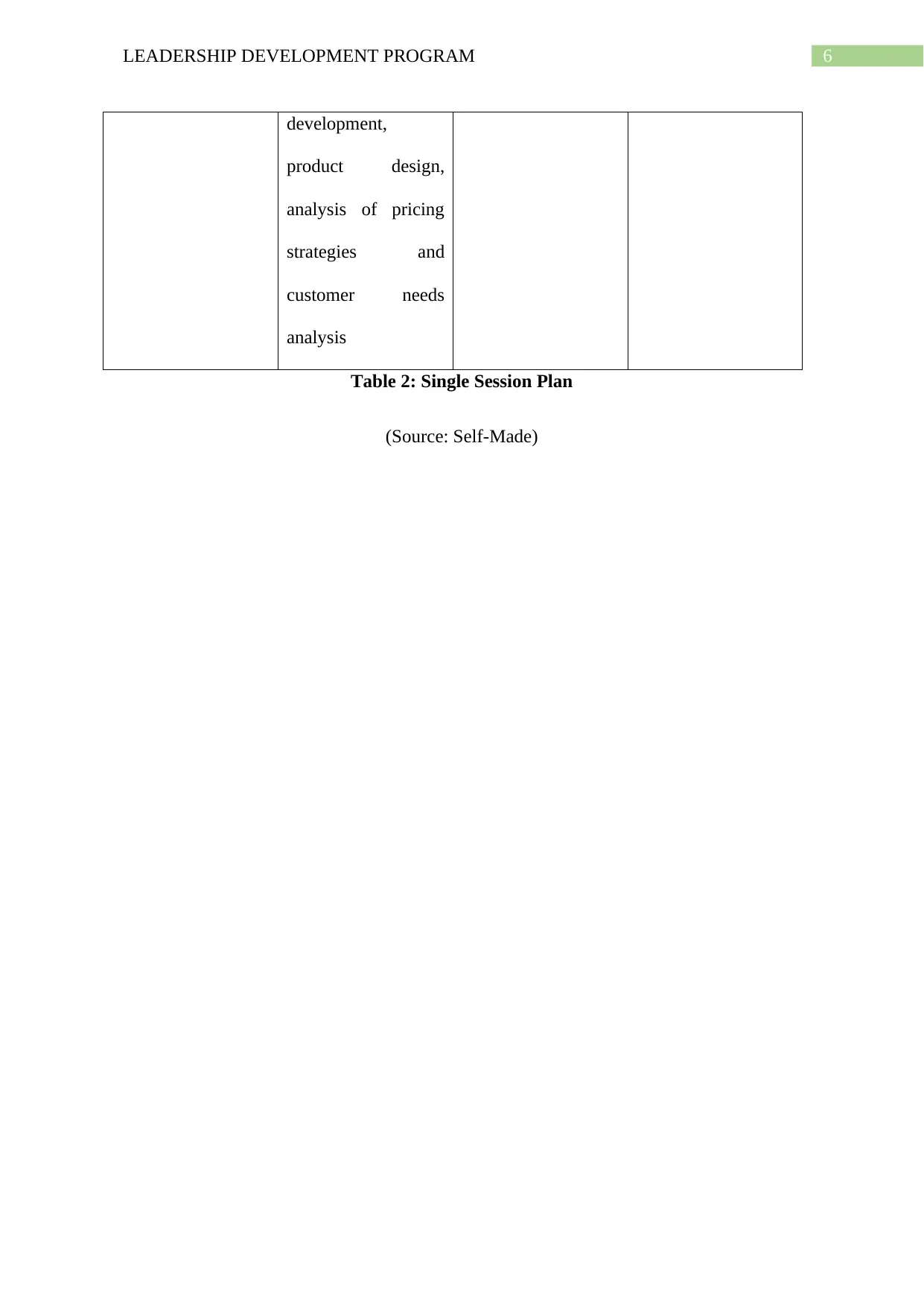
development,
product design,
analysis of pricing
strategies and
customer needs
analysis
Table 2: Single Session Plan
(Source: Self-Made)
development,
product design,
analysis of pricing
strategies and
customer needs
analysis
Table 2: Single Session Plan
(Source: Self-Made)
Paraphrase This Document
Need a fresh take? Get an instant paraphrase of this document with our AI Paraphraser

7LEADERSHIP DEVELOPMENT PROGRAM
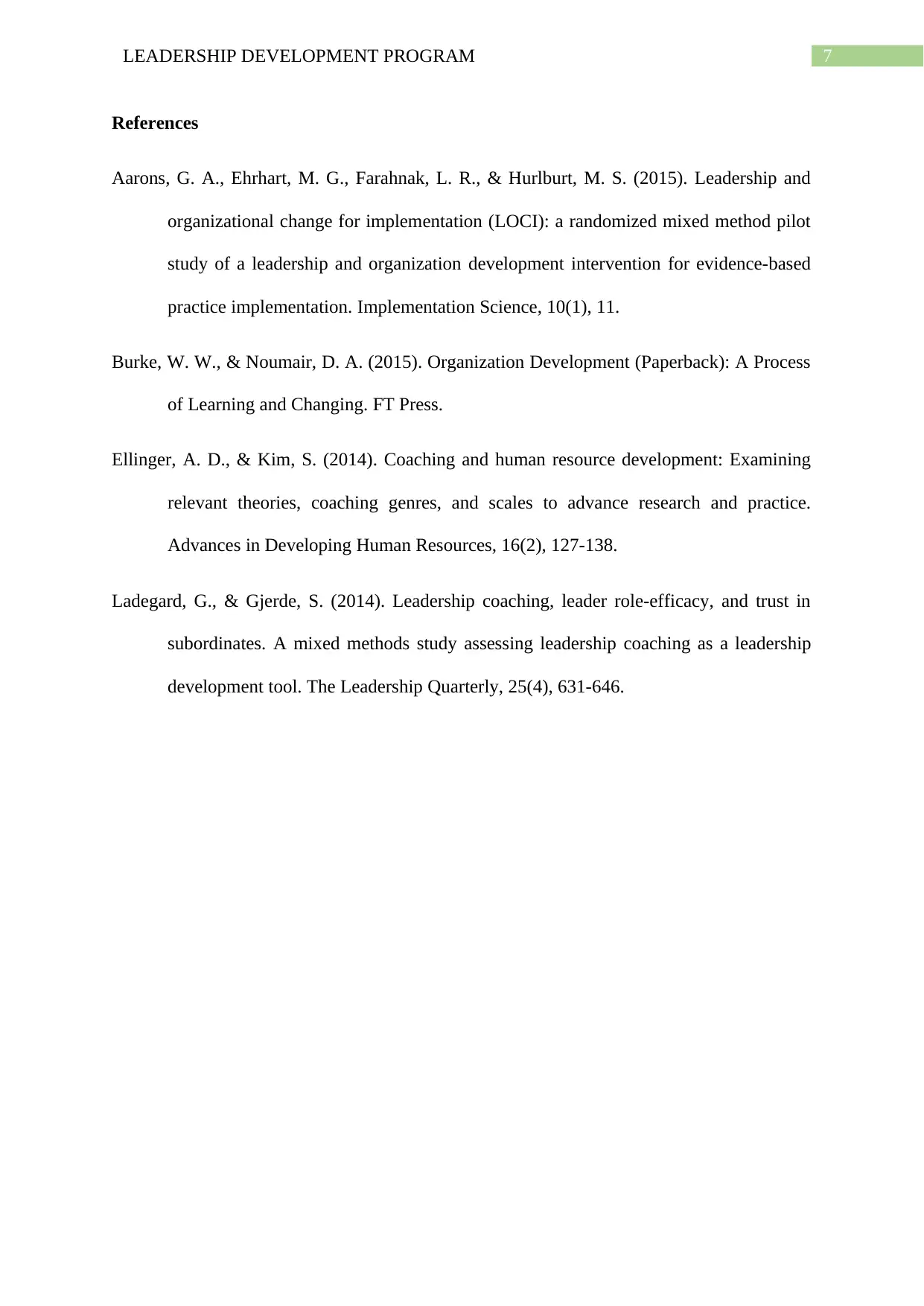
References
Aarons, G. A., Ehrhart, M. G., Farahnak, L. R., & Hurlburt, M. S. (2015). Leadership and
organizational change for implementation (LOCI): a randomized mixed method pilot
study of a leadership and organization development intervention for evidence-based
practice implementation. Implementation Science, 10(1), 11.
Burke, W. W., & Noumair, D. A. (2015). Organization Development (Paperback): A Process
of Learning and Changing. FT Press.
Ellinger, A. D., & Kim, S. (2014). Coaching and human resource development: Examining
relevant theories, coaching genres, and scales to advance research and practice.
Advances in Developing Human Resources, 16(2), 127-138.
Ladegard, G., & Gjerde, S. (2014). Leadership coaching, leader role-efficacy, and trust in
subordinates. A mixed methods study assessing leadership coaching as a leadership
development tool. The Leadership Quarterly, 25(4), 631-646.
References
Aarons, G. A., Ehrhart, M. G., Farahnak, L. R., & Hurlburt, M. S. (2015). Leadership and
organizational change for implementation (LOCI): a randomized mixed method pilot
study of a leadership and organization development intervention for evidence-based
practice implementation. Implementation Science, 10(1), 11.
Burke, W. W., & Noumair, D. A. (2015). Organization Development (Paperback): A Process
of Learning and Changing. FT Press.
Ellinger, A. D., & Kim, S. (2014). Coaching and human resource development: Examining
relevant theories, coaching genres, and scales to advance research and practice.
Advances in Developing Human Resources, 16(2), 127-138.
Ladegard, G., & Gjerde, S. (2014). Leadership coaching, leader role-efficacy, and trust in
subordinates. A mixed methods study assessing leadership coaching as a leadership
development tool. The Leadership Quarterly, 25(4), 631-646.
1 out of 8
Related Documents
Your All-in-One AI-Powered Toolkit for Academic Success.
+13062052269
info@desklib.com
Available 24*7 on WhatsApp / Email
Unlock your academic potential
Copyright © 2020–2025 A2Z Services. All Rights Reserved. Developed and managed by ZUCOL.