Leadership and Governance Report: CEO, Board, and Stakeholders
VerifiedAdded on 2022/12/27
|10
|3213
|32
Report
AI Summary
This report delves into the crucial aspects of leadership and governance within an organization. It begins by examining the responsibilities of the board of governors in monitoring CEOs, especially in cases of unethical behavior, and outlines processes for risk management and audits to ensure compliance. The report then explores how CEOs should lead by example, considering the perspectives of employees, managers, owners, and society, and emphasizes the importance of ethical behavior and stakeholder engagement. Furthermore, it investigates strategies for CEOs to leverage employee loyalty through organizational climate, culture, teamwork, and diversity initiatives. The report integrates relevant leadership theories to provide a comprehensive understanding of effective governance and leadership practices.
1
Leadership and governance
Leadership and governance

Paraphrase This Document
Need a fresh take? Get an instant paraphrase of this document with our AI Paraphraser
2
Table of Contents
Introduction......................................................................................................................................3
Responsibilities of Board of Governors to monitor CEOs..............................................................3
How CEOs should be leading by example?....................................................................................5
How CEOs can leverage the loyalty of their employees?...............................................................6
Conclusion.......................................................................................................................................8
References........................................................................................................................................9
Table of Contents
Introduction......................................................................................................................................3
Responsibilities of Board of Governors to monitor CEOs..............................................................3
How CEOs should be leading by example?....................................................................................5
How CEOs can leverage the loyalty of their employees?...............................................................6
Conclusion.......................................................................................................................................8
References........................................................................................................................................9
3
Introduction
The report will be providing aspects in relation to leadership and governance. In this, there is a
case study which has been provided in relation to the CEO who has performed in an unethical
manner. There will be consideration of the same and then the responsibilities of the board in this
respect will be discussed. The process undertaken for the carrying out of the audit to manage the
risk is to be accounted for. The manner in which the CEO shall perform the operations will be
discussed from the perspective of various stakeholders. In that, all the employees, managers,
owners and society will be considered. The CEO shall maintain the loyalty of the customers and
the manner in which it is possible will be covered. The organizational effectiveness will be taken
into account and with that, the importance of the politics and ethical diversity shall be involved
in the process.
Responsibilities of the Board of Governors to monitor CEOs
The CEO has the main responsibility in relation to the maintenance of the operations and other
aspects of the business. For that, they are required to behave in an ethical manner. In the current
case, there are various issues, which have been noted, and it is identified that the CEO is not
behaving in an ethical manner (Klettner, Clarke and Boersma, 2014). In such situations, it is the
responsibility of the board to take the required action to resolve the issue and make the CEO to
perform in an effective manner. The bad behavior of the CEO can be prevented by making him
adopt the correct policies and procedures. There will be consideration of the leadership style,
which shall be followed by him and in that, all the required attributes shall be given the due
importance.
A leader is accountable for all the actions that are taken by him and for that the responsibility lies
on him. They should perform in such a manner that all of the operations provide the best results,
which will be in the overall interest of all. In such processes, the involvement of the employees
shall be made and they shall be considered as part of decision-making. There will be the
adoption of the democratic style of leadership and in that; all of the involved parties will be
having the right to participate in the business (Voegtlin, Patzer and Scherer, 2012). They will be
given the authority to present their views and ideas and by this importance will be given to them,
Introduction
The report will be providing aspects in relation to leadership and governance. In this, there is a
case study which has been provided in relation to the CEO who has performed in an unethical
manner. There will be consideration of the same and then the responsibilities of the board in this
respect will be discussed. The process undertaken for the carrying out of the audit to manage the
risk is to be accounted for. The manner in which the CEO shall perform the operations will be
discussed from the perspective of various stakeholders. In that, all the employees, managers,
owners and society will be considered. The CEO shall maintain the loyalty of the customers and
the manner in which it is possible will be covered. The organizational effectiveness will be taken
into account and with that, the importance of the politics and ethical diversity shall be involved
in the process.
Responsibilities of the Board of Governors to monitor CEOs
The CEO has the main responsibility in relation to the maintenance of the operations and other
aspects of the business. For that, they are required to behave in an ethical manner. In the current
case, there are various issues, which have been noted, and it is identified that the CEO is not
behaving in an ethical manner (Klettner, Clarke and Boersma, 2014). In such situations, it is the
responsibility of the board to take the required action to resolve the issue and make the CEO to
perform in an effective manner. The bad behavior of the CEO can be prevented by making him
adopt the correct policies and procedures. There will be consideration of the leadership style,
which shall be followed by him and in that, all the required attributes shall be given the due
importance.
A leader is accountable for all the actions that are taken by him and for that the responsibility lies
on him. They should perform in such a manner that all of the operations provide the best results,
which will be in the overall interest of all. In such processes, the involvement of the employees
shall be made and they shall be considered as part of decision-making. There will be the
adoption of the democratic style of leadership and in that; all of the involved parties will be
having the right to participate in the business (Voegtlin, Patzer and Scherer, 2012). They will be
given the authority to present their views and ideas and by this importance will be given to them,
⊘ This is a preview!⊘
Do you want full access?
Subscribe today to unlock all pages.

Trusted by 1+ million students worldwide
4
which will make them feel connected to the business. there will be proper consideration of the
feelings of others and the ideas which are provided by them will be given the importance and
evaluation of them will be made. The ones, which will be beneficial for the company, will be
identified and taken into account in the further processes of the company.
The balance will be required to be established between the operations and management. There
will be involvement of several processes and they all shall be managed in such a manner that
none is affected in an adverse manner. The interest of any party involved shall not be harmed and
that shall be kept on the priority.
The board of governance will be playing an important role in this and will be setting the process
by which the performance of the CEO can be monitored on a timely basis (Blaschke, Frost and
Hattke, 2014). There will be proper standards, which will be set, and all the work will be
required to be carried in accordance with them. the proper evaluation of the policies adopted by
the CEO will be made and if there is any shortcoming in the process then the same will be
identified. This will help in designing the process for the coming period by which the current
issues can be avoided and all the targets are attained in the most effective and efficient manner.
There are several ethical and legal requirements, which are required to be fulfilled by all the
corporate. It is hence required that they shall be in knowledge of all by which compliance can be
ensured. This will be made possible with the undertaking of the audit in this context. There will
be the determination of the laws which are applicable and then their compliance will be
evaluated. The audit will be performed in which all the areas will be checked (Purdy, 2012). The
risk is involved in the business and it is the duty of the CEO to manage them in an effective
manner. there will be an audit in which all the risks which are involved and the manner in which
they can be eliminated will be taken into account. There will be the maintenance of the risk so
that all the adverse impacts, which are faced by the business, can be avoided.
The board will make the evaluation of all the aspects and then on that basis, there will be a
making-of all the standards, which are to be followed by all the parties involved. This will be
helping in reducing the problems which are arising and the process will be improved which will
be in the interest of all involving the company and the individuals.
which will make them feel connected to the business. there will be proper consideration of the
feelings of others and the ideas which are provided by them will be given the importance and
evaluation of them will be made. The ones, which will be beneficial for the company, will be
identified and taken into account in the further processes of the company.
The balance will be required to be established between the operations and management. There
will be involvement of several processes and they all shall be managed in such a manner that
none is affected in an adverse manner. The interest of any party involved shall not be harmed and
that shall be kept on the priority.
The board of governance will be playing an important role in this and will be setting the process
by which the performance of the CEO can be monitored on a timely basis (Blaschke, Frost and
Hattke, 2014). There will be proper standards, which will be set, and all the work will be
required to be carried in accordance with them. the proper evaluation of the policies adopted by
the CEO will be made and if there is any shortcoming in the process then the same will be
identified. This will help in designing the process for the coming period by which the current
issues can be avoided and all the targets are attained in the most effective and efficient manner.
There are several ethical and legal requirements, which are required to be fulfilled by all the
corporate. It is hence required that they shall be in knowledge of all by which compliance can be
ensured. This will be made possible with the undertaking of the audit in this context. There will
be the determination of the laws which are applicable and then their compliance will be
evaluated. The audit will be performed in which all the areas will be checked (Purdy, 2012). The
risk is involved in the business and it is the duty of the CEO to manage them in an effective
manner. there will be an audit in which all the risks which are involved and the manner in which
they can be eliminated will be taken into account. There will be the maintenance of the risk so
that all the adverse impacts, which are faced by the business, can be avoided.
The board will make the evaluation of all the aspects and then on that basis, there will be a
making-of all the standards, which are to be followed by all the parties involved. This will be
helping in reducing the problems which are arising and the process will be improved which will
be in the interest of all involving the company and the individuals.
Paraphrase This Document
Need a fresh take? Get an instant paraphrase of this document with our AI Paraphraser
5
How CEOs should be leading by example?
A CEO is the main part of the organization who is involved in the governance and it is required
that they shall be fulfilling their duties in an effective manner. in that process they will be
required to follow all the set principles and standards and by that all the achievements will be
made in appropriate manner (Othman and Rahman, 2014). They are the leaders of many people
and all have the focus on their every move. Due to this, it is required that they shall perform in
the best manner. Many people consider them as their role models and will be following the
manner in which the CEO completes the tasks. Being on the leadership task, they are provided
with certain roles and responsibilities in respect of all the stakeholders involved in the business.
To manage all the operations the CEO will be required to undertake the process by which they
can deal with all the circumstances in an effective manner and can set the example for all to be
followed. Leading by example is applicable to them as they are the ones who will be setting the
example for all and the remaining will be following their actions. In this process, there will be
involvement of the employees, managers, society, owners, and sustainability.
The employees will be affected most as they follow the instructions and actions of their leaders.
Due to this, the CEO will be required to follow the process and set the example which will be
motivating for all. They shall make the operations to be completed in such a manner that best
results are attained and also the incentive of the best performance is made available (Valentine
and Stewart, 2013). This will be working as the motivation for the employees and they will also
be following the path of their leader. There will be the use of the behavioral theory as the manner
which will be followed by them will be followed by others. It is identified that all the things
which are seen in the original can be duplicated in an effective manner and the same will be
applicable for the leaders. The examples will be set and they will be followed by the others
including employees.
The owners are interested in the benefits of the company and want that the tasks shall be
performed in the best manner. For that, the CEO will be required to set good examples so that the
support from the owners can be obtained. The good results will be obtained and for that, there
How CEOs should be leading by example?
A CEO is the main part of the organization who is involved in the governance and it is required
that they shall be fulfilling their duties in an effective manner. in that process they will be
required to follow all the set principles and standards and by that all the achievements will be
made in appropriate manner (Othman and Rahman, 2014). They are the leaders of many people
and all have the focus on their every move. Due to this, it is required that they shall perform in
the best manner. Many people consider them as their role models and will be following the
manner in which the CEO completes the tasks. Being on the leadership task, they are provided
with certain roles and responsibilities in respect of all the stakeholders involved in the business.
To manage all the operations the CEO will be required to undertake the process by which they
can deal with all the circumstances in an effective manner and can set the example for all to be
followed. Leading by example is applicable to them as they are the ones who will be setting the
example for all and the remaining will be following their actions. In this process, there will be
involvement of the employees, managers, society, owners, and sustainability.
The employees will be affected most as they follow the instructions and actions of their leaders.
Due to this, the CEO will be required to follow the process and set the example which will be
motivating for all. They shall make the operations to be completed in such a manner that best
results are attained and also the incentive of the best performance is made available (Valentine
and Stewart, 2013). This will be working as the motivation for the employees and they will also
be following the path of their leader. There will be the use of the behavioral theory as the manner
which will be followed by them will be followed by others. It is identified that all the things
which are seen in the original can be duplicated in an effective manner and the same will be
applicable for the leaders. The examples will be set and they will be followed by the others
including employees.
The owners are interested in the benefits of the company and want that the tasks shall be
performed in the best manner. For that, the CEO will be required to set good examples so that the
support from the owners can be obtained. The good results will be obtained and for that, there
6
will be the adoption of the functional theory in which the focus will be made on the attainment of
the goals and the owners are interested in that only (Galpin and Lee Whittington, 2012). All of
the targets will be focused and the functions will then be carried in accordance with that. The
specific functions, which are designed for the success, will be undertaken in this and the main
targets will be made on them. This will be done by adopting proper policies and then the
example will be used for further improvement.
The managers require that all of the tasks shall be managed in the best possible manner and for
that, there will be a need to adopt the techniques of some great leader. In this, the great man
theory will be of great help and the CEO will also be using the same (Afegbua and Adejuwon,
2012). He will be choosing the policies and procedures which have been adopted by that leader
and that will help him in carrying the task in the manner by which the set targets will be attained.
The goals which are set will then be achieved and this will be an example for all to be followed
in the coming period.
All of the main theories will be applied and by that, the other parties will be affected as they will
be setting the example for all by maintaining the effective position in the business. all of the
involved stakeholders will also be wanting the same as their interest is affected by the measures
and decisions taken by the authorities due to this it is highly important that correct process and
procedure shall be followed by which interest of all will be served.
How CEOs can leverage the loyalty of their employees?
Employees are an important part of the organization and it is required that they shall be managed
in a proper manner. This is required as all the operations are performed by them and the
efficiency of that depends on the manner in which the task will be performed by them. this
requires that the loyalty among the employees shall be maintained which will be motivating them
to complete the task with the use of full potential (Swanson and Frederick, 2016). There will
need to provide them with the required motivation and incentives which will persuade them to
perform effectively. the loyalty of the employees can be gained by the use of various concepts
which needs to be involved in the business processes. The CEO is required to design the
organization in such a manner that the loyalty of the consumers is managed to the highest
possible level.
will be the adoption of the functional theory in which the focus will be made on the attainment of
the goals and the owners are interested in that only (Galpin and Lee Whittington, 2012). All of
the targets will be focused and the functions will then be carried in accordance with that. The
specific functions, which are designed for the success, will be undertaken in this and the main
targets will be made on them. This will be done by adopting proper policies and then the
example will be used for further improvement.
The managers require that all of the tasks shall be managed in the best possible manner and for
that, there will be a need to adopt the techniques of some great leader. In this, the great man
theory will be of great help and the CEO will also be using the same (Afegbua and Adejuwon,
2012). He will be choosing the policies and procedures which have been adopted by that leader
and that will help him in carrying the task in the manner by which the set targets will be attained.
The goals which are set will then be achieved and this will be an example for all to be followed
in the coming period.
All of the main theories will be applied and by that, the other parties will be affected as they will
be setting the example for all by maintaining the effective position in the business. all of the
involved stakeholders will also be wanting the same as their interest is affected by the measures
and decisions taken by the authorities due to this it is highly important that correct process and
procedure shall be followed by which interest of all will be served.
How CEOs can leverage the loyalty of their employees?
Employees are an important part of the organization and it is required that they shall be managed
in a proper manner. This is required as all the operations are performed by them and the
efficiency of that depends on the manner in which the task will be performed by them. this
requires that the loyalty among the employees shall be maintained which will be motivating them
to complete the task with the use of full potential (Swanson and Frederick, 2016). There will
need to provide them with the required motivation and incentives which will persuade them to
perform effectively. the loyalty of the employees can be gained by the use of various concepts
which needs to be involved in the business processes. The CEO is required to design the
organization in such a manner that the loyalty of the consumers is managed to the highest
possible level.
⊘ This is a preview!⊘
Do you want full access?
Subscribe today to unlock all pages.
Trusted by 1+ million students worldwide
7
The management will be required to be made effectively and that will be possible by making the
organizational culture to be in the format which provides the best results. The culture will be set
in such manner that all the employees will be feeling comfortable in the company and will be
able to trust the actions which are taken by the authorities (Saebi and Foss, 2015). There will be
undertaking of the processes by which the company will be able to make the culture in such
manner that all are performing as per the requirements and there is no force on them. they will
feel that it is their company and will be performing accordingly.
There will be the development of the teams and in that the delegation of the task will be made
and all will be given the particular target which needs to be attained by them. All the employees
will be motivated to work in the team so that they can attain the targets and there will be a certain
incentive which will be provided to them (Chung and Chan, 2012). The teamwork will help them
in making the task ton be completed in a better manner as all will be using their specific skills
and knowledge. This way the loyalty will be gained as they will be ensured that their hard work
will be paid for. The team will be given the required training which will help them in operating
in the best manner and the results which will be attained will also be of the best quality.
The sustainability will have to be ensured by which there will be the development of the sense of
security among the employees and for that various actions will be taken. The targets will be
attained and there will be making the profits which will then be distributed among the employees
also (Yar Hamidi and Gabrielsson, 2014). It will be motivating them and they will be performing
in an even better manner. The sustainability will be ensured with the making of the continuous
profits and that will ensure that business will be continuing to provide the same.
There will be flexibility which will be maintained in the business and rigidity will not be
involved. In this process, the employees will also be given the power to make the decision and
work in the manner in which they feel to be suitable and will be provided with the best results.
They will have the power to make the decisions in the situation of requirement and will not be
forced to follow the set procedure and structure even though the same may be wrong (Adams,
2013). By the help of this, the employees will also be having the authority and this will be
making them feel satisfied and create a sense of loyalty towards the organization.
The management will be required to be made effectively and that will be possible by making the
organizational culture to be in the format which provides the best results. The culture will be set
in such manner that all the employees will be feeling comfortable in the company and will be
able to trust the actions which are taken by the authorities (Saebi and Foss, 2015). There will be
undertaking of the processes by which the company will be able to make the culture in such
manner that all are performing as per the requirements and there is no force on them. they will
feel that it is their company and will be performing accordingly.
There will be the development of the teams and in that the delegation of the task will be made
and all will be given the particular target which needs to be attained by them. All the employees
will be motivated to work in the team so that they can attain the targets and there will be a certain
incentive which will be provided to them (Chung and Chan, 2012). The teamwork will help them
in making the task ton be completed in a better manner as all will be using their specific skills
and knowledge. This way the loyalty will be gained as they will be ensured that their hard work
will be paid for. The team will be given the required training which will help them in operating
in the best manner and the results which will be attained will also be of the best quality.
The sustainability will have to be ensured by which there will be the development of the sense of
security among the employees and for that various actions will be taken. The targets will be
attained and there will be making the profits which will then be distributed among the employees
also (Yar Hamidi and Gabrielsson, 2014). It will be motivating them and they will be performing
in an even better manner. The sustainability will be ensured with the making of the continuous
profits and that will ensure that business will be continuing to provide the same.
There will be flexibility which will be maintained in the business and rigidity will not be
involved. In this process, the employees will also be given the power to make the decision and
work in the manner in which they feel to be suitable and will be provided with the best results.
They will have the power to make the decisions in the situation of requirement and will not be
forced to follow the set procedure and structure even though the same may be wrong (Adams,
2013). By the help of this, the employees will also be having the authority and this will be
making them feel satisfied and create a sense of loyalty towards the organization.
Paraphrase This Document
Need a fresh take? Get an instant paraphrase of this document with our AI Paraphraser
8
There will be diversity which will be provided to them by making them involved in all the
processes and tasks which are being undertaken. This will be giving them the opportunity to
work in different scenarios and help them in attaining the targets. This will be developing their
personal as well as professional aspects and that will help them in maintaining the position in the
company. they will feel that they are being developed and this will all the way to increase their
loyalty towards the company which will make them perform in the best manner.
Conclusion
The report has elucidated all the concepts in relation to leadership and governance. The issues
which are faced by the CEO are required to e eliminated and for that, the steps which need to be
taken by the governance are described. The manner in which the bad behavior of the CEO will
be changed is considered and steps to be taken for the same has been discussed. The theories
which are to be adopted in the decision making and by which the stakeholders are affected have
also been considered and proper discussion for the same has been made. In that, all of the
theories are taken into account with the manner they will be affecting the position of the
business. the various aspects which need to be considered in creating the loyalty of the
employees have been identified. It is an important factor as the employees will be the one who
will be making it possible for the company to attain the targets and make it successful.
There will be diversity which will be provided to them by making them involved in all the
processes and tasks which are being undertaken. This will be giving them the opportunity to
work in different scenarios and help them in attaining the targets. This will be developing their
personal as well as professional aspects and that will help them in maintaining the position in the
company. they will feel that they are being developed and this will all the way to increase their
loyalty towards the company which will make them perform in the best manner.
Conclusion
The report has elucidated all the concepts in relation to leadership and governance. The issues
which are faced by the CEO are required to e eliminated and for that, the steps which need to be
taken by the governance are described. The manner in which the bad behavior of the CEO will
be changed is considered and steps to be taken for the same has been discussed. The theories
which are to be adopted in the decision making and by which the stakeholders are affected have
also been considered and proper discussion for the same has been made. In that, all of the
theories are taken into account with the manner they will be affecting the position of the
business. the various aspects which need to be considered in creating the loyalty of the
employees have been identified. It is an important factor as the employees will be the one who
will be making it possible for the company to attain the targets and make it successful.
9
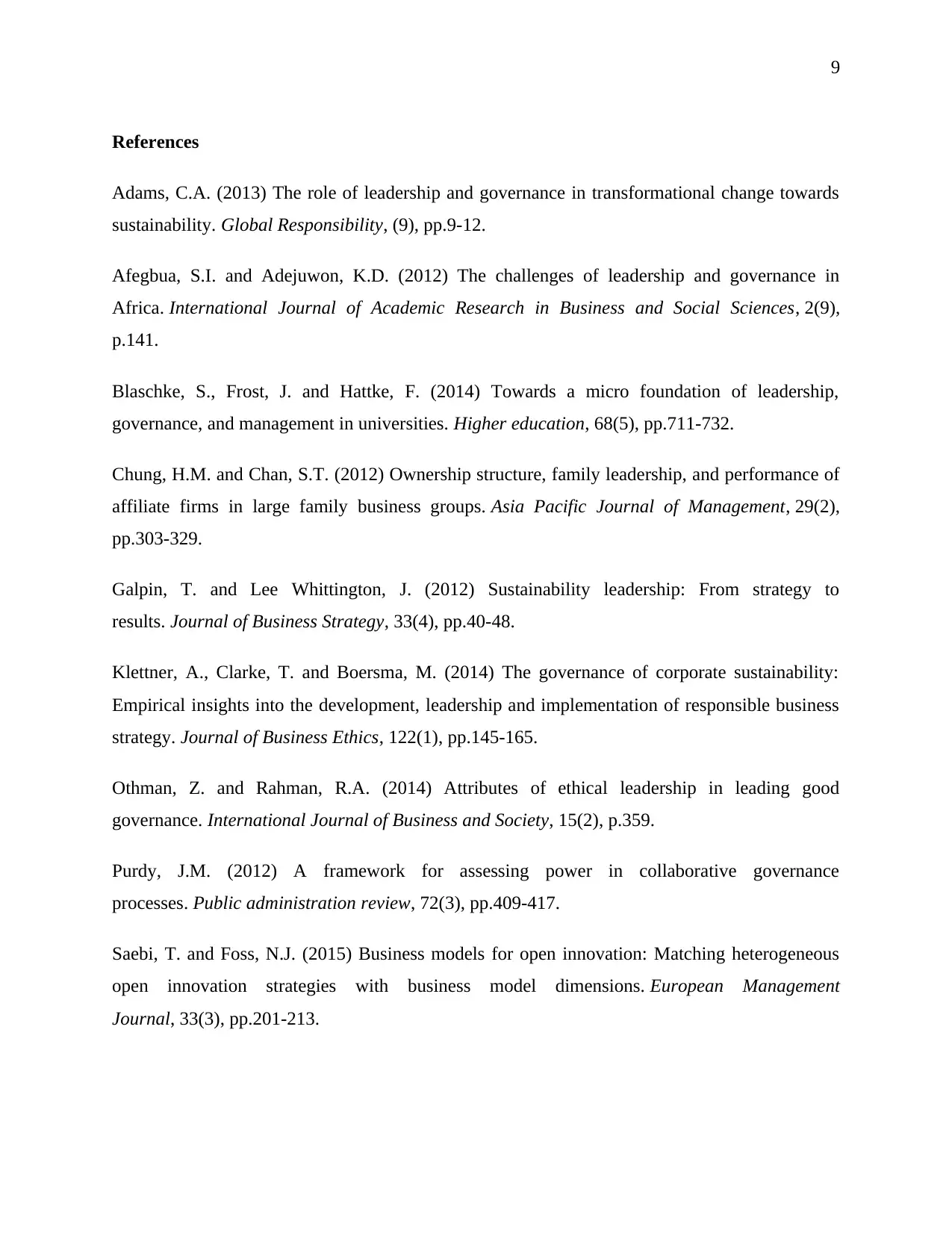
References
Adams, C.A. (2013) The role of leadership and governance in transformational change towards
sustainability. Global Responsibility, (9), pp.9-12.
Afegbua, S.I. and Adejuwon, K.D. (2012) The challenges of leadership and governance in
Africa. International Journal of Academic Research in Business and Social Sciences, 2(9),
p.141.
Blaschke, S., Frost, J. and Hattke, F. (2014) Towards a micro foundation of leadership,
governance, and management in universities. Higher education, 68(5), pp.711-732.
Chung, H.M. and Chan, S.T. (2012) Ownership structure, family leadership, and performance of
affiliate firms in large family business groups. Asia Pacific Journal of Management, 29(2),
pp.303-329.
Galpin, T. and Lee Whittington, J. (2012) Sustainability leadership: From strategy to
results. Journal of Business Strategy, 33(4), pp.40-48.
Klettner, A., Clarke, T. and Boersma, M. (2014) The governance of corporate sustainability:
Empirical insights into the development, leadership and implementation of responsible business
strategy. Journal of Business Ethics, 122(1), pp.145-165.
Othman, Z. and Rahman, R.A. (2014) Attributes of ethical leadership in leading good
governance. International Journal of Business and Society, 15(2), p.359.
Purdy, J.M. (2012) A framework for assessing power in collaborative governance
processes. Public administration review, 72(3), pp.409-417.
Saebi, T. and Foss, N.J. (2015) Business models for open innovation: Matching heterogeneous
open innovation strategies with business model dimensions. European Management
Journal, 33(3), pp.201-213.
References
Adams, C.A. (2013) The role of leadership and governance in transformational change towards
sustainability. Global Responsibility, (9), pp.9-12.
Afegbua, S.I. and Adejuwon, K.D. (2012) The challenges of leadership and governance in
Africa. International Journal of Academic Research in Business and Social Sciences, 2(9),
p.141.
Blaschke, S., Frost, J. and Hattke, F. (2014) Towards a micro foundation of leadership,
governance, and management in universities. Higher education, 68(5), pp.711-732.
Chung, H.M. and Chan, S.T. (2012) Ownership structure, family leadership, and performance of
affiliate firms in large family business groups. Asia Pacific Journal of Management, 29(2),
pp.303-329.
Galpin, T. and Lee Whittington, J. (2012) Sustainability leadership: From strategy to
results. Journal of Business Strategy, 33(4), pp.40-48.
Klettner, A., Clarke, T. and Boersma, M. (2014) The governance of corporate sustainability:
Empirical insights into the development, leadership and implementation of responsible business
strategy. Journal of Business Ethics, 122(1), pp.145-165.
Othman, Z. and Rahman, R.A. (2014) Attributes of ethical leadership in leading good
governance. International Journal of Business and Society, 15(2), p.359.
Purdy, J.M. (2012) A framework for assessing power in collaborative governance
processes. Public administration review, 72(3), pp.409-417.
Saebi, T. and Foss, N.J. (2015) Business models for open innovation: Matching heterogeneous
open innovation strategies with business model dimensions. European Management
Journal, 33(3), pp.201-213.
⊘ This is a preview!⊘
Do you want full access?
Subscribe today to unlock all pages.
Trusted by 1+ million students worldwide
10
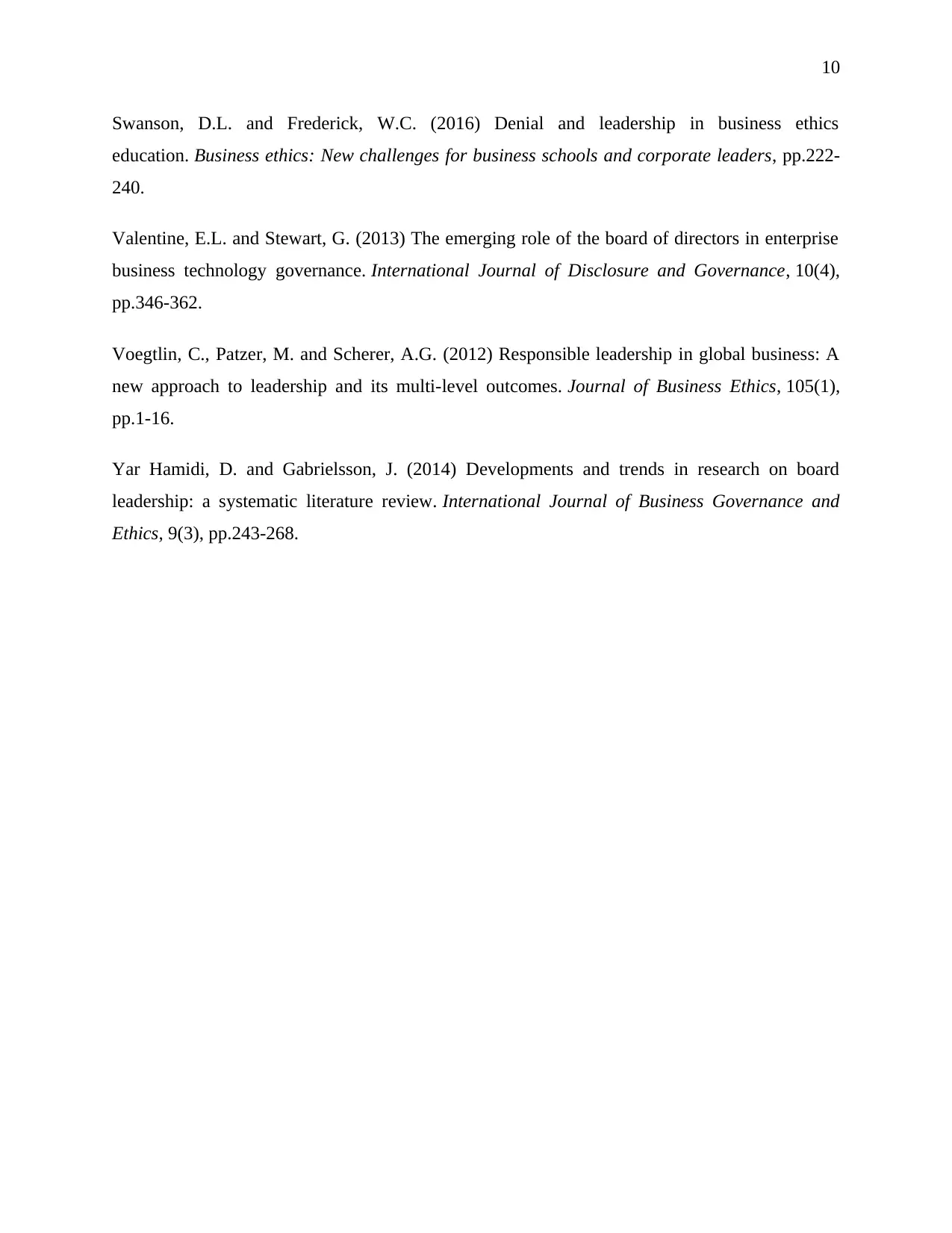
Swanson, D.L. and Frederick, W.C. (2016) Denial and leadership in business ethics
education. Business ethics: New challenges for business schools and corporate leaders, pp.222-
240.
Valentine, E.L. and Stewart, G. (2013) The emerging role of the board of directors in enterprise
business technology governance. International Journal of Disclosure and Governance, 10(4),
pp.346-362.
Voegtlin, C., Patzer, M. and Scherer, A.G. (2012) Responsible leadership in global business: A
new approach to leadership and its multi-level outcomes. Journal of Business Ethics, 105(1),
pp.1-16.
Yar Hamidi, D. and Gabrielsson, J. (2014) Developments and trends in research on board
leadership: a systematic literature review. International Journal of Business Governance and
Ethics, 9(3), pp.243-268.
Swanson, D.L. and Frederick, W.C. (2016) Denial and leadership in business ethics
education. Business ethics: New challenges for business schools and corporate leaders, pp.222-
240.
Valentine, E.L. and Stewart, G. (2013) The emerging role of the board of directors in enterprise
business technology governance. International Journal of Disclosure and Governance, 10(4),
pp.346-362.
Voegtlin, C., Patzer, M. and Scherer, A.G. (2012) Responsible leadership in global business: A
new approach to leadership and its multi-level outcomes. Journal of Business Ethics, 105(1),
pp.1-16.
Yar Hamidi, D. and Gabrielsson, J. (2014) Developments and trends in research on board
leadership: a systematic literature review. International Journal of Business Governance and
Ethics, 9(3), pp.243-268.

1 out of 10


Related Documents


Your All-in-One AI-Powered Toolkit for Academic Success.
+13062052269
info@desklib.com
Available 24*7 on WhatsApp / Email
![[object Object]](/_next/static/media/star-bottom.7253800d.svg)
Unlock your academic potential
Copyright © 2020–2026 A2Z Services. All Rights Reserved. Developed and managed by ZUCOL.