Leadership Skills to Boost Employee Morale in the Workplace Assignment
VerifiedAdded on 2022/09/07
|10
|2559
|12
Project
AI Summary
This project investigates the crucial role of leadership skills in enhancing employee morale within the workplace. It begins by defining morale and its significance, highlighting how it influences employee performance, engagement, and organizational success. The project explores the direct correlation between leadership behaviors, such as respect, appreciation, and trustworthiness, and improved employee morale. Through an evidence-based review of the literature, the project justifies the importance of effective leadership in fostering a positive work environment and achieving organizational goals. The methodology involves gathering data from online databases and secondary sources, with a focus on analyzing existing research and scholarly articles. The project outlines the resources utilized, including human, physical, and technical resources, and details the formative and summative evaluation processes. The formative evaluation includes strategies such as feedback from supervisors and peers, while the summative evaluation assesses the acquisition of knowledge dimensions using Bloom’s taxonomy. The project aims to provide leaders with actionable insights into leadership skills that can boost employee morale, ultimately contributing to a more engaged, productive, and successful workplace.
Running head: LEADERSHIP SKILLS TO BOOST EMPLOYEE MORALE 1
Leadership Skills to Boost Employee Morale in the Workplace
Name
Institutional Affiliation
Leadership Skills to Boost Employee Morale in the Workplace
Name
Institutional Affiliation

Paraphrase This Document
Need a fresh take? Get an instant paraphrase of this document with our AI Paraphraser
LEADERSHIP SKILLS TO BOOST EMPLOYEE MORALE 2
Leadership Skills to Boost Employee Morale in the Workplace
People are likely to perform their duties as expected when they get inspiration from
within their organizations, and consequently put their heart into their work. When employees
develop an indifferent attitude towards their roles, they are likely to demonstrate poor
performance, even when they are provided with all the necessary resources. The willingness and
enthusiasm that a person has in performing their work is called morale. Individuals with high
morale are likely to develop objectives that align with those of their organization, while
individuals with low morale develop hostility and indifference towards their work, and also
demonstrate lack of cooperation with their leaders or supervisors (Singh 2018). Employees with
a high degree of morae often demonstrate a superior execution for their roles and responsibilities,
low levels of truancy, high reliability and high confidence levels (Mallik, Mallik & Keerthi
2019). Leadership is a critical antecedent of morale. Ngambi (2011) posited that the behaviors
of leaders and direct supervisors have an important role in determining the employee morale.
Leaders who demonstrate high levels of respect, appreciation, inspiration and trustworthiness
contribute to the improvement of morale and confidence among employees. It is against this
background that I sought to investigate the leadership skills that can boost employee morale.
The aim of this project is to investigate the leadership skills that contributes to
improvement of employee morale. In particular, this assignment seeks to provide a reflection
report on my practicum so far. The reflection report entails various sections including: clearly
outlining the goals and objectives of the project; an evidence-based review to provide a project
justification; the methodology detailing how the project objectives have been achieved; the
resources needed to complete the project; details on how the formative and summative
Leadership Skills to Boost Employee Morale in the Workplace
People are likely to perform their duties as expected when they get inspiration from
within their organizations, and consequently put their heart into their work. When employees
develop an indifferent attitude towards their roles, they are likely to demonstrate poor
performance, even when they are provided with all the necessary resources. The willingness and
enthusiasm that a person has in performing their work is called morale. Individuals with high
morale are likely to develop objectives that align with those of their organization, while
individuals with low morale develop hostility and indifference towards their work, and also
demonstrate lack of cooperation with their leaders or supervisors (Singh 2018). Employees with
a high degree of morae often demonstrate a superior execution for their roles and responsibilities,
low levels of truancy, high reliability and high confidence levels (Mallik, Mallik & Keerthi
2019). Leadership is a critical antecedent of morale. Ngambi (2011) posited that the behaviors
of leaders and direct supervisors have an important role in determining the employee morale.
Leaders who demonstrate high levels of respect, appreciation, inspiration and trustworthiness
contribute to the improvement of morale and confidence among employees. It is against this
background that I sought to investigate the leadership skills that can boost employee morale.
The aim of this project is to investigate the leadership skills that contributes to
improvement of employee morale. In particular, this assignment seeks to provide a reflection
report on my practicum so far. The reflection report entails various sections including: clearly
outlining the goals and objectives of the project; an evidence-based review to provide a project
justification; the methodology detailing how the project objectives have been achieved; the
resources needed to complete the project; details on how the formative and summative
LEADERSHIP SKILLS TO BOOST EMPLOYEE MORALE 3
evaluation have been conducted; and a graphical representation of the timelines required to
complete the project.
Goal Statement
To provide leaders in workplaces on the appropriate leadership skills that they can
employ in their organizations or firms to boost employee morale.
Project Objectives
The project aims to meet the following objectives
1. To identify various leadership skills employed in workplaces
2. To investigate the leadership skills that can be used to boost employee morale in the workplace
Evidence-Based Review of The Literature
There exists evidence on the importance of leadership in determining employee
motivation and performance as demonstrated in previous parts of the literature. However, I will
conduct further research in this section for further justification of the project. The aim is to
provide an evidence-based review of why the project is important for leaders and organizations’
stakeholders.
Leaders contribute to organizations success and performance. Bell and Raj (2016)
emphasized that the success of industries of businesses depends on the effectiveness of the
leaders and their skillfulness in influencing their followers towards success of the given tasks.
Employees are important resources in firms and they need appropriate tasks to achieve the
organizational goals and objectives. Employee morale and leadership behavior are interlinked
and can either change negatively o positively. Leaders have a role to foster higher levels of
morale among employees on order to ensure the smooth running of organizations. Bell and Raj
(2016) also confirmed that ergonomics and work environment play a critical role in determining
evaluation have been conducted; and a graphical representation of the timelines required to
complete the project.
Goal Statement
To provide leaders in workplaces on the appropriate leadership skills that they can
employ in their organizations or firms to boost employee morale.
Project Objectives
The project aims to meet the following objectives
1. To identify various leadership skills employed in workplaces
2. To investigate the leadership skills that can be used to boost employee morale in the workplace
Evidence-Based Review of The Literature
There exists evidence on the importance of leadership in determining employee
motivation and performance as demonstrated in previous parts of the literature. However, I will
conduct further research in this section for further justification of the project. The aim is to
provide an evidence-based review of why the project is important for leaders and organizations’
stakeholders.
Leaders contribute to organizations success and performance. Bell and Raj (2016)
emphasized that the success of industries of businesses depends on the effectiveness of the
leaders and their skillfulness in influencing their followers towards success of the given tasks.
Employees are important resources in firms and they need appropriate tasks to achieve the
organizational goals and objectives. Employee morale and leadership behavior are interlinked
and can either change negatively o positively. Leaders have a role to foster higher levels of
morale among employees on order to ensure the smooth running of organizations. Bell and Raj
(2016) also confirmed that ergonomics and work environment play a critical role in determining
⊘ This is a preview!⊘
Do you want full access?
Subscribe today to unlock all pages.

Trusted by 1+ million students worldwide
LEADERSHIP SKILLS TO BOOST EMPLOYEE MORALE 4
employee health, absenteeism and turnover. Organizational management need to understand and
fulfill the needs of their employees such as provide beneficial schemes, training motivation and
appropriate job assignments to boost their morale
Mallik et al. (2019) effective leaders should possess skills such as the ability to engage
employees towards setting mutual goals, clarifying the role expectations, and regular feedback
regarding performance. Leaders should also be in a position to adhere to work ethics, encourage
team spirit and maintain a favorable and cordial relationship in order to improve employee
morale. Leaders should also support and encourage their employees individually or within a
team, embrace open communication, motivate employees and appreciate them in a timely
manner, through rewards and recognitions. For instance, Dangmei and Singh (2017) established
that aesthetic leadership is essential in bringing harmony, ethical judgement, balance,
compassion, positive work environment, moral values and openness to employee feedback,
which consequently foster employee morale
High morale among employees is essential for the success and performance of
organizations. Employee morale significantly depends on leadership. Low morale is an
antecedent for loss productivity, high turnover and rate of absenteeism, reduced quality of work
and indiscipline in the workplace. Competent leadership is essential for dealing with the
challenge of reduces employee morale. Leaders need to focus on employee needs and welfare, so
that they can nurture creativity and achieve competitive advantage. In the 21st centry, where the
business environment is characterized by intensive competition, it is important for managers and
leaders to develop competencies and capabilities that can enable them to solve employee and
organizational problems, and improve employee satisfaction (Dangmei & Singh, 2017).
employee health, absenteeism and turnover. Organizational management need to understand and
fulfill the needs of their employees such as provide beneficial schemes, training motivation and
appropriate job assignments to boost their morale
Mallik et al. (2019) effective leaders should possess skills such as the ability to engage
employees towards setting mutual goals, clarifying the role expectations, and regular feedback
regarding performance. Leaders should also be in a position to adhere to work ethics, encourage
team spirit and maintain a favorable and cordial relationship in order to improve employee
morale. Leaders should also support and encourage their employees individually or within a
team, embrace open communication, motivate employees and appreciate them in a timely
manner, through rewards and recognitions. For instance, Dangmei and Singh (2017) established
that aesthetic leadership is essential in bringing harmony, ethical judgement, balance,
compassion, positive work environment, moral values and openness to employee feedback,
which consequently foster employee morale
High morale among employees is essential for the success and performance of
organizations. Employee morale significantly depends on leadership. Low morale is an
antecedent for loss productivity, high turnover and rate of absenteeism, reduced quality of work
and indiscipline in the workplace. Competent leadership is essential for dealing with the
challenge of reduces employee morale. Leaders need to focus on employee needs and welfare, so
that they can nurture creativity and achieve competitive advantage. In the 21st centry, where the
business environment is characterized by intensive competition, it is important for managers and
leaders to develop competencies and capabilities that can enable them to solve employee and
organizational problems, and improve employee satisfaction (Dangmei & Singh, 2017).
Paraphrase This Document
Need a fresh take? Get an instant paraphrase of this document with our AI Paraphraser
LEADERSHIP SKILLS TO BOOST EMPLOYEE MORALE 5
Hao and Yazdanifard (2015) explained that effective leaders play a vital role in
organizations, particularly in the management of changes, which is an important aspect for
sustainability in the modern business environment. People often develop resistance to change
and effective leadership is essential in motivating people to appreciate and adopt change.
Effective leadership also motivates organizational members to improve their performance and
become innovative. Leaders with effective leadership skills are able to gain the trust of their
followers and establish positive organizational cultures that encourage communication and
improve employee morale.
Methodology
In this project, I am gathering data from online databases such as ProQuest, Emerald and
EBSCOhost. The data has been collected from various including reports and journal articles
retrieved from variety of available data sources. I used secondary data in the studyand the study
does not have research participants. Consequently I was not required to obtain consent from
participant and will be authority to use numerous scholarly articles.
In the research process, I have learnt a lot about secondary data sources. According to
Johnston (2017), research questions shape the study process. I examines the research questions,
in order to gain understanding of the objectives of the study and the expected outcomes. I
identified the relevant database from which the relevant data will be gathered. During this stage,
I completed a comprehensive literature review on the topic of leadership skills that boost
employees’ morale by evaluating available current and previous scholarly works related to the
study topic. I sought to understand the views and perceptions of various scholars regarding the
topic of leadership skills that boost employees’ morale. At this point, I also identified the
research centers and agencies that have carried out research on the topic. Other steps that I will
Hao and Yazdanifard (2015) explained that effective leaders play a vital role in
organizations, particularly in the management of changes, which is an important aspect for
sustainability in the modern business environment. People often develop resistance to change
and effective leadership is essential in motivating people to appreciate and adopt change.
Effective leadership also motivates organizational members to improve their performance and
become innovative. Leaders with effective leadership skills are able to gain the trust of their
followers and establish positive organizational cultures that encourage communication and
improve employee morale.
Methodology
In this project, I am gathering data from online databases such as ProQuest, Emerald and
EBSCOhost. The data has been collected from various including reports and journal articles
retrieved from variety of available data sources. I used secondary data in the studyand the study
does not have research participants. Consequently I was not required to obtain consent from
participant and will be authority to use numerous scholarly articles.
In the research process, I have learnt a lot about secondary data sources. According to
Johnston (2017), research questions shape the study process. I examines the research questions,
in order to gain understanding of the objectives of the study and the expected outcomes. I
identified the relevant database from which the relevant data will be gathered. During this stage,
I completed a comprehensive literature review on the topic of leadership skills that boost
employees’ morale by evaluating available current and previous scholarly works related to the
study topic. I sought to understand the views and perceptions of various scholars regarding the
topic of leadership skills that boost employees’ morale. At this point, I also identified the
research centers and agencies that have carried out research on the topic. Other steps that I will

LEADERSHIP SKILLS TO BOOST EMPLOYEE MORALE 6
conduct later include assessing the validity and reliability of available data sets and data
processing and analysis using thematic analysis techniques.
Resources
I have utilized various human, physical and technical resources in order to complete the
project. The human resource is required conduct secondary research on the leadership skills and
styles that are effective for improving employee morale. The resource is provided bymyself. I am
responsible for conducting the physical and online research in order to gather data, and prepare a
report at the end of the project. The supervisor is also an important human resource to provide
guidance throughout the research.
Most of the data I obtained previously was from online sources. However, my supervisor
informed me that I needed to use physical resources include books, journals, company reports and
archival data, that are available in the school library. I have since visited visit the library severally,
and with the help of the librarian, located important print resources. The feedback was insightful as I
have accumulated essential data that was not available online for use in my project.
Formative Evaluation
The first assessment was completed during the seventh day of the third week, and I
intend to do the second during the seventh day of the sixth week. Formative assessment is often used
in the first of education. According to Ryerse and Brookhart (2018), formative assessment simply
means understanding understanding where one is going, where one is now, and where they need to
be next, and is an important part of the learning process. In the formative assessment, I have
employed the five strategies employees in the field of education which include sharing the
expectations, intentions and criteria of success; questioning through discussions and tasks to elicit
evidence of learning; obtaining feedback from the supervisor and peers; self-assessment; and peer
conduct later include assessing the validity and reliability of available data sets and data
processing and analysis using thematic analysis techniques.
Resources
I have utilized various human, physical and technical resources in order to complete the
project. The human resource is required conduct secondary research on the leadership skills and
styles that are effective for improving employee morale. The resource is provided bymyself. I am
responsible for conducting the physical and online research in order to gather data, and prepare a
report at the end of the project. The supervisor is also an important human resource to provide
guidance throughout the research.
Most of the data I obtained previously was from online sources. However, my supervisor
informed me that I needed to use physical resources include books, journals, company reports and
archival data, that are available in the school library. I have since visited visit the library severally,
and with the help of the librarian, located important print resources. The feedback was insightful as I
have accumulated essential data that was not available online for use in my project.
Formative Evaluation
The first assessment was completed during the seventh day of the third week, and I
intend to do the second during the seventh day of the sixth week. Formative assessment is often used
in the first of education. According to Ryerse and Brookhart (2018), formative assessment simply
means understanding understanding where one is going, where one is now, and where they need to
be next, and is an important part of the learning process. In the formative assessment, I have
employed the five strategies employees in the field of education which include sharing the
expectations, intentions and criteria of success; questioning through discussions and tasks to elicit
evidence of learning; obtaining feedback from the supervisor and peers; self-assessment; and peer
⊘ This is a preview!⊘
Do you want full access?
Subscribe today to unlock all pages.
Trusted by 1+ million students worldwide
LEADERSHIP SKILLS TO BOOST EMPLOYEE MORALE 7
assessment to obtain feedback from fellow students and faculty (Bennett 2011). Some of the
important feedback I have obtained from fellow students is the need to visit specific organizational
and request for archival regarding employee feedback, which could be unavailable in the school
library of online. I plan to visit the companies soon. The formative assessment results will help me to
to utilize feedback, set goals, monitor progress and set strategies that will help them achieve the
project goals moving forward. From the results, I will be in a position to restructure my project
moving forward, so that I can optimize data collection and obtain quality data for the project.
Summative Evaluation
The project summative assessment will be conducted during the first day of the eleventh
week to allow me address issues from the feedback before project submission. According to Kibble
(2017) formative assessment is conducted at the end of the project to assess learning outcomes. The
assessment will be characterized by the six cognitive processes of the Bloom’s taxonomy, which
include remembering, understanding, applying, analyzing, evaluating and creating. The Bloom’s
taxonomy is essential for the identification of project objectives and facilitating a more details
learning process and knowledge transfer (Adams 2015). As described by Hao and Yazdanifard,
(2015) the summative assessment will enable me to assess the acquisition of various knowledge
dimensions namely; factual knowledge, which entails terminologies and specific elements and
details; conceptual knowledge, which describes relationships between elements such as morale and
leadership; procedural knowledge describing methods and criteria of inquiry and metacognitive
knowledge which entails awareness and self-cognition. Through the assessment, I will understand
whether I have met the project goals and objectives, and outline the knowledge gaps that are
required for further research.
assessment to obtain feedback from fellow students and faculty (Bennett 2011). Some of the
important feedback I have obtained from fellow students is the need to visit specific organizational
and request for archival regarding employee feedback, which could be unavailable in the school
library of online. I plan to visit the companies soon. The formative assessment results will help me to
to utilize feedback, set goals, monitor progress and set strategies that will help them achieve the
project goals moving forward. From the results, I will be in a position to restructure my project
moving forward, so that I can optimize data collection and obtain quality data for the project.
Summative Evaluation
The project summative assessment will be conducted during the first day of the eleventh
week to allow me address issues from the feedback before project submission. According to Kibble
(2017) formative assessment is conducted at the end of the project to assess learning outcomes. The
assessment will be characterized by the six cognitive processes of the Bloom’s taxonomy, which
include remembering, understanding, applying, analyzing, evaluating and creating. The Bloom’s
taxonomy is essential for the identification of project objectives and facilitating a more details
learning process and knowledge transfer (Adams 2015). As described by Hao and Yazdanifard,
(2015) the summative assessment will enable me to assess the acquisition of various knowledge
dimensions namely; factual knowledge, which entails terminologies and specific elements and
details; conceptual knowledge, which describes relationships between elements such as morale and
leadership; procedural knowledge describing methods and criteria of inquiry and metacognitive
knowledge which entails awareness and self-cognition. Through the assessment, I will understand
whether I have met the project goals and objectives, and outline the knowledge gaps that are
required for further research.
Paraphrase This Document
Need a fresh take? Get an instant paraphrase of this document with our AI Paraphraser
LEADERSHIP SKILLS TO BOOST EMPLOYEE MORALE 8
References
Adams N. E. (2015). Bloom's taxonomy of cognitive learning objectives. Journal of the Medical
Library Association : JMLA, 103(3), 152–153. doi:10.3163/1536-5050.103.3.010
Bell, J. S. L., & Raj, S. S. (2016). Role of leaders for boosting morale of employees in IT sector
with special reference to Technopark, Trivandrum. International Journal of Management
Research and Reviews, 6(9), 1155.
Bennett, R. E. (2011). Formative assessment: A critical review. Assessment in Education:
principles, policy & practice, 18(1), 5-25.
Dangmei, J., & Singh, A. (2017). How Aesthetic Leadership Style Might Relate to Employee
Morale at Workplace? An Analytical Study. Asia Pacific Journal of Research, 1.
Hao, M. J., & Yazdanifard, R. (2015). How effective leadership can facilitate change in
organizations through improvement and innovation. Global journal of management and
business research, 15(9), 1-5.
Haring, P., Warmelink, H., Valente, M., & Roth, C. (2018). Using the revised Bloom Taxonomy
to analyze psychotherapeutic games. International Journal of Computer Games
Technology, 2018. doi:10.1155/2018/8784750
Johnston, M. P. (2017). Secondary data analysis: A method of which the time has come.
Qualitative and Quantitative Methods in Libraries, 3(3), 619-626. Retrieved from
http://www.qqml-journal.net/index.php/qqml/article/view/169
Kibble, J. D. (2017). Best practices in summative assessment. Advances in Physiology
Education, 41 110-119
References
Adams N. E. (2015). Bloom's taxonomy of cognitive learning objectives. Journal of the Medical
Library Association : JMLA, 103(3), 152–153. doi:10.3163/1536-5050.103.3.010
Bell, J. S. L., & Raj, S. S. (2016). Role of leaders for boosting morale of employees in IT sector
with special reference to Technopark, Trivandrum. International Journal of Management
Research and Reviews, 6(9), 1155.
Bennett, R. E. (2011). Formative assessment: A critical review. Assessment in Education:
principles, policy & practice, 18(1), 5-25.
Dangmei, J., & Singh, A. (2017). How Aesthetic Leadership Style Might Relate to Employee
Morale at Workplace? An Analytical Study. Asia Pacific Journal of Research, 1.
Hao, M. J., & Yazdanifard, R. (2015). How effective leadership can facilitate change in
organizations through improvement and innovation. Global journal of management and
business research, 15(9), 1-5.
Haring, P., Warmelink, H., Valente, M., & Roth, C. (2018). Using the revised Bloom Taxonomy
to analyze psychotherapeutic games. International Journal of Computer Games
Technology, 2018. doi:10.1155/2018/8784750
Johnston, M. P. (2017). Secondary data analysis: A method of which the time has come.
Qualitative and Quantitative Methods in Libraries, 3(3), 619-626. Retrieved from
http://www.qqml-journal.net/index.php/qqml/article/view/169
Kibble, J. D. (2017). Best practices in summative assessment. Advances in Physiology
Education, 41 110-119
LEADERSHIP SKILLS TO BOOST EMPLOYEE MORALE 9
Mallik, A., Mallik, L. & Keerthi D.S. (2019). Impact of Employee Morale on Organizational
Success. International Journal of Recent Technology and Engineering (IJRTE), 8(4),
3289-3293
Ngambi, H. C. (2011). The relationship between leadership and employee morale in higher
education. African Journal of Business Management, 5(3), 762.
Ryerse. M, & Brookhart, S (2018). The Research Base for Formative Assessment. Retrieved
from https://www.gettingsmart.com/2018/07/the-research-base-for-formative-assessment/
Singh, S. R. (2018). Employees Morale: A Review Appraisal. International Journal of 360
Management Review, 06(02), 304-315
Mallik, A., Mallik, L. & Keerthi D.S. (2019). Impact of Employee Morale on Organizational
Success. International Journal of Recent Technology and Engineering (IJRTE), 8(4),
3289-3293
Ngambi, H. C. (2011). The relationship between leadership and employee morale in higher
education. African Journal of Business Management, 5(3), 762.
Ryerse. M, & Brookhart, S (2018). The Research Base for Formative Assessment. Retrieved
from https://www.gettingsmart.com/2018/07/the-research-base-for-formative-assessment/
Singh, S. R. (2018). Employees Morale: A Review Appraisal. International Journal of 360
Management Review, 06(02), 304-315
⊘ This is a preview!⊘
Do you want full access?
Subscribe today to unlock all pages.
Trusted by 1+ million students worldwide
LEADERSHIP SKILLS TO BOOST EMPLOYEE MORALE 10
Appendix A: Timeline
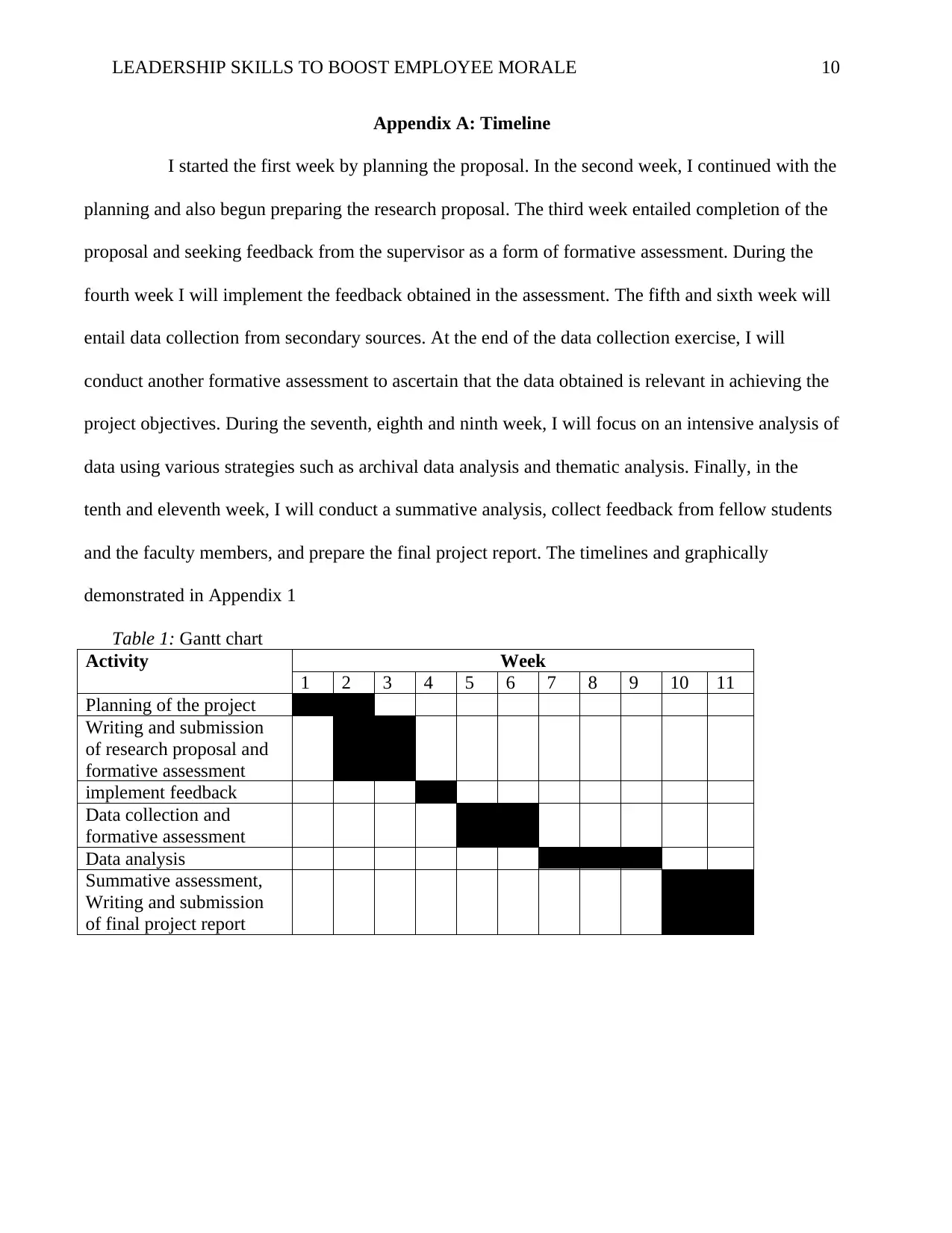
I started the first week by planning the proposal. In the second week, I continued with the
planning and also begun preparing the research proposal. The third week entailed completion of the
proposal and seeking feedback from the supervisor as a form of formative assessment. During the
fourth week I will implement the feedback obtained in the assessment. The fifth and sixth week will
entail data collection from secondary sources. At the end of the data collection exercise, I will
conduct another formative assessment to ascertain that the data obtained is relevant in achieving the
project objectives. During the seventh, eighth and ninth week, I will focus on an intensive analysis of
data using various strategies such as archival data analysis and thematic analysis. Finally, in the
tenth and eleventh week, I will conduct a summative analysis, collect feedback from fellow students
and the faculty members, and prepare the final project report. The timelines and graphically
demonstrated in Appendix 1
Table 1: Gantt chart
Activity Week
1 2 3 4 5 6 7 8 9 10 11
Planning of the project
Writing and submission
of research proposal and
formative assessment
implement feedback
Data collection and
formative assessment
Data analysis
Summative assessment,
Writing and submission
of final project report
Appendix A: Timeline
I started the first week by planning the proposal. In the second week, I continued with the
planning and also begun preparing the research proposal. The third week entailed completion of the
proposal and seeking feedback from the supervisor as a form of formative assessment. During the
fourth week I will implement the feedback obtained in the assessment. The fifth and sixth week will
entail data collection from secondary sources. At the end of the data collection exercise, I will
conduct another formative assessment to ascertain that the data obtained is relevant in achieving the
project objectives. During the seventh, eighth and ninth week, I will focus on an intensive analysis of
data using various strategies such as archival data analysis and thematic analysis. Finally, in the
tenth and eleventh week, I will conduct a summative analysis, collect feedback from fellow students
and the faculty members, and prepare the final project report. The timelines and graphically
demonstrated in Appendix 1
Table 1: Gantt chart
Activity Week
1 2 3 4 5 6 7 8 9 10 11
Planning of the project
Writing and submission
of research proposal and
formative assessment
implement feedback
Data collection and
formative assessment
Data analysis
Summative assessment,
Writing and submission
of final project report

1 out of 10


Related Documents


Your All-in-One AI-Powered Toolkit for Academic Success.
+13062052269
info@desklib.com
Available 24*7 on WhatsApp / Email
![[object Object]](/_next/static/media/star-bottom.7253800d.svg)
Unlock your academic potential
Copyright © 2020–2026 A2Z Services. All Rights Reserved. Developed and managed by ZUCOL.